
摘要 / Abstract
在全球推動淨零碳排與能源轉型的政策背景下,間歇性再生能源在現代電網中的滲透率急遽攀升,導致電網淨負載(Net Load)呈現極端的「鴨子曲線(Duck Curve)」特徵1。此一趨勢迫使過去長期擔任基載(Base-load)的複循環燃氣發電機組(Combined Cycle Power Plant, CCPP),必須轉型為肩負負載隨動(Load-following)與頻繁日常起停(Two-shifting)任務的調峰主力。通霄電廠作為台灣電網穩定之核心,其擴建之高效率複循環機組(如第一、二、三號機,單部裝置容量達 892.6 MW),即面臨極端高溫高壓與頻繁熱瞬態交替的雙重嚴峻考驗2。Under the policy background of promoting net-zero carbon emissions and energy transition globally, the penetration rate of intermittent renewable energy in modern power grids has surged rapidly, causing the grid’s net load to exhibit extreme “Duck Curve” characteristics1. This trend forces Combined Cycle Power Plants (CCPP), which historically served as base-load generators, to transition into peaking powerhouses shouldering load-following and frequent daily start-stop (two-shifting) tasks. As the core of Taiwan’s power grid stability, the Tongxiao Power Plant’s newly expanded high-efficiency combined cycle units (such as Units 1, 2, and 3, each with an installed capacity of 892.6 MW) are facing the severe dual challenges of extreme high temperature and pressure coupled with frequent alternating thermal transients2.
傳統上,CCPP 廠內餘熱回收鍋爐(HRSG)與汽輪機相連的高能管線(High-Energy Piping, HEP)系統,高度依賴符合 ASME B16.9 標準的 1.5D 短半徑鍛造對銲彎頭1。然而,在570°C 至 620°C、170 bar 至230 bar 的極端工況下,1.5D 電銲彎頭因先天幾何不連續性所引發的應力集中,加上銲接熱影響區(HAZ)的微觀組織退化,已成為誘發第四型潛變破裂(Type IV Creep Cracking)與熱疲勞失效的致命弱點1。Traditionally, the High-Energy Piping (HEP) systems connecting the Heat Recovery Steam Generators (HRSG) to the steam turbines in CCPP plants have heavily relied on 1.5D short-radius forged butt-welded elbows compliant with the ASME B16.9 standard1. However, under extreme operating conditions of 570°C to 620°C and 170 bar to 230 bar, the stress concentration caused by the inherent geometric discontinuities of 1.5D welded elbows, combined with the microstructural degradation in the Heat-Affected Zone (HAZ) of the welds, has become a fatal vulnerability inducing Type IV Creep Cracking and thermal fatigue failures1.
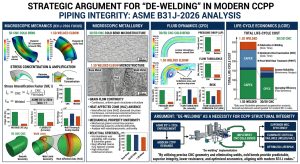
隨著 2024 年版 ASME B31.1(動力管線規範)正式廢除長期使用的強制性附錄 D(Mandatory Appendix D),並全面將應力強度因子(Stress Intensification Factor, SIF)與柔性係數(Flexibility Factor)之計算導向 ASME B31J 規範,全球管線應力分析正式邁入三維解耦與精確疲勞計算的新紀元。此規範框架將於 2026 年成為新建電廠與管線升級的強制性準則3。本研究以通霄二期專案高能蒸氣系統為實證背景,基於最新 2026 ASME B31J 規範,針對 3D/5D 數控冷作彎管(CNC Cold Bends)與傳統 1.5D 電銲彎頭,進行巨觀力學、微觀冶金、流體動力學與全生命週期經濟性之深度差異化分析,藉此論證「以彎代銲(De-welding)」工法在確保現代 CCPP 結構完整性上之必然趨勢。As the 2024 edition of ASME B31.1 (Power Piping Code) officially abolished the long-used Mandatory Appendix D and comprehensively directed the calculation of Stress Intensification Factors (SIF) and Flexibility Factors to the ASME B31J standard, global piping stress analysis has officially entered a new era of three-dimensional decoupling and precise fatigue calculation. This regulatory framework will become a mandatory requirement for new power plants and piping upgrades by 20263. Using the high-energy steam system of the Tongxiao Phase II project as an empirical background and based on the latest 2026 ASME B31J code, this study conducts an in-depth differential analysis on 3D/5D CNC Cold Bends versus traditional 1.5D welded elbows across macroscopic mechanics, microscopic metallurgy, fluid dynamics, and full-lifecycle economics. Thereby, it demonstrates the inevitable trend of the “De-welding” method in ensuring the structural integrity of modern CCPP plants.
一、 緒論 / I. Introduction
1.1 研究背景與電網調度挑戰 / 1.1 Research Background and Grid Dispatch Challenges
現代電力系統在大量整合太陽光電與風力發電後,面臨著嚴峻的供需平衡挑戰。當日間太陽能發電量達到顛峰時,電網淨負載大幅下降;而至日落時分,太陽能發電量驟降,卻伴隨用電尖峰的到來,導致淨負載急遽上升7。為了彌補此巨大的電力缺口,現代 CCPP 必須具備極高的升降載率(Ramp Rate)與快速冷熱啟動能力。以通霄電廠為例,其建置之複循環機組不僅裝置容量龐大,更須因應經濟調度進行頻繁啟停,這對機組的硬體結構提出了前所未有的挑戰2。Modern power systems face severe supply-demand balancing challenges after integrating large amounts of solar photovoltaic and wind power. When solar power generation peaks during the day, the grid’s net load drops significantly; however, at sunset, solar power generation plummets just as peak electricity demand arrives, causing the net load to spike sharply7. To bridge this enormous power gap, modern CCPPs must possess extremely high ramp rates and rapid cold/hot start capabilities. Taking the Tongxiao Power Plant as an example, its combined cycle units not only have massive installed capacities but must also undergo frequent start-stops in response to economic dispatching, posing unprecedented challenges to the physical structure of the units2.
1.2 高能蒸氣管線之嚴苛工況 / 1.2 Extreme Operating Conditions of High-Energy Steam Piping
高能蒸氣系統(主蒸氣與高溫再熱蒸氣)堪稱 CCPP 機組的動力命脈。在穩態滿載運轉時,管線主要面臨長時間高溫應力下的均勻穩態潛變(Steady-state Creep)與高溫氧化。然而,在頻繁調峰與低負載運轉過程中,管線經歷高度的非線性與非對稱熱力學瞬態。管內過熱蒸氣與金屬管壁之間會在極短時間內產生巨大溫差,進而誘發強烈的過渡熱應力(Transient Thermal Stress)與熱衝擊(Thermal Shock)1。在此動態負載下,管線幾何突變處(如傳統 1.5D 彎頭與環向銲縫)往往成為疲勞裂紋萌生與潛變空洞加速成核的破壞熱點1。The high-energy steam systems (main steam and hot reheat steam) are the vital power arteries of CCPP units. During steady-state full-load operation, the piping primarily faces uniform steady-state creep and high-temperature oxidation under prolonged high-temperature stress. However, during frequent peak-shaving and low-load operations, the piping undergoes highly non-linear and asymmetric thermodynamic transients. An enormous temperature differential forms between the superheated steam inside the pipe and the metal pipe wall within a very short time, thereby inducing intense transient thermal stresses and thermal shocks1. Under this dynamic loading, abrupt geometric discontinuities in the piping (such as traditional 1.5D elbows and circumferential welds) often become destructive hotspots for fatigue crack initiation and accelerated creep cavity nucleation1.
1.3 研究目的 / 1.3 Research Objectives
本研究旨在跳脫傳統僅關注單一材料或單一力學公式的侷限,建立一套涵蓋規範演進、斷裂力學、微觀冶金相變及計算流體動力學(CFD)的綜合評估模型。探討核心聚焦於:(1) ASME B31.1 與 B31J 規範演進對管線應力設計邊界的影響;(2) 潛變強度強化鐵素體鋼(CSEF,如 P91/P92)在不同成型與熱處理工法下的微觀組織演變與 Type IV 破裂抗性;(3) 冷作彎管技術如何透過消除物理銲縫與流場平順化,全方位提升管線在極端工況下之結構完整性。This study aims to break free from the limitations of traditional approaches that focus solely on a single material or mechanical formula, establishing a comprehensive evaluation model encompassing code evolution, fracture mechanics, microscopic metallurgical phase transformations, and Computational Fluid Dynamics (CFD). The core exploration focuses on: (1) the impact of ASME B31.1 and B31J code evolution on piping stress design boundaries; (2) the microstructural evolution and Type IV cracking resistance of Creep-Strength Enhanced Ferritic (CSEF) steels (e.g., P91/P92) under different forming and heat treatment methods; (3) how cold bending technology comprehensively enhances the structural integrity of piping under extreme conditions by eliminating physical welds and smoothing flow fields.
二、 規範演進與力學解構:從 ASME B31.1 附錄 D 到 B31J / II. Code Evolution and Mechanical Deconstruction: From ASME B31.1 Appendix D to B31J
過去數十年間,全球管線應力分析高度仰賴 ASME B31.1(動力管線)與 B31.3(製程管線)中的附錄 D 5。然而,該理論體系在面對現代薄壁、大口徑且承受複雜三維熱瞬態載荷的高能管線時,已顯露出極大的侷限性。Over the past few decades, global piping stress analysis has heavily relied on Appendix D in ASME B31.1 (Power Piping) and B31.3 (Process Piping) 5. However, this theoretical framework has revealed significant limitations when dealing with modern thin-walled, large-diameter high-energy piping subjected to complex three-dimensional thermal transient loads.
2.1 傳統 Markl 理論與附錄 D 之結構性缺陷 / 2.1 Structural Flaws of Traditional Markl Theory and Appendix D
舊版附錄 D 的理論基礎源自 1950 年代 A.R.C. Markl 的懸臂樑疲勞實驗3。該規範對於彎頭與三通管(Tees)強行賦予單一的 SIF 數值,並未區分面內(In-Plane)與面外(Out-of-Plane)彎矩的作用差異。實際上,當彎矩施加於薄壁管件時,元件幾何會發生非對稱性的塑性變形,即截面橢圓化現象(Ovalization)3。The theoretical foundation of the legacy Appendix D originated from A.R.C. Markl’s cantilever beam fatigue experiments in the 1950s3. The code forcefully assigned a single SIF value to elbows and tees, failing to distinguish between the effects of In-Plane and Out-of-Plane bending moments. In reality, when bending moments are applied to thin-walled piping components, the component geometry undergoes asymmetric plastic deformation, known as cross-sectional ovalization3.
更致命的是,舊版規範完全忽視了扭轉力矩對疲勞剪應力的貢獻,預設扭轉應力強度因子 it=1.0 3。在現代 CCPP 工廠高密度的立體空間佈局中,管線熱膨脹往往產生極大的扭曲位移,忽略扭轉 SIF 將導致應力分析嚴重失真並偏於非保守;另一方面,將面內與面外 SIF 取大者作為單一設計基準,又會導致某些受力方向的設計顯得過度保守5。More fatally, the legacy code completely ignored the contribution of torsional moments to fatigue shear stresses, defaulting the torsional stress intensification factor to it=1.0 3. In the high-density three-dimensional spatial layouts of modern CCPP plants, thermal expansion of piping often generates massive torsional displacements; ignoring the torsional SIF leads to severely distorted and non-conservative stress analyses. On the other hand, taking the larger of the in-plane and out-of-plane SIFs as a single design baseline makes the design overly conservative in certain loading directions5.
2.2 ASME B31J 柔性特徵模型與三維 SIF 解耦 / 2.2 ASME B31J Flexibility Characteristic Model and 3D SIF Decoupling
為了導正上述偏差,ASME 推動了革命性的規範變革。ASME B31.1 在 2016 年版將 B31J 列為替代選項,2022 年版允許全面使用,而至 2024 年版則正式且徹底地刪除強制性附錄 D,將所有 i-factor 與 k-factor 的計算源頭直接指向 ASME B31J 規範5。至 2026 年,此規範框架將在所有新建專案中具備絕對的強制效力。To correct these deviations, ASME spearheaded a revolutionary code transformation. ASME B31.1 listed B31J as an alternative option in the 2016 edition, permitted its full use in the 2022 edition, and in the 2024 edition, officially and thoroughly deleted Mandatory Appendix D, pointing the calculation source for all i-factors and k-factors directly to the ASME B31J standard5. By 2026, this regulatory framework will hold absolute mandatory force across all new construction projects.
B31J 規範引入了嚴密的幾何特徵數學模型,定義柔性特徵值(Flexibility Characteristic, h)為:
The B31J standard introduced a rigorous mathematical model for geometric characteristics, defining the Flexibility Characteristic (h) as:
h=T⋅R1/r22
式中,T 為管線公稱壁厚,R1 為彎曲半徑,r2 為管線平均半徑(r2 =(D-T)/2) 3。h 值控制了管件受力時的截面橢圓化比例;數值越小,代表橢圓化越劇烈,管件柔性也越高。Where T is the nominal pipe wall thickness, R1 is the bend radius, and r2 is the mean pipe radius (r2 =(D-T)/2) 3. The h value controls the proportion of cross-sectional ovalization when the component is under load; a smaller value indicates more severe ovalization and higher component flexibility.
基於 h 值,B31J 將應力強度因子進行了精確的三維解耦:Based on the h value, B31J precisely decouples the stress intensification factors in three dimensions:
- 柔性係數(Flexibility Factor, k):量化彎管相較於等長直管的柔性倍率,公式為: Quantifies the flexibility multiplier of a bend compared to a straight pipe of equal length, with the formula:
k=1.65/h
- 面內應力強度因子(In-Plane SIF, ii):ii=0.9/h2/3。
- 面外應力強度因子(Out-of-Plane SIF, io):io=0.75/h2/3。
- 扭轉應力強度因子(Torsional SIF, it):由實驗與有限元素分析(FEA)得出,正式納入位移應力計算中,真實反映扭轉剪力之集中效應。Derived from experiments and Finite Element Analysis (FEA), it is officially incorporated into displacement stress calculations to truly reflect the concentration of torsional shear stress.
需特別注意的是,B31J 規範在應用上設定了幾何邊界條件,例如管徑對壁厚比(D/T ratio)必須小於或等於 100,且分支管徑不得大於主管徑。It is particularly important to note that the B31J code sets geometric boundary conditions for its application, such as the diameter-to-thickness (D/T) ratio must be less than or equal to 100, and branch diameters must not exceed run diameters.
2.3 持續應力指數 (Sustained Stress Index) 與疲勞應力方程式 / 2.3 Sustained Stress Index and Fatigue Stress Equations
在 B31.1-2024 規範架構下,應力評估被劃分為不同的嚴重等級。疲勞測試得出的 SIF (ii ,io , it)未經折減,直接應用於位移應力範圍(Displacement Stress Range, Equation 17)的計算中,以精確評估熱膨脹與冷縮的疲勞損傷。Under the B31.1-2024 regulatory framework, stress assessment is categorized into different severity levels. The SIFs (ii ,io , it) derived from fatigue testing are applied unreduced directly into the calculation of the Displacement Stress Range (Equation 17) to precisely evaluate fatigue damage from thermal expansion and contraction.
相對於此,重量與內壓等靜態載荷所引發的持續應力(Sustained Stress, Equation 15)與偶發應力(Occasional Stress, Equation 16),則引入了持續應力指數(Sustained Stress Index, I)5。B31.1 段落 104.8.1 規定,在缺乏更適用數據的情況下, Ii ,Io , It皆取 0.75i 與 1.00 兩者間之較大極限值。此「0.75i」法則承襲自 Markl 時代的認知,即持續載荷產生的是一次性應力,而非循環疲勞應力;而 1.00 的下限則確保指數評估永遠不會低於理想直管的應力狀態。In contrast, sustained stresses induced by static loads such as weight and internal pressure (Sustained Stress, Equation 15) and occasional stresses (Occasional Stress, Equation 16) introduce the Sustained Stress Index (I)5. ASME B31.1 Paragraph 104.8.1 stipulates that, in the absence of more applicable data, Ii ,Io , It shall each be taken as the greater limit value between 0.75i and 1.00. This “0.75i” rule inherits the Markl-era recognition that sustained loads produce one-time stresses rather than cyclic fatigue stresses; meanwhile, the lower limit of 1.00 ensures that the index assessment will never evaluate a component as being less stressed than an ideal straight pipe.
| 規範項目 / Code Item | 傳統 ASME B31.1 附錄 D (已廢除) / Legacy ASME B31.1 App. D (Obsolete) | 最新 ASME B31.1 + B31J (2024/2026) / Latest ASME B31.1 + B31J (2024/2026) |
| SIF 方向性 / SIF Directionality | 面內與面外取單一最大值,扭轉預設為 1.0 / Max of in-plane and out-of-plane used; torsion defaults to 1.0 | 面內 (ii)、面外 (io)、扭轉 (it) 徹底解耦 / Complete decoupling of in-plane (ii), out-of-plane (io), and torsional (it) |
| 柔性係數 (k) / Flexibility Factor (k) | 分支管件常過度簡化 (預設為 1.0) / Branch fittings often overly simplified (defaults to 1.0) | 依據實體受力狀態動態計算 k 值 / Dynamically calculated k value based on actual loading state |
| 持續載荷應力 / Sustained Load Stress | 計算模糊,有時因簡化公式導致應力被低估 / Ambiguous calculation; stress sometimes underestimated due to simplified formulas | 明確定義 Ia = 1.0,彎矩指數取 max(0.75i , 1.0) / Explicitly defines Ia = 1.0, bending moment index takes max(0.75i , 1.0) |
| 方程式結構 / Equation Structure | 單一合成力矩計算 / Single resultant moment calculation | 圖 104.8-1 Eq (15), (16), (17) 軸向+彎曲+扭轉分量 SRSS 合成 / Fig 104.8-1 Eq (15), (16), (17) SRSS synthesis of axial + bending + torsional components |
2.4 冷作彎管與電銲彎頭之應力集中效應比較 / 2.4 Comparison of Stress Concentration Effects between Cold Bends and Welded Elbows
將前述理論應用於工程實務,傳統符合 B16.9 規範的 1.5D 短半徑電銲彎頭因其彎曲半徑 R1 極小,導致柔性特徵值 h 偏低。代入 B31J 公式後,1.5D 彎頭往往會產生高達 3.0 至 5.0 的 SIF 值13。在相同的系統熱膨脹位移下,1.5D 彎頭處的局部疲勞應力將被不合理地放大數倍,迫使設計者必須配置大量昂貴的恆力彈簧吊架或膨脹環(Expansion loops)以吸收額外的熱應力。Applying the aforementioned theories to engineering practice, traditional 1.5D short-radius welded elbows compliant with the B16.9 standard possess a very small bend radius R1, resulting in a low flexibility characteristic value h. Plugging this into the B31J formulas, 1.5D elbows often generate extremely high SIF values ranging from 3.0 to 5.013. Under the same system thermal expansion displacement, the localized fatigue stress at 1.5D elbows will be unreasonably amplified several times over, forcing designers to deploy numerous expensive constant-effort spring hangers or expansion loops to absorb the excessive thermal stress.
反觀採用數控冷作彎管(3D 或 5D 彎曲半徑),因幾何彎曲半徑 R1 增長 2 至 3.3 倍,使得 h 值顯著提升。高 h 值賦予了管件強大的截面剛度,能有效抵抗畸變與橢圓化。數值分析指出,5D 冷作彎管在巨觀力學上的 SIF 被大幅抑制,近乎趨近於理論無應力集中的極限值 1.0 3。在 ASME B31J 框架下,冷作彎管完美實現了應力的平滑轉移,徹底卸除了低週疲勞的幾何放大因子。In contrast, utilizing CNC cold bends (with 3D or 5D bend radii) increases the geometric bend radius R1 by 2 to 3.3 times, significantly elevating the h value. A high h value grants the piping component robust cross-sectional stiffness, effectively resisting distortion and ovalization. Numerical analyses indicate that the macroscopic SIF of 5D cold bends is massively suppressed, approaching the theoretical stress-free concentration limit value of 1.0 3. Within the ASME B31J framework, cold bends perfectly achieve smooth stress transfer, completely removing the geometric magnification factor for low-cycle fatigue.
三、 微觀冶金與結構完整性:CSEF 鋼銲接退化與 Type IV 潛變破裂 / III. Microscopic Metallurgy and Structural Integrity: Weld Degradation of CSEF Steels and Type IV Creep Cracking
現代 CCPP 高壓蒸氣管線為抵抗塑性降伏與高溫潛變變形,全面採用了「潛變強度強化鐵素體鋼」(CSEF),如 ASTM A335 P91 (9Cr-1Mo-V) 與 P92 (9Cr-2W-V-Nb-B)1。這類高階合金的高溫強度,建立在精確調控的回火馬氏體(Tempered Martensite)基體,以及奈米級碳氮化物(如富鉻的 M23C6 晶界析出物與富釩/鈮的 MX 晶內析出相)之上9。然而,傳統管線佈置大量依賴直管與 1.5D 彎頭之間的對銲(Butt-welding),此環向銲縫工序成為材料微觀降解的致命根源。To resist plastic yielding and high-temperature creep deformation, modern CCPP high-pressure steam piping has universally adopted Creep-Strength Enhanced Ferritic (CSEF) steels, such as ASTM A335 P91 (9Cr-1Mo-V) and P92 (9Cr-2W-V-Nb-B)1. The high-temperature strength of these high-tier alloys is built upon a precisely controlled tempered martensite matrix, alongside nano-scale carbonitrides (such as Cr-rich M23C6 grain boundary precipitates and V/Nb-rich MX intra-granular precipitates)9. However, traditional piping layouts rely heavily on butt-welding between straight pipes and 1.5D elbows; this circumferential welding process becomes the fatal root cause of microstructural degradation in the material.
3.1 銲接熱影響區 (HAZ) 的微觀組織演變 / 3.1 Microstructural Evolution in the Heat-Affected Zone (HAZ)
多道次環向銲接使母材周圍經歷了溫度梯度極大的熱循環。在熱影響區中,峰值溫度介於 AC1(下臨界溫度)與 AC3(上臨界溫度)之間的相間臨界區(ICHAZ),以及略高於AC3 的細晶熱影響區(FGHAZ),成為材料抗潛變強度的最弱環節1。Multi-pass circumferential welding subjects the surrounding base metal to thermal cycles with extreme temperature gradients. Within the Heat-Affected Zone (HAZ), the Intercritical HAZ (ICHAZ)—where peak temperatures fall between the lower critical temperature (AC1) and upper critical temperature (AC3)—and the Fine-Grained HAZ (FGHAZ), which reaches just above AC3, become the weakest links in the material’s creep resistance1.
此特殊熱歷史導致原先完美的回火馬氏體發生部分相變,原始奧氏體晶粒(PAG)未及長大即被快速淬火,形成大量無方向性且細小等軸的亞晶粒1。更嚴重的是,熱循環使部分固溶的合金元素在隨後的銲後熱處理(PWHT)或高溫服役中,以粗大富鉻碳化物或 Laves 相的形式重新析出。這不僅破壞了原始的固溶強化機制,更使得相界與晶界嚴重弱化,造成潛變強度呈現斷崖式的衰減4。This unique thermal history causes the originally perfect tempered martensite to undergo partial phase transformation. The Prior Austenite Grains (PAG) are rapidly quenched before they can grow, forming massive amounts of directionless, fine equiaxed sub-grains1. Worse yet, the thermal cycle causes partially solid-solutioned alloy elements to reprecipitate as coarse Cr-rich carbides or Laves phases during subsequent Post-Weld Heat Treatment (PWHT) or high-temperature service. This not only destroys the original solid-solution strengthening mechanisms but also severely weakens phase boundaries and grain boundaries, resulting in a cliff-like drop in creep strength4.
3.2 應力三軸度與 Type IV 破裂力學機制 / 3.2 Stress Triaxiality and Type IV Cracking Mechanics
在服役狀態下,由於未受影響的母材與銲道金屬的抗變形能力遠高於 FGHAZ/ICHAZ 軟弱層,導致在接頭處形成複雜的「三軸應力狀態(Triaxial Stress State)」4。In service conditions, because the deformation resistance of the unaffected base metal and the weld metal is far superior to that of the weak FGHAZ/ICHAZ layers, a complex “Triaxial Stress State” is formed at the joint4.
通霄二期等調峰機組在滿載運轉的保載(Hold time)期間,受「彈性隨動(Elastic follow-up)」效應驅動,周圍高強度組織的彈性應變會轉化為塑性變形,並強制集中於狹窄的 FGHAZ 軟弱層9。有限元素分析與破裂力學研究證實,第一主應力與應力三軸度高度集中於此區域,極大地加速了晶界上潛變空洞(Creep Cavitation)的成核速率4。During the hold time of full-load operations in peaking units like Tongxiao Phase II, driven by the “Elastic follow-up” effect, the elastic strain of surrounding high-strength structures converts into plastic deformation and is forcefully concentrated into the narrow, weak FGHAZ layer9. Finite element analysis and fracture mechanics studies confirm that the first principal stress and stress triaxiality are highly concentrated in this region, enormously accelerating the nucleation rate of creep cavitation on the grain boundaries4.
根據 NSW(Nikbin-Smith-Webster)模型與 C* 積分預測,在複雜應力狀態下,空洞密度可隨服役時間急遽攀升(文獻指出,破裂前夕的 FGHAZ 內空洞密度甚至可達 700 voids/mm2)9。這些空洞沿著細小晶界彼此串聯,最終在缺乏顯著巨觀塑性變形預警的情況下,引發災難性的第四型潛變破裂(Type IV Cracking)9。According to predictions from the NSW (Nikbin-Smith-Webster) model and the C* integral, under complex stress states, void density can soar rapidly with service time (literature indicates that the void density in the FGHAZ on the eve of rupture can reach up to 700 voids/ mm2)9. These cavities coalesce along the fine grain boundaries, ultimately triggering catastrophic Type IV Creep Cracking without any significant macroscopic plastic deformation as a warning9.
3.3 疲勞-潛變交互作用與 Coffin-Manson 模型 / 3.3 Creep-Fatigue Interaction and the Coffin-Manson Model
頻繁起停更為系統帶來了額外的熱疲勞損傷。低週疲勞(LCF)壽命可透過 Coffin-Manson 應變-壽命方程式進行量化:Frequent start-stops inflict additional thermal fatigue damage on the system. Low-Cycle Fatigue (LCF) life can be quantified using the Coffin-Manson strain-life equation:
Δϵp/2=ϵf‘(2Nf)c
式中,Δϵp/2 為塑性應變幅,2Nf 為失效反轉次數,疲勞延性指數 c 常介於 -0.4 至 -0.8 之間10。此負指數特徵表明,疲勞壽命對局部塑性應變極度敏感。傳統 1.5D 彎頭極高的 SIF 值(放大應變)與銲縫弱化疊加,使得 Δϵp 急遽放大,疲勞壽命以三次方的速率崩跌9。同時,疲勞循環產生的局部滑移帶會為潛變孔洞提供絕佳的成核位置,形成高度破壞性的「潛變-疲勞交互作用(Creep-Fatigue Interaction)」,使得管線實際壽命常縮減至設計壽命的三分之一以下1。Where Δϵp/2 is the plastic strain amplitude, 2Nf is the number of reversals to failure, and the fatigue ductility exponent c usually ranges between -0.4 and -0.810. This negative exponent characteristic indicates that fatigue life is extremely sensitive to local plastic strain. The overlay of the extraordinarily high SIF values (which amplify strain) of traditional 1.5D elbows and weld weakening causes Δϵp to enlarge sharply, resulting in fatigue life collapsing at a cubic rate9. Simultaneously, localized slip bands generated by fatigue cycles provide excellent nucleation sites for creep cavities, forming a highly destructive “Creep-Fatigue Interaction” that often curtails the actual piping lifespan to less than one-third of its design life1.
3.4 ASME 規範懲罰:銲接強度折減因子 (WSRF) / 3.4 ASME Code Penalties: Weld Strength Reduction Factor (WSRF)
為量化並防範 Type IV 破裂帶來的強度衰減,ASME B31.1 規範強制引入了銲接接頭強度折減因子(Weld Strength Reduction Factor, WSRF 或 W-Factor)1。依據規範 Table 102.4.7-1 及其相關條文,當 Grade 91 組件在潛變溫度區間服役且包含縱向或環向銲道時,其材料容許應力必須乘上一個小於 1.0 的折減係數21。To quantify and guard against the strength degradation brought on by Type IV cracking, the ASME B31.1 code mandatorily introduced the Weld Strength Reduction Factor (WSRF or W-Factor)1. According to Code Table 102.4.7-1 and its associated provisions, when Grade 91 components operate in the creep temperature regime and contain longitudinal or circumferential welds, their allowable material stress must be multiplied by a reduction factor of less than 1.0 21.
在計算管件最小容許壁厚 tm 時,ASME B31.1 Eq (4) 定義如下:When calculating the minimum allowable wall thickness tm for pipe components, ASME B31.1 Eq (4) is defined as follows:
tm=[P⋅Do/2(SEW+Py)]+A
其中,P 為內部設計壓力,Do 為外徑,S 為最大容許材料應力(自 Table A-1 至 A-10 查表),E 為接頭效率,W 即為銲接強度折減因子,y 為溫度相關的厚度係數,A 為腐蝕與裕度補償23。Where P is the internal design pressure, Do is the outside diameter, S is the maximum allowable material stress (referenced from Tables A-1 to A-10), E is the joint efficiency, W is the weld strength reduction factor, y is a temperature-dependent thickness coefficient, and A accounts for corrosion and allowance compensations23.
當高溫 W 因子顯著下降時(極端條件可能接近 0.5),為滿足承壓需求,工程師被迫大幅增加管壁厚度 tm。然而,壁厚增加將反向提升管線剛性,導致熱瞬態期間的過渡熱應力進一步上升,陷入了「增加厚度反而增加熱疲勞風險」的工程惡性循環。When the high-temperature W factor drops significantly (potentially nearing 0.5 under extreme conditions), engineers are forced to substantially increase the wall thickness tm to satisfy pressure containment requirements. However, increasing wall thickness inversely elevates piping stiffness, which causes transient thermal stresses during thermal transients to rise even further, trapping designs in a vicious engineering cycle where “increasing thickness actually increases thermal fatigue risks.”
四、 3D/5D 冷作彎管技術與 PBHT 最佳化工法 / IV. 3D/5D Cold Bending Technology and Optimized PBHT Methods
為徹底解決傳統電銲彎頭的先天結構缺陷,當代先進 EPC 大廠與管線協力商積極導入了 3D 或 5D 數控(CNC)任意角度冷作彎管技術1。To thoroughly resolve the inherent structural flaws of traditional welded elbows, contemporary advanced EPC contractors and piping subcontractors have actively introduced 3D or 5D CNC arbitrary-angle cold bending technology1.
4.1 「去銲接化」與應力集中抹除 / 4.1 “De-welding” and the Eradication of Stress Concentration
冷作彎管工法最大的工程價值在於實現「去銲接化(De-welding)」。透過一體成型的無縫轉折,直接從物理拓撲上徹底抹除了管線彎曲處的 FGHAZ 與 ICHAZ 等微觀軟弱層,使管件完全免疫於 Type IV 潛變破裂1。在免除銲道的情況下,系統無需承擔 WSRF 的折減懲罰,得以採用較薄的最佳化壁厚,大幅提升了系統的整體柔性。此外,如前節所述,5D 彎管具備極低的 SIF 值,搭配 Coffin-Manson 定律的指數級保護,使其熱疲勞壽命獲得了數倍乃至數十倍的延長9。The greatest engineering value of the cold bending method lies in realizing “De-welding”. Through seamless, one-piece forming, it directly and completely eradicates microstructural weak layers like FGHAZ and ICHAZ at piping turns from a physical topology standpoint, rendering the component entirely immune to Type IV creep cracking1. Without welds, the system does not bear the WSRF reduction penalty and can utilize thinner, optimized wall thicknesses, drastically improving the system’s overall flexibility. Furthermore, as previously mentioned, 5D bends possess extremely low SIF values; coupled with the exponential protection of the Coffin-Manson law, their thermal fatigue lifespan is extended by several times or even dozens of times9.
4.2 冷作應變評估與 ASME 規範限制 / 4.2 Cold Strain Assessment and ASME Code Limits
儘管冷作彎管具備壓倒性的力學優勢,但其製程本質上伴隨著塑性形變與管壁減薄。依據幾何關係,外弧側的冷作塑性應變率(ϵ)可估算為:Although cold bends possess overwhelming mechanical advantages, their manufacturing process inherently involves plastic deformation and wall thinning. Based on geometric relationships, the cold plastic strain rate (ϵ) on the extrados can be estimated as:
ϵ=Do/(2Rc)×100%
計算顯示,3D 彎管的成形應變率約為 16.7%,5D 彎管則約為 10.0%6。同時,對於 5D 彎曲,管壁在彎曲外弧側的減薄率可嚴格控制在 8% 以內,因此無需耗費鉅資採購客製化的超厚母管,即可滿足 ASME 規範的補償要求6。Calculations reveal that the forming strain rate for 3D bends is approximately 16.7%, and around 10.0% for 5D bends6. Concurrently, for 5D bends, wall thinning on the extrados can be strictly controlled to within 8%, meaning there is no need to spend vast sums procuring customized extra-thick mother pipes to meet ASME code compensation requirements6.
針對此應變級別,ASME B31.1-2026(Table 129.3.3.1-1: Post Cold-Forming Strain Limits and Heat-Treatment Requirements for Creep-Strength Enhanced Ferritic Steels)明確界定了應變極限值與後續熱處理的強制要求21。由於 3D/5D 彎管應變率精準落於 5% 至 20% 的過渡區間,法規強制要求實施彎後熱處理(PBHT)以修復晶格畸變與差排堆積,進而確保高溫潛變延展性6。若系統配置有其他特殊材質(如特定等級之不銹鋼管件),其熱處理極限值亦須參照相關規範進行嚴格控管。Addressing this strain level, ASME B31.1-2026 (Table 129.3.3.1-1: Post Cold-Forming Strain Limits and Heat-Treatment Requirements for Creep-Strength Enhanced Ferritic Steels) explicitly defines strain limit values and mandatory requirements for subsequent heat treatment21. Because the strain rates of 3D/5D bends fall precisely into the 5% to 20% transitional range, the code mandates Post-Bend Heat Treatment (PBHT) to repair lattice distortion and dislocation pile-ups, thereby ensuring high-temperature creep ductility6. If the system incorporates other special materials (such as specific grades of stainless steel fittings), their heat treatment limit values must also be strictly controlled in reference to relevant codes.
4.3 P91/P92 嚴密熱處理工法:次臨界 PBHT vs N&T / 4.3 Rigorous Heat Treatment Methods for P91/P92: Subcritical PBHT vs. N&T
針對微觀組織極度敏感的 CSEF 鋼材,熱處理(無論是 PWHT 或 PBHT)的精準度決定了材料的生死存亡。P91 材料的熱處理包含以下幾個不可省略的臨界階段:For highly microstructurally sensitive CSEF steels, the precision of heat treatment (whether PWHT or PBHT) dictates the life or death of the material. The heat treatment of P91 materials includes several indispensable critical stages:
- 預熱 (Preheat) 與除氫烘烤 (H2 Bake-out):成形或銲接前,必須進行至少204°C 的預熱,並在工序完成後立即提升至 300°C -350°C 保持 2 至 3 小時進行除氫烘烤,以防止氫致延遲開裂(HICC)33。 Preheat and H2 Bake-out: Prior to forming or welding, a preheat of at least 204°C must be applied; immediately after the process, the temperature must be raised to 300°C -350°C and held for 2 to 3 hours for hydrogen bake-out to prevent Hydrogen-Induced Cold Cracking (HICC)33.
- 馬氏體轉變冷卻 (Martensite Transformation Cooling):隨後必須讓工件冷卻至馬氏體轉變終了溫度(Mf,約 96°C)以下(實務上建議低於 90°C),確保奧氏體 100% 轉變為馬氏體,避免殘留奧氏體在後續熱處理中引發體積膨脹與應力開裂33。 Martensite Transformation Cooling: The workpiece must then be allowed to cool below the martensite finish temperature (Mf, roughly 96°C , though dropping below 90°C is recommended in practice) to ensure 100% of the austenite transforms into martensite, preventing retained austenite from causing volumetric expansion and stress cracking during subsequent heat treatments33.
- PBHT 策略選擇 (PBHT Strategy Selection):
- 正常化與回火 (N&T):加熱至 1040°C -1080°C(遠高於AC3 )實現完全奧氏體化,空冷後再於 730°C -780°C 進行高溫回火。此法能完美重置微觀組織,但對於大口徑成型管件而言,現地執行難度與變形風險極高9。 Normalizing and Tempering (N&T): Heating to 1040°C -1080°C (well above AC3 ) achieves full austenitization, followed by air cooling and high-temperature tempering at 730°C -780°C. This method perfectly resets the microstructure, but for large-diameter formed pipe components, the on-site execution difficulty and deformation risks are extremely high9.
- 次臨界感應加熱熱處理 (Subcritical IH-PBHT):對於應變率落於 5% 至 20% 適中區間的冷作彎管,ASME 規範允許執行次臨界熱處理。將溫度嚴格且精確地控制在 740°C 至 760°C 的極窄區間內(保溫時間約 1 hr / 25mm),既能消除殘餘應力與冷作硬化,又能保留母材原始精細的碳氮化物強化相13。 Subcritical Induction Heating PBHT (Subcritical IH-PBHT): For cold bends with strain rates falling within the moderate 5% to 20% range, ASME codes permit subcritical heat treatment. By strictly and precisely controlling the temperature within a very narrow range of 740°C to 760°C (hold time approx. 1 hr / 25mm), it simultaneously eliminates residual stress and cold work hardening while preserving the base metal’s original fine carbonitride strengthening phases13.
執行次臨界 PBHT 的最大冶金風險在於絕對不可跨越下臨界溫度(AC1)。P91/P92 中的微量元素(如 Ni 與 Mn)會顯著壓低 AC1 溫度極限值14。根據 ASME B31.1 Table 132.1.1-1 與相關研究,當 Ni+Mn 含量 ≦ 1.0% 時,最高熱處理溫度可達 790°C(實際 AC1 約 800°C -825°C);但若 Ni+Mn > 1.2%,則必須針對該批次材料獨立量測AC1 ,且最高熱處理溫度必須低於實測 AC1 至少 10°C。一旦溫度失控越過 AC1,材料將形成強度極低的「雙相」結構,潛變壽命將縮減近兩個數量級9。因此,現代工法必須採用數位溫控感應加熱設備,確保溫度曲線絕對可控。The greatest metallurgical risk in executing Subcritical PBHT lies in absolutely avoiding crossing the lower critical temperature (AC1). Trace elements in P91/P92 (like Ni and Mn) significantly depress the AC1 temperature limit value14. According to ASME B31.1 Table 132.1.1-1 and relevant research, when Ni+Mn content is ≦ 1.0%, the maximum heat treatment temperature can reach 790°C (actual AC1 is about 800°C -825°C); however, if Ni+Mn > 1.2%, the AC1 of that specific material batch must be independently measured, and the maximum heat treatment temperature must remain at least 10°C below the measured AC1. If temperatures lose control and exceed AC1, the material forms an extremely low-strength “dual-phase” structure, reducing creep life by nearly two orders of magnitude9. Thus, modern methods must employ digital temperature-controlled induction heating equipment to ensure temperature curves remain absolutely controllable.
五、 流體動力學與熱力瞬態破壞機制分析 / V. Fluid Dynamics and Thermal Transient Destructive Mechanics Analysis
高能管線內部傳輸之高壓蒸氣具備極大動能。傳統 1.5D 彎頭不僅在固體力學上存在應力集中缺陷,更是管線內部流體擾動、沖蝕與振動的亂源。The high-pressure steam transported inside high-energy piping possesses immense kinetic energy. Traditional 1.5D elbows not only suffer from stress concentration defects in solid mechanics but are also a source of internal fluid turbulence, erosion, and vibration.
5.1 狄恩渦流 (Dean Vortices) 與流體加速腐蝕 (FAC) / 5.1 Dean Vortices and Flow-Accelerated Corrosion (FAC)
當高壓流體行經彎管時,離心力會將中心高速流體甩向外弧側,而邊界層低速流體則被迫沿管壁流向內弧側,形成雙迴流結構的狄恩渦流1。流體二次流強度可由狄恩數(Dean Number, De)表徵:When high-pressure fluids travel through a bend, centrifugal forces fling the high-velocity central fluid towards the extrados, while the low-velocity boundary layer fluid is forced along the pipe wall towards the intrados, forming dual-circulation structures known as Dean vortices1. The intensity of this secondary flow can be characterized by the Dean Number (De):
De=Re√D/2Rc
由上式可知,當曲率半徑 Rc 極小(如 1.5D)時,狄恩數將呈指數級飆升3。高強度的狄恩渦流會強烈剝離管壁表面的磁鐵礦(Fe3O4)保護層,引發致命的流體加速腐蝕(FAC)與局部沖蝕3。改採 5D 柔緩曲率的冷作彎管,能使流體流線緊貼管壁,大幅壓抑渦流生成。這不僅降低了 20% 至 30% 的系統壓降,更從物理根源上拔除了 FAC 的生成條件6。From the formula above, it is evident that when the radius of curvature Rc is extremely small (such as 1.5D), the Dean Number will surge exponentially3. High-intensity Dean vortices violently strip away the magnetite (Fe3O4) protective layer on the pipe wall, triggering fatal Flow-Accelerated Corrosion (FAC) and localized erosion3. Switching to cold bends with a gentle 5D curvature keeps fluid streamlines closely attached to the wall, vastly suppressing vortex generation. This not only reduces system pressure drop by 20% to 30% but also uproots the generative conditions for FAC from their physical source6.
5.2 聲學共振與凝結水誘發水錘 (CIWH) / 5.2 Acoustic Resonance and Condensation-Induced Water Hammer (CIWH)
在通霄二期等調峰機組由冷態快升滿載的過程中,蒸氣流速急遽上升。當氣流流經突變幾何(如 1.5D 彎頭銲縫)時,渦流脫落頻率會隨流速增加而上升。當該頻率(透過斯特勞哈爾數 St=(f⋅D)/v評估,約落於 0.4 至 0.5 區間)與管線內部氣柱的固有聲學頻率重合時,將觸發「頻率鎖定(Frequency Lock-in)」,產生能量極高的聲學共振。此高頻共振若傳遞至結構較弱的儀表分支管線(Impulse Lines),極易引發高週疲勞斷裂。During the process of peaking units like Tongxiao Phase II ramping rapidly from cold to full load, steam velocity surges abruptly. When airflow passes through abrupt geometries (like 1.5D elbow welds), the vortex shedding frequency increases with velocity. When this frequency (evaluated via the Strouhal number St=(f⋅D)/v, falling roughly into the 0.4 to 0.5 range) aligns with the inherent acoustic frequency of the gas column inside the pipe, it triggers “Frequency Lock-in”, producing exceptionally high-energy acoustic resonance. If this high-frequency resonance transmits to structurally weaker instrument impulse lines, it easily induces high-cycle fatigue fractures.
同時,停機冷卻與暖管階段產生的凝結水,若因管線佈置不當(例如為屈就 1.5D 彎頭對接而產生斜切、錯位或反坡度),極易引發高破壞力的凝結水誘發水錘(Condensation Induced Water Hammer, CIWH),其瞬間釋放的動能足以撕裂銲道與管線支撐。5D CNC 冷彎管可精準加工出 1° 至 3°的微小洩水坡度,確保冷凝水順暢排出,徹底消弭 CIWH 的風險5。Simultaneously, condensation generated during shutdown cooling and warm-up phases can, if piped improperly (such as using miter cuts, misalignments, or reverse slopes to accommodate 1.5D elbow fittings), easily trigger highly destructive Condensation-Induced Water Hammer (CIWH). The kinetic energy released instantaneously by CIWH is enough to tear welds and pipe supports. 5D CNC cold bends can precisely machine micro-drainage slopes of 1° to 3°, ensuring the smooth expulsion of condensate and completely eliminating the risk of CIWH 5.
5.3 閃蒸 (Flashing)、汽蝕 (Cavitation) 與熱層流分層 / 5.3 Flashing, Cavitation, and Thermal Stratification
在調峰旁路閥頻繁作動時,流道縮小導致流速飆升、靜壓驟降(白努利定律)。若壓力跌破飽和蒸氣壓極限值,將引發閃蒸現象;而當壓力回升致使汽泡內爆時,將產生微射流衝擊,形成嚴重的汽蝕現象。傳統 1.5D 彎頭下游的高擾動區往往是汽蝕最嚴重的受害區域。When peaking bypass valves actuate frequently, the narrowing of the flow path causes velocity to spike and static pressure to plummet (Bernoulli’s principle). If the pressure falls below the saturation vapor pressure limit value, flashing will occur; when pressure recovers, causing the bubbles to implode, micro-jet impacts are generated, forming severe cavitation. The high-turbulence zones downstream of traditional 1.5D elbows are frequently the hardest-hit areas for cavitation.
此外,在低流量熱待機狀態下,水平配置的高能管線內部極易發生熱層流分層(Thermal Stratification)。密度低的熱蒸氣上浮,冷水下沉,同一管截面上下溫差可超過 100°C,導致管線呈現「香蕉狀」彎曲變形並產生極大的二次彎矩。一體成型且具備高幾何柔性(即高 h 值)的 5D 彎管,能以最小的結構應力代價吸收這些極端的變形與位移。In addition, during low-flow hot standby conditions, horizontally routed high-energy piping is highly prone to Thermal Stratification. Low-density hot steam rises while cold water sinks; the temperature difference between the top and bottom of the same cross-section can exceed 100°C, causing the pipe to deform into a “banana” shape and generating massive secondary bending moments. One-piece 5D bends, equipped with high geometric flexibility (i.e., high h values), can absorb these extreme deformations and displacements at a minimal structural stress cost.
六、 綜合技術經濟與全生命週期效益評估 / VI. Comprehensive Technical-Economic and Full-Lifecycle Benefit Assessment
以通霄二期專案為代表的現代 CCPP 建置,其管線組件的經濟效益評估已從傳統的「初始材料採購成本」,全面轉向全生命週期的資本支出(CAPEX)與營運維護成本(OPEX)之最佳化。For modern CCPP builds, represented by the Tongxiao Phase II project, the economic benefit assessment of piping components has fully transitioned from traditional “initial material procurement costs” to the optimization of full-lifecycle Capital Expenditure (CAPEX) and Operational Expenditure (OPEX).
6.1 高密度空間解耦與模組化預製 / 6.1 High-Density Spatial Decoupling and Modular Prefabrication
現代電廠為縮短工期,大量採用模組化預製工法。在 HRSG 頂部與汽機工廠等狹小受限的空間內,使用 1.5D 彎頭不僅需要繁瑣的現地對銲操作,其極高的 SIF 值更迫使 EPC 廠商必須設計厚重的鋼構支撐與昂貴的恆力彈簧吊架來牽制熱膨脹應力。To shorten construction periods, modern power plants heavily utilize modular prefabrication methods. In cramped and confined spaces such as the top of HRSGs and steam turbine factories, using 1.5D elbows not only requires tedious on-site butt-welding operations, but their extremely high SIF values also force EPC contractors to design massive steel supports and expensive constant-effort spring hangers to restrain thermal expansion stresses.
全面導入 3D/5D 連續冷作彎管,憑藉其數控成形能力可順利達成「高密度空間解耦」。冷彎管的高柔性特徵大幅降低了管線的自重應力與熱膨脹應力峰值,使 EPC 能夠精簡甚至免除複雜的支撐系統設計。目前包含 GE、Siemens、Mitsubishi(如 JAC 級機組)等全球三大燃氣渦輪原廠,皆已於最新世代機組的設計源頭全面導入 5D 連續冷作彎管。此外,冷彎技術所需的壁厚補償僅約 8%,完全無需採購特製的超厚母管,實質降低了整體管線重量與原材料成本。The comprehensive integration of 3D/5D continuous cold bends successfully achieves “high-density spatial decoupling” by leveraging CNC forming capabilities. The high flexibility of cold bends drastically reduces piping self-weight stresses and thermal expansion stress peaks, enabling EPCs to simplify or even eliminate complex support system designs. Currently, the world’s top three gas turbine OEMs—GE, Siemens, and Mitsubishi (e.g., JAC-class units)—have all fully integrated 5D continuous cold bends at the fundamental design level for their newest generation units. Moreover, the wall thickness compensation required for cold bending is only about 8%, entirely negating the need to procure custom extra-thick mother pipes, substantially lowering overall piping weight and raw material costs.
6.2 預測性維護 (PdM) 負擔免除與營運優勢 / 6.2 Exemption from Predictive Maintenance (PdM) Burdens and Operational Advantages
在再生能源高佔比的今日,頻繁啟停已使傳統基於等效運轉時數(EOH)的大修策略面臨失效。為了防範 Type IV 無預警破裂,電廠業主被迫投入巨資執行預測性維護(PdM),引入相控陣超音波(PAUT)、飛行時間繞射(TOFD)以及金相覆膜檢驗,並結合 API 579 適用性評估(FFS)來精確追蹤每一道銲接縫的損傷狀態。每次檢修更需搭設鷹架與拆解保溫層,耗費極大的人力與時間。In today’s era of high renewable energy penetration, frequent start-stops have rendered traditional overhaul strategies based on Equivalent Operating Hours (EOH) obsolete. To guard against unnotified Type IV ruptures, power plant owners are forced to invest heavily in executing Predictive Maintenance (PdM), introducing Phased Array Ultrasonic Testing (PAUT), Time of Flight Diffraction (TOFD), and metallographic replication, combined with API 579 Fitness-For-Service (FFS) assessments, to precisely track the damage status of every weld. Each inspection requires erecting scaffolding and dismantling insulation, consuming immense manpower and time.
「以彎代銲」策略雖然在初期建廠時微幅增加了管件加工成本,但其物理性地消除了最具潛在破壞風險的環向銲縫。在長達 30 年的服役壽命期內,廠方徹底免除了頻繁且昂貴的銲道 NDT 追蹤,亦免除了因 FAC 沖蝕而需頻繁執行彎頭超音波測厚(UT)的沉重負擔。這不僅大幅降低了非計畫性停機(Unplanned Outage)的營運風險,更為電廠實現了真正的免維護(Maintenance-free)長遠效益1。Although the “De-welding” strategy slightly increases pipe fitting processing costs during initial plant construction, it physically eliminates circumferential welds—the source of the greatest potential destructive risk. Over a 30-year service life, the plant is completely exempt from the heavy burdens of frequent, expensive NDT tracking of welds, as well as the need for frequent Ultrasonic Thickness (UT) testing on elbows due to FAC erosion. This not only drastically lowers the operational risk of Unplanned Outages but also realizes true Maintenance-free long-term benefits for the power plant1.
七、 1.5D 銲接彎頭工序與 3D/5D 大半徑冷作彎管工法差異之實務決策分析 / VII. Practical Decision Analysis of the Differences Between 1.5D Welded Elbow Processes and 3D/5D Large-Radius Cold Bending Methods
在現代複循環電廠的生命週期中,高能管線組件的選擇已不再僅是應力分析工程師的單一力學課題,更是牽涉到業主營運、設備製造商設計、EPC 建廠佈置及協力廠商製造工法的跨領域權衡。本節針對傳統 1.5D 銲接彎頭與 3D/5D 冷作彎管,從五大核心利害關係人的角度進行深度的實務決策剖析。Throughout the lifecycle of a modern combined cycle power plant, the selection of high-energy piping components is no longer just a singular mechanical issue for stress analysis engineers; it involves cross-disciplinary trade-offs among owner operations, OEM design, EPC plant layout, and subcontractor manufacturing methods. This section conducts an in-depth practical decision analysis on traditional 1.5D welded elbows versus 3D/5D cold bends from the perspectives of five core stakeholders.
7.1 業主(如台電)視角:維護管理與營運決策 / 7.1 Owner’s Perspective (e.g., Taipower): Maintenance Management and Operational Decisions
在極端鴨子曲線的電網調度環境下,通霄二期等機組被迫從基載轉向頻繁起停的調峰任務。站在電廠業主的營運(O&M)決策高度:In the grid dispatch environment dictated by the extreme Duck Curve, units like Tongxiao Phase II are forced to pivot from base load to frequent start-stop peaking tasks. From the high-level O&M decision-making perspective of a power plant owner:
- 預測性維護(PdM)的沉重負擔:傳統1.5D 彎頭帶有大量的環向銲縫。由於機組頻繁起停,單純依賴等效運轉時數(EOH)的大修排程已無法有效預防 P91 鋼的第四型潛變破裂(Type IV Cracking)。為避免無預警的災難性破管,業主必須投入巨額維護成本,定期實施高階非破壞檢測(如 PAUT、TOFD)以嚴密追蹤銲道損傷。The Heavy Burden of Predictive Maintenance (PdM): Traditional 1.5D elbows come with a massive number of circumferential welds. Because of frequent start-stops, overhaul schedules relying purely on Equivalent Operating Hours (EOH) can no longer effectively prevent Type IV Creep Cracking in P91 steels. To avoid unpredicted catastrophic pipe ruptures, owners must invest huge maintenance budgets to regularly perform advanced NDT (like PAUT, TOFD) to closely track weld damage.
- 全生命週期成本(TOTEX)最佳化:儘管採用 3D/5D 冷作彎管在建廠初期的資本支出(CAPEX)可能微幅上升,但其「去銲接化」徹底消除了銲縫檢驗熱點。從長達 30 年的營運週期來看,此舉大幅削減了營運維護支出(OPEX),並極大地降低了非計畫性停機的斷電風險,實現了最長遠的經濟與安全效益。Total Expenditure (TOTEX) Optimization: Although adopting 3D/5D cold bends might slightly increase initial Capital Expenditure (CAPEX) during construction, its “De-welding” entirely eliminates weld inspection hotspots. Over a 30-year operational lifecycle, this substantially slashes Operational Expenditure (OPEX) and tremendously mitigates the blackout risks associated with unplanned outages, achieving the most enduring economic and safety benefits.
7.2 發電機組設計製造商(OEM)視角:落實「能彎不銲」之源頭設計理念 / 7.2 OEM Perspective: Implementing the “Bend-Instead-of-Weld” Source Design Philosophy
在全球淨零碳排趨勢下,燃氣渦輪機組的設計哲學已發生根本性改變。全球三大燃氣渦輪機原廠(如 GE、Siemens、Mitsubishi)針對最新世代的高效能機組,已紛紛從設計源頭落實「能彎不銲」的核心理念,全面導入 5D 連續冷作彎管:Driven by the global net-zero carbon trend, the design philosophy for gas turbine units has fundamentally changed. The world’s top three gas turbine OEMs (such as GE, Siemens, Mitsubishi) have sequentially implemented the core “Bend-Instead-of-Weld” concept right from the design source for their newest generation high-efficiency units, fully integrating 5D continuous cold bends:
- 模組化與高密度解耦:以 GE Vernova 的 HA 級(HA-class)機組為例,其輔助系統(AIP 模組)深度依賴 5D 冷彎管的 3D 自由成形能力。透過在廠內預製階段一體成型,徹底消除了狹小空間內大量的現場銲接需求,不僅提升了預製模組的完整性,更大幅優化了現場安裝的效率與品質。Modularization and High-Density Decoupling: Taking GE Vernova’s HA-class units as an example, its auxiliary system (AIP module) deeply relies on the 3D free-forming capability of 5D cold bends. Forming the pipes as single pieces during factory prefabrication completely eliminates the need for massive amounts of field welding in confined spaces, not only boosting the integrity of prefab modules but also vastly optimizing field installation efficiency and quality.
- 極端熱力循環的先天抗性:如 Mitsubishi Power 的 JAC 級機組,面臨極端調峰帶來的劇烈熱應力交替。OEM 廠商在設計初期即利用冷作彎管極低的應力強度因子(SIF),從物理結構源頭賦予了管線系統強大的熱疲勞抗性,確保機組在頻繁起停的嚴苛條件下,仍能維持長達數十年的結構完整性。Inherent Resistance to Extreme Thermal Cycles: For units like Mitsubishi Power’s JAC-class facing violent thermal stress alternations brought on by extreme peaking, OEMs leverage the ultra-low Stress Intensification Factors (SIF) of cold bends in the early design phase. This bestows the piping system with robust thermal fatigue resistance straight from its physical structure, ensuring the unit maintains structural integrity for decades under the harsh conditions of frequent start-stops.
7.3 EPC 承包商與設計單位視角:空間佈置與實務考量 / 7.3 EPC Contractor and Design Unit Perspective: Spatial Layout and Practical Considerations
對於負責電廠統包與管線應力設計的 EPC 廠商而言,設計安全裕度與現場施工可行性是首要考量:For EPC firms responsible for turnkey plant delivery and piping stress design, design safety margins and field construction feasibility are paramount considerations:
- 高密度空間佈置解耦:在 HRSG 頂部與汽機工廠等高度擁擠的模組化預製空間中,傳統5D 彎頭常面臨嚴重的現場環向銲口干涉問題。導入 3D/5D 連續冷作彎管,能利用其靈活的自由成形能力閃避結構障礙,順利實現複雜空間的管線解耦。High-Density Spatial Layout Decoupling: In highly congested modular prefab spaces like the top of HRSGs and steam turbine factories, traditional 1.5D elbows often face severe field circumferential weld interference issues. Introducing 3D/5D continuous cold bends harnesses their agile free-forming capability to dodge structural obstacles, smoothly achieving piping decoupling in complex spaces.
- 力學與支撐系統精簡:ASME B31J 規範科學地揭露了1.5D 彎頭極高的 SIF 值。過去為壓制這些過大的熱膨脹應力,設計單位常被迫配置極端厚重的鋼構支撐與昂貴的恆力彈簧吊架。改採高柔性的冷作彎管後,系統應力得以大幅降低,使 EPC 能大幅精簡支撐系統設計;同時,其 8% 的壁厚減薄極限值無需額外採購客製化超厚母管,進一步降低了管線重量與材料成本。Mechanics and Support System Streamlining: The ASME B31J code scientifically unmasked the exceedingly high SIF values of 1.5D elbows. Previously, to suppress these oversized thermal expansion stresses, designers were frequently forced to deploy extremely heavy steel supports and expensive constant-effort spring hangers. By switching to highly flexible cold bends, system stresses are significantly reduced, enabling EPCs to radically streamline support system designs; meanwhile, its 8% wall thinning limit value requires no extra purchases of custom extra-thick mother pipes, further lowering piping weight and material costs.
- 微小洩水坡度之精確實現:為確保管線在停機冷卻階段能順利排空冷凝水,系統常需設計 1° 至 3° 的微小洩水坡度。傳統工序往往必須對5D 彎頭進行斜切(Miter Cuts)或強行錯位組對,引發嚴重的局部應力集中。而 CNC 冷彎技術能精準加工出任意的微小角度,完美適應嚴苛的洩水佈置要求。Precise Realization of Micro-Drainage Slopes: To ensure condensate can drain smoothly during shutdown cooling phases, the system often requires micro-drainage slopes of 1° to 3°. Traditional processes frequently require miter cuts or forced misalignments on 1.5D elbows, causing severe local stress concentrations. CNC cold bending technology, however, can precisely machine any microscopic angle, perfectly accommodating stringent drainage layout requirements.
7.4 廠務管理者視角:極端工況下之管線合規與抗破壞要求 / 7.4 Plant Management Perspective: Piping Compliance and Destructive Resistance Under Extreme Conditions
負責日常運轉安全的廠務工程師,最關注的是流體瞬態現象對管線壁面造成的物理性破壞:Plant engineers responsible for daily operational safety are most concerned with the physical damage inflicted on pipe walls by fluid transient phenomena:
- 流動加速腐蝕 (FAC) 與沖蝕控制:高壓蒸氣流經1.5D 急彎時,會激發出極高強度的狄恩渦流,其離心力與二次流將劇烈剝離管壁的磁鐵礦保護層,形成 FAC 沖蝕熱點。5D 彎管的平順流線型設計能使流體緊貼管壁,大幅壓抑渦流,不僅消除了物理性沖蝕的根源,更能降低 20% 至 30% 的系統壓降,全面提升熱力學效率。FAC and Erosion Control: As high-pressure steam navigates the sharp turns of 1.5D elbows, it provokes extremely intense Dean vortices whose centrifugal forces and secondary flows violently strip the magnetite protective layer off the wall, creating FAC erosion hotspots. The smooth, streamlined design of 5D bends keeps fluid hugging the pipe wall, vastly suppressing vortices, which not only eradicates the physical root of erosion but also cuts system pressure drop by 20% to 30%, comprehensively boosting thermodynamic efficiency.
- 聲學共振與水錘防治:冷態快升滿載時,蒸氣流速劇增會使斯特勞哈爾數掃過易引發共振的區間,1.5D 彎頭的銲縫突變極易激發強烈的聲學共振,導致周邊儀表管線發生高週疲勞斷裂。此外,不當的洩水設計極易引發凝結水誘發水錘(CIWH)。採用平滑的冷作彎管工法與設定精確的洩水坡度,能同時免除這兩種致命的流體動態破壞機制。Acoustic Resonance and Water Hammer Prevention: During rapid cold-to-full-load ramps, soaring steam velocities drive the Strouhal number through resonance-triggering regimes. The weld discontinuities of 1.5D elbows easily incite fierce acoustic resonance, causing high-cycle fatigue fractures in adjacent instrument impulse lines. Furthermore, improper drainage design easily sparks Condensation-Induced Water Hammer (CIWH). Adopting smooth cold bending methods alongside precisely set drainage slopes simultaneously immunizes the system against both of these fatal fluid dynamic destructive mechanisms.
7.5 冷作彎管協力廠商視角:2026 ASME 規範應變率放寬機制與潁璋工程「三合一工法」之合規性 / 7.5 Cold Bending Subcontractor Perspective: 2026 ASME Code Strain Rate Relaxation Mechanism and Compliance of Ying Zhang Engineering’s “Three-in-One Method”
在 CCPP 頻繁起停的物理瞬態與熱力學循環破壞機制下,高能管線承受了極大的低週疲勞與潛變交互損傷。為徹底解決 1.5D 銲接彎頭帶來的幾何應力放大與 HAZ 弱化,導入冷作彎管成為必然。然而,厚壁管材冷作彎曲伴隨的塑性形變,必須受到嚴格的法規管控與先進工法的支持:Under the physical transient and thermodynamic cyclic destructive mechanisms of frequent CCPP start-stops, high-energy piping endures immense interacting damage from low-cycle fatigue and creep. To thoroughly resolve the geometric stress amplification and HAZ weakening caused by 1.5D welded elbows, introducing cold bends has become inevitable. Nevertheless, the plastic deformation accompanying the cold bending of thick-walled pipes must be backed by strict regulatory controls and advanced manufacturing methods:
- 應變率 (5%~20%) 區間之法規放寬與次臨界 IH-PBHT 之適用:根據 2026 年版 ASME B31.1(Table 129.3.3.1-1)規範,針對潛變強度強化鐵素體鋼(CSEF,如 P91/P92),當冷作成形應變率落於 5% 至 20% 的過渡區間時,法規提供了一套具科學基礎的熱處理放寬機制6。實務上,3D 彎管的成形應變率約為7%,5D 彎管約為 10.0%,皆精準落入此一區間內。這意味著協力廠商無需執行極高風險、易導致大口徑管件變形且耗時的全管正常化與回火(N&T),而是被允許採用「次臨界感應加熱彎後熱處理(Subcritical IH-PBHT)」13。此法規放寬機制完美契合了調峰機組的需求:既能透過冷作成形大幅降低應力強度因子(SIF),又可透過次臨界熱處理安全地修復晶格畸變與差排堆積,進而保留母材原有的奈米級強化析出相,維持其卓越的抗潛變韌性。 Regulatory Relaxation for Strain Rate Range (5%~20%) and Applicability of Subcritical IH-PBHT: According to the 2026 edition of ASME B31.1 (Table 129.3.3.1-1), for Creep-Strength Enhanced Ferritic (CSEF) steels (like P91/P92), when the cold-forming strain rate falls into the 5% to 20% transitional range, the code provides a scientifically founded heat treatment relaxation mechanism6. Practically, the forming strain rate is about 16.7% for 3D bends and 10.0% for 5D bends, both falling precisely within this range. This means subcontractors do not have to execute the highly risky, time-consuming full-pipe Normalizing and Tempering (N&T) process that easily distorts large-diameter components; instead, they are permitted to use “Subcritical Induction Heating Post-Bend Heat Treatment (Subcritical IH-PBHT)”13. This regulatory relaxation perfectly aligns with the needs of peaking units: it significantly reduces the SIF through cold forming while safely repairing lattice distortion and dislocation pile-ups via subcritical heat treatment, thereby retaining the base metal’s original nano-scale strengthening precipitates and maintaining its outstanding creep resistance.
- 對 P9x 高能管線之潁璋工程「三合一工法」合規性與管理優化:為落實 ASME 規範的嚴苛要求並克服厚壁管材冷作硬化的技術瓶頸,台灣指標性管線協力廠商(如潁璋工程)首創並推動了「能彎不銲」的「三合一工法」,將製造合規性與品質管理推向極致11:Compliance and Management Optimization of Ying Zhang Engineering’s “Three-in-One Method” on P9x High-Energy Piping: To actualize the stringent requirements of ASME codes and overcome the technical bottlenecks of thick-walled pipe cold hardening, benchmark piping subcontractors in Taiwan (such as Ying Zhang Engineering) pioneered and promoted the “Bend-Instead-of-Weld” “Three-in-One Method”, pushing manufacturing compliance and quality management to the absolute limit11:
- CNC 精密冷作彎管 (CNC Precision Cold Bending):透過高精度的數控技術,確保彎管截面橢圓化與壁厚減薄嚴格控制在 ASME B31J 要求的幾何極限值內(如 5D 彎管減薄率可控於 8% 以下),並滿足系統微小洩水坡度的精準佈置需求13。 CNC Precision Cold Bending: Utilizing high-precision CNC technology, it ensures that cross-sectional ovalization and wall thinning are strictly controlled within the geometric limit values required by ASME B31J (e.g., 5D bend thinning rates can be controlled under 8%), while fulfilling the precise layout needs of the system’s micro-drainage slopes13.
- 中頻感應彎後熱處理 (IH-PBHT) (Induction Heating PBHT):針對 P9x 鋼材極度敏感的冶金特性,該工法透過數位溫控,將 PBHT 溫度精確鎖定於 740°C 至 760°C 的極窄區間內。此精準控溫確保了熱處理過程絕對不會跨越受 Ni+Mn 等微量元素壓低之下臨界溫度(AC1),完美規避了「雙相軟化」的災難性失效風險28。 Induction Heating PBHT (IH-PBHT): Addressing the extremely sensitive metallurgical properties of P9x steels, this method utilizes digital temperature control to lock the PBHT temperature precisely within the ultra-narrow range of 740°C to 760°C. This precise temperature control ensures the heat treatment process absolutely never crosses the lower critical temperature (AC1) which is depressed by trace elements like Ni and Mn, perfectly side-stepping the catastrophic failure risk of “dual-phase softening”28.
- 數位履歷 (QR Code) 建檔與全生命週期溯源 (Digital Resume (QR Code) Archiving and Full-Lifecycle Traceability):每一件出廠的冷作彎管,其材質成分(包含關鍵的 Ni+Mn 含量)、冷作成形應變率計算、IH-PBHT 的完整數位溫度曲線,以及超音波測厚(UT)的檢驗數據,皆被無縫整合並綁定於專屬的 QR Code 數位履歷中28。此一系統不僅確保了1 製造合規性的百分之百透明化,更為 EPC 統包商及台電等業主在未來長達 30 年的預測性維護(PdM)與 API 579 適用性評估(FFS)中,提供了無可取代的溯源基礎與極具震撼性的品保信心1。 Digital Resume (QR Code) Archiving and Full-Lifecycle Traceability: For every cold bend dispatched from the factory, its material composition (including the critical Ni+Mn content), cold-forming strain rate calculations, the complete digital temperature curve of the IH-PBHT, and Ultrasonic Thickness (UT) inspection data are all seamlessly integrated and bound into an exclusive QR Code digital resume28. This system not only ensures 100% transparency in B31.1 manufacturing compliance but also provides an irreplaceable traceability foundation and overwhelming quality assurance confidence for EPC contractors and owners like Taipower in their Predictive Maintenance (PdM) and API 579 Fitness-For-Service (FFS) assessments over the next 30 years1.
八、 結論 / VIII. Conclusion
針對 CCPP 廠高能廢熱回收管線之結構完整性,本研究整合了 2026 ASME B31J 規範演繹、微觀冶金相變、流體動力學與經濟性分析,以通霄二期專案為參照,得出以下總結:Regarding the structural integrity of high-energy heat recovery piping in CCPP plants, this study integrates the 2026 ASME B31J code deduction, microscopic metallurgical phase transformation, fluid dynamics, and economic analysis, using the Tongxiao Phase II project as a reference, to yield the following conclusions:
- 力學規範進化之必然性 / The Inevitability of Mechanical Code Evolution:2026 年全面強制實施的 ASME B31.1 與 B31J 規範(正式廢除附錄 D),透過三維 SIF 解耦(ii ,io ,it)與柔性特徵值(h)之嚴格定義,科學地揭露了傳統1.5D 電銲彎頭在熱瞬態負載下極度嚴重的應力集中現象。反之,3D/5D 冷作彎管憑藉高柔性特徵,將 SIF 抑制於近乎 1.0 的理論極限值下限,徹底卸除了低週疲勞的幾何放大因子。The Inevitability of Mechanical Code Evolution: The ASME B31.1 and B31J codes, fully mandatory by 2026 (officially abolishing Appendix D), scientifically expose the extremely severe stress concentration phenomenon of traditional 1.5D welded elbows under thermal transient loads through the 3D SIF decoupling (ii ,io ,it) and strict definition of the flexibility characteristic (h). Conversely, 3D/5D cold bends, relying on their high flexibility traits, suppress the SIF to near the theoretical limit value of 1.0, thoroughly shedding the geometric magnification factor for low-cycle fatigue.
- 根除冶金退化與 Type IV 破裂 / Eradicating Metallurgical Degradation and Type IV Cracking:P91/P92 高階合金鋼最大的壽命瓶頸在於銲接熱影響區(FGHAZ/ICHAZ)中,因相變與碳化物粗化引發的高溫潛變強度崩跌。冷作彎管的「去銲接化」徹底抹除了三軸應力局部化與潛變空洞成核的溫床,完美規避了災難性的 Type IV 潛變破裂風險,並豁免了規範中嚴苛的銲接強度折減因子(WSRF)壁厚懲罰。Eradicating Metallurgical Degradation and Type IV Cracking: The greatest lifespan bottleneck for P91/P92 high-tier alloy steels lies in the collapse of high-temperature creep strength induced by phase transformation and carbide coarsening in the weld heat-affected zone (FGHAZ/ICHAZ). The “De-welding” of cold bends thoroughly obliterates the hotbed for localized triaxial stress and creep cavity nucleation, perfectly evading the catastrophic risk of Type IV creep cracking and exempting the piping from the severe wall thickness penalty of the Weld Strength Reduction Factor (WSRF) in the codes.
- 精準熱處理確保材料韌性 / Precise Heat Treatment Ensures Material Toughness:3D/5D 冷作彎管伴隨的 10% 至7% 塑性應變,完美落於 ASME B31.1 允許的放寬調控區間。透過搭配數位溫控的次臨界感應加熱熱處理(Subcritical IH-PBHT),將溫度嚴控於740°C 至760°C ,在確保不跨越受 Ni+Mn 含量限制之下臨界溫度的前提下,完美消除冷作硬化並保留母材微觀強化相。Precise Heat Treatment Ensures Material Toughness: The 10% to 16.7% plastic strain accompanying 3D/5D cold bends falls perfectly into the relaxed regulatory range permitted by ASME B31.1. By pairing this with digital temperature-controlled Subcritical Induction Heating Post-Bend Heat Treatment (Subcritical IH-PBHT), tightly controlling the temperature between 740°C and 760°C, it perfectly eliminates cold hardening and preserves the base metal’s microstructural strengthening phases, provided the lower critical temperature restricted by Ni+Mn content is never crossed.
- 流體動力學最佳化 / Fluid Dynamics Optimization:5D 彎頭引發的極端狄恩渦流(Dean Vortices)是導致流體加速腐蝕(FAC)的主因。5D 冷作彎管的平順流線型設計,不僅降低了 20% 至 30% 的系統壓降,更消除了管壁的沖蝕熱點與聲學共振風險。Fluid Dynamics Optimization: The extreme Dean vortices incited by 1.5D elbows are the primary cause of Flow-Accelerated Corrosion (FAC). The smooth, streamlined design of 5D cold bends not only reduces system pressure drop by 20% to 30% but also eliminates pipe wall erosion hotspots and acoustic resonance risks.
- 全生命週期綜合效益 / Full-Lifecycle Comprehensive Benefits:面對極端鴨子曲線帶來的頻繁啟停需求,高密度空間解耦的冷彎模組化預製不僅降低了初期的支撐系統資本支出(CAPEX),更在全生命週期中透過三合一工法的數位履歷溯源,大幅削減了 PAUT/TOFD 等高階非破壞檢測的營運維護費用(OPEX)。Full-Lifecycle Comprehensive Benefits: Confronting the frequent start-stop demands brought on by the extreme Duck Curve, the high-density spatially decoupled cold-bend modular prefabrication not only lowers initial Capital Expenditure (CAPEX) for support systems but also vastly slashes Operational Expenditure (OPEX) for high-end NDT (like PAUT/TOFD) across the entire lifecycle through the digital resume traceability of the Three-in-One Method.
綜上所述,以 3D/5D 數控冷作彎管取代傳統 1.5D 電銲彎頭,不僅是順應 2026 ASME 規範框架更新的合規需求,更是解決現代燃氣複循環發電廠高能管線在頻繁啟停下「潛變-疲勞交互破壞」的最佳工程實踐。此一革新工法將為確保如通霄電廠等電網核心調度機組之長期安全與穩定運轉,提供無可取代的核心價值。In conclusion, replacing traditional 1.5D welded elbows with 3D/5D CNC cold bends is not only a compliance requirement adapting to the 2026 ASME code framework update, but it is also the optimal engineering practice for resolving the “Creep-Fatigue Interacting Damage” suffered by high-energy piping in modern combined cycle power plants undergoing frequent start-stops. This innovative method will provide irreplaceable core value in ensuring the long-term safe and stable operation of core grid dispatch units like the Tongxiao Power Plant.
參考文獻 / References
- 複循環燃氣機組頻繁起停之物理瞬態與熱力學 … – 潁璋工程興業有限公司, https://yz-pipe-bending.com.tw/%E8%A4%87%E5%BE%AA%E7%92%B0%E7%87%83%E6%B0%A3%E6%A9%9F%E7%B5%84%E9%A0%BB%E7%B9%81%E8%B5%B7%E5%81%9C%E4%B9%8B%E7%89%A9%E7%90%86%E7%9E%AC%E6%85%8B%E8%88%87%E7%86%B1%E5%8A%9B%E5%AD%B8%E5%BE%AA%E7%92%B0/
- 全國火力發電廠簡介-通霄電廠 – 台灣電力公司, https://www.taipower.com.tw/2289/2558/2387/10648/
- 基於ASME B31J 規範之電廠高能管線任意角度冷作彎管空間佈置與, https://yz-pipe-bending.com.tw/%E5%9F%BA%E6%96%BC-asme-b31j-%E8%A6%8F%E7%AF%84%E4%B9%8B%E9%9B%BB%E5%BB%A0%E9%AB%98%E8%83%BD%E7%AE%A1%E7%B7%9A%E4%BB%BB%E6%84%8F%E8%A7%92%E5%BA%A6%E5%86%B7%E4%BD%9C%E5%BD%8E%E7%AE%A1%E7%A9%BA%E9%96%93/
- (PDF) Low temperature friction stir welding of P91 steel, https://www.researchgate.net/publication/287360111_Low_temperature_friction_stir_welding_of_P91_steel
- ASME B31.1-2024 Stress Intensification Factors (SIFs) — FAQ, https://pipingtoolset.com/faq/b311-stress-intensification-factors/
- 基於2026 ASME B31.1 與B31J 規範之複循環發電廠動力管線3D/5D, https://yz-pipe-bending.com.tw/%E5%9F%BA%E6%96%BC-2026-asme-b31-1-%E8%88%87-b31j-%E8%A6%8F%E7%AF%84%E4%B9%8B%E8%A4%87%E5%BE%AA%E7%92%B0%E7%99%BC%E9%9B%BB%E5%BB%A0%E5%8B%95%E5%8A%9B%E7%AE%A1%E7%B7%9A-3d-5d-%E5%86%B7%E4%BD%9C/
- ASME B31J: I & K Factors in Pipe Analysis, https://www.cortexsoftware.com.au/blog/understanding-asme-b31j-methods-i-factors-and-k-factors-in-piping-stress-analysis
- 從大潭、通霄電廠是不是「蚊子電廠」談起燃氣發電甘苦經驗, https://gordoncheng.wordpress.com/2012/05/05/%E5%BE%9E%E5%A4%A7%E6%BD%AD%E3%80%81%E9%80%9A%E9%9C%84%E9%9B%BB%E5%BB%A0%E6%98%AF%E4%B8%8D%E6%98%AF%E3%80%8C%E8%9A%8A%E5%AD%90%E9%9B%BB%E5%BB%A0%E3%80%8D%E8%AB%87%E8%B5%B7%E7%87%83%E6%B0%A3%E7%99%BC/
- 複循環電廠調峰操作下高能管線之疲勞壽命分析 – 潁璋工程興業有限公司, https://yz-pipe-bending.com.tw/%E8%A4%87%E5%BE%AA%E7%92%B0%E9%9B%BB%E5%BB%A0%E8%AA%BF%E5%B3%B0%E6%93%8D%E4%BD%9C%E4%B8%8B%E9%AB%98%E8%83%BD%E7%AE%A1%E7%B7%9A%E4%B9%8B%E7%96%B2%E5%8B%9E%E5%A3%BD%E5%91%BD%E5%88%86%E6%9E%90%EF%BC%9A/
- Stress Intensity Factor (SIF), Flexibility Factor: ASME B31.3 vs ASME, https://whatispiping.com/stress-intensity-factor-sif-flexibility-factor-asme-b-31j/
- Stress Intensification & Flexibility Factor Calculator (B31.3 Appendix D), https://pipingtoolset.com/calculators/b313-stress-intensification-factors/
- Welding Tee SIF Calculator — B31.3 App. D, 2018 & Earlier, https://pipingtoolset.com/calculators/welding-tee-sif/
- 現代高能動力管線「以彎代銲」之技術經濟評估:從傳統配管到大, https://yz-pipe-bending.com.tw/%E7%8F%BE%E4%BB%A3%E9%AB%98%E8%83%BD%E5%8B%95%E5%8A%9B%E7%AE%A1%E7%B7%9A%E3%80%8C%E4%BB%A5%E5%BD%8E%E4%BB%A3%E9%8A%B2%E3%80%8D%E4%B9%8B%E6%8A%80%E8%A1%93%E7%B6%93%E6%BF%9F%E8%A9%95%E4%BC%B0%EF%BC%9A/
- P91 and P92 Welding – Importance of Ni + Mn Restrictions, https://www.weldfabworld.com/nimn-in-p91-and-p92/
- Failure Analysis of T91 Finish Superheater Tube in 660 MW, https://www.researchgate.net/publication/383470639_Failure_Analysis_of_T91_Finish_Superheater_Tube_in_660_MW_Supercritical_Thermal_Power_Plant
- Characteristics of premature creep failure in over-tempered base, https://www.researchgate.net/publication/350594611_Characteristics_of_premature_creep_failure_in_over-tempered_base_metal_of_grade_91_steel_weldment
- Weld Cracking in Ferrous Alloys – PDF Free Download – epdf.pub, https://epdf.pub/weld-cracking-in-ferrous-alloys.html
- Study of the creep cavitation behavior of P91 steel under different, https://www.researchgate.net/publication/361889394_Study_of_the_creep_cavitation_behavior_of_P91_steel_under_different_stress_states_and_its_effect_on_high-temperature_creep_properties
- Type IV cracking behaviour of modified 9Cr-1Mo steel weld joints, https://www.researchgate.net/publication/300089140_Type_IV_cracking_behaviour_of_modified_9Cr-1Mo_steel_weld_joints
- Finite element simulation of creep-fatigue crack growth behavior for, https://www.researchgate.net/publication/312140948_Finite_element_simulation_of_creep-fatigue_crack_growth_behavior_for_P91_steel_at_625_C_considering_creep-fatigue_interaction
- ASME-B31.1.pdf – Future Energy Steel, https://energy-steel.com/wp-content/uploads/2025/03/ASME-B31.1.pdf
- ASME B31.1-2022 Power Piping Code – Studylib, https://studylib.net/doc/28370349/asme-b31.1
- ASME B31.1 Power Piping Allowable Stress – Pipeng Toolbox, http://pipeng.com/index.php/ts/itdmotdiam006b/
- ASME B31.1 Power Piping Code (1995) Requirements, http://www.maeumnet.co.kr/data/12.06.PDF
- Pipe Thickness Calculator ASME B31.1 – MILLWRIGHT, https://millwright.co.il/pipe-thickness-calculator-asme-b31-1/
- CAEPIPE Code Compliance Manual – Wayplant, https://wayplant.com/wp-content/uploads/2022/06/CAEPIPE_Code_Compliance_Manual.pdf
- CNC 冷作彎管與彎後感應式退應力熱處理之創新應用:厚壁管線加工, https://yz-pipe-bending.com.tw/cnc-%E5%86%B7%E4%BD%9C%E5%BD%8E%E7%AE%A1%E8%88%87%E5%BD%8E%E5%BE%8C%E6%84%9F%E6%87%89%E5%BC%8F%E9%80%80%E6%87%89%E5%8A%9B%E7%86%B1%E8%99%95%E7%90%86%E4%B9%8B%E5%89%B5%E6%96%B0%E6%87%89%E7%94%A8/
- 2026 ASME 規範下P9x 高能蒸汽管線「冷作彎管」與「傳統銲接」之, https://yz-pipe-bending.com.tw/2026-asme-%E8%A6%8F%E7%AF%84%E4%B8%8B-p9x-%E9%AB%98%E8%83%BD%E8%92%B8%E6%B1%BD%E7%AE%A1%E7%B7%9A%E3%80%8C%E5%86%B7%E4%BD%9C%E5%BD%8E%E7%AE%A1%E3%80%8D%E8%88%87%E3%80%8C%E5%82%B3%E7%B5%B1%E9%8A%B2/
- 2026 ASME 規範下1 動力管線施工工法之深度剖析, https://yz-pipe-bending.com.tw/2026-asme-%E8%A6%8F%E7%AF%84%E4%B8%8B-b31-1-%E5%8B%95%E5%8A%9B%E7%AE%A1%E7%B7%9A%E6%96%BD%E5%B7%A5%E5%B7%A5%E6%B3%95%E4%B9%8B%E6%B7%B1%E5%BA%A6%E5%89%96%E6%9E%90%EF%BC%9A5d-%E5%86%B7%E4%BD%9C%E5%BD%8E/
- ASME B31.1-2016 – Standards Michigan, https://standardsmichigan.com/wp-content/uploads/2018/01/Proposed-Revision-of-B31.X-Power-Piping-Public-Review-Draft-2346.pdf
- ASME B31.1 Power Piping 2018 Changes – Bradley Sawler, https://www.bradleysawler.com/engineering/asme-b31-1-power-piping-2018-changes/
- Growing experience with P91/T91 forcing essential code changes, https://www.ccj-online.com/growing-experience-with-p91-t91-forcing-essential-code-changes/
- Welding P91 Steel: Essential Requirements – WeldFabWorld, https://www.weldfabworld.com/p91-material-requirement/
- What is P91 welding? – Axiom Heat Treatment, https://axiomht.com/blog/what-is-p91-welding/
- P91 Normalization and Tempering Guide | PDF | Heat Treating | Steel, https://www.scribd.com/document/323997387/Normalization-and-Temper-Heat-Treatment-on-P91
- 基於ASME B31J (2024-2026) 規範演進之高能管線佈局最佳化, https://yz-pipe-bending.com.tw/%E5%9F%BA%E6%96%BC-asme-b31j-2024-2026-%E8%A6%8F%E7%AF%84%E6%BC%94%E9%80%B2%E4%B9%8B%E9%AB%98%E8%83%BD%E7%AE%A1%E7%B7%9A%E4%BD%88%E5%B1%80%E6%9C%80%E4%BD%B3%E5%8C%96%EF%BC%9A3d-5d-%E5%86%B7%E4%BD%9C/
- 超高壓蒸氣管線(300 kg/cm²/600°C )沖蝕機制與防護工法研究:5, https://yz-pipe-bending.com.tw/%E8%B6%85%E9%AB%98%E5%A3%93%E8%92%B8%E6%B0%A3%E7%AE%A1%E7%B7%9A%EF%BC%88300-kg-cm%C2%B2-600c-%EF%BC%89%E6%B2%96%E8%9D%95%E6%A9%9F%E5%88%B6%E8%88%87%E9%98%B2%E8%AD%B7%E5%B7%A5%E6%B3%95%E7%A0%94/