
摘要 / Abstract
在現代特殊石化與先進材料製程中,高黏度非牛頓流體(Non-Newtonian Fluids)的管線輸送效能與系統完整性,是決定建廠資本支出(CAPEX)、長期營運成本(OPEX)以及終端產品品質的核心關鍵。當高分子聚合物溶液(如聚乙烯醇,PVA)流經管線系統的幾何突變處(尤其是彎管段)時,極端的三維流場分離與高強度的二次流(Secondary Flow,即迪安渦流 Dean Vortices)不僅會引發龐大的壓力降,更會誘發高分子鏈的機械性剪切降解(Mechanical Shear Degradation),造成產品黏度與流變特性發生不可逆的喪失。同時,流場紊亂所產生的動態壓力脈動,將透過流固耦合(Fluid-Structure Interaction, FSI)機制傳遞至管壁,進而引發管系的高周波疲勞與結構失效。In modern specialty petrochemical and advanced material manufacturing processes, the pipeline transportation efficiency and system integrity of high-viscosity non-Newtonian fluids are core factors determining capital expenditure (CAPEX), operational expenditure (OPEX), and end-product quality. When high-molecular-weight polymer solutions (such as Polyvinyl Alcohol, PVA) flow through geometric transitions in piping systems (especially pipe bends), extreme three-dimensional flow separation and high-intensity secondary flows (Dean Vortices) not only cause massive pressure drops but also induce mechanical shear degradation of polymer chains. This results in an irreversible loss of product viscosity and rheological properties. Concurrently, dynamic pressure pulsations generated by turbulent flow fields are transmitted to the pipe wall via Fluid-Structure Interaction (FSI) mechanisms, leading to high-cycle fatigue and structural failure in the piping system.
本研究聚焦於流體動力學與固體力學的跨領域交集,以長春石油化學股份有限公司(Chang Chun Petrochemical)之特種 PVA 膠體輸送系統為實務案例,深入探討管線彎曲曲率半徑(R值)的最佳化設計。研究指出,2024至2026年版之 ASME B31.1 與 B31.3 規範已全面廢除沿用半世紀的 Appendix D 經驗公式,並強制導入 ASME B31J 作為管線組件應力強度因子(SIF)與柔性因子(k)的唯一評估標準。在 ASME B31J 的嚴格檢核下,傳統採用 1.5D 銲接彎頭(Welded Elbows)的管線系統,將面臨極高的局部應力集中與疲勞超標風險。本研究透過理論推導與技術經濟分析證實,採用 5D 大半徑數控冷作彎管(CNC Cold Bends)能完美契合赫歇爾-巴爾克萊(Herschel-Bulkley)流體的流變需求,從根源消除剪切降解;同時在固體力學上,其 8% 的壁厚減薄率與 10% 的成形應變率不僅符合 ASME 最新之次臨界彎後熱處理(IH-PBHT)放寬機制,更可直接採用市售標準鋼管,成為兼顧流體輸送效率、疲勞壽命與建廠經濟學的最佳解決方案。Focusing on the interdisciplinary intersection of fluid dynamics and solid mechanics, this study uses the specialty PVA gel transportation system of Chang Chun Petrochemical as a practical case to deeply investigate the optimal design of pipeline bend curvature radii (R-values). The research highlights that the 2024–2026 editions of the ASME B31.1 and B31.3 codes have completely abolished the empirical Appendix D formulas used for half a century, mandating ASME B31J as the sole evaluation standard for Stress Intensification Factors (SIFs) and flexibility factors (k). Under the rigorous verification of ASME B31J, piping systems traditionally employing 1.5D welded elbows face extremely high risks of local stress concentration and fatigue exceedance. Through theoretical derivation and techno-economic analysis, this study demonstrates that adopting 5D large-radius CNC cold bends perfectly aligns with the rheological requirements of Herschel-Bulkley fluids, eradicating shear degradation at the source. Simultaneously, in terms of solid mechanics, its 8% wall thinning rate and 10% forming strain rate not only comply with ASME’s latest relaxation mechanisms for subcritical Post-Bend Heat Treatment (IH-PBHT) but also allow the direct use of standard commercial steel pipes. This makes it the optimal solution balancing fluid transportation efficiency, fatigue life, and construction economics.
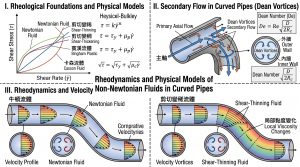
1. 緒論與研究背景 / 1. Introduction and Research Background
在全球化學工業朝向高附加價值與精細化發展的趨勢下,特種高分子溶液、乳液與懸浮液的管線輸送需求與日俱增。此類流體在管線中流動時,其表觀黏度(Apparent Viscosity)並非恆定的物理常數,而是高度依賴於局部剪切速率(Shear Rate)、流場幾何與溫度分佈的非牛頓流體1。在製程工廠複雜的三維管線佈局中,彎管與彎頭是改變流體動量方向的必要組件,卻也同時成為流體能量耗散與固體應力集中的雙重熱點3。 With the global chemical industry trending towards high-added-value and refinement, the demand for pipeline transportation of specialty polymer solutions, emulsions, and suspensions is growing rapidly. When flowing through pipelines, the apparent viscosity of such fluids is not a constant physical value but a non-Newtonian property highly dependent on local shear rates, flow field geometry, and temperature distribution1. In the complex 3D piping layouts of process plants, pipe bends and elbows are necessary components for altering fluid momentum direction; however, they simultaneously act as dual hotspots for fluid energy dissipation and solid stress concentration3.
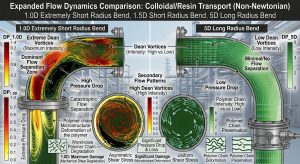
長春石油化學股份有限公司作為全球聚乙烯醇(PVA)與相關特種膠體的領導製造商,其產品線涵蓋光學膜、生醫材料與高階接著劑,對流體的分子量分佈與流變穩定性具有極度嚴苛的要求5。在傳統的建廠思維中,管線設計工程師為追求空間利用率的最大化與預製的便利性,普遍大量採用曲率半徑為公稱管徑 1.5 倍(R = 1.5D)的標準短半徑或長半徑銲接彎頭7。然而,從流體力學的微觀視角檢視,1.5D 彎頭極小的曲率半徑會在管內激發強烈的迪安渦流(Dean Vortices)與流場分離4。這種三維擾動流場會在管壁附近產生極高的局部剪切應力,當應力超越 PVA 碳-碳骨架的鍵能時,將引發高分子鏈的機械性斷裂(Chain Scission),導致產品發生剪切降解,進而喪失其特有的剪切稀化(Shear-thinning)特徵與黏著性能9。 As a leading global manufacturer of Polyvinyl Alcohol (PVA) and related specialty gels, Chang Chun Petrochemical’s product lines cover optical films, biomedical materials, and high-end adhesives, imposing extremely stringent requirements on the molecular weight distribution and rheological stability of fluids5. In traditional plant construction methodologies, piping design engineers, pursuing maximized space utilization and prefabrication convenience, widely adopted standard short- or long-radius welded elbows with a curvature radius of 1.5 times the nominal pipe diameter (R = 1.5D)7. However, examined from a microscopic fluid dynamics perspective, the extremely small curvature radius of 1.5D elbows triggers intense Dean Vortices and flow separation within the pipe4. This 3D disturbed flow field generates exceptionally high local shear stresses near the pipe wall. When these stresses exceed the bond energy of the PVA carbon-carbon backbone, mechanical chain scission is induced, leading to shear degradation of the product and the subsequent loss of its unique shear-thinning characteristics and adhesive performance9.
與此同時,在高溫、高壓或高頻率起停的製程管線系統中,結構的疲勞壽命是決定工廠安全性的核心指標。美國機械工程師學會(ASME)在重新審視過去數十年來的管線破裂事故與多軸疲勞測試數據後,啟動了重大的規範範式轉移(Paradigm Shift)12。最新頒布的 2026 年版 ASME B31.1(動力管線)與 B31.3(製程管線)不僅修訂了疲勞應力範圍因子(Stress Range Factor, f)的衰減斜率,更以強制作為將 ASME B31J 標準列為應力分析的唯一合法依據12。ASME B31J 透過空間方向性矩陣將應力強度因子(SIF)徹底解耦,精確暴露了 1.5D 銲接彎頭在扭轉與面外彎矩下的極高應力集中缺陷7。 Simultaneously, in process piping systems subjected to high temperatures, high pressures, or frequent start-stop cycles, structural fatigue life is the core metric determining plant safety. After re-evaluating decades of pipeline rupture incidents and multi-axial fatigue test data, the American Society of Mechanical Engineers (ASME) initiated a major paradigm shift in its codes12. The newly published 2026 editions of ASME B31.1 (Power Piping) and B31.3 (Process Piping) not only revised the decay slope of the fatigue Stress Range Factor (f) but also strictly mandated ASME B31J as the sole legal basis for stress analysis12. By thoroughly decoupling the Stress Intensification Factor (SIF) through a spatial directional matrix, ASME B31J precisely exposes the extreme stress concentration flaws of 1.5D welded elbows under torsional and out-of-plane bending moments7.
為突破此一流體與結構的雙重瓶頸,工程界開始將目光轉向大半徑(3D/5D)的一體成形冷作彎管(Cold Bends)15。冷作彎管利用機械力矩,在室溫或次臨界溫度下將直管成形,徹底消除了熱影響區(HAZ)與環向銲道17。本研究將以長春化工的高黏度 PVA 膠體輸送為實證模型,結合非牛頓流體力學之控制方程式與 ASME B31J 固體力學框架,系統性地量化 3D 與 5D 彎管在防範剪切降解、控制壁厚減薄、優化疲勞壽命與降低總體建置成本上的跨學科優勢。 To overcome this dual bottleneck in fluid and structural mechanics, the engineering community has shifted its focus to large-radius (3D/5D) integrally formed cold bends15. Cold bends utilize mechanical torque to form straight pipes at room or subcritical temperatures, completely eliminating the Heat-Affected Zone (HAZ) and circumferential welds17. Using Chang Chun Petrochemical’s high-viscosity PVA gel transportation as an empirical model, this study integrates governing equations of non-Newtonian fluid mechanics with the ASME B31J solid mechanics framework to systematically quantify the interdisciplinary advantages of 3D and 5D cold bends in preventing shear degradation, controlling wall thinning, optimizing fatigue life, and reducing overall construction costs.
2. 非牛頓流體在彎管內之流變動力學與物理模型 / 2. Rheological Dynamics and Physical Models of Non-Newtonian Fluids in Pipe Bends
在探討彎管幾何對流體的影響前,必須先建立高黏度特種膠體的流變學行為模型,並解析流體在管線轉向時所誘發的複雜三維邊界層變化。Before exploring the impact of bend geometry on fluids, it is necessary to establish the rheological behavior model of high-viscosity specialty gels and analyze the complex 3D boundary layer changes induced when fluid changes direction in a pipeline.
2.1 聚乙烯醇 (PVA) 膠體之流變學特徵與微觀降解機制 / 2.1 Rheological Characteristics of Polyvinyl Alcohol (PVA) Gels and Microscopic Degradation Mechanisms
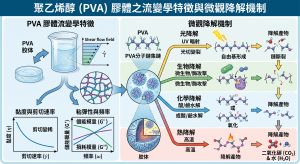
長春化工生產之 PVA 水溶液及特種乳液,屬於具有黏彈性(Viscoelasticity)與假塑性(Pseudoplastic)的非牛頓流體11。在靜態或極低剪切速率下,PVA 的高分子鏈呈現隨機的無規線團(Random Coil)構象,分子鏈間彼此深度纏結,阻礙流體微團的相對滑動,因此表現出極高的零剪切黏度(Zero-shear Viscosity)10。當流體進入管線受到外部剪切力驅動時,高分子鏈開始沿流線方向解纏結(Disentanglement)並定向排列,導致表觀黏度隨剪切速率的增加而顯著下降,此即為剪切稀化現象6。 The PVA aqueous solutions and specialty emulsions produced by Chang Chun Petrochemical are non-Newtonian fluids exhibiting viscoelasticity and pseudoplasticity11. Under static or extremely low shear rate conditions, PVA polymer chains adopt a random coil conformation, deeply entangled with one another. This restricts the relative sliding of fluid micro-parcels, resulting in an exceptionally high zero-shear viscosity10. When the fluid enters the pipeline and is driven by external shear forces, the polymer chains begin to disentangle and align along the streamlines, causing the apparent viscosity to decrease significantly as the shear rate increases—a phenomenon known as shear-thinning6.
工程上,PVA 膠體的非牛頓流動行為最適宜以包含降伏應力(Yield Stress)的赫歇爾-巴爾克萊模型(Herschel-Bulkley Model)或簡化的冪律模型(Power-law Model)進行數值描述1: In engineering, the non-Newtonian flow behavior of PVA gels is best described numerically using the Herschel-Bulkley model, which includes a yield stress, or the simplified Power-law model1:
τ=τy+Kγ ̇ n
其中,τ 為局部剪切應力,τy 為啟動流動所需的降伏應力,K 為稠度係數(Consistency Index),γ ̇ 為剪切速率,n 為流動行為指數(Flow Behavior Index)。對於呈現剪切稀化的 PVA 膠體,0 < n < 1;n 值越小,代表流體受剪切應力作用時的黏度衰減越劇烈21。在計算流體力學(CFD)的實務模擬中,為避免當γ ̇ → 0 時表觀黏度趨於無限大的數值發散問題,通常會引入 Papanastasiou 規則化模型(Regularization Model)來修正黏度函數23。 Here, τ is the local shear stress, τy is the yield stress required to initiate flow, K is the consistency index, γ ̇ is the shear rate, and n is the flow behavior index. For PVA gels exhibiting shear-thinning, 0 < n < 1; a smaller n value indicates a more drastic viscosity decay when the fluid is subjected to shear stress21. In practical Computational Fluid Dynamics (CFD) simulations, to prevent the numerical divergence issue where apparent viscosity approaches infinity as γ ̇ → 0, the Papanastasiou regularization model is commonly introduced to correct the viscosity function23.
除了剪切稀化,PVA 膠體的流變特性亦對外部物理化學條件極度敏感。然而,在連續的管線輸送過程中,最具破壞性的威脅來自於機械剪切降解(Mechanical Shear Degradation)。當高分子溶液流經截面急遽變化的組件(如 1.5D 彎頭或閥門)時,局部流場會產生強烈的伸長流(Extensional Flow)與紊流渦動9。當作用於單一高分子鏈上的流體動力拉伸力超過碳-碳主鏈的共價鍵能時,鏈中段會發生斷裂(Chain Scission),導致平均分子量永久性降低9。這種微觀結構的破壞,將直接反映在終端產品黏度不可逆的喪失,嚴重影響光學膜成膜的均勻性或特種膠體的剝離強度。 Beyond shear-thinning, the rheological properties of PVA gels are extremely sensitive to external physicochemical conditions. However, during continuous pipeline transportation, the most destructive threat comes from mechanical shear degradation. When polymer solutions flow through components with abrupt cross-sectional changes (such as 1.5D elbows or valves), the local flow field generates intense extensional flow and turbulent eddies9. When the hydrodynamic tensile force acting on a single polymer chain exceeds the covalent bond energy of the carbon-carbon backbone, chain scission occurs in the middle segments, leading to a permanent reduction in average molecular weight9. This microscopic structural destruction directly reflects as an irreversible loss of end-product viscosity, severely affecting the film-forming uniformity of optical films or the peel strength of specialty adhesives.
2.2 彎管流場之三維邊界層分離與迪安渦流效應 / 2.2 Three-Dimensional Boundary Layer Separation and Dean Vortex Effects in Bend Flow Fields
當非牛頓流體在直管中發展為充分發展流(Fully Developed Flow)後,進入彎管段時,流體微團必須承受向心力矩的約束以改變動量方向。由於管壁邊界層的無滑移條件(No-slip Condition),管中心區域的流體速度最高,其所受之離心力遠大於近壁面區域的流體4。這種沿徑向的離心力梯度,迫使中心的高速流體向彎管的外弧側(Extrados)擠壓,而外弧側的高壓流體則沿著管壁周向,向壓力較低的內弧側(Intrados)回流。這種由離心力驅動的二次流,與主流方向(Streamwise)的軸向速度疊加後,在彎管的橫截面上形成了兩個對稱、反向旋轉的螺旋渦流,被稱為迪安渦流(Dean Vortices)4。 After a non-Newtonian fluid establishes a fully developed flow in a straight pipe and enters a bend segment, fluid micro-parcels must endure centripetal torque constraints to alter their momentum direction. Due to the no-slip condition at the pipe wall boundary layer, the fluid velocity is highest in the central region, experiencing a centrifugal force much greater than the fluid near the wall4. This radial centrifugal force gradient forces the high-speed fluid at the center to squeeze towards the extrados (outer bend), while the high-pressure fluid at the extrados flows back circumferentially along the pipe wall towards the lower-pressure intrados (inner bend). This centrifugally driven secondary flow, when superimposed with the axial velocity in the streamwise direction, forms two symmetrical, counter-rotating spiral vortices on the cross-section of the bend, known as Dean Vortices4.
二次流的強度可由無因次迪安數(Dean Number, De)精確量化。對於非牛頓冪律流體,結合改進的雷諾數定義,迪安數可表示為15: The intensity of the secondary flow can be precisely quantified by the dimensionless Dean Number (De). For non-Newtonian power-law fluids, combined with a modified Reynolds number definition, the Dean number can be expressed as15:
De=ReMR √D/2Rc
其中,ReMR 為適用於非牛頓流體的 Metzner-Reed 雷諾數,D 為管線內徑,Rc 為彎管的中心曲率半徑15。由方程式可知,迪安數與曲率半徑 Rc 的平方根呈反比。當採用傳統 1.5D 短半徑彎頭時,Rc 極小,迪安數將呈指數級放大。強烈的二次流會將流場主流區的高速核心推向外彎側,使得軸向速度分佈呈現出典型的「腎形」(Kidney-shaped)特徵4。 Where ReMR is the Metzner-Reed Reynolds number applicable to non-Newtonian fluids, D is the internal pipe diameter, and Rc is the central curvature radius of the bend15. As the equation shows, the Dean number is inversely proportional to the square root of the curvature radius Rc. When using traditional 1.5D short-radius elbows, Rc is extremely small, causing the Dean number to amplify exponentially. The intense secondary flow pushes the high-speed core of the mainstream flow towards the outer bend, resulting in an axial velocity distribution that exhibits a typical “kidney-shaped” profile4.
在迪安數極高的狀態下(例如 De > 150),二維迪安渦流甚至可能分裂為四個或更多個次級渦流迴圈(Vortex loops),導致流場進入極度紊亂的狀態27。更甚者,由於內弧側流體在經過彎管頂點後遭遇強烈的逆壓梯度(Adverse Pressure Gradient),極易發生邊界層流場分離(Boundary Layer Separation),在彎頭下游形成巨大的迴流區(Recirculation Zone),導致動能的大量耗散4。 Under states of extremely high Dean numbers (e.g., De > 150), the two-dimensional Dean vortices may even split into four or more secondary vortex loops, plunging the flow field into a highly chaotic state27. Furthermore, because the fluid on the intrados encounters a strong adverse pressure gradient after passing the bend’s apex, boundary layer flow separation is highly prone to occur, forming a massive recirculation zone downstream of the elbow and leading to substantial kinetic energy dissipation4.
2.3 局部壁面剪切應力分佈與管線壓力降預測 / 2.3 Local Wall Shear Stress Distribution and Pipeline Pressure Drop Prediction
流場的三維畸變直接決定了彎管內壁面剪切應力(Wall Shear Stress, WSS)的極端分佈。大量的高解析度計算流體力學(CFD)與實驗數據證實,赫歇爾-巴爾克萊流體在彎管中的 WSS 會出現兩個明顯的極值區域:第一處位於彎管入口段的內弧側,流體在此處急遽加速以順應曲率;第二處則位於彎管出口段的外弧側,受迪安渦流與高速核心偏移的劇烈衝擊而產生高剪應力26。 The 3D distortion of the flow field directly dictates the extreme distribution of Wall Shear Stress (WSS) within the pipe bend. Extensive high-resolution Computational Fluid Dynamics (CFD) and experimental data confirm that for Herschel-Bulkley fluids in pipe bends, WSS exhibits two distinct peak regions: the first is located on the inner wall at the bend entrance, where the fluid rapidly accelerates to conform to the curvature; the second is on the outer wall at the bend exit, which generates high shear stress due to the severe impact of Dean vortices and the deflected high-speed core26.
這兩個局部高剪切應力區,正是引發 PVA 膠體發生機械性剪切降解的「絞肉機」。在高剪切速率下,局部表觀黏度因剪切稀化而急遽下降,這使得流體對渦流與紊流動能的黏性耗散能力減弱,進一步加劇了流場的波動與不穩定性26。 These two local high-shear-stress zones act precisely as the “meat grinders” that trigger the mechanical shear degradation of PVA gels. Under high shear rates, the local apparent viscosity drops sharply due to shear-thinning, weakening the fluid’s ability for viscous dissipation of vortex and turbulent kinetic energy, which further exacerbates the fluctuation and instability of the flow field26.
此外,強烈的二次流與邊界層分離所產生的能量耗散,構成了管線系統的局部壓力降(Minor Losses)。在工程實務中,含彎管系統的局部阻力係數 ξ與迪安數及流動行為指數 n 密切相關29。當曲率半徑 Rc 擴大時(如改用 5D 彎管),二次流強度大幅衰減,流場分離區幾乎消失,其局部壓力降可較 1.5D 彎頭減少高達 20% 至 30%26。這不僅顯著降低了輸送泵浦的能耗(OPEX),更從物理根源上消除了誘發高分子鏈斷裂的極端應力場10。 Moreover, the energy dissipation generated by strong secondary flows and boundary layer separation constitutes the local pressure drop (minor losses) of the piping system. In engineering practice, the local resistance coefficient ξ of systems with bends is closely related to the Dean number and the flow behavior index n 29. When the curvature radius Rc is expanded (e.g., switching to 5D bends), secondary flow intensity attenuates massively, flow separation zones practically disappear, and the local pressure drop can be reduced by up to 20% to 30% compared to 1.5D elbows26. This not only significantly lowers the energy consumption of transport pumps (OPEX) but also physically eliminates the extreme stress fields that induce polymer chain scission from their root source10.
3. 2026 ASME 規範演進與流固耦合 (FSI) 應力解析 / 3. 2026 ASME Code Evolution and Fluid-Structure Interaction (FSI) Stress Analysis
流體在彎管中因離心力與渦流脫落(Vortex Shedding)所產生的動態壓力脈動,將透過流固耦合(Fluid-Structure Interaction, FSI)機制持續反作用於管壁結構上34。對於承受頻繁熱循環的特種石化管線,這些由流體動力學誘發的交變載荷若疊加於管系本身的熱膨脹應力集中處,將導致管件提早發生高周波疲勞斷裂35。為確保管線結構的絕對安全,ASME 針對應力分析模型進行了底層邏輯的重大革新。 Dynamic pressure pulsations generated by centrifugal force and vortex shedding in pipe bends continuously react against the pipe wall structure through Fluid-Structure Interaction (FSI) mechanisms34. For specialty petrochemical pipelines enduring frequent thermal cycling, if these fluid-dynamically induced alternating loads superimpose on the piping system’s inherent thermal expansion stress concentrations, they will cause the components to suffer premature high-cycle fatigue fracture35. To ensure absolute structural safety of pipelines, ASME has undertaken a major overhaul of the underlying logic of stress analysis models.
3.1 ASME B31.1 與 B31.3 規範之範式轉移 (Paradigm Shift) / 3.1 Paradigm Shift in ASME B31.1 and B31.3 Codes
過去七十年間,全球管線應力工程師皆奉 A.R.C. Markl 教授於 1950 年代提出的疲勞測試方程式為圭臬。Markl 透過對薄壁碳鋼管的平面彎曲試驗,定義了應力強度因子(SIF, 代號 i),並將標準直管對接銲縫的 SIF 設為 1.0 作為基準13。傳統的 ASME B31.1 與 B31.3 規範將這些測試結果收錄於 Mandatory Appendix D 中。 For the past seventy years, global pipe stress engineers have revered the fatigue testing equations proposed by Professor A.R.C. Markl in the 1950s as the gold standard. Through planar bending tests on thin-walled carbon steel pipes, Markl defined the Stress Intensification Factor (SIF, denoted as i) and set the SIF of a standard straight pipe girth butt weld at 1.0 as the baseline13. Traditional ASME B31.1 and B31.3 codes incorporated these test results into Mandatory Appendix D.
然而,Appendix D 存在嚴重的時代侷限性。首先,它將複雜的彎管應力集中效應簡化為單一的純量 SIF(通常為面內與面外應力強度的最大值),並統一乘入合成彎矩中,完全忽略了空間向量的解耦7。其次,它忽略了極端厚壁管(低 D/t 比)對截面扁平化的抵抗剛度補償,導致 SIF 估算過度保守。最致命的是,舊版規範缺乏對扭轉剪應力極值的評估,長期預設扭轉 SIF(it)為 1.0 18。這導致工程師在面對 1.5D 銲接彎頭時,計算出的節點應力往往異常巨大,被迫在現場盲目增設龐大且昂貴的剛性管架、膨脹環(Expansion Loops)與液壓阻尼器(Snubbers),造成建造成本的無謂浪費15。 However, Appendix D harbored severe temporal limitations. First, it oversimplified complex bend stress concentration effects into a single scalar SIF (typically the maximum of in-plane and out-of-plane stress intensification), uniformly multiplying it into the resultant moment while completely ignoring the decoupling of spatial vectors7. Second, it neglected the stiffness compensation against cross-sectional flattening offered by extremely thick-walled pipes (low D/t ratio), leading to overly conservative SIF estimations. Most critically, older codes lacked evaluations for peak torsional shear stresses, defaulting the torsional SIF (it) to 1.0 for decades18. Consequently, when dealing with 1.5D welded elbows, engineers often calculated abnormally large nodal stresses, forcing them to blindly add bulky and expensive rigid supports, expansion loops, and hydraulic snubbers on-site, resulting in needless waste of construction costs15.
有鑑於此,ASME 在 2024 年至 2026 年版的 B31.1(動力管線)與 B31.3(製程管線)規範中,正式且全面地廢除了 Mandatory Appendix D。新規範強制要求,所有金屬管線組件的應力強度因子與柔性因子,必須全面改採 ASME B31J 標準進行精確計算14。規範明確禁止工程師將 B31J 提供的高精度矩陣數據倒搭回舊版的合成彎矩公式中,確立了新一代管線應力分析的範式轉移15。 In light of this, the 2024 to 2026 editions of ASME B31.1 (Power Piping) and B31.3 (Process Piping) have formally and completely abolished Mandatory Appendix D. The new codes mandate that the Stress Intensification Factors and flexibility factors for all metallic piping components must be calculated precisely using the ASME B31J standard14. The codes explicitly prohibit engineers from substituting the high-precision matrix data provided by B31J back into the old resultant moment formulas, cementing a paradigm shift in next-generation pipe stress analysis15.
3.2 ASME B31J 空間方向性彈性矩陣與解耦演算法 / 3.2 ASME B31J Spatial Directional Flexibility Matrix and Decoupling Algorithm
ASME B31J 的核心精神,在於利用三維實體有限元素分析(FEA)與現代多軸疲勞試驗數據,真實還原管件在複雜載荷下的「橢圓化效應(Ovalization)」38。當彎管承受管系的熱膨脹推擠時,其圓形截面會發生畸變。這種變形雖然賦予了彎管吸收位移的「柔性」,但也同時在管壁的中性軸兩側(Crowns)引發了強烈的局部周向彎曲應力,成為疲勞熱點7。 The core ethos of ASME B31J lies in utilizing 3D solid Finite Element Analysis (FEA) and modern multi-axial fatigue test data to realistically replicate the “Ovalization effect” of piping components under complex loads38. When a pipe bend is pushed by thermal expansion from the piping system, its circular cross-section distorts. Although this deformation grants the bend the “flexibility” to absorb displacement, it simultaneously triggers intense local circumferential bending stresses on both sides of the pipe wall’s neutral axis (crowns), becoming hotspots for fatigue7.
為了在代數層面上精確描述此現象,ASME B31J 引入了關鍵的無因次幾何參數——柔性特徵 (Flexibility Characteristic, h),其閉式解(Closed-form equation)定義為7: To precisely describe this phenomenon algebraically, ASME B31J introduces a crucial dimensionless geometric parameter—the Flexibility Characteristic (h), defined by the closed-form equation7:
h=T⋅R1/r22
式中,T 為管件的公稱壁厚(Nominal wall thickness),R1 為幾何彎曲半徑(Bend radius),r2 為管線的平均截面半徑(r2 =(D-T)/2)。 由 h 值的構造可知,彎曲半徑 R1位於分子。這意味著,當我們將傳統的 1.5D 短半徑彎頭升級為 5D 大半徑冷作彎管時,R1 放大了 3.3 倍,柔性特徵 h 也隨之呈線性倍增。較大的 h 值代表管件具備極強的截面穩定性,能有效抵抗彎矩引發的畸變與橢圓化。Where T is the nominal wall thickness, R1 is the bend radius, and r2 is the mean cross-sectional radius of the pipe (r2 =(D-T)/2). From the structure of the h value, the bend radius R1 sits in the numerator. This means that when upgrading a traditional 1.5D short-radius elbow to a 5D large-radius cold bend, R1 is magnified 3.3 times, causing the flexibility characteristic h to multiply linearly. A larger h value indicates that the component possesses exceptional cross-sectional stability, effectively resisting distortion and ovalization induced by bending moments.
基於 h 值,ASME B31J 將彎管的應力反應徹底解耦為三維獨立參數7: Based on the h value, ASME B31J thoroughly decouples the stress response of the pipe bend into three-dimensional independent parameters7:
- 柔性係數 (Flexibility Factor, k):量化彎管相較於等長直管的幾何剛度倍率。公式為: Quantifies the geometric stiffness multiplier of the bend compared to a straight pipe of equal length. Formula:
k=1.65/h。
- 面內應力強度因子 (In-Plane SIF, ii):評估面內彎矩導致彎管「張開」或「閉合」時的應力集中。公式為 :Evaluates the stress concentration when in-plane bending moments cause the bend to “open” or “close.” Formula:
ii =0.9/h2/3
面外應力強度因子 (Out-of-Plane SIF, io):評估面外彎矩迫使管件橫向扭曲時的應力集中。公式為: Evaluates the stress concentration when out-of-plane bending moments force the component to twist laterally. Formula:
io =0.75/h2/3
- 扭轉應力強度因子 (Torsional SIF, it):B31J 首度將三維空間的扭轉剪力集中正式納入位移應力範圍計算,打破了舊版預設為 1.0 的盲區7。 B31J officially incorporates 3D torsional shear stress concentration into displacement stress range calculations for the first time, breaking the blind spot of the legacy default value of 1.0 7.
此外,ASME B31J 在計算自重與內壓產生的持續應力(Sustained Stress)時,引入了持續應力指數 (Sustained Stress Index, SSI) 的概念。規範要求 SSI 取值為 0.75i(且下限不得低於 1.0)16。在舊版規範中,工程師被迫將巨大的疲勞 SIF 直接套用於持續負載,導致防止管線塑性塌陷的基礎厚度設計變得極度且不合理地保守16。B31J 的 SSI 解耦機制,大幅減少了過度設計,賦予了管線佈局更高的彈性16。 Additionally, when calculating sustained stress generated by dead weight and internal pressure, ASME B31J introduces the concept of the Sustained Stress Index (SSI). The code requires SSI to be taken as 0.75i (with a minimum lower limit of 1.0)16. In older codes, engineers were forced to apply massive fatigue SIFs directly to sustained loads, rendering baseline thickness designs aimed at preventing plastic collapse extremely and unreasonably conservative16. The SSI decoupling mechanism in B31J drastically curtails over-design, granting piping layouts much higher flexibility16.
| 應力參數與特性Stress Parameters & Characteristics | 傳統 1.5D 銲接彎頭 (舊版 Appendix D)Traditional 1.5D Welded Elbow (Legacy Appendix D) | 5D 大半徑冷作彎管 (ASME B31J-2026)5D Large-Radius Cold Bend (ASME B31J-2026) | 對高黏度管網佈局之影響Impact on High-Viscosity Piping Network Layout |
| 面內/面外 SIF (ii, io)/
In-Plane/Out-of-Plane SIF |
SIF 值極高(常 > 3.0),且不分方向性,將熱膨脹位移應力放大數倍15。/
Extremely high SIFs (often > 3.0), lacking directionality, amplifying thermal expansion displacement stress multiple times. |
由於 h 值倍增,SIF 指數級衰減,趨近於理論無應力集中的完美下限 1.0 7。/
Due to doubled h values, SIF decays exponentially, approaching the perfect theoretical stress-free lower limit of 1.0. |
消除虛假應力超標,大幅減少膨脹環與剛性支撐需求,降低建廠成本與空間佔用。/
Eliminates false stress exceedance, drastically reducing the need for expansion loops and rigid supports, lowering construction costs and spatial footprint. |
| 持續應力指數 (SSI)/
Sustained Stress Index (SSI) |
直接沿用疲勞 SIF,導致持續載荷(自重/內壓)評估嚴重失真16。/
Directly inherits fatigue SIF, causing severe distortion in sustained load (weight/pressure) evaluation. |
解耦為 0.75i(下限 1.0),精確防範一次膜應力導致的塑性塌陷16。/
Decoupled to 0.75i (min 1.0), accurately preventing plastic collapse caused by primary membrane stress. |
使重型閥門與設備管嘴(Nozzle loads)的受力計算更貼近真實,保護關鍵動態設備。/
Makes force calculations for heavy valves and equipment nozzle loads more realistic, protecting critical dynamic equipment. |
| 流固耦合 (FSI) 抵抗力/
Fluid-Structure Interaction (FSI) Resistance |
在 1.5D 急彎處,流場震動與高 SIF 疊加,極易誘發管壁微裂紋萌生7。/
At 1.5D sharp bends, flow vibrations superimpose with high SIF, highly prone to inducing pipe wall microcrack initiation. |
平滑的流線與極低的 SIF,使流體動態壓力脈動無法在彎管處形成破壞性應力集中。/
Smooth streamlines and extremely low SIF ensure fluid dynamic pressure pulsations cannot form destructive stress concentrations at bends. |
徹底延長管線系統的熱疲勞極限值,避免非預期停機17。/
Completely extends the thermal fatigue limits of the piping system, avoiding unexpected downtime. |
3.3 疲勞應力範圍因子 (Stress Range Factor, f) 之嚴苛化懲罰 / 3.3 Stringent Penalties of the Fatigue Stress Range Factor (f)
促使業界必須放棄 1.5D 彎頭而擁抱 5D 冷作彎管的另一關鍵驅動力,來自於 ASME B31.3 2022/2024 版本對疲勞計算公式的重磅修正。在評估位移控制的交變應力時,規範使用應力範圍因子 f 來折減許用應力範圍SA: Another key driver forcing the industry to abandon 1.5D elbows and embrace 5D cold bends stems from the heavyweight revisions to fatigue calculation formulas in the ASME B31.3 2022/2024 editions. When evaluating displacement-controlled alternating stresses, the code uses the stress range factor f to reduce the allowable stress range SA:
SA=f[1.25(Sc+Sh )-SL ]
(此公式涵蓋了未使用的持續應力餘裕SL,即工程上俗稱的「Liberal allowable stress」)12。 (This formula encompasses the unused sustained stress margin SL, commonly known in engineering as the “Liberal allowable stress”)12.
在長達 70 年的時間裡,f 值的計算公式為 f=6.0N-0.2,這隱含了 S-N 曲線的斜率為 5:1。然而,為真實反映多軸疲勞與複雜管件的破壞機制,最新規範將公式修正為: For up to 70 years, the calculation formula for the f value was f=6.0N-0.2 , which implied an S-N curve slope of 5:1. However, to truthfully reflect multi-axial fatigue and the failure mechanisms of complex pipe fittings, the latest code revised the formula to:
f=20N-0.333
新公式將 S-N 曲線斜率調整為 3:1。力學分析表明,這兩條曲線在循環次數N≈2×10⁴ 時交叉;當循環次數超過此極限值,進入高周波疲勞區間(如頻繁起停或受流體連續震動的製程管線),新的 f 值將呈斷崖式下跌。在 N≈105 次時,許用應力將被砍半。這意味著,過去使用 1.5D 彎頭且在舊版公式下勉強及格(如應力比達到 85%)的管線系統,在 2026 年新規範的檢核下將全面呈現「應力超標(Failure)」。唯有全面導入 SIF 趨近於 1.0 的 3D 或 5D 冷作彎管,從源頭將管網「柔性化」,方能順利通過新規範的嚴苛考驗7。 The new formula adjusts the S-N curve slope to 3:1. Mechanical analysis indicates that these two curves intersect at approximately N≈2×10⁴ cycles; when the number of cycles exceeds this limit and enters the high-cycle fatigue regime (such as process piping subjected to frequent start-stops or continuous fluid vibration), the new f value drops precipitously. At N≈105 cycles, the allowable stress is slashed in half. This means that piping systems that previously used 1.5D elbows and barely passed under the old formula (e.g., reaching an 85% stress ratio) will comprehensively exhibit “Failure” (stress exceedance) under the 2026 code checks. Only by fully adopting 3D or 5D cold bends with SIFs approaching 1.0 to “flexibilize” the piping network from its source can one successfully pass the stringent tests of the new code7.
4. 冷作彎管 (Cold Bending) 之製造邊界條件與 R 值最佳化準則 / 4. Manufacturing Boundary Conditions and R-value Optimization Criteria for Cold Bends
雖然 5D 大半徑彎管在流體力學與 B31J 應力解析中具備壓倒性優勢,但將直管強行彎曲的「冷作塑性變形(Cold Forming)」製程,亦會帶來壁厚減薄、橫截面橢圓化與加工硬化等製造邊界挑戰。工程師必須在 R 值的選用上,取得物理性能與建廠經濟學的最佳平衡。While 5D large-radius bends possess overwhelming advantages in fluid dynamics and B31J stress analysis, the “Cold Forming” process of forcibly bending straight pipes brings manufacturing boundary challenges, including wall thinning, cross-sectional ovalization, and work hardening. Engineers must strike an optimal balance between physical performance and construction economics when selecting the R-value.
4.1 冷作塑性應變率與次臨界熱處理 (IH-PBHT) 放寬機制 / 4.1 Plastic Strain Rate of Cold Forming and Subcritical Heat Treatment (IH-PBHT) Relaxation Mechanisms
冷彎過程會導致管材外弧側發生極大的拉伸塑性變形,內弧側發生壓縮變形。這種變形會增加材料內部的差排密度(Dislocation density),產生巨觀的加工硬化,並積累龐大的殘餘拉伸應力8。在含有腐蝕介質或高溫環境下,殘餘應力是誘發應力腐蝕破裂(SCC)與加速流動加速腐蝕(FAC)的關鍵因子8。 The cold bending process causes immense tensile plastic deformation on the pipe’s extrados and compressive deformation on the intrados. This deformation increases the internal dislocation density of the material, generating macroscopic work hardening and accumulating massive residual tensile stresses8. In environments containing corrosive media or high temperatures, residual stress is a key factor inducing Stress Corrosion Cracking (SCC) and Flow-Accelerated Corrosion (FAC)8.
冷作變形對微觀組織的破壞程度可由極限纖維的塑性應變率(Plastic Strain Rate, ϵ)量化。基於幾何關係,公式為18: The degree of microscopic structural destruction caused by cold deformation can be quantified by the Plastic Strain Rate (ϵ) of the extreme fibers. Based on geometric relationships, the formula is18:
ϵ=ro/R1 ×100%=Do/(2R1 )×100%
式中,ro 為管件外半徑( Do/2),R1 為彎曲中心半徑。 將主流的曲率半徑代入計算:Where ro is the pipe outer radius (Do/2) and R1 is the center bend radius. Substituting mainstream curvature radii into the calculation:
- 3D 彎管 (R1 = 3Do):最大成形應變率ϵ≈16.67%。Maximum forming strain rate ϵ≈16.67%.
- 5D 彎管 (R1 = 5Do):最大成形應變率 ϵ≈10.0%。Maximum forming strain rate ϵ≈10.0%.
在舊版規範中,對於高合金鋼(如 P91/P92)的冷成型應變管控極其僵化,動輒要求進行破壞性的整體固溶退火。然而,為順應大半徑彎管的普及,2026 版 ASME B31.1 在第 129 節(Bending and Forming)中,釋出了基於應變率階層的熱處理放寬機制。對於應變率精準落於 5% 至 20% 過渡區間內的 3D 與 5D 彎管,規範允許採用次臨界感應加熱彎後熱處理 (Subcritical Induction Heating Post-Bend Heat Treatment, IH-PBHT)18。 In older codes, cold-forming strain control for high-alloy steels (like P91/P92) was exceedingly rigid, frequently demanding destructive full solution annealing. However, to accommodate the popularization of large-radius bends, the 2026 edition of ASME B31.1 Section 129 (Bending and Forming) introduced heat treatment relaxation mechanisms based on strain rate tiers. For 3D and 5D bends where strain rates fall precisely within the transitional range of 5% to 20%, the code permits the use of Subcritical Induction Heating Post-Bend Heat Treatment (IH-PBHT)18.
以高階管材為例,IH-PBHT 將溫度精確控制在 AC1 下臨界相變溫度之下(如 705°C 至 760°C)。此舉不僅完美消除了冷作加工硬化與殘餘應力,恢復了材料延展性(滿足 ASME B31.3 Para 332.4.2 要求的至少 10% 殘餘延伸率)8,更重要的是避免了高溫相變對母材精細碳氮化物(Carbonitrides)強化析出相的破壞,徹底保障了材料長期的潛變韌性。這項放寬機制賦予了 3D/5D 冷彎管在高端管線工程中的絕對合法性與操作空間43。 Taking high-grade piping as an example, IH-PBHT precisely controls the temperature below the AC1 lower critical transformation temperature (e.g., 705°C to 760°C). This action not only perfectly eliminates cold work hardening and residual stresses while restoring material ductility (meeting the minimum 10% retained elongation requirement of ASME B31.3 Para 332.4.2)8, but more importantly, avoids the destruction of the base metal’s fine carbonitride strengthening precipitates caused by high-temperature phase transitions, thoroughly safeguarding the material’s long-term creep toughness. This relaxation mechanism grants 3D/5D cold bends absolute legitimacy and operational leeway in high-end piping engineering43.
4.2 橢圓化控制與壁厚減薄補償方程 (Wall Thinning Allowance) / 4.2 Ovalization Control and Wall Thinning Allowance Equation
彎管在成形過程中,除了壁厚改變,還會發生橫截面扁平化(Flattening),即橢圓度(Ovality)。依據 ASME B16.49 等規範,最大允許橢圓度通常必須嚴格限制在 8% 以內。過大的橢圓度不僅會擾亂流體,更會削弱管件抵抗外部壓力與交變彎矩的能力。為此,現代 CNC 冷彎設備配備了精密的內部芯軸(Mandrel)支撐系統,在彎曲瞬間提供強大的反向支撐力,有效抵銷管壁向內屈曲(Buckling)的趨勢8。 During forming, pipe bends undergo not only wall thickness changes but also cross-sectional flattening, known as Ovality. According to codes like ASME B16.49, the maximum allowable ovality is generally restricted to strictly under 8%. Excessive ovality disrupts fluids and weakens the component’s resistance to external pressures and alternating bending moments. To counter this, modern CNC cold bending equipment is outfitted with precision internal mandrel support systems, providing robust reverse support at the moment of bending to effectively counteract the pipe wall’s tendency to buckle inwards8.
另一個嚴峻的挑戰是外彎壁的減薄。為確保彎曲後最薄處的實際壁厚仍大於或等於設計所需的最小耐壓壁厚tm,ASME 規範強制要求在成形前,必須依據彎曲半徑按比例增加母管的初始標稱壁厚(Nominal Thickness)。設計壁厚 tm 的計算基礎依循 ASME B31.3 的 Barlow 修正方程式: Another severe challenge is the thinning of the extrados wall. To ensure that the actual wall thickness at the thinnest point after bending remains greater than or equal to the minimum required design thickness tm, ASME codes mandate a proportional increase in the mother pipe’s initial Nominal Thickness prior to forming, based on the bend radius. The calculation for the design thickness tm follows ASME B31.3’s modified Barlow equation:
t=P⋅D/2(S⋅E⋅W+P⋅Y)
tm=t+c
其中,P 為設計壓力,S 為材料許用應力,E 為品質因子,W 為銲接強度折減因子(冷彎無銲縫故 W=1.0),Y 為溫度相依係數(用以補償厚壁內部應力重分配),c 為腐蝕/機械加工餘量7。 Where P is design pressure, S is allowable stress, E is the quality factor, W is the weld joint strength reduction factor (for seamless cold bends, W=1.0), Y is the temperature-dependent coefficient (compensating for stress redistribution inside thick walls), and c is the corrosion/mechanical allowance7.
根據 ASME 規範之壁厚減薄補償要求: According to ASME code requirements for wall thinning compensation:
- 3D 彎管:直管母管壁厚必須達到1.25* tm(需預留高達 25% 的減薄餘裕)18。 3D Bends: Mother pipe wall thickness must reach 1.25* tm (requiring a massive 25% thinning allowance)18.
- 4D 彎管:母管壁厚需滿足1.14* tm(約 14% 餘裕)。4D Bends: Mother pipe thickness must meet 1.14* tm (approx. 14% allowance).
- 5D 彎管:母管壁厚僅需滿足 1.08* tm(僅需 8% 補償餘裕)。5D Bends: Mother pipe thickness only needs to meet 1.08* tm (requiring only an 8% allowance).
這組數據揭示了 3D 與 5D 彎管在材料經濟學上的巨大分水嶺。採用 3D 彎管時,25% 的厚度補償遠遠超出了標準鋼管的製造公差,迫使建廠單位必須向鋼廠訂購非標準規格的客製化超厚壁管,這不僅大幅推升了採購成本,更面臨漫長的交期(Lead time)。相對地,5D 彎管僅需 8% 的減薄補償。由於 ASME B36.10M 標準無縫鋼管的預設軋機負公差(Mill Tolerance)即為 12.5%,這意味著 8% 的減薄量可直接被市售標準 Schedule 管材的厚度餘裕所吸收。業主可直接採購現貨標準鋼管進行 5D 冷彎,實現了工程品質與資本支出(CAPEX)的最佳化18。 This data reveals a massive watershed in material economics between 3D and 5D bends. When adopting 3D bends, a 25% thickness compensation far exceeds the manufacturing tolerances of standard steel pipes, forcing plant builders to order custom, non-standard ultra-thick-wall pipes from steel mills, drastically inflating procurement costs and risking long lead times. In contrast, 5D bends require only an 8% thinning compensation. Since the default mill tolerance for ASME B36.10M standard seamless steel pipes is 12.5%, an 8% thinning can be directly absorbed by the thickness margins of off-the-shelf standard Schedule pipes. Owners can procure standard stock steel pipes for 5D cold bending, realizing optimized engineering quality and Capital Expenditure (CAPEX)18.
5. 實務應用與技術經濟分析 (TEA):以長春化工 PVA 膠體管網為例 / 5. Practical Application and Techno-Economic Analysis (TEA): A Case Study of Chang Chun Petrochemical’s PVA Gel Piping Network
將 2026 ASME B31J 的力學架構與 5D 大半徑冷彎的物理特性,應用於長春化工等高階石化廠的非牛頓特種流體(如 PVA 膠體)管網設計中,可產生貫穿全生命週期(Lifecycle)的綜合經濟效益。Applying the mechanical framework of 2026 ASME B31J and the physical properties of 5D large-radius cold bends to the piping network design for non-Newtonian specialty fluids (such as PVA gels) in high-end petrochemical plants like Chang Chun Petrochemical yields comprehensive economic benefits spanning the entire lifecycle.
5.1 保護高分子微觀流變性,確保產品品質良率 / 5.1 Protecting Macromolecular Micro-Rheology and Ensuring Product Quality Yield
PVA 溶液作為典型的剪切稀化流體,其產品核心價值在於精準的分子量分佈與穩定的黏度平台11。在由傳統 1.5D 銲接彎頭構成的管網中,極端的迪安渦流與急遽的流場分離,會在內壁交界處產生超越共價鍵能的極端拉伸與剪切應力,將長鏈聚合物無情切斷,導致終端產品發生不可逆的機械剪切降解,良率大幅下滑4。 As a typical shear-thinning fluid, the core product value of PVA solutions lies in their precise molecular weight distribution and stable viscosity plateaus11. In piping networks composed of traditional 1.5D welded elbows, extreme Dean vortices and sharp flow separation generate extreme tensile and shear stresses at the inner wall boundaries that surpass covalent bond energies, ruthlessly severing long-chain polymers. This causes irreversible mechanical shear degradation of the end product, significantly driving down yield rates4.
導入 5D 數控冷作彎管後,曲率半徑的放大極大地平緩了向心力梯度,迪安數(De)顯著降低,二次流強度被有效抑制15。平滑過渡的幾何形狀消除了邊界層分離與逆壓梯度,使得管內壁面剪切應力被均勻分散,始終維持在 PVA 高分子鏈斷裂的臨界極限值之下10。這從流體力學的物理根源上達成了「零降解」的理想運輸狀態,確保了光學膜或特種接著劑在終端擠出時,仍具備完美的流變特性與結構強度10。 Upon integrating 5D CNC cold bends, the enlarged curvature radius vastly flattens the centripetal force gradient, significantly reducing the Dean number (De) and effectively suppressing secondary flow intensity15. The smoothly transitioning geometry eliminates boundary layer separation and adverse pressure gradients, ensuring that inner wall shear stresses are uniformly distributed and maintained well below the critical limits for PVA polymer chain scission10. This achieves an ideal “zero degradation” transport state from the physical roots of fluid dynamics, guaranteeing that optical films or specialty adhesives retain perfect rheological characteristics and structural strength upon terminal extrusion10.
5.2 大幅降低營運成本 (OPEX) 與流固耦合疲勞風險 / 5.2 Substantially Reducing Operating Expenses (OPEX) and FSI Fatigue Risks
非牛頓流體的管線輸送本就耗能巨大。1.5D 彎頭頻繁的流場分離會將流體動能轉化為無效的熱能與紊流耗散,產生極大的局部壓力降。5D 彎管透過流線型導流,可將彎管區域的流體摩擦損失與壓力降減少高達 20% 至 30%32。對於長距離或高流量的膠體輸送系統,這意味著可以選用揚程與功率較小的泵浦,或是顯著降低既有泵浦的運轉能耗,實現可觀的 OPEX 節省與碳足跡(Carbon Footprint)縮減26。 Pipeline transportation of non-Newtonian fluids is inherently energy-intensive. Frequent flow separations in 1.5D elbows convert fluid kinetic energy into ineffective thermal and turbulent dissipation, generating massive local pressure drops. Through streamlined flow guidance, 5D bends can reduce fluid friction losses and pressure drops in the bend region by 20% to 30%32. For long-distance or high-flow gel transportation systems, this means smaller head and lower power pumps can be selected, or the operating energy consumption of existing pumps can be markedly reduced, realizing substantial OPEX savings and carbon footprint reductions26.
在系統妥善率方面,5D 彎管在 ASME B31J 計算下的 SIF 值趨近於 1.0,擁有極佳的柔性特徵 h。它能如彈簧般吸收系統的高溫熱膨脹位移,同時將流體脈動(Vortex Shedding)誘發的交變載荷均勻消散。相較於 1.5D 銲接彎頭在最新 f=20N-0.333疲勞公式下動輒「應力超標」的窘境,5D 冷彎管徹底消除了銲縫處的局部應力集中,將系統的抗熱疲勞極限與壽命延長了數十倍,避免了因管線破裂所導致的高昂停機損失(Downtime Cost)12。 Regarding system reliability, 5D bends yield SIF values approaching 1.0 under ASME B31J calculations, boasting excellent flexibility characteristics h. They act like springs to absorb the system’s high-temperature thermal expansion displacement while uniformly dissipating alternating loads induced by fluid pulsations (vortex shedding). Compared to the frequent “stress exceedance” predicament of 1.5D welded elbows under the new f=20N-0.333 fatigue formula, 5D cold bends completely eradicate local stress concentrations at welds, extending the system’s thermal fatigue limits and lifespan by decades and averting exorbitant downtime costs caused by pipeline ruptures12.
5.3 資本支出 (CAPEX) 的全面最佳化 / 5.3 Comprehensive Optimization of Capital Expenditure (CAPEX)
在初期建廠投資(CAPEX)的視角下,5D 冷作彎管展現出三維度的成本優勢: From the perspective of initial plant investment (CAPEX), 5D cold bends demonstrate a three-dimensional cost advantage:
- 管材採購經濟性 / Material Procurement Economics:5D 彎管僅 8% 的壁厚減薄要求,完美相容於 ASME 標準鋼管5% 的公差範圍,徹底免除了訂製超厚壁管的高昂材料溢價與漫長交期。The mere 8% wall thinning requirement for 5D bends is perfectly compatible with the 12.5% tolerance of ASME standard steel pipes, completely averting the steep material premiums and long lead times of custom ultra-thick-walled pipes.
- 銲接與檢測成本歸零 / Zero Welding and Inspection Costs:「以彎代銲」工法消除了管線方向改變處的環向銲縫。這直接省去了高薪氬銲技師的人工成本、耗時的銲前預熱與銲後熱處理(PWHT),更免除了 100% 射線探傷(RT)或超音波檢測(UT)等非破壞檢測(NDE)的龐大開銷43。 The “Bend-Instead-of-Weld” method removes circumferential welds at changes in piping direction. This directly eliminates the labor costs of highly paid argon welders, time-consuming pre-heating, and Post-Weld Heat Treatment (PWHT), and abolishes the massive expenses of 100% Non-Destructive Examination (NDE) like Radiographic (RT) or Ultrasonic Testing (UT)43.
- 支撐系統精簡 / Streamlined Support Systems:得益於 B31J 解耦矩陣對 5D 彎管柔性的精準認定,應力工程師可在 CAESAR II 分析模型中,合法且安全地移除原本為應付1.5D 彎頭假性應力超標而設置的大量剛性支撐、滑動支座與昂貴的液壓減震器,進一步精簡了鋼結構材料與現場安裝成本。Benefiting from the B31J decoupling matrix’s precise recognition of 5D bend flexibility, stress engineers can legally and safely remove the numerous rigid supports, sliding shoes, and expensive hydraulic snubbers originally intended to handle the pseudo-stress exceedance of 1.5D elbows in CAESAR II analytical models, further streamlining structural steel materials and on-site installation costs.
6. 傳統 1.5D 銲接彎頭與 3D/5D 冷作彎管之實務工法差異與多方決策分析 / 6. Practical Construction Differences and Multi-Stakeholder Decision Analysis Between Traditional 1.5D Welded Elbows and 3D/5D Cold Bends
為更透徹了解在長春化工等高階製程工廠中管網設計的變革,本章節將從業主、EPC 設計單位、工廠管理者以及施作協力廠商等不同利害關係人之視角,深度剖析傳統 1.5D 銲接彎頭與 3D/5D 冷作彎管在實務面上的巨大差異,並闡述導入先進工程管理模式的核心價值。To gain a clearer understanding of piping network design transformations in high-end process plants like Chang Chun Petrochemical, this chapter offers a deep dive from the distinct perspectives of stakeholders—owners, EPC design units, plant managers, and subcontractor fabricators. It dissects the vast practical differences between traditional 1.5D welded elbows and 3D/5D cold bends, elaborating on the core value of integrating advanced engineering management models.
6.1 業主對於管線銲道與冷作彎管維護管理及營運決策 / 6.1 Owner’s Maintenance Management and Operational Decisions Regarding Welded vs. Cold Bent Pipes
從投資業主(Owner)的角度出發,工廠的長期營運成本(OPEX)、系統妥善率與日常維護管理是決策的關鍵。傳統 1.5D 銲接彎頭的銲道(特別是熱影響區 HAZ)是整段管線中最易發生流動加速腐蝕(FAC)與應力腐蝕破裂(SCC)的弱點。在連續運轉的高能管線中,銲道處易萌生極具隱蔽性的第四型潛變裂紋(Type IV Creep Cracking),這迫使業主必須在歲修期間投入龐大資金進行 100% 射線或超音波非破壞檢測(NDE)15。 From the Owner’s perspective, long-term OPEX, system reliability, and routine maintenance are decision-making cornerstones. The welds of traditional 1.5D elbows (especially the HAZ) are the weakest links in the entire pipeline, highly prone to Flow-Accelerated Corrosion (FAC) and Stress Corrosion Cracking (SCC). In continuously operating high-energy pipelines, welds are susceptible to highly concealed Type IV Creep Cracking, forcing owners to invest heavily in 100% RT or UT non-destructive testing during annual maintenance turnarounds15.
相對而言,採用 3D/5D 大半徑冷作彎管實現了「無銲縫」的平滑過渡。這不僅從冶金學上消除了脆弱的 HAZ 與局部腐蝕風險,更讓業主得以大幅削減例行性檢測的次數與停機維護成本,從根本上確保了工廠長達數十年的資產完整性與營運安全8。 Conversely, deploying 3D/5D large-radius cold bends yields a “seamless” smooth transition. Metallurgically, this eliminates fragile HAZ and local corrosion risks. More importantly, it empowers owners to drastically slash the frequency of routine inspections and downtime maintenance costs, fundamentally ensuring the plant’s asset integrity and operational safety for decades8.
6.2 EPC 承包商設計單位對於空間佈置與實務考量 / 6.2 EPC Contractor Design Unit’s Spatial Layout and Practical Considerations
在 EPC(設計、採購、建造)承包商的管線應力工程師眼中,傳統 1.5D 銲接彎頭因極小的曲率而帶來了極大的幾何應力集中。在舊版規範下,為解決這些往往是理論運算放大後的「虛假應力超標」,設計者被迫在有限的工廠空間內,增設極佔空間的膨脹環(Expansion Loops)、昂貴的剛性管架與液壓阻尼器。In the eyes of pipe stress engineers at EPC (Engineering, Procurement, Construction) contractors, traditional 1.5D welded elbows introduce massive geometric stress concentrations due to their tiny curvature radii. Under old codes, to resolve these often theoretically magnified “pseudo-stress exceedances,” designers were forced to clutter confined plant spaces with bulky expansion loops, costly rigid supports, and hydraulic snubbers.
但在 ASME B31J 解耦矩陣的精確計算下,5D 冷作彎管的應力強度因子(SIF)趨近於 1.0,具備極佳的柔性特徵 h。這賦予了 EPC 工程師前所未有的設計彈性,可以合法且安全地移除冗餘的支撐系統,釋放寶貴的空間,同時降低設備管嘴(Nozzle loads)受力,達到簡化佈局與降低整體 CAPEX 的雙重綜合效益16。 However, calculated via the precision of the ASME B31J decoupling matrix, 5D cold bends present SIFs approaching 1.0 and boast superior flexibility characteristics h. This grants EPC engineers unprecedented design flexibility, allowing them to legally and safely strip away redundant support systems. It reclaims valuable space while simultaneously lowering equipment nozzle loads, achieving the dual comprehensive benefits of simplified layouts and reduced CAPEX16.
6.3 以廠務管理者角度看待管線銲道與冷作彎管要求 / 6.3 Plant Manager’s Perspective on Piping Weld and Cold Bend Requirements
廠務管理團隊(Plant Managers)最關注的是管線系統內部的流體潔淨度、減少停機清理頻率以及防範突發洩漏。傳統套銲或對銲接頭內部常存在微小的幾何間隙與凸起(如 Bottoming out 應力預留間隙)。在高速非牛頓流體的沖刷下,這些間隙會引發嚴重的「間隙沖蝕(Gap erosion)」,不僅微小的金屬微粒會污染高純度的 PVA 膠體,更可能導致局部管壁迅速穿孔洩漏44。 Plant Management teams are laser-focused on internal pipeline fluid cleanliness, minimizing downtime for cleaning, and preventing sudden leaks. Traditional socket welds or butt welds inherently harbor minute geometric gaps or protrusions internally (such as bottoming-out stress relief gaps). Bombarded by high-speed non-Newtonian fluids, these gaps provoke severe “gap erosion,” where shedding metal micro-particles contaminate high-purity PVA gels, and worse, cause rapid localized wall perforation and leaks44.
採用一體成形的 3D/5D 冷作彎管,其管內壁平滑連續,無任何銲渣或幾何間隙。這種平滑的流場大幅降低了二次流與微粒的高頻碰撞機率,使得日常的管線沖洗(Flushing)與清管器(Pigging)作業變得極為順暢,從而大幅提升了流體輸送的衛生等級,並縮短了停機清洗時間44。 Employing integrally formed 3D/5D cold bends ensures smooth and continuous inner walls, devoid of any welding slag or geometric gaps. This pristine flow field drastically mitigates the high-frequency collisions of secondary flows and particulates, making routine flushing and pigging operations incredibly seamless. Consequently, this elevates the sanitary grade of fluid transport and cuts downtime for cleaning44.
6.4 以冷作彎管施作協力廠商角度之要求及因應策略 / 6.4 Cold Bend Subcontractor’s Requirements and Response Strategies
站在冷作彎管施作協力廠商(Subcontractors)的製造前線,雖然冷作彎管具備顯著效益,但製程中必須嚴格克服 ASME 規範的製造邊界限制。首要挑戰是橫截面的橢圓化控制(Ovality),規範強制要求橢圓度必須小於 8%。為此,專業加工廠必須投入配備精密內部芯軸(Mandrel)的數控(CNC)彎管機,在彎曲瞬間提供強大反向支撐,防止管壁向內屈曲。Stationed on the manufacturing frontlines, Cold Bend Subcontractors recognize the pronounced benefits of cold bends but must strictly navigate ASME’s manufacturing boundary limits during production. The primary hurdle is cross-sectional ovality control, with codes mandating ovality strictly below 8%. To conquer this, specialized fabrication shops must invest in CNC bending machines outfitted with precision internal mandrels, supplying formidable reverse support at the moment of bending to prevent inward wall buckling.
另一個挑戰則是外彎壁的拉伸減薄。如同前述分析,5D 彎管僅需 8% 的減薄補償,而 3D 彎管則高達 25%。協力廠商必須精確評估初始母管壁厚(Nominal Thickness),並配合超音波測厚檢驗,確保彎曲後的最薄處仍滿足 ASME B31.3 要求的最小耐壓壁厚tm,方能交付合格且合規的管件8。 Another challenge is the tensile thinning of the extrados wall. As analyzed earlier, 5D bends need only 8% thinning compensation, whereas 3D bends demand up to 25%. Subcontractors must precisely appraise the initial mother pipe’s nominal thickness, paired with ultrasonic thickness testing, guaranteeing that the thinnest point post-bending still satisfies the minimum pressure-retaining thickness tm required by ASME B31.3, ensuring the delivery of qualified and compliant fittings8.
6.5 導入潁璋工程(能彎不銲)之三合一工法管理核心價值優化 / 6.5 Core Value Optimization of Ying-Zhang Engineering’s “Bend-Instead-of-Weld” Three-in-One Method
針對上述多方利害關係人的痛點,業界先進廠商如潁璋工程,成功導入了以「能彎不銲」為核心的「三合一工法」(CNC 精密冷作彎管 + IH-PBHT 次臨界熱處理 + 數位履歷雲端化整合)18。 Addressing the aforementioned pain points across multiple stakeholders, advanced industry players like Ying-Zhang Engineering have successfully integrated a “Three-in-One Method” anchored in the “Bend-Instead-of-Weld” ethos (CNC Precision Cold Bending + IH-PBHT + Digital Resume Cloud Integration)18.
此管理模式的核心價值在於:不僅利用 CNC 設備精準克服了橢圓度與減薄率的物理挑戰,更針對 P9x 等高階耐熱合金,嚴格執行次臨界感應加熱彎後熱處理(Subcritical IH-PBHT)。將溫度精確控制在 705°C 至 760°C 之間(確保低於 AC1 相變點),結合 Larson-Miller 參數(LMP)進行保溫控制,完美釋放了冷加工的殘餘應力並恢復延展性,同時避免了破壞母材的精細碳氮化物強化相18。透過「能彎不銲」的源頭管理,實現了工程品質、材料壽命與專案交期的一體化最佳化。 The core value of this management paradigm lies in utilizing CNC equipment to flawlessly overcome the physical challenges of ovality and thinning rates, whilst rigorously executing Subcritical Induction Heating Post-Bend Heat Treatment (Subcritical IH-PBHT) for high-grade heat-resistant alloys like P9x. By precisely controlling the temperature between 705°C and 760°C (ensuring it stays below the AC1 transformation point) and combining it with the Larson-Miller Parameter (LMP) for holding time control, it perfectly liberates cold-work residual stresses and restores ductility. Crucially, it avoids obliterating the base metal’s fine carbonitride strengthening phases18. Through this “Bend-Instead-of-Weld” source management, the unified optimization of engineering quality, material lifespan, and project lead times is fully realized.
6.6 在 2026 ASME B31.3 & B31J 規範下落實「能彎不銲」設計之核心理念 / 6.6 Implementing the Core Concept of “Bend-Instead-of-Weld” Design under 2026 ASME B31.3 & B31J Codes
從 2024 年過渡至 2026 年,ASME 規範的演進確立了一項不可逆的產業趨勢:捨棄 1.5D 銲接彎頭並非僅是工程上的「優化選項」,而是符合新規範的「合法性(Code Compliance)必然」。The transition from 2024 to 2026 marks an irreversible industry trend cemented by ASME code evolution: discarding 1.5D welded elbows is no longer merely an engineering “optimization option” but a “Code Compliance necessity.”
ASME B31.1 與 B31.3 全面廢除 Appendix D 並強制使用 B31J 矩陣解耦,揭露了傳統彎頭在扭轉與面外方向的致命應力集中;同時,疲勞應力範圍因子 f 衰減斜率調整為 f=20N-0.333,對頻繁起停的高能管線施加了嚴厲的疲勞極限值懲罰12。在這些法規夾擊下,唯有徹底落實「能彎不銲」的核心設計理念,全面導入 SIF 極低、柔性極佳的冷作大半徑彎管,方能從根本上避開應力超標的法規地雷,確保管線系統在未來數十年的安全合法營運14。 ASME B31.1 and B31.3 completely abolished Appendix D and mandated B31J matrix decoupling, uncovering the fatal stress concentrations of traditional elbows in torsional and out-of-plane directions. Concurrently, modifying the fatigue stress range factor f decay slope to f=20N-0.333 inflicted harsh fatigue limit penalties on frequently cycling high-energy pipelines12. Sandwiched by these regulatory shifts, only by resolutely implementing the “Bend-Instead-of-Weld” core design concept—comprehensively introducing cold large-radius bends with ultra-low SIFs and excellent flexibility—can one fundamentally sidestep the regulatory landmines of stress exceedance and ensure the safe, legal operation of piping systems for decades to come14.
6.7 專案建廠規模化效應:10,000 個管件之技術經濟差異化分析 / 6.7 Scale Effect of Project Construction: Techno-Economic Differentiation Analysis of 10,000 Pipe Fittings
在大型石化或複循環發電廠建廠專案中,管線轉向組件的需求量往往動輒上萬。若以 10,000 個轉向節點為基礎,對比傳統 1.5D 銲接彎頭與 3D/5D 冷作彎管的導入差異,其在資本支出、工期與品質管理上的差距將被規模化效應(Economies of Scale)急遽放大: In large-scale petrochemical or combined-cycle power plant projects, the demand for pipeline directional change components easily numbers in the tens of thousands. Using a baseline of 10,000 directional nodes, comparing the implementation of traditional 1.5D welded elbows versus 3D/5D cold bends reveals disparities in CAPEX, schedules, and quality management that are drastically amplified by Economies of Scale:
- 銲口數量與直接人工工時 / Number of Welds and Direct Labor Hours:10,000 個傳統彎頭意味著必須在現場或預製工廠完成至少 20,000 個環向對銲銲縫。這不僅需要大量具備特殊資質的高薪氬銲技師,且厚壁管銲接必須經歷耗時的銲前準備、多道次堆銲、銲後冷卻等繁瑣工序49。反之,冷作彎管採用「以彎代銲」工法,直接將直管一體成形,徹底消除了這 20,000 個管件銲口,免除了大量動火作業許可(Hot work permits)的申請與現場監工,大幅縮短了整體施工時程32。 10,000 traditional elbows equate to completing at least 20,000 circumferential butt welds on-site or in fab shops. This demands legions of specially certified, high-wage argon welders, and welding thick-walled pipes entails tedious, time-consuming preparations, multi-pass welding, and post-weld cooling procedures49. Conversely, cold bends utilize the “Bend-Instead-of-Weld” method to integrally form straight pipes, entirely obliterating these 20,000 fitting welds. It bypasses the need for massive hot work permit applications and on-site supervision, significantly slashing the overall construction schedule32.
- 檢測 (NDE) 與熱處理成本 / NDE and Heat Treatment Costs:高能與高壓製程管線通常被規範要求執行 100% 的射線探傷(RT)或超音波檢測(UT)。20,000 個銲口的非破壞檢測費用,以及高階合金管材必備的銲後熱處理(PWHT)開銷,構成極龐大的隱藏成本。全面導入冷作彎管,使彎管處的銲接與 X光檢測成本歸零;即使針對彎管本體需執行次臨界熱處理(IH-PBHT),其集中於加工廠內自動化完成的成本亦遠低於現場 20,000 次的手工 PWHT 作業,整體管線系統的安裝與油洗(Oil flush)成本估計可節省高達 35% 至 45%47。 High-energy and high-pressure process piping are typically code-mandated to undergo 100% Radiographic (RT) or Ultrasonic Testing (UT). The NDE expenses for 20,000 welds, alongside the indispensable Post-Weld Heat Treatment (PWHT) for high-grade alloy pipes, constitute colossal hidden costs. A blanket rollout of cold bends zeroes out welding and X-ray inspection costs at bends. Even if the bend body requires subcritical heat treatment (IH-PBHT), performing this automatically in centralized shops is vastly cheaper than 20,000 manual field PWHT operations. The overall installation and oil flush costs for the piping system can realize estimated savings of 35% to 45%47.
- 物料採購與供應鏈管理 / Material Procurement and Supply Chain Management:訂購 10,000 個高階材質的1.5D 彎頭,需面臨製造廠接單生產、防腐處理及漫長的交期等待(Lead time),且單價通常較直管昂貴。相對而言,5D 冷作彎管憑藉僅 8% 的減薄補償優勢,允許業主直接大批量採購市售標準直管進行加工。這極大地簡化了物料清單(BOM),省去購買大量彎頭、法蘭與墊片等附屬耗材的繁瑣供應鏈環節,實現了專案總體成本的最佳化32。 Ordering 10,000 high-grade 1.5D elbows entails made-to-order manufacturing, anti-corrosion treatments, and agonizing lead times, with unit prices generally higher than straight pipe. Conversely, backed by a mere 8% thinning allowance advantage, 5D cold bends permit owners to directly bulk-buy commercial standard straight pipes for processing. This profoundly simplifies the Bill of Materials (BOM), circumventing the convoluted supply chain logistics of procuring masses of elbows, flanges, and gaskets, ultimately optimizing the project’s aggregate costs32.
7. 結論 / 7. Conclusion
高黏度非牛頓流體的管線輸送工程,是一門深度融合流變動力學、斷裂力學與材料冶金的尖端跨學科領域。本研究透過理論推導與技術經濟分析,得出以下核心結論: The pipeline transportation engineering of high-viscosity non-Newtonian fluids is a cutting-edge interdisciplinary field deeply integrating rheological dynamics, fracture mechanics, and materials metallurgy. Through theoretical derivation and techno-economic analysis, this study draws the following core conclusions:
- 新規範強制作為設計依據 / New Codes Mandated as Design Basis:2026 版 ASME B31.1 與B31.3 規範透過全面廢除 Appendix D 並強制導入 ASME B31J,在代數與力學法則上徹底否定了傳統 1.5D 銲接彎頭在複雜交變載荷系統中的安全性。配合疲勞應力範圍因子 f 的嚴苛化修訂,管網走向「大半徑柔性化」已成為合規設計的必然路徑。The 2026 editions of ASME B31.1 and B31.3, by comprehensively abolishing Appendix D and mandating ASME B31J, theoretically and algebraically negate the safety of traditional 1.5D welded elbows in complex alternating load systems. Coupled with the stringent revisions to the fatigue stress range factor f, steering piping networks towards “large-radius flexibilization” has become an inevitable path for code-compliant design.
- 5D 曲率為工程黃金比例 / 5D Curvature as the Engineering Golden Ratio:在冷作彎管的 R 值選型中,5D 曲率展現出最佳的工程物理與經濟平衡。其成形應變率(~10%)精準落於規範允許採用次臨界 IH-PBHT 熱處理的放寬區間內;且其 8% 的壁厚減薄補償,使建廠方可直接使用市售標準無縫管,大幅降低了採購成本與專案時程風險。In R-value selection for cold bends, 5D curvature exhibits the optimum equilibrium of engineering physics and economics. Its forming strain rate (~10%) lands precisely within the code-allowed relaxation window for subcritical IH-PBHT. Furthermore, its 8% wall thinning compensation enables constructors to use commercial standard seamless pipes directly, drastically slashing procurement costs and project timeline risks.
- 多方利害關係人之實務效益與「能彎不銲」理念 / Multi-Stakeholder Practical Benefits and the “Bend-Instead-of-Weld” Ethos:從業主營運、EPC 空間佈局到工廠管理,傳統1.5D 銲接彎頭衍生的間隙沖蝕、第四型潛變破裂及龐大檢測成本,皆可透過導入大半徑冷彎技術迎刃而解。結合如潁璋工程所倡導之 CNC 精密冷彎與 IH-PBHT 三合一工法,落實「能彎不銲」設計理念,能從流體動力學根源上抑制迪安渦流,消除 PVA 膠體的機械剪切降解,並實現 CAPEX 與 OPEX 的雙重最佳化。From owner operations and EPC spatial layouts to plant management, the gap erosion, Type IV creep cracking, and massive inspection costs spawned by traditional 1.5D welded elbows can all be effortlessly resolved by adopting large-radius cold bending technology. Integrating the Three-in-One Method (CNC precision cold bending and IH-PBHT) championed by firms like Ying-Zhang Engineering, and enforcing the “Bend-Instead-of-Weld” design ethos, can suppress Dean vortices at their fluid dynamic roots, eliminate the mechanical shear degradation of PVA gels, and achieve a dual optimization of CAPEX and OPEX.
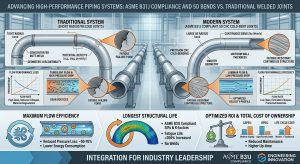
綜上所述,在現代精細化工與高端動力管線系統中,採用符合 ASME B31J 標準之 5D 大半徑數控冷作彎管取代傳統短半徑銲接彎頭,是融合流場效率最大化、結構壽命最長化及總體投資報酬率(ROI)最佳化的前瞻性工程科學決策。In summary, replacing traditional short-radius welded elbows with 5D large-radius CNC cold bends compliant with ASME B31J standards in modern fine chemical and high-end power piping systems is a forward-looking engineering science decision that fuses maximized flow field efficiency, longest structural lifespan, and optimized overall Return on Investment (ROI).
參考文獻 / References
- RHEOLOGICAL METHODS IN FOOD PROCESS ENGINEERING, https://dafe.unibas.it/site/home/didattica/risorse-per-gli-studenti/documento32026282.html
- Non-Newtonian Viscosity Models – Fluid Flow Help Center, https://knowledge.fluidflowinfo.com/en/articles/13271434-non-newtonian-viscosity-models
- Stress Analysis in Pipe Bends: Reducing Fatigue Risks … – F&L United, https://fl-united.com/blog/2024/05/30/stress-analysis-in-pipe-bends-reducing-fatigue-risks-in-your-piping-system/
- Numerical study on flow separation in 90° pipe bend under high, https://www.scipedia.com/public/Dutta_et_al_2016a
- 聚乙烯醇(PVA)是什么?有什么用途? – ChemicalBook, https://www.chemicalbook.com/NewsInfo_57770.htm
- An Effective Mixing for Lithium Ion Battery Slurries, https://file.scirp.org/Html/12-3700508_50729.htm
- 基於ASME B31J 規範之電廠高能管線任意角度冷作彎管空間佈置與, https://yz-pipe-bending.com.tw/%E5%9F%BA%E6%96%BC-asme-b31j-%E8%A6%8F%E7%AF%84%E4%B9%8B%E9%9B%BB%E5%BB%A0%E9%AB%98%E8%83%BD%E7%AE%A1%E7%B7%9A%E4%BB%BB%E6%84%8F%E8%A7%92%E5%BA%A6%E5%86%B7%E4%BD%9C%E5%BD%8E%E7%AE%A1%E7%A9%BA%E9%96%93/
- 5D電銲彎頭沖蝕現象綜合分析、退化機制與3D/5D冷作彎管系統化, https://yz-pipe-bending.com.tw/1-5d%E9%9B%BB%E9%8A%B2%E5%BD%8E%E9%A0%AD%E6%B2%96%E8%9D%95%E7%8F%BE%E8%B1%A1%E7%B6%9C%E5%90%88%E5%88%86%E6%9E%90%E3%80%81%E9%80%80%E5%8C%96%E6%A9%9F%E5%88%B6%E8%88%873d-5d%E5%86%B7%E4%BD%9C%E5%BD%8E/
- Polymer-Induced Drag Reduction in Dilute Newtonian and Semi, https://pmc.ncbi.nlm.nih.gov/articles/PMC9354081/
- Laminar flow-induced scission kinetics of polymers in dilute solutions, https://www.cambridge.org/core/journals/journal-of-fluid-mechanics/article/laminar-flowinduced-scission-kinetics-of-polymers-in-dilute-solutions/5333A85EE178D9F08E8B374CA35CBB71
- Thermal, Rheological, and Moisture Absorption Behaviours of, https://www.mdpi.com/2073-4360/17/21/2918
- ASME B31.3 Stress Range Factor: The 2022 Revision and Why It, https://blog.vibrationdata.com/2026/07/18/asme-b31-3-piping-fatigue/
- 2022 Edition ASME B31.3 – Stressman Engineering AS, https://stressman.no/2022-edition-asme-b31-3/
- ASME B31.1-2024 Stress Intensification Factors (SIFs) — FAQ, https://pipingtoolset.com/faq/b311-stress-intensification-factors/
- 基於ASME B31J (2024-2026) 規範演進之高能管線佈局最佳化, https://yz-pipe-bending.com.tw/%E5%9F%BA%E6%96%BC-asme-b31j-2024-2026-%E8%A6%8F%E7%AF%84%E6%BC%94%E9%80%B2%E4%B9%8B%E9%AB%98%E8%83%BD%E7%AE%A1%E7%B7%9A%E4%BD%88%E5%B1%80%E6%9C%80%E4%BD%B3%E5%8C%96%EF%BC%9A3d-5d-%E5%86%B7%E4%BD%9C/
- Mastering ASME B31J Piping Stress Analysis for Plant Integrity, https://epcland.com/asme-b31j-piping-stress-analysis/
- 複循環電廠調峰操作下高能管線之疲勞壽命分析 – 潁璋工程興業有限公司, https://yz-pipe-bending.com.tw/%E8%A4%87%E5%BE%AA%E7%92%B0%E9%9B%BB%E5%BB%A0%E8%AA%BF%E5%B3%B0%E6%93%8D%E4%BD%9C%E4%B8%8B%E9%AB%98%E8%83%BD%E7%AE%A1%E7%B7%9A%E4%B9%8B%E7%96%B2%E5%8B%9E%E5%A3%BD%E5%91%BD%E5%88%86%E6%9E%90%EF%BC%9A/
- 解析2026 ASME B31.1與B31J應變率(5%~20%)放寬與IH-PBHT適用, https://yz-pipe-bending.com.tw/%E8%A7%A3%E6%9E%902026-asme-b31-1%E8%88%87b31j%E6%87%89%E8%AE%8A%E7%8E%87520%E6%94%BE%E5%AF%AC%E8%88%87ih-pbht%E9%81%A9%E7%94%A8%EF%BC%9A%E6%BD%81%E7%92%8B%E5%B7%A5%E7%A8%8B%E5%B0%8D%E6%96%BCp9x/
- Polyvinyl Alcohol Emulsion: Comprehensive Analysis Of, https://eureka.patsnap.com/materials/pva-emulsion-formulation
- The Rheological Properties of Poly(vinyl alcohol) Gels from, https://pendidikankimia.walisongo.ac.id/wp-content/uploads/2018/10/34-4.pdf
- Non-Newtonian Models | Materials – SimScale, https://www.simscale.com/docs/simulation-setup/materials/non-newtonian-models/
- A Method for Measuring the Rheology of a Non-Newtonian Fluid, https://www.mdpi.com/2311-5521/10/3/65
- Predicting the distribution of yield-stress fluids in branched pipe, https://arxiv.org/pdf/2509.22192
- Long-term degradation of high molar mass poly(ethylene oxide) in a, https://pubs.aip.org/aip/pof/article/35/2/023102/2867904/Long-term-degradation-of-high-molar-mass-poly
- FluidFlow Technical Glossary – A-Z Engineering Terms, https://knowledge.fluidflowinfo.com/en/articles/13240104-fluidflow-technical-glossary-a-z-engineering-terms
- Numerical Studies on the Flow of Coal Water Slurries with a Yield, https://www.mdpi.com/1996-1073/15/19/7006
- Multi-material Additive Manufacturing of Energy Storage … – NSF PAR, https://par.nsf.gov/servlets/purl/10599333
- Heat Transfer and Flow Characteristics of Coal Slurries under the, https://www.mdpi.com/2076-3417/12/23/12028
- Darcy-Weisbach Equation: Friction Factor & Pressure Drop – FluidFlow, https://fluidflowinfo.com/darcy-weisbach-equation/
- Effects of Polymer Addition to a Newtonian Solvent in Horizontal, https://scialert.net/fulltext/?doi=jas.2016.271.278
- Heat Transfer and Flow Characteristics of Coal Slurries under the, https://pdfs.semanticscholar.org/773a/2eccfedc1c021c186261743b5795e5382df0.pdf
- Difference Between Elbow and Bend – MATERIAL & STANDARD, https://www.oepipe.com/info/the-differences-of-pipe-bend-and-elbow-78161159.html
- Experimental insights into energy savings and future directions of, https://pmc.ncbi.nlm.nih.gov/articles/PMC10313646/
- Fluid Structure Interaction in Piping Systems, https://svingentech.no/onewebmedia/svingen_dr_thesis.pdf
- Combined residual stresses and fluid-structure interaction finite, https://www.tandfonline.com/doi/full/10.1080/09603409.2021.1971358
- a study of pulsatile flow phenomena with computational fluid, http://reposit.library.du.ac.bd:8080/xmlui/bitstream/handle/123456789/4727/5.pdf?sequence=1&isAllowed=y
- Stress Intensity Factor (SIF), Flexibility Factor: ASME B31.3 vs ASME, https://whatispiping.com/stress-intensity-factor-sif-flexibility-factor-asme-b-31j/
- Stress Intensification & Flexibility Factor Calculator (B31.3 Appendix D), https://pipingtoolset.com/calculators/b313-stress-intensification-factors/
- 深度分析基於ASME B31.1 與B31J 規範之管線應力強化研究:以麥寮, https://yz-pipe-bending.com.tw/%E6%B7%B1%E5%BA%A6%E5%88%86%E6%9E%90%E5%9F%BA%E6%96%BC-asme-b31-1-%E8%88%87-b31j-%E8%A6%8F%E7%AF%84%E4%B9%8B%E7%AE%A1%E7%B7%9A%E6%87%89%E5%8A%9B%E5%BC%B7%E5%8C%96%E7%A0%94%E7%A9%B6%EF%BC%9A%E4%BB%A5/
- 基於2026 年版ASME B31J 規範之CCPP 高能蒸汽管線冷作彎管工法, https://yz-pipe-bending.com.tw/%E5%9F%BA%E6%96%BC-2026-%E5%B9%B4%E7%89%88-asme-b31j-%E8%A6%8F%E7%AF%84%E4%B9%8B-ccpp-%E9%AB%98%E8%83%BD%E8%92%B8%E6%B1%BD%E7%AE%A1%E7%B7%9A%E5%86%B7%E4%BD%9C%E5%BD%8E%E7%AE%A1%E5%B7%A5%E6%B3%95/
- 現代高能動力管線「以彎代銲」之技術經濟評估:從傳統配管到大, https://yz-pipe-bending.com.tw/%E7%8F%BE%E4%BB%A3%E9%AB%98%E8%83%BD%E5%8B%95%E5%8A%9B%E7%AE%A1%E7%B7%9A%E3%80%8C%E4%BB%A5%E5%BD%8E%E4%BB%A3%E9%8A%B2%E3%80%8D%E4%B9%8B%E6%8A%80%E8%A1%93%E7%B6%93%E6%BF%9F%E8%A9%95%E4%BC%B0%EF%BC%9A/
- 基於ASME B31J 規範與三維有限元素分析之4″ XXS P91 彎管力學, https://yz-pipe-bending.com.tw/%E5%9F%BA%E6%96%BC-asme-b31j-%E8%A6%8F%E7%AF%84%E8%88%87%E4%B8%89%E7%B6%AD%E6%9C%89%E9%99%90%E5%85%83%E7%B4%A0%E5%88%86%E6%9E%90%E4%B9%8B-4-xxs-p91-%E5%BD%8E%E7%AE%A1%E5%8A%9B%E5%AD%B8%E9%9F%BF/
- 基於2026 ASME B31.1 與B31J 規範之複循環發電廠動力管線3D/5D, https://yz-pipe-bending.com.tw/%E5%9F%BA%E6%96%BC-2026-asme-b31-1-%E8%88%87-b31j-%E8%A6%8F%E7%AF%84%E4%B9%8B%E8%A4%87%E5%BE%AA%E7%92%B0%E7%99%BC%E9%9B%BB%E5%BB%A0%E5%8B%95%E5%8A%9B%E7%AE%A1%E7%B7%9A-3d-5d-%E5%86%B7%E4%BD%9C/
- 0D套銲彎頭間隙沖蝕失效機制分析,暨基於ASME/API標準與空間, https://yz-pipe-bending.com.tw/1-0d%E5%A5%97%E9%8A%B2%E5%BD%8E%E9%A0%AD%E9%96%93%E9%9A%99%E6%B2%96%E8%9D%95%E5%A4%B1%E6%95%88%E6%A9%9F%E5%88%B6%E5%88%86%E6%9E%90%EF%BC%8C%E6%9A%A8%E5%9F%BA%E6%96%BCasme-api%E6%A8%99%E6%BA%96/
- ASME B31.3 Pipe Wall Thickness Calculator — Eq. (3a), https://pipingtoolset.com/calculators/b313-pipe-wall-thickness/
- ASME B31.3 Wall Thickness Calculator Internal pressure – MechitCalc, https://mechitcalc.com/page/asme-b313-wall-thickness-calculator
- Cost Comparison Charts – Tube-Mac Piping Technologies, https://tube-mac.com/resources/cost-comparison-charts/
- 2026 ASME 規範下P9x 高能蒸汽管線「冷作彎管」與「傳統銲接」之, https://yz-pipe-bending.com.tw/2026-asme-%E8%A6%8F%E7%AF%84%E4%B8%8B-p9x-%E9%AB%98%E8%83%BD%E8%92%B8%E6%B1%BD%E7%AE%A1%E7%B7%9A%E3%80%8C%E5%86%B7%E4%BD%9C%E5%BD%8E%E7%AE%A1%E3%80%8D%E8%88%87%E3%80%8C%E5%82%B3%E7%B5%B1%E9%8A%B2/
- 簡述管線的電銲銲接工法與冷作彎管工法有何差異性?, https://yz-pipe-bending.com.tw/%E7%B0%A1%E8%BF%B0%E7%AE%A1%E7%B7%9A%E7%9A%84%E9%9B%BB%E9%8A%B2%E9%8A%B2%E6%8E%A5%E5%B7%A5%E6%B3%95%E8%88%87%E5%86%B7%E4%BD%9C%E5%BD%8E%E7%AE%A1%E5%B7%A5%E6%B3%95%E6%9C%89%E4%BD%95%E5%B7%AE%E7%95%B0/