
摘要 / Abstract
隨著全球對火力發電廠與超超臨界(Ultra-Supercritical, USC)發電機組熱效率要求的日益嚴苛,運轉參數已逐步推升至600°C至650°C的高溫區間,並伴隨極高的內部蒸汽壓力。在此極端服役環境下,以P91與P92為代表的潛變強度強化肥粒鐵鋼(Creep Strength Enhanced Ferritic Steels, CSEF Steels)成為高溫高壓蒸汽管線的主力材料。然而,銲接熱循環對這類材料所造成的局部微觀組織退化,極易在長期的潛變服役中誘發第四型(Type IV)早期破裂,成為威脅工廠與電廠運轉安全的最大隱患。本研究報告以學術視角,全面剖析高溫高壓管線銲道潛變失效型態(Type I至IV)的演變特徵,深入探討微觀冶金退化(如碳化物粗化、Z相析出)與巨觀多軸應力狀態(應力三軸度)之間的耦合驅動機制。報告中導入Cocks-Ashby空洞成長模型與Kachanov-Rabotnov連續體損傷力學(CDM)模型,以量化空洞演化行為,並探討基於Neubauer分類的微觀損傷檢測技術。此外,本報告詳細論述了P9x合金鋼在美國機械工程師學會(ASME)B31.1動力管線規範下的銲道強度折減係數(WSRF),以及B31J規範中的應力強度因子(SIF)防護策略。最後,結合實務工程應用(如應變率區間界定、5%~20%冷彎退應力執行與潁璋工程之冷彎替代工法)、美國電力研究院(EPRI)之異種金屬銲接指引與新型加硼(Boron)MARBN鋼的發展,提出涵蓋設計、檢測與材料改良的全方位管線壽命延長與防護策略。With the increasingly stringent global demands for thermal efficiency in thermal power plants and ultra-supercritical (USC) power generation units, operating parameters have been progressively pushed to the high-temperature range of 600°C to 650°C, accompanied by extremely high internal steam pressures. Under these extreme service environments, creep strength enhanced ferritic (CSEF) steels, represented by P91 and P92, have become the primary materials for high-temperature and high-pressure steam piping. However, local microstructural degradation caused by welding thermal cycles makes these materials highly susceptible to premature Type IV cracking during long-term creep service, posing a major threat to the operational safety of plants and power stations. This research report offers an academic perspective to comprehensively analyze the evolution characteristics of weld creep failure modes (Type I to IV) in high-temperature and high-pressure piping. It deeply explores the coupled driving mechanisms between microscopic metallurgical degradation (e.g., carbide coarsening, Z-phase precipitation) and macroscopic multiaxial stress states (stress triaxiality). The report introduces the Cocks-Ashby void growth model and the Kachanov-Rabotnov continuum damage mechanics (CDM) model to quantify void evolution behavior and discusses micro-damage detection technologies based on the Neubauer classification. Furthermore, the report details protection strategies for P9x alloy steels, including the Weld Strength Reduction Factor (WSRF) under the ASME B31.1 Power Piping Code and the Stress Intensification Factor (SIF) under the ASME B31J code. Finally, by integrating practical engineering applications (such as the definition of strain rate regimes, 5%~20% cold-bend stress relief execution, and Ying Zhang Engineering’s cold bending alternative methods), EPRI’s dissimilar metal welding guidelines, and the development of novel boron-added MARBN steels, a comprehensive piping life extension and protection strategy encompassing design, inspection, and material improvement is proposed.
一、 前言 / 1. Introduction
現代化超超臨界火力發電廠的發展,高度仰賴於先進耐熱材料的突破。為承受高達650°C的蒸汽溫度與超越25 MPa的蒸汽壓力,傳統的低合金鋼(如2.25Cr-1Mo)已無法滿足嚴苛的長效期潛變強度需求。因此,9-12% Cr的潛變強度強化肥粒鐵鋼,如P91(9Cr-1Mo-V-Nb)與P92(以鎢取代部分鉬),應運而生並被廣泛應用於主蒸汽管線與鍋爐集管1。這些高合金化鋼種在母材狀態下,憑藉其回火麻田散鐵(Tempered Martensite)基底、高差排密度,以及晶界與晶內的奈米級析出物,展現出卓越的抗潛變變形能力與高溫抗氧化性2。The development of modern ultra-supercritical thermal power plants relies heavily on breakthroughs in advanced heat-resistant materials. To withstand steam temperatures up to 650°C and pressures exceeding 25 MPa, traditional low-alloy steels (e.g., 2.25Cr-1Mo) can no longer meet the stringent requirements for long-term creep strength. Consequently, 9-12% Cr creep strength enhanced ferritic (CSEF) steels, such as P91 (9Cr-1Mo-V-Nb) and P92 (where tungsten partially replaces molybdenum), have emerged and are widely used in main steam piping and boiler headers 1. In their base metal state, these highly alloyed steels exhibit outstanding resistance to creep deformation and high-temperature oxidation, owing to their tempered martensite matrix, high dislocation density, and nano-scale precipitates located both within grains and along grain boundaries 2.
然而,在發電廠管線系統的建構過程中,銲接加工是不可或缺的環節。銲接時極端的加熱與冷卻速率,會對銲道及其鄰近區域的材料造成不可逆的熱擾動,導致微觀結構發生非均勻的相變與演化。大量的工業服役經驗與學術研究均指出,P9x系列合金鋼的銲接接頭在長期高溫服役下,其整體潛變壽命顯著低於母材,且往往在遠低於設計壽命的階段發生無預警的早期破裂1。這種現象主要歸因於銲道熱影響區(Heat-Affected Zone, HAZ)中極易發生的「第四型潛變破裂」(Type IV Creep Cracking)5。面對此一嚴峻的工程挑戰,必須從基礎物理冶金、固體力學、連續體損傷模型,乃至於工程法規(如ASME B31.1與B31J)等多個維度,建立系統化的失效預測與防護框架。However, welding is an indispensable process in the construction of power plant piping systems. The extreme heating and cooling rates during welding cause irreversible thermal perturbations to the material in and adjacent to the weld, leading to heterogeneous phase transformations and microstructural evolution. Extensive industrial service experience and academic research indicate that the overall creep life of P9x alloy steel welded joints under long-term high-temperature service is significantly lower than that of the base metal. Furthermore, these joints often experience sudden premature failures well before their design life is reached 1. This phenomenon is primarily attributed to “Type IV Creep Cracking,” which is highly prone to occur in the heat-affected zone (HAZ) of the weld 5. To address this severe engineering challenge, a systematic failure prediction and protection framework must be established across multiple dimensions, ranging from fundamental physical metallurgy, solid mechanics, and continuum damage models, to engineering codes (such as ASME B31.1 and B31J).
二、 P9x合金鋼之物理冶金與微觀組織退化 / 2. Physical Metallurgy and Microstructural Degradation of P9x Alloy Steels
2.1 初始微觀組織特徵與強化機制 / 1.1 Initial Microstructural Characteristics and Strengthening Mechanisms
P91鋼與P92鋼的優異高溫強度,源自於其複雜且高度控制的微觀組織。這類材料通常在1040°C至1080°C進行正常化(Normalizing)處理以形成全沃斯田鐵,隨後空冷轉變為板條狀麻田散鐵(Lath Martensite),最後在730°C至780°C進行高溫回火(Tempering)9。相較於P91鋼,P92鋼加入了約1.8%的鎢(W)並降低了鉬的含量,此種固溶強化的改變使得P92鋼在600°C下經歷100,000小時的潛變抵抗力較P91鋼提升了約25% 2。The excellent high-temperature strength of P91 and P92 steels stems from their complex and highly controlled microstructures. These materials are typically normalized at 1040°C to 1080°C to form full austenite, subsequently air-cooled to transform into lath martensite, and finally tempered at high temperatures between 730°C and 780°C 9. Compared to P91 steel, P92 incorporates approximately 1.8% tungsten (W) while reducing its molybdenum content. This shift in solid solution strengthening enhances the creep resistance of P92 steel by about 25% over P91 steel when exposed to 600°C for 100,000 hours 2.
在回火過程中,過飽和的碳與合金元素會析出形成兩種主要的強化相:第一種是富鉻的 M23C6 碳化物,主要沿著原沃斯田鐵晶界(Prior-Austenite Grain Boundaries, PAGB)以及板條邊界析出,負責釘扎(Pinning)晶界,抑制晶界滑動與次晶粒的生長;第二種是富釩與鈮的 MX 型碳氮化物(如 V, Nb(C, N)),這類奈米級析出物均勻散佈於麻田散鐵板條內部,有效阻礙高溫下的差排攀移(Dislocation Climb)與滑移3。這兩種析出物與基體內高密度的差排網路,共同構成了CSEF鋼強大的抗潛變基礎。During the tempering process, supersaturated carbon and alloying elements precipitate to form two primary strengthening phases. The first is chromium-rich M23C6 carbides, which precipitate mainly along prior-austenite grain boundaries (PAGB) and lath boundaries. They are responsible for pinning the boundaries, thereby suppressing grain boundary sliding and sub-grain growth. The second is vanadium- and niobium-rich MX-type carbonitrides (e.g., V, Nb(C, N)). These nano-scale precipitates are uniformly dispersed within the martensite laths and effectively hinder dislocation climb and glide at high temperatures 3. Together with the high-density dislocation network within the matrix, these two precipitates form the robust foundation of the creep resistance in CSEF steels.
2.2 銲接熱循環對微觀組織之擾動 / 1.2 Perturbation of Microstructure by Welding Thermal Cycles
在銲接過程中,HAZ內不同區域經歷了不同的峰值溫度(Peak Temperature, Tp)與加熱速率。研究指出,P9x鋼的AC1(沃斯田鐵相變起始溫度)與AC3(沃斯田鐵相變完成溫度)會隨著加熱速率的增加而向高溫區間偏移。相較於P91鋼,P92鋼由於含有較為穩定的M23C6碳化物,延遲了加熱過程中的碳化物溶解,導致其AC1與AC3溫度更高。During welding, different sub-zones within the HAZ experience varying peak temperatures (Tp) and heating rates. Research indicates that the AC1 (austenite transformation start temperature) and AC3 (austenite transformation finish temperature) of P9x steels shift to higher temperature ranges as the heating rate increases. Compared to P91 steel, P92 steel contains more stable M23C6 carbides, which delays carbide dissolution during heating, resulting in higher AC1 and AC3 temperatures.
當Tp介於AC1與AC3之間時(即臨介熱影響區,ICHAZ),材料發生部分沃斯田鐵相變;當Tp剛好超過AC3時(即細晶熱影響區,FGHAZ),材料完全轉變為沃斯田鐵,但由於溫度不夠高且停留時間極短,晶粒無法長大,冷卻後形成極細小的麻田散鐵晶粒6。在這些區域中,原有的M23C6與MX相會發生不完全溶解。隨後的銲後熱處理(PWHT)雖然能釋放殘餘應力,但會促使這些未完全溶解的碳化物以前所未有的速率重新析出並粗化,導致該區域失去原有的析出強化與晶界釘扎效應5。When Tp falls between AC1 and AC3 (forming the intercritical heat-affected zone, ICHAZ), the material undergoes a partial austenite transformation. When Tp just exceeds AC3 (forming the fine-grained heat-affected zone, FGHAZ), the material fully transforms into austenite; however, due to the relatively low temperature and extremely short dwell time, grain growth is suppressed, resulting in extremely fine martensitic grains upon cooling 6. In these regions, the pre-existing M23C6 and MX phases undergo incomplete dissolution. Although subsequent post-weld heat treatment (PWHT) relieves residual stresses, it also prompts these partially dissolved carbides to re-precipitate and coarsen at an unprecedented rate, causing the region to lose its original precipitation strengthening and grain boundary pinning effects 5.
三、 銲道潛變失效型態與Type IV破裂特徵 / 3. Weld Creep Failure Modes and Type IV Cracking Characteristics
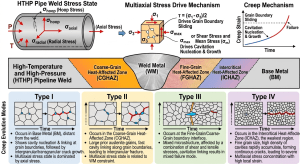
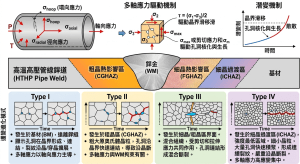
高溫高壓管線銲接接頭由於經歷了複雜的熱力循環,導致其從銲縫金屬(Weld Metal, WM)至母材(Base Metal, BM)之間存在顯著的組織梯度與機械性質差異。根據破裂發生的空間位置與主導的物理機制,學界與產業界將銲道的潛變失效型態分為四種主要類型(Type I至IV),如下表所示:Due to the complex thermal cycles experienced by high-temperature and high-pressure piping welded joints, significant microstructural gradients and mechanical property variations exist from the weld metal (WM) to the base metal (BM). Based on the spatial location of the rupture and the dominant physical mechanisms, academia and industry classify weld creep failure modes into four main types (Type I to IV), as detailed in the table below:
| 潛變失效型態Creep Failure Type | 發生位置特徵Location Characteristics | 破裂特徵與主導物理機制Failure Characteristics & Dominant Mechanisms | 常見發生條件與時期Common Conditions & Timing |
| Type I | 銲縫金屬內部/
(Inside the Weld Metal) |
裂紋方向通常與主應力方向垂直。肇因於銲縫金屬本身的潛變強度實質低於母材,或銲道內部存在缺陷。/
Cracks are typically perpendicular to the principal stress. Caused by the weld metal’s inherent creep strength being lower than the base metal, or by internal defects. |
較常發生於高系統應力、較短服役時間,或誤用低階銲材。/
Common under high system stress, short service life, or if substandard consumables were used. |
| Type II | 熔合線/
(Fusion Boundary) |
裂紋沿著銲縫金屬與熱影響區的交界面擴展。通常由兩側材料的潛變變形不匹配及長時間服役下的碳遷移引起。/
Cracks propagate along the WM/HAZ interface. Usually caused by creep deformation mismatch and carbon migration during long-term service. |
極為常見於異種金屬銲接,通常在服役中期發生。/
Highly common in Dissimilar Metal Welds (DMW), typically occurring mid-service. |
| Type III | 粗晶熱影響區/
(CGHAZ) |
裂紋發生於緊鄰熔合線的粗晶區。此區經歷極端高溫導致晶粒粗大,晶界承受極高應力集中,易產生沿晶破裂。/
Cracking in the CGHAZ adjacent to the fusion line. Extreme temperatures cause grain coarsening, leading to high stress concentration and intergranular cracking. |
通常伴隨著較低的PWHT溫度或不當的應力釋放程序。/
Usually associated with low PWHT temperatures or improper stress relief procedures. |
| Type IV | 細晶區/臨介區/
(FGHAZ/ICHAZ) |
發生於HAZ最外側與母材交界處。因微觀組織嚴重退化導致局部強度急遽下降,形成「軟化帶」。破裂巨觀呈低延展性。/
Occurs at the outer HAZ/base metal boundary. Severe microstructural degradation forms a “soft zone,” leading to macroscopic low-ductility failure. |
現代CSEF鋼在高溫低應力長期服役下最具代表性且致命的模式。/
The most representative and fatal mode for modern CSEF steels under long-term, high-temp, low-stress service. |
3.1 第四型潛變破裂(Type IV Cracking)之微觀演變機制 / 2.1 Microstructural Evolution Mechanism of Type IV Cracking
在P9x系列合金鋼中,Type IV潛變破裂是最具威脅且最難以預測的失效模式。該型態破裂具有極低的巨觀變形特徵(Low Cross-Weld Strain),裂紋在FGHAZ或ICHAZ內萌生並迅速沿著晶界擴展,導致管線在無明顯鼓脹(Swelling)警告的情況下發生突發性斷裂1。In P9x series alloy steels, Type IV creep cracking is the most threatening and unpredictable failure mode. This type of failure exhibits extremely low macroscopic deformation (low cross-weld strain). Cracks initiate within the FGHAZ or ICHAZ and rapidly propagate along grain boundaries, leading to sudden pipeline ruptures without obvious swelling warnings 1.
Type IV破裂的根源在於長期的潛變服役進一步放大了FGHAZ與ICHAZ在銲接熱循環中遭受的冶金破壞。這種退化主要體現在以下三個互相耦合的微觀機制:The root cause of Type IV cracking lies in long-term creep service, which further amplifies the metallurgical damage inflicted on the FGHAZ and ICHAZ during welding thermal cycles. This degradation is primarily manifested through three coupled microscopic mechanisms:
首先,非均質回復與基體軟化。由於晶界上的M23C6碳化物在服役過程中迅速粗化,其對次晶界的釘扎力大幅下降。這直接導致了高密度差排的快速回復(Recovery)與次晶界(Sub-grain boundaries)的合併3。在長期的潛變變形下,細晶區原有的高強度麻田散鐵板條結構會逐漸轉變為低強度的等軸狀亞晶粒結構,造成該區域巨觀硬度大幅下降。實驗證實,P91鋼在長期潛變暴露後,FGHAZ的硬度下降幅度可高達約34%,而銲縫金屬僅下降約7%,形成了極為明顯的「軟化帶」(Soft Zone)8。First, heterogeneous recovery and matrix softening. Because M23C6 carbides on the grain boundaries rapidly coarsen during service, their pinning force on sub-grain boundaries drops drastically. This directly leads to the rapid recovery of high-density dislocations and the coalescence of sub-grain boundaries 3. Under long-term creep deformation, the originally high-strength lath martensite structure in the fine-grained zone gradually transforms into a low-strength equiaxed sub-grain structure, causing a massive reduction in macroscopic hardness. Experiments confirm that after long-term creep exposure, the hardness of the FGHAZ in P91 steel can decrease by up to approximately 34%, whereas the weld metal only decreases by about 7%, forming a highly distinct “soft zone” 8.
其次,Z相(Z-phase)的強制析出與MX相的耗竭。在9-12% Cr合金鋼(特別是含有較高鉻與鈮的鋼種,如P92)長時間服役於600°C以上時,微觀組織中會出現一種複雜且熱力學上極為穩定的Cr-V-Nb氮化物,即Z相(CrVN)2。研究指出,在923K至948K的潛變條件下,奈米級的MX顆粒會透過原位轉變(in-situ transformation)機制的立方晶格重組,或是透過奧斯華熟化(Ostwald Ripening)機制驅使基體中的鉻原子連續通量流入,最終轉變為巨大的Z相顆粒11。Z相的粗化不僅徹底剝奪了MX相提供的晶內析出強化效應,粗大的Z相顆粒與基體的相界面更因為嚴重的晶格不匹配(Lattice Mismatch),成為了潛變微空洞(Creep Cavities)成核的絕佳場所11。Second, forced precipitation of the Z-phase and depletion of the MX phase. When 9-12% Cr alloy steels (especially those with higher chromium and niobium contents, like P92) operate for long periods above 600°C, a complex and thermodynamically ultra-stable Cr-V-Nb nitride known as the Z-phase (CrVN) appears in the microstructure 2. Studies indicate that under creep conditions between 923K and 948K, nano-scale MX particles undergo cubic lattice reorganization via an in-situ transformation mechanism, or are driven by an Ostwald ripening mechanism that forces a continuous influx of chromium atoms from the matrix, ultimately transforming them into massive Z-phase particles 11. The coarsening of the Z-phase not only completely strips away the intragranular precipitation strengthening provided by the MX phase but also creates ideal nucleation sites for creep cavities due to the severe lattice mismatch between the coarse Z-phase particles and the matrix 11.
最後,Laves相的析出與應力集中。在含有鉬或鎢的高鉻鋼中,高溫長時服役會促使富含Fe-Cr-Mo-W的Laves金屬間化合物沿晶界大量析出。雖然Laves相在初期能提供短暫的固溶強化補償,但其本質脆硬且生長迅速。當粗大的Laves相與粗化的M23C6或Z相共存於細小晶粒的邊界時,在外部應力作用下,這些硬質顆粒周圍會產生極高的局部應力集中,極大地加速了晶界微空洞的萌生與聚集3。Lastly, precipitation of the Laves phase and stress concentration. In high-chromium steels containing molybdenum or tungsten, prolonged high-temperature service prompts the abundant intergranular precipitation of Fe-Cr-Mo-W rich Laves intermetallic compounds. Although the Laves phase provides brief solid solution strengthening compensation initially, it is inherently brittle and grows rapidly. When coarse Laves phases coexist with coarsened M23C6 or Z-phases at the boundaries of fine grains, extreme local stress concentrations develop around these hard particles under external stress, greatly accelerating the initiation and coalescence of grain boundary micro-cavities 3.
四、 多軸應力驅動機制與空洞演化力學 / 4. Multiaxial Stress Driving Mechanisms and Void Evolution Mechanics
銲道Type IV破裂不僅僅是單純的材料微觀冶金退化問題,其本質是微觀組織軟化與巨觀幾何約束(Geometric Constraint)所產生的「多軸應力狀態」(Multiaxial Stress State)強烈耦合的結果。在實際的高溫高壓管線系統中,管壁承受內壓產生的環向應力(Hoop Stress)、系統熱膨脹帶來的軸向彎曲應力(Axial Bending Stress),以及銲接殘餘應力。Type IV cracking in welds is not merely a material micro-metallurgical degradation issue; fundamentally, it is the result of strong coupling between microstructural softening and the “multiaxial stress state” generated by macroscopic geometric constraints. In practical high-temperature, high-pressure piping systems, the pipe wall is subjected to hoop stress from internal pressure, axial bending stress from system thermal expansion, and welding residual stresses.
4.1 應力三軸度(Stress Triaxiality)與幾何約束效應 / 3.1 Stress Triaxiality and Geometric Constraint Effects
FGHAZ作為一個極窄的軟化帶(通常寬度僅約1至2毫米),被兩側潛變強度與屈服強度顯著較高的母材與粗晶熱影響區(或銲縫金屬)所緊密夾持5。當管線承受負載時,較軟的FGHAZ傾向於發生較大的塑性與潛變變形,但其變形卻受到兩側堅硬區域的剛性約束。這種幾何約束效應強烈阻止了FGHAZ在受拉伸時的側向收縮(Poisson’s effect),進而在該狹窄區域的內部生成了高度的靜水張應力(Hydrostatic Tensile Stress)。As an extremely narrow soft zone (typically only 1 to 2 millimeters wide), the FGHAZ is tightly sandwiched between the base metal and the coarse-grained HAZ (or weld metal), both of which possess significantly higher creep and yield strengths 5. When the pipeline is loaded, the softer FGHAZ tends to undergo larger plastic and creep deformations, but this deformation is rigidly constrained by the harder regions on either side. This geometric constraint strongly resists the lateral contraction (Poisson’s effect) of the FGHAZ when pulled, generating a highly elevated hydrostatic tensile stress within this narrow region.
在固體力學中,應力三軸度(Triaxiality factor, h)被定義為靜水應力(σm)與等效馮·米塞斯應力(von Mises equivalent stress, σeq)的比值:
In solid mechanics, the stress triaxiality factor (h) is defined as the ratio of hydrostatic stress (σm) to the von Mises equivalent stress (σeq):
h=σm/σeq =(1/3 (σ1+σ2+σ3 ))/√(1/2 [(σ1-σ2 )2+(σ2-σ3 )2+(σ3-σ1 )2 ] )
有限元素分析(FEA)的數值模擬表明,在典型的V型或U型銲接坡口中,厚壁管線內部的FGHAZ區域具有極高的應力三軸度峰值,且最大值通常位於管壁厚度的中央區域,而非表面7。高應力三軸度會顯著限制材料的巨觀塑性變形能力(Creep Ductility Exhaustion),並從根本上改變了微觀層面的潛變空洞成核與成長動力學。Finite element analysis (FEA) numerical simulations demonstrate that in typical V- or U-groove welds, the FGHAZ inside thick-walled piping exhibits exceptionally high peak stress triaxiality, with the maximum value usually located at the center of the wall thickness rather than on the surface 7. High stress triaxiality significantly limits the material’s capacity for macroscopic plastic deformation (creep ductility exhaustion) and fundamentally alters the nucleation and growth dynamics of creep cavities at the microscopic level.
4.2 Cocks-Ashby多軸空洞成長模型 / 3.2 Cocks-Ashby Multiaxial Void Growth Model
在多軸應力狀態下,潛變空洞的擴張速率與材料延展性的衰減可透過力學模型進行嚴謹的量化,其中最被廣泛應用的為Cocks-Ashby空洞成長模型16。該模型基於晶界擴散(Grain Boundary Diffusion)與基體塑性流變(Plastic Flow)的耦合機制,定義了多軸應力對空洞擴張速率的非線性放大效應。Under multiaxial stress states, the expansion rate of creep cavities and the degradation of material ductility can be rigorously quantified via mechanical models, the most widely applied being the Cocks-Ashby void growth model 16. Based on the coupled mechanisms of grain boundary diffusion and matrix plastic flow, this model defines the nonlinear amplification effect of multiaxial stress on the void expansion rate.
Cocks-Ashby模型明確指出,多軸應力狀態下的潛變破斷延展性(Multiaxial Creep Ductility, εf*)相對於單軸標準潛變延展性(Uniaxial Creep Ductility, εf),會隨著應力三軸度的增加而呈現雙曲正弦函數級的急遽衰減:The Cocks-Ashby model clearly states that multiaxial creep ductility (εf*) drops precipitously as a hyperbolic sine function of increasing stress triaxiality, relative to the standard uniaxial creep ductility (εf):
(εf*)/εf =[sinh(2/3*(n-0.5)/(n+0.5))]/[sinh(2*(n-0.5)/(n+0.5)*σm/σeq)]
其中,n 為Norton潛變定律中的應力指數。由上述公式可知,當FGHAZ內的應力三軸度 σm/σeq 因幾何約束而大幅提高時,分母項呈指數增長,導致材料的破斷延展性 εf* 趨近於零17。Here, n represents the stress exponent in Norton’s creep law. As the formula shows, when the stress triaxiality σm/σeq within the FGHAZ rises sharply due to geometric constraints, the denominator grows exponentially, causing the fracture ductility εf* to approach zero 17.
為實證此一力學機制,學界針對Grade 91鋼進行了帶有缺口(Notch)的圓柱試棒潛變試驗。透過改變缺口銳度比(Acuity Ratios, d/R),可人為控制試棒截面上的應力三軸度。實驗結果顯示,在600°C的相同淨截面應力下,缺口銳度比為2.28(較鈍,三軸度較低)的試片破斷壽命最長可達398小時;而缺口銳度比為4.56(較銳,三軸度極高)的試片,其破斷壽命急劇下降,僅為81至890小時(取決於具體應力位準),且破斷面呈現典型的低延展性沿晶斷裂20。這完美解釋了為何Type IV失效在巨觀上幾乎無變形預兆,而在微觀上卻充滿了大量的晶界空洞5。在靜水張應力的驅動下,空洞在粗化的第二相顆粒周圍成核後,不再依賴整體的塑性變形,而是透過龐大的應力梯度驅使,快速沿著與主應力垂直的晶界成長並聚集成微裂紋。To validate this mechanical mechanism, academia conducted creep tests on notched cylindrical specimens of Grade 91 steel. By altering the notch acuity ratio (d/R), the stress triaxiality on the specimen cross-section could be artificially controlled. Experimental results showed that under the same net-section stress at 600°C, specimens with an acuity ratio of 2.28 (blunter, lower triaxiality) exhibited a rupture life of up to 398 hours; conversely, specimens with an acuity ratio of 4.56 (sharper, extremely high triaxiality) saw their rupture lives plummet to between 81 and 890 hours (depending on specific stress levels), and the fracture surfaces displayed typical low-ductility intergranular fracture 20. This perfectly explains why Type IV failures occur with virtually no macroscopic deformation warnings yet are microscopically riddled with massive grain boundary cavities8. Driven by hydrostatic tensile stress, cavities nucleate around coarsened secondary phase particles and then, rather than relying on bulk plastic deformation, are propelled by vast stress gradients to grow rapidly along grain boundaries perpendicular to the principal stress, ultimately coalescing into microcracks.
五、 連續體損傷力學(CDM)與Kachanov-Rabotnov模型應用 / 5. Continuum Damage Mechanics (CDM) and Kachanov-Rabotnov Model Application
為進一步預測包含Type IV損傷在內的複雜三維銲件壽命,並克服傳統基於時間分數法則(如Robinson’s Rule)的侷限性,現代高溫工程分析大量導入了基於Kachanov-Rabotnov(K-R)方程的連續體損傷力學(Continuum Damage Mechanics, CDM)模型19。To further predict the life of complex 3D weldments containing Type IV damage and to overcome the limitations of traditional time-fraction rules (like Robinson’s Rule), modern high-temperature engineering analyses have widely adopted Continuum Damage Mechanics (CDM) models based on the Kachanov-Rabotnov (K-R) equations 19.
5.1 Hayhurst多軸損傷演化方程 / 4.1 Hayhurst Multiaxial Damage Evolution Equation
K-R模型的核心思想是引入一個純量或張量的內部損傷變數 ω(介於0至1之間,0代表無損傷原始狀態,1代表材料發生宏觀破斷),將微觀晶界空洞的累積演化與巨觀的潛變應變率進行數學耦合。在多軸應力狀態下,改進型的K-R模型(如廣泛使用的Hayhurst公式)可表述為以下兩個耦合的微分方程:The core concept of the K-R model introduces a scalar or tensor internal damage variable ω (ranging from 0 to 1, where 0 denotes an undamaged virgin state and 1 denotes macroscopic material rupture), mathematically coupling the cumulative evolution of microscopic grain boundary cavities with macroscopic creep strain rates. Under multiaxial stress states, the modified K-R model (such as the widely used Hayhurst formula) can be expressed as the following two coupled differential equations:
ε ̇eq=A(σeq/(1-ω))n
ω ̇=B (σrχ)/(1-ω)ϕ
其中,A,n,B,χ,ϕ 皆為透過一系列不同應力位準的單軸潛變試驗所擬合而成的材料常數。ε ̇eq 代表等效潛變應變率,ω ̇ 代表損傷累積速率。方程中最為關鍵的變數為 σr,即多軸破斷應力(Multiaxial Rupture Stress)。Hayhurst巧妙地引入了材料多軸參數α,來綜合評估最大主應力(σ1)與等效馮·米塞斯應力(σeq)對空洞損傷演化的雙重貢獻19:Where A,n,B,χ,ϕ are material constants fitted from a series of uniaxial creep tests at different stress levels. ε ̇eq represents the equivalent creep strain rate, and ω ̇ is the damage accumulation rate. The most critical variable in the equation is σr, the Multiaxial Rupture Stress. Hayhurst ingeniously introduced the material multiaxial parameter α to comprehensively evaluate the dual contributions of the maximum principal stress (σ1) and the von Mises equivalent stress (σeq) to void damage evolution 19:
σr=ασ1+(1-α)σeq
對於P91與P92這類對空洞極為敏感的合金鋼,其Type IV損傷的動力學過程受到上述兩種應力分量的共同支配:最大主應力 σ1 驅動了沿晶界的空洞成核與體積膨脹,而等效應力 σeq 則主導了空洞周圍基體金屬的塑性剪切變形15。For highly void-sensitive alloy steels like P91 and P92, the kinetics of Type IV damage are jointly governed by these two stress components: the maximum principal stress σ1 drives void nucleation and volumetric expansion along grain boundaries, while the equivalent stress σeq dictates the plastic shear deformation of the matrix metal surrounding the voids 15.
5.2 參數反演獲取與FEA整合 / 4.2 Parameter Inversion and FEA Integration
要將上述複雜的CDM方程應用於實際電廠管線的預測,首要挑戰在於獲取HAZ各個狹窄次區域(如FGHAZ)的精確材料常數。由於FGHAZ寬度過窄,無法直接加工成標準的單軸拉伸試片,當代研究發展出了基於微型三點彎曲試片(Miniature Three-Point Bending Specimen)結合逆向解析(Inverse Approach)的技術22。透過在微型試片上施加彎曲潛變負載,並記錄隨時間變化的撓度曲線,結合MATLAB優化演算法與數學解析模型,可逆向推導出FGHAZ局部的 A,n,B,χ,ϕ 參數。The primary challenge in applying the complex CDM equations to predict the life of actual power plant piping is obtaining accurate material constants for each narrow sub-zone of the HAZ (such as the FGHAZ). Because the FGHAZ is too narrow to be machined into standard uniaxial tensile specimens, contemporary research has developed techniques based on Miniature Three-Point Bending Specimens combined with an Inverse Approach 22. By applying bending creep loads to miniature specimens and recording time-dependent deflection curves, coupled with MATLAB optimization algorithms and mathematical analytical models, researchers can inversely deduce the localized A,n,B,χ,ϕ parameters for the FGHAZ.
透過將這些區域特異性的CDM模型寫入有限元素分析軟體(如Abaqus的使用者自定義子程式UMAT或USDFLD),工程師可以動態模擬銲接接頭在長期承受內部高壓時,應力如何隨著時間的推移發生應力鬆弛(Stress Relaxation)與重新分配(Stress Redistribution),並由初期的銲縫金屬逐漸轉移至最脆弱的FGHAZ 7。不僅如此,對於高溫下運作的螺紋連接件(Threaded Connections),K-R模型亦被成功應用於評估應力鬆弛導致的預力喪失與潛變損傷累積26。模擬結果高度吻合了實際工業界中觀察到的內部空洞先於表面裂紋生成的現象,這證實了三軸應力在管壁厚度中心區域的最大化效應,並為管線的非破壞檢測提供了明確的位置指引7。By incorporating these region-specific CDM models into finite element analysis software (e.g., as User Subroutines UMAT or USDFLD in Abaqus), engineers can dynamically simulate how stresses undergo relaxation and redistribution within the welded joint under long-term internal high pressure, gradually shifting from the weld metal initially to the highly vulnerable FGHAZ 7. Furthermore, for threaded connections operating at high temperatures, the K-R model has been successfully applied to evaluate the loss of preload and the accumulation of creep damage caused by stress relaxation 26. The simulation results strongly align with the phenomenon observed in actual industry—internal voids form prior to surface cracks—confirming the maximized effect of triaxial stress in the center of the wall thickness and providing clear locational guidance for non-destructive testing of pipelines 7.
六、 非破壞檢測與微觀損傷量化評估 / 6. Non-Destructive Testing and Quantitative Evaluation of Micro-Damage
鑑於Type IV潛變破裂在巨觀上缺乏明顯的預兆(管徑膨脹率通常極低,甚至不到1%),且初始的空洞損傷往往萌生於管壁厚度內部或次表面,傳統的非破壞檢測(NDT)如超音波檢測(UT)或射線照相檢測(RT)在損傷發展的早期與中期難以發揮預警作用1。因此,工業界針對高溫管線的壽命評估,發展了基於微觀金相特徵的現地覆膜金相技術(Replica Metallography)與損傷量化評估準則29。Given that Type IV creep cracking lacks obvious macroscopic warnings (diametral expansion rates are typically extremely low, often less than 1%) and that initial void damage frequently nucleates in the interior or sub-surface of the wall thickness, traditional non-destructive testing (NDT) such as Ultrasonic Testing (UT) or Radiographic Testing (RT) struggles to provide early or mid-stage warnings1. Consequently, the industry has developed life evaluation criteria based on micro-metallographic features, utilizing on-site Replica Metallography and quantitative damage evaluation rules for high-temperature piping 29.
6.1 Neubauer損傷分類與A參數 / 5.1 Neubauer Damage Classification and A-Parameter
在覆膜金相的檢測實務中,表面經精密拋光與腐蝕後,透過醋酸纖維素膜複製表面微觀組織,再置於光學顯微鏡或電子顯微鏡下進行分析。Wedel與Neubauer所提出的微觀損傷分類法,被廣泛應用於潛變壽命的現場評估31。該分類法將潛變空洞的演化階段劃分為五個等級,並建立起微觀特徵與剩餘壽命(Remaining Life Fraction)之間的對應關係,詳見下表:In the practice of replica metallography, after the surface is precision polished and etched, the surface microstructure is replicated using a cellulose acetate film, which is then analyzed under an optical or electron microscope. The microscopic damage classification proposed by Wedel and Neubauer is widely applied in on-site creep life assessments 31. This classification divides the evolutionary stages of creep cavities into five classes and establishes a correlation between microstructural features and the Remaining Life Fraction, as detailed below:
| Neubauer 分級Neubauer Class | 微觀損傷特徵描述Micro-Damage Feature Description | 潛變演化階段與工程對應措施Creep Stage & Engineering Response |
| Class 1/
(Undamaged) |
無可見空洞,晶界結構完整,碳化物分佈正常。/
No visible cavities; intact grain boundaries; normal carbide distribution. |
處於第一或第二階段潛變早期。維持例行性檢測。/
Primary or early secondary creep. Maintain routine inspection. |
| Class 2/
(Isolated Cavities) |
晶界出現零星、個別且未連結的細小空洞。/
Isolated, unlinked fine cavities appear on grain boundaries. |
進入第二階段潛變。應縮短下一次覆膜金相檢測週期。/
Secondary creep. Shorten the interval for the next replica inspection. |
| Class 3/
(Oriented Cavities) |
空洞數量顯著增加,並沿著與主拉伸應力垂直的晶界呈線性定向排列。/
Cavities increase significantly and align linearly along boundaries perpendicular to principal tensile stress. |
進入第三階段潛變早期。強烈警訊,需嚴密評估與監測。/
Early tertiary creep. Strong warning sign; requires rigorous evaluation and monitoring. |
| Class 4/
(Microcracks) |
定向空洞相互聚合、連通,形成微觀裂紋。/
Oriented cavities coalesce and link to form microcracks. |
潛變壽命即將耗盡,極高破裂風險。建議立即排程修復或重銲。/
Creep life nearly exhausted; extremely high risk of rupture. Immediate repair or re-welding recommended. |
| Class 5/
(Macrocracks) |
微裂紋進一步擴展成跨越多個晶粒的巨觀裂紋,常規NDT已可察覺。/
Microcracks propagate into macrocracks crossing multiple grains; detectable by standard NDT. |
結構完整性已遭破壞,必須立即停機更換,以避免爆管。/
Structural integrity destroyed. Immediate shutdown and replacement mandatory to prevent burst. |
為了進一步將上述定性的Neubauer分類轉化為適合輸入力學模型的定量損傷參數,學界引入了A參數(A-parameter)的概念29。A參數的定義為:在平行於最大主應力方向的一條觀測截線上,發生空洞化(Cavitated)的晶界數量(Ncav)與該截線所經過的總晶界數量(Ntotal)的比值:To further translate the qualitative Neubauer classification into quantitative damage parameters suitable for mechanical models, academia introduced the concept of the A-parameter 29. The A-parameter is defined as the ratio of the number of cavitated grain boundaries (Ncav) to the total number of grain boundaries (Ntotal) intersected by an observation line drawn parallel to the direction of maximum principal stress:
A=Ncav/Ntotal
在P9x鋼的實際壽命評估中,A參數展現了與潛變損傷程度(Damage Fraction)極高的線性或非線性相關性33。研究指出,當A參數超過特定的臨界極限值(例如某些針對沃斯田鐵或高鉻鋼的研究指出的0.25)時,代表材料內部的損傷網絡已經達到滲流極限值(Percolation Threshold),材料已經進入脆性破斷的邊緣,剩餘壽命極為有限35。In the actual life assessment of P9x steels, the A-parameter exhibits a highly linear or non-linear correlation with the Damage Fraction 33. Studies indicate that when the A-parameter exceeds a specific critical limit value (e.g., 0.25 as indicated by certain studies on austenitic or high-chromium steels), it signifies that the internal damage network has reached the percolation threshold; the material is on the verge of brittle rupture, and its remaining life is extremely limited 35.
6.2 API 579-1 / ASME FFS-1 第10部分之工程應用 / 5.2 Engineering Application of API 579-1 / ASME FFS-1 Part 10
為將微觀檢測數據系統化地應用於電廠的工程決策,業界廣泛採用 API 579-1 / ASME FFS-1 (Fitness-For-Service) 規範的 Part 10「潛變損傷組件評估」(Assessment of Components Operating in the Creep Range)36。To systematically apply micro-inspection data to power plant engineering decisions, the industry widely utilizes Part 10 (“Assessment of Components Operating in the Creep Range”) of the API 579-1 / ASME FFS-1 (Fitness-For-Service) standard 36.
該規範提供了一套嚴謹的多級別(Levels 1 to 3)評估程序:The standard provides a rigorous, multi-level (Levels 1 to 3) assessment procedure:
- Level 1 Assessment: 基於設計壓力、名目溫度與最保守的材料數據庫,利用Larson-Miller參數(LMP)進行剩餘壽命的初步估算。這層級的計算不需要現場檢測數據,但結果通常極度保守。(Based on design pressure, nominal temperature, and the most conservative material databases, this level estimates remaining life using the Larson-Miller Parameter (LMP). It requires no field inspection data, but the results are typically highly conservative.)
- Level 2 Assessment: 要求導入實際的操作溫度/壓力履歷,並強烈建議結合現場的無損檢測與金相覆膜檢測結果(如前述的Neubauer分級與A參數)來修正殘餘壽命模型。此層級可提供具備經濟效益且兼顧安全的維修排程建議。(Requires the input of actual operating temperature/pressure histories and strongly recommends incorporating field NDT and replica metallography results (such as the aforementioned Neubauer classes and A-parameter) to calibrate the remaining life model. This level provides cost-effective yet safe maintenance scheduling recommendations.)
- Level 3 Assessment: 針對形狀複雜或處於高風險狀態的關鍵組件(如具有嚴重Type IV損傷徵兆的主蒸汽管線環銲道),要求結合詳細的應力分析(如引入前述的 Kachanov-Rabotnov CDM 模型的 FEA 分析),並將實際的微觀空洞分佈參數、應力鬆弛效應及熱疲勞負載納入,進行最高精度的非線性剩餘壽命與破壞力學計算。API 579 規範為 P91 銲道在服役中期的檢測頻率調整與維修決策提供了堅實的法規與科學支持。(Targeting complex or high-risk critical components (e.g., main steam piping circumferential welds showing severe Type IV damage signs), this level requires detailed stress analysis (such as FEA incorporating the K-R CDM models). It integrates actual micro-void distribution parameters, stress relaxation effects, and thermal fatigue loads to perform the highest-precision nonlinear remaining life and fracture mechanics calculations. API 579 provides solid regulatory and scientific backing for mid-service inspection frequency adjustments and maintenance decisions for P91 welds.)
七、 ASME B31.1與B31J規範下之防護與設計策略 / 7. Protection and Design Strategies under ASME B31.1 and B31J Codes
為應對CSEF鋼(特別是Grade 91與92)在全球發電廠中頻繁發生的Type IV早期破裂問題,美國機械工程師學會(ASME)在動力管線設計法規中進行了重大的修訂與補充,強制設計者在管線系統的初始設計階段,即必須將銲道在高溫下的潛變弱化效應納入嚴格的數學考量23。To address the frequent occurrence of Type IV premature failures in CSEF steels (especially Grades 91 and 92) in global power plants, the American Society of Mechanical Engineers (ASME) has made significant revisions and additions to the power piping design codes. It forces designers to rigorously account for the creep-weakening effects of welds at high temperatures mathematically, right from the initial design phase of piping systems 23.
7.1 B31.1 銲道強度折減係數 (WSRF) / 6.1 B31.1 Weld Strength Reduction Factor (WSRF)
在 ASME B31.1 動力管線規範(Power Piping Code)中,一項最具影響力的防護策略是引入「銲道強度折減係數」(Weld Strength Reduction Factor, WSRF,法規中以符號 W 表示)27。過去的舊版規範中,管徑與壁厚的設計主要基於母材的許用應力(Allowable Stress, S),這導致在高溫潛變區間運行的銲接管線,因未能真實反映HAZ(特別是FGHAZ)的潛變強度衰減而過早發生Type IV失效。One of the most impactful protection strategies introduced in the ASME B31.1 Power Piping Code is the “Weld Strength Reduction Factor” (WSRF, denoted by the symbol W in the code) 27. In older versions of the code, pipe diameter and wall thickness designs were primarily based on the allowable stress (S) of the base metal. This caused welded pipes operating in the high-temperature creep regime to fail prematurely via Type IV cracking, as the designs failed to truly reflect the creep strength attenuation in the HAZ (especially the FGHAZ).
根據 ASME B31.1 的規定,WSRF 被強制應用於長期承受潛變條件(通常高於 510°C 或 950°F)的縱向(Longitudinal)與螺旋形(Spiral)銲道;此外,對於承受高局部彎曲應力或軸向負載的環向(Circumferential)銲道,設計者亦被要求評估 WSRF 的適用性23。對於 P91(Grade 91)鋼材,其 WSRF 值會隨運轉溫度的升高而產生嚴格的階梯式遞減。在較低的潛變起始溫度下(如 510°C),WSRF 值可能維持在 1.0 或極接近 1.0;然而,當運轉溫度推升至其常見設計區間(如 600°C 左右)時,WSRF 可能急遽折減至 0.5 甚至更低38。在計算承受內部壓力所需的最小管壁厚度(tm)時,ASME B31.1的設計公式被修正為:According to ASME B31.1, the WSRF is mandatorily applied to longitudinal and spiral welds subjected to long-term creep conditions (typically above 510°C or 950°F). Additionally, designers are required to assess the applicability of the WSRF for circumferential welds bearing high local bending stresses or axial loads 23. For P91 (Grade 91) steel, its WSRF undergoes a strict step-wise reduction as operating temperatures rise. At lower initial creep temperatures (e.g., 510°C), the WSRF may remain at or very close to 1.0; however, as temperatures climb to its typical design range (around 600°C), the WSRF can sharply drop to 0.5 or even lower 38. When calculating the minimum wall thickness (tm) required to withstand internal pressure, the ASME B31.1 design formula is modified as follows:
tm=(PDo)/2(SEW+Py) +A
其中 P 為內部設計壓力,Do 為管線外徑,S 為母材在該溫度下的許用應力,E 為接頭品質因數(Joint Efficiency Factor),W 即為 WSRF 銲道強度折減係數,y 為溫度修正係數,A 為腐蝕裕度與機械加工裕度之總和。WSRF 的強制實施,本質上是對 Type IV 破裂的直接工程補償機制。藉由將有效許用應力降低為 (S×W),法規強制設計者採用更厚的管壁。這雖然增加了初期的材料採購與銲接成本,但直接降低了管線在運轉時的實際環向應力與軸向應力,減少了驅動 FGHAZ 內部空洞生長的靜水應力與等效應力分量,極大地提升了整體管線系統在長效期潛變區間的可靠度。Where P is the internal design pressure, Do is the outside diameter, S is the allowable stress of the base metal at temperature, E is the joint efficiency factor, W is the WSRF, y is the temperature coefficient, and A is the sum of corrosion and mechanical allowances. The mandatory implementation of the WSRF is essentially a direct engineering compensation mechanism for Type IV cracking. By reducing the effective allowable stress to (S×W), the code forces designers to use thicker pipe walls. Although this increases initial material and welding costs, it directly reduces the actual hoop and axial stresses during operation. This lowers the hydrostatic and equivalent stress components driving void growth in the FGHAZ, vastly improving the long-term reliability of the entire piping system in the creep regime.
7.2 B31J 應力強度因子 (SIF) 與柔性係數 (Flexibility Factor) / 6.2 B31J Stress Intensification Factor (SIF) and Flexibility Factor
高溫管線系統除了承受內部蒸汽壓力外,還承受著因啟停爐熱膨脹與熱收縮所帶來的強烈循環彎曲應力(Bending Stress)與扭轉應力。這些二次應力(Secondary Stresses)會在管系幾何複雜處(如彎管、三通分支、異徑管)產生嚴重的應力集中,進一步加劇局部的潛變-疲勞交互作用(Creep-Fatigue Interaction),特別是在脆弱的銲道區域。在傳統的 ASME B31 系列規範中,評估這些幾何不連續處的應力強度因子(SIF, i)與柔性係數(k),主要依賴於數十年前基於 Markl 室溫疲勞測試數據所推導出的簡化經驗公式與查表法40。然而,這類方法往往會嚴重低估厚壁 P91 鍛造閥門或複雜分支連接處的應力峰值。In addition to internal steam pressure, high-temperature piping systems are subjected to intense cyclic bending and torsional stresses caused by thermal expansion and contraction during startup and shutdown cycles. These secondary stresses create severe stress concentrations at complex geometric locations (like bends, tee branches, and reducers), further exacerbating localized creep-fatigue interactions, especially at vulnerable welds. In traditional ASME B31 codes, evaluating the Stress Intensification Factor (SIF, i) and Flexibility Factor (k) at these geometric discontinuities relied heavily on simplified empirical formulas and lookup tables derived from Markl’s room-temperature fatigue test data from decades ago 40. However, such methods often severely underestimate the stress peaks at thick-walled P91 forged valves or complex branch connections.
ASME B31J 規範提供了一套更為精確且符合現代運算能力的標準方法。B31J 允許工程師利用實體破壞測試或高精度 FEA 有限元素分析(虛擬測試)來獲取特定幾何結構的準確 SIF 與 k 值40。在 P9x 高溫管線的設計防護上,導入 B31J 能精確捕捉銲道幾何過渡區的局部應力放大效應,確保在進行全廠管系柔性應力分析時,能準確評估系統峰值應力40。這有效地防止了因傳統法規過度簡化而導致局部應力集中在極短時間內耗盡 P91 極低的潛變延展性,迅速引發 Type IV 空洞成核。The ASME B31J code provides a more accurate standard method aligned with modern computational capabilities. B31J allows engineers to use physical destructive tests or high-precision FEA (virtual tests) to obtain accurate SIF and k values for specific geometries 40. In the design protection of P9x high-temperature piping, adopting B31J precisely captures local stress amplification effects in weld transition zones, ensuring accurate evaluation of system peak stresses during plant-wide piping flexibility analysis 40. This effectively prevents situations where oversimplified traditional codes hide local stress concentrations that can rapidly exhaust P91’s extremely low creep ductility and trigger rapid Type IV void nucleation.
八、 異種金屬銲接(DMW)與EPRI製程防護規範 / 8. Dissimilar Metal Welding (DMW) and EPRI Process Protection Guidelines
在超超臨界電廠的實際佈局中,P9x管線經常需要與承受更高溫度的沃斯田鐵系不銹鋼(如304H, 316H)進行異種金屬銲接(Dissimilar Metal Welds, DMW)。這類接頭面臨著比同種金屬銲接更為複雜的冶金與力學挑戰。美國電力研究院(EPRI)針對Grade 91鋼的銲接與製造,發布了詳盡的指引以應對這些難題45。In the practical layout of ultra-supercritical power plants, P9x piping often needs to be joined to austenitic stainless steels (e.g., 304H, 316H) handling even higher temperatures through Dissimilar Metal Welds (DMW). These joints face metallurgical and mechanical challenges that are far more complex than those of similar metal welds. The Electric Power Research Institute (EPRI) has issued detailed guidelines for the welding and fabrication of Grade 91 steel to tackle these difficulties 45.
8.1 碳遷移(Carbon Migration)與熱膨脹係數(CTE)不匹配 / 7.1 Carbon Migration and Coefficient of Thermal Expansion (CTE) Mismatch
異種金屬銲接在高溫服役下面臨兩大主要退化機制:DMWs face two primary degradation mechanisms during high-temperature service:
- 碳遷移。由於肥粒鐵鋼(P91)與沃斯田鐵鋼或鎳基銲材之間的碳活性存在差異,碳原子會從P91 HAZ區域越過熔合線擴散至銲縫金屬中。這導致P91側形成缺乏碳化物的「碳貧乏區」(即軟化區),極易引發Type II或Type IV破裂46。
First, Carbon Migration. Because of the difference in carbon activity between the ferritic steel (P91) and the austenitic steel or nickel-based filler, carbon atoms diffuse from the P91 HAZ across the fusion line into the weld metal. This creates a carbide-depleted “carbon-poor zone” (a soft zone) on the P91 side, highly susceptible to Type II or Type IV cracking 46.
- 熱膨脹係數(CTE)不匹配。在電廠啟停爐熱循環中,P91鋼與316H不銹鋼顯著的CTE差異會產生極大的熱應力(介面應變可高達327%),導致嚴重的潛變疲勞交互作用46。
Second, Coefficient of Thermal Expansion (CTE) Mismatch. During thermal cycling from plant startups and shutdowns, the significant CTE difference between P91 and 316H stainless steel generates massive thermal stresses (interfacial strain can reach up to 0.327%), leading to severe creep-fatigue interactions 46.
為緩解上述問題,EPRI指引強烈建議在DMW中採用鎳基銲材,而非直接使用不銹鋼銲材。例如常規蒸汽溫度下建議使用 ERNiCr-3 (Alloy 82),因其CTE介於兩者之間且能減緩碳遷移;更高溫則建議採用與P91碳活性更接近的 ERNiCrCoMo-1 (Alloy 617)43。此外,EPRI也推薦採用堆銲過渡層(Buttering Procedure)工法來避免316H因高溫熱處理而發生敏化。To mitigate these issues, EPRI guidelines strongly recommend using nickel-based filler metals in DMWs instead of stainless steel fillers. For example, at conventional steam temperatures, ERNiCr-3 (Alloy 82) is recommended as its CTE lies between the two base metals and it retards carbon migration; at higher temperatures, ERNiCrCoMo-1 (Alloy 617) 43, whose carbon activity is closer to P91, is advised. Moreover, EPRI recommends the Buttering Procedure to prevent the 316H from undergoing sensitization caused by high-temperature heat treatments.
8.2 銲後熱處理的優化:PWDT 與 PWNT / 7.2 Optimization of Post-Weld Heat Treatment: PWDT and PWNT
P91的標準銲後熱處理通常為銲後直接回火(PWDT,約730°C至760°C),以釋放應力與回火新生成的脆硬麻田散鐵9。然而,PWDT溫度低於AC1,無法消除FGHAZ的微觀組織不均勻性48。為徹底解決此退化,業界發展了「銲後正常化與回火」(PWNT)整體熱處理技術。透過將全件重新加熱至沃斯田鐵化溫度(如1040°C – 1080°C)並隨後回火,徹底抹除了銲縫與各HAZ的區別,使組織完全恢復為均勻的回火麻田散鐵。這成功將破壞模式從HAZ的Type IV脆性破裂轉移回母材的Type I延性破壞4。Standard post-weld heat treatment for P91 usually involves Post-Weld Direct Tempering (PWDT, around 730°C to 760°C) to relieve stress and temper the newly formed brittle martensite 9. However, PWDT occurs below AC1 and cannot eliminate microstructural heterogeneity in the FGHAZ 48. To entirely resolve this degradation, the industry developed the Post-Weld Normalizing and Tempering (PWNT) full-body heat treatment technique. By reheating the entire component to the austenitizing temperature (e.g., 1040°C – 1080°C) followed by tempering, it completely erases the distinctions between the weld and all HAZ sub-zones, fully restoring the structure to homogeneous tempered martensite. This successfully shifts the failure mode from brittle Type IV cracking in the HAZ back to ductile Type I failure in the base metal 4.
8.3 窄間隙銲接(Narrow Gap Welding)技術的應用 / 7.3 Application of Narrow Gap Welding Technology
在幾何約束層面上,採用窄間隙銲接(如 NG-TIG)能大幅減少銲接坡口體積與熱輸入量,使整體HAZ寬度縮小。更重要的是,直壁或極小角度的銲接幾何形態減少了剛性突變梯度,顯著降低了跨越 FGHAZ 的幾何約束力與應力三軸度,從而延緩微空洞的生長速率1。At the geometric constraint level, employing narrow gap welding (e.g., NG-TIG) massively reduces weld groove volume and heat input, shrinking the overall HAZ width. More importantly, the straight-walled or minimal-angle weld geometry reduces abrupt rigidity gradients, significantly lowering the geometric constraints and stress triaxiality across the FGHAZ, thereby retarding the void growth rate 1.
九、 新型合金設計:加硼(Boron)與MARBN鋼之發展 / 9. Advanced Alloy Design: Addition of Boron and Development of MARBN Steel
材料科學家致力於從合金成分設計的根本上消除Type IV破裂。日本國立材料科學研究所(NIMS)與國際學界共同開發了新型加硼、控氮的 MARBN 鋼(Martensitic steel strengthened by Boron and Nitrogen)12。微量硼元素偏析在原沃斯田鐵晶界上形成富硼的 M23(C,B)6 碳化物,能在高溫下保持極低的粗化速率,緊緊釘扎晶界13。更重要的是,含硼9Cr鋼在銲接熱循環時表現出「沃斯田鐵記憶效應」(Austenite Memory Effect),使得熱影響區在冷卻後完美繼承了母材的粗大晶粒特徵,不會發生晶粒細化12。由於徹底消除了FGHAZ軟化帶,MARBN鋼達成了對Type IV破裂的免疫12。Materials scientists strive to eradicate Type IV cracking entirely via fundamental alloy design. The National Institute for Materials Science (NIMS) in Japan, along with the international academic community, developed the novel boron-added, nitrogen-controlled MARBN steel (Martensitic steel strengthened by Boron and Nitrogen) 12. Trace boron segregates at the prior-austenite grain boundaries to form boron-rich M23(C,B)6 carbides, which maintain incredibly low coarsening rates at high temperatures, tightly pinning the boundaries 13. Crucially, boron-containing 9Cr steels exhibit an “Austenite Memory Effect” during welding thermal cycles, meaning the HAZ perfectly inherits the coarse-grained characteristics of the base metal upon cooling, avoiding grain refinement 12. By completely eliminating the FGHAZ soft zone, MARBN steel achieves immunity to Type IV cracking 12.
十、 實務應用探討:P9x管線之冷彎替代工法與決策分析 / 10. Practical Application Discussion: Cold Bending Alternative Methods and Decision Analysis for P9x Piping
面對銲接衍生之 Type IV 潛變破裂風險,產業界更積極發展「以彎代銲」的工程策略。本章將針對業主、EPC 承包商的考量及特殊彎管工法進行深度解析。Facing the risks of Type IV creep cracking induced by welding, the industry actively develops the “bending replacing welding” engineering strategy. This chapter deeply analyzes the considerations of owners and EPC contractors, as well as specialized bending methods.
10.1 業主營運決策:選取 3D/5D 彎徑替代 1.5D 彎頭銲道 / 10.1 Owner’s Operational Decision: Selecting 3D/5D Bends to Replace 1.5D Welded Elbows
對於終端營運業主而言,確保電廠的高可用率是首要考量。業主傾向於指定採用 3D 或 5D 的大彎徑冷作彎管,來取代傳統的 1.5D 對銲彎頭。其優勢在於從根源消除了廠內或現場的環向銲道,等於直接排除了 Type IV 潛變裂紋發生的可能性,極小化全壽命週期成本 (LCC)53。此外,3D/5D 彎管能平順流場,降低流體衝擊力道,減緩管壁的液滴撞擊沖蝕(LDI)。For end-operating owners, ensuring high plant availability is paramount. Owners prefer specifying large-radius cold bends (3D or 5D) to replace traditional 1.5D butt-welded elbows. The advantage lies in fundamentally eliminating circumferential welds in the plant or field, equating to the outright removal of the possibility of Type IV creep cracking and minimizing Life Cycle Costs (LCC) 53. Additionally, 3D/5D bends smooth out the flow field, reducing fluid impact forces and mitigating Liquid Droplet Impingement (LDI) erosion on the pipe wall.
10.2 EPC 承包商設計考量:1.5D/3D/5D 彎徑空間排列與系統優化 / 10.2 EPC Contractor Design Considerations: Spatial Arrangement and System Optimization of 1.5D/3D/5D Bends
在 EPC 設計階段,改用 3D/5D 連續彎管能消除高風險的銲接過渡區,優化局部的 SIF 值,並大幅提升管系柔性,有效緩解熱疲勞應力。然而,這需要更大的佈局空間,設計單位必須利用 3D 模型進行嚴密的碰撞檢查。此外,透過將彎管轉移至工廠內預製,EPC 承包商能減少現場高空銲接作業,縮短工期並規避重工風險。During the EPC design phase, switching to continuous 3D/5D bends eliminates high-risk weld transitions, optimizes local SIF values, and vastly improves piping flexibility, effectively mitigating thermal fatigue stresses. However, since this requires more layout space, design teams must conduct rigorous collision checks using 3D models. Moreover, by shifting bend fabrication to factory prefabrication, EPC contractors reduce on-site high-altitude welding, shortening schedules and avoiding rework risks.
10.3 潁璋工程「三合一工法」於 P9x 冷作彎管之實務效益 / 10.3 Practical Benefits of Ying Zhang Engineering’s “Three-in-One Method” in P9x Cold Bending
厚壁高強度的 P9x 鋼在冷作彎管時,易導致微觀組織破壞與殘餘應力。為克服此難題,潁璋工程發展出「三合一工法」:Cold bending thick-walled, high-strength P9x steels can easily cause microstructural damage and residual stress. To overcome this, Ying Zhang Engineering developed the “Three-in-One Method”:
- CNC 數控冷作彎管 (CNC Cold Bending):精準控制彎曲角度與 3D/5D 幾何曲率。CNC Cold Bending: Precisely controls bend angles and 3D/5D geometric curvature.
- 感應加熱彎後熱處理 (IH-PBHT):利用精準可控的高頻/中頻感應加熱,消除冷作殘餘應力,促使差排回復,徹底恢復母材的衝擊韌性與微觀組織。Induction Heating Post-Bend Heat Treatment (IH-PBHT): Uses precision-controlled high/medium frequency induction heating to eliminate cold-work residual stresses, promote dislocation recovery, and completely restore the base metal’s impact toughness and microstructure.
- 數位化模組管理 (Digital Module Management):全製程數位化監控,實現高品質追溯。 此工法成功突破了 P9x 冷作彎管的瓶頸,使「以彎代銲」在實務上達到原廠材料強度規範,確保了高能管線在雙相流沖蝕及熱疲勞環境下的安全性。Digital Module Management: Fully digitalized process monitoring for high-quality traceability. This method successfully breaks through the bottleneck of P9x cold bending, bringing “bending replacing welding” practically up to original material strength codes, ensuring the safety of high-energy piping in dual-phase flow erosion and thermal fatigue environments.
10.4 應變率與冷作應變區間之界定及 ASME 規範下 5%~20% 退應力熱處理執行 / 10.4 Definition of Strain Rate Regimes, Cold Strain Ranges, and Execution of 5%~20% Stress Relief Heat Treatment under ASME Codes
在 P9x 高能管線的製造與成型過程中,必須嚴格區分「製造變形應變率」與「服役潛變應變率」。在管線的冷作或熱作彎曲成型(如 3D/5D 彎管)過程中,材料承受巨觀塑性變形,其應變率(Strain rate)區間通常落在 0.01 s-1 至 10 s-1 之間54。在此高應變率區間下,P91 鋼的流變應力(Flow stress)高度依賴於變形溫度與應變率,且會引發大量的晶格位錯與應變硬化55。相對地,管線在長期服役時則處於極低應變率的潛變區間。將這兩種極端的應變率區間予以力學解耦(Decoupling),是精確設定彎管製造參數的重要基礎57。In the manufacturing and forming processes of P9x high-energy piping, it is essential to strictly distinguish between “manufacturing deformation strain rates” and “service creep strain rates.” During cold or hot bending (such as 3D/5D bends), the material undergoes macroscopic plastic deformation, where the strain rate typically ranges from 0.01 s-1 to10 s-1 54. In this high strain rate regime, the flow stress of P91 steel is highly dependent on deformation temperature and strain rate, inducing massive lattice dislocations and strain hardening 55. Conversely, during long-term service, the piping operates in an extremely low strain rate creep regime. Decoupling the mechanical behaviors of these two extreme strain rate regimes is a critical foundation for precisely setting bend manufacturing parameters 57.
此外,針對冷作彎管所產生的塑性應變量,ASME B31.1 動力管線規範(詳見 Table 129.3.4.1)針對 P-No. 15E(即 Grade 91)材料制定了嚴格的「冷作成型後應變極限與熱處理要求」(Post-Cold-Forming Strain Limits and Heat-Treatment Requirements)58。當彎管外徑側的局部冷作應變(Cold-forming strain)超過 5% 且小於等於 20% 時,規範強制要求必須進行彎後熱處理(PBHT),通常為亞臨界退應力回火(Subcritical stress relief tempering),以釋放殘餘應力並恢復麻田散鐵基體的韌性58。Furthermore, regarding the plastic strain induced by cold bending, the ASME B31.1 Power Piping Code (specifically Table 129.3.4.1) establishes strict “Post-Cold-Forming Strain Limits and Heat-Treatment Requirements” for P-No. 15E (Grade 91) materials 58. When the localized cold-forming strain at the outer fiber of the bend exceeds 5% but is less than or equal to 20%, the code mandates a Post-Bend Heat Treatment (PBHT)—typically subcritical stress relief tempering—to release residual stresses and restore the toughness of the martensitic matrix 58.
若冷作應變超過 20% 的極限值,則單純的退應力回火已無法修復嚴重的微觀組織破壞,規範嚴格要求必須執行完整的「正常化與回火」(Normalizing and Tempering, N&T)重新沃斯田鐵化熱處理,以徹底重構晶粒組織48。在實務應用中,前述之「三合一工法」正是透過 CNC 精算彎曲應變,並針對 5%~20% 應變區間的 3D/5D 彎管,自動化執行精準的感應加熱退應力處理(IH-PBHT),從而完美契合 ASME B31.1 規範,確保管線免於提早發生潛變疲勞破壞53。If the cold strain exceeds the 20% limit, simple stress relief tempering is no longer sufficient to repair the severe microstructural damage; the code strictly requires a full Normalizing and Tempering (N&T) re-austenitizing heat treatment to completely reconstitute the grain structure 48. In practical applications, the aforementioned “Three-in-One Method” perfectly complies with these ASME requirements by using CNC to calculate bending strain precisely and automating the induction heating post-bend heat treatment (IH-PBHT) for 3D/5D bends falling within the 5%~20% strain range, thereby safeguarding the piping against premature creep-fatigue failures 53.
十一、 結論 / 11. Conclusion
高溫高壓蒸汽管線中 CSEF 合金鋼銲道的潛變失效,是一個橫跨物理冶金、固體力學與高溫損傷動力學的複雜難題。為有效預測與防護此類風險,現代化電廠已發展出多層次的系統性策略:The creep failure of CSEF alloy steel welds in high-temperature, high-pressure steam piping is a complex puzzle spanning physical metallurgy, solid mechanics, and high-temperature damage dynamics. To effectively predict and protect against these risks, modern power plants have developed multi-layered systematic strategies:
- 規範法規防護:ASME B31.1 的 WSRF 強制折減銲道強度並增加管壁厚度;B31J 的 SIF 則消除了複雜熱應力下的局部應力集中盲點。Regulatory Protection: ASME B31.1’s WSRF mandates reducing weld strength allowance and increasing wall thickness; B31J’s SIF eliminates local stress concentration blind spots under complex thermal stresses.
- 量化檢測與評估:透過 Neubauer 分級與 A參數,結合 API 579-1 的 CDM 模型,實施高精度的剩餘壽命預測。Quantitative Inspection and Evaluation: Utilizing Neubauer classifications, A-parameters, and API 579-1’s CDM models for high-precision remaining life prediction.
- 材料進化與製程極致化:開發 MARBN 合金鋼以消除 FGHAZ;實施 PWNT 與窄間隙銲接;並在異種金屬銲接中選用鎳基銲材。Material Evolution and Process Optimization: Developing MARBN steel to eliminate the FGHAZ; implementing PWNT and narrow gap welding; and using nickel-based fillers for DMWs.
- 工程實務與以彎代銲:採用先進冷彎技術(如三合一工法),透過 3D/5D 彎管直接消滅銲接熱影響區;並嚴格遵循 ASME B31.1 落實 5%~20% 冷作應變範圍內的退應力熱處理控管。Engineering Practice and Bending Replacements: Adopting advanced cold bending (e.g., the 3-in-1 method) using 3D/5D bends to outright eradicate weld HAZs, alongside strict adherence to ASME B31.1 for managing post-bend stress relief heat treatments within the 5%~20% cold strain limits.
綜上所述,唯有結合材料科學、力學建模與嚴格落實法規及先進加工技術,方能確保 P9x 合金鋼高溫高壓管線系統的長期服役安全性。In summary, only through combining materials science, mechanical modeling, strict code implementation, and advanced processing technologies can the long-term service safety of P9x alloy steel high-temperature and high-pressure piping systems be guaranteed.
參考文獻 / References
- Type IV Cracking of Weldments in Enhanced Ferritic Steels – TWI, https://www.twi-global.com/technical-knowledge/published-papers/review-of-type-iv-cracking-of-weldments-in-9-12cr-creep-strength-enhanced-ferritic-steels/
- Creep Rupture of the Simulated HAZ of T92 Steel Compared to that, https://pmc.ncbi.nlm.nih.gov/articles/PMC5459100/
- Root Cause of Degradation in the Creep Strength of Martensitic Steel, https://ccsenet.org/journal/index.php/jmsr/article/download/0/0/46361/49453
- Variation in the Type IV cracking behaviour of a high Cr steel weld, https://www.researchgate.net/publication/222379592_Variation_in_the_Type_IV_cracking_behaviour_of_a_high_Cr_steel_weld_with_post_weld_heat_treatment
- Microstructure Evolution of Fine-Grained Heat-Affected Zone in Type, https://www.researchgate.net/publication/288840159_Microstructure_Evolution_of_Fine-Grained_Heat-Affected_Zone_in_Type_IV_Failure_of_P91_Welds
- Evolution of Microstructure in Welding Heat-Affected Zone of G115, https://pmc.ncbi.nlm.nih.gov/articles/PMC8950922/
- Damage assessment method of P91 steel welded tube under, https://www.researchgate.net/publication/239359297_Damage_assessment_method_of_P91_steel_welded_tube_under_internal_pressure_creep_based_on_void_growth_simulation
- Factors affecting Type IV creep damage in Grade 91 steel welds, https://www.researchgate.net/publication/257340149_Factors_affecting_Type_IV_creep_damage_in_Grade_91_steel_welds
- What Grade is P91 Pipe? – Knowledge, https://www.vicsteelpipe.com/info/what-grade-is-p91-pipe-97697240.html
- Creep cavities and carbide evolution in interrupted creep conditions, https://www.tandfonline.com/doi/full/10.1080/01694243.2024.2368826
- Z-phase formation and its effect on long-term creep strength in 9–12, https://www.researchgate.net/publication/251300253_Z-phase_formation_and_its_effect_on_long-term_creep_strength_in_9-12Cr_creep_resistant_steels
- A Review of Austenite Memory Effect in HAZ of B Containing 9% Cr, https://www.mdpi.com/2075-4701/9/11/1233
- IMPROVEMENT OF TYPE IV CRACKING RESISTANCE OF 9Cr, https://www.semanticscholar.org/paper/IMPROVEMENT-OF-TYPE-IV-CRACKING-RESISTANCE-OF-9Cr-Tabuchi-Kondo/46fe7765076c4b68eee5c4dc082b2b413b5c92d8
- Damage modelling: the current state and the latest progress on the, https://www.tandfonline.com/doi/full/10.1080/09603409.2017.1289613@yema20.2017.12.issue-1
- Optimization flow chart used for obtaining the P91 base metal and, https://www.researchgate.net/figure/Optimization-flow-chart-used-for-obtaining-the-P91-base-metal-and-simulated-HAZ_fig5_354882917
- Experimental characterisation of mechanical behaviour for a TA2, https://www.researchgate.net/publication/332121317_Experimental_characterisation_of_mechanical_behaviour_for_a_TA2_welded_joint_using_digital_image_correlation
- Effects of Stress Level and Stress State on Creep Ductility, https://www.researchgate.net/publication/301755238_Effects_of_Stress_Level_and_Stress_State_on_Creep_Ductility_Evaluation_of_Different_Models
- Aditya Narayanan’s research works | Imperial College London, https://www.researchgate.net/scientific-contributions/Aditya-Narayanan-2057177995
- Experimental Investigation and Modeling of Damage Accumulation, https://www.mdpi.com/1996-1944/14/2/404
- Modeling of Creep Behaviour in Grade 91 Steel under Complex, https://journal.ump.edu.my/ijame/article/download/11425/3590
- Application of the Liu and Murakami Damage Model for Creep Crack, https://www.intechopen.com/chapters/45954
- Determination of Creep Damage Properties from a Miniature Three, https://www.researchgate.net/publication/316336440_Determination_of_Creep_Damage_Properties_from_a_Miniature_Three_Point_Bending_Specimen_Using_an_Inverse_Approach
- Power Piping ASME Code for Pressure Piping, B31 – pdfcoffee.com, https://pdfcoffee.com/power-piping-asme-code-for-pressure-piping-b31-2-pdf-free.html
- Numerical simulation of creep notched bar of P91 steel, https://www.researchgate.net/publication/364460742_Numerical_simulation_of_creep_notched_bar_of_P91_steel
- Finite-element creep damage analyses of P91 pipes – ResearchGate, https://www.researchgate.net/publication/222624010_Finite-element_creep_damage_analyses_of_P91_pipes
- (PDF) Study on creep damage and life prediction of threaded, https://www.researchgate.net/publication/292345913_Study_on_creep_damage_and_life_prediction_of_threaded_connections_at_high_temperature
- ASME B31.1-2020 Power Piping Code – Studylib, https://studylib.net/doc/25824675/asme-b31.1-2020-power-piping
- ASME-B31.1.pdf – Future Energy Steel, https://energy-steel.com/wp-content/uploads/2025/03/ASME-B31.1.pdf
- Life-assessment technology for fossil power plants, https://www.ias.ac.in/public/Volumes/sadh/020/01/0301-0329.pdf
- Use of Replication and Portable Hardness Testing for High, https://www.slideshare.net/slideshow/use-of-replication-and-portable-hardness-testing-for-high-temperature-plant-integrity-and-life-assessment-66727497/66727497
- Metallurgical Replication in Creep Assessment | PDF | Alloy – Scribd, https://www.scribd.com/document/444299272/09-Replication-Met-Evaluation-pdf
- Residual Life Assessment and Microstructure, https://www.eccc-creep.com/archive/ECCC_RECOMMENDATIONS-2014-Vol6.pdf
- Creep Damage Assessment and Void Formation in Engineering, https://www.academia.edu/98448490/Creep_Damage_Assessment_and_Void_Formation_in_Engineering_Materials
- (PDF) Modern approaches to component life assessment – damage, https://www.researchgate.net/publication/303919259_Modern_approaches_to_component_life_assessment_-_damage_degradation_defects
- Creep cavity growth models for austenitic stainless steels, https://www.researchgate.net/publication/305109464_Creep_cavity_growth_models_for_austenitic_stainless_steels
- Fitness-for-Service Creep Life Evaluation of a Hot Reheat Piping, https://www.researchgate.net/publication/316995379_Fitness-for-Service_Creep_Life_Evaluation_of_a_Hot_Reheat_Piping_System_at_400000_Operating_Hours
- (PDF) Fitness-for-Service Evaluation of a Gr 91 to Gr 22 Dissimilar, https://www.researchgate.net/publication/325028584_Fitness-for-Service_Evaluation_of_a_Gr_91_to_Gr_22_Dissimilar_Metal_Weldment_Subject_to_Creep
- Asset Integrity Management of High Pressure Piping Systems, https://www.researchgate.net/publication/267613633_Asset_Integrity_Management_of_High_Pressure_Piping_Systems_Subject_to_Creep
- Improving the Performance of Creep- Strength-Enhanced Ferritic, https://netl.doe.gov/sites/default/files/event-proceedings/2012/26th%20Annual%20Conference%20on%20Fossil%20Energy%20Materials/Yamamoto–2012-26th-FEM-Conference_Yamamoto_final.pdf
- SIF Calculation for Special Piping Geometries | PDF – Scribd, https://www.scribd.com/document/648211331/SIF-ASME-B31J-for-special-geometries-not-covered-in-ASME-B31
- 基於2026 ASME B31J 規範之P9x 高壓蒸汽管線設計與工法解析, https://yz-pipe-bending.com.tw/%E5%9F%BA%E6%96%BC-2026-asme-b31j-%E8%A6%8F%E7%AF%84%E4%B9%8B-p9x-%E9%AB%98%E5%A3%93%E8%92%B8%E6%B1%BD%E7%AE%A1%E7%B7%9A%E8%A8%AD%E8%A8%88%E8%88%87%E5%B7%A5%E6%B3%95%E8%A7%A3%E6%9E%90%EF%BC%9A/
- ASME B31J (2023) Stress Intensification Factors, https://docs.bentley.com/LiveContent/web/AutoPIPE-v2026/Help/en/Topics/Codes/ASME_B31J_2023_Stress_Intensification_Factors.html
- Flexibility Analysis – ASME Digital Collection, https://asmedigitalcollection.asme.org/books/chapter-pdf/6760595/883792_ch8.pdf
- What Is New in CAESAR II Version 14 Pipe Stress Analysis – EPCLand, https://epcland.com/caesar-ii-version-14-features/
- EPRI 3002001465 – Grade 91 Steel Handbook – Scribd, https://www.scribd.com/document/689638950/EPRI-3002001465-Grade-91-Steel-Handbook
- Dissimilar Metal Welding — P91/P22 to Austenitic Stainless Steel, https://www.weldfabworld.com/welding-p91-to-p22-to-austenitic-stainless-steel/
- Full article: Microstructural features, mechanical properties and high, https://www.tandfonline.com/doi/full/10.1080/09506608.2017.1410943
- Effect of Normalization and Tempering on Microstructure and, https://www.researchgate.net/publication/312027762_Effect_of_Normalization_and_Tempering_on_Microstructure_and_Mechanical_Properties_of_V-Groove_and_Narrow-groove_P91_Pipe_Weldments
- What is Meant by Post Weld Heat Treatment? – AZoM, https://www.azom.com/article.aspx?ArticleID=21939
- Homogenization of P91 weldments using varying normalizing and, https://www.researchgate.net/publication/320621164_Homogenization_of_P91_weldments_using_varying_normalizing_and_tempering_treatment
- Creep behavior of dissimilar metal weld joints between P91 and AISI, https://www.researchgate.net/publication/313464311_Creep_behavior_of_dissimilar_metal_weld_joints_between_P91_and_AISI_304
- (PDF) Improvement of type IV creep cracking resistance of 9Cr heat, https://www.researchgate.net/publication/237769280_Improvement_of_type_IV_creep_cracking_resistance_of_9Cr_heat_resisting_steels_by_boron_addition
- 深度分析CCPP系統中濕蒸氣之沖蝕行為種類與P9x高能管線防護優化, https://yz-pipe-bending.com.tw/%E6%B7%B1%E5%BA%A6%E5%88%86%E6%9E%90ccpp%E7%B3%BB%E7%B5%B1%E4%B8%AD%E6%BF%95%E8%92%B8%E6%B0%A3%E4%B9%8B%E6%B2%96%E8%9D%95%E8%A1%8C%E7%82%BA%E7%A8%AE%E9%A1%9E%E8%88%87p9x%E9%AB%98%E8%83%BD%E7%AE%A1/
- Comparative Study on Hot Metal Flow Behaviour of Virgin … – MDPI, https://www.mdpi.com/2076-3417/13/7/4449
- Comparative Study on Hot Metal Flow Behaviour of Virgin and, https://www.preprints.org/manuscript/202302.0502
- An Incremental Physically-Based Model of P91 Steel Flow … – MDPI, https://www.mdpi.com/2075-4701/8/4/269
- ASME B31.1/B31J 動力管線成型機制與冶金策略演進:P91 熱彎急冷, https://yz-pipe-bending.com.tw/asme-b31-1-b31j-%E5%8B%95%E5%8A%9B%E7%AE%A1%E7%B7%9A%E6%88%90%E5%9E%8B%E6%A9%9F%E5%88%B6%E8%88%87%E5%86%B6%E9%87%91%E7%AD%96%E7%95%A5%E6%BC%94%E9%80%B2%EF%BC%9Ap91-%E7%86%B1%E5%BD%8E%E6%80%A5%E5%86%B7/
- ASME B31.1-2016 Power Piping Code – studylib.net, https://studylib.net/doc/26181325/asme—asme-b31.1-power-piping–2016-
- Power Piping ASME Code for Pressure Piping, B31 – Academia.edu, https://www.academia.edu/32405461/Power_Piping_ASME_Code_for_Pressure_Piping_B31
- 2026年ASME 規範體系下P-No. 15E (Grade 91) 材料冷加工與應變, https://yz-pipe-bending.com.tw/2026%E5%B9%B4-asme-%E8%A6%8F%E7%AF%84%E9%AB%94%E7%B3%BB%E4%B8%8B-p-no-15e-grade-91-%E6%9D%90%E6%96%99%E5%86%B7%E5%8A%A0%E5%B7%A5%E8%88%87%E6%87%89%E8%AE%8A%E7%AE%A1%E7%90%86%E4%B9%8B%E5%90%88/
- ASME B31.1 Power Piping Code 2024: Design & Standards – Studylib, https://studylib.net/doc/27709358/asme-b31-1-2024year