
一、 緒論與研究背景 / I. Introduction and Research Background
在全球能源轉型與淨零排放的宏觀趨勢下,大型燃氣複循環發電廠(Combined Cycle Power Plant, CCPP)已成為現代電網中肩負基載供應與再生能源調峰雙重任務的核心樞紐。為了極大化熱力學循環效率並降低單位發電量的碳排放,現代化先進機組的燃燒渦輪機入口溫度(Turbine Inlet Temperature, TIT)與排氣溫度不斷攀升。在此極端熱力學條件下,熱回收蒸汽鍋爐(Heat Recovery Steam Generator, HRSG)所產生的主蒸汽與再熱蒸汽之溫度與壓力,已逼近甚至超越傳統低合金鋼的冶金極限1。工程界因而全面轉向採用潛變強度增強型肥粒鐵鋼(Creep Strength Enhanced Ferritic Steels, CSEF),特別是具備優異高溫強度的 Grade 91(P91)與 Grade 92(P92)管材,以確保高能管線(High Energy Piping, HEP)在 600°C 以上惡劣環境中的承壓完整性2。 Under the macro-trend of global energy transition and net-zero emissions, large-scale Combined Cycle Power Plants (CCPP) have become the core hubs in modern power grids, bearing the dual tasks of base-load supply and renewable energy peak-shaving. To maximize thermodynamic cycle efficiency and reduce carbon emissions per unit of power generated, the Turbine Inlet Temperature (TIT) and exhaust temperature of modern advanced units continue to rise. Under these extreme thermodynamic conditions, the temperature and pressure of the main steam and reheat steam generated by the Heat Recovery Steam Generator (HRSG) are approaching or even exceeding the metallurgical limits of traditional low-alloy steels1. Consequently, the engineering sector has comprehensively shifted toward using Creep Strength Enhanced Ferritic Steels (CSEF), specifically Grade 91 (P91) and Grade 92 (P92) pipes with their superior high-temperature strength, to ensure the pressure-retaining integrity of High Energy Piping (HEP) in harsh environments above 600°C2.
然而,伴隨材料升級而來的,是極具挑戰性的冶金與力學衍生問題。在過去數十年的常規建廠實務中,管線佈局高度依賴 1.5D 短半徑的「傳統銲接彎頭(Welded Elbows)」。當這種依賴熔銲的連接方式應用於 P91/P92 等對熱循環極度敏感的麻田散鐵鋼材時,銲接過程所產生的熱影響區(Heat-Affected Zone, HAZ)會在微觀組織上形成無可避免的弱化帶3。在多軸應力拘束與高溫潛變的協同作用下,這些微觀弱化帶極易萌生致命的第四型潛變破裂(Type IV Cracking),導致造價高昂的厚壁管線在遠低於設計預期壽命的階段發生無預警的災難性斷裂3。此外,電網負載的劇烈波動迫使機組頻繁啟停,巨幅的溫度梯度在管壁內部產生強烈的暫態熱應力;這股熱應力若疊加在傳統銲接彎頭固有的幾何應力集中效應上,將進一步引發低週期疲勞(Low-Cycle Fatigue)損傷5。 However, accompanying this material upgrade are highly challenging metallurgical and mechanical issues. In conventional plant construction practices over the past few decades, piping layouts have heavily relied on 1.5D short-radius “Traditional Welded Elbows.” When this fusion-welding-dependent connection method is applied to martensitic steels like P91/P92, which are extremely sensitive to thermal cycling, the Heat-Affected Zone (HAZ) generated during welding forms an unavoidable microscopic weakened band3. Under the synergistic effects of multiaxial stress constraints and high-temperature creep, these microscopic weakened zones are highly susceptible to initiating fatal Type IV Cracking, leading to unpredicted, catastrophic fractures in expensive heavy-wall piping long before their design life expectancy is reached3. Furthermore, severe fluctuations in grid loads force units into frequent startups and shutdowns, generating intense transient thermal stresses within the pipe walls. When superimposed on the inherent geometric stress concentration effects of traditional welded elbows, this thermal stress further induces Low-Cycle Fatigue damage5.
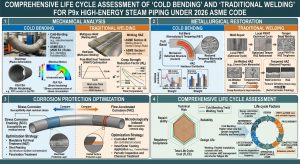
有鑑於此,本學術論文旨在以 2026 年版 ASME B31.1 與 B31J 規範之最新理論框架為基礎,針對 P9x 高能蒸汽管線進行一項全生命週期的跨領域綜合評估。研究將首先梳理次世代大型燃氣機組(如三菱重工 M501JAC)的極端運行參數,剖析其對下游管線造成的熱力學與疲勞邊界條件7。隨後,透過 ASME B31J 規範中基於有限元素分析(FEA)的應力增強係數(Stress Intensification Factor, SIF)重構模型,精確量化 3D/5D 數控「冷作彎管(Cold Bending)」與傳統 1.5D 銲接彎頭在系統力學上的差異8。同時,本研究將結合 CSEF 鋼的物理冶金機制,深入探討冷作彎管技術如何從微觀層面拔除潛變破裂的根源,並嚴謹論證台灣高鹽害環境下「先冷作彎曲、後噴塗熱噴塗鋁(TSA)防蝕層」工法的絕對必要性10。透過力學、冶金學與防蝕科學的三重維度,期能為現代電廠高能管線提供兼具極限安全性與全生命週期經濟效益的工程指引。 In light of this, this academic paper aims to conduct an in-depth, full-lifecycle, cross-disciplinary comprehensive evaluation based on the latest theoretical framework of the 2026 ASME B31.1 and B31J codes, specifically targeting P9x high-energy steam piping. The research will first outline the extreme operating parameters of next-generation large gas turbines (e.g., Mitsubishi Heavy Industries M501JAC) to analyze the thermodynamic and fatigue boundary conditions imposed on downstream piping7. Subsequently, utilizing the FEA-based Stress Intensification Factor (SIF) reconstruction models in the ASME B31J code, this study accurately quantifies the mechanical differences between 3D/5D CNC “Cold Bends” and traditional 1.5D welded elbows8. Concurrently, by integrating the physical metallurgy of CSEF steels, this report deeply explores how cold bending technology eradicates the root causes of creep rupture at the microscopic level, while rigorously validating the absolute necessity of the “Bend First, Spray Thermal Spray Aluminum (TSA) Later” methodology in Taiwan’s high-salinity environments10. Through the triple dimensions of mechanics, metallurgy, and corrosion science, this report seeks to provide engineering guidelines for modern power plant high-energy piping that offer both ultimate safety and full life-cycle economic benefits.
二、 次世代燃氣複循環機組之運行參數與管線熱疲勞邊界條件 / II. Operating Parameters of Next-Generation CCGTs and Thermal Fatigue Boundary Conditions for Piping
2.1 M501JAC 機組之核心架構與熱力學指標 / 2.1 Core Architecture and Thermodynamic Metrics of the M501JAC Unit
要精確評估高能管線的受力與疲勞損耗,必須先從源頭理解現代燃氣渦輪機的輸出特性。以目前全球商業運轉效率頂尖的三菱 M501JAC 系列為例,該機組代表了 J-Class 渦輪技術的成熟演進。其導入了先進的三維空氣動力學設計以降低各級葉片的氣動損失,並配置 15 級壓縮機、16 具燃燒筒與 4 級透平轉子。相較於前代機型,M501JAC 的透平入口溫度(TIT)大幅提升至 1,600°C 級別。值得注意的是,JAC 型號將燃燒室冷卻方式由繁瑣的蒸汽冷卻改為純空氣冷卻,不僅簡化了底層循環系統,更極大地提升了機組調峰運轉的靈活性7。 To accurately assess the stresses and fatigue depletion of high-energy piping, one must fundamentally understand the output characteristics of modern gas turbines. Taking the globally top-tier Mitsubishi M501JAC series as an example, this unit represents the mature evolution of J-Class turbine technology. It incorporates advanced three-dimensional aerodynamic designs to minimize aerodynamic losses across all blade stages and is configured with a 15-stage compressor, 16 combustor cans, and a 4-stage turbine rotor. Compared to its predecessors, the M501JAC’s Turbine Inlet Temperature (TIT) has been significantly elevated to the 1,600°C class. Notably, the JAC model transitions the combustor cooling method from cumbersome steam cooling to pure air cooling, which not only simplifies the bottoming cycle system but also immensely enhances the unit’s peak-shaving operational flexibility7.
在熱力學輸出表現上,M501JAC 的極端參數設定直接決定了下游 HRSG 與主蒸汽管線的設計壓力與溫度。以下為其關鍵運行參數之彙整:In terms of thermodynamic output performance, the extreme parameter settings of the M501JAC directly dictate the design pressure and temperature of the downstream HRSG and main steam piping. A summary of its key operating parameters is as follows:
| 評估參數 / Evaluation Parameter | 數值與規格 / Value & Specification | 系統工程意義與後續影響 / System Engineering Significance & Impact |
| 額定轉速與頻率 / Rated Speed & Frequency | 3,600 rpm (60 Hz) | 精準契合台灣電網標準,高速旋轉體對軸系振動與管線共振設計提出嚴苛要求。 / Perfectly matches Taiwan’s grid standards; high-speed rotation imposes stringent demands on shaft vibration and piping resonance design.7 |
| 複循環出力 / CCGT Output | 664 MW (1 on 1) | 龐大的功率輸出意味著極高的蒸汽質量流率,要求主蒸汽管徑必須擴大以控制流速。 / Massive power output implies extremely high steam mass flow rates, requiring expanded main steam pipe diameters to control velocity. |
| 機組總體熱效率 / Overall Thermal Efficiency | > 64.0 % (LHV) | 逼近物理極限的熱回收效率,迫使 HRSG 高壓過熱器必須在極限溫度下運作。 / Heat recovery efficiency approaching physical limits forces the HRSG high-pressure superheater to operate at extreme temperatures. |
| 排氣溫度與流量 / Exhaust Temp. & Flow | 649 C / 815 kg/s | 巨量且高達 649°C 的排氣直接衝擊 HRSG,使得產出的主蒸汽溫度輕易跨越 600°C 門檻。 / Massive exhaust at 649°C directly impacts the HRSG, easily pushing the generated main steam temperature past the 600°C threshold.7 |
| 升降載率 / Ramp Rate | 42 至 150 MW/min | 機組具備極端快速的負載跟隨能力,導致下游管線在短時間內承受劇烈的流體溫度與壓力暫態變化。 / The unit possesses extremely rapid load-following capabilities, subjecting downstream piping to severe transient fluid temperature and pressure changes in short periods. |
| 啟動時間與降載極限 / Startup Time & Turndown Limit | 熱機啟動約 30 分鐘 / 最低降載至 15% (Hot start ~30 min / Turndown to 15%) | 頻繁的啟停與深度降載能力,將基載管線轉變為每天經歷強烈交變熱應力的疲勞試件。 / Frequent startup/shutdown and deep turndown capabilities transform base-load piping into fatigue specimens experiencing intense daily alternating thermal stresses. |
| 氫氣混燒潛力 / Hydrogen Co-firing Potential | 已驗證 30% 氫氣混燒 (30% H2 co-firing verified) | 未來氫能導入將改變燃燒產物的熱容與水氣比例,可能進一步改變管內的熱傳導環境。 / Future hydrogen introduction will alter the heat capacity and moisture ratio of combustion products, potentially changing the internal heat transfer environment.7 |
2.2 頻繁調峰衍生的暫態熱應力挑戰 / 2.2 Transient Thermal Stress Challenges Derived from Frequent Peak-Shaving
在再生能源發電量占比急遽升高的當代電網中,傳統被視為基載電力的 CCPP 被賦予了吸收電網波動的調峰任務。當 M501JAC 以高達 42 MW/min 甚至更快的速率進行升降載,或在 30 分鐘內完成熱機啟動時,高達 600°C 以上的超高壓蒸汽會以極高流速湧入 HRSG 與主蒸汽管線中。In contemporary power grids with a rapidly increasing share of renewable energy generation, CCPPs, traditionally viewed as base-load power, have been tasked with peak-shaving to absorb grid fluctuations. When the M501JAC ramps up or down at a rate of 42 MW/min or faster, or completes a hot start within 30 minutes, ultra-high-pressure steam over 600°C surges into the HRSG and main steam piping at extremely high velocities.
從固體力學角度審視,P91/P92 這類高合金鋼雖然高溫潛變強度極佳,但其熱傳導係數相對於低合金鋼而言較低。當高溫蒸汽瞬間接觸管壁內側,內壁金屬迅速受熱膨脹,而厚達數十公釐的管壁外側仍處於相對低溫的收縮狀態。這種徑向的熱膨脹不一致,會在管壁內部產生高達數百 MPa 的暫態熱應力(Transient Thermal Stresses)6。 From a solid mechanics perspective, although high-alloy steels like P91/P92 possess excellent high-temperature creep strength, their thermal conductivity is relatively low compared to low-alloy steels. When high-temperature steam instantaneously contacts the inner pipe wall, the inner metal rapidly heats up and expands, while the outer wall, dozens of millimeters thick, remains in a relatively low-temperature, contracted state. This radial thermal expansion mismatch generates transient thermal stresses within the pipe wall reaching hundreds of MPa6.
隨著機組啟動、滿載、降載到停機,此熱應力呈現週期性的交變。根據 Coffin-Manson 低週期疲勞模型,材料的疲勞壽命與塑性應變幅(Δϵp)呈指數級別的反比關係5。一旦這股熱應力傳遞至傳統 1.5D 短半徑銲接彎頭處,受到幾何不連續性及可能存在的銲接角度錯位(Angular Misalignment)影響,局部應力集中係數會急遽放大18。這些峰值應力極易突破材料屈服極限並累積塑性變形,最終在極短年限內萌生熱疲勞裂紋。這正是推動工程界重新審視管件幾何設計與應力評估標準的核心動力。 As the unit cycles through startup, full load, turndown, and shutdown, this thermal stress alternates periodically. According to the Coffin-Manson low-cycle fatigue model, a material’s fatigue life is inversely proportional to the plastic strain amplitude (Δϵp) on an exponential scale5. Once this thermal stress propagates to a traditional 1.5D short-radius welded elbow, local stress concentration factors are drastically amplified due to geometric discontinuities and potential angular misalignment from welding18. These peak stresses can easily exceed the material’s yield limit and accumulate plastic deformation, ultimately initiating thermal fatigue cracks within a very short timeframe. This is the core driver pushing the engineering community to re-evaluate piping geometry designs and stress assessment standards.
三、 2026 ASME B31J 理論重構與應力增強係數 (SIF) 深度解析 / III. Theoretical Reconstruction of 2026 ASME B31J and In-Depth Analysis of Stress Intensification Factors (SIF)
3.1 舊版 ASME B31 附錄 D 之歷史局限與過度保守性 / 3.1 Historical Limitations and Over-Conservatism of Legacy ASME B31 Appendix D
在進行管線系統的三維柔性分析與應力計算時,必須考量管件在承受彎矩時發生的局部畸變與應力集中效應。數十年來,全球工程師皆奉行 ASME B31.1 與 B31.3 規範中附錄 D(Appendix D)的公式來計算應力增強係數(SIF, i)與柔性係數(Flexibility Factor, k)19。這些舊版公式的理論基礎源自 1950 年代由 A.R.C. Markl 團隊執行的基礎疲勞破壞測試。 When performing 3D flexibility analysis and stress calculations for piping systems, engineers must consider the local distortion and stress concentration effects that occur when fittings are subjected to bending moments. For decades, engineers worldwide adhered to the formulas in Appendix D of the ASME B31.1 and B31.3 codes to calculate Stress Intensification Factors (SIF, i) and Flexibility Factors (k)19. The theoretical foundation of these legacy formulas originated from the foundational fatigue failure tests conducted by A.R.C. Markl and his team in the 1950s.
然而,舊版規範存在嚴重的時代局限。首先,附錄 D 的公式通常只計算出一個綜合的 SIF 值,並同等地應用於平面內(In-plane)與平面外(Out-of-plane)的彎矩計算,忽略了彎管在不同方向受力時截面畸變模式的巨大差異9。其次,舊版規範長期忽視扭轉力矩(Torsional Moment)對剪應力的貢獻,粗略預設扭轉 SIF 為 it=1.0。這種處理方式導致管線設計被迫引入不必要的冗餘(如增設過多的膨脹環與剛性極高的彈簧吊架),不僅增加建廠成本,反倒可能因系統剛性過強而將破壞性負載轉嫁給極為敏感的轉動機械噴嘴。 However, legacy codes suffered from severe temporal limitations. First, Appendix D formulas typically calculated a single composite SIF value, applying it equally to both in-plane and out-of-plane bending moment calculations, ignoring the vast differences in cross-sectional distortion modes when a bend is stressed in different directions9. Second, legacy codes long neglected the contribution of torsional moments to shear stress, roughly presetting the torsional SIF to it=1.0 . This approach forced piping designs to introduce unnecessary redundancies (such as adding excessive expansion loops and highly rigid spring hangers), which not only increased construction costs but also potentially transferred destructive loads to highly sensitive rotating machinery nozzles due to excessive system rigidity.
3.2 ASME B31J 之 FEA 驗證架構與力學參數解耦 / 3.2 FEA Validation Framework and Mechanical Parameter Decoupling in ASME B31J
隨著計算力學的進步,ASME 正式推出 B31J 規範,將 1950 年代的粗略經驗公式徹底翻新為經由大量現代有限元素分析(FEA)與實體驗證的閉式解。在 2026 年最新版的 ASME B31.1 與 B31.3 規範中,已正式廢除附錄 D,並強制要求在複雜管網分析中全面導入 B31J 標準19。 With advancements in computational mechanics, ASME officially introduced the B31J code, thoroughly overhauling the rough empirical formulas of the 1950s into closed-form solutions validated by extensive modern Finite Element Analysis (FEA) and empirical testing. In the latest 2026 editions of the ASME B31.1 and B31.3 codes, Appendix D has been officially abolished, and the B31J standard is universally mandated for complex piping network analysis19.
在 B31J 理論框架中,評估彎管力學響應的核心幾何參數為「柔性特徵(Flexibility Characteristic, h)」。對於標準彎管,其無因次閉式解定義為:In the B31J theoretical framework, the core geometric parameter for evaluating the mechanical response of bends is the Flexibility Characteristic (h). For standard bends, its dimensionless closed-form equation is defined as:
h=T⋅R1/r22
其中,T 為管線公稱壁厚,R1 為彎曲中心半徑,r2 為管線平均截面半徑(r2=(D-T)/2)8。 Where T is the nominal wall thickness, R1 is the bend center radius, and r2 is the mean pipe cross-sectional radius (r2=(D-T)/2)8.
h 值的物理意義在於量化管壁發生「橢圓化(Ovalization)」的抗性。公式揭示了一個殘酷的幾何現實:若採用傳統短半徑(極小的 R1)或較薄的管壁(極小的 T),h 值將發生斷崖式下降,代表管件極易發生橢圓化畸變,進而產生災難性的應力集中9。 The physical significance of the h value lies in quantifying the pipe wall’s resistance to “Ovalization.” The formula reveals a harsh geometric reality: if a traditional short radius (extremely small R1) or a thinner wall (extremely small T) is used, the h value will drop precipitously, indicating that the fitting is highly susceptible to ovalization distortion, thereby generating catastrophic stress concentrations9.
基於 h 值,ASME B31J 將管件力學行為進行了精確的三維解耦:Based on the h value, ASME B31J accurately decouples the mechanical behavior of fittings in three dimensions:
| B31J物理與力學參數 / B31J Physical & Mechanical Parameter | 閉式解公式 / Closed-Form Equation | 物理意義與相較舊版之變革 / Physical Significance & Evolution from Legacy Codes |
| 柔性係數 / Flexibility Factor (k) | k=1.65/h | 量化彎管相較於同等長度直管的柔性倍率。消除了舊版的過度簡化。 / Quantifies the flexibility multiplier of a bend compared to a straight pipe. Eliminates legacy oversimplifications. |
| 面內應力強度因子 / In-Plane SIF (ii) | ii=0.9/h2/3 | 放大面內彎矩引起的熱膨脹應力範圍。獨立計算以精確評估疲勞損耗。 / Amplifies in-plane thermal expansion stress range. Calculated independently for precise fatigue assessment.9 |
| 面外應力強度因子 / Out-of-Plane SIF (io) | io=0.75/h2/3 | 評估扭曲位移產生的面外應力集中。與面內 SIF 徹底解耦,提高 3D 解析精度。 / Evaluates out-of-plane stress concentration from torsional displacement. Decoupled from in-plane SIF, improving 3D resolution. |
| 扭轉應力強度因子 / Torsional SIF (it) | 依幾何查表或 FEA / Based on geometry tables or FEA | 納入位移應力範圍計算,捕捉空間局部剪應力極值,推翻舊版預設謬誤。 / Incorporated into displacement stress range, capturing spatial shear stress peaks, overturning legacy defaults. |
| 持續應力指數 / Sustained Stress Index (SSI) | SSI=0.75i | 用於計算恆載下的應力,設有極限值 1.0 以防範塑性坍塌。 / Used to calculate stress under sustained loads, with a lower limit of 1.0 to prevent plastic collapse.19 |
在先進管線應力分析軟體(如 CAESAR II)中啟用 B31J 模組後,軟體將自動套用上述解耦矩陣,並對應力指數底限進行嚴格把關。這確保了系統柔性獲得釋放的同時,承載安全性不會被反向低估。Upon enabling the B31J module in advanced piping stress analysis software (like CAESAR II), the software automatically applies the aforementioned decoupled matrix and strictly enforces the stress index floor values. This ensures that while system flexibility is unleashed, load-bearing safety is not inversely underestimated.
3.3 傳統 1.5D 銲接與 3D/5D 冷作彎管之 B31J 實證比較 / 3.3 Empirical Comparison between Traditional 1.5D Welded and 3D/5D Cold Bends under B31J
將 B31J 理論應用於 M501JAC 高壓蒸汽管線設計時,傳統的 1.5D 銲接彎頭與現代的 3D/5D 數控冷作彎管展現出截然不同的疲勞壽命潛力。When applying B31J theory to the design of M501JAC high-pressure steam piping, traditional 1.5D welded elbows and modern 3D/5D CNC cold bends demonstrate vastly different fatigue life potentials.
傳統 1.5D 彎頭由於曲率極大,h 值通常極低,導致其平面內與平面外 SIF 往往高達 3.0 至 5.0。更致命的是,銲接彎頭在施工時極易產生角度錯位,此錯位引入的局部二次彎曲應力,會與 B31J 計算出的 SIF 產生惡性的乘數效應疊加,使得局部峰值應力輕易突破疲勞容許極限9。 Due to their extreme curvature, traditional 1.5D elbows usually have very low h values, causing their in-plane and out-of-plane SIFs to often reach as high as 3.0 to 5.0. More fatally, welded elbows are highly prone to angular misalignment during construction. The local secondary bending stress introduced by this misalignment creates a vicious multiplier effect when superimposed with the SIF calculated by B31J, making local peak stresses easily breach fatigue allowable limits9.
反觀 3D 或 5D 冷作彎管,其彎曲半徑 R1 達到原本的 2 至 3.3 倍,推升了整體 h 值。數值分析顯示,當 h 值增大到一定程度時,公式計算出的 SIF 會跌破 1.0,此時規範會將 SIF 強制鎖定在下限值 1.0,意味著其幾何力學表現幾乎等同於理想直管8。一體成型的冷彎管完美排除了銲接錯位疊加效應,將實際承受的塑性應變幅(Δϵp)急遽縮小,使其抗疲勞壽命可達傳統錯位銲接彎頭的數十倍以上5。這不僅減輕了整體管網的自重應力,更優化了高階合金材料的巨額採購成本。 Conversely, for 3D or 5D cold bends, their bend radius R1 is 2 to 3.3 times that of the original, elevating the overall h value. Numerical analyses show that when the h value increases to a certain degree, the calculated SIF drops below 1.0; at this point, the code forcibly locks the SIF at its lower limit of 1.0, meaning its geometric mechanical performance is nearly identical to an ideal straight pipe8. Integrally formed cold bends perfectly eliminate the superimposed effects of welding misalignment, drastically shrinking the actual plastic strain amplitude (Δϵp) experienced, which can extend their fatigue life to dozens of times that of misaligned traditional welded elbows5. This not only mitigates the deadweight stress of the entire piping network but also optimizes the immense procurement costs of high-grade alloy materials.
四、 CSEF 鋼之物理冶金學與第四型潛變破裂 (Type IV Cracking) 機制 / IV. Physical Metallurgy of CSEF Steels and the Mechanism of Type IV Cracking
4.1 P91/P92 鋼之多層次奈米析出強化機制 / 4.1 Multi-tier Nano-Precipitation Strengthening Mechanism of P91/P92 Steels
要理解冷作彎管為何能從根本上解決高溫失效問題,必須深入探究 P91/P92 這類潛變強度增強型肥粒鐵鋼的物理冶金基礎。其卓越的抗潛變能力,完全仰賴「回火麻田散鐵(Tempered Martensite)」基體中複雜且高度熱力學穩定的奈米析出物網路20。 To understand why cold bends fundamentally resolve high-temperature failure issues, one must delve into the physical metallurgy foundation of Creep Strength Enhanced Ferritic (CSEF) steels like P91/P92. Their exceptional creep resistance relies entirely on a complex and highly thermodynamically stable nano-precipitate network within a “Tempered Martensite” matrix20.
經過嚴格的正常化與高溫回火處理後,P9x 鋼內部建構出兩大強效強化機制:After strict normalizing and high-temperature tempering treatments, P9x steels build two potent strengthening mechanisms internally:
- M23C6 碳化物釘紮效應:富含鉻與鐵的 M23C6 碳化物沿著原奧氏體晶界(PAGB)及次晶粒邊界析出,如同微觀鉚釘般發揮「釘紮(Zener Pinning)」作用,防止晶界在高溫應力下發生滑移或異常成長3。M23C6 Carbide Zener Pinning Effect: Chromium and iron-rich M23C6 carbides precipitate along Prior Austenite Grain Boundaries (PAGB) and subgrain boundaries. Acting like microscopic rivets, they exert a “Zener Pinning” effect, preventing boundary sliding or abnormal subgrain growth under high-temperature stress3.
- MX 型碳氮化物之差排阻擋:富含釩與鈮的 MX 型碳氮化物極為均勻地散佈於晶內區域,有效阻擋差排的高溫攀移與滑移,為合金提供最核心且持久的析出強化效應3。Dislocation Blocking by MX Carbonitrides: Vanadium and niobium-rich MX carbonitrides are exceptionally evenly distributed within the intra-grain regions. They effectively block the high-temperature climb and glide of dislocations, providing the alloy with its most core and enduring precipitation strengthening effect3.
4.2 銲接熱循環與第四型潛變破裂之微觀演化 / 4.2 Welding Thermal Cycles and Microstructural Evolution of Type IV Cracking
儘管母材極為強韌,傳統「銲接」工法伴隨的劇烈熱循環卻會對此精密微觀組織造成毀滅性打擊。銲接時,緊鄰銲道的母材區域會形成極度不均勻的熱影響區(HAZ),其中細晶區(FGHAZ)與跨臨界區(ICHAZ)是潛伏於高能管線中最致命的弱點4。 Despite the exceptional toughness of the base metal, the severe thermal cycles accompanying traditional “welding” methods deliver a devastating blow to this precise microstructure. During welding, the base metal area immediately adjacent to the weld forms a highly non-uniform Heat-Affected Zone (HAZ), within which the Fine-Grained HAZ (FGHAZ) and Intercritical HAZ (ICHAZ) are the most lethal weaknesses lurking in high-energy piping4.
第四型潛變破裂(Type IV Cracking)的本質,在於峰值溫度對局部相變的干擾。在銲接時,ICHAZ 所經歷的最高溫度剛好介於材料的下臨界溫度與上臨界溫度之間。在此半奧氏體化區間內,原始強大的 M23C6 與 MX 析出物發生部分溶解並異常粗化,徹底失去對次晶界的釘紮能力3。冷卻後,該區域生成大量等軸的細小多邊形肥粒鐵,充斥著過度密集的晶界,演變成一個抗拉強度驟降的「軟化帶(Soft Zone)」3。 The essence of Type IV Cracking lies in the interference of peak temperatures with local phase transformations. During welding, the peak temperature experienced by the ICHAZ falls exactly between the material’s lower and upper critical temperatures. Within this partially austenitized zone, the original robust M23C6 and MX precipitates partially dissolve and abnormally coarsen, completely losing their pinning ability on subgrain boundaries3. Upon cooling, this region generates a massive amount of equiaxed, fine polygonal ferrite filled with an overly dense network of grain boundaries, evolving into a “Soft Zone” with plummeted tensile strength3.
服役期間,這個微觀軟化帶被兩側較強硬的銲道金屬與母材夾持,受到極高的三維拘束應力限制。根據 Monkman-Grant 方程式,局部潛變應變(Creep Strain)以極高頻率累積於此,呈指數級別縮短材料壽命3。更為雪上加霜的是,高溫服役中 Laves 相會在 FGHAZ 晶界處快速成核並劇烈粗化,不僅導致固溶強化機制枯竭,粗大硬脆的顆粒交界面更成為潛變空孔優先成核的絕佳位置3。這些空孔最終連結成微裂紋並引發災難性斷裂,這正是轟動業界的 Type IV Cracking 典型特徵3。 During service, this microscopic soft zone is sandwiched between the harder weld metal and base metal on either side, subjected to extreme triaxial stress constraints. According to the Monkman-Grant equation, localized Creep Strain accumulates here at an extremely high rate, shortening the material’s life exponentially3. To make matters worse, during high-temperature service, the Laves phase rapidly nucleates and severely coarsens at the FGHAZ grain boundaries. This not only depletes solid solution strengthening mechanisms, but the interfaces of these coarse, brittle particles become prime locations for the preferential nucleation of creep cavities3. These cavities ultimately link up into micro-cracks and trigger catastrophic fractures, representing the classic characteristics of Type IV Cracking that have shaken the industry3.
4.3 銲道強度折減係數 (W) 與異種金屬銲接 (DMW) 困境 / 4.3 Weld Strength Reduction Factor (W) and Dissimilar Metal Weld (DMW) Dilemmas
為確保工業安全,ASME B31.3 規範明文制定了「銲道強度折減係數(Weld Strength Reduction Factor, W)」,強制作業工程師必須補償 Type IV 破裂造成的強度流失。To ensure industrial safety, the ASME B31.3 code explicitly established the “Weld Strength Reduction Factor (W)”, mandating that operating engineers must compensate for the strength loss caused by Type IV cracking.
以 600°C 為例,P91 鋼在該溫度的 W 值可能降至 0.67 甚至更低1。這意味著工程師必須將容許應力打對折計算,迫使全線管壁厚度大幅增加。管壁增厚不僅使材料採購成本暴增,沉重的管線更會導致系統剛性變得極度僵硬;在機組啟停時,難以吸收熱膨脹位移的管線會將極大熱應力直接傳遞並破壞設備噴嘴,形成設計上的惡性循環1。 Taking 600°C as an example, the W value for P91 steel at that temperature may drop to 0.67 or even lower1. This implies that engineers must effectively halve the allowable stress in their calculations, forcing a massive increase in the wall thickness of the entire pipeline. Thickening the walls not only skyrockets material procurement costs, but the heavier piping also makes system rigidity extremely stiff. During unit startups and shutdowns, piping unable to absorb thermal expansion displacement will directly transmit immense thermal stresses to and potentially destroy equipment nozzles, creating a vicious cycle in design1.
此外,在 M501JAC 機組中,常需將 P91/P92 管線與沃斯田鐵不銹鋼進行異種金屬銲接(Dissimilar Metal Weld, DMW)。DMW 介面存在巨大的化學勢梯度,高溫服役下會發生碳遷移(Carbon Migration),在 P9x 側留下極脆弱的「碳貧化帶」3。伴隨嚴重的熱膨脹係數不匹配,極易引發介面的熱疲勞撕裂,成為另一顆隨時可能引爆的定時炸彈3。 Additionally, in M501JAC units, it is often necessary to perform Dissimilar Metal Welds (DMW) between P91/P92 piping and austenitic stainless steel. A massive chemical potential gradient exists at the DMW interface; under high-temperature service, Carbon Migration occurs, leaving an extremely fragile “Carbon Depleted Zone” on the P9x side3. Accompanied by a severe mismatch in thermal expansion coefficients, this highly promotes thermal fatigue tearing at the interface, serving as another ticking time bomb in the system3.
五、 冷作彎管技術與彎後熱處理 (PBHT) 組織修復論證 / V. Cold Bending Technology and Post-Bend Heat Treatment (PBHT) Microstructural Restoration Analysis
5.1 「以彎代銲」:徹底拔除第四型破裂基因 / 5.1 “Bend-instead-of-Weld”: Thoroughly Uprooting the Type IV Cracking Gene
面對傳統銲接在微觀冶金與巨觀力學上難以跨越的雙重障礙,「以彎代銲」的 3D/5D 數控冷作彎管技術提供了根本性的破局之道。Facing the dual macroscopic mechanical and microscopic metallurgical hurdles of traditional welding that are difficult to overcome, the “Bend-instead-of-Weld” 3D/5D CNC cold bending technology offers a fundamental breakthrough.
冷作彎管工法透過數控彎管機對無縫母管施加機械力,使其在室溫下發生塑性變形。此工法實現了管線幾何轉向區域的一體成型,全區完美維持未受熱擾動的母材微觀結構,徹底移除了組織失配的 HAZ、FGHAZ 與 ICHAZ3。這意味著引發第四型潛變破裂的晶界軟化與碳化物異常溶解溫床在物理層面上被完全消弭,大幅降低了非預期停機的營運風險5。 The cold bending process applies mechanical force to a seamless mother pipe via a CNC bending machine, causing plastic deformation at room temperature. This method achieves integral forming of the piping’s geometric directional changes, perfectly maintaining the thermally undisturbed base metal microstructure throughout the entire zone, entirely removing the microstructurally mismatched HAZ, FGHAZ, and ICHAZ3. This means the hotbed for grain boundary softening and abnormal carbide dissolution, which trigger Type IV creep cracking, is completely eradicated at the physical level, drastically reducing the operational risks of unplanned outages5.
5.2 塑性應變動力學與管壁厚度預留補償 / 5.2 Plastic Strain Dynamics and Wall Thickness Reservation Compensation
冷成形在彎管外緣(Extrados)會產生拉伸減薄,內彎側(Intrados)則受壓縮增厚。彎管外緣所承受的最大纖維應變率 ϵ 可由下列關係估算:Cold forming induces tensile thinning on the bend’s extrados and compressive thickening on the intrados. The maximum fiber strain rate ϵ experienced by the extrados can be estimated by the following relationship:
ϵ=ro/R1 ×100%
若採用 3D 彎管,外緣最大塑性應變率約高達 16.7%;若採用 5D 彎管,則應變率約為 10%18。 If a 3D bend is used, the maximum plastic strain rate at the extrados reaches roughly 16.7%; if a 5D bend is used, the strain rate is about 10%18.
為確保減薄後的管壁仍能滿足設計承壓需求,ASME 規範強制規定母管在彎曲前必須預留厚度補償。例如 3D 彎管需預留約 25% 減薄餘量,5D 彎管需預留約 8% 餘量21。透過精密的厚度預測與補償,冷彎管完工後能完美符合承壓邊界條件,無需如同銲接系統般為了補償 W 係數而將整段管線無差別地過度加厚。 To ensure the thinned pipe wall can still satisfy design pressure requirements, ASME codes mandate that mother pipes must reserve a thickness compensation proportional to the bend before forming. For instance, a 3D bend requires approx. 25% thinning allowance, while a 5D bend requires approx. 8% allowance21. Through precise thickness prediction and compensation, completed cold bends perfectly meet pressure boundary conditions, eliminating the need to indiscriminately over-thicken the entire piping line just to compensate for the W factor, as is done in welded systems.
5.3 彎後熱處理 (PBHT) 消除應變與析出物重構 / 5.3 Post-Bend Heat Treatment (PBHT) for Strain Elimination and Precipitate Reconstruction
高達 10-16.7% 的冷加工塑性變形會在 P91/P92 鋼內部引入高密度的差排堆積與加工硬化,並殘留巨大的巨觀內應力。若未經熱力學復原即投入高溫服役,高密度差排將成為原子擴散的快速通道,大幅加速 M23C6 碳化物的熟化與 Laves 相的脆化,導致潛變壽命崩潰19。 A cold-working plastic deformation of 10-16.7% introduces high-density dislocation pile-ups and work hardening within P91/P92 steels, leaving massive macroscopic internal stresses. If put into high-temperature service without thermodynamic restoration, the high dislocation density becomes a fast track for atomic diffusion, drastically accelerating the ripening of M23C6 carbides and the embrittlement of the Laves phase, causing creep life to collapse19.
因此,執行嚴密控管的彎後熱處理(Post-Bend Heat Treatment, PBHT)是決定成敗的最終防線。標準的修復程序是重新對全管進行「正常化與高溫回火」:Therefore, executing strictly controlled Post-Bend Heat Treatment (PBHT) is the ultimate defense determining success or failure. The standard restoration procedure is to re-subject the entire pipe to “Normalizing and High-Temperature Tempering”:
- 正常化 (Normalizing):加熱至 1040°C – 1080°C,將冷加工產生的扭曲晶格完全消除,並使碳化物重新固溶入基體中。隨後控制空氣冷卻,使組織轉變為無應力的麻田散鐵28。 / Heat to 1040°C – 1080°C to completely eliminate the twisted crystal lattice caused by cold work, allowing carbides to re-dissolve into the matrix. Subsequent controlled air cooling transforms the structure into stress-free martensite28.
- 高溫回火 (Tempering):於 730°C – 800°C 進行深度回火,釋放相變應力並促使 M23C6 與 MX 析出物極為均勻地重新奈米析出3。 / Perform deep tempering at 730°C – 800°C to release phase transformation stresses and drive M23C6 and MX precipitates to uniformly re-nucleate at the nanoscale3.
另一種作法為次臨界熱處理(Subcritical PBHT),僅在 AC1 以下的高溫進行長時間回火33。為確保組織修復成效,現代工程實務已導入磁聲發射(MAE)等先進非破壞檢測技術,確保出廠的冷彎管皆具備卓越的潛變韌性。 An alternative method is Subcritical PBHT, executing long-duration tempering exclusively at high temperatures below AC1 33. To assure structural restoration efficacy, modern engineering practices have introduced advanced non-destructive testing technologies like Magnetic Acoustic Emission (MAE), guaranteeing every shipped cold bend possesses exceptional creep toughness.
六、 流體力學優化:流動加速腐蝕 (FAC) 與二次水錘效應之抑制 / VI. Fluid Dynamics Optimization: Suppression of Flow-Accelerated Corrosion (FAC) and Secondary Water Hammer Effects
在聚焦固體力學與冶金學之餘,冷作彎管在內部流體動力學上的優勢亦是確保管線長效安全不可或缺的一環。Beyond focusing on solid mechanics and metallurgy, the internal fluid dynamic advantages of cold bends are also an indispensable element in ensuring long-term pipeline safety.
傳統 1.5D 短半徑彎頭內部,流體在通過極大曲率轉向時會受到強烈離心力作用,形成「迪安渦流(Dean Vortices)」。迪安數(De)公式為:Inside traditional 1.5D short-radius elbows, fluid passing through a turn with extreme curvature is subjected to strong centrifugal forces, forming “Dean Vortices.” The dimensionless formula for the Dean Number (De) is:
De=Re√D/Rc
公式明確指出,彎曲半徑 Rc 越小(如 1.5D),渦流強度越強9。在機組啟動初期的濕蒸汽階段,高強度的迪安渦流會將管底滯留的冷凝水捲起形成「段塞流」,猛烈撞擊彎管外緣,引發劇烈的流動加速腐蝕(FAC)與次生水錘現象。 The formula explicitly indicates that the smaller the bend radius Rc (e.g., 1.5D), the higher the vortex intensity9. During the wet steam phase at early unit startup, high-intensity Dean vortices whip up stagnant condensate from the pipe bottom to form a liquid “Slug Flow,” which violently impacts the extrados of the elbow, triggering severe Flow-Accelerated Corrosion (FAC) and secondary water hammer phenomena.
當採用 5D 大半徑冷彎管時,Rc 大幅增加使得迪安渦流強度呈指數級下降。平滑的流線不僅降低了流體壓力降,更消除了強烈渦流對管壁外緣的沖刷侵蝕,確保管壁厚度在長期服役中的穩定性,進一步鞏固了 B31J 應力解析的初始設計假設。When utilizing 5D large-radius cold bends, the massive increase in Rc causes Dean vortex intensity to drop exponentially. The smooth streamlines not only reduce fluid pressure drops but also eliminate the erosive scouring of intense vortices on the outer pipe wall. This ensures wall thickness stability over long-term service, further consolidating the initial design assumptions of the B31J stress analysis.
七、 台灣高鹽害沿海環境之塗層完整性:先冷作後噴塗 (TSA) 實務論證 / VII. Coating Integrity in Taiwan’s High-Salinity Coastal Environments: Practical Proof of “Bend First, Spray TSA Later”
7.1 ISO 12944 CX 極端腐蝕環境與熱噴塗鋁 (TSA) 屏障 / 7.1 ISO 12944 CX Extreme Corrosion Environments and Thermal Spray Aluminum (TSA) Barriers
台灣多數發電廠皆臨海而建,常年暴露於高溫、高濕且富含氯離子的鹽霧中,環境等級達到 ISO 12944 標準中最高的 CX(極端海洋環境)等級11。為達成 25 年以上的極高耐久性設計目標,業界廣泛導入熱噴塗鋁塗層(Thermal Spray Aluminum, TSA)作為高溫管線的終極防護裝甲10。 Most power plants in Taiwan are built near the coast, perennially exposed to high-temperature, high-humidity salt sprays rich in chloride ions, reaching the highest environmental category CX (Extreme Marine/Offshore Environments) under the ISO 12944 standard11. To achieve a Very High Durability design target of over 25 years, the industry has widely adopted Thermal Spray Aluminum (TSA) coatings as the ultimate protective armor for high-temperature piping10.
TSA 具有雙重防蝕機制:一方面,鋁在大氣中會瞬間氧化形成緻密堅硬的氧化鋁鈍化膜,徹底隔絕氯離子滲透10;另一方面,當塗層遭遇意外刮傷時,較活潑的鋁會主動作為犧牲陽極溶解,提供強大的陰極保護電流防止深層點蝕10。TSA 施作主要仰賴雙絲電弧噴塗,並於表面塗覆封孔劑以確保 CX 等級的絕對密封10。 TSA possesses dual anti-corrosion mechanisms: on one hand, aluminum instantly oxidizes in the atmosphere to form a dense, hard aluminum oxide passivation film, completely isolating chloride ion penetration10; on the other hand, when the coating suffers accidental scratches, the more active aluminum acts as a sacrificial anode, dissolving proactively to provide powerful cathodic protection current against deep pitting10. TSA application relies primarily on Twin Wire Arc Spraying, with sealers applied over the surface to ensure absolute sealing for CX-level environments10.
7.2 機械拉伸破壞與「先彎曲、後噴塗」之絕對準則 / 7.2 Mechanical Tensile Destruction and the Absolute Principle of “Bend First, Spray Later”
在廠內預製排序上,塗層施加的時間點是決定附著力完整性的生死關鍵。若將預先噴塗 TSA 的直管送入冷作彎曲,3D/5D 彎管外緣高達 10-16.7% 的劇烈拉伸塑性應變將遠超 TSA 的斷裂伸長率,導致塗層瞬間崩裂;內彎側則會因擠壓發生大面積剝離18。 In shop prefabrication sequencing, the timing of coating application is the life-or-death factor deciding adhesion integrity. If straight pipes pre-sprayed with TSA are sent for cold bending, the severe tensile plastic strain at the 3D/5D bend extrados (up to 10-16.7%) will far exceed the elongation at break of TSA, causing the coating to instantaneously shatter; conversely, the intrados will experience massive delamination due to compression18.
基於此物理現實,必須嚴格確立「先冷作彎曲成形,並完成 PBHT 熱處理後,最後再進行表面前處理與 TSA 噴塗」的標準工法。在徹底釋放應變後,進行 Sa 2.5 噴砂創造粗糙尖銳輪廓10,再於無外力變形的狀態下噴塗 TSA。完工後依據 ASTM D4541 標準執行拉拔試驗,實測附著力往往能輕易突破 14.5 MPa 乃至更高水準10。一體成型的冷彎管表面平滑流暢,徹底剝奪了鹽霧冷凝水滯留的溫床,使得 TSA 塗層能發揮最完美的設計潛力。 Based on this physical reality, it is mandatory to strictly establish the standard procedure of “Bend-First, PBHT Heat Treatment next, and Surface Prep with TSA Spraying Later.” After strains are thoroughly released, Sa 2.5 grit blasting is performed to create an angular profile10, followed by TSA spraying in a state free of external deformation. After completion, pull-off tests executed according to ASTM D4541 standards often show adhesion forces easily exceeding 14.5 MPa or higher10. The smooth, fluid surface of the integrally formed cold bend completely deprives salt-spray condensation of a breeding ground to stagnate, allowing the TSA coating to fulfill its absolute design potential.
八、 多方利益關係人之實務考量與營運決策分析 / VIII. Practical Considerations and Operational Decision Analysis for Multiple Stakeholders
從發電廠全生命週期的角度審視,傳統 1.5D 銲接彎頭與 3D/5D 大半徑冷作彎管的決策深刻影響著各方利益關係人的成本與風險。以下結合熱力學瞬態分析與 ASME B31.1 規範進行深度擴充分析。Viewed from the perspective of a power plant’s full lifecycle, the decision between traditional 1.5D welded elbows and 3D/5D large-radius cold bends profoundly impacts the costs and risks for all stakeholders. Below is an in-depth expanded analysis combining thermodynamic transients and the ASME B31.1 code.
8.1 業主之維護管理與營運決策 / 8.1 Owner’s Maintenance Management and Operational Decisions
對電廠業主而言,決策指標在於平衡初期資本支出(CAPEX)與長期營運支出(OPEX)。傳統 1.5D 銲接彎頭雖建廠初期成本較低,但其潛伏的第四型潛變破裂基因,將在長期調峰服役下轉變為龐大的 OPEX 負擔。由於 Type IV 裂紋潛伏期極長且晚期拓展極快,業主必須頻繁投入鉅額資金實施相控陣超音波檢測(PAUT)3。若採用冷作彎管徹底「以彎代銲」,不僅排除了這類難以預測的冶金定時炸彈,其挽救的非預期停機損失與後續檢測成本,遠超初期的資本溢價。 For plant owners, the decision metric lies in balancing initial Capital Expenditure (CAPEX) with long-term Operational Expenditure (OPEX). Although traditional 1.5D welded elbows have lower initial plant-building costs, their latent Type IV creep cracking genes mutate into massive OPEX burdens during long-term peak-shaving service. Because Type IV cracks have extremely long latency periods but expand swiftly in late stages, owners must frequently invest huge sums in Phased Array Ultrasonic Testing (PAUT)3. If cold bends are adopted to thoroughly “Bend-instead-of-Weld,” it not only eliminates these unpredictable metallurgical time-bombs but the saved costs from mitigating unpredicted outages and avoiding subsequent testing far exceed the initial capital premium.
8.2 EPC 統包商設計單位之空間佈置與實務考量 / 8.2 EPC Contractors’ Design Spatial Layout and Practical Considerations
對 EPC 統包商而言,導入 ASME B31J 規範下的冷作彎管是一把雙面刃。在力學優勢上,較大的柔性特徵(h 值)能將 SIF 大幅壓低,意味著 EPC 可以減少膨脹環與彈簧吊架數量,並免除銲道強度折減係數(W)的厚度懲罰,進而降低特種合金的採購成本與自重。然而,在空間實務佈置上,5D 大半徑彎管需要較大的幾何轉向空間。這要求 EPC 設計團隊必須在 3D 模型建立的極早期階段,進行嚴密的空間碰撞檢查並優化路由規劃。For EPC contractors, adopting cold bends under the ASME B31J code is a double-edged sword. On the mechanical advantage side, the larger flexibility characteristic (h value) significantly suppresses the SIF, meaning EPCs can reduce expansion loops and spring hanger counts, while bypassing the thickness penalties of the Weld Strength Reduction Factor (W), thereby lowering special alloy procurement costs and deadweight. However, in practical spatial layouts, 5D large-radius bends require much larger geometric turning envelopes. This requires EPC design teams to conduct rigorous spatial clash checks and optimize routing plans at the very early stages of 3D modeling.
8.3 廠務管理者對管線可靠度與運轉之要求 / 8.3 Plant Managers’ Requirements for Piping Reliability and Operations
對於負責日常運轉的廠務主管而言,高溫蒸汽管線的安全性與流體穩定性是重中之重。5D 冷作彎管平滑的流線徹底消除了外緣管壁的 FAC 沖刷隱患與次生水錘現象,確保了流體穩定性。此外,冷彎管無銲冠的平滑表面消除了鹽霧積聚死角,讓保溫層包覆更緊密;無銲道的特性更大幅免除了廠務端在進行在役檢查(ISI)時必須反覆拆裝保溫層的繁瑣作業與工安風險。For plant managers in charge of daily operations, the safety and fluid stability of high-temperature steam piping are paramount. The smooth streamlines of 5D cold bends thoroughly eliminate FAC scouring threats on the outer walls and secondary water hammer phenomena, ensuring fluid stability. Moreover, the smooth, weld-crown-free surfaces of cold bends eliminate blind spots where salt spray can accumulate, allowing tighter insulation wrapping; the weld-free nature also drastically spares plant staff from the tedious and hazardous work of repeatedly removing and reinstalling insulation during In-Service Inspections (ISI).
8.4 發電機組設計製造商 (OEM) 視角:落實「能彎不銲」設計理念 / 8.4 OEM Perspective: Implementing the “Bend-instead-of-Weld” Design Philosophy
從機組原廠設計製造商(如三菱重工)的高度來看,為了保證機組在極端條件下(1,600°C 的 TIT、42 至 150 MW/min 的升降載率)依然能安全靈活地調峰運轉,必須防止下游管線成為系統瓶頸7。落實「能彎不銲」理念,等同於從物理層面消弭了無法精確預測的疲勞與潛變破裂變數。透過要求下游包商採用 3D/5D 冷作彎管,OEM 得以確保整個高能管網的柔性特徵能夠完美匹配其先進氣冷式渦輪機的調峰生命週期,進而兌現長期性能保證。 From the vantage point of Original Equipment Manufacturers (OEMs, like Mitsubishi Heavy Industries), guaranteeing that units can safely and flexibly perform peak-shaving operations under extreme conditions (TIT of 1,600°C, ramp rates of 42 to 150 MW/min) requires preventing downstream piping from becoming systemic bottlenecks7. Implementing the “Bend-instead-of-Weld” philosophy equates to eliminating unpredictable fatigue and creep fracture variables at the physical level. By requiring downstream contractors to utilize 3D/5D cold bends, OEMs can ensure the entire high-energy piping network’s flexibility characteristic perfectly matches the peak-shaving lifecycle of their advanced air-cooled turbines, thereby fulfilling long-term performance guarantees.
8.5 複循環機組頻繁起停之物理瞬態與熱力學循環破壞機制 / 8.5 Physical Transients and Thermodynamic Cycle Destruction Mechanisms of Frequent CCGT Cycling
隨著電網淨負載呈現劇烈的「鴨子曲線」,複循環機組被迫轉型為頻繁起停的調度核心。這種運轉模式帶來兩大挑戰:其一,冷態啟動時蒸汽流速急遽上升,若渦流脫落頻率與氣柱聲學頻率重合,將觸發能量極高的聲學共振,引發高週疲勞斷裂。其二,起停產生的過渡熱應力與滿載高溫持載交替作用,會產生「蠕變-疲勞交互作用」。疲勞微裂紋會極大化空位的擴散速率,促使潛變孔洞加速成核;密集的孔洞又成為裂紋擴展的捷徑。這種交互機制會將傳統 1.5D 銲接彎頭的實際壽命截斷至設計壽命的三分之一以下。As grid net-loads exhibit severe “Duck Curves,” CCGT units are forced to transition into the core of frequent startup/shutdown dispatching. This operational mode brings two major challenges: First, during cold starts, steam velocity rises sharply; if the vortex shedding frequency coincides with the air column’s acoustic frequency, it triggers highly energetic acoustic resonance, inducing high-cycle fatigue fractures. Second, the transient thermal stresses from startups/shutdowns alternating with full-load high-temperature holding periods generate “Creep-Fatigue Interactions.” Fatigue microcracks maximize vacancy diffusion rates, accelerating the nucleation of creep cavities; dense cavities then become shortcuts for crack propagation. This interactive mechanism can truncate the actual lifespan of traditional 1.5D welded elbows to less than one-third of their design life.
8.6 2026 ASME B31.1 下 P9x 應變率放寬與 IH-PBHT 適用性 / 8.6 Strain Rate Relaxation and IH-PBHT Applicability for P9x under 2026 ASME B31.1
冷作彎管的物理代價是大量的冷加工塑性變形,這會引發應變時效並導致衝擊韌性驟降。對此,2026 年最新版 ASME B31.1 第 129 節針對 P-No. 15E(如 P91/P92)材料,頒布了極嚴格的熱處理豁免邊界。當 3D/5D 冷彎產生的最大應變率落於 5% 至 20% 之間,或局部減薄量超過 25% 時,規範「強制要求」必須執行 PBHT 來恢復材料微觀組織。為滿足此標準,採用次臨界感應加熱彎後熱處理(IH-PBHT)成為了消弭冷作應變並符合規範的最佳技術徑路。The physical cost of cold bending is massive cold-worked plastic deformation, which triggers strain aging and causes impact toughness to plummet. In response, Section 129 of the newest 2026 ASME B31.1 code issued highly stringent heat treatment exemption boundaries for P-No. 15E (like P91/P92) materials. When the maximum strain rate generated by 3D/5D cold bending falls between 5% and 20%, or if local thinning exceeds 25%, the code “mandates” the execution of PBHT to restore the material’s microstructure. To meet this standard, adopting subcritical Induction Heating Post-Bend Heat Treatment (IH-PBHT) has become the optimal technological pathway to eliminate cold-work strains and achieve code compliance.
8.7 供應鏈整合指標:三合一工法之合規性與管理優化 / 8.7 Supply Chain Integration Metrics: Compliance and Management Optimization of the Three-in-One Method
針對 ASME B31.1 強制熱處理規範與機組 OEM 廠的極限要求,產業界(如國內預製廠潁璋工程)已發展出「CNC 精密冷作彎管 + 中頻感應彎後熱處理 (IH-PBHT) + 數位履歷 (QR Code)」的整合性三合一工法,為 EPC 統包商帶來了極具震撼性的綜合商業效益5。 In response to the mandatory heat treatment regulations of ASME B31.1 and the extreme requirements of unit OEMs, the industry (e.g., domestic prefabricator Ying-Zhang Engineering) has developed an integrated “Three-in-One Method” comprising “CNC Precision Cold Bending + Induction Heating Post-Bend Heat Treatment (IH-PBHT) + Digital Traceability Record (QR Code)”, bringing tremendously impactful comprehensive commercial benefits to EPC contractors5.
該工法的合規性與管理核心價值體現於:The compliance and core management value of this method are reflected in:
- CNC 精密冷作彎管 / CNC Precision Cold Bending:以 3D/5D 彎曲技術完全消除 HAZ,從物理上根絕軟化帶的出現,完美消弭第四型潛變破裂風險與流體加速腐蝕問題21。 / By utilizing 3D/5D bending technology to completely eliminate the HAZ, it physically eradicates the appearance of softening zones, perfectly mitigating the risks of Type IV creep cracking and flow-accelerated corrosion21.
- 中頻感應彎後熱處理 (IH-PBHT) / Induction Heating Post-Bend Heat Treatment (IH-PBHT):為符合1 對 5%~20% 應變率的熱處理規範,IH-PBHT 製程整合了紅外線熱像儀與多點熱電偶的「數位化熱歷程監控系統」。此系統確保了管壁全斷面的均溫性與恆定冷卻速率,精準控制拉森-米勒參數(LMP)於約 20.97k,完美釋放冷彎殘餘應力並重建碳化物網路21。 / To comply with B31.1 heat treatment requirements for strain rates of 5%~20%, the IH-PBHT process integrates a “digital thermal history monitoring system” using infrared thermal cameras and multi-point thermocouples. This ensures cross-sectional temperature uniformity and constant cooling rates, precisely controlling the Larson-Miller Parameter (LMP) at approximately 20.97k to perfectly release residual cold-bending stresses and rebuild the carbide network21.
- 數位履歷 (QR Code) / Digital Traceability Record (QR Code):為每一件高能管線建立專屬的數位身分證,將母材材質證明、冷作成形參數及 IH-PBHT 熱歷程圖表無縫整合至雲端。這項創新消除了品質交接盲區,實現了生產全週期的絕對可溯性與透明度,大幅降低了 EPC 統包商的品保稽核成本21。 / Creating an exclusive digital ID for each high-energy pipe seamlessly integrates the base material test reports (MTR), cold-forming parameters, and IH-PBHT thermal history charts into the cloud. This innovation eliminates quality handover blind spots, achieving absolute traceability and transparency throughout the production lifecycle, thereby significantly reducing QA/QC audit costs for EPC contractors21.
九、 結論 / IX. Conclusion
隨著淨零碳排趨勢下電網結構的巨變,新一代燃氣複循環機組(如 M501JAC)不僅將熱力學參數推向 1,600°C 級別的極端邊界,頻繁的調峰起停更引發了致命的聲學共振與「蠕變-疲勞交互作用」,對下游 P91/P92 高能蒸汽管線帶來了史無前例的挑戰。本研究透過多維度解析,得出以下結論:As grid structures undergo tectonic shifts under the net-zero emission trend, next-generation CCGT units (like the M501JAC) not only push thermodynamic parameters to 1,600°C extreme boundaries, but their frequent peak-shaving startups and shutdowns also trigger lethal acoustic resonances and “Creep-Fatigue Interactions,” bringing unprecedented challenges to downstream P91/P92 high-energy steam piping. Through multi-dimensional analysis, this study concludes the following:
- B31J 理論下 SIF 之斷崖式下降 / Cliff-like Drop in SIF under B31J Theory:傳統5D 銲接彎頭由於 h 值極低且易受錯位缺陷疊加影響,其 SIF 極高。2026 ASME B31J 規範證實,導入 3D/5D 大半徑冷作彎管能極大化柔性特徵 h,將平面內外應力增強係數解耦並大幅壓縮至逼近直管的 1.0 狀態,使得管線熱疲勞極限獲得數十倍的躍升。 / Traditional 1.5D welded elbows suffer from extremely high SIFs due to very low h values and susceptibility to superimposed misalignment defects. The 2026 ASME B31J code verifies that introducing 3D/5D large-radius cold bends maximizes the flexibility characteristic h, decouples in-plane and out-of-plane SIFs, and vastly compresses them to a near-straight-pipe state of 1.0, enabling the piping thermal fatigue limit to leap by dozens of times.
- 微觀冶金上根除 Type IV 破裂 / Micro-metallurgical Eradication of Type IV Cracking:P91/P92 鋼傳統銲接所產生的 ICHAZ/FGHAZ 微觀軟化帶是誘發第四型潛變破裂的致命基因,並衍生高昂的銲道強度折減係數(W)厚度懲罰。一體成型的冷彎技術徹底迴避了熱影響區的生成,從根本上阻斷了潛變空孔在 Laves 相界面的成核危機。 / The ICHAZ/FGHAZ microscopic soft zones generated by traditional welding of P91/P92 steels are the lethal genes triggering Type IV creep cracking, deriving costly thickness penalties from the Weld Strength Reduction Factor (W). Integrally formed cold bending technology entirely bypasses HAZ generation, fundamentally blocking the nucleation crisis of creep cavities at Laves phase interfaces.
- ASME B31.1 應變規範合規與 IH-PBHT 修復 / ASME B31.1 Strain Code Compliance and IH-PBHT Restoration:針對 P9x 鋼在冷彎後高達 10-16.7% 的拉伸應變,2026 年 ASME B31.1 規範明確指示應變率落於 5%~20% 時必須強制執行彎後熱處理。利用精密數位溫控的 IH-PBHT 技術,能完美釋放殘餘應變、重建 M23C6 與 MX 奈米析出網路,恢復材料卓越的潛變韌性。 / Targeting the up to 10-16.7% tensile strains in P9x steel after cold bending, the 2026 ASME B31.1 code explicitly dictates mandatory post-bend heat treatment when strain rates fall between 5% and 20%. Utilizing precision digitally-temperature-controlled IH-PBHT perfectly releases residual strains, rebuilds the M23C6 and MX nano-precipitate network, and restores the material’s excellent creep toughness.
- 確守 CX 等級高鹽害防蝕防線 / Securing the CX-Level High-Salinity Anti-Corrosion Defense Line:在台灣嚴苛的臨海環境中,TSA 熱噴塗鋁是防蝕首選。基於冷作彎管的拉伸塑性應變極限,必須嚴格恪守「先冷作彎曲成形與熱處理、後表面噴砂與 TSA 噴塗」的絕對工序,以確保依據 ASTM D4541 標準拉拔力大於9 MPa 的極致附著力。 / In Taiwan’s harsh coastal environments, TSA is the top choice for corrosion protection. Based on the tensile plastic strain limits of cold bends, the absolute sequence of “Cold Bend Forming and Heat Treatment First, Surface Blasting and TSA Spraying Later” must be strictly adhered to, ensuring ultimate adhesion exceeding 6.9 MPa pull-off force under ASTM D4541 standards.
- 落實「能彎不銲」與供應鏈三合一工法 / Implementing “Bend-instead-of-Weld” and the Supply Chain Three-in-One Method:機組 OEM 廠自設計源頭導入冷彎工法,能使管線匹配先進渦輪機組的嚴苛調峰任務;而產業界(如潁璋工程)發展出的「CNC 精密冷作彎管 + 中頻感應彎後熱處理 (IH-PBHT) + 數位履歷 (QR Code)」三合一工法,為 EPC 統包商帶來了極具震撼性的綜合商業效益,更為全廠實現極限安全性與資產經濟價值提供了最具保障的管理核心策略。 / By introducing the cold bending method at the design source, OEMs enable piping to match the rigorous peak-shaving tasks of advanced turbines. Meanwhile, the integrated “CNC Precision Cold Bending + Induction Heating Post-Bend Heat Treatment (IH-PBHT) + Digital Traceability Record (QR Code)” Three-in-One Method developed by the industry (e.g., Ying-Zhang Engineering) brings tremendously impactful comprehensive commercial benefits to EPC contractors, providing the most guaranteed core management strategy for achieving ultimate plant safety and asset economic value.
綜上所述,整合 ASME B31J 應力力學解析、P9x 系列材料物理冶金學,以及 ISO 12944 CX 防蝕工程科學,「以冷彎代銲搭配數位化後置熱處理與 TSA 噴塗」的全面升級,不僅是現代高能動力管線突破熱疲勞與潛變瓶頸的最佳化技術路徑,更是確保先進發電廠實現全生命週期絕對安全、降低停機營運風險並最大化資產經濟價值的關鍵戰略準則。In conclusion, integrating ASME B31J stress mechanics analysis, P9x series physical metallurgy, and ISO 12944 CX corrosion engineering science, the comprehensive upgrade of “Substituting Welding with Cold Bending paired with Digital Post-Heat Treatment and TSA Spraying” is not only the optimized technological pathway for modern high-energy power piping to break through fatigue and creep bottlenecks; it is also the key strategic principle to ensure that advanced power plants achieve absolute safety throughout their lifecycle, reduce operational outage risks, and maximize asset economic value.
參考文獻 / References
- Weld Joint Strength Reduction Factor — ASME B31.3 – WeldFabWorld, https://www.weldfabworld.com/weld-joint-strength-reduction-factor-w/
- 2026 版ASME 規範對於A335Px管線冷作技術與銲接工法決策模型, https://yz-pipe-bending.com.tw/2026-%E7%89%88-asme-%E8%A6%8F%E7%AF%84%E5%B0%8D%E6%96%BCa335px%E7%AE%A1%E7%B7%9A%E5%86%B7%E4%BD%9C%E6%8A%80%E8%A1%93%E8%88%87%E9%8A%B2%E6%8E%A5%E5%B7%A5%E6%B3%95%E6%B1%BA%E7%AD%96%E6%A8%A1%E5%9E%8B/
- 燃氣複循環電廠(CCPP) P9x 級高能高壓管線銲道之綜合分析與微觀潛, https://yz-pipe-bending.com.tw/%E7%87%83%E6%B0%A3%E8%A4%87%E5%BE%AA%E7%92%B0%E9%9B%BB%E5%BB%A0-ccpp-p9x-%E7%B4%9A%E9%AB%98%E8%83%BD%E9%AB%98%E5%A3%93%E7%AE%A1%E7%B7%9A%E9%8A%B2%E9%81%93%E4%B9%8B%E7%B6%9C%E5%90%88%E5%88%86/
- Welding and weldability of candidate ferritic alloys for future, https://www.tandfonline.com/doi/full/10.1179/1362171813Y.0000000152
- 複循環電廠調峰操作下高能管線之疲勞壽命分析 – 潁璋工程興業有限公司, https://yz-pipe-bending.com.tw/%E8%A4%87%E5%BE%AA%E7%92%B0%E9%9B%BB%E5%BB%A0%E8%AA%BF%E5%B3%B0%E6%93%8D%E4%BD%9C%E4%B8%8B%E9%AB%98%E8%83%BD%E7%AE%A1%E7%B7%9A%E4%B9%8B%E7%96%B2%E5%8B%9E%E5%A3%BD%E5%91%BD%E5%88%86%E6%9E%90%EF%BC%9A/
- 複循環燃氣機組頻繁起停之物理瞬態與熱力學循環破壞機制及前瞻, https://yz-pipe-bending.com.tw/%E8%A4%87%E5%BE%AA%E7%92%B0%E7%87%83%E6%B0%A3%E6%A9%9F%E7%B5%84%E9%A0%BB%E7%B9%81%E8%B5%B7%E5%81%9C%E4%B9%8B%E7%89%A9%E7%90%86%E7%9E%AC%E6%85%8B%E8%88%87%E7%86%B1%E5%8A%9B%E5%AD%B8%E5%BE%AA%E7%92%B0/
- M501J/JAC Series – Mitsubishi Power, https://power.mhi.com/products/gasturbines/lineup/m501j
- Stress Intensification & Flexibility Factor Calculator (B31.3 Appendix D), https://pipingtoolset.com/calculators/b313-stress-intensification-factors/
- 基於ASME B31J 規範之電廠高能管線任意角度冷作彎管空間佈置與, https://yz-pipe-bending.com.tw/%E5%9F%BA%E6%96%BC-asme-b31j-%E8%A6%8F%E7%AF%84%E4%B9%8B%E9%9B%BB%E5%BB%A0%E9%AB%98%E8%83%BD%E7%AE%A1%E7%B7%9A%E4%BB%BB%E6%84%8F%E8%A7%92%E5%BA%A6%E5%86%B7%E4%BD%9C%E5%BD%8E%E7%AE%A1%E7%A9%BA%E9%96%93/
- (PDF) Thermal Arc Spray Overview – ResearchGate, https://www.researchgate.net/publication/258805736_Thermal_Arc_Spray_Overview
- ISO 12944 2022 Master | PDF | Corrosion | Paint – Scribd, https://www.scribd.com/document/684606012/ISO-12944-2022-Master
- Splash Zone Coating for Offshore Structures: Selection Guide & CX, https://huilicoating.com/splash-zone-coating-offshore-structures-guide/
- Gas and Steam Turbines Adapt | Turbomachinery Magazine, https://www.turbomachinerymag.com/view/gas-and-steam-turbines-adapt
- Extras (Part III) – Gas Turbines for Electric Power Generation, https://www.cambridge.org/core/books/gas-turbines-for-electric-power-generation/extras/B3A1CA66DD329A3415089401C421A07F
- Coke Boiler Replacement Project: HRSG Temperature, https://temp-pro.com/2026/06/24/coke-boiler-replacement-project-hrsg-temperature-measurement-and-helical-thermowells/
- Gas Turbines vs Fuel Cells 2026: Efficiency, Cost, Scale & Hydrogen, https://www.greengasturbines.com/blog/gas-turbines-vs-fuel-cells-industrial-decarbonization
- Hydrogen-Ready Gas Turbines: 2026 OEM Comparison, https://www.greengasturbines.com/blog/hydrogen-ready-gas-turbines-oem-comparison
- 現代高能動力管線「以彎代銲」之技術經濟評估:從傳統配管到大, https://yz-pipe-bending.com.tw/%E7%8F%BE%E4%BB%A3%E9%AB%98%E8%83%BD%E5%8B%95%E5%8A%9B%E7%AE%A1%E7%B7%9A%E3%80%8C%E4%BB%A5%E5%BD%8E%E4%BB%A3%E9%8A%B2%E3%80%8D%E4%B9%8B%E6%8A%80%E8%A1%93%E7%B6%93%E6%BF%9F%E8%A9%95%E4%BC%B0%EF%BC%9A/
- Mastering ASME B31J Piping Stress Analysis for Plant Integrity, https://epcland.com/asme-b31j-piping-stress-analysis/
- Stress Intensification Factors (SIFs) in Pipe Stress Analysis, https://simumech.com/stress-intensification-factors-sifs-in-pipe-stress-analysis/
- 解析2026 ASME B31.1與B31J應變率(5%~20%)放寬與IH-PBHT適用, https://yz-pipe-bending.com.tw/%E8%A7%A3%E6%9E%902026-asme-b31-1%E8%88%87b31j%E6%87%89%E8%AE%8A%E7%8E%87520%E6%94%BE%E5%AF%AC%E8%88%87ih-pbht%E9%81%A9%E7%94%A8%EF%BC%9A%E6%BD%81%E7%92%8B%E5%B7%A5%E7%A8%8B%E5%B0%8D%E6%96%BCp9x/
- Understanding SIF for Piping Elbows | PDF | Stress (Mechanics), https://www.scribd.com/document/961304255/Pipe-ELbow-SIF
- 3 branch stress own-goal – Stress and Integrity, https://stressandintegrity.com/b31-3-2016-stress-issue/
- Creep resistance of similar and dissimilar weld joints of P91 steel, https://www.researchgate.net/publication/233570319_Creep_resistance_of_similar_and_dissimilar_weld_joints_of_P91_steel
- Journal of Welding and Joining, https://www.e-jwj.org/journal/view.php?number=2032070
- Effect of Postweld Heat Treatments on Type IV Creep Failure in the, https://www.mdpi.com/2075-4701/11/5/726
- Analysis of the creep behaviour of modified P91 (9Cr-1Mo-NbV) welds, https://www.researchgate.net/publication/234063044_Analysis_of_the_creep_behaviour_of_modified_P91_9Cr-1Mo-NbV_welds
- (PDF) Microstructure investigation on Type IV cracking in P92 steel, https://www.researchgate.net/publication/286826616_Microstructure_investigation_on_Type_IV_cracking_in_P92_steel
- (PDF) Creep and microstructural development in P91 weldments at, https://www.researchgate.net/publication/274248075_Creep_and_microstructural_development_in_P91_weldments_at_elevated_temperature
- Review of Type IV Cracking in Piping Welds, https://restservice.epri.com/publicdownload/TR-108971/0/Product
- Dissimilar Metal Welding — P91/P22 to Austenitic Stainless Steel, https://www.weldfabworld.com/welding-p91-to-p22-to-austenitic-stainless-steel/
- Growing experience with P91/T91 forcing essential code changes, https://www.ccj-online.com/growing-experience-with-p91-t91-forcing-essential-code-changes/
- Influence of post-weld heat treatment (PWHT) on the tensile, https://open.uct.ac.za/items/26900674-9452-4054-adf8-ab20f0756847
- the influence of post bend heat treatment on material properties and, https://www.confer.cz/metal/2021/download/4157-the-influence-of-post-bend-heat-treatment-on-material-properties-and-creep-resistance-of-a-pipeline-bend.pdf
- Transformer Corrosion Protection: A Complete Guide for Southeast, https://seller.alibaba.com/blogs/2026/southeast-asia/electrical-equipment/transformer-corrosion-protection-coating-guide-alibaba-b2b
- TSA Coating Specification for CUI Prevention | PDF – Scribd, https://www.scribd.com/document/360589218/TSA-Spec-2
- Shipbuilding and Ship Repair Surface Coating NESHAP, https://www.epa.gov/sites/default/files/2016-06/documents/shipyardmact.pdf
- Pull-off Test and Bend Test Results | Download Table – ResearchGate, https://www.researchgate.net/figure/Pull-off-Test-and-Bend-Test-Results_tbl2_275540057
- Thermally Sprayed Metal – Hempel, https://www.hempel.com/-/media/Hempel/Files/Technical-Guidelines/Substrates/Thermally-sprayed-metal.pdf
- Thermally Sprayed Metal Coatings to Protect Steel Pilings, https://www.metal-spray.co.nz/files/6214/4493/9197/thermal_spray_steel_piles.pdf