
一、摘要與緒論 / I. Abstract and Introduction
在現代超臨界(USC)燃煤發電廠與複循環燃氣機組(CCPP)中,高能動力管線(High-Energy Piping, HEP)長期暴露於極端的高溫(高於 550°C)與高壓(高達 250 bar 以上)環境下。為因應此類嚴苛的熱力學工況並同時減輕系統重量,潛變強度強化鐵素體鋼(Creep Strength Enhanced Ferritic Steels, CSEF),如 P91(9Cr-1Mo-V)與 P92(9Cr-2W-V)已被全球電力產業廣泛採用1。與傳統的低合金鋼(如 P22)相比,P9x 系列材料憑藉其精密的微觀組織調控,展現出卓越的高溫潛變抗力,使管壁厚度得以縮減達百分之五十至六十,進而將熱疲勞壽命提升十倍以上2。In modern ultra-supercritical (USC) coal-fired power plants and combined cycle power plants (CCPP), high-energy piping (HEP) is chronically exposed to extreme high temperatures (above 550°C) and high pressures (exceeding 250 bar). To cope with such severe thermodynamic conditions while simultaneously reducing system weight, creep-strength-enhanced ferritic steels (CSEF), such as P91 (9Cr-1Mo-V) and P92 (9Cr-2W-V), have been widely adopted by the global power industry1. Compared to traditional low-alloy steels (e.g., P22), the P9x series materials demonstrate superior high-temperature creep resistance owing to their precise microstructural regulation. This allows for a 50% to 60% reduction in wall thickness, thereby increasing thermal fatigue life by more than tenfold2.
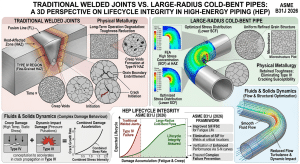
然而,CSEF 鋼材在工程實務上面臨著一個極為致命的物理冶金弱點,即對熱循環與應變局部化的極度敏感性1。傳統的管線佈局高度依賴符合 ASME B16.9 標準的 1.5D 短半徑鍛造對銲彎頭(Welded Elbows)。這意味著在應力最為集中的幾何轉向處,必然存在多道次的環向與縱向銲縫。在長期高溫服役下,這些銲接熱影響區(Heat-Affected Zone, HAZ)內的細晶區(FGHAZ)與間臨界區(ICHAZ)會發生嚴重的微觀組織退化,最終誘發「第四型潛變破裂」(Type IV Creep Cracking)1。此類破裂模式極具隱蔽性,往往在毫無巨觀變形預警的情況下瞬間爆發;若再伴隨管線系統中常見的動態衝擊(如蒸汽錘效應),將瞬間擊穿退化材料的破壞韌性極限值,引發災難性的斷裂失效8。However, CSEF steels face a highly fatal physical metallurgy weakness in engineering practice: extreme sensitivity to thermal cycling and strain localization1. Traditional piping layouts rely heavily on 1.5D short-radius forged welded elbows conforming to the ASME B16.9 standard. This implies the inevitable presence of multi-pass circumferential and longitudinal welds at geometrical turns where stress is most concentrated. Under long-term high-temperature service, the fine-grained heat-affected zone (FGHAZ) and intercritical heat-affected zone (ICHAZ) within these weldments undergo severe microstructural degradation, ultimately inducing “Type IV Creep Cracking”1. This fracture mode is highly insidious, often occurring instantaneously without any macroscopic deformation warning. If accompanied by dynamic impacts common in piping systems (such as the steam hammer effect), it will instantly breach the fracture toughness limit of the degraded material, triggering a catastrophic rupture failure8.
隨著國際管線設計標準的演進,2024 至 2026 年版的 ASME B31.1(動力管線規範)與 B31.3(製程管線規範)進行了歷史性的改版。新規範正式廢除沿用半個世紀的附錄 D(Appendix D),強制全面導入 ASME B31J 作為應力強化因子(Stress Intensification Factors, SIFs)與柔性係數(Flexibility Factors, k-factors)的唯一計算標準4。此規範變革,不僅在力學計算層面上無情地揭露了 1.5D 傳統銲接彎頭在複雜三維負載下的脆弱性,同時也為「以彎代銲」(Bend rather than weld)的 3D/5D 大半徑數控冷作彎管(CNC Cold Bending)技術提供了堅實的法規與力學背書11。本研究報告將深入剖析傳統對銲接頭在長期運轉下破壞韌性下降的微觀機制,探討 Type IV 潛變與動態衝擊的複合損傷行為,並基於最新的 2026 版 ASME B31J 規範,從固體力學、流體動力學與物理冶金學的三維視角,全面論證大半徑冷作彎管工法如何透過移除 HAZ 弱點與優化應力分佈,從根本上確保高能管線的生命週期完整性。With the evolution of international piping design standards, the 2024 to 2026 editions of ASME B31.1 (Power Piping Code) and B31.3 (Process Piping Code) have undergone historic revisions. The new codes officially abolish Appendix D, which had been in use for half a century, and mandate the comprehensive implementation of ASME B31J as the sole calculation standard for Stress Intensification Factors (SIFs) and Flexibility Factors (k-factors)4. This regulatory paradigm shift not only relentlessly exposes the vulnerability of traditional 1.5D welded elbows under complex 3D loads at the mechanical calculation level, but also provides solid regulatory and mechanical endorsement for the 3D/5D large-radius CNC Cold Bending technology, guided by the “Bend rather than weld” philosophy11. This research report will deeply analyze the micro-mechanisms of fracture toughness degradation in traditional welded joints during long-term operation, explore the composite damage behavior of Type IV creep and dynamic impact, and comprehensively demonstrate from the 3D perspectives of solid mechanics, fluid dynamics, and physical metallurgy how the large-radius cold bending method fundamentally ensures the lifecycle integrity of high-energy piping by eliminating HAZ weaknesses and optimizing stress distribution, based on the latest 2026 ASME B31J code.
二、傳統對銲接頭之微觀冶金缺陷與 Type IV 潛變破裂機制 / II. Micro-metallurgical Defects of Traditional Welded Joints and Type IV Creep Cracking Mechanisms
2.1 CSEF 鋼之強化機制與熱力學不穩定性 / 2.1 Strengthening Mechanisms and Thermodynamic Instability of CSEF Steels
P91 與 P92 等 9% 鉻系馬氏體耐熱鋼的優異高溫強度,並非單純依賴固溶強化,而是源於極為精密的合金成分配比與出廠前嚴格的正火及回火(Normalizing & Tempering, N&T)熱處理程序1。其微觀組織的穩定性仰賴於各種合金元素的協同作用。鉻提供抗高溫蒸汽氧化能力;鉬與鎢提供高溫固溶強化並抑制回火脆性;微量的釩(V)、鈮(Nb)與氮(N)則在高溫回火過程中析出極為細小且穩定的 MX 型碳氮化物1。此外,P92 更引入了硼(B)元素,透過偏析於晶界以抑制晶界滑移,進一步提升潛變抗力1。這些奈米級析出相與富鉻的金屬碳化物(M23C6)共同釘紮(Pinning)在馬氏體板條(Lath)與原奧氏體晶界(Prior Austenite Grain Boundaries, PAGB)上,有效阻礙了高溫下差排(Dislocations)的滑移與攀移16。The excellent high-temperature strength of 9% chromium martensitic heat-resistant steels such as P91 and P92 does not rely solely on solid solution strengthening; rather, it originates from extremely precise alloy composition ratios and strict pre-delivery Normalizing & Tempering (N&T) heat treatment procedures1. The stability of their microstructure depends on the synergistic effect of various alloying elements. Chromium provides high-temperature steam oxidation resistance; molybdenum and tungsten offer high-temperature solid solution strengthening and suppress temper embrittlement; trace amounts of vanadium (V), niobium (Nb), and nitrogen (N) precipitate as extremely fine and stable MX-type carbonitrides during high-temperature tempering1. Furthermore, P92 introduces boron (B), which segregates at grain boundaries to inhibit grain boundary sliding, further enhancing creep resistance1. These nanoscale precipitates and chromium-rich metal carbides (M23C6) jointly pin the martensite laths and prior austenite grain boundaries (PAGB), effectively impeding the sliding and climb of dislocations at high temperatures16.
| 合金元素 (Alloying Elements) | 在 P91/P92 中之冶金角色與物理功能 (Metallurgical Role and Physical Function) | 含量失衡之負面效應 (Negative Effects of Imbalance) |
| 碳 (C) | 形成各類碳化物,提供析出強化與晶界釘紮。 (Forms carbides for precipitation strengthening and grain boundary pinning.) | 過高導致韌性下降;過低則強度不足。 (Excess lowers toughness; deficiency lacks strength.) |
| 鉻 (Cr) | 提供高溫抗氧化性,為形成 M23C6 之主要元素。 (Provides oxidation resistance; main element for M23C6 .) | 誘發 Z 相快速析出,導致潛變強度斷崖式下降。 (Induces Z-phase precipitation, causing sharp strength drops.) |
| 鉬/鎢 (Mo/W) | 提供強效高溫固溶強化,減緩碳化物粗化速率。 (Provides strong solid solution strengthening; slows carbide coarsening.) | 過高易引發低溫區粗大 Laves 相析出。 (Excess triggers coarse Laves phase precipitation at low temps.) |
| 釩/鈮 (V/Nb) | 形成高穩定性、奈米級之 MX 碳氮化物,阻礙差排運動。 (Forms highly stable nanoscale MX carbonitrides to hinder dislocations.) | 缺乏將無法生成 MX 相,導致潛變壽命巨幅縮減。 (Deficiency prevents MX formation, drastically reducing creep life.) |
| 氮 (N) | 與釩、鈮結合形成 MX;必須與鋁 (Al) 比例嚴格控制。 (Combines with V/Nb to form MX; must be strictly balanced with Al.) | 若鋁雜質過高,將搶奪氮形成粗大 AlN,剝奪強化相。 (Excess Al steals N to form coarse AlN, depriving strengthening phases.) |
| 硼 (B) | 偏析於晶界,抑制晶界滑移,並穩定 M23C6。 (Segregates at grain boundaries to inhibit sliding and stabilize M23C6 .) | 含量不當將導致粗大氮化硼生成,降低破壞韌性。 (Improper levels form coarse boron nitrides, reducing fracture toughness.) |
(表 1:CSEF 鋼之核心合金元素及其冶金強化機制與失衡風險綜合分析 / Table 1: Comprehensive Analysis of Core Alloying Elements in CSEF Steels, Their Metallurgical Strengthening Mechanisms, and Imbalance Risks) [cite: 1, 17, 19]
然而,這種非平衡的回火馬氏體微觀組織在熱力學上極具敏感性1。當母材經歷現場銲接電弧的高熱輸入時,原有的熱力學平衡被瞬間打破,導致銲縫兩側形成微觀組織與力學性質差異極大的熱影響區(HAZ)。這種破壞性的熱循環正是後續一切失效機制的開端。However, this non-equilibrium tempered martensite microstructure is highly sensitive thermodynamically1. When the base metal experiences the high heat input of an on-site welding arc, the original thermodynamic equilibrium is instantaneously shattered, resulting in the formation of heat-affected zones (HAZ) on both sides of the weld with vastly different microstructures and mechanical properties. This destructive thermal cycling is precisely the genesis of all subsequent failure mechanisms.
2.2 ICHAZ/FGHAZ 之微觀退化與三軸應力局部化 / 2.2 Microstructural Degradation and Triaxial Stress Localization in ICHAZ/FGHAZ
Type IV 潛變破裂特指發生在銲接熱影響區最外緣,亦即間臨界熱影響區(ICHAZ)或細晶熱影響區(FGHAZ)的過早脆性失效1。此區域的形成機制與銲接熱循環中的峰值溫度(Tp)密切相關。在銲接過程中,ICHAZ 所經歷的峰值溫度恰好落於材料的下臨界溫度(AC1,對於 P91 約為 800°C 至 830°C)與上臨界溫度(AC3,約為 890°C 至 940°C)之間1。在此特定的溫度區間內,鐵素體基體發生不完全的奧氏體相變。原先穩固釘紮晶界的 M23C6 與 MX 析出物在此過程中發生部分溶解,隨後又在不穩定的狀態下異常粗化,徹底失去對次晶界的釘紮能力1。Type IV creep cracking specifically refers to the premature brittle failure occurring at the outermost edge of the weld heat-affected zone, namely the intercritical heat-affected zone (ICHAZ) or the fine-grained heat-affected zone (FGHAZ)1. The formation mechanism of this region is closely related to the peak temperature (Tp) during the welding thermal cycle. During welding, the peak temperature experienced by the ICHAZ falls exactly between the material’s lower critical temperature (AC1 , approximately 800°C to 830°C for P91) and the upper critical temperature (AC3 , approximately 890°C to 940°C)1. Within this specific temperature range, the ferrite matrix undergoes an incomplete austenitic phase transformation. The M23C6 and MX precipitates, which previously securely pinned the grain boundaries, partially dissolve during this process and subsequently coarsen abnormally in an unstable state, completely losing their pinning capability on sub-grain boundaries1.
伴隨後續的冷卻與銲後熱處理(PWHT),該區域形成強度極低的「多邊形鐵素體」(Polygonal Ferrite)與過回火馬氏體(Over-tempered Martensite)混合組織11。其硬度與潛變抗力呈現斷崖式下降,在管壁內部形成一道極窄的軟化帶(Soft Zone)。在巨觀力學層面,由於銲道金屬與未受影響的母材潛變強度顯著高於狹窄的 ICHAZ/FGHAZ,導致機組滿載服役的保載(Dwell)期間,周圍強硬組織的應變被迫轉移。在「彈性隨動」(Elastic follow-up)效應驅動下,變形高度集中於軟弱的 FGHAZ 內部17。Following subsequent cooling and post-weld heat treatment (PWHT), this region forms a mixed microstructure of extremely low-strength “polygonal ferrite” and “over-tempered martensite”11. Its hardness and creep resistance plummet drastically, forming a very narrow soft zone within the pipe wall. At the macroscopic mechanical level, because the creep strength of the weld metal and the unaffected base metal is significantly higher than that of the narrow ICHAZ/FGHAZ, the strain from the surrounding stronger structures is forced to transfer during the dwell period of full-load service. Driven by the “elastic follow-up” effect, deformation becomes highly concentrated within the weak FGHAZ17.
這種顯著的剛度失配(Stiffness Mismatch)在材料內部激發了強烈的三軸應力狀態(Triaxial Stress State)17。在三軸應力與應變局部化的雙重驅動下,潛變空洞(Creep Cavities)在晶界處的成核率呈指數級上升18。冶金微觀觀察顯示,這些微孔洞會沿著原奧氏體晶界快速成核、長大,並藉由晶界滑移彼此串聯(Coalescence),最終演化為巨觀的沿晶微裂紋7。根據歐洲潛變協作委員會(ECCC)與美國電力研究所(EPRI)的長期驗證資料,P91 鋼銲接接頭在 600°C 條件下的實際潛變壽命,往往僅為未銲接母材的五分之一甚至十分之一23。This significant stiffness mismatch induces a strong triaxial stress state within the material17. Driven simultaneously by triaxial stress and strain localization, the nucleation rate of creep cavities at grain boundaries rises exponentially18. Micro-metallurgical observations reveal that these micro-cavities rapidly nucleate and grow along the prior austenite grain boundaries, linking together via grain boundary sliding (coalescence) to ultimately evolve into macroscopic intergranular microcracks7. According to long-term validation data from the European Creep Collaborative Committee (ECCC) and the Electric Power Research Institute (EPRI), the actual creep life of P91 steel welded joints at 600°C is often only one-fifth to one-tenth that of the unwelded base metal23.
三、破壞韌性衰退與動態衝擊之複合破壞風險 / III. Decline in Fracture Toughness and Composite Failure Risk from Dynamic Impact
Type IV 損傷最危險的特徵在於其屬於「低延展性脆性斷裂」(Low-ductility brittle fracture)7。在潛變壽命的前百分之七十至八十階段,金屬表面幾乎觀察不到任何巨觀的塑性鼓脹(Bulging)或變形,損傷完全以次表面(Sub-surface)的微觀孔洞形式隱蔽累積11。這種隱蔽性使得傳統基於外徑量測或表面覆膜金相(Replication)的非破壞檢測手段經常失效,因為當表面觀察到巨觀裂紋時,內部往往已達臨界破裂尺寸與極限值26。The most dangerous characteristic of Type IV damage is its nature as a “low-ductility brittle fracture”7. During the first 70% to 80% of the creep life, almost no macroscopic plastic bulging or deformation can be observed on the metal surface; the damage accumulates entirely covertly in the form of sub-surface micro-cavities11. This concealment frequently renders traditional non-destructive testing methods based on outer diameter measurements or surface replication metallography ineffective. By the time macroscopic cracks are observed on the surface, the interior has often already reached the critical rupture dimension and limit value26.
3.1 破壞韌性之深層衰退 / 3.1 Deep Decline of Fracture Toughness
隨著潛變孔洞密集化,FGHAZ 區域的破壞韌性(Fracture Toughness)急遽衰退。先進斷裂力學測試,包括 ASTM E1820 的J1c(J 積分極限值)與 ASTM E399 的 K1c(臨界應力強度因子)結果顯示,經歷長期潛變老化的 HAZ,其裂紋尖端張開位移(CTOD)與臨界應力強度因子遠低於未受影響的母材30。微觀組織中粗大的 Laves 相與溶解後重新析出的碳化物,不僅無法提供潛變強度,反而成為微裂紋優先萌生的應力集中點,進一步惡化了夏比 V 型缺口(Charpy V-notch)衝擊吸收能,使得原本應具備高韌性的材料在服役中期徹底轉變為脆性狀態19。As creep cavities become denser, the fracture toughness of the FGHAZ region deteriorates sharply. Advanced fracture mechanics tests, including ASTM E1820’s J1c (critical J-integral value) and ASTM E399’s K1c (critical stress intensity factor), show that the crack tip opening displacement (CTOD) and critical stress intensity factors of the HAZ, having undergone long-term creep aging, are far lower than those of the unaffected base metal30. The coarse Laves phase and re-precipitated carbides in the microstructure not only fail to provide creep strength, but instead act as stress concentration points for preferential microcrack initiation. This further deteriorates the Charpy V-notch impact absorbing energy, causing a material that should possess high toughness to completely transition into a brittle state midway through its service life19.
3.2 蒸汽錘(Steam Hammer)與動態衝擊之致命疊加 / 3.2 Fatal Superposition of Steam Hammer and Dynamic Impacts
在複循環發電廠的實際營運中,管線系統難免遭受到動態負載的衝擊,其中最具破壞性的便是「蒸汽錘」(Steam Hammer)或「水錘」(Water Hammer)效應8。當系統內的控制閥門急遽關閉、安全閥起跳,或是兩相流體在管內發生劇烈相變時,會產生高達數百百萬帕斯卡(MPa)的瞬間流體動力學衝擊波8。In the actual operation of combined cycle power plants, piping systems inevitably suffer from dynamic load impacts, the most destructive of which is the “steam hammer” or “water hammer” effect8. When control valves within the system close abruptly, safety valves pop, or severe phase changes of two-phase fluids occur inside the pipes, instantaneous hydrodynamic shock waves of up to several hundred Megapascals (MPa) are generated8.
當高頻、高振幅的動態衝擊波傳遞至帶有 Type IV 潛變損傷的 1.5D 對銲彎頭時,破壞力會呈現非線性疊加。首先,幾何不連續性(如銲趾 Weld Toe)與彎管外弧處的應力集中,會將蒸汽錘的衝擊應力放大數倍。其次,FGHAZ 區域原本已因潛變孔洞串聯而達到極限值,其剩餘的J1c 破壞韌性根本無法吸收瞬間龐大的彈性應變能。結果將導致原本處於亞臨界擴展(Sub-critical growth)的微裂紋,在毫秒之間發生失穩擴展,引發災難性的瞬間爆管。這種現象被業界稱為「破裂而未洩漏」(Break-before-leak)模式,完全剝奪了操作人員採取緊急停機措施的反應時間,對工廠資產與人員安全構成極端威脅12。When these high-frequency, high-amplitude dynamic shock waves propagate to 1.5D welded elbows carrying Type IV creep damage, the destructive forces exhibit non-linear superposition. First, geometric discontinuities (such as the weld toe) and stress concentrations at the extrados of the bend amplify the steam hammer’s impact stress by several times. Second, because the FGHAZ has already reached its limit value due to the coalescence of creep cavities, its residual J1c fracture toughness is fundamentally incapable of absorbing the massive instantaneous elastic strain energy. Consequently, microcracks originally in a state of sub-critical growth undergo unstable propagation within milliseconds, triggering a catastrophic instantaneous pipe explosion. This phenomenon, known in the industry as the “break-before-leak” mode, completely deprives operators of response time to initiate emergency shutdown measures, posing an extreme threat to plant assets and personnel safety12.
四、潛變-疲勞交互作用與斷裂力學評估模型 (ECA) / IV. Creep-Fatigue Interaction and Fracture Mechanics Assessment Models (ECA)
為了量化評估高能管線銲縫在現代機組頻繁調峰操作(Peaking operation)下的失效風險,現代工程臨界評估(Engineering Critical Assessment, ECA)已逐漸放棄傳統且不保守的 Miner-Robinson 線性損傷疊加法則(即 ∑Ni/Nfi +∑ti/tri =D)。學界與產業界轉而採用更能精確反映微觀冶金交互作用的非線性斷裂力學模型23。To quantitatively assess the failure risk of high-energy piping welds under the frequent peaking operations of modern units, modern Engineering Critical Assessment (ECA) has gradually abandoned the traditional and unconservative Miner-Robinson linear damage superposition rule (i.e., ∑Ni/Nfi +∑ti/tri =D). Academia and industry are pivoting toward non-linear fracture mechanics models that more accurately reflect microscopic metallurgical interactions23.
4.1 延性耗竭(Ductility Exhaustion)與應力多軸性 / 4.1 Ductility Exhaustion and Stress Multiaxiality
在頻繁起停的熱循環下,P91/P92 鋼的疲勞退化伴隨嚴重的「循環軟化」(Cyclic Softening)效應。根據微觀力學模型,材料的降伏強度隨循環次數不斷下降。在應力控制的工況下,這導致每次熱循環累積的塑性應變幅(Δεp)逐漸放大,進一步加速材料邁向破壞的進程23。Under frequent start-stop thermal cycling, the fatigue degradation of P91/P92 steels is accompanied by severe “cyclic softening” effects. According to micro-mechanical models, the material’s yield strength continuously decreases with the number of cycles. Under stress-controlled conditions, this causes the accumulated plastic strain amplitude (Δεp) in each thermal cycle to gradually amplify, further accelerating the material’s progression toward failure23.
針對此現象,延性耗竭法則(Ductility Exhaustion Approach)提供了更精確的預測基礎。該模型指出,HAZ 內部累積的潛變應變一旦達到材料在該應力狀態下的「破壞應變」(Failure strain 或 Creep ductility),即會發生破裂23。特別是引入應力多軸性(Stress Multiaxiality)修正後,模型精確預測了 FGHAZ 在保載條件下的提早破裂。由於局部的三軸應力強烈抑制了材料的塑性流動,導致多軸潛變延展性遠低於單軸拉伸測試值,這正是 Type IV 損傷巨觀上表現為極低延展性脆性斷裂的力學根源23。Addressing this phenomenon, the Ductility Exhaustion Approach provides a more precise predictive foundation. This model indicates that once the accumulated creep strain within the HAZ reaches the material’s “failure strain” (or creep ductility) under that specific stress state, rupture will occur23. Particularly with the introduction of the stress multiaxiality correction, the model accurately predicts the early rupture of the FGHAZ under dwell conditions. Because localized triaxial stress strongly inhibits the material’s plastic flow, multiaxial creep ductility is far lower than uniaxial tensile test values. This is the precise mechanical root of why Type IV damage manifests macroscopically as extremely low-ductility brittle fracture23.
4.2 NSW 模型與 C* 積分預測潛變裂紋擴展 / 4.2 NSW Model and C* Integral for Predicting Creep Crack Growth
針對潛變裂紋擴展(Creep Crack Growth, CCG)階段,斷裂力學界廣泛採用基於 C* 積分的 Nikbin-Smith-Webster (NSW) 模型23。其核心方程式將穩態潛變下裂紋的擴展速率 da/dt 與裂紋尖端約束參數 C* 建立緊密關聯:For the creep crack growth (CCG) phase, the fracture mechanics community widely adopts the Nikbin-Smith-Webster (NSW) model based on the C* integral23. Its core equation establishes a close correlation between the crack growth rate under steady-state creep, da/dt, and the crack tip constraint parameter C*:
da/dt=(n+1)/(ϵf*⋅Inc ) (C*/A)n/(n+1) rc^1/(n+1)
方程式中,n 為 Norton 潛變指數,ϵf* 為多軸應力狀態下的有效破壞應變(Multiaxial Creep Ductility),A 為潛變係數,而 rc 為潛變損傷過程區的特徵尺寸37。NSW 模型的深遠意義在於證實了裂紋尖端約束(Constraint)的決定性影響。當應力狀態由平面應力(Plane Stress)轉向平面應變(Plane Strain,代表高三軸應力)時,有效破壞應變 ϵf* 會大幅縮減。實驗指出,平面應變條件下的裂紋擴展速率可高達平面應力條件下的五十倍37。在傳統 1.5D 銲接彎頭的幾何不連續處,恰好提供了極佳的平面應變約束條件,使得微裂紋一旦在 HAZ 內部成核,便會以極高的非線性速率貫穿管壁,最終導致破裂23。In the equation, n is the Norton creep exponent, ϵf* is the effective failure strain (multiaxial creep ductility) under a multiaxial stress state, A is the creep coefficient, and rc is the characteristic dimension of the creep damage process zone37. The profound significance of the NSW model lies in its confirmation of the decisive influence of crack tip constraint. When the stress state shifts from plane stress to plane strain (representing high triaxial stress), the effective failure strain ϵf* is drastically reduced. Experiments indicate that crack growth rates under plane strain conditions can be up to fifty times higher than those under plane stress conditions37. The geometrical discontinuities of traditional 1.5D welded elbows happen to provide excellent plane strain constraint conditions, enabling microcracks, once nucleated within the HAZ, to penetrate the pipe wall at extremely high, non-linear rates, ultimately leading to rupture23.
五、基於 2026 年版 ASME B31J 規範之管線空間應力分佈解析 / V. Spatial Stress Distribution Analysis of Piping Based on the 2026 ASME B31J Code
面對 1.5D 銲接彎頭在實務中頻發的疲勞與潛變失效,美國機械工程師學會(ASME)委員會進行了徹底的規範改革。自 2020 年版 B31.3 開始,並延續至 2024 及 2026 年版 B31.1,正式廢除傳統的附錄 D(Appendix D),全面強制實施 ASME B31J《金屬管件應力強化因子(i-Factors)與柔性係數(k-Factors)之決定標準》4。In response to the frequent fatigue and creep failures of 1.5D welded elbows in practice, the American Society of Mechanical Engineers (ASME) committee implemented radical code reforms. Beginning with the 2020 edition of B31.3 and continuing into the 2024 and 2026 editions of B31.1, the traditional Appendix D was officially abolished, mandating the comprehensive implementation of ASME B31J, “Standard for Stress Intensification Factors (i-Factors) and Flexibility Factors (k-Factors) for Metallic Piping Components”4.
5.1 從傳統單一純量 SIF 到空間方向性彈性矩陣 / 5.1 From Traditional Single Scalar SIFs to Spatial Directional Flexibility Matrices
過去半個世紀,ASME B31 系列規範計算疲勞位移應力容許範圍的核心基石,是建立在 A.R.C. Markl 於 1950 年代基於薄壁碳鋼管進行的平面疲勞測試之上14。Markl 導出的經典方程式為 i⋅Sa=245,000N-0.2,並預設標準直管對銲縫的 SIF 為 1.0 14。然而,實際上一道標準的碳鋼對銲縫其 SIF 約介於 1.7 至 2.0 之間,這意味著傳統規範中的 SIF 數值實際上已被隱含折減了近一半42。For the past half-century, the core cornerstone of the ASME B31 series codes for calculating allowable fatigue displacement stress ranges has rested on the planar fatigue tests conducted by A.R.C. Markl on thin-walled carbon steel pipes in the 1950s14. The classic equation derived by Markl is i⋅Sa=245,000N-0.2, with a default SIF of 1.0 for standard straight pipe girth welds14. However, in reality, the SIF of a standard carbon steel girth butt weld ranges from 1.7 to 2.0, meaning the SIF values in the traditional codes were actually implicitly reduced by nearly half42.
更致命的是,傳統附錄 D 將複雜的三維彎矩簡化為單一合成力矩,並統一乘以一個未區分方向的最大純量 SIF14。這種「單一純量理論」完全忽略了厚壁管抵抗橫截面扁平化(Ovalization)的能力,以及真實三維空間中的多軸應力張量分佈,導致計算結果存在極大的保守誤差與空間盲點11。在 2022 年版的 B31.3 中,規範甚至將高循環次數下的疲勞壽命曲線指數由 -0.2修正為-0.333(即f=20N-0.333),顯示管線疲勞壽命對應力振幅的敏感度遠比過去假設的更高,對應力評估提出更嚴苛的要求13。More fatally, the traditional Appendix D simplified complex 3D bending moments into a single resultant moment and uniformly multiplied it by a maximum scalar SIF that lacked directional distinction14. This “single scalar theory” completely ignored the ability of thick-walled pipes to resist cross-sectional ovalization, as well as the multiaxial stress tensor distribution in true 3D space, leading to immense conservative errors and spatial blind spots in the calculation results11. In the 2022 edition of B31.3, the code even revised the fatigue life curve exponent for high cycle counts from -0.2 to -0.333 (i.e., f=20N-0.333). This indicates that piping fatigue life is far more sensitive to stress amplitudes than previously assumed, imposing much stricter requirements on stress evaluations13.
為解決上述缺陷,2026 年版 ASME B31J 導入了「空間解耦的彈性矩陣」(Spatially Decoupled Flexibility Matrix)概念,針對管件的三個空間方向分別定義了獨立參數:To resolve the aforementioned defects, the 2026 edition of ASME B31J introduces the concept of a “Spatially Decoupled Flexibility Matrix,” defining independent parameters for the three spatial directions of piping components:
- 面內(In-Plane):當彎矩導致彎頭產生張角「打開」或「閉合」的變形趨勢時,應用面內應力強度因子ii = 0.9/h2/3 與專屬的面內柔性係數 ki。In-Plane: Applied when bending moments cause the bend to exhibit a deformation trend of “opening” or “closing” its included angle, utilizing an in-plane stress intensification factor ii = 0.9/h2/3 and a dedicated in-plane flexibility factor ki .
- 面外(Out-of-Plane):當彎矩迫使管件發生橫向「扭曲」時,應用面外應力強度因子 io = 0.75/h2/3與面外柔性係數 ko。Out-of-Plane: Applied when bending moments force the component to undergo lateral “twisting,” utilizing an out-of-plane stress intensification factor io = 0.75/h2/3 and an out-of-plane flexibility factor ko.
- 扭轉(Torsional):精確反映三維扭矩造成的剪應力集中,引入專屬的扭轉 SIF(it)與扭轉柔性係數(kt),修正了過去將扭轉 SIF 默認為0 的嚴重失真。Torsional: Accurately reflects shear stress concentration caused by 3D torsion by introducing a dedicated torsional SIF (it) and torsional flexibility factor (kt), correcting the severe distortion of defaulting the torsional SIF to 1.0 in the past.
| 力學分析參數 (Mechanical Analysis Parameters) | 傳統 1.5D 銲接彎頭 (Traditional 1.5D Welded Elbows) | 3D/5D 大半徑冷作彎管 (3D/5D Large-Radius Cold Bends) | 系統影響與工程意義 (System Impact and Engineering Significance) |
| 彎曲半徑 (R1) | 極小 (1.5*Do) | 極大 (3.0*Do 或 5.0*Do) | 決定應力消散空間與流體邊界層過渡平順度 (Determines stress dissipation space and fluid boundary layer transition smoothness) |
| 柔性特徵值 (h) | 偏低,易發生截面橢圓化 (Low, prone to cross-section ovalization) | 顯著提升,截面抗變形剛度極高 (Significantly increased, extremely high cross-section deformation stiffness) | h 值越高,管件受彎矩時幾何穩定性越強 (Higher h means stronger geometric stability under bending moments) |
| 應力強度因子 (SIFs) | 極高 (i ≧ 3),採單一純量 (Extremely high, single scalar calculated) | 極低,精確解耦為 ii,io,it (Extremely low, precisely decoupled to ii,io,it) | 冷彎管免除虛假應力放大,避免過度設計 (Cold bends eliminate false stress amplification, avoiding over-design)4 |
| 疲勞與潛變風險 (Fatigue & Creep Risk) | 極高 (HAZ 位於最大應力與紊流區) (Extremely high, HAZ in max stress & turbulence zones) | 完全消除 (物理上無銲縫與 HAZ) (Completely eliminated, physically no weld or HAZ) | 冷彎從根本移除脆弱介面,杜絕 Type IV (Cold bending fundamentally removes fragile interfaces, preventing Type IV)4 |
(表 2:1.5D 銲接彎頭與 3D/5D 冷作彎管基於 B31J 之力學特徵對比 / Table 2: Comparison of Mechanical Characteristics Between 1.5D Welded Elbows and 3D/5D Cold Bends Based on B31J)
5.2 1.5D 銲接彎頭之幾何畸變與應力集中效應 / 5.2 Geometric Distortion and Stress Concentration Effects of 1.5D Welded Elbows
在 B31J 的嚴格檢視下,管件的力學表現取決於其核心無因次參數「柔性特徵值」(Flexibility Characteristic, h),其閉合公式定義為:Under the strict scrutiny of B31J, the mechanical performance of a piping component depends on its core dimensionless parameter, the “Flexibility Characteristic” (h), defined by the closed-form equation:
h=T⋅R1/r22
其中,T 為管線公稱壁厚,R1 為彎曲中心半徑,r2 為管線平均半徑11。 Where T is the nominal wall thickness, R1 is the bend center radius, and r2 is the mean pipe radius11.
對於傳統的 1.5D 短半徑銲接彎頭,由於彎曲半徑 R1 極小,導致計算出的 h 值偏低。這在固體力學上意味著管件在受彎矩作用時,會發生劇烈的橫截面畸變(截面橢圓化現象,Ovalization)11。根據 B31J 公式,極低的 h 值會使得面內應力強度因子ii 與面外應力強度因子io 呈指數級飆升。在實際管線系統中,代表因高溫熱膨脹產生的位移應力在 1.5D 彎頭處會被不合理地放大數倍。為了解決計算上的應力超標,工程師被迫在工廠內加裝大量昂貴的剛性管架(Rigid Supports)、導向裝置與阻尼器(Snubbers)。這不僅推升建廠成本,更因對管線的過度拘束而引發破壞性的二次應力(Secondary Stress),反而加劇了彎頭處 HAZ 發生 Type IV 潛變破裂的風險。For traditional 1.5D short-radius welded elbows, the extremely small bend radius R1 results in a low calculated h value. In solid mechanics, this means that the component will undergo severe cross-sectional distortion (cross-sectional ovalization) when subjected to bending moments11. According to B31J formulas, an extremely low h value causes the in-plane stress intensification factor ii and out-of-plane SIF io to skyrocket exponentially. In actual piping systems, this implies that the displacement stresses generated by high-temperature thermal expansion are unreasonably amplified several times over at the 1.5D elbow. To resolve these calculated stress exceedances, engineers are forced to install numerous expensive rigid supports, guides, and snubbers in the plant. This not only inflates construction costs but also induces destructive secondary stresses due to the over-constraint of the piping, ironically exacerbating the risk of Type IV creep cracking at the HAZ of the elbows.
5.3 3D/5D 冷作彎管之應力消散優勢與柔性補償 / 5.3 Stress Dissipation Advantages and Flexibility Compensation of 3D/5D Cold Bends
相較之下,採用 3D(R1=3Do)或 5D(R1=5Do)的大半徑冷作彎管,幾何彎曲半徑倍增使得 h 值顯著提升11。數值分析與 FEA 模擬顯示,5D 冷彎管在幾何力學上的表現幾乎等同於理想直管,應力集中效應極低14。In contrast, by adopting 3D (R1=3Do) or 5D (R1=5Do) large-radius cold bends, the multiplication of the geometric bend radius significantly elevates the h value11. Numerical analyses and FEA simulations reveal that the geometric-mechanical performance of a 5D cold bend is nearly identical to an ideal straight pipe, presenting extremely low stress concentration effects14.
將此力學優勢代回前述的疲勞模型中:由於 3D/5D 冷作彎管的 SIF 被大幅抑制,管壁承受的實際塑性應變幅(Δεp)急遽縮小。在疲勞延性指數 c 所賦予的非線性效應下,應變幅的些微下降即可換來熱疲勞壽命幾何級數的巨大增長。此外,在 B31J 的空間彈性矩陣中,柔性係數 k(k = 1.65/h)的重新定義,使得大半徑冷彎管能提供優異的系統柔性補償(Flexibility Compensation),自主吸收熱膨脹位移,大幅降低管系整體對端點設備的拘束反力。Substituting this mechanical advantage back into the aforementioned fatigue model: Because the SIF of 3D/5D cold bends is massively suppressed, the actual plastic strain amplitude (Δεp) endured by the pipe wall shrinks drastically. Under the non-linear effects imparted by the fatigue ductility exponent c, even a slight decrease in the strain amplitude translates to an exponential, massive increase in thermal fatigue life. Furthermore, within B31J’s spatial flexibility matrix, the redefinition of the flexibility factor k (k = 1.65/h) allows large-radius cold bends to provide outstanding systemic flexibility compensation. They autonomously absorb thermal expansion displacements, vastly reducing the overall constraint reactions exerted by the piping system on terminal equipment.
六、冷作彎管工法消除 HAZ 弱點之工程實證與冶金調控 / VI. Engineering Empirical Data and Metallurgical Regulation of Cold Bending to Eliminate HAZ Weaknesses
2026 年版 ASME 規範的演進不僅是數學公式的更迭,更宣示了高能動力管線「以彎代銲」的工程範式轉移。透過 CNC 室溫冷作彎管工法,直接對 P91/P92 母管進行 3D 或 5D 成形,在實體空間中徹底移除幾何轉向處的銲縫。此技術從物理上根絕了 ICHAZ 軟化帶的出現,完全消弭最致命的 Type IV 潛變破裂風險與銲道強度折減係數(WSRF)的懲罰11。The evolution of the 2026 ASME codes is not merely a replacement of mathematical formulas, but a declaration of the engineering paradigm shift toward “Bend rather than weld” for high-energy piping. By utilizing CNC room-temperature cold bending methods to directly form 3D or 5D bends on P91/P92 mother pipes, the welds at geometric turns are thoroughly removed in physical space. This technology physically eradicates the emergence of the ICHAZ softening band, completely eliminating the most fatal risk of Type IV creep cracking and the penalties of the Weld Strength Reduction Factor (WSRF)11.
6.1 大半徑冷作成形之流體力學效益與 WSRF 豁免 / 6.1 Fluid Dynamics Benefits and WSRF Exemption of Large-Radius Cold Forming
在流體動力學層面,高壓蒸汽以高速進入 1.5D 彎頭時,極小的曲率半徑會激發異常強烈的二次流與迪恩渦流(Dean Vortices)。這會引發流體分離,生成大面積的負壓梯度區與回流區,導致管壁遭受流體加速腐蝕(FAC)與應力腐蝕開裂(SCC)的嚴重威脅4。改採 3D/5D 冷作彎管後,迪安數(Dean Number, De = Re√D/2Rc)因曲率半徑 Rc 放大而顯著下降。流線得以緊密附著於管壁,流體轉向極為平滑,大幅消散渦流能量,並降低固相顆粒的撞擊角,徹底解決局部異常沖蝕難題4。On the fluid dynamics level, when high-pressure steam enters a 1.5D elbow at high velocities, the extremely small radius of curvature excites exceptionally strong secondary flows and Dean Vortices. This triggers flow separation, generating large areas of adverse pressure gradients and recirculation zones, causing the pipe wall to face severe threats from Flow-Accelerated Corrosion (FAC) and Stress Corrosion Cracking (SCC)4. After switching to 3D/5D cold bends, the Dean Number (De = Re√D/2Rc)) drops significantly due to the enlargement of the bend radius Rc . Streamlines are able to adhere closely to the pipe wall, ensuring extremely smooth fluid turns, massively dissipating vortex energy, and reducing the impingement angle of solid particles, completely solving local abnormal erosion dilemmas4.
更重要的是,ASME B31.1 在 Table 102.4.7-1 中強制要求對處於潛變範圍內的縱向與環向銲縫引入「銲道強度折減係數」(Weld Strength Reduction Factor, WSRF)。對於 P91/P92 材質,在高溫長期服役下,其 WSRF 值可能被折減至 0.7 甚至更低1。採用一體成型的冷作彎管,因無銲縫存在,得以完全豁免 WSRF 的嚴厲懲罰,允許工程師採用更薄的管壁厚度,避免在特定需求下升級至昂貴的高階不銹鋼材質,進一步減輕系統重量與熱應力。More importantly, ASME B31.1 in Table 102.4.7-1 mandates the introduction of a “Weld Strength Reduction Factor” (WSRF) for longitudinal and circumferential welds situated in the creep range. For P91/P92 materials under long-term high-temperature service, their WSRF values may be reduced to 0.7 or even lower1. Utilizing integrally formed cold bends, given the absence of welds, affords complete exemption from the severe penalties of the WSRF. This allows engineers to adopt thinner wall thicknesses and avoid the necessity of upgrading to expensive high-grade stainless steels under certain requirements, further reducing system weight and thermal stress.
6.2 減薄補償與橢圓度控制 / 6.2 Thinning Compensation and Ovality Control
為落實冷彎工法,必須針對管壁的「外弧減薄(Extrados Thinning)」與「截面橢圓度(Ovality)」進行精確控制。依據 ASME B31.1 與 B16.49 規範,母管厚度必須按比例增加以補償塑性拉伸造成的減薄。5D 彎管外弧減薄率約 8%~10%,需準備 1.08*tm 的母管;而 3D 彎管減薄率更高,需準備 1.25*tm(25% 餘量)的母管4。配備內部剛性聯結芯棒(Mandrel)的頂尖 CNC 彎管技術,能將橢圓度精準控制在 3% 至 5% 以內,抵抗徑向塌陷,維持完美的抗彎截面模數14。To implement the cold bending method, precise control must be exerted over the “Extrados Thinning” and cross-sectional “Ovality” of the pipe wall. According to ASME B31.1 and B16.49 codes, the mother pipe thickness must be proportionally increased to compensate for the thinning caused by plastic tension. A 5D bend’s extrados thinning rate is about 8% to 10%, requiring a mother pipe of 1.08*tm; whereas a 3D bend has a higher thinning rate, necessitating a mother pipe of 1.25*tm (a 25% margin)4. Top-tier CNC bending technology equipped with internal rigid linked mandrels can precisely control ovality to within 3% to 5%, resisting radial collapse and maintaining perfect bending section moduli14.
6.3 應變率控制與次臨界感應加熱彎後熱處理 (IH-PBHT) / 6.3 Strain Rate Control and Subcritical Induction Heating Post-Bend Heat Treatment (IH-PBHT)
儘管冷作彎管工法免除了銲接熱循環的禍害,但室溫下的劇烈塑性變形(Cold Working)會為 P91 鋼引入巨量晶格畸變與差排堆積。依據工程幾何推算,極限纖維應變率(Extreme Fiber Strain Rate)為 ϵ=(ro/R1 )×100% 4。3D 彎管的最大應變率高達 16.7%,5D 彎管約為 10%4。未經修復的高冷作應變會嚴重損害 CSEF 鋼材的高溫潛變延展性,導致局部硬度異常飆高並誘發脆化4。因此,ASME B31.1 第 129 節與 B31.3 強制規定,當 P9x 鋼應變率落於 5% 至 20% 的法規臨界區間時,必須執行彎後熱處理(PBHT)以恢復延展性4。Although the cold bending method bypasses the scourges of welding thermal cycles, drastic plastic deformation at room temperature (cold working) introduces massive lattice distortions and dislocation pile-ups into P91 steel. Based on engineering geometrical calculations, the Extreme Fiber Strain Rate is ϵ=(ro/R1 )×100% 4. A 3D bend’s maximum strain rate is up to 16.7%, and a 5D bend is around 10%4. Unrepaired high cold work strains will severely impair the high-temperature creep ductility of CSEF steels, causing local hardness to spike abnormally and inducing embrittlement4. Thus, ASME B31.1 Section 129 and B31.3 mandate that when the strain rate of P9x steel falls within the regulatory critical range of 5% to 20%, Post-Bend Heat Treatment (PBHT) must be executed to restore ductility4.
針對 5D 大半徑冷彎管,現代工程最頂尖的冶金調控策略為「次臨界感應加熱彎後熱處理」(Subcritical Induction Heating PBHT, IH-PBHT)4。工法核心在於將加熱溫度精確控制在 705°C 至 760°C 之間,絕對避免穿越AC1下臨界相變溫度15。為驗證熱處理的微觀有效性,工程界廣泛導入 Larson-Miller Parameter (LMP) 進行量化評估: For 5D large-radius cold bends, the pinnacle metallurgical regulation strategy in modern engineering is “Subcritical Induction Heating PBHT” (IH-PBHT)4. The core of the method is precisely controlling the heating temperature between 705°C and 760°C, absolutely avoiding crossing the AC1 lower critical phase transformation temperature15. To verify the micro-effectiveness of the heat treatment, the engineering sector widely introduces the Larson-Miller Parameter (LMP) for quantitative evaluation:
LMP=Tabs (C+log10t )
以 EPRI 建議並經實務驗證的 760°C(1033 K)保溫 2 小時為例3: Using the EPRI-recommended and practically verified 760°C (1033 K) for a 2-hour hold as an example3:
LMP=1033×(20+log102 )≈20,970
科學研究與長期潛變破裂曲線(Creep Rupture Curve)證實,P91 鋼在冷作後恢復最佳潛變綜合性能的 LMP 視窗為 20.8k 至 21.9k4。此工法設定完美落於最佳安全窗口下限邊緣,既能透過回復作用徹底消除冷作加工硬化與殘餘拉伸應力,又避免因過度回火導致M23C6 碳化物粗化與 Laves 相異常析出,保全了基體中奈米級 MX 碳氮化物的釘紮效應4。此外,由於無電弧熔池介入,母材內優異的氮鋁比與微量元素分佈得以完整保留,排除了非金屬夾雜物引發微裂紋的風險12。Scientific research and long-term Creep Rupture Curves confirm that the LMP window for P91 steel to restore optimal comprehensive creep performance after cold working is between 20.8k and 21.9k4. This method’s setting lands perfectly at the lower edge of the optimal safety window. It thoroughly eliminates cold working hardening and residual tensile stress via recovery, while avoiding M23C6 carbide coarsening and abnormal Laves phase precipitation due to over-tempering, preserving the pinning effect of the nanoscale MX carbonitrides in the matrix4. Additionally, because no electric arc weld pool intervenes, the excellent nitrogen-aluminum ratio and trace element distribution within the base metal are completely preserved, ruling out the risk of microcracks initiated by non-metallic inclusions12.
| 冶金與力學特徵 (Metallurgical and Mechanical Features) | 傳統 1.5D 銲接彎頭 (Traditional 1.5D Welded Elbows) | 3D/5D 次臨界熱處理冷彎管 (3D/5D Subcritically Heat-Treated Cold Bends) | 比較優勢與結果 (Comparative Advantages and Outcomes) |
| 微觀組織缺陷 (Microstructural Defects) | 存在脆弱的 FGHAZ/ICHAZ 軟化帶 (Contains fragile FGHAZ/ICHAZ soft zones) | 無相變、無 HAZ,維持均勻回火馬氏體 (No phase changes, no HAZ, maintains uniform tempered martensite) | 根絕 Type IV 潛變破裂源頭。 (Eradicates the source of Type IV creep rupture.) |
| 殘餘應力狀態 (Residual Stress State) | 銲接引發複雜三軸拉伸應力 (Welding induces complex triaxial tensile stress) | 經 LMP 20.97k 熱處理,徹底釋放變形應力 (LMP 20.97k heat treatment fully releases deformation stress) | 消除應力腐蝕開裂 (SCC) 與多軸脆化。 (Eliminates SCC and multiaxial embrittlement.) |
| 設計容許應力 (Design Allowable Stress) | 須承受 WSRF 嚴厲折減 (降至 0.7) (Must bear severe WSRF reduction to 0.7) | 視同母材,免除 WSRF 折減 (Treated as base metal, exempt from WSRF reduction) | 允許更薄的管壁設計,降低重量與熱應力。 (Allows thinner wall designs, reducing weight and thermal stress.) |
| 動態破壞韌性 (Dynamic Fracture Toughness) | J1c/K1c隨潛變急遽衰退 (J1c/K1c declines sharply with creep) | 保留母材優異的韌性與衝擊吸收能 (Retains excellent toughness and impact energy of base metal) | 能抵禦蒸汽錘衝擊,避免瞬間爆管。 (Defends against steam hammer impacts, preventing bursts.) |
(表 3:銲接彎頭與次臨界熱處理冷彎管之綜合冶金與力學效益評估 / Table 3: Comprehensive Metallurgical and Mechanical Benefit Assessment of Welded Elbows and Subcritically Heat-Treated Cold Bends)
七、實務工程觀點:1.5D 銲接彎頭工序與 3D/5D 大半徑冷作彎管工法差異 / VII. Practical Engineering Perspectives: Differences Between 1.5D Welded Elbows and 3D/5D Large-Radius Cold Bends
除了微觀冶金與固體力學理論外,從 1.5D 對銲彎頭過渡至 3D/5D 冷作彎管工法,對整個工程生命週期的執行與管理也產生顛覆性影響。以下針對四大核心利害關係人(業主、EPC 設計單位、廠務管理者、冷作彎管協力廠商)的視角進行深度實務分析,並進一步探討特殊工法的合規性與應用。Beyond micro-metallurgy and solid mechanics theories, the transition from 1.5D welded elbows to 3D/5D cold bending methods generates a disruptive impact on the execution and management of the entire engineering lifecycle. The following provides a deep practical analysis from the perspectives of four core stakeholders (Owners, EPC Designers, Plant Managers, and Cold Bending Subcontractors), and further explores the compliance and application of special methods.
7.1 業主對於高能蒸汽管線銲道與冷作彎管維護管理及營運決策 / 7.1 Owner’s Perspective on Maintenance, Management, and Operational Decisions for HEP Welds and Cold Bends
對發電廠業主而言,高能管線(HEP)的營運夢魘往往來自生命週期後期(Late-life)無預警爆發的 Type IV 潛變破裂。For power plant owners, the operational nightmare of High-Energy Piping (HEP) often stems from the unpredicted outbreak of Type IV creep cracking during the late-life stages of the lifecycle.
- 1.5D 銲接彎頭的營運挑戰:傳統銲縫高度依賴短期腐蝕率(STCR)監控與定期的相陣列超音波(PAUT)檢測。然而這類被動檢測手段難以精準捕捉潛變孔洞的微觀成核期,業主必須時刻承受「破裂而未洩漏(Break-before-leak)」的瞬間爆管風險11。Operational Challenges of 1.5D Welded Elbows: Traditional welds rely heavily on Short-Term Corrosion Rate (STCR) monitoring and periodic Phased Array Ultrasonic Testing (PAUT). However, these passive inspection methods struggle to precisely capture the microscopic nucleation phase of creep cavities, leaving owners to constantly bear the risk of instantaneous pipe bursts via the “break-before-leak” mode11.
- 3D/5D 冷作彎管的營運決策優勢:在 FEED(前端工程設計)階段即導入大半徑冷作彎管,能從根本移除 HAZ 缺陷,直接減少營運期間針對銲道的高昂 NDE(非破壞檢測)頻率與歲修停機成本。流暢的內部層流亦大幅消除流體加速腐蝕(FAC)熱點,免除在幾何彎管處頻繁進行超音波測厚的營運負擔12。Operational Decision Advantages of 3D/5D Cold Bends: Introducing large-radius cold bends during the FEED (Front-End Engineering Design) stage fundamentally removes HAZ defects, directly reducing the frequency of costly NDE (Non-Destructive Examination) on welds and turnaround downtime costs during operations. The smooth internal laminar flow also significantly eliminates Flow-Accelerated Corrosion (FAC) hot spots, freeing owners from the operational burden of frequently conducting ultrasonic thickness measurements at geometric bends12.
7.2 EPC 承包商設計單位對於空間佈置與實務考量 / 7.2 EPC Contractor and Design Unit Perspective on Spatial Layout and Practical Considerations
在工廠區管線佈局(Piping Layout)與 3D 建模階段,設計單位面臨幾何限制與應力補償的雙重拉扯。During the piping layout and 3D modeling stages in plant areas, design units face the dual tug-of-war of geometric constraints and stress compensation.
- 1.5D 銲接彎頭的設計限制:儘管 1.5D 彎頭體積小巧,易於擠入擁擠空間,但其 B31J 柔性特徵值(h)極低,會產生極高的 SIF 值。為解決計算上的應力超標,EPC 必須盲目增設昂貴的剛性管架、彈簧吊架或阻尼器。這不僅推升鋼材與建廠成本,更佔用大量周邊立體空間。Design Limitations of 1.5D Welded Elbows: Although 1.5D elbows are compact and easy to squeeze into crowded spaces, their extremely low B31J flexibility characteristic (h) produces exceptionally high SIF values. To resolve calculated stress overloads, EPCs must blindly add expensive rigid supports, spring hangers, or snubbers. This not only inflates steel and construction costs but also occupies substantial surrounding 3D space.
- 3D/5D 冷作彎管的佈局策略:冷作彎管跨距顯著增加,要求 EPC 必須在 3D 建模初期預留足夠幾何餘裕。然而,受惠於其優異的柔性係數(k),管系彈性大幅增加,有效舒緩熱膨脹應力,從而能大量裁減不必要的支撐結構,反向優化整體的管架配置空間。此外,設計端必須精算壁厚減薄(如 5D 需預留 8% 餘量),在採購母管時確保厚度規格達標4。Layout Strategies for 3D/5D Cold Bends: The span of cold bends increases significantly, requiring EPCs to reserve sufficient geometric margins early in 3D modeling. However, benefiting from their excellent flexibility factors (k), the elasticity of the piping system increases massively, effectively alleviating thermal expansion stress. This permits the massive reduction of unnecessary support structures, inversely optimizing the overall pipe rack allocation space. Additionally, the design end must precisely calculate wall thinning (e.g., reserving an 8% margin for 5D) to ensure thickness specifications are met when procuring mother pipes4.
7.3 以廠務管理者角度看待管線實務要求 / 7.3 Plant Manager Perspective on Practical Piping Requirements
廠務管理者最關注施工進度、現場工安與後續常態性維護負擔。Plant managers are most concerned with construction schedules, on-site safety, and subsequent routine maintenance burdens.
- 1.5D 銲接彎頭的現場施工與安全痛點:1.5D 彎頭送達現場後,每個彎頭皆需處理兩端的對銲接頭。這意味著必須在工廠內密集搭設高空鷹架、準備預熱與高溫銲後熱處理(PWHT)設備,並進行耗時的多道次銲接。這極大增加了現場動火作業的工安風險與專案延宕可能;在日常維護中,FAC 造成的管壁局部減薄更是誘發爆管的主要元兇之一4。On-site Construction and Safety Pain Points of 1.5D Welded Elbows: Once 1.5D elbows arrive on-site, both ends of every elbow require butt-welding. This dictates the intensive erection of high-altitude scaffolding within the plant, preparation of preheating and Post-Weld Heat Treatment (PWHT) equipment, and time-consuming multi-pass welding. This massively increases the safety risks of on-site hot work and the likelihood of project delays. In routine maintenance, localized wall thinning caused by FAC is a primary culprit for pipe explosions4.
- 3D/5D 冷作彎管的廠務效益:冷彎管線大多在協力廠商專業廠房內完成預製,並以一體成型管段運抵現場。這免除了彎管區域的高空銲接,大幅降低現場動火次數、鷹架搭建量與 PWHT 作業風險22。對廠務管理而言,系統銲道數量的驟減,意味著營運中調整管架或彈簧吊架的頻率大幅下降,顯著提升整體運行穩定度。Plant Management Benefits of 3D/5D Cold Bends: Cold-bent piping is mostly prefabricated in subcontractors’ professional workshops and delivered to the site as integrally formed pipe spools. This exempts the bend areas from high-altitude welding, drastically reducing the frequency of on-site hot work, scaffolding volumes, and PWHT operational risks22. For plant management, the sharp drop in the number of system welds means the frequency of adjusting pipe racks or spring hangers during operation declines significantly, notably elevating overall operational stability.
7.4 冷作彎管施作協力廠商對於管線要求及因應策略 / 7.4 Subcontractor Perspective on Piping Requirements and Strategies for Cold Bending
將管線由傳統鍛造對銲轉向冷作成形,品質控制的重擔隨之轉移至專業冷彎協力廠商身上。Transitioning piping from traditional forged butt-welding to cold forming shifts the burden of quality control onto professional cold bending subcontractors.
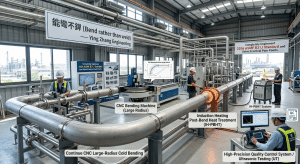
- 製造技術與參數管制的挑戰:面對 P91 等高應變敏感材料,協力廠商面臨最嚴格的工序限制。必須使用配備高剛性內部聯結芯棒的大型 CNC 機台,將截面橢圓度嚴格控制在 3% 至 5% 以內,並隨時監控拉伸側管壁減薄率(若減薄超過極限值,則須執行 100% 超音波測厚)12。Challenges in Manufacturing Technology and Parameter Control: When dealing with highly strain-sensitive materials like P91, subcontractors face the strictest procedural limits. They must use large CNC machines equipped with highly rigid internal linked mandrels to strictly control cross-sectional ovality to within 3% to 5%, while constantly monitoring the extrados wall thinning rate (if thinning exceeds the limit, 100% ultrasonic thickness testing must be executed)12.
- 次臨界熱處理 (IH-PBHT) 的技術突圍:針對應變率落在 5% 至 20% 區間的 3D/5D 彎管,必須揚棄傳統爐內高溫正規化與回火(N&T),改採極高精度的感應加熱次臨界彎後熱處理(Subcritical IH-PBHT)12。要求廠商導入紅外線熱像儀與多點熱電偶的數位化熱歷程監控系統,確保溫度鎖定在 705°C 至 760°C 的極窄視窗內(低於 AC1),科學保證材料潛變韌性完全恢復且未發生相變4。Technological Breakthroughs via Subcritical Heat Treatment (IH-PBHT): For 3D/5D bends with strain rates falling within the 5% to 20% range, traditional high-temperature Normalizing & Tempering (N&T) in furnaces must be abandoned in favor of extremely high-precision Induction Heating Subcritical Post-Bend Heat Treatment (Subcritical IH-PBHT)12. This requires manufacturers to introduce digital thermal history monitoring systems equipped with infrared thermal imaging and multi-point thermocouples, ensuring the temperature is locked within a very narrow window of 705°C to 760°C (below AC1). This scientifically guarantees the complete restoration of the material’s creep toughness without phase transformations occurring4.
7.5 導入潁璋工程「能彎不銲」之三合一工法管理核心價值與設計優化 / 7.5 Core Management Value and Design Optimization of Introducing Ying Zhang Engineering’s “Bend rather than Weld” 3-in-1 Method
為徹底落實 2026 ASME B31J 規範並解決實務痛點,現代管線工程開始導入專業廠商(如潁璋工程 Ying Zhang Engineering)推動的「能彎不銲(Bend rather than weld)」核心理念。此理念具體化為針對高能管線的「三合一工法」:(1) CNC 大半徑冷作彎管;(2) 感應加熱次臨界彎後熱處理(IH-PBHT);(3) 高精密品質管制體系22。To thoroughly implement the 2026 ASME B31J code and resolve practical pain points, modern piping engineering has begun introducing the core philosophy of “Bend rather than weld,” promoted by professional manufacturers (such as Ying Zhang Engineering). This philosophy materializes into a “3-in-1 Method” targeting high-energy piping: (1) CNC Large-Radius Cold Bending; (2) Induction Heating Subcritical Post-Bend Heat Treatment (IH-PBHT); and (3) High-Precision Quality Control Systems22.
此工法核心價值在於透過工程設計初期之前置優化,將製造風險從不可控的現場高空動火,轉移至環境受控的專業廠房。三大管制支柱包括14:The core value of this method lies in shifting manufacturing risks from uncontrollable on-site high-altitude hot work to environment-controlled professional workshops via proactive optimization during the early engineering design phase. The three major control pillars include14:
- 壁厚減薄逆向推算:採購母管時,精算 5D 彎管 8%~10% 或 3D 彎管 25% 的物理減薄餘量,確保冷彎外弧(Extrados)成形後仍高於系統最小設計壁厚。Reverse Calculation of Wall Thinning: During mother pipe procurement, precise calculations of physical thinning margins (8%–10% for 5D bends or 25% for 3D bends) are made to ensure the formed extrados remains thicker than the system’s minimum design wall thickness.
- 高精度橢圓度控制(Ovality Control):採用大型數控機台精準將截面橢圓度控制在 3% 至 5% 內,避免徑向塌陷損及截面抗彎模數。High-Precision Ovality Control: Utilizing large CNC machines to accurately control cross-sectional ovality within 3% to 5%, avoiding radial collapse that would compromise the bending section modulus.
- 冶金與流體力學之雙效優化:透過實體無銲縫化,物理上根絕 ICHAZ 軟化帶與 Type IV 破裂發生;且因曲率半徑由5D 放大至 3/5D,消散內弧側負壓分離區與迪恩渦流,根除流動加速腐蝕(FAC)熱點22。Dual Optimization of Metallurgy and Fluid Dynamics: Through physical seamlessness, the ICHAZ softening band and Type IV cracking occurrences are physically eradicated; concurrently, because the radius of curvature is expanded from 1.5D to 3D/5D, negative pressure separation zones and Dean Vortices on the inner arc are dissipated, uprooting Flow-Accelerated Corrosion (FAC) hot spots22.
7.6 複循環燃氣機組頻繁起停之物理瞬態與應變率 (5%~20%) 放寬 IH-PBHT 適用解析 / 7.6 Physical Transients of Frequent Start-Stops in CCPPs and Strain Rate (5%-20%) Relaxation for IH-PBHT Application
現代複循環機組(CCPP)為配合再生能源負載,必須面臨高頻率起停(Start-stop)與調峰操作。在此物理瞬態下,管線承受劇烈熱應力循環,誘發嚴重的潛變-疲勞交互作用。由於 P9x 鋼在循環軟化效應下,對塑性應變幅極度敏感(疲勞延性指數 c 顯著),1.5D 銲接接頭極易提早耗竭而斷裂20。Modern combined cycle power plants (CCPPs), to complement renewable energy loads, must face high-frequency start-stop and peak-shaving operations. Under these physical transients, piping endures severe thermal stress cycling, inducing grave creep-fatigue interactions. Due to the extreme sensitivity of P9x steels to plastic strain amplitudes under cyclic softening effects (a significant fatigue ductility exponent c), 1.5D welded joints are highly prone to premature exhaustion and fracture20.
導入冷作彎管工法取代 1.5D 銲接彎頭,材料勢必經歷強烈室溫塑性變形。依據規範極限纖維應變率公式ϵ=(ro/R1 )×100% 計算,3D 彎管最大應變率達 16.7%,5D 彎管約為 10%22。此數據精準落入 ASME B31.1 第 129 節規範的 5% 至 20% 「法規臨界區間」4。Introducing the cold bending method to replace 1.5D welded elbows necessitates that materials undergo intense room-temperature plastic deformation. Calculated by the code’s extreme fiber strain rate formula ϵ=(ro/R1 )×100% , the maximum strain rate of a 3D bend reaches 16.7%, and a 5D bend is around 10%22. These figures accurately land within the “regulatory critical range” of 5% to 20% specified in ASME B31.1 Section 129 4.
新規範在此 5%~20% 區間釋放了重要的熱處理放寬機制:允許厚壁高合金鋼採用次臨界溫度(705°C ~ 760°C)進行感應加熱彎後熱處理(Subcritical IH-PBHT),而不必像傳統製程般,為重建微觀相變進行全爐的正常化與回火(N&T,溫度需拉高至 AC3 以上)15。此科學放寬機制意義重大:次臨界 IH-PBHT 既能完全釋放高達 16.7% 的冷作硬化與殘餘拉伸應力,又絕對避免穿越 AC1 下臨界溫度(P91 約 800°C)所造成的雙相結構軟化,完美保全基體優異的奈米級 MX 碳氮化物強化相15。Within this 5% to 20% range, the new codes release an important heat treatment relaxation mechanism: they allow thick-walled high-alloy steels to use subcritical temperatures (705°C–760°C) for induction heating post-bend heat treatment (Subcritical IH-PBHT), instead of having to perform full-furnace Normalizing & Tempering (N&T, raising temperatures above AC3 to reconstruct microstructural phases) like traditional processes15. This scientific relaxation mechanism holds major significance: Subcritical IH-PBHT not only completely releases up to 16.7% of cold work hardening and residual tensile stresses but also absolutely avoids the dual-phase structural softening caused by crossing the AC1 lower critical temperature (approx. 800°C for P91), perfectly preserving the matrix’s excellent nanoscale MX carbonitride strengthening phases15.
7.7 針對 P9x 高能管線之冷作彎管三合一工法合規性與深度驗證 / 7.7 Compliance and Deep Verification of the 3-in-1 Cold Bending Method for P9x High-Energy Piping
對於高溫、高壓的 P9x 級高能管線而言,工程技術合規性(Compliance)是資產安全的最後防線。三合一工法在應對 2026 年版 ASME 規範(包含 B31.1、B31.3 與 BPVC Section IX)時,展現出高度適應性與完整性4:For high-temperature, high-pressure P9x-grade high-energy piping, engineering technical compliance is the final line of defense for asset safety. The 3-in-1 method exhibits high adaptability and completeness when navigating the 2026 editions of the ASME codes (including B31.1, B31.3, and BPVC Section IX)4:
- WSRF 豁免與設計餘裕最大化:一體成型免去銲道強度折減係數(WSRF)高達 30% 的嚴厲折減,使 EPC 能以更薄管壁、更低材料成本設計出同等耐壓強度的管線,亦降低系統整體剛度與熱應力1。 WSRF Exemption and Maximization of Design Margins: Integral forming exempts the piping from the severe 30% reduction of the Weld Strength Reduction Factor (WSRF). This enables EPCs to design piping with equivalent pressure resistance using thinner walls and lower material costs, while also decreasing the system’s overall stiffness and thermal stress1.
- LMP 量化指標的最佳化控制:IH-PBHT 嚴格以 Larson-Miller Parameter (LMP) 進行科學驗證。以 760°C(1033 K)保溫 2 小時為例,LMP 值 20,970 完美落在實驗室證實可恢復最佳潛變性能的8k 至 21.9k 靶區下緣。此控制既消除應力,也防堵過度回火(Over-tempering)引發的 M23C6 粗化風險22。 Optimal Control of LMP Quantitative Metrics: The IH-PBHT is strictly verified scientifically using the Larson-Miller Parameter (LMP). For example, a 2-hour hold at 760°C (1033 K) yields an LMP value of 20,970, which lands perfectly at the lower edge of the target zone (20.8k to 21.9k) proven in labs to restore optimum creep performance. This control both relieves stress and forestalls the risk of M23C6 coarsening caused by over-tempering22.
- 數位化熱歷程監控符合新版品質要求:為防範熱處理溫度過衝(Temperature overshoot)引發 Laves 相異常析出,新規範對現場檢測提出更嚴苛要求19。三合一工法在 IH-PBHT 過程中,全面整合紅外線熱像儀與多點熱電偶,建立即時數位化熱歷程監控系統22。這確保了全斷面的均溫性與冷卻速率可溯源性,高度契合 2026 ASME 規範對高階檢驗與數位資料追溯(Traceability)的合規期待,成為確保 P9x 管線生命週期完整性的堅實後盾。 Digital Thermal History Monitoring Meeting New Quality Requirements: To prevent abnormal Laves phase precipitation caused by temperature overshoots during heat treatment, the new codes propose stricter requirements for field inspections19. During the IH-PBHT process, the 3-in-1 method fully integrates infrared thermal imaging and multi-point thermocouples to establish a real-time digital thermal history monitoring system22. This ensures full-cross-section temperature uniformity and cooling rate traceability, highly resonating with the 2026 ASME codes’ compliance expectations for advanced inspection and digital data traceability, serving as a solid backing for ensuring the lifecycle integrity of P9x piping.
八、結論 / VIII. Conclusion
現代超臨界與燃氣複循環發電廠的高能管線安全,正處於物理冶金與工程力學交互影響的深水區。本報告綜合 2026 年版 ASME B31J 規範演進、斷裂力學模型、微觀冶金機制與多維度的實務工程視角,得出以下工程洞見與結論:The high-energy piping safety of modern ultra-supercritical and combined cycle power plants is navigating the deep waters where physical metallurgy and engineering mechanics interact. By integrating the evolution of the 2026 ASME B31J codes, fracture mechanics models, micro-metallurgical mechanisms, and multi-dimensional practical engineering perspectives, this report deduces the following engineering insights and conclusions:
首先,Type IV 潛變破裂本質上是熱力學不穩定與三軸力學局部化的必然產物。在傳統 1.5D 銲接彎頭中,銲接熱循環不可避免地在 P9x 鋼中創造出間臨界軟化帶(ICHAZ)。在機組調峰運轉的彈性隨動效應驅動下,該區域承受極端的應變局部化與三軸應力,導致晶界微孔洞快速成核,破壞韌性極度衰退。一旦遭遇管線動態衝擊(如蒸汽錘),將引發無預警的災難性脆性斷裂。Firstly, Type IV creep cracking is fundamentally the inevitable product of thermodynamic instability and triaxial mechanical localization. In traditional 1.5D welded elbows, welding thermal cycles unavoidably create an intercritical soft zone (ICHAZ) in P9x steels. Driven by the elastic follow-up effect during unit peak-shaving operations, this region suffers extreme strain localization and triaxial stress, leading to the rapid nucleation of grain boundary micro-cavities and drastic deterioration of fracture toughness. Once encountering dynamic piping impacts (such as steam hammers), an unwarned catastrophic brittle fracture will be triggered.
其次,ASME B31J 規範的強制導入重塑了高能管線的力學邊界。2026 年版規範廢止過度簡化的 Appendix D,導入空間方向性彈性矩陣。新算法無情地暴露 1.5D 銲接彎頭極低的柔性特徵值與極高的應力集中效應,同時在數學上證實 3D/5D 大半徑冷作彎管具備卓越的應力消散能力與系統柔性補償效益,避免了無效且危險的過度剛性支撐設計。Secondly, the mandatory introduction of the ASME B31J code reshapes the mechanical boundaries of high-energy piping. The 2026 edition abolishes the overly simplified Appendix D, introducing a spatial directional flexibility matrix. The new algorithm ruthlessly exposes the extremely low flexibility characteristic and extremely high stress concentration effects of 1.5D welded elbows. Simultaneously, it mathematically verifies that 3D/5D large-radius cold bends possess superior stress dissipation capabilities and systemic flexibility compensation benefits, avoiding ineffective and dangerous over-rigid support designs.
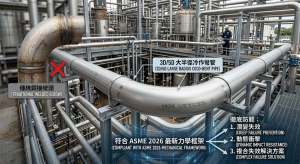
最後,從工程實務與生命週期管理而言,3D/5D 數控冷作彎管工法(如推廣之「能彎不銲」三合一工法)實現了針對 HAZ 弱點的根本性降維打擊。透過實體空間中一體成型的大半徑彎管,物理上徹底移除了應力最大處的銲縫,直接宣告 Type IV 潛變破裂風險的終結並豁免 WSRF 折減。對於頻繁起停的複循環機組,藉由精確運用 5%~20% 應變率放寬機制,搭配精算 Larson-Miller Parameter 視窗的次臨界感應加熱彎後熱處理(IH-PBHT),並以數位監控確保合規性,能在不破壞奈米級析出相的前提下,完美釋放殘餘應力並恢復材料延展性。總結而言,摒棄傳統銲接彎頭、全面採用 3D/5D 大半徑冷作彎管,已成為符合 ASME 2026 最新力學框架,並能徹底防範潛變與動態衝擊複合失效的最佳工程解決方案。Finally, from the perspectives of engineering practice and lifecycle management, the 3D/5D CNC cold bending method (such as the promoted “Bend rather than weld” 3-in-1 method) achieves a fundamental, overwhelming strike against HAZ weaknesses. Through the integrally formed large-radius bends in physical space, the welds at the points of maximum stress are completely removed physically, directly declaring the end of Type IV creep cracking risks and granting exemption from WSRF reductions. For frequently starting and stopping combined cycle units, by precisely utilizing the 5%–20% strain rate relaxation mechanism paired with Subcritical Induction Heating Post-Bend Heat Treatment (IH-PBHT) within a calculated Larson-Miller Parameter window—and ensuring compliance via digital monitoring—residual stresses can be perfectly released and material ductility restored without destroying nanoscale precipitate phases. In conclusion, abandoning traditional welded elbows and comprehensively adopting 3D/5D large-radius cold bends has emerged as the optimum engineering solution that complies with the latest 2026 ASME mechanical framework and thoroughly prevents the composite failure of creep and dynamic impact.
參考文獻 / References
- 燃氣複循環電廠(CCPP) P9x 級高能高壓管線銲道之綜合分析與微觀潛, https://yz-pipe-bending.com.tw/%E7%87%83%E6%B0%A3%E8%A4%87%E5%BE%AA%E7%92%B0%E9%9B%BB%E5%BB%A0-ccpp-p9x-%E7%B4%9A%E9%AB%98%E8%83%BD%E9%AB%98%E5%A3%93%E7%AE%A1%E7%B7%9A%E9%8A%B2%E9%81%93%E4%B9%8B%E7%B6%9C%E5%90%88%E5%88%86/
- Vallorec P91 BOOK | PDF | Pipe (Fluid Conveyance) | Heat Treating, https://www.scribd.com/document/430621945/Vallorec-P91-BOOK
- EPRI Best Practice Guidelines For P91 1023199 | PDF – Scribd, https://www.scribd.com/doc/246144971/EPRI-Best-Practice-Guidelines-for-P91-1023199
- 解析2026 ASME B31.1與B31J應變率(5%~20%)放寬與IH-PBHT適用, https://yz-pipe-bending.com.tw/%E8%A7%A3%E6%9E%902026-asme-b31-1%E8%88%87b31j%E6%87%89%E8%AE%8A%E7%8E%87520%E6%94%BE%E5%AF%AC%E8%88%87ih-pbht%E9%81%A9%E7%94%A8%EF%BC%9A%E6%BD%81%E7%92%8B%E5%B7%A5%E7%A8%8B%E5%B0%8D%E6%96%BCp9x/
- Growing experience with P91/T91 forcing essential code changes, https://www.ccj-online.com/growing-experience-with-p91-t91-forcing-essential-code-changes/
- Yukio Takahashi | Researcher – SciProfiles, https://sciprofiles.com/profile/author/RkNNVkVuazRucXdkN2dRbSswTy9KSXJ2SzNNRlZaVlhsb1RwdjZDUFh1Zz0=?utm_source=mdpi.com&utm_medium=website&utm_campaign=avatar_name
- Microstructure Evolution of Fine-Grained Heat-Affected Zone in Type, https://www.researchgate.net/publication/288840159_Microstructure_Evolution_of_Fine-Grained_Heat-Affected_Zone_in_Type_IV_Failure_of_P91_Welds
- Hse RR509 | PDF | Nondestructive Testing | Safety – Scribd, https://www.scribd.com/document/136432168/HSE-RR509
- Creep-Fatigue Damage Assessment Methods | PDF – Scribd, https://www.scribd.com/document/742577682/1017608-Plant-Component-Assessment-for-Creep-Fatigue-Damage-Component-Assessment-Methodologies
- Effect of Operational Transients on Boiler Damage – EPRI, https://restservice.epri.com/publicdownload/000000000001015649/0/Product
- 基於ASME B31J 規範之電廠高能管線任意角度冷作彎管空間佈置與, https://yz-pipe-bending.com.tw/%E5%9F%BA%E6%96%BC-asme-b31j-%E8%A6%8F%E7%AF%84%E4%B9%8B%E9%9B%BB%E5%BB%A0%E9%AB%98%E8%83%BD%E7%AE%A1%E7%B7%9A%E4%BB%BB%E6%84%8F%E8%A7%92%E5%BA%A6%E5%86%B7%E4%BD%9C%E5%BD%8E%E7%AE%A1%E7%A9%BA%E9%96%93/
- 基於2026 ASME B31.1 與B31J 規範之複循環發電廠動力管線3D/5D, https://yz-pipe-bending.com.tw/%E5%9F%BA%E6%96%BC-2026-asme-b31-1-%E8%88%87-b31j-%E8%A6%8F%E7%AF%84%E4%B9%8B%E8%A4%87%E5%BE%AA%E7%92%B0%E7%99%BC%E9%9B%BB%E5%BB%A0%E5%8B%95%E5%8A%9B%E7%AE%A1%E7%B7%9A-3d-5d-%E5%86%B7%E4%BD%9C/
- ASME B31.3 Stress Range Factor: The 2022 Revision and Why It, https://blog.vibrationdata.com/2026/07/18/asme-b31-3-piping-fatigue/
- 基於ASME B31J (2024-2026) 規範演進之高能管線佈局最佳化, https://yz-pipe-bending.com.tw/%E5%9F%BA%E6%96%BC-asme-b31j-2024-2026-%E8%A6%8F%E7%AF%84%E6%BC%94%E9%80%B2%E4%B9%8B%E9%AB%98%E8%83%BD%E7%AE%A1%E7%B7%9A%E4%BD%88%E5%B1%80%E6%9C%80%E4%BD%B3%E5%8C%96%EF%BC%9A3d-5d-%E5%86%B7%E4%BD%9C/
- 現代高能動力管線「以彎代銲」之技術經濟評估:從傳統配管到大, https://yz-pipe-bending.com.tw/%E7%8F%BE%E4%BB%A3%E9%AB%98%E8%83%BD%E5%8B%95%E5%8A%9B%E7%AE%A1%E7%B7%9A%E3%80%8C%E4%BB%A5%E5%BD%8E%E4%BB%A3%E9%8A%B2%E3%80%8D%E4%B9%8B%E6%8A%80%E8%A1%93%E7%B6%93%E6%BF%9F%E8%A9%95%E4%BC%B0%EF%BC%9A/
- Coal Power Plant Materials And Life Assessment Developments, https://pt.slideshare.net/slideshow/coal-power-plant-materials-and-life-assessment-developments-and-applications-1st-ahmed-shibli-ed/280069241
- Effect of Boron Addition and Initial Heat-Treatment Temperature on, https://www.researchgate.net/publication/257707934_Effect_of_Boron_Addition_and_Initial_Heat-Treatment_Temperature_on_Microstructure_and_Mechanical_Properties_of_Modified_9Cr-1Mo_Steels_Under_Different_Heat-Treatment_Conditions
- Creep and High Temperature Deformation of Metals and Alloys – MDPI, https://mdpi-res.com/bookfiles/book/1887/Creep_and_High_Temperature_Deformation_of_Metals_and_Alloys.pdf
- 2025 版ASME鍋爐與壓力容器規範及B31 系列重大修訂, https://yz-pipe-bending.com.tw/2025-%E7%89%88-asme%E9%8D%8B%E7%88%90%E8%88%87%E5%A3%93%E5%8A%9B%E5%AE%B9%E5%99%A8%E8%A6%8F%E7%AF%84%E5%8F%8A-b31-%E7%B3%BB%E5%88%97%E9%87%8D%E5%A4%A7%E4%BF%AE%E8%A8%82%EF%BC%9A%E5%B0%88%E6%A5%AD/
- Creep Damage Repair for High-Temp Steel – Scribd, https://www.scribd.com/document/481107922/TGN-PE-04-Weld-Repair-of-Creep-Damaged-Steel
- Effect of composition within the specification range on A1, https://www.researchgate.net/figure/Effect-of-composition-within-the-specification-range-on-A1-temperature-of-CSEF-Steels_fig1_257726695
- Influence of Material Inhomogeneity on the Mechanical Response of, https://research.universityofgalway.ie/files/25869592/ML-ND_MDA16_105(Revision_3-nod-lm).pdf
- 複循環電廠調峰操作下高能管線之疲勞壽命分析 – 潁璋工程興業有限公司, https://yz-pipe-bending.com.tw/%E8%A4%87%E5%BE%AA%E7%92%B0%E9%9B%BB%E5%BB%A0%E8%AA%BF%E5%B3%B0%E6%93%8D%E4%BD%9C%E4%B8%8B%E9%AB%98%E8%83%BD%E7%AE%A1%E7%B7%9A%E4%B9%8B%E7%96%B2%E5%8B%9E%E5%A3%BD%E5%91%BD%E5%88%86%E6%9E%90%EF%BC%9A/
- Microstructure Evolution of a 10Cr Heat-Resistant Steel during High, https://www.researchgate.net/publication/257445871_Microstructure_Evolution_of_a_10Cr_Heat-Resistant_Steel_during_High_Temperature_Creep
- Modelling for Creep Cavitation Damage and Life of Three Metallic, https://www.tandfonline.com/doi/full/10.1080/09603409.2021.2024420
- Review of Type IV Cracking in Piping Welds, https://restservice.epri.com/publicdownload/TR-108971/0/Product
- Type IV Cracking of Weldments in Enhanced Ferritic Steels – TWI, https://www.twi-global.com/technical-knowledge/published-papers/review-of-type-iv-cracking-of-weldments-in-9-12cr-creep-strength-enhanced-ferritic-steels/
- ASME-B31.1.pdf – Future Energy Steel, https://energy-steel.com/wp-content/uploads/2025/03/ASME-B31.1.pdf
- 4443 31846 1 PB PDF | PDF | Fatigue (Material) | Fracture – Scribd, https://www.scribd.com/document/420132776/4443-31846-1-PB-pdf
- Eun2020_Chapter_DesignEngin, https://pubhtml5.com/huuo/gbpb/basic/51-100
- TCR Engineering Company Profile 2026, https://www.tcreng.com/assets/docs/tcr-engineering-company-profile-2026-v8-7.pdf
- Steam Turbine Materials for Ultrasupercritical Coal Power Plants, https://digital.library.unt.edu/ark:/67531/metadc828281/m2/1/high_res_d/1081317.pdf
- EPRI Advances in Life Assessment | PDF – Scribd, https://www.scribd.com/document/607107691/EPRI-Advances-in-Life-Assessment
- Leak before break in reactor piping and vessels – INIS-IAEA, https://inis.iaea.org/records/n73tr-tma20/files/43012290.pdf?download=1
- Creep–Fatigue Life Estimation of Gr.91 Steel and Its Welded Joints, https://www.mdpi.com/2075-4701/13/11/1880
- Creep Fatigue Behavior of Creep Strength Enhanced Ferritic Steels, https://dl.astm.org/themeredirect/journalastminternational/article-pdf/8/8/1/7242117/10_1520_jai103888.pdf
- A Unified Multiscale/Multiaxial Constraint-Based Model for Creep, https://www.researchgate.net/publication/356120234_A_Unified_MultiscaleMultiaxial_Constraint-Based_Model_for_Creep_Damage_and_Crack_Growth_in_Engineering_Alloys
- Experimental investigation of specimen size effect on creep crack, https://www.researchgate.net/publication/277531292_Experimental_investigation_of_specimen_size_effect_on_creep_crack_growth_behavior_in_P92_steel_welded_joint
- Stress Intensification Factors (SIFs) in Pipe Stress Analysis, https://simumech.com/stress-intensification-factors-sifs-in-pipe-stress-analysis/
- Importance & Impact of Stress Intensification Factor (SIF) in Piping, https://whatispiping.com/stress-intensification-factor-sif/
- Background of SIFs and Stress Indices for Moment Loadings of, https://www.osti.gov/servlets/purl/841246
- B31 Code Stress, https://sites.google.com/site/fareastpiperreference/asme/b31-code-stress
- Stress Intensification & Flexibility Factor Calculator (B31.3 Appendix D), https://pipingtoolset.com/calculators/b313-stress-intensification-factors/
- 中鋼CDQ 專案P91 冷彎與電銲技術數據比較及其2026 ASME 規範, https://yz-pipe-bending.com.tw/%E4%B8%AD%E9%8B%BC-cdq-%E5%B0%88%E6%A1%88-p91-%E5%86%B7%E5%BD%8E%E8%88%87%E9%9B%BB%E9%8A%B2%E6%8A%80%E8%A1%93%E6%95%B8%E6%93%9A%E6%AF%94%E8%BC%83%E5%8F%8A%E5%85%B6-2026-asme-%E8%A6%8F%E7%AF%84/
- 複循環燃氣機組頻繁起停之物理瞬態與熱力學 … – 潁璋工程興業有限公司, https://yz-pipe-bending.com.tw/%E8%A4%87%E5%BE%AA%E7%92%B0%E7%87%83%E6%B0%A3%E6%A9%9F%E7%B5%84%E9%A0%BB%E7%B9%81%E8%B5%B7%E5%81%9C%E4%B9%8B%E7%89%A9%E7%90%86%E7%9E%AC%E6%85%8B%E8%88%87%E7%86%B1%E5%8A%9B%E5%AD%B8%E5%BE%AA%E7%92%B0/
- ASME B31.1 Power Piping Code 2024: Design & Standards, https://studylib.net/doc/27709358/asme-b31-1-2024year
- 高能廢熱回收管線之冷作彎管工法應用與結構完整性評估, https://yz-pipe-bending.com.tw/%E9%AB%98%E8%83%BD%E5%BB%A2%E7%86%B1%E5%9B%9E%E6%94%B6%E7%AE%A1%E7%B7%9A%E4%B9%8B%E5%86%B7%E4%BD%9C%E5%BD%8E%E7%AE%A1%E5%B7%A5%E6%B3%95%E6%87%89%E7%94%A8%E8%88%87%E7%B5%90%E6%A7%8B%E5%AE%8C%E6%95%B4/
- ANSI/ASME B31.1, “Power Piping” American National Standard, https://www.nrc.gov/docs/ML0314/ML031470592.pdf
- EPRI Best Practice Guidelines For P91 1023199 – pdfcoffee.com, https://pdfcoffee.com/epri-best-practice-guidelines-for-p91-1023199-pdf-free.html
- Temperature dependence of creep rupture life of long-term serviced, https://www.frontiersin.org/journals/materials/articles/10.3389/fmats.2025.1613803/full
- Influence of Extra Coarse Grains on the Creep Properties of 9, https://www.researchgate.net/publication/200653168_Influence_of_Extra_Coarse_Grains_on_the_Creep_Properties_of_9_Percent_CrMoV_P91_Steel_Weldment