
一、 緒論 / 1. Introduction
1.1 研究背景 / 1.1 Research Background
在全球能源轉型的宏觀背景下,為追求極致的發電效率並大幅削減溫室氣體排放,現代燃氣複循環發電廠(Combined Cycle Power Plant, CCPP)與超超臨界(Ultra-Supercritical, USC)發電機組的設計正快速朝向更高溫、高壓的蒸汽參數邊界推進。在此嚴苛的操作環境中,傳統的低合金鋼(如 P11、P22)已面臨其材料物理極限,無法在超越500°C 的高溫下提供足夠的潛變強度與抗氧化性能1。為了突破此一技術瓶頸,工程界廣泛引入了潛變強度強化鐵素體鋼(Creep Strength Enhanced Ferritic Steels, CSEF),其中最具代表性且應用最廣的即為 P91(9Cr-1Mo-V)與 P92(9Cr-0.5Mo-2W)合金鋼1。 Against the macro-background of global energy transition, in pursuit of ultimate power generation efficiency and significant reduction of greenhouse gas emissions, the design of modern Combined Cycle Power Plants (CCPP) and Ultra-Supercritical (USC) power generation units is rapidly advancing toward higher temperature and high-pressure steam parameter boundaries. In this harsh operating environment, traditional low-alloy steels (such as P11, P22) have reached their material physical limits and cannot provide sufficient creep strength and oxidation resistance at high temperatures exceeding 500°C1. To overcome this technological bottleneck, the engineering field has widely introduced Creep Strength Enhanced Ferritic Steels (CSEF), with P91 (9Cr-1Mo-V) and P92 (9Cr-0.5Mo-2W) alloy steels being the most representative and widely applied1.
這些先進材料的最大優勢在於,當電廠高能管線承受高達540°C 至610°C 的主蒸汽溫度時,其容許應力(Allowable Stress)遠高於傳統的奧氏體不銹鋼與低合金材料,使得管壁厚度得以縮減近三分之二,整體組件重量減輕約 60% 2。壁厚的縮減不僅降低了材料與建造成本,更實質上提升了管線對急遽溫度變化的熱疲勞承受力,賦予了現代電廠更高的運轉靈活性與起停效率3。 The greatest advantage of these advanced materials lies in the fact that when the plant’s high-energy piping is subjected to main steam temperatures as high as 540°C to 610°C, their Allowable Stress is far higher than that of traditional austenitic stainless steels and low-alloy materials. This allows the wall thickness to be reduced by nearly two-thirds and the overall component weight to be decreased by about 60% 2. The reduction in wall thickness not only lowers material and construction costs but also substantially enhances the piping’s thermal fatigue resistance to rapid temperature changes, granting modern power plants greater operational flexibility and start-stop efficiency3.
1.2 局部銲後熱處理之挑戰與研究目的 / 1.2 Challenges of Local Post-Weld Heat Treatment and Research Objectives
然而,厚壁縮減的優勢背後,卻為後續的銲接與熱處理帶來了極大的考驗。P91 與 P92 鋼材卓越的高溫機械性質,建立在其極度敏感且脆弱的微觀冶金平衡之上;這些材料對銲接熱循環與銲後熱處理(Post-Weld Heat Treatment, PWHT)的製程參數具有極高的排他性與敏感度4。若 PWHT 過程中的溫度分佈未能嚴格控制,極易導致微觀組織的不可逆劣化,進而在長期高溫服役中誘發提早失效,其中最典型的災難性失效模式即為發生於細晶熱影響區(Fine-Grained Heat-Affected Zone, FGHAZ)的第四型裂紋(Type IV Cracking)7。 However, behind the advantages of reduced wall thickness lies a tremendous challenge for subsequent welding and heat treatment. The excellent high-temperature mechanical properties of P91 and P92 steels are built on their extremely sensitive and fragile microstructural metallurgical balance; these materials possess an extremely high exclusivity and sensitivity to the process parameters of welding thermal cycles and Post-Weld Heat Treatment (PWHT)4. If the temperature distribution during the PWHT process is not strictly controlled, it easily leads to irreversible degradation of the microstructure, which in turn induces premature failure during long-term high-temperature service. The most typical catastrophic failure mode is Type IV Cracking, which occurs in the Fine-Grained Heat-Affected Zone (FGHAZ)7.
在 CCPP 現場管線施工環境中,由於主蒸汽管線尺寸龐大、幾何形狀複雜且多處於空間受限的管架上,無法將整個管線系統送入大型恆溫加熱爐中進行整體熱處理,因此必須完全仰賴局部銲後熱處理(Local PWHT)技術10。現場局部 PWHT 所面臨的核心挑戰,在於如何克服複雜熱傳邊界條件下所產生的「加熱不均」現象,這包含了厚壁管線中難以避免的徑向溫度梯度(Through-Thickness Temperature Gradient, TTG)、軸向的熱量流失,以及管線圓周方向受熱空氣對流影響所造成的溫度分佈差異12。 In the CCPP on-site piping construction environment, because main steam piping is massive in size, complex in geometry, and mostly located on space-constrained pipe racks, it is impossible to send the entire piping system into a large constant-temperature furnace for global heat treatment. Therefore, there must be complete reliance on Local PWHT technology10. The core challenge faced by on-site local PWHT lies in how to overcome the phenomenon of “uneven heating” generated under complex heat transfer boundary conditions. This includes the unavoidable Through-Thickness Temperature Gradient (TTG) in heavy-wall piping, axial heat loss, and temperature distribution differences caused by the convective effect of heated air in the circumferential direction of the piping12.
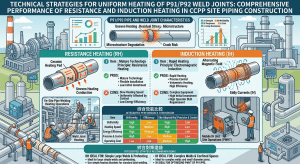
目前工業界為應對此一挑戰,主要採用傳統的電阻式加熱(Resistance Heating)與近年逐漸普及的感應式加熱(Induction Heating)兩種核心技術14。本研究旨在深入剖析 P91/P92 材料的實體冶金特性與國際 PWHT 規範標準,並透過熱傳學與電磁學的理論基礎,系統性評估這兩種加熱技術在克服厚壁管線加熱不均問題上的物理機制、侷限性與實際效能。同時,本報告將深度結合台灣近年大型建廠案例(如台電興達電廠複循環機組更新計畫)的工程實踐與冷彎成型技術發展,提出具體可行的技術對策與最佳化混合施工策略。 To address this challenge, the industry currently primarily adopts two core technologies: traditional Resistance Heating and the increasingly popular Induction Heating14. This study aims to deeply analyze the physical metallurgical characteristics of P91/P92 materials and international PWHT code standards, and systematically evaluate the physical mechanisms, limitations, and actual performance of these two heating technologies in overcoming the uneven heating problem of heavy-wall piping through the theoretical foundations of heat transfer and electromagnetism. At the same time, this report will deeply integrate the engineering practices and cold bending technology developments of recent large-scale plant construction cases in Taiwan (such as the Taipower Hsinta Power Plant Combined Cycle Unit Renewal Project) to propose concrete and feasible technological countermeasures and an optimized hybrid construction strategy.
二、 P91/P92 鋼材之實體冶金學與潛變強化機制 / 2. Physical Metallurgy and Creep Strengthening Mechanisms of P91/P92 Steels
要理解 PWHT 在施工中的重要性,必須先從這類材料的微觀演化機制著手。To understand the importance of PWHT during construction, one must first start with the microstructural evolution mechanisms of these materials.
2.1 微觀組織演化與析出強化原理 / 2.1 Microstructural Evolution and Precipitation Strengthening Principles
P91 與 P92 鋼材之所以能在高溫下展現出色的潛變抗力,主要歸功於其嚴密設計的化學成分與極其精確的熱處理工序。在煉鋼與製造階段,這類材料必須先加熱至上臨界轉變溫度(AC3)以上(約 1040°C 至1080°C)進行完全奧氏體化(Austenitizing),隨後於空氣中快速冷卻至馬氏體轉變完成溫度(Mf)以下(通常低於200°C 或更低),使奧氏體基體完全轉變為極硬且脆的未回火馬氏體(Untempered Martensite)1。這種未回火馬氏體的硬度極高(可達 350-420 HV),內部充滿高密度的差排,幾乎不具備工程所需的延展性與韌性,因此絕對禁止在未經回火的狀態下直接投入服役15。 The reason P91 and P92 steels exhibit excellent creep resistance at high temperatures is primarily attributed to their strictly designed chemical compositions and extremely precise heat treatment processes. During the steelmaking and manufacturing stages, these materials must first be heated above the upper critical transformation temperature (AC3) (approximately 1040°C to 1080°C) for complete austenitizing, and subsequently cooled rapidly in the air to below the martensite finish temperature (Mf) (usually below 200°C or lower). This causes the austenitic matrix to completely transform into extremely hard and brittle untempered martensite1. This untempered martensite has an extremely high hardness (up to 350-420 HV) and is filled with a high density of dislocations internally, possessing almost no ductility and toughness required for engineering. Therefore, it is strictly prohibited to put it into service directly in an untempered state15.
為了賦予鋼材優異的綜合機械性質,必須進行嚴格的高溫回火處理(Tempering)。對於 P91 而言,此溫度區間通常介於730°C 至775°C 之間2。在回火過程中,過飽和的碳與合金元素會從基體中析出,形成兩種至關重要的強化相:第一種是富含鉻的M23C6 型碳化物,主要沿著原奧氏體晶界(Prior Austenite Grain Boundaries, PAGB)與馬氏體板條邊界生長,其作用在於穩定晶界結構,防止高溫環境下的晶界滑移與晶粒粗化6;第二種則是極為細小的 MX 型碳氮化物(主要由鈮 Nb 與釩 V 構成),這類奈米級析出物均勻散佈於馬氏體基體與板條內部,能夠極為有效地釘紮(Pinning)差排運動,是賦予 P91/P92 卓越潛變強度的核心機制。合金成分中對碳、鈮與氮的精確控制,便是為了確保這兩種強化相的充足生成2。 To endow the steel with excellent comprehensive mechanical properties, a strict high-temperature tempering process must be conducted. For P91, this temperature range is usually between 730°C and 775°C2. During the tempering process, supersaturated carbon and alloying elements will precipitate from the matrix to form two crucial strengthening phases: the first is chromium-rich M23C6-type carbides, which mainly grow along the Prior Austenite Grain Boundaries (PAGB) and martensite lath boundaries. Their function is to stabilize the grain boundary structure and prevent grain boundary sliding and grain coarsening in high-temperature environments6; the second is extremely fine MX-type carbonitrides (mainly composed of niobium Nb and vanadium V). These nano-scale precipitates are evenly distributed inside the martensite matrix and laths, and can extremely effectively pin dislocation movements, serving as the core mechanism that grants P91/P92 their outstanding creep strength. The precise control of carbon, niobium, and nitrogen in the alloy composition is exactly to ensure the sufficient generation of these two strengthening phases2.
2.2 第四型裂紋(Type IV Cracking)之生成與演化機制 / 2.2 Formation and Evolution Mechanism of Type IV Cracking
然而,這種精細的微觀組織在現場銲接過程中會遭到嚴重破壞。母材承受了極端且不均勻的熱循環,形成了複雜的熱影響區(Heat-Affected Zone, HAZ),可進一步細分為粗晶區(CGHAZ)、細晶區(FGHAZ)與跨臨界區(ICHAZ)7。在 P91/P92 高能管線的長期服役歷史中,最致命且難以預測的失效模式,即為發生於 FGHAZ 或 ICHAZ 的第四型裂紋(Type IV Cracking)8。 However, this delicate microstructure is severely damaged during the on-site welding process. The base metal undergoes an extreme and uneven thermal cycle, forming a complex Heat-Affected Zone (HAZ), which can be further subdivided into the Coarse-Grained HAZ (CGHAZ), Fine-Grained HAZ (FGHAZ), and Intercritical HAZ (ICHAZ)7. In the long-term service history of P91/P92 high-energy piping, the most fatal and unpredictable failure mode is Type IV Cracking, which occurs in the FGHAZ or ICHAZ8.
第四型裂紋的生成肇因於該區域在銲接期間被加熱至略高於下臨界溫度(AC1)但低於上臨界溫度(AC3)的狹窄區間。在此跨臨界熱循環下,母材發生了局部且不完全的奧氏體化,不僅導致晶粒大幅細化,更使原本提供強化作用的 M23C6 與 MX 析出物發生嚴重的粗化或部分溶解9。這使得 FGHAZ 成為整個銲接接頭中潛變強度最薄弱的環節,形成所謂的「冶金軟區」。在長達數萬小時的高溫服役與軸向系統應力作用下,此區域極易沿著晶界萌生微觀的潛變空洞,並在達到設計壽命的 70% 至 80% 後迅速串連形成巨觀裂紋,最終導致無預警的災難性破裂8。雖然適當的 PWHT 有助於釋放銲接殘餘應力並回火銲道金屬,但若溫度控制不當,將直接加速析出物的粗化與基體的軟化,使第四型裂紋的爆發時間大幅提前。 The formation of Type IV cracking originates from this region being heated during welding to a narrow interval slightly above the lower critical temperature (AC1) but below the upper critical temperature (AC3). Under this intercritical thermal cycle, the base metal undergoes localized and incomplete austenitizing, which not only leads to significant grain refinement but also causes severe coarsening or partial dissolution of the M23C6 and MX precipitates that originally provided the strengthening effect9. This makes the FGHAZ the weakest link in creep strength within the entire welded joint, forming the so-called “metallurgical soft zone.” Under tens of thousands of hours of high-temperature service and axial system stress, this region is highly prone to initiating microscopic creep cavities along the grain boundaries. Once reaching 70% to 80% of the design life, these cavities will rapidly link up to form macroscopic cracks, eventually leading to unpredictable catastrophic rupture8. Although proper PWHT helps to relieve welding residual stresses and temper the weld metal, if the temperature is improperly controlled, it will directly accelerate the coarsening of precipitates and the softening of the matrix, causing the outbreak time of Type IV cracking to be significantly advanced.
2.3 PWHT 溫度視窗的嚴格限制與成分敏感性 / 2.3 Strict Limitations of the PWHT Temperature Window and Composition Sensitivity
基於上述冶金特徵,國際規範對 P91/P92 的 PWHT 溫度區間設定了極為嚴格的上下極限值。若恆溫溫度過低(例如低於730°C),未回火馬氏體無法充分軟化,導致硬度超標且室溫衝擊韌性無法滿足安全需求2;反之,若恆溫溫度過高,特別是超越了鋼材的下臨界相變溫度 AC1,部分組織將重新奧氏體化,並在隨後的冷卻過程中再次轉變為脆性的未回火馬氏體,這將徹底摧毀該組件的潛變抗力與韌性,造成不可逆的致命缺陷16。 Based on the aforementioned metallurgical characteristics, international codes have established extremely strict upper and lower limits for the PWHT temperature range of P91/P92. If the soaking temperature is too low (e.g., below 730°C), the untempered martensite cannot be fully softened, resulting in excessive hardness and room-temperature impact toughness that fails to meet safety requirements2; conversely, if the soaking temperature is too high, especially exceeding the lower critical phase transformation temperature AC1 of the steel, a portion of the structure will re-austenitize and transform back into brittle untempered martensite during subsequent cooling. This will completely destroy the creep resistance and toughness of the component, causing irreversible and fatal defects16.
決定此工法視窗上限的核心參數 AC1 溫度並非恆定值,而是極度敏感於銲材與母材的化學成分。其中,鎳(Ni)與錳(Mn)作為強烈的奧氏體穩定元素,對 AC1 的抑制作用最為顯著3。冶金研究明確指出,當銲材中的 (Mn + Ni) 總和超過 1.0% 時,AC1 溫度將開始顯著下降,這迫使安全的 PWHT 溫度上限必須隨之降低;若 (Mn + Ni) 含量失控超過 1.5%,連帶馬氏體轉變完成溫度(Mf)亦可能跌破室溫,引發銲道內部殘留奧氏體的嚴重風險20。因此,在現場實施 PWHT 時,必須精確計算目標溫度,並將溫度均勻度嚴格限制在極小的公差範圍內(通常為目標溫度的 ±10°C至15°C),這是防範 P91/P92 提早失效的絕對前提13。 The core parameter determining the upper limit of this process window, the AC1 temperature, is not a constant value, but is extremely sensitive to the chemical composition of the weld filler metal and base metal. Among them, Nickel (Ni) and Manganese (Mn), acting as strong austenite stabilizers, have the most significant suppressive effect on AC1 3. Metallurgical research clearly indicates that when the sum of (Mn + Ni) in the weld metal exceeds 1.0%, the AC1 temperature will begin to drop significantly, which forces the safe PWHT upper temperature limit to be correspondingly lowered. If the (Mn + Ni) content uncontrollably exceeds 1.5%, the martensite finish temperature (Mf) may correspondingly drop below room temperature, triggering a severe risk of retained austenite inside the weld20. Therefore, when implementing on-site PWHT, the target temperature must be precisely calculated, and the temperature uniformity strictly limited within a very small tolerance range (usually ±10°C to 15°C of the target temperature). This is the absolute prerequisite for preventing the premature failure of P91/P9213.
三、 國際規範標準與局部加熱控制帶設計理論 / 3. International Code Standards and Design Theory of Local Heating Control Bands
正因為 P91/P92 對 PWHT 溫度的極度敏感,如何精準控制熱量分佈便成為工程規範的核心。在工廠現場無法使用大型恆溫爐的情況下,局部加熱成為不可避免的妥協方案。為了規範局部 PWHT 的熱力學邊界與溫度梯度,美國銲接學會(AWS)發布了 D10.10 標準,該標準協同 ASME B31.1 等法規,構建了嚴謹的熱處理控制帶數學模型20。 Precisely because P91/P92 is extremely sensitive to PWHT temperatures, how to precisely control heat distribution has become the core of engineering codes. In situations where large constant-temperature furnaces cannot be used at the factory or site, local heating becomes an inevitable compromise solution. To regulate the thermodynamic boundaries and temperature gradients of local PWHT, the American Welding Society (AWS) issued the D10.10 standard. This standard, in conjunction with regulations such as ASME B31.1, has constructed a rigorous mathematical model for heat treatment control bands20.
3.1 加熱區域之幾何劃分 / 3.1 Geometric Division of Heating Zones
AWS D10.10 與 WRC Bulletin 452 將局部加熱區域精確劃分為三個具備不同熱力學功能的關鍵區帶,施工單位必須依據管線的幾何尺寸進行嚴密計算與佈設11: AWS D10.10 and WRC Bulletin 452 precisely divide the local heating area into three key bands equipped with different thermodynamic functions. Construction units must conduct rigorous calculations and layouts based on the geometric dimensions of the piping11:
- 恆溫帶(Soak Band, SB):此為必須嚴格達到並維持於目標 PWHT 溫度區間(例如 730°C-775°C)的核心區域,必須完全涵蓋銲道本體以及兩側的熱影響區。根據建議,SB 的最小寬度通常為銲道最寬處向兩側延伸管壁厚度 t 或 2 英吋(50 mm),取其較小值25。 Soak Band (SB): This is the core area that must strictly reach and be maintained within the target PWHT temperature range (e.g., 730°C – 775°C). It must completely cover the weld body and the heat-affected zones on both sides. According to recommendations, the minimum width of the SB is usually the greatest width of the weld extending outward to both sides by the pipe wall thickness t or 2 inches (50 mm), whichever is less25.
- 加熱帶(Heated Band, HB):此為實際佈設主動熱源(如電阻加熱片或感應線圈)的區域,負責提供足夠的總熱能輸入以補償向兩側傳導流失的熱量,確保 SB 內的徑向與軸向溫度均勻。AWS D10.10 建議的最小 HB 寬度公式為SB+2 in. 或 SB+4√Rt(R 為平均半徑,t 為壁厚)27。 Heated Band (HB): This is the area where active heat sources (such as resistance heating pads or induction coils) are actually deployed. It is responsible for providing sufficient total heat energy input to compensate for the heat lost through conduction to both sides, ensuring uniform radial and axial temperatures within the SB. The minimum HB width formula recommended by AWS D10.10 is SB+2 in. or SB+4√Rt (where R is the average radius and t is the wall thickness)27.
- 梯度控制帶(Gradient Control Band, GCB):位於 HB 兩側,雖不佈設主動熱源,但必須包覆足夠厚度的高溫保溫棉,藉以減緩熱量沿軸向消散的速率,避免因急遽的冷熱交界誘發極高的熱應力與潛在變形。法規建議 GCB 的寬度至少應涵蓋HB+4√Rt 的範圍23。 Gradient Control Band (GCB): Located on both sides of the HB, although no active heat sources are deployed here, it must be wrapped with high-temperature insulation cotton of sufficient thickness to slow the rate of heat dissipation along the axial direction. This avoids inducing extremely high thermal stresses and potential deformation caused by sudden hot-cold boundaries. The codes recommend that the width of the GCB should cover a range of at least HB+4√Rt 23.
3.2 規範參數在厚壁管線上面臨的挑戰 / 3.2 Challenges Faced by Code Parameters on Heavy-Wall Piping
儘管 AWS D10.10 提供了標準化的操作指引,但多項先進的有限元素分析(FEA)與現場實測數據皆明確指出:對於對溫度梯度容忍度極低的 P91/P92 厚壁管線(如厚度達 50 mm 至 100 mm 的主蒸汽管線),若僅套用 AWS D10.10 的最低 HB 寬度建議值,往往會面臨熱處理失敗的結果14。當 HB 寬度僅符合法規低標時,熱能從管線外表面向內傳導的速率,遠無法彌補內壁熱能向管線軸向冷區流失的速度,這將導致嚴重的徑向溫度梯度(TTG),使得外表面雖已達標,內壁卻陷入加熱不足的困境12。 Although AWS D10.10 provides standardized operational guidelines, multiple advanced Finite Element Analyses (FEA) and on-site measured data clearly indicate: for P91/P92 heavy-wall piping (such as main steam piping with thicknesses reaching 50 mm to 100 mm) which has an extremely low tolerance for temperature gradients, merely applying the minimum HB width recommended by AWS D10.10 often leads to failed heat treatment results14. When the HB width only meets the regulatory minimum, the rate at which heat conducts from the outer surface of the pipe inward is far from sufficient to compensate for the speed at which heat from the inner wall is lost to the cold axial zones of the pipe. This leads to a severe Through-Thickness Temperature Gradient (TTG), meaning that while the outer surface may reach the target, the inner wall falls into a predicament of insufficient heating12.
四、 銲口加熱不均之熱傳物理與邊界條件分析 / 4. Heat Transfer Physics and Boundary Condition Analysis of Uneven Weld Heating
為解決上述厚壁管線的規範適用性問題,必須深入剖析其背後的熱傳物理機制。在 CCPP 建廠現場,實施局部 PWHT 的熱力學系統極度複雜,加熱不均的現象是徑向熱傳阻力、內部對流損失以及重力浮力效應交互作用的結果。To resolve the applicability issues of the aforementioned codes for heavy-wall piping, it is necessary to deeply analyze the underlying heat transfer physical mechanisms. At the CCPP construction site, the thermodynamic system for implementing local PWHT is extremely complex. The phenomenon of uneven heating is the result of the combined interactions of radial heat transfer resistance, internal convective losses, and gravitational buoyancy effects.
4.1 徑向溫度梯度(Through-Thickness Temperature Gradient, TTG) / 4.1 Through-Thickness Temperature Gradient (TTG)
局部 PWHT 的本質是透過包覆於管線外表面的熱源,將熱能強行注入管壁內。根據傅立葉熱傳導定律,熱流的傳遞必須依賴溫度梯度的存在。在厚壁管線中,外層金屬吸收熱量後,必須克服鋼材自身的熱阻向內層傳導;同時,熱能也會沿著管線的軸向向未加熱區流失(熱沉效應)13。 The essence of local PWHT is to forcibly inject heat energy into the pipe wall through a heat source wrapped on the outer surface of the piping. According to Fourier’s Law of Heat Conduction, the transfer of heat flow must rely on the existence of a temperature gradient. In heavy-wall piping, after the outer layer of metal absorbs heat, it must overcome the steel’s own thermal resistance to conduct inward; simultaneously, thermal energy is also lost axially along the piping towards unheated zones (Heat Sink Effect)13.
當管壁厚度增加時,這種「外熱內冷」的現象將急遽惡化。實務上,若欲將內壁溫度提升至最低要求的730°C,操作人員往往必須調高外表面熱源的設定溫度;但一旦外表面超過 775°C,便極可能突破 P91 的 AC1 溫度造成相變損害12。反之,若保守地將外壁限制在760°C,內壁則極可能因 TTG 過大(例如大於30°C)而僅有720°C,導致細晶熱影響區未完全回火。因此,如何在上、下限僅有約 45°C的狹窄工法視窗中,將厚壁管線的 TTG 強制壓縮並維持在 ±10°C至 15°C之間,是執行 P91/P92 熱處理時最艱鉅的物理挑戰13。 As the wall thickness increases, this phenomenon of “hot outside, cold inside” sharply deteriorates. In practice, to raise the inner wall temperature to the minimum requirement of 730°C, operators often have to increase the set temperature of the external heat source; however, once the outer surface exceeds 775°C, it is highly likely to break through the AC1 temperature of P91, causing phase transformation damage12. Conversely, if the outer wall is conservatively limited to 760°C, the inner wall will very likely sit at only 720°C due to an excessively large TTG (e.g., greater than 30°C), resulting in incomplete tempering of the fine-grained heat-affected zone. Therefore, compressing the TTG of heavy-wall piping and maintaining it within ±10°C to 15°C inside a narrow process window with only about a 45°C gap between upper and lower limits, is the most daunting physical challenge when executing P91/P92 heat treatments13.
4.2 內部氣流的對流冷卻效應(Internal Airflow Convection) / 4.2 Internal Airflow Convection Cooling Effect
除了金屬內部的熱傳導限制,管線內部的空氣動態流動是導致 TTG 惡化與溫度分佈失控的另一個隱形殺手。在建廠施工階段,尚未完全密閉的長距離管排容易因工廠內外的溫差產生強烈的煙囪效應,或是受環境風壓影響形成內部氣流7。 Besides the internal heat conduction limitations of the metal, the dynamic flow of air inside the piping is another invisible killer that exacerbates TTG and causes temperature distribution to spiral out of control. During the plant construction stage, long-distance pipe racks that are not yet completely sealed are prone to generating a strong stack effect due to temperature differences inside and outside the facility, or forming internal airflow influenced by environmental wind pressures7.
透過計算流體力學(CFD)與共軛熱傳分析證實,內部氣流會在加熱區段的管線內壁產生極為強烈的強制對流熱損失。研究數據指出,內部空氣流速每增加1 m/s,銲道中心線上內外壁的徑向溫度差將急遽擴大約14.5°C 12。更為棘手的是,氣流的冷卻效應會破壞熱場的對稱性,使得管線最高溫度的發生點順著氣流方向向後偏移,並在進氣端與出氣端產生極大的軸向溫度落差10。這意味著若未能有效控制內部氣流,局部 PWHT 幾乎注定失敗。 Through Computational Fluid Dynamics (CFD) and conjugate heat transfer analysis, it is confirmed that internal airflow generates extremely strong forced convective heat loss on the inner wall of the heated piping section. Research data indicates that for every 1 m/s increase in internal air velocity, the radial temperature difference between the inner and outer walls at the weld centerline expands sharply by approximately 14.5°C12. Even more troublesome is that the cooling effect of the airflow destroys the symmetry of the thermal field, causing the location of the maximum temperature in the pipe to shift backward along the airflow direction, and generating a massive axial temperature drop between the air inlet and outlet ends10. This means that if internal airflow is not effectively controlled, local PWHT is almost destined to fail.
4.3 圓周方向的熱浮力效應 / 4.3 Circumferential Thermal Buoyancy Effect
在水平放置的大管徑管線中,圓周方向的溫度均勻性亦是一大考驗。受熱的空氣密度降低而產生向上的浮力(Buoyancy Effect),導致管線內部及外部保溫層內的熱能自然向管線頂部(12 點鐘方向)聚集。若熱源在圓周方向提供等量的熱量輸出,頂部的熱累積效應將使其溫度顯著高於底部(6 點鐘方向),且此溫差會隨著管徑的增大而呈非線性擴大,時常超出規範允許的公差範圍31。 In horizontally placed large-diameter piping, temperature uniformity in the circumferential direction is also a major test. Heated air decreases in density, creating an upward Buoyancy Effect that causes the heat energy inside the piping and within the external insulation layer to naturally gather toward the top of the pipe (12 o’clock position). If the heat source provides an equal amount of heat output in the circumferential direction, the heat accumulation effect at the top will make its temperature significantly higher than the bottom (6 o’clock position). This temperature difference expands non-linearly as the pipe diameter increases, often exceeding the tolerance limits permitted by codes31.
五、 電阻式加熱技術之效能評估與改良對策 / 5. Performance Evaluation and Improvement Strategies for Resistance Heating Technology
面對上述徑向、軸向與圓周方向的熱傳挑戰,工業界發展出電阻式與感應式加熱兩大技術途徑。其中,電阻式加熱(Resistance Heating)是迄今在電力建廠現場應用最為普及的方法。其運作原理是利用變壓器提供之低壓大電流,通過鎳鉻合金絲產生焦耳熱,再由包覆於外的氧化鋁陶瓷絕緣珠吸收熱能後,透過直接接觸的熱傳導與高溫紅外輻射將熱能傳遞至管線表面14。 Faced with the aforementioned radial, axial, and circumferential heat transfer challenges, the industry has developed two major technological approaches: resistance and induction heating. Among them, Resistance Heating is the most widely applied method at power plant construction sites to date. Its operating principle utilizes a transformer to provide low-voltage, high-current electricity to generate Joule heat through nickel-chromium alloy wires. The heat is then absorbed by the aluminum oxide ceramic insulating beads wrapped on the outside, and subsequently transferred to the pipe surface through direct contact heat conduction and high-temperature infrared radiation14.
5.1 電阻式加熱之核心優勢 / 5.1 Core Advantages of Resistance Heating
- 精細的多區獨立溫度控制(Multi-Zone Control):為了解決水平大管徑管線因熱空氣上升導致的頂部過熱現象,電阻加熱系統展現了高度的幾何佈設靈活性。實務上可將圓周分割為多個獨立控制區(例如 12、3、6、9 點鐘四個獨立象限)31。透過獨立的功率輸出與 PID 控制器即時調節,底部區段可輸出更高功率以彌補散熱,從而強制實現圓周方向的高精度溫度均勻性31。 Fine Multi-Zone Independent Temperature Control: To resolve the top overheating phenomenon in horizontal large-diameter pipes caused by rising hot air, resistance heating systems demonstrate a high degree of geometric layout flexibility. In practice, the circumference can be divided into multiple independent control zones (e.g., four independent quadrants at 12, 3, 6, and 9 o’clock)31. Through independent power outputs and real-time adjustment via PID controllers, the bottom section can output higher power to compensate for heat dissipation, thereby forcibly achieving high-precision temperature uniformity in the circumferential direction31.
- 無電磁干擾與絕佳的銲接相容性:電阻加熱墊純粹依賴熱能的物理傳遞,不會在金屬內部誘發交變電磁場。在進行 P91 銲接前204°C 以上的預熱時,銲接工匠能在穩定的層間溫度下持續進行電弧銲接,完全不會遭遇電磁場干擾引發的「磁偏吹」(Magnetic Arc Blow)現象31。 No Electromagnetic Interference and Excellent Welding Compatibility: Resistance heating pads purely rely on the physical transfer of thermal energy and do not induce alternating electromagnetic fields inside the metal. When performing preheating above 204°C before P91 welding, welders can continuously perform arc welding under stable interpass temperatures without encountering the “Magnetic Arc Blow” phenomenon triggered by electromagnetic interference31.
- 複雜幾何的優異適應性:陶瓷加熱墊具備極佳的柔韌度與可彎折性,能夠輕易服貼於漸縮管(Reducer)、三通(Tee)、閥體接頭等形狀不規則的管件表面,確保熱能傳導面積的最大化。 Excellent Adaptability to Complex Geometries: Ceramic heating pads possess excellent flexibility and bendability, allowing them to easily conform to the surfaces of irregularly shaped fittings such as reducers, tees, and valve joints, ensuring the maximization of the heat conduction area.
5.2 物理機制侷限與 TTG 瓶頸 / 5.2 Limitations of Physical Mechanisms and the TTG Bottleneck
儘管具備高度靈活性,電阻式加熱在面對 P91 厚壁管線時,其依賴外部傳導的物理本質暴露了嚴重的侷限性:Although highly flexible, resistance heating exposes severe limitations due to its physical nature of relying on external conduction when faced with P91 heavy-wall piping:
- 低劣的熱傳遞效率與冗長的工時:熱量必須先加熱陶瓷墊再穿透接觸介面,極易受綁紮緊密度影響。整體系統的能源轉換效率通常僅落於 35% 至 55% 之間30。且為避免加熱初期產生過大的內外壁溫差,規範對厚壁管線的加熱速率施加了嚴苛限制(如大於 75 mm 時限制在 55°C/hr以下)1。這使得單次 PWHT 週期動輒超過十數小時。 Poor Heat Transfer Efficiency and Lengthy Working Hours: Heat must first warm the ceramic pads and then penetrate the contact interface, making it highly susceptible to strapping tightness. The overall energy conversion efficiency of the system typically falls between only 35% and 55%30. Moreover, to avoid excessively large inner-outer wall temperature differences during the initial heating phase, codes impose severe restrictions on the heating rates for heavy-wall piping (e.g., restricted to below 55°C/hr for thicknesses greater than 75 mm)1. This makes a single PWHT cycle routinely exceed a dozen hours.
- 厚壁管徑向溫度梯度(TTG)失控風險:由於熱源完全貼附於外部,當厚壁管線內的軸向熱沉效應發揮作用時,極難將熱能均勻推入內壁。現場實例中,即便外壁已達法規中值,內壁往往仍未突破最低極限值,導致 TTG 遠大於容許範圍。 Risk of TTG Spiraling Out of Control in Heavy-Wall Pipes: Because the heat source is completely attached to the exterior, it is extremely difficult to evenly push heat energy into the inner wall when the axial heat sink effect inside the heavy-wall pipe comes into play. In on-site examples, even if the outer wall has reached the regulatory median value, the inner wall often still hasn’t broken through the minimum limit, leading to a TTG far exceeding the permissible range.
5.3 克服厚壁 TTG 之電阻式改良對策 / 5.3 Resistance-Based Improvement Strategies to Overcome Heavy-Wall TTG
為了解決傳統電阻加熱的 TTG 瓶頸,產業界發展出幾套具體的修正工法:To resolve the TTG bottleneck of traditional resistance heating, the industry has developed several specific modified approaches:
- 延伸加熱帶寬度(Extended Heated Band Width, Approach C):這是最有效但成本高昂的策略。將實際佈設加熱墊的 HB 寬度大幅擴增至法規建議值的5 倍甚至 2 倍以上,藉由注入龐大熱能來削減軸向導熱損失,迫使熱流更深入地向內壁傳導以壓縮 TTG12。 Extended Heated Band Width (Approach C): This is the most effective but costly strategy. It significantly expands the HB width where heating pads are actually deployed to 1.5 times or even more than twice the code-recommended value. By injecting a massive amount of heat to curtail axial conductive losses, it forces the heat flow to conduct deeper into the inner wall to compress the TTG12.
- 強勢減緩加熱速率(Approach B):將規範允許的最高加熱速率直接砍半,讓注入外層的熱能有充足時間慢慢滲透至內壁,從而在緩慢的熱平衡中降低動態的 TTG。Forcefully Reducing Heating Rates (Approach B): Directly halving the maximum heating rate permitted by the code gives the heat energy injected into the outer layer ample time to slowly permeate to the inner wall, thereby reducing the dynamic TTG through a slow thermal equilibrium.
- 電力設備之擴容挑戰:實施擴增 HB 寬度意味著必須纏繞額外加熱墊,這對電源供應單元(PSU)提出了嚴苛考驗,往往需串聯多台 75 kVA 主機,大幅增加設備調度難度與成本。Capacity Expansion Challenges for Electrical Equipment: Implementing an expanded HB width means additional heating pads must be wrapped. This poses a severe test to the Power Supply Unit (PSU), often requiring the complex cascading of multiple 75 kVA main units, which drastically increases the difficulty and cost of equipment dispatching.
六、 感應式加熱技術之電磁機制與臨界效應探討 / 6. Discussion on Electromagnetic Mechanisms and Critical Effects of Induction Heating Technology
為克服厚壁管線 TTG 的先天障礙並追求更高施工效率,感應式加熱(Induction Heating)技術強勢介入高能管線熱處理領域。其原理是利用中/高頻交流電通過環繞於管線外部的感應線圈,在周圍激發出強烈交變電磁場,進而在金屬內部誘導出渦電流(Eddy Currents)產生焦耳熱,同時伴隨鐵磁性材料的磁滯損(Magnetic Hysteresis Losses)發熱27。 To overcome the inherent obstacles of TTG in heavy-wall piping and pursue higher construction efficiency, Induction Heating technology has aggressively intervened in the field of heat treatment for high-energy piping. Its principle is to utilize medium/high-frequency alternating current passing through induction coils wrapped around the outside of the pipe to excite a strong alternating electromagnetic field nearby. This induces eddy currents within the metal to generate Joule heat, accompanied simultaneously by magnetic hysteresis losses from ferromagnetic materials27.
6.1 感應式加熱之顛覆性優勢:由內而外的發熱機制 / 6.1 Subversive Advantages of Induction Heating: Inside-Out Heating Mechanism
相較於依賴外部熱傳導的電阻式加熱,感應加熱取得了根本性的物理突破:Compared to resistance heating, which relies on external heat conduction, induction heating has achieved fundamental physical breakthroughs:
- 徹底擊潰徑向溫度梯度(TTG):熱能是在金屬管壁表層瞬間直接生成,極大地削弱了對表面熱傳導邊界條件的依賴。在處理厚壁 P91 管線時,感應加熱能以遠超傳導的速度推動內外溫度達到平衡,將 TTG 壓縮至極小值,徹底解除內壁回火不足的隱患30。 Completely Crushing the Radial Temperature Gradient (TTG): Heat energy is instantly and directly generated in the surface layer of the metal pipe wall, greatly diminishing the reliance on surface heat conduction boundary conditions. When treating heavy-wall P91 piping, induction heating can drive the inner and outer temperatures to equilibrium at a speed far exceeding conduction, compressing the TTG to a minimal value and completely eliminating the hidden danger of insufficient inner-wall tempering30.
- 極致的能源效率與升溫速率:熱量直接從工件內部誕生,省略了中間介質的熱阻。系統能源轉換效率可輕易攀升至 90% 至 92%,幾乎是傳統電阻加熱的兩倍,能將冗長工序大幅濃縮並降低耗能30。 Ultimate Energy Efficiency and Heating Rate: Heat is born directly from within the workpiece, omitting the thermal resistance of intermediate mediums. System energy conversion efficiency can easily climb to 90% to 92%, nearly twice that of traditional resistance heating, allowing lengthy processes to be vastly condensed and energy consumption reduced30.
- 精準的數位控制與高重複性:現代高階感應逆變器全面採用 IGBT 技術,能即時接收熱電偶微秒級數據回饋並精確微調輸出頻率與電流,使得恆溫區間的溫度曲線平穩,確保 PWHT 的高可靠度30。 Precise Digital Control and High Repeatability: Modern high-end induction inverters comprehensively adopt IGBT technology, which can instantly receive microsecond-level data feedback from thermocouples and precisely fine-tune the output frequency and current. This makes the temperature curve in the soaking zone incredibly smooth, ensuring high reliability of the PWHT30.
6.2 物理機制之邊界限制:趨膚效應與居禮點(Curie Point)挑戰 / 6.2 Boundary Limits of Physical Mechanisms: Skin Effect and Curie Point Challenges
儘管效能超群,但在應用於 P91 的精確 PWHT 時,必須深刻理解其兩大物理邊界效應:Despite its superior performance, when applied to the precise PWHT of P91, one must deeply understand its two major physical boundary effects:
首先是趨膚效應(Skin Effect)。
渦電流強烈集中於靠近線圈的金屬表面,其趨膚深度(Skin Depth, δ)受交流頻率與磁導率影響。公式近似為δ=√(2ρ/ωμ)。為確保深層加熱,系統通常採用較低的中頻頻率(1∼10 kHz),以促使磁力線能更深地穿透管壁,避免表面瞬間過熱30。 First is the Skin Effect. Eddy currents concentrate intensely on the metal surface close to the coil, and their skin depth (δ) is affected by the AC frequency and magnetic permeability. The formula is approximated asδ=√(2ρ/ωμ) . To ensure deep heating, systems usually adopt a lower medium frequency (1∼10 kHz) to urge the magnetic field lines to penetrate deeper into the pipe wall, avoiding instant surface overheating30.
其次是嚴峻的居禮點(Curie Point)效應。
P91 鋼材的居禮溫度約落在760°C 31。當加熱曲線跨越此溫度時,材料突變為順磁性,相對磁導率驟降至接近真空磁導率(μr≈1)。這會造成磁滯損發熱瞬間歸零,且趨膚深度暴增導致負載線圈阻抗劇變30。由於 P91 的最佳 PWHT 目標剛好跨坐在此邊緣,感應加熱系統必須具備高度智慧化的自動頻率追蹤(Auto-frequency Tracking)與動態阻抗匹配能力,否則將直接導致升溫停滯、熱處理失敗。 Second is the severe Curie Point Effect. The Curie temperature of P91 steel falls at approximately 760°C31. When the heating curve crosses this temperature, the material suddenly mutates to paramagnetic, and the relative magnetic permeability plunges to near vacuum permeability (μr≈1). This causes the heat generated by magnetic hysteresis loss to instantly drop to zero, and the sudden surge in skin depth leads to drastic changes in the load coil impedance30. Because the optimal PWHT target for P91 sits right on this edge, the induction heating system must possess highly intelligent Auto-frequency Tracking and dynamic impedance matching capabilities; otherwise, it will directly result in stagnant heating and failed heat treatment.
6.3 磁偏吹干擾與幾何包覆限制 / 6.3 Magnetic Arc Blow Interference and Geometric Wrapping Limitations
若在銲接預熱階段導入感應加熱,強大的交變電磁場無可避免地會對銲接電弧產生磁力干擾,引發嚴重的「磁偏吹」導致夾渣42。繁複的消磁程序會極大增加現場施作難度36。此外,感應線圈多為剛性或半柔性纜線,對於未完全置中或幾何形狀複雜的管件,難以像電阻加熱墊那樣完美服貼並實施圓周多分區控制,補償熱浮力效應的靈活度相對較弱。 If induction heating is introduced during the welding preheat stage, the powerful alternating electromagnetic field will inevitably cause magnetic interference with the welding arc, triggering severe “magnetic arc blow” that leads to slag inclusions42. Cumbersome demagnetization procedures greatly increase the difficulty of on-site operation36. Furthermore, induction coils are mostly rigid or semi-flexible cables; for pipe fittings that are not perfectly centered or have complex geometric shapes, it is difficult to conform as perfectly as resistance heating pads and implement multi-zone circumferential control, making their flexibility in compensating for thermal buoyancy effects relatively weak.
七、 台灣 CCPP 現場建廠案例分析:以興達電廠等高能管線施工為例 / 7. Taiwan CCPP On-Site Construction Case Analysis: Take High-Energy Piping Construction at Hsinta Power Plant as an Example
理論與物理機制的探討,最終必須落實於工程實踐。台灣近年來積極推動燃氣複循環發電廠更新計畫(如台電興達、大潭等新建機組),其高溫高壓主蒸汽管線大量採用 P91 甚至 P92 材質43。面對嚴苛的冶金限制與緊迫的建廠時效,業主與統包商發展出了高度定製化且趨吉避凶的規範。 The discussion of theories and physical mechanisms must ultimately be implemented in engineering practice. In recent years, Taiwan has actively promoted gas-fired combined cycle power plant renewal projects (such as the new units at Taipower’s Hsinta and Datan plants), and its high-temperature and high-pressure main steam piping extensively uses P91 or even P92 materials43. Faced with stringent metallurgical constraints and tight plant construction timelines, owners and EPC contractors have developed highly customized codes designed to maximize benefits and avoid risks.
7.1 管線冷彎成型(PBHT)取代現場銲接之主流趨勢 / 7.1 Mainstream Trend of Cold Bending (PBHT) Replacing On-Site Welding
有鑑於現場實施 P91 銲接與 PWHT 的風險極高(受天候、內部氣流與 TTG 影響),台電在新建機組規範中,強烈傾向實施「以彎代銲」的設計理念27。工程規範強制要求大、中管徑採用 3D 彎管,小管徑採用 5D 彎管,藉由預製工廠內進行冷作彎管(Cold Bending),大量消除現場對接銲口44。冷塑性變形後必須進行彎管後熱處理(PBHT)以釋放應力。在工廠端執行 PBHT 時,為了追求極致效率與克服厚壁彎管的 TTG,感應式加熱憑藉其深層快速發熱與高自動化優勢,成為此階段最受青睞的標準配備27。 Given the extremely high risks of executing P91 welding and PWHT on-site (affected by weather, internal airflow, and TTG), Taipower strongly leans toward implementing the design concept of “replacing welding with bending” in new unit specifications27. Engineering codes mandate 3D bends for large and medium pipe diameters, and 5D bends for small diameters. By performing Cold Bending in prefabrication factories, on-site butt welds are eliminated in massive numbers44. After cold plastic deformation, Post Bending Heat Treatment (PBHT) must be performed to release stress. When executing PBHT at the factory, in pursuit of ultimate efficiency and to overcome the TTG of heavy-wall bends, induction heating has become the most favored standard equipment in this stage by virtue of its deep, rapid heating and high-automation advantages27.
7.2 現場銲口熱處理執行重點與熱電偶高標準配置 / 7.2 Key Points of On-Site Weld Heat Treatment Execution and High-Standard Thermocouple Configuration
儘管大幅減少了銲口數量,設備交接處的現場對接銲口仍無可避免。針對這些關鍵銲口,施工單位必須毫無折扣地執行 AWS D10.10 等規範23。在測溫神經末梢——熱電偶(Thermocouples, TC)的佈設上,台灣案例展現極高嚴謹度。全面摒棄綁紮法,嚴格要求使用電容放電銲接法(Capacitor Discharge Welding)將熱電偶直接點銲於管線表面10。熱電偶佈設數量依管徑幾何級數增加(大於 24 英吋管線必須滿編佈設於 12、3、6、9 點鐘四個方位)33。此外,連接點必須塗抹高質量耐熱泥(Thermal Putty)以絕緣輻射熱33,且啟動前必須嚴密實施管內擋板封堵,以阻絕內部對流散熱,成為強制查驗項目39。 Although the number of welds is drastically reduced, on-site butt welds at equipment interfaces remain unavoidable. For these critical welds, construction units must uncompromisingly execute standards such as AWS D10.1023. Regarding the deployment of the temperature-measuring nerve endings—Thermocouples (TC)—Taiwanese cases display extremely high rigor. The tying method is completely abandoned, and there is a strict requirement to use Capacitor Discharge Welding to spot-weld the thermocouples directly to the pipe surface10. The number of thermocouples deployed increases geometrically according to pipe diameter (pipes larger than 24 inches must be fully equipped at the four azimuths of 12, 3, 6, and 9 o’clock)33. Additionally, connection points must be smeared with high-quality Thermal Putty to insulate against radiant heat33, and strict sealing of inner pipe baffles must be implemented before startup to block internal convective heat loss, becoming a mandatory inspection item39.
八、 CCPP 現場管線施工之實務考量與營運決策 / 8. Practical Considerations and Operational Decisions for CCPP On-Site Piping Construction
這些台灣建廠案例的背後,實則蘊含了專案生命週期中不同參與者(業主與 EPC 承包商)在空間排列、施工難易度與長期營運維護上的深度博弈。Behind these Taiwanese plant construction cases lies a deep interplay in space arrangement, construction difficulty, and long-term operational maintenance among different participants (owners and EPC contractors) in the project lifecycle.
8.1 業主對於管線維護管理及營運決策觀點 / 8.1 Owner’s Perspective on Piping Maintenance Management and Operational Decisions
從營運業主的角度,發電設備的長期穩定性與較低的營運支出(OPEX)是核心決策驅動力。P91 管線若因熱處理不當而在後期發生第四型裂紋,所導致的無預警停機損失無可估量8。因此,業主通常高度重視感應式加熱技術。儘管其初始成本較高,但能嚴格保證厚壁管線的徑向溫度梯度(TTG)降至最低,避免內壁回火不足或外壁超溫34。這種確保微觀組織最佳化的工法能極大化管線壽命,且在歲修期間具備極佳的經濟效益。只有在對成本極度敏感或針對薄壁管線時,電阻式加熱才會成為優先選項。 From the perspective of operating owners, long-term stability of power generation equipment and lower Operating Expenses (OPEX) are core decision-making drivers. If P91 piping experiences Type IV cracking in later stages due to improper heat treatment, the resulting losses from unscheduled shutdowns are immeasurable8. Therefore, owners typically place a high value on induction heating technology. Although its initial cost is higher, it strictly ensures that the radial temperature gradient (TTG) of heavy-wall piping is minimized, avoiding insufficient tempering of the inner wall or over-temperature of the outer wall34. This process, which ensures the optimization of the microstructure, maximizes pipe life and boasts excellent economic benefits during annual turnarounds. Resistance heating becomes the preferred option only in highly cost-sensitive scenarios or for thin-wall piping.
8.2 EPC 承包商設計單位之空間排列與實務考量 / 8.2 Space Arrangement and Practical Considerations of EPC Contractor Design Units
從 EPC 統包商的視角,廠房三維空間的干涉是決定工法的現實考量。對於空間極度侷限的閥體、三通與漸縮管,電阻式加熱展現了不可替代的優勢。陶瓷加熱墊能隨意彎曲貼合,並靈活切割控制區塊以補償熱浮力效應。相反地,感應式加熱的剛性線圈需要足夠的迴轉空間,對於狹窄死角難以完美纏繞,易引發圓周溫差。因此,EPC 在規劃階段便須依據管線圖面,界定出適合感應操作的「直管段」與仰賴電阻加熱的「干涉區」。From the EPC contractor’s perspective, 3D space interference in the plant is a practical consideration dictating the construction method. For extremely confined spaces around valves, tees, and reducers, Resistance Heating demonstrates irreplaceable advantages. Ceramic heating pads can be arbitrarily bent and fitted, and flexibly cut into control blocks to compensate for thermal buoyancy effects. Conversely, the rigid coils of Induction Heating require sufficient turning space and are difficult to wind perfectly in narrow dead ends, easily leading to circumferential temperature differences. Thus, during the planning phase, EPCs must use piping drawings to demarcate “straight pipe sections” suitable for induction operations and “interference zones” that rely on resistance heating.
8.3 現場加熱技術難易度之實務考量 / 8.3 Practical Considerations on the Difficulty of On-Site Heating Technologies
現場施工難易度同樣左右著技術選擇:On-site construction difficulty also sways technology choices:
- 電阻式加熱的實務難題:最大困難在於「耗時」與「耗電」。為避免產生過大 TTG,必須在極低加熱速率下漫長等待,且常需採用加寬加熱帶(HB)策略,這導致單台主機功率不足,需複雜串聯多台設備,增加現場電力調度困難。 Practical Dilemmas of Resistance Heating: The biggest difficulties lie in being “time-consuming” and “power-consuming.” To avoid generating excessive TTG, there must be long waits at extremely low heating rates, and the expanded Heated Band (HB) strategy must often be used. This leads to insufficient power from single main units, requiring complex cascading of multiple equipment pieces, which increases the difficulty of on-site power dispatch.
- 感應式加熱的實務難題:操作技術門檻極高。預熱階段使用會產生「磁偏吹」干擾銲接;而在加熱逼近760°C 時面臨「居禮點危機」,若操作不當或設備無自動追頻功能,加熱將瞬間停滯。且為防止磁場干擾測溫,對熱電偶的點銲與耐熱泥塗抹紀律要求極高48。 Practical Dilemmas of Induction Heating: The operational skill threshold is extremely high. Use in the preheating phase generates “magnetic arc blow” that interferes with welding; while as heating approaches 760°C, it faces the “Curie point crisis.” If improperly operated or if the equipment lacks an auto-frequency tracking function, heating stalls instantly. Additionally, to prevent magnetic field interference with temperature measurement, there are exceedingly high discipline requirements for spot-welding thermocouples and applying thermal putty48.
九、 綜合效能評估與潁璋工程三合一工法效益 / 9. Comprehensive Performance Evaluation and the Benefits of the Ying-Zhang Engineering Three-in-One Method
基於上述理論與實務的多維度剖析,我們可以將兩種加熱技術的綜合效能進行量化評估,並推導出最佳化的混合施工策略。Based on the multi-dimensional analysis of theory and practice above, we can quantitatively evaluate the comprehensive performance of both heating technologies and derive an optimized hybrid construction strategy.
9.1 綜合效能評估比較 / 9.1 Comprehensive Performance Evaluation Comparison
| 評估指標 / Evaluation Metrics | 電阻式加熱 / Resistance Heating | 感應式加熱 / Induction Heating |
| 發熱物理機制/
Physical Heating Mechanism |
外部合金絲產生焦耳熱,經固體傳導與輻射至內部31/
External alloy wires generate Joule heat, conducted and radiated inward |
內部電磁感應,利用渦電流與磁滯損於鋼材表層直接產熱27/
Internal electromagnetic induction, using eddy currents and hysteresis loss to heat steel directly |
| 徑向溫差 (TTG) 控制力/
TTG Control Capability |
劣。厚壁內壁易陷低溫區,外壁易逼近 AC1 邊界1/
Poor. Inner wall falls into cold zones; outer wall approaches AC1 limits |
優。熱能內部生成,趨膚深度穿透力強,內外溫差極微30/
Excellent. Heat generated internally, strong skin depth penetration, minimal diff. |
| 圓周溫度均勻性/
Circumferential Uniformity |
優。可依方位(12, 3, 6, 9點鐘)分割多區獨立精準控制31/
Excellent. Divisible into independent zones (12, 3, 6, 9 o’clock) for precise control |
較弱。受單一線圈纏繞限制,難以分區補償重力引發之上熱下冷/
Weaker. Limited by single coil winding; hard to compensate for gravity thermal buoyancy |
| 系統能源與時間效率/
Energy & Time Efficiency |
低。轉換效率僅約 35%-55%,升溫緩慢,極度耗時耗能/
Low. 35%-55% efficiency, slow heating, highly time/energy consuming |
極高。IGBT 變頻效率達 90% 以上,升溫迅猛,大幅縮減工期/
Very high. IGBT inverter >90% efficiency, rapid heating, cuts schedule heavily |
| 居禮點 (Curie Point) 衝擊/
Curie Point Impact |
無影響。純粹依靠外部熱傳遞,不受材料磁性相變干擾/
No effect. Relies purely on external heat transfer, unaffected by magnetic phase transition |
高度敏感。接近760°C 磁性崩潰,需依賴高階設備自動追頻維持恆溫/
Highly sensitive. Magnetic breakdown near 760°C requires auto-tracking to maintain heat |
| 預熱與銲接相容性/
Welding Compatibility |
完美相容。無交變磁場,電弧極度穩定7/
Perfectly compatible. No AC magnetic field, highly stable arc |
存在衝突。強烈磁場引發磁偏吹,不利於預熱階段的同時銲接7/
Conflicted. Strong fields cause arc blow, unfavorable for concurrent welding |
| 複雜幾何管件適應性/
Complex Geometry Fit |
高。串珠狀加熱墊極具柔韌性,完美包覆漸縮管、三通等死角/
High. Beaded pads are very flexible, perfectly covering reducers/tees |
低。線圈彎折半徑受限,難以完美服貼不規則幾何形狀/
Low. Coil bend radius is limited, difficult to perfectly fit irregular shapes |
表一:電阻式與感應式加熱技術於 P91/P92 PWHT 之綜合效能評估比較矩陣 / Table 1: Comprehensive Performance Evaluation Matrix of Resistance and Induction Heating for P91/P92 PWHT
9.2 潁璋工程三合一工法與混搭效益(Hybrid Optimization Strategy) / 9.2 Ying-Zhang Engineering Three-in-One Method and Hybrid Benefits
顯然,沒有任何單一技術能夠完美應對所有挑戰。最明智的決策是揚棄單一思維,採取因地制宜的混搭策略。在台灣大型建廠實務中,業界推廣的「潁璋工程三合一工法」即完美詮釋了截長補短的效益:Obviously, no single technology can perfectly tackle all challenges. The wisest decision is to abandon monolithic thinking and adopt a site-specific hybrid strategy. In Taiwan’s large-scale plant construction practices, the “Ying-Zhang Engineering Three-in-One Method” promoted by the industry perfectly illustrates the benefits of combining strengths to offset weaknesses:
- 管線預製廠冷作彎管與廠內感應熱處理:盡可能將 P91 管線於工廠內進行冷彎成型,最大程度保留原材潛變強度45。隨後利用感應式加熱執行彎管後熱處理(PBHT),大幅減少現場銲口數量與高空作業風險。 Pipe Prefabrication Factory Cold Bending and In-Factory Induction Heat Treatment: Cold bend P91 piping inside the factory as much as possible to maximally retain the original material’s creep strength45. Subsequently, use induction heating to execute Post Bending Heat Treatment (PBHT), drastically reducing the number of on-site welds and high-altitude operational risks.
- 現場預熱與複雜管件 PWHT 全面採用電阻式加熱:針對現場不可避免的銲接,預熱階段採用電阻加熱墊提供穩定的204°C 預熱,徹底避免感應磁場帶來的磁偏吹與夾渣風險。對於閥體、三通等死角,亦回歸電阻加熱的高包覆性,搭配加寬加熱帶與強效保溫,確保熱能深透。 Full Adoption of Resistance Heating for On-Site Preheating and Complex Fittings PWHT: For unavoidable on-site welding, employ resistance heating pads in the preheat stage to provide a stable 204°C preheat, completely avoiding the risks of magnetic arc blow and slag inclusions brought by induction magnetic fields. For dead ends like valves and tees, revert to the high-wrapping capability of resistance heating, paired with expanded heated bands and potent insulation, ensuring deep heat penetration.
- 現場大管徑、厚壁直管 PWHT 強烈指定感應式加熱:針對主蒸汽厚壁直管,全面切換為感應式加熱,利用其由內而外的發熱特性極限壓縮 TTG,確保內外壁同時符合嚴苛的溫度規範要求34。配備高階變頻主機克服居禮點危機,極大化施工效率與品質。 Strong Designation of Induction Heating for On-Site Large-Diameter, Heavy-Wall Straight Pipe PWHT: For main steam heavy-wall straight piping, comprehensively switch to induction heating. Utilize its inside-out heating characteristics to maximally compress TTG, ensuring both inner and outer walls concurrently meet stringent temperature code requirements34. Equip high-end inverter units to overcome the Curie point crisis, maximizing construction efficiency and quality.
透過這種「以彎代銲減量、電阻抗磁偏吹、感應攻克厚壁 TTG」的三合一策略,業主能獲得最具壽命保障的銲口品質,EPC 承包商也能在空間調度、施工時程與設備耗能上取得最佳平衡。Through this three-in-one strategy of “replacing welding with bending for reduction, resisting magnetic arc blow with resistance heating, and conquering heavy-wall TTG with induction,” owners obtain weld quality with the greatest life assurance, and EPC contractors can strike the best balance in spatial dispatch, construction schedules, and equipment energy consumption.
十、 結論 / 10. Conclusion
P91 與 P92 潛變強度強化鐵素體鋼的高溫效能,宛如走在鋼索上的冶金藝術,建立在極其嚴格且脆弱的微觀碳氮化物析出與馬氏體基體平衡之上。精確且毫無瑕疵的銲後熱處理(PWHT),是維持此一平衡並確保管線長達數十萬小時壽命的唯一途徑。本研究透過理論與實務的深度剖析指出,在現場實施局部 PWHT 時,失敗的核心肇因在於厚壁管線徑向溫度梯度(TTG)過大以及內部對流氣流造成的隱性散熱效應,這極易導致細晶熱影響區生成第四型裂紋,或因局部越過AC1 線而摧毀母材。The high-temperature performance of P91 and P92 creep strength enhanced ferritic steels is like metallurgical art walking on a tightrope, built on an extremely rigorous and fragile balance of microscopic carbonitride precipitation and the martensitic matrix. Precise and flawless Post-Weld Heat Treatment (PWHT) is the only pathway to maintaining this balance and ensuring the piping’s lifespan spans hundreds of thousands of hours. Through in-depth theoretical and practical analysis, this study points out that when implementing local PWHT on-site, the core causes of failure lie in excessively large Through-Thickness Temperature Gradients (TTG) in heavy-wall piping and hidden heat dissipation effects caused by internal convective airflows. These easily lead to the generation of Type IV cracking in the fine-grained heat-affected zone, or the destruction of the base metal by locally crossing the AC1 line.
面對此一挑戰,傳統電阻式加熱具備優異的多分區獨立控制力與無磁偏吹的特性,但在推動厚壁熱傳導時顯得力有未逮;相對而言,感應式加熱直接於金屬內部產熱,從物理根源上瓦解了厚壁 TTG 難題,並展現極高的能源效率,但需高階控制系統以克服居禮點磁性崩潰及複雜幾何包覆的限制。Faced with this challenge, traditional resistance heating possesses excellent multi-zone independent control and the characteristic of no magnetic arc blow, but appears inadequate when driving heavy-wall heat conduction; comparatively, induction heating directly generates heat within the metal, dismantling the heavy-wall TTG problem at its physical roots and demonstrating extremely high energy efficiency, though it requires advanced control systems to overcome magnetic breakdown at the Curie point and limitations in wrapping complex geometries.
隨著台灣如興達電廠等大型 CCPP 計畫的大步邁進,管線施工已從單純的法規遵循,進化為技術決策與營運維護的全面考量。導入如「潁璋工程三合一工法」的最佳化策略已成為強烈趨勢:透過預製工廠冷彎成型減少現場銲口、利用電阻加熱克服複雜管件與磁偏吹問題、並以感應加熱徹底解決厚壁直管的 TTG 難題。唯有在理論指導下精準調度這些加熱利器,並嚴格落實熱電偶點銲與管內氣流封堵等施工紀律,方能確保 P91/P92 高能管線在台灣能源轉型的長遠服役中,展現其應有的極致可靠度與安全性。With the major strides forward in large-scale CCPP projects in Taiwan such as the Hsinta power plant, piping construction has evolved from simple regulatory compliance into comprehensive considerations of technical decision-making and operational maintenance. The introduction of optimized strategies like the “Ying-Zhang Engineering Three-in-One Method” has become a strong trend: reducing on-site welds through cold bending in prefabrication factories, utilizing resistance heating to overcome complex fittings and magnetic arc blow issues, and employing induction heating to thoroughly resolve the TTG dilemma in heavy-wall straight piping. Only by precisely dispatching these heating tools under theoretical guidance, and strictly enforcing construction disciplines such as thermocouple spot-welding and in-pipe airflow sealing, can it be guaranteed that P91/P92 high-energy piping will demonstrate its due ultimate reliability and safety during its long-term service in Taiwan’s energy transition.
參考文獻 / References
- EPRI Best Practice Guidelines For P91 1023199 | PDF – Scribd, https://www.scribd.com/doc/246144971/EPRI-Best-Practice-Guidelines-for-P91-1023199
- Welding P91 Steel: Essential Requirements – WeldFabWorld, https://www.weldfabworld.com/p91-material-requirement/
- Growing experience with P91/T91 forcing essential code changes, https://www.ccj-online.com/growing-experience-with-p91-t91-forcing-essential-code-changes/
- P91 Welding and Heat Treatment Guide | PDF – Scribd, https://www.scribd.com/document/379951724/p91-Pwht-Aws
- T/P23, 24, 911 and 92: New grades for advanced coal-fired power, https://www.researchgate.net/publication/223744115_TP23_24_911_and_92_New_grades_for_advanced_coal-fired_power_plants-Properties_and_experience
- Influence of Post-Weld Heat Treatment on the Mechanical Properties, https://www.scielo.br/j/mr/a/pdFCPvYYPLwVy7QgTjQW4jM/?lang=en
- Evolution of microstructure and mechanical properties of the heat, https://tugraz.elsevierpure.com/ws/portalfiles/portal/1706234/Dissertation_Mayr_complete_small.pdf
- Post-Weld Heat Treatment Effects on Grade 91 – Scribd, https://www.scribd.com/document/338210604/Post-Weld-Heat-Treatment
- Review of Type IV Cracking in Piping Welds – EPRI, https://restservice.epri.com/publicdownload/TR-108971/0/Product
- Recommended Practices for Local Heating of Welds in Piping … – AWS, https://pubs.aws.org/Download_PDFS/D10.10-D10.10M-1999(R2009)pv.pdf
- Local PWHT Requirements in ASME Codes | PDF | Welding – Scribd, https://www.scribd.com/document/608043724/Local-PWHT-in-ASME-Codes
- Experimental and Numerical Investigation of Heated Band Width for, https://www.researchgate.net/publication/269924702_Experimental_and_Numerical_Investigation_of_Heated_Band_Width_for_Local_Post_Weld_Heat_Treatment_of_ASME_P92_Steel_Pipe
- Techno-economical comparative evaluation of diverse local heat, https://www.ias.ac.in/public/Volumes/sadh/049/00/0228.pdf
- GUIDE LINES FOR HEAT TREATMENT – BHEL, https://www.bhel.com/sites/default/files/sct-1867-nit-volume-1a-techno-commercial-bid_part3-1572614268.pdf
- Post-Weld Heat Treatment (PWHT): ASME Section VIII Compliance, https://zxweldingrobot.com/blog/post-weld-heat-treatment/
- P91 Heat Treatment and Hardness Analysis | PDF – Scribd, https://www.scribd.com/doc/52904963/Controlling-Heat-Treatment-of-Welded-P91
- THESE Experimental study and modelling of high temperature creep, https://inis.iaea.org/records/s1gq2-jef92/files/38074005.pdf?download=1
- Weld Metals for P91 – Tough Enough?, https://netlite.com.my/wp-content/uploads/2021/10/P91-EPRI-USA-June-2000.pdf
- ASME-B31.1.pdf – Future Energy Steel, https://energy-steel.com/wp-content/uploads/2025/03/ASME-B31.1.pdf
- 10/D10/10M:2021 RECOMMENDED PRACTICES FOR LOCAL, https://pubs.aws.org/p/2056/d1010d1010m2021-recommended-practices-for-local-heating-of-welds-in-piping-and-tubing
- P91 Post Weld Heat Treatment Guidelines | PDF – Scribd, https://www.scribd.com/document/137149894/PWHT-of-P91
- AWS RP D10.10 Recommended Practices For Local Heating of Wel, https://www.scribd.com/document/372638049/AWS-RP-D10-10-Recommended-Practices-for-Local-Heating-of-Wel
- 2026 ASME規範更新下P91/P92退應力熱處理(SRHT)之應變率界定與, https://yz-pipe-bending.com.tw/2026-asme%E8%A6%8F%E7%AF%84%E6%9B%B4%E6%96%B0%E4%B8%8B-p91-p92%E9%80%80%E6%87%89%E5%8A%9B%E7%86%B1%E8%99%95%E7%90%86srht%E4%B9%8B%E6%87%89%E8%AE%8A%E7%8E%87%E7%95%8C%E5%AE%9A%E8%88%87%E5%86%B7/
- Grade 91 (P91) Welding and Type IV Cracking | DoaWise, https://doawise.com/blog/grade-91-p91-welding-and-type-iv-cracking/
- PHWT Procedure REV (1) – Flip eBook Pages 1-24 | AnyFlip, https://anyflip.com/ememj/tmvc/basic
- ASME PCC-2-2022: Repair of Pressure Equipment and Piping, https://studylib.net/doc/28179806/asme-pcc-2-2022
- Debunking Four Common Myths About Induction Heating In Welding, https://www.millerwelds.com/en-us/resources/knowledge-hub/field-welding/pipe/debunking-four-common-myths-about-induction-heating
- Effect of Internal Air Flow on Local Postweld Heat Treatment for, https://asmedigitalcollection.asme.org/pressurevesseltech/article/142/1/014503/1069502/Effect-of-Internal-Air-Flow-on-Local-Postweld-Heat
- Finite element simulation of feedback-controlled, resistance-based, https://www.researchgate.net/publication/373812662_Finite_element_simulation_of_feedback-controlled_resistance-based_local_heating_-_a_closer_prediction
- How Does Induction Heating Work? A Complete Guide to the, https://axiomht.com/blog/how-does-induction-heating-work/
- Features of local heat treatment of welds, https://rem-teh.com/stati/information/Osobennosti_mestnoj_termoobrabotki/
- Conduction and Induction Heating Guide | PDF – Scribd, https://www.scribd.com/document/949964923/Conduction-and-Induction-Heating
- PWHT Procedure for Carbon Steel Piping | PDF | Welding – Scribd, https://www.scribd.com/document/482979304/PWHT-PROCEDURE-11-Rev-0
- Engineering Comparison for Post Weld Heat Treatment, https://dw-inductionheater.com/induction-pwht-machine-vs-resistance-pwht-machine-engineering-comparison-for-post-weld-heat-treatment.html
- PWHT Chart Reading Guide | PDF | Thermocouple | Heat Treating, https://id.scribd.com/doc/307105419/How-to-Read-PWHTchart
- Applied Metallurgy and Corrosion Control – FlipHTML5, https://fliphtml5.com/osspz/amov/Applied_Metallurgy_and_Corrosion_Control/
- UIE 2021 – Percy Roc, https://percyroc.se/wp-content/uploads/2021/10/Proceeding_2021_cs_web_z.pdf
- Full text of “Maxwell’s Equations” – Internet Archive, https://archive.org/stream/Maxwell_Equations/03.%20Maxwell%27s%20Equations_djvu.txt
- 磁性與順磁性管材在感應加熱下的熱效應行為差異研究:以P91 合金, https://yz-pipe-bending.com.tw/%E7%A3%81%E6%80%A7%E8%88%87%E9%A0%86%E7%A3%81%E6%80%A7%E7%AE%A1%E6%9D%90%E5%9C%A8%E6%84%9F%E6%87%89%E5%8A%A0%E7%86%B1%E4%B8%8B%E7%9A%84%E7%86%B1%E6%95%88%E6%87%89%E8%A1%8C%E7%82%BA%E5%B7%AE%E7%95%B0/
- Lawrence Berkeley National Laboratory – eScholarship.org, https://escholarship.org/content/qt5q85m0j3/qt5q85m0j3.pdf?t=p0xfei
- Encyclopedia of Imaging Science & Technology – epdf.pub, https://epdf.pub/encyclopedia-of-imaging-science-amp-technology.html
- 2026版ASME規範CCPP 動力管線冷彎成型PBHT之感應加熱與電阻, https://yz-pipe-bending.com.tw/2026%E7%89%88asme%E8%A6%8F%E7%AF%84ccpp-%E5%8B%95%E5%8A%9B%E7%AE%A1%E7%B7%9A%E5%86%B7%E5%BD%8E%E6%88%90%E5%9E%8Bpbht%E4%B9%8B%E6%84%9F%E6%87%89%E5%8A%A0%E7%86%B1%E8%88%87%E9%9B%BB%E9%98%BB%E5%8A%A0/
- yz – 第52 頁 – 潁璋工程興業有限公司, https://yz-pipe-bending.com.tw/author/yz/page/52/
- 冷作彎管3D(2.5”~8”)/5D(2”以下)設計理念與圖面彎管製作的鴻溝隔閡, https://yz-pipe-bending.com.tw/%E5%86%B7%E4%BD%9C%E5%BD%8E%E7%AE%A13d2-58-5d2%E4%BB%A5%E4%B8%8B%E8%A8%AD%E8%A8%88%E7%90%86%E5%BF%B5%E8%88%87%E5%9C%96%E9%9D%A2%E5%BD%8E%E7%AE%A1%E8%A3%BD%E4%BD%9C%E7%9A%84%E9%B4%BB/
- 針對P91 &P92合金鋼材,熱彎曲與冷彎曲加工有何差異不同?, https://yz-pipe-bending.com.tw/%E9%87%9D%E5%B0%8Da335-p91-p92%E5%90%88%E9%87%91%E9%8B%BC%E6%9D%90%E5%85%B6%E7%86%B1%E5%BD%8E%E6%9B%B2%E8%88%87%E5%86%B7%E5%BD%8E%E6%9B%B2%E6%9C%89%E4%BD%95%E5%B7%AE%E7%95%B0%E4%B8%8D%E5%90%8C/
- 針對2026 年強制執行ASME B31.1 規範下P91 (Grade 91) 高能管線冷, https://yz-pipe-bending.com.tw/%E9%87%9D%E5%B0%8D-2026-%E5%B9%B4%E5%BC%B7%E5%88%B6%E5%9F%B7%E8%A1%8C-asme-b31-1-%E8%A6%8F%E7%AF%84%E4%B8%8B-p91-grade-91-%E9%AB%98%E8%83%BD%E7%AE%A1%E7%B7%9A%E5%86%B7%E5%BD%8E%E6%88%90%E5%9E%8B/
- Guidelines and Specifications For High Reliability Fossil Power Plants, https://www.scribd.com/document/679819039/Guidelines-and-Specifications-for-High-Reliability-Fossil-Power-Plants-Best-Practice-Guideline-for-Manufacturing-and-C
- AWS D10.10 – PWHT Standard Procedure Document | PDF – Scribd, https://www.scribd.com/document/773833430/AWS-D10-10-PWHT-Standard-Procedure-Document
- RE: [MW:14020] PWHT OF P91 BY INDUCTION HEATING, https://materials-welding.blogspot.com/2012/03/re-mw14020-pwht-of-p91-by-induction.html?m=1