
摘要 / Abstract
隨著全球能源產業向超臨界(Supercritical, SC)、超超臨界(Ultra-Supercritical, USC)發電以及具備碳捕獲與封存(CCUS)技術的複循環發電工廠(CCPP)高速轉型,高溫高壓(HPHT)蒸汽管線的運行環境已逼近材料的物理極限。為滿足高達590°C至620°C的運行溫度與超過250 bar的系統壓力,P9x系列(如ASTM A335 P91與P92,歸類為ASME P-No. 15E)等潛變強化鐵素體鋼(Creep Strength Enhanced Ferritic Steels, CSEF)已成為現代發電工廠設計的標準材料1。然而,傳統上高度依賴ASME B16.9標準之1.5D短半徑銲接彎頭,在這些極端熱力學與流體動力學環境下面臨嚴峻挑戰,特別是熱影響區(HAZ)極易誘發致命的Type IV潛變破裂(Type IV Creep Cracking)以及流體加速腐蝕(FAC)4。As the global energy sector rapidly transitions towards Supercritical (SC), Ultra-Supercritical (USC) power generation, and Combined Cycle Power Plants (CCPP) equipped with Carbon Capture, Utilization, and Storage (CCUS) technologies, the operating environments of High-Pressure, High-Temperature (HPHT) steam piping have approached the physical limits of materials. To withstand operating temperatures of 590°C to 620°C and system pressures exceeding 250 bar, the P9x series (e.g., ASTM A335 P91 and P92, classified as ASME P-No. 15E) and other Creep Strength Enhanced Ferritic Steels (CSEF) have become the standard materials in modern power plant design1. However, the traditional reliance on ASME B16.9 standard 1.5D short-radius welded elbows faces severe challenges in these extreme thermodynamic and fluid dynamic environments, particularly because the Heat-Affected Zone (HAZ) is highly susceptible to fatal Type IV Creep Cracking and Flow-Accelerated Corrosion (FAC)4.
有鑑於此,美國機械工程師學會(ASME)對管線設計與應力分析規範進行了根本性的架構重構。本研究針對2026年版ASME B31.1(動力管線規範)與ASME B31J(管線應力分析標準)的最新修訂進行深度學術解析,特別聚焦於B31.1 Table 129.3.3.1-1中針對P-No. 15E材料冷作成形應變率(5%~20%)的嚴格限制與亞臨界彎後熱處理(Subcritical PBHT)之強制性規範7。同時,本研究以國內潁璋工程(Ying-Zhang Engineering)針對P9x高能管線所開發之「三合一工法」(整合 CNC 大半徑冷作彎曲、感應式亞臨界彎後熱處理 IH-PBHT 與數據雲端數位化)作為實證對象1。透過微觀冶金機制、三維應力耦合響應,以及Larson-Miller參數(LMP)在潛變壽命預測上的應用分析,本報告論證了該整合工法不僅從幾何與冶金層面徹底根除傳統銲接彎頭的結構弱點,亦透過精確的應力強化因子(SIF)解耦計算,大幅提升系統的柔性與長期服役可靠度,為現代高能管線工程提供了具備高度技術與經濟效益的最佳實踐指南。In response to these complex failure modes, the American Society of Mechanical Engineers (ASME) has fundamentally restructured its piping design and stress analysis codes. This study provides an in-depth academic analysis of the latest revisions in the 2026 editions of ASME B31.1 (Power Piping Code) and ASME B31J (Standard Method for Determining Stress Intensification Factors). It focuses specifically on the strict limits on cold-forming strain rates (5%~20%) and the mandatory requirements for Subcritical Post-Bend Heat Treatment (PBHT) for P-No. 15E materials, as outlined in B31.1 Table 129.3.3.1-17. Concurrently, this research utilizes the “Three-in-One Method” developed by Ying-Zhang Engineering for P9x high-energy piping—integrating CNC large-radius cold bending, Induction Heating Subcritical PBHT (IH-PBHT), and data cloud digitization—as an empirical subject1. Through analyses of micro-metallurgical mechanisms, three-dimensional stress-coupling responses, and the application of the Larson-Miller Parameter (LMP) in creep life prediction, this report demonstrates that this integrated method not only completely eradicates the structural weaknesses of traditional welded elbows geometrically and metallurgically, but also significantly enhances system flexibility and long-term service reliability via precise Stress Intensification Factor (SIF) decoupling calculations. This provides a highly technical and cost-effective best-practice guide for modern high-energy piping engineering.
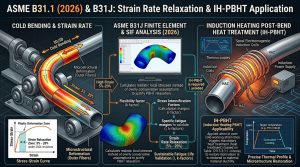
一、 現代高能管線之工程挑戰與 ASME 規範哲學演進 / Engineering Challenges of Modern High-Energy Piping and the Evolution of ASME Code Philosophies
1.1 超臨界發電環境下之管線完整性挑戰 / Piping Integrity Challenges in Supercritical Power Generation Environments
在追求極致熱效率與降低溫室氣體排放的全球趨勢下,現代火力發電與複循環發電系統的熱力學循環條件不斷攀升。主蒸汽管線(Main Steam Piping)與高溫再熱蒸汽管線(Hot Reheat Piping)長期暴露於極端的高溫與高壓中。傳統的低合金鉻鉬鋼(如2.25Cr-1Mo的P22材料)在超過540°C的環境下,其高溫許用應力(Allowable stress)急遽下降,導致管壁厚度必須大幅增加以抵抗內壓2。過厚的管壁不僅顯著增加材料成本與系統呆重,更會在發電工廠頻繁啟停(Cycling operations)的過程中,因管壁內外的巨大溫度梯度而產生嚴重的熱疲勞(Thermal fatigue)應力3。Propelled by the global imperative to maximize thermal efficiency and reduce greenhouse gas emissions, the thermodynamic cycle conditions of modern thermal and combined cycle power systems continue to escalate. Main Steam Piping and Hot Reheat Piping are chronically exposed to extreme high temperatures and pressures. Conventional low-alloy chrome-moly steels (e.g., 2.25Cr-1Mo P22 material) experience a precipitous drop in high-temperature allowable stress in environments exceeding 540°C, necessitating a substantial increase in wall thickness to resist internal pressure2. Excessively thick pipe walls not only significantly increase material costs and system deadweight, but also generate severe thermal fatigue stress during frequent power plant cycling operations due to massive temperature gradients between the inner and outer pipe walls3.
潛變強化鐵素體鋼(CSEF)的引入成功解決了這一困境。以P91(9Cr-1Mo-V)為例,透過添加微量的釩(V)、鈮(Nb)與控制氮(N)含量,其在500°C至610°C區間維持了卓越的潛變強度,使得設計管壁厚度較傳統P22材料縮減達60%,同時熱疲勞壽命提升了10至12倍3。然而,CSEF材料對製造過程中的熱循環與機械變形具有極端敏感性。不當的銲接熱輸入、冷作成形應變,或是不合規範的熱處理,皆會輕易摧毀其精心調控的微觀組織,使得原本預期具備100,000小時設計壽命的管線,在服役僅20,000小時後即面臨災難性的潛變失效9。The introduction of Creep Strength Enhanced Ferritic Steels (CSEF) successfully resolved this dilemma. Taking P91 (9Cr-1Mo-V) as an example, by adding trace amounts of vanadium (V), niobium (Nb), and controlling nitrogen (N) content, it maintains exceptional creep strength in the 500°C to 610°C range. This allows the design wall thickness to be reduced by up to 60% compared to traditional P22 materials, while increasing thermal fatigue life by 10 to 12 times3. However, CSEF materials are extremely sensitive to thermal cycles and mechanical deformation during the manufacturing process. Improper welding heat input, cold-forming strain, or non-compliant heat treatment can easily destroy their carefully engineered microstructures, causing piping systems designed for a 100,000-hour lifespan to face catastrophic creep failure after only 20,000 hours of service9.
1.2 ASME B31.1與B31.3設計哲學與安全裕度之根本差異 / Fundamental Differences in Design Philosophies and Safety Margins Between ASME B31.1 and B31.3
為確保壓力管線之安全性,業界廣泛遵循ASME B31系列規範。然而,應用於發電工廠之ASME B31.1(動力管線,Power Piping)與應用於石化工廠之ASME B31.3(製程管線,Process Piping)在設計哲學與風險容忍度上存在本質差異10。動力管線系統(如鍋爐外部管線 Boiler External Piping, BEP)一旦發生高壓蒸汽洩漏或爆管,將導致災難性的人員傷亡與大規模電網癱瘓,因此B31.1的設計基調極度保守,長期以來採用約4.0的高安全係數(Factor of Safety),並以高度指令性(Prescriptive)的條文約束製造行為11。相較之下,B31.3製程管線規範更側重於風險管理與靈活性,採用約3.0的安全係數,並賦予工程師透過嚴密的應力分析來換取設計彈性的空間11。To ensure the safety of pressure piping, the industry widely adheres to the ASME B31 series of codes. However, there is a fundamental difference in design philosophy and risk tolerance between ASME B31.1 (Power Piping), applied in power plants, and ASME B31.3 (Process Piping), applied in petrochemical plants10. Should a high-pressure steam leak or pipe rupture occur in a power piping system (such as Boiler External Piping, BEP), it would lead to catastrophic casualties and large-scale power grid paralysis. Therefore, the design tone of B31.1 is extremely conservative, historically employing a high Factor of Safety of approximately 4.0, and constraining manufacturing activities with highly prescriptive clauses11. In contrast, the B31.3 Process Piping code focuses more on risk management and flexibility, utilizing a safety factor of approximately 3.0 and granting engineers the latitude to trade rigorous stress analysis for design flexibility11.
此兩種規範在面對極端環境檢驗時的邏輯差異,充分展現了其保守程度的不同。下表詳列了兩大規範的核心參數對比:The logical differences between these two codes when dealing with extreme environmental inspections fully demonstrate their varying degrees of conservatism. The table below details the core parameters of both codes:
| 評估參數 / Evaluation Parameter | ASME B31.1 (2026版 動力管線 / Power Piping) | ASME B31.3 (2026版 製程管線 / Process Piping) |
| 安全係數 / Factor of Safety | 4.0 (高度保守,許用應力較低 / Highly conservative, lower allowable stress) | 3.0 (經濟與彈性導向,許用應力較高 / Economics and flexibility oriented, higher allowable stress) |
| 低溫衝擊測試豁免機制 / Low-Temp Impact Test Exemption | 採用固定溫度極限值。MDMT低於 -20°F (-29°C) 強制測試10。 / Uses a fixed temperature threshold. Mandatory testing if MDMT is below -20°F (-29°C)10. | 採用複雜材料韌性曲線。高韌性材料可豁免至更低溫10。 / Employs complex material toughness curves. High-toughness materials can be exempted at much lower temps10. |
| 應力比率信用 / Stress Ratio Credit | 嚴格限制,不允許放寬溫度極限值10。 / Strictly limited; does not allow relaxation of temperature thresholds10. | 允許應力比率折扣,管線未滿載可大幅降低豁免溫度10。 / Allows stress ratio credit; under-stressed pipes can significantly lower the exemption temp10. |
| 碳鋼 (P-No.1) 熱處理極限值 / Carbon Steel (P-No.1) PWHT Threshold | 管壁厚度 ≧ 19 mm (3/4 in) 時,強制執行應力消除熱處理11。 / Mandatory stress relief if wall thickness is ≧ 19 mm (3/4 in)11. | 依據計算之纖維伸長率。 > 50% 且未保留10%韌性始強制熱處理11。 / Based on calculated fiber elongation. Mandatory if > 50% and fails to retain 10% ductility11. |
從上述對比可知,B31.1不鼓勵製造商對厚壁管或高合金鋼進行任何可能影響金相組織的非標準化嘗試11。在處理P9x這類高敏材料的冷作成形時,B31.1的強制性條文成為確保發電工廠40年以上生命週期的最後防線11。 From the above comparison, it is evident that B31.1 discourages manufacturers from attempting any non-standardized practices on thick-walled pipes or high-alloy steels that might affect the metallographic structure11. When processing highly sensitive materials like P9x during cold forming, the mandatory clauses of B31.1 serve as the ultimate line of defense to ensure a power plant’s lifecycle of over 40 years11.
二、 P9x (P-No. 15E) 材料之微觀冶金力學與失效機制 / Micro-Metallurgical Mechanics and Failure Mechanisms of P9x (P-No. 15E) Materials
2.1 CSEF 鋼材之化學成分與微觀組織穩定性 / Chemical Composition and Microstructural Stability of CSEF Steels
P91(ASTM A335 P91,9Cr-1Mo-V)屬於ASME P-No. 15E材料組別,其優異的高溫潛變抗力,奠基於極其複雜且精確的微觀組織:回火馬氏體基體(Tempered Martensite Matrix),以及散佈於原奧氏體晶界(Prior Austenite Grain Boundaries, PAGBs)和板條邊界(Lath boundaries)的析出強化相3。P91 (ASTM A335 P91, 9Cr-1Mo-V) belongs to the ASME P-No. 15E material group. Its excellent high-temperature creep resistance is founded on a highly complex and precise microstructure: a Tempered Martensite Matrix, accompanied by precipitation-strengthening phases dispersed along Prior Austenite Grain Boundaries (PAGBs) and lath boundaries3.
材料的潛變抗力由兩種主要析出物維持:其一為富鉻的 M23C6碳化物,主要提供晶界穩定作用;其二為細小且彌散分佈的 MX 碳氮化物(如NbC、VN)。這些奈米級微粒在高溫下極難粗化,透過齊納釘紮效應(Zener Pinning Effect)有效阻礙了位錯(Dislocations)的滑移與亞晶界的遷移2。為了確保這些析出物能夠正確生成,P91的化學成分受到了極為嚴格的控制。The material’s creep resistance is maintained by two main precipitates: chromium-rich M23C6 carbides, which primarily stabilize grain boundaries, and fine, homogeneously dispersed MX carbonitrides (e.g., NbC, VN). These nano-scale particles are extremely resistant to coarsening at high temperatures, effectively impeding dislocation slip and subgrain boundary migration through the Zener Pinning Effect2. To ensure the proper formation of these precipitates, the chemical composition of P91 is subjected to extremely strict controls.
| 合金元素 / Alloy Element | 在 P91 (P-No. 15E) 中之冶金角色 / Metallurgical Role in P91 | 含量超標之負面效應 / Negative Effects of Excess | 含量不足之負面效應 / Negative Effects of Deficiency |
| 碳 / Carbon (C) | M23C6 與 MX 碳氮化物之前驅物;強奧氏體穩定劑 (≧0.09%)2 / Precursor to M23C6 and MX ; austenite stabilizer (≧0.09%)2 | 導致銲接性惡化與過度硬化2 / Worsens weldability and causes over-hardening2 | 碳化物析出不足,潛變強度下降2 / Insufficient precipitation, drop in creep strength2 |
| 鈮 / Niobium (Nb) | 形成極穩定的 NbC/NbN,促進晶粒細化與強化 (≧0.03%)2 / Forms stable NbC/NbN; refines grains (≧0.03%)2 | 過量會大幅降低低溫衝擊韌性2 / Substantially lowers low-temp impact toughness2 | 失去齊納釘紮效應,早期潛變失效2 / Loss of Zener pinning, early creep failure2 |
| 氮 / Nitrogen (N) | 與 Nb, V 結合形成 MX 碳氮化物 (≧0.03%)2 / Combines with Nb/V to form MX (≧0.02%)2 | 生成氣孔風險增加,抑制鐵素體2 / Increases porosity risk, retards ferrite2 | MX 密度不足,無法阻礙位錯2 / Insufficient MX density to impede dislocations2 |
| 錳 + 鎳 / Mn + Ni | 改善低溫韌性,但強烈抑制相變溫度2 / Improves toughness but suppresses phase transition temp2 | (Mn+Ni) > 1.5% 導致殘餘奧氏體,壓低 AC1 2 / (Mn+Ni) 1.5% causes retained austenite, lowers AC1 2 | 脫氧能力下降,影響基礎韌性2 / Decreased deoxidation, affects baseline toughness2 |
由上表可知,(Mn+Ni)的總和是影響P91安全熱處理溫度的關鍵參數。當(Mn+Ni)超過1.0%時,下臨界點 AC1 溫度會顯著降低,這直接壓縮了安全進行銲後熱處理(PWHT)或彎後熱處理(PBHT)的溫度視窗;一旦局部加熱溫度不慎越過 AC1,材料將部分奧氏體化,並在冷卻後形成缺乏延展性且極脆的「新鮮馬氏體」(Fresh Martensite),埋下應力腐蝕開裂與早期失效的隱患2。As the table shows, the sum of (Mn+Ni) is the critical parameter affecting the safe heat treatment temperature of P91. When (Mn+Ni) exceeds 1.0%, the lower critical temperature AC1 significantly decreases, directly compressing the safe temperature window for Post-Weld Heat Treatment (PWHT) or Post-Bend Heat Treatment (PBHT). If localized heating inadvertently exceeds AC1 , the material will partially austenitize and, upon cooling, form “Fresh Martensite”—a brittle phase lacking ductility, embedding hidden risks of Stress Corrosion Cracking and early failure2.
2.2 傳統 1.5D 銲接彎頭之 Type IV 潛變破裂機制 / Type IV Creep Cracking Mechanism of Traditional 1.5D Welded Elbows
在傳統管線施工中,流體轉向通常依賴符合ASME B16.9標準的1.5D對銲彎頭。在彎頭與直管的對銲過程中,電弧的極高熱輸入在母材上形成了熱影響區(HAZ)。HAZ依據經歷的峰值溫度可分為粗晶區(CGHAZ)、細晶區(FGHAZ)與跨臨界區(Intercritical HAZ, ICHAZ)14。In traditional piping construction, fluid redirection usually relies on 1.5D butt-welded elbows conforming to the ASME B16.9 standard. During the butt-welding process of elbows and straight pipes, the extremely high heat input of the arc creates a Heat-Affected Zone (HAZ) on the base metal. Depending on the peak temperatures experienced, the HAZ can be divided into the Coarse-Grained HAZ (CGHAZ), Fine-Grained HAZ (FGHAZ), and Intercritical HAZ (ICHAZ)14.
其中,ICHAZ所經歷的峰值溫度恰好落於 AC1 與上臨界點 AC3 之間。在這種半奧氏體化的熱循環下,原本提供強化作用的細小 MX 碳氮化物會部分溶解或異常聚集成粗大的Laves相(如Fe₂Mo或Fe₂W聚集體,尺寸可達3.4 μm),而原有的馬氏體板條邊界則會消失,轉變為異常的等軸鐵素體結構9。這導致ICHAZ的硬度出現顯著的「軟化凹陷」(Softening dip)。在管線高溫服役的長期應力作用下,潛變空洞(Creep cavities)會優先在這些粗大析出物周圍成核(Nucleation)、長大,並迅速連結成巨觀裂紋,最終導致沿著HAZ外緣發生的災難性斷裂,此即業界高度重視的 Type IV 潛變破裂(Type IV Cracking)3。Among these, the peak temperatures experienced by the ICHAZ fall exactly between AC1 and the upper critical point AC3 . Under this semi-austenitizing thermal cycle, the fine MX carbonitrides that originally provided strengthening either partially dissolve or abnormally agglomerate into coarse Laves phases (e.g., Fe₂Mo or Fe₂W aggregates, reaching sizes up to 3.4 μm). Concurrently, original martensitic lath boundaries disappear, transforming into aberrant equiaxed ferrite structures9. This results in a significant “softening dip” in the hardness of the ICHAZ. Under long-term stress during high-temperature service, creep cavities preferentially nucleate and grow around these coarse precipitates, rapidly linking into macroscopic cracks and ultimately leading to catastrophic fracture along the outer edge of the HAZ. This phenomenon is highly scrutinized in the industry as Type IV Creep Cracking3.
2.3 流體動力學病灶:迪恩渦流與流體加速腐蝕 (FAC) / Fluid Dynamic Defects: Dean Vortices and Flow-Accelerated Corrosion (FAC)
除了冶金層面的Type IV破裂,傳統1.5D彎頭在流體力學上亦存在嚴重的結構性缺陷。在現代發電工廠的脫硝系統(SCR)與碳捕獲(CCUS)系統中,流體環境極為惡劣。在SCR系統中,未反應的氨氣逸散(Ammonia slip)會與煙氣中的 SO3 和氣態 H2SO4 反應,生成具備高黏性、強吸水性與強腐蝕性的硫酸氫銨(Ammonium Bisulfate, ABS)4。在CCUS系統中,胺基溶劑(如MEA、DEA)亦對碳鋼與低合金鋼具有強烈的腐蝕性,容易引發胺應力腐蝕開裂(Amine SCC / ASCC)4。Beyond metallurgical Type IV cracking, traditional 1.5D elbows also possess severe structural defects in terms of fluid dynamics. In the Selective Catalytic Reduction (SCR) and Carbon Capture, Utilization, and Storage (CCUS) systems of modern power plants, the fluid environment is exceptionally harsh. In SCR systems, unreacted ammonia slip reacts with SO3 and gaseous H2SO4 in the flue gas to form Ammonium Bisulfate (ABS), which is highly viscous, hygroscopic, and corrosive4. In CCUS systems, amine-based solvents (such as MEA and DEA) are also highly corrosive to carbon and low-alloy steels, easily triggering Amine Stress Corrosion Cracking (ASCC)4.
當這些夾帶ABS液滴、胺基溶劑與飛灰的高壓多相流體,以高速通過曲率半徑極短的1.5D彎頭時,流體因強烈的離心力作用在管截面內部產生二次流(Secondary Flow),即迪恩渦流(Dean vortices)4。強烈的渦流導致嚴重的流動分離(Flow separation),並使高密度的腐蝕性液滴與微粒,以近乎90°的垂直撞擊角(Impingement angle)猛烈撞擊彎管外弧側(Extrados)4。這種高動能的物理切削作用不斷剝離管壁表面的保護性氧化層,配合化學腐蝕的疊加效應,引發了流體加速腐蝕(Flow-Accelerated Corrosion, FAC),導致管壁厚度急遽減薄,大幅縮短管線壽命4。When high-pressure multiphase fluids entrained with ABS droplets, amine solvents, and fly ash travel at high speeds through 1.5D elbows with extremely short curvature radii, the fluid generates secondary flows within the pipe cross-section due to intense centrifugal forces—known as Dean vortices4. These powerful vortices cause severe flow separation and force high-density corrosive droplets and particulates to violently strike the extrados (outer curve) of the elbow at steep impingement angles of nearly 90°4. This high-kinetic physical cutting action continually strips the protective oxide layer from the pipe wall. Coupled with the synergistic effects of chemical corrosion, it triggers Flow-Accelerated Corrosion (FAC), causing a rapid thinning of the wall thickness and drastically shortening the lifespan of the piping4.
三、 2026年版 ASME B31.1 冷作成形應變率與厚度管理 / 2026 ASME B31.1 Cold-Forming Strain Rates and Thickness Management
面對P9x材料在銲接彎頭上的種種失效風險,採用整管冷作彎曲(Cold Bending)成為消除銲縫與HAZ的理想替代方案。然而,冷作變形同樣會引發材料內部差排密度的劇增與加工硬化。為此,ASME B31.1在第129節(Bending and Forming)中頒布了極其嚴格的管理規範7。Faced with the various failure risks of P9x materials in welded elbows, utilizing whole-pipe CNC Cold Bending emerges as the ideal alternative to eliminate welds and HAZ. However, cold deformation inherently triggers a surge in dislocation density and work hardening within the material. To address this, ASME B31.1 issued highly stringent management codes in Section 129 (Bending and Forming)7.
3.1 應變率限制 (Table 129.3.3.1-1) 與強制 PBHT / Strain Limits (Table 129.3.3.1-1) and Mandatory PBHT
在2024與2026年版的ASME B31.1中,針對CSEF材料發布了 Table 129.3.3.1-1 規範(Post-Cold-Forming Strain Limits and Heat Treatment Requirements for Creep Strength Enhanced Ferritic Steels)7。規範定義「冷作成形」為在低於臨界溫度下對材料施加的塑性應變。根據冷彎工法的幾何關係,極限纖維應變率 ε可透過以下公式估算:In the 2024 and 2026 editions of ASME B31.1, Table 129.3.3.1-1 (Post-Cold-Forming Strain Limits and Heat Treatment Requirements for Creep Strength Enhanced Ferritic Steels) was published for CSEF materials7. The code defines “cold forming” as the plastic strain applied to the material at temperatures below the critical transformation range. Based on the geometric relationship of the cold bending method, the extreme fiber strain rate ε can be estimated using the following formula:
ε=ro/R1 ×100%
其中,ro 為管件外半徑,R1 為彎曲中心半徑7。若採用3D彎管(R1 =3Do),最大應變率約高達16.7%;若採用5D彎管(R1 =5Do),則應變率約為10% 7。
Where ro is the outer radius of the pipe and R1 is the bend center radius7. If a 3D bend is used (R1 =3Do), the maximum strain rate reaches approximately 16.7%; if a 5D bend is used (R1 =5Do), the strain rate is about 10% 7.
依據 B31.1 規範條文,當P-No. 15E材料的計算應變率落入 5% 至 20% 的區間時,由於材料內部已累積巨量的加工殘餘應力,且塑性耗損嚴重,規範強制要求必須進行彎後熱處理(PBHT)以恢復材料的韌性並消弭應力鬆弛開裂(SRC)的風險7。若未執行PBHT,高密度的位錯將使局部硬度異常升高,完全無法滿足ASME BPVC規定的硬度標準(185-248 HBW),且在高溫運行中極易發生脆性斷裂9。According to B31.1 code provisions, when the calculated strain rate of P-No. 15E materials falls within the 5% to 20% range, the code mandates Post-Bend Heat Treatment (PBHT) to restore material toughness and eliminate the risk of Stress Relaxation Cracking (SRC), as massive amounts of residual processing stress have accumulated and plastic exhaustion is severe7. Failure to perform PBHT will cause the localized hardness to spike abnormally due to high dislocation densities, entirely failing to meet the ASME BPVC hardness standards (185-248 HBW), and rendering the material highly susceptible to brittle fracture during high-temperature operations9.
3.2 管壁減薄控制與設計裕度 (Table 102.4.5) / Wall Thinning Control and Design Margins (Table 102.4.5)
除了應變導致的冶金退化,冷彎過程在物理上會不可避免地造成外弧側壁厚減薄。為了確保彎曲後的最終厚度仍能滿足設計公式算出的最小耐壓厚度(tm),ASME B31.1 第102.4.5節規定了嚴格的彎曲減薄裕度(Bend Thinning Allowance)7。In addition to metallurgical degradation caused by strain, the cold bending process inevitably causes physical wall thinning on the extrados. To ensure that the final thickness after bending still meets the minimum pressure design thickness (tm) calculated from design formulas, ASME B31.1 Section 102.4.5 stipulates strict Bend Thinning Allowances7.
根據規範,成形前母管的厚度必須依據彎曲半徑進行按比例增加7:According to the code, the thickness of the mother pipe prior to forming must be proportionally increased based on the bend radius7:
- 6D 及以上彎管 / 6D and above bends:母管厚度需滿足06 tm(約6%減薄餘量 / approx. 6% thinning allowance)。
- 5D 彎管 / 5D bends:母管厚度需滿足08 tm(約8%減薄餘量 / approx. 8% thinning allowance)。
- 4D 彎管 / 4D bends:母管厚度需滿足14 tm(約14%減薄餘量 / approx. 14% thinning allowance)。
- 3D 彎管 / 3D bends:母管厚度需滿足25 tm(約25%減薄餘量 / approx. 25% thinning allowance)。
這項規定在管線設計與材料採購上具有關鍵指導意義。採用5D彎管僅需增加8%的厚度裕度,通常沿用原始設計的管排程(Schedule)或微幅提升一個排程即可滿足;但若採用3D彎管,高達25%的厚度增量往往迫使設計單位必須採購特殊加厚的無縫鋼管,大幅墊高物料與倉儲成本4。This provision holds pivotal guiding significance in piping design and material procurement. Utilizing a 5D bend only requires an 8% thickness margin, which can usually be satisfied by retaining the original pipe Schedule or increasing it slightly. However, employing a 3D bend demands a 25% thickness increase, often forcing design units to procure specially thickened seamless pipes, drastically inflating material and warehousing costs4.
四、 2026年版 ASME B31J:應力強化因子與柔性特徵之理論重構 / 2026 ASME B31J: Theoretical Reconstruction of Stress Intensification Factors and Flexibility Characteristics
在計算管系疲勞應力時,傳統工程師仰賴ASME B31.1 / B31.3 附錄D(Appendix D)的簡化圖表來獲取應力強化因子(Stress Intensification Factors, SIF, i-factor)與柔性係數(Flexibility Factors, k-factor)19。然而,Appendix D建立於1950年代Markl的低循環疲勞實驗,存在過度簡化且忽略三維空間幾何影響的缺陷。在2026年版規範中,Appendix D已被徹底廢除,全面強制導入 ASME B31J 作為唯一合法的管件應力因子計算標準1。When calculating fatigue stress in piping systems, traditional engineers relied on the simplified charts of ASME B31.1 / B31.3 Appendix D to obtain Stress Intensification Factors (SIF, i-factors) and Flexibility Factors (k-factors)19. However, Appendix D was founded on Markl’s low-cycle fatigue experiments from the 1950s and suffers from flaws of oversimplification and the neglect of three-dimensional spatial geometric effects. In the 2026 edition of the codes, Appendix D has been completely abolished, and ASME B31J is universally mandated as the sole legitimate standard for calculating piping stress factors1.
4.1 橢圓化效應 (Ovalization) 與柔性特徵 (h) / Ovalization Effect and Flexibility Characteristic (h)
B31J 的理論核心在於精確量化管件在受彎矩作用時的「橢圓化效應」。當彎管受到熱膨脹位移推擠時,其圓形截面會發生畸變,趨向橢圓形。這種橢圓化變形吸收了系統的角位移,賦予了彎管高於直管的「柔性」,但也同時在管壁兩側(Crowns)引發了強烈的局部周向彎曲應力,成為疲勞裂紋的起源點1。The theoretical core of B31J lies in accurately quantifying the “ovalization effect” of piping components under bending moments. When a bend is subjected to thermal expansion displacement, its circular cross-section distorts toward an elliptical shape. This ovalization absorbs the system’s angular displacement, endowing the bend with greater “flexibility” than a straight pipe. However, it simultaneously induces severe localized circumferential bending stress at the crowns of the pipe wall, which act as initiation points for fatigue cracks1.
為了數學化描述此現象,B31J引入了無因次參數「柔性特徵」(Flexibility Characteristic, h),其公式定義為:To mathematically describe this phenomenon, B31J introduces a dimensionless parameter known as the “Flexibility Characteristic” (h), defined by the formula:
h=T⋅R1/r22
其中,T 為管件標稱壁厚(Nominal Wall Thickness),R1 為彎曲半徑,r2 為平均截面半徑(r2=(D-T)/2)1。由公式可知,當彎曲半徑 R1 越小(如短半徑彎頭),或壁厚 T 越薄(大 D/T 比)時,h 值急遽下降,代表管件極易發生橢圓化,產生巨大的應力集中1。Where T is the Nominal Wall Thickness, R1 is the bend radius, and r2 is the mean cross-sectional radius (r2=(D-T)/2)1. The formula indicates that a smaller bend radius R1 (like a short-radius elbow) or a thinner wall T (large D/T ratio) causes a precipitous drop in h. This signifies that the component is highly susceptible to ovalization, generating massive stress concentrations1.
4.2 SIF 解耦與 3D 空間幾何驗證 / SIF Decoupling and 3D Spatial Geometric Validation
基於柔性特徵 h,B31J 將單一的 SIF 解耦為三個獨立方向的向量,大幅提升了三維空間分析的精度1: Based on the flexibility characteristic h, B31J decouples the singular SIF into three independent directional vectors, drastically improving the precision of 3D spatial analysis1:
| B31J 物理參數 / B31J Physical Parameter | 閉式解公式 / Closed-Form Equation | 物理意義與 B31J 變革 / Physical Significance & B31J Evolution |
| 柔性係數 / Flexibility Factor (k) | K=1.65/h | 量化彎管相較於同等長度直管的柔性倍率1。 / Quantifies the flexibility multiplier of a bend compared to a straight pipe1. |
| 平面內 / In-plane SIF (ii) | ii=0.9/h2/3 | 用於放大面內彎矩引起的熱膨脹應力範圍。舊版取單一最大值,B31J 徹底解耦1。 / Amplifies in-plane thermal stress range. B31J decouples what older codes treated as a single max SIF1. |
| 平面外 / Out-of-plane SIF (io) | ii=0.75/h2/3 | 評估因扭曲位移產生的面外應力集中效應1。 / Evaluates out-of-plane stress concentration from torsional displacement1. |
| 扭轉 / Torsional SIF (it) | 依據具體幾何查表 / Refer to specific geometry tables | 捕捉三維空間局部剪應力極值。舊版長期預設 it =1.0 1。 / Captures peak local shear stress in 3D space. Older codes defaulted to it =1.0 1. |
透過 B31J 框架的驗證,當系統將R1=1.5Do的銲接彎頭替換為 R1=3Do 或R1=5Do 的大半徑冷作彎管時,R1 的倍增直接導致柔性特徵 h 值成比例上升,進而使得 ii與io 呈現指數級別的衰減4。這證明了大半徑彎管不僅消除了HAZ,更能實質降低整體管系的局部應力集中,大幅延長疲勞壽命4。Through validation within the B31J framework, replacing an R1=1.5Do welded elbow with a R1=3Do or R1=5Do large-radius cold bend doubles (or triples) R1, which directly leads to a proportional increase in the flexibility characteristic h. This, in turn, causes ii and io to attenuate exponentially4. This proves that large-radius bends not only eliminate the HAZ but also substantially reduce localized stress concentrations across the piping system, vastly extending fatigue life4.
五、 潁璋工程「三合一工法」之實務解析 / Practical Analysis of Ying-Zhang Engineering’s “Three-in-One Method”
為克服 P9x 管線在現代發電工廠所面臨的冶金與幾何雙重挑戰,潁璋工程(Ying-Zhang Engineering)整合了三大核心技術,提出針對高壓高溫管線的「三合一工法」(Three-in-One Method):(1) CNC 大半徑冷作彎曲;(2) 感應式亞臨界彎後熱處理 (IH-PBHT);(3) 結合數據雲端數位化1。To overcome the dual metallurgical and geometric challenges faced by P9x piping in modern power plants, Ying-Zhang Engineering integrated three core technologies into a “Three-in-One Method” for HPHT piping: (1) CNC Large-Radius Cold Bending; (2) Induction Heating Subcritical Post-Bend Heat Treatment (IH-PBHT); and (3) Integration of data cloud digitization1.
5.1 3D/5D 大半徑冷作成形:流體力學與冶金缺陷之根除 / 3D/5D Large-Radius Cold Forming: Eradication of Fluidic and Metallurgical Defects
三合一工法的首要步驟,是放棄傳統的 1.5D B16.9 銲接彎頭,改採 CNC 冷彎機直接對 P91/P92 母管進行 3D 或 5D 的冷作成形1。 The first step of the Three-in-One Method abandons traditional 1.5D B16.9 welded elbows in favor of using CNC cold bending machines to directly form 3D or 5D cold bends on P91/P92 mother pipes1.
冶金層面上,此舉實現了關鍵彎曲區段的「無銲縫化」。由於沒有電弧高熱的介入,材料內部完全不會生成熱影響區(HAZ),物理上根絕了 ICHAZ 軟化帶的出現,徹底消弭了最致命的 Type IV 潛變破裂風險1。在流體力學層面分析,曲率半徑由 1.5D 增加至 3D/5D,使得流體轉向極為平滑。流線能夠緊密附著於管壁,大幅消散了迪恩渦流(Dean vortices)的能量,消除了彎管內弧側的負壓分離區4。腐蝕性介質對外弧管壁的撞擊角(Impingement angle)大幅降低,固相顆粒僅是順著流線滑過壁面,從根本上解決了流體加速腐蝕(FAC)與應力腐蝕開裂(ASCC)的問題4。Metallurgically speaking, this achieves a “seamless” state in critical bending zones. Without the high heat of an electric arc, the material develops absolutely no Heat-Affected Zone (HAZ), physically eradicating the ICHAZ softening band and completely eliminating the most fatal risk of Type IV Creep Cracking1. In terms of fluid dynamics, increasing the curvature radius from 1.5D to 3D/5D makes fluid redirection exceptionally smooth. Streamlines adhere closely to the pipe wall, largely dissipating the energy of Dean vortices and eliminating negative pressure separation zones on the intrados4. The impingement angle of corrosive media on the extrados is vastly reduced, allowing solid particulates to merely glide past the wall along the streamlines, fundamentally resolving Flow-Accelerated Corrosion (FAC) and Amine SCC (ASCC) issues4.
5.2 結合去磁技術的 IH-PBHT 亞臨界熱處理 / IH-PBHT Subcritical Heat Treatment with Degaussing Technology
依據 ASME B31.1 Table 129.3.3.1-1,冷彎產生的 5%~20% 應變必須透過彎後熱處理(PBHT)來釋放8。有別於受熱不均且耗時的傳統工廠爐內熱處理,潁璋工程採用感應加熱(Induction Heating, IH)技術執行 PBHT1。 According to ASME B31.1 Table 129.3.3.1-1, the 5%~20% strain generated by cold bending must be relieved through Post-Bend Heat Treatment (PBHT)8. Unlike traditional, time-consuming furnace heat treatments that suffer from uneven heating, Ying-Zhang Engineering employs Induction Heating (IH) technology to execute PBHT1.
精確溫控與冶金回復 / Precise Temp Control & Metallurgical Recovery: IH-PBHT 透過電磁感應在鋼管內部直接產生焦耳熱,升溫迅速且穿透性極佳。工法將 PBHT 溫度精準鎖定在 760°C1。此設定深具冶金學考量:P91 的下臨界點AC1 約在 800°C 左右,鎖定 760°C 確保了熱處理過程絕對處於「亞臨界」(Subcritical)狀態,使冷作產生的高密度位錯得以回復(Recovery),同時促進M23C6 碳化物適度回火並穩固於晶界,將硬度精確降至安全的 185-248 HBW 範圍內,完美恢復材料的潛變韌性1。此外,該工法嚴格遵守 ASME 規範,將加熱與冷卻速率控制在 200°C/hr 以內1。IH-PBHT directly generates Joule heat inside the steel pipe via electromagnetic induction, providing rapid temperature elevation with excellent penetration. The method precisely locks the PBHT temperature at 760°C1. This setting possesses profound metallurgical reasoning: the lower critical point AC1 of P91 is around 800°C; targeting 760°C guarantees the heat treatment remains absolutely “Subcritical.” This allows high-density dislocations caused by cold work to undergo recovery, while moderately tempering M23C6 carbides to stabilize at grain boundaries. It accurately drops hardness into the safe 185-248 HBW range, perfectly restoring the material’s creep toughness1. Furthermore, the method strictly adheres to ASME codes by controlling heating and cooling rates to within 200°C/hr1.
三級數位去磁作業 (Degaussing SOP) / Three-Stage Digital Degaussing SOP: P9x 鋼材具有強烈的鐵磁性。在歷經冷作高應變、感應電磁場加熱,以及後續的磁粉探傷(MT)檢驗後,管端極易殘留高達數十 Gauss 的強烈磁場1。當殘磁超過 20 Gauss 時,現場進行打底銲接將遭遇毀滅性的「磁吹效應」(Magnetic Arc Blow)。磁場強烈干擾電弧中帶電粒子的洛倫茲力(Lorentz force),導致電弧偏航、飛濺、未熔合甚至無法起弧27。為此,工法導入了特製的三級去磁標準作業程序,將接管端部的殘餘磁場強制中和至 10 Gauss 以內,為後續現場無缺陷銲接奠定基礎1。P9x steel is highly ferromagnetic. After undergoing high-strain cold work, induction electromagnetic heating, and subsequent Magnetic Particle Testing (MT), pipe ends can easily retain a powerful magnetic field up to dozens of Gauss1. If residual magnetism exceeds 20 Gauss, on-site root pass welding will encounter the devastating “Magnetic Arc Blow” effect. The magnetic field severely disrupts the Lorentz force acting on charged particles in the arc, causing arc wander, spatter, lack of fusion, or failure to strike an arc27. To counter this, the method introduces a custom three-stage degaussing SOP, forcibly neutralizing the residual magnetic field at the pipe ends to under 10 Gauss, laying the foundation for defect-free on-site welding1.
六、 ASME Section IX 銲接與熱處理程序品質管控 / ASME Section IX Welding and Heat Treatment Procedure Quality Control
在執行如 IH-PBHT 等熱處理工序時,其合規性必須置於 ASME Section IX(銲接與銅銲程序檢定)的框架下進行檢視31。ASME Section IX 的核心在於確保製造程序(WPS)具備通過機械測試的程序檢定紀錄(PQR)支撐31。 When executing heat treatment processes like IH-PBHT, compliance must be reviewed under the framework of ASME Section IX (Welding, Brazing, and Fusing Qualifications)31. The core of ASME Section IX is to ensure that a Welding Procedure Specification (WPS) is supported by a Procedure Qualification Record (PQR) that has passed mechanical testing31.
在 Section IX 中,變數被分為三大類32: In Section IX, variables are divided into three categories32:
- 基本變數 (Essential variables):如母材 P-Number、填料金屬 F-Number,以及 PWHT/PBHT 的有無與溫度範圍。若熱處理溫度超出檢定範圍,強制要求重新進行 PQR 測試32。 / Essential variables: e.g., base metal P-Number, filler metal F-Number, and the presence and temperature range of PWHT/PBHT. If heat treatment temps exceed the qualified range, re-qualification via PQR testing is mandatory32.
- 輔助基本變數 (Supplementary essential variables):當建構規範要求進行低溫衝擊韌性測試時,這些變數即升級為基本變數,變更亦需重新檢定32。 / Supplementary essential variables: When construction codes require low-temperature impact toughness testing, these upgrade to essential variables; any change requires re-qualification32.
- 非基本變數 (Nonessential variables):如接頭幾何細節,不影響機械性能,可經簽核直接修改 WPS31。 / Nonessential variables: e.g., joint geometry details, which do not affect mechanical properties and allow direct WPS modification upon sign-off31.
針對厚壁 P91 管線,B31.1 強制要求熱處理11。Section IX 規定,生產過程必須嚴格遵循 WPS 參數。若僅依賴傳統的點溫計(Pyrometer)進行人工抽測,無法證明熱處理過程中的全斷面均溫性與恆定冷卻速率34。因此,潁璋工程在 IH-PBHT 過程中整合了紅外線熱像儀與多點熱電偶的數位化熱歷程監控系統。這不僅消除了人工紀錄的盲區,更確保熱處理歷程能完美對應 PQR 所核准的輔助基本變數,實現了管線製造履歷的高度透明與可稽核性1。For thick-walled P91 piping, B31.1 mandates heat treatment11. Section IX dictates that production processes strictly adhere to WPS parameters. Relying solely on traditional pyrometers for manual spot checks fails to prove full cross-sectional temperature uniformity and constant cooling rates during heat treatment34. Therefore, Ying-Zhang Engineering integrated a digital thermal history monitoring system featuring infrared thermal cameras and multi-point thermocouples during IH-PBHT. This eliminates the blind spots of manual recording and guarantees that the thermal history perfectly corresponds to the supplementary essential variables approved by the PQR, achieving highly transparent and auditable piping manufacturing records1.
七、 潛變壽命評估:Larson-Miller 參數 (LMP) 驗證 / Creep Life Assessment: Validation via Larson-Miller Parameter (LMP)
為了從理論上驗證三合一工法中 760°C PBHT 的長期可靠度,材料科學界廣泛採用 Larson-Miller 參數(LMP)進行高溫潛變壽命預測36。LMP 數學模型定義為:To theoretically validate the long-term reliability of the 760°C PBHT used in the Three-in-One Method, materials scientists widely utilize the Larson-Miller Parameter (LMP) for predicting high-temperature creep life36. The LMP mathematical model is defined as:
LMP=T(C+logt )
其中,T 為絕對溫度,單位為 Kelvin (K) 或 Rankine (°R)37;C 為材料常數(對於 9% Cr 的 P91 通常取 20 作為基準38);t 為保溫時間(小時)37。Where T is absolute temperature in Kelvin (K) or Rankine (°R)37; C is a material constant (typically 20 is used as a baseline for 9% Cr P9138); and t is hold time in hours37.
IH-PBHT 的 LMP 驗證實例 / LMP Validation Example for IH-PBHT:
以潁璋工法設定之 760°C (1033 K) 保溫 2 小時為例:Taking Ying-Zhang’s method set at 760°C (1033 K) with a 2-hour hold as an example:
LMP=1033×(20+log2 )=1033×20.301=20,970
文獻研究指出,為了使 P91 在銲後或冷彎後獲得最佳的綜合性能,其 LMP 值應落在 20.8k 至 21.9k 的極窄視窗內14。計算顯示,工法的 LMP (約 20.97k) 完美落於此最佳安全窗口的下限邊緣,既能充分消除殘餘應力,又避免了過度回火(Over-tempering)導致 M23C6 碳化物粗化與潛變強度喪失3。Literature research indicates that for P91 to attain optimal comprehensive properties after welding or cold bending, its LMP value must fall within an extremely narrow window of 20.8k to 21.9k14. Calculations show that the method’s LMP (approx. 20.97k) perfectly lands at the lower edge of this optimal safety window. This sufficiently eliminates residual stresses while avoiding over-tempering, which would lead to the coarsening of M23C6 carbides and the loss of creep strength3.
八、 利害關係人視角之高能管線實務與決策分析 / Stakeholder Perspectives on High-Energy Piping Practices and Decision Analysis
為更全面地展現P9x高能管線技術升級的工程價值,本章節分別從多方角度深度擴充實務層面的評估策略與營運考量,並導入「能彎不銲」的管理核心價值。To more comprehensively illustrate the engineering value of technological upgrades in P9x high-energy piping, this chapter deeply expands on practical evaluation strategies and operational considerations from multiple perspectives, introducing the core management value of “Bend, Don’t Weld.”
8.1 業主對於 P9x 級高能管線維護管理及營運決策 / Plant Owners’ Maintenance and Operational Decisions for P9x High-Energy Piping
對於發電工廠業主而言,高能管線的生命週期長達40年以上,其首要考量為預防Type IV潛變破裂與應對頻繁啟停(Cycling)造成的熱疲勞3。採用3D/5D冷作彎管取代銲接彎頭,由於消除了HAZ,業主可大幅降低營運期間針對Type IV破裂的強制性非破壞檢測(NDE)頻率與維護成本,並顯著縮短停機歲修的時間13。同時,業主在設備採購時必須要求供應商提供數位化、具備連續「時間-溫度履歷」的熱處理紀錄,以確保LMP嚴格控制在安全視窗內34。For power plant owners, the lifecycle of high-energy piping extends over 40 years. Their primary concern is preventing Type IV creep cracking and handling thermal fatigue caused by frequent cycling3. By replacing welded elbows with 3D/5D cold bends and eliminating the HAZ, owners can drastically reduce the frequency and maintenance costs of mandatory Non-Destructive Examination (NDE) targeting Type IV cracking during operations, significantly shortening outage times13. Concurrently, during equipment procurement, owners must require suppliers to provide digital heat treatment records featuring continuous “time-temperature histories” to ensure the LMP was strictly controlled within the safe window34.
8.2 EPC承包商設計單位之空間排列與實務考量 / EPC Designers’ Spatial Layout and Practical Considerations
EPC設計單位導入2026年版ASME B31J規範,從根本上改變了空間管排的設計邏輯。透過將應力強化因子精確解耦為平面內(ii)、平面外(io)與扭轉(it)分量1,設計師能避免Appendix D時代的過度保守設計,在受限空間中釋放更多系統柔性。此外,依據ASME B31.1,5D彎管只需預留約8%(1.08 tm)的減薄裕度,這讓EPC採購部門免除採購昂貴特厚鍛件的困擾,降低材料成本並減少現場鷹架搭設工時4。EPC design units integrating the 2026 ASME B31J code fundamentally alter spatial piping layout logic. By precisely decoupling SIFs into in-plane (ii), out-of-plane (io), and torsional (it) components1, designers can avoid the overly conservative designs of the Appendix D era, freeing up more system flexibility in constrained spaces. Moreover, per ASME B31.1, a 5D bend only requires an approx. 8% (1.08 tm) thinning margin, relieving EPC procurement from buying expensive ultra-thick forgings, thereby lowering material costs and reducing on-site scaffolding labor4.
8.3 CCPP 工廠經營管理者看待 2026 ASME B31J 要求及改善策略 / CCPP Plant Managers’ View on 2026 ASME B31J Requirements and Improvement Strategies
複循環發電工廠(CCPP)每日面臨高頻率負載升降,管線長期處於熱應力與壓力脈動中。B31J成為強制標準後,管理者必須利用新型k-factor與i-factor來重新評估管系的真實疲勞損耗19。此外,針對脫硝系統(SCR)易發的流體加速腐蝕(FAC)痛點,導入「三合一工法」能消除流體死角與渦流4。數位去磁技術更能將管端殘磁強制中和至10 Gauss以內,確保搶修時打底銲接一次合格29。Combined Cycle Power Plants (CCPP) face daily high-frequency load ramping, subjecting piping to chronic thermal stress and pressure pulsation. With B31J becoming a mandatory standard, managers must utilize the new k-factors and i-factors to re-evaluate the actual fatigue depletion of piping systems19. Additionally, regarding the Flow-Accelerated Corrosion (FAC) pain point prevalent in SCR systems, introducing the Three-in-One Method eliminates fluid dead zones and vortices4. Digital degaussing technology forces residual magnetism below 10 Gauss, ensuring root pass welding passes first-time during emergency repairs29.
8.4 管線施作協力廠商之因應策略 / Response Strategies for Piping Construction Subcontractors
面對P9x材料極為嚴苛的施工標準,協力廠商必須強制執行至少204°C的預熱,且銲後需經300°C~350°C烘烤降溫後始可進行PWHT2。若熱處理溫度超出PQR核准範圍,該銲口即告失效32。這迫使廠商投資數位化熱監控系統以取代傳統點溫計34。同時,在B31J鼓勵大半徑彎管的趨勢下,高風險作業「從現場轉移至工廠預製」,廠商需轉型具備處理大體積預製管軸(Spool)的吊裝能力。Facing the extremely strict construction standards of P9x materials, subcontractors must enforce a minimum preheat of 204°C, followed by a 300°C~350°C bake-out before cooling for PWHT2. If heat treatment temps exceed the PQR approved range, the weld fails instantly32. This forces contractors to invest in digital thermal monitoring systems to replace traditional pyrometers34. Concurrently, with B31J encouraging large-radius bends, high-risk work is “transferred from the site to factory prefabrication,” prompting contractors to transition into capabilities for lifting large prefabricated pipe spools.
8.5 導入潁璋工程「能彎不銲」之管理核心價值優化 / Integrating the Core Management Value of Ying-Zhang’s “Bend, Don’t Weld” Concept
「能彎不銲」帶來了全面性的管理價值優化:The “Bend, Don’t Weld” concept brings comprehensive management value optimization:
- 品質價值 (Quality):直接消除銲縫與HAZ,從源頭抽離冶金缺陷,潛變壽命發生質的飛躍。/ Quality: Directly eliminates welds and HAZs, extracting metallurgical defects at the source, causing a qualitative leap in creep life.
- 時程價值 (Schedule):免除現場繁瑣的銲接、PWHT與100% NDE,大幅縮短安裝關鍵要徑 (Critical Path)。/ Schedule: Exempts tedious on-site welding, PWHT, and 100% NDE, vastly shortening the installation critical path.
- 成本價值 (Cost):減少高級銲工人力、現場熱處理電費及剷修風險,專案總體擁有成本 (TCO) 具壓倒性優勢1。/ Cost: Reduces high-level welder labor, on-site heating electricity, and repair risks, providing an overwhelming advantage in Total Cost of Ownership (TCO)1.
- 工安與 ESG 價值 (Safety & ESG):減少現場高空銲接暴露風險;將局部熱處理轉化為工廠內高效感應加熱,符合節能減排的ESG理念。/ Safety & ESG: Reduces on-site elevated welding exposure risks; transitions localized heating to highly efficient factory induction heating, aligning with energy-saving ESG principles.
九、 結論 / Conclusion
面對全球能源產業向高溫、高壓及減碳排放系統演進的嚴峻挑戰,2026年版 ASME B31.1 與 B31J 規範的修訂,標誌著高能管線的設計與製造正式從傳統的「經驗與圖表估算」,跨入「精密數值解算與微觀冶金控制」的新時代。Faced with the severe challenges of the global energy sector evolving toward high-temperature, high-pressure, and carbon-reduction systems, the revisions in the 2026 editions of ASME B31.1 and B31J signify that the design and manufacturing of high-energy piping have officially crossed from traditional “empirical and chart estimation” into a new era of “precise numerical calculation and micro-metallurgical control.”
本研究針對 CSEF (P-No. 15E) 材料在冷作應變、流體動力學與潛變破裂上的機制進行了深入的學術剖析,並論證了潁璋工程「三合一工法」的高度合規性與前瞻性:
This study provides an in-depth academic analysis of the mechanisms underlying cold-forming strain, fluid dynamics, and creep cracking in CSEF (P-No. 15E) materials, demonstrating the high compliance and forward-thinking nature of Ying-Zhang Engineering’s “Three-in-One Method”:
- 結構與流體力學之優化 / Structural and Fluidic Optimization:捨棄傳統1.5D 銲接彎頭,改採 3D/5D CNC 冷作彎管。依據 ASME B31J 模型以指數級降低了面內與面外應力強化因子 (ii , io),並從流體力學層面消除了迪恩渦流與流動分離,徹底遏制了流體加速腐蝕 (FAC) 與磨耗。 / Abandons traditional 1.5D welded elbows for 3D/5D CNC cold bends. Based on the ASME B31J model, it exponentially reduces in-plane and out-of-plane stress intensification factors (ii , io), whilst fluidically eliminating Dean vortices and flow separation, thoroughly curbing Flow-Accelerated Corrosion (FAC) and abrasion.
- 微觀冶金病灶之根除 / Eradication of Micro-Metallurgical Defects:物理上根除了 Type IV 潛變破裂的熱影響區 (HAZ)。針對B31.1 約束的 5%~20% 冷作應變,採用控制於 760°C 的 IH-PBHT。藉由 LMP 分析證實,此溫控完美落於 20.8k~21.9k 的最佳窗口,成功恢復材料韌性。 / Physically eradicates the HAZ responsible for Type IV creep cracking. Addressing B31.1’s 5%~20% cold-forming strain limits, it applies an IH-PBHT controlled at 760°C. LMP analysis validates that this temperature perfectly lands within the optimal 20.8k~21.9k window, successfully restoring material toughness.
- 銲接品質與數位化管理 / Welding Quality and Digital Management:殘磁強制中和至 10 Gauss 以內的去磁標準程序,徹底預防磁吹效應。透過數位化熱歷程監控,賦予了專案最高級別的品質保證 (QA/QC) 與可追溯性。 / The standard degaussing procedure forcibly neutralizes residual magnetism below 10 Gauss, thoroughly preventing magnetic arc blow. Through digital thermal history monitoring, it grants the project the highest level of Quality Assurance (QA/QC) and traceability.
綜上所述,整合 CNC 大半徑冷作彎曲、感應式亞臨界彎後熱處理 (IH-PBHT) 以及數據雲端數位化技術,並輔以 B31J 先進三維應力分析,不僅是一套完美契合 2026 年版 ASME 規範的工程實踐,其蘊含的「能彎不銲」核心價值更是推動現代發電產業邁向高可靠度、延長生命週期與極大化經濟效益的必由技術路徑。In summary, integrating CNC large-radius cold bending, Induction Heating Subcritical PBHT (IH-PBHT), and data cloud digitization technology, supplemented by advanced B31J 3D stress analysis, is not only an engineering practice that perfectly aligns with the 2026 ASME codes, but its inherent core value of “Bend, Don’t Weld” also serves as the necessary technological pathway to propel the modern power generation industry toward high reliability, extended lifecycles, and maximized economic benefits.
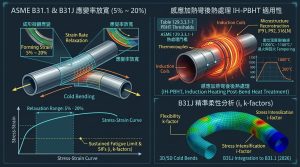
參考文獻 / References
- 基於2026 ASME B31J 規範之P9x 高壓蒸汽管線設計與工法解析, https://yz-pipe-bending.com.tw/%E5%9F%BA%E6%96%BC-2026-asme-b31j-%E8%A6%8F%E7%AF%84%E4%B9%8B-p9x-%E9%AB%98%E5%A3%93%E8%92%B8%E6%B1%BD%E7%AE%A1%E7%B7%9A%E8%A8%AD%E8%A8%88%E8%88%87%E5%B7%A5%E6%B3%95%E8%A7%A3%E6%9E%90%EF%BC%9A/
- Welding P91 Steel: Essential Requirements – WeldFabWorld, https://www.weldfabworld.com/p91-material-requirement/
- Growing experience with P91/T91 forcing essential code changes, https://www.ccj-online.com/growing-experience-with-p91-t91-forcing-essential-code-changes/
- 複循環發電廠脫硝與碳捕捉管線系統採用3D/5D 冷作彎管工法取代, https://yz-pipe-bending.com.tw/%E8%A4%87%E5%BE%AA%E7%92%B0%E7%99%BC%E9%9B%BB%E5%BB%A0%E8%84%AB%E7%A1%9D%E8%88%87%E7%A2%B3%E6%8D%95%E6%8D%89%E7%AE%A1%E7%B7%9A%E7%B3%BB%E7%B5%B1%E6%8E%A1%E7%94%A8-3d-5d-%E5%86%B7%E4%BD%9C%E5%BD%8E/
- Post-Weld Heat Treatment Effects on Grade 91 – Scribd, https://www.scribd.com/document/338210604/Post-Weld-Heat-Treatment
- Type IV Cracking of Weldments in Enhanced Ferritic Steels – TWI Ltd, https://www.twi-global.com/technical-knowledge/published-papers/review-of-type-iv-cracking-of-weldments-in-9-12cr-creep-strength-enhanced-ferritic-steels/
- 2026 ASME 規範下1 動力管線施工工法之深度剖析, https://yz-pipe-bending.com.tw/2026-asme-%E8%A6%8F%E7%AF%84%E4%B8%8B-b31-1-%E5%8B%95%E5%8A%9B%E7%AE%A1%E7%B7%9A%E6%96%BD%E5%B7%A5%E5%B7%A5%E6%B3%95%E4%B9%8B%E6%B7%B1%E5%BA%A6%E5%89%96%E6%9E%90%EF%BC%9A5d-%E5%86%B7%E4%BD%9C%E5%BD%8E/
- ASME B31.1 Power Piping Code 2024: Design & Standards – Studylib, https://studylib.net/doc/27709358/asme-b31-1-2024year
- Significant reduction in creep life of P91 steam pipe elbow caused, https://pmc.ncbi.nlm.nih.gov/articles/PMC10909855/
- ASME B31.3 vs B31.1 Impact Testing: 2026 Comparison Guide, https://epcland.com/asme-b31-3-vs-b31-1-impact-testing/
- ASME B31.1 與ASME B31.3 感應熱彎退應力熱處理(SRHT)差異化, https://yz-pipe-bending.com.tw/asme-b31-1-%E8%88%87-asme-b31-3-%E6%84%9F%E6%87%89%E7%86%B1%E5%BD%8E%E5%BE%8C%E9%80%80%E6%87%89%E5%8A%9B%E7%86%B1%E8%99%95%E7%90%86srht%E5%B7%AE%E7%95%B0%E5%8C%96%E5%88%86%E6%9E%90%E7%A0%94%E7%A9%B6/
- ASME B31.1 與ASME B31.3 在冷作彎管要求上差異分析研究(A, https://yz-pipe-bending.com.tw/asme-b31-1-%E8%88%87-asme-b31-3-%E5%9C%A8%E5%86%B7%E4%BD%9C%E5%BD%8E%E7%AE%A1%E8%A6%81%E6%B1%82%E4%B8%8A%E7%9A%84%E5%B7%AE%E7%95%B0%E5%88%86%E6%9E%90%E7%A0%94%E7%A9%B6-a-comparative-analysis-of-cold/
- ASME B31.1 vs B31.3: Key Piping Code Differences (2026 Guide), https://epcland.com/asme-b31-1-vs-b31-3-comparison/
- (PDF) Controlling heat treatment of welded P91 – ResearchGate, https://www.researchgate.net/publication/291818792_Controlling_heat_treatment_of_welded_P91
- P91 Normalization and Tempering Guide | PDF | Heat Treating | Steel, https://www.scribd.com/document/323997387/Normalization-and-Temper-Heat-Treatment-on-P91
- CREEP CRACK GROWTH BEHAVIOR OF P91 STEEL WELDMENTS, https://thermalscience.rs/pdfs/papers-2017/TSCI170729240S.pdf
- ASME B31.1 Power Piping 2018 Changes – Bradley Sawler, https://www.bradleysawler.com/engineering/asme-b31-1-power-piping-2018-changes/
- ASME B31.1-2016 – Standards Michigan, https://standardsmichigan.com/wp-content/uploads/2018/01/Proposed-Revision-of-B31.X-Power-Piping-Public-Review-Draft-2346.pdf
- ASME B31J: I & K Factors in Pipe Analysis, https://www.cortexsoftware.com.au/blog/understanding-asme-b31j-methods-i-factors-and-k-factors-in-piping-stress-analysis
- ASME B31.3 Guide (2026 Edition): Process Piping Design & SIF, https://epcland.com/asme-b31-3-process-piping-design/
- Introduction to ASME B31J Standard – Northern Crescent Inc., https://www.northerncrescent.ca/blog/introduction-to-asme-b31j-standard/
- ASME B31J – Bentley Software Documentation, https://docs.bentley.com/LiveContent/web/AutoPIPE-v2026.0.1/Help/en/Topics/Codes/ASME_B31J_R23.html
- ASME B31.1-2024 Stress Intensification Factors (SIFs) — FAQ, https://pipingtoolset.com/faq/b311-stress-intensification-factors/
- Microstructure and mechanical property of P92 steel welded joints, https://www.researchgate.net/publication/287943048_Microstructure_and_mechanical_property_of_P92_steel_welded_joints_after_non-standard_heat_treatment
- ASME PWHT Requirements Overview | PDF | Pipe (Fluid Conveyance), https://www.scribd.com/document/888388707/ASME-B31-PWHT
- Pre-welding degaussing – GaussKO, https://gaussko.com/en/applications/pre-welding-degaussing/
- Magnetic Arc Blow in Pipe Welding | PDF – Scribd, https://www.scribd.com/document/611927924/How-does-magnetism-in-pipes-stop-the-welding-process
- Magnetism in welding – how to tackle the issue – Kemppi, https://www.kemppi.com/en/blogs/magnetism-in-welding-how-to-treat-the-magnetic-blow
- Magnetism and the arc: arc blow – Canadian Metalworking, https://www.canadianmetalworking.com/canadianfabricatingandwelding/blog/welding/magnetism-and-the-arc-arc-blow
- Magnetic Arc Blow Joint Degauss – YouTube, https://www.youtube.com/watch?v=L_7XGQdbOsA
- ASME Section IX: WPS and PQR Guidelines | PDF – Scribd, https://www.scribd.com/document/711893032/ASME-SEC-9-ARTICLE-2-Welding-procedure-qualification
- How to Develop a Welding Procedure (WPS) per ASME Section IX, https://normanqc.com/blog/welding-procedure-wps-asme-section-ix-guide
- 1501 – E118 – 07 – Weld Procedure and Welder Qualification., https://www.nrc.gov/docs/ML1215/ML12157A671.pdf
- ASME Section IX: which essential variables force a new PQR, https://www.therness.com/blog/asme-section-ix-welding-procedure-qualification-digital-monitoring/
- ASME Section IX: WPS, PQR and Essential Variables – Atlantis NDT, https://atlantisndt.com/standards/asme-section-ix
- Larson-Miller parameters [The heart of crystalline materials], https://nte.mines-albi.fr/SciMat/en/co/SM6uc4-3.html
- Larson–Miller relation – Wikipedia, https://en.wikipedia.org/wiki/Larson%E2%80%93Miller_relation
- What is the Larson-Miller parameter? – TWI Ltd, https://www.twi-global.com/technical-knowledge/faqs/faq-what-is-the-larson-miller-parameter/
- Creep Life Calculator — Larson-Miller Parameter, https://www.firgelliauto.com/blogs/engineering-calculators/creep-life-calculator-larson-miller-parameter-1
- Larson-Miller Parameter for Creep Analysis | PDF – Scribd, https://www.scribd.com/document/470669418/LM-Parameter
- Analytical Formulation for Larson–Miller Constant of Steel, https://ccsenet.org/journal/index.php/jmsr/article/download/0/0/52697/57433
- Weld Metals for P91 – Tough Enough?, https://netlite.com.my/wp-content/uploads/2021/10/P91-EPRI-USA-June-2000.pdf