
一、 緒論與研究背景 / I. Introduction and Research Background
在現代高端船舶製造工程中,液化天然氣(LNG)運輸船因其貨物具備極低溫(-163°C)與高易燃易爆等嚴苛物理化學特性,被視為造船工業皇冠上的明珠。為確保這類船舶在極端海況與長達數十年的全生命週期中保持絕對的安全與結構完整性,國際海事組織(IMO)制定並持續修訂《國際散裝運輸液化氣體船舶構造與設備規則》(IGC Code)1。該規範針對貨物圍護系統、貨物管系、材料選擇以及無損檢驗(Non-Destructive Testing, NDT)標準,設定了海事工程領域中最為嚴厲的門檻1。 In modern high-end shipbuilding engineering, Liquefied Natural Gas (LNG) carriers are regarded as the crown jewel of the shipbuilding industry due to the cargo’s extreme physical and chemical characteristics, such as ultra-low temperatures (-163°C) and high flammability and explosiveness. To ensure the absolute safety and structural integrity of these vessels in extreme sea states and over their decades-long life cycles, the International Maritime Organization (IMO) formulated and continuously revises the International Code for the Construction and Equipment of Ships Carrying Liquefied Gases in Bulk (IGC Code)1. This code sets the most stringent thresholds in maritime engineering concerning cargo containment systems, cargo piping, material selection, and Non-Destructive Testing (NDT) standards1.
在傳統的 LNG 運輸船建造實務中,甲板貨物管系(Cargo Piping)的佈置與工廠預製面臨著巨大的工程挑戰。由於船體結構複雜、甲板空間受限,管線在連接各液貨艙口、歧管(Manifold)、壓縮機房與氣化設備時,頻繁依賴 1.5D 的短半徑或長半徑電銲彎頭(Welded Elbows)來實現空間轉向。然而,根據 IGC 規範第 5 章的強制性規定,位於貨物區域外的貨物管系及相關設備管線,必須採用全熔透對接銲接(Full penetration butt-welded),並且無論管徑大小與設計溫度為何,均須實施 100% 的射線探傷(Radiographic Testing, RT)或超音波檢驗(Ultrasonic Testing, UT)2。 In traditional LNG carrier construction practices, the layout and factory prefabrication of deck cargo piping face immense engineering challenges. Due to complex hull structures and limited deck space, piping frequently relies on 1.5D short-radius or long-radius welded elbows to achieve spatial turns when connecting cargo tank hatches, manifolds, compressor rooms, and vaporization equipment. However, according to the mandatory requirements of Chapter 5 of the IGC Code, cargo piping and related equipment piping located outside the cargo area must use full penetration butt-welded joints and be subjected to 100% radiographic testing (RT) or ultrasonic testing (UT), regardless of pipe diameter and design temperature2.
每一個電銲彎頭的應用,意味著必須在管系中人為增加兩道環向對接銲縫。這不僅直接推高了高昂的 NDT 檢驗成本,更因射線探傷作業所伴隨的輻射管制區(Radiation Exclusion Zone),嚴重中斷了造船廠甲板的平行艤裝作業,成為延宕船舶總裝進度的核心瓶頸4。此外,從船舶營運的全生命週期視角觀察,銲縫與熱影響區(Heat-Affected Zone, HAZ)往往是金屬疲勞與深冷環境下微洩漏(Micro-leakage)的發源地,增加了船舶發生冷卻劑流失事故(LOCA)的長期風險7。 The application of each welded elbow necessitates the artificial addition of two circumferential butt welds to the piping system. This not only directly drives up the exorbitant NDT costs but also severely interrupts parallel outfitting operations on the shipyard deck due to the radiation exclusion zone associated with RT, becoming a core bottleneck that delays the overall ship assembly schedule4. Furthermore, from the perspective of the ship’s full life cycle, welds and heat-affected zones (HAZ) are often the origins of metal fatigue and micro-leakage in cryogenic environments, increasing the long-term risk of a Loss of Coolant Accident (LOCA)7.
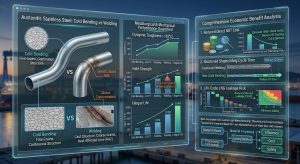
本研究從船舶管系自動化設計與預製優化的系統視角出發,提出以 3D 與 5D 數控大半徑冷作彎管(CNC Cold Bending)全面或部分替代傳統 1.5D 電銲彎頭的工程方案。透過建立融合空間幾何約束與經濟懲罰函數的改進型 EPA-star(Elbow-Penalized A-star)數學模型,本研究深入探討如何在不違反造船規範的前提下,最大化冷作彎管的應用比例。深度剖析冷作彎管工法在奧氏體不銹鋼材料上的冶金力學表現,並量化其在降低 NDT 直接成本、縮短造船工期,以及削減全生命週期 LNG 洩漏風險上的綜合經濟效益,從而為新一代 LNG 運輸船的精實製造提供堅實的理論與實證基礎。From a systematic perspective of automated ship piping design and prefabrication optimization, this study proposes an engineering solution that fully or partially replaces traditional 1.5D welded elbows with 3D and 5D CNC large-radius cold bending technology. By establishing an improved EPA-star (Elbow-Penalized A-star) mathematical model integrating spatial geometric constraints and economic penalty functions, this study thoroughly investigates how to maximize the application ratio of cold bends without violating shipbuilding codes. It deeply analyzes the metallurgical and mechanical performance of the cold bending method on austenitic stainless steel materials and quantifies its comprehensive economic benefits in reducing direct NDT costs, shortening shipbuilding schedules, and mitigating full life-cycle LNG leakage risks. Consequently, this research provides a solid theoretical and empirical foundation for the lean manufacturing of next-generation LNG carriers.
二、 IGC 規範約束、船級社法則與 NDT 檢驗的工程衝突 / II. Engineering Conflicts Among IGC Code Constraints, Classification Society Rules, and NDT Inspections
LNG 運輸船的甲板管系直接暴露於海洋高鹽腐蝕環境中,同時必須承受船體總縱彎曲應力以及深冷貨物裝卸時產生的劇烈熱循環應力。因此,國際法規對該系統的連接方式與檢驗標準採取了零容忍的嚴格態度。The deck piping of LNG carriers is directly exposed to the high-salt corrosive marine environment, while simultaneously having to withstand overall hull longitudinal bending stresses and severe thermal cycling stresses generated during the loading and unloading of cryogenic cargo. Therefore, international regulations adopt a strict, zero-tolerance attitude towards the connection methods and inspection standards of this system.
2.1 IGC 規範與法蘭、銲縫之嚴格限制 / 2.1 Strict Restrictions of IGC Code on Flanges and Welds
依據 IGC Code 5.8 節(管系製造與連接細節),規範明文要求管線應盡可能採用銲接連接以取代法蘭,因為法蘭接頭在經歷極端熱脹冷縮後極易產生墊片鬆弛與洩漏。對於設計溫度低於 -55°C 的深冷管系,僅允許使用帶頸對銲法蘭(Welding-neck flanges),且法蘭連接僅限於貨物區域內、岸端連接處(Shore connection)或特殊設備介面;而針對設計溫度低於 -10°C 的管線,其對接銲縫必須為雙面銲接或具備等效的完全熔透單面銲(例如使用背部惰性氣體保護或消耗性嵌條)3。 According to Section 5.8 of the IGC Code (Piping fabrication and joining details), the regulation explicitly requires that piping should utilize welded connections instead of flanges wherever possible, as flange joints are highly susceptible to gasket relaxation and leakage after experiencing extreme thermal expansion and contraction. For cryogenic piping with design temperatures below -55°C, only welding-neck flanges are permitted, and flange connections are restricted to within the cargo area, shore connections, or special equipment interfaces; furthermore, for piping with design temperatures below -10°C, butt welds must be double welded or equivalent to a full penetration single-sided weld (e.g., using inert gas backup or consumable inserts)3.
更具挑戰性的是 IGC Code 5.9 節。該條款規定,貨物區域外的所有氣體與液體管線,必須進行 100% 的射線或超音波檢驗2。各大船級社(如 ABS、DNV、LR、ClassNK)在執行此規範時,亦對檢驗比例與範圍有著嚴密的監管矩陣。相比於常規商船僅在關鍵區域(Critical areas)要求 20% 的抽檢或一般區域僅 2% 的抽檢,LNG 運輸船貨物管系 100% NDT 的要求,無疑將造船廠的品質檢驗資源推向了極限10。 Even more challenging is Section 5.9 of the IGC Code. This clause stipulates that all gas and liquid piping outside the cargo area must undergo 100% radiographic or ultrasonic testing2. Major classification societies (such as ABS, DNV, LR, ClassNK) also maintain a strict regulatory matrix on inspection ratios and scopes when enforcing this code. Compared to conventional merchant ships, which only require a 20% spot check in critical areas or a 2% spot check in general areas, the 100% NDT requirement for LNG carrier cargo piping undoubtedly pushes shipyard quality inspection resources to their limits10.
2.2 射線探傷(RT)的經濟成本與時空代價 / 2.2 Economic Costs and Spatiotemporal Sacrifices of Radiographic Testing
射線探傷(RT)是造船業界最廣泛接受的體積性缺陷(Volumetric defects,如氣孔、夾渣)檢測標準。然而,RT 的實施伴隨著極高的直接成本與間接的時空代價。使用諸如銥-192(Iridium-192)等高強度放射源進行管線雙壁單影(Dual-wall viewing)曝光時,單個 6 吋管徑的銲縫大約需要 4 至 10 分鐘的曝光時間4。 Radiographic testing (RT) is the most widely accepted standard in the shipbuilding industry for detecting volumetric defects (such as porosity and slag inclusions). However, implementing RT entails extremely high direct costs and indirect spatiotemporal sacrifices. When using high-intensity radioactive sources such as Iridium-192 for dual-wall viewing exposures, a single weld on a 6-inch pipe requires approximately 4 to 10 minutes of exposure time4.
更為致命的是,為了防範電離輻射危害,造船廠必須在甲板上劃定龐大的輻射管制區。對於 100 Ci 的銥-192 放射源,其高輻射邊界可達半徑 50 公尺,而受限區域邊界甚至可延伸至 140 公尺。在一艘長度通常約為 300 公尺的 LNG 運輸船上,啟動 RT 檢驗等同於要求大面積甲板區淨空。所有正在進行的平行作業——包括電纜敷設、絕緣包覆、塗裝與鷹架搭設——均被迫中斷。這種「時空排他性」嚴重拖延了船舶的總裝進度5。 More critically, to prevent ionizing radiation hazards, shipyards must establish massive radiation exclusion zones on the deck. For a 100 Ci Iridium-192 source, the high-radiation boundary can reach a radius of 50 meters, and the restricted area boundary can extend up to 140 meters. On an LNG carrier typically around 300 meters long, initiating RT effectively requires evacuating large areas of the deck. All ongoing parallel operations—including cable laying, insulation cladding, painting, and scaffolding—are forced to halt. This “spatiotemporal exclusivity” severely delays the overall ship assembly progress5.
儘管相控陣列超音波(PAUT)在檢驗效率與安全性上具有優勢,且已被部分規範接受,但在諸多船東保守的技術規格與 IGC 規範嚴格的審查下,RT 仍是深冷管系驗收的主流標竿。因此,從源頭「減少銲縫數量」成為迴避 NDT 成本與工期延誤的唯一治本之道。Although Phased Array Ultrasonic Testing (PAUT) offers advantages in inspection efficiency and safety and has been accepted by some codes, RT remains the mainstream benchmark for cryogenic piping acceptance under the conservative technical specifications of many shipowners and the strict scrutiny of the IGC Code. Therefore, reducing the number of welds from the source has become the only fundamental solution to avoid NDT costs and schedule delays.
三、 奧氏體不銹鋼深冷管系之冷作彎管冶金與力學機制 / III. Metallurgical and Mechanical Mechanisms of Cold Bending in Austenitic Stainless Steel Cryogenic Piping
為了合法且安全地消除管系中的對接銲縫,引進 3D 或 5D 大半徑數控冷作彎管(Long-Radius Swept Bends)成為最佳的替代方案。然而,LNG 運輸船的管線材料選擇與冷作彎管工法有著密不可分的冶金學關聯。To legally and safely eliminate butt welds in the piping system, introducing 3D or 5D long-radius CNC cold bends has become the optimal alternative. However, the material selection and cold bending methods for LNG carrier piping are inextricably linked metallurgically.
3.1 316L/304L 的極低溫衝擊韌性與冶金特性 / 3.1 Cryogenic Impact Toughness and Metallurgical Characteristics of 316L/304L
為抵抗 LNG 的 -163°C 極低溫,IGC 規範與各船級社要求管線材料必須在設計溫度的基礎上通過嚴格的夏比 V 型缺口(Charpy V-notch)衝擊試驗11。依據規範,奧氏體不銹鋼(如 304、304L、316、316L、321)在 -196°C 條件下的縱向試樣最低平均吸收能量必須達到 41 焦耳(41J),而橫向試樣須達到 27 焦耳(27J)2。 To withstand the -163°C extreme low temperature of LNG, the IGC Code and classification societies require piping materials to pass strict Charpy V-notch impact tests based on the design temperature11. According to regulations, the minimum average absorbed energy for longitudinal specimens of austenitic stainless steel (e.g., 304, 304L, 316, 316L, 321) at -196°C must reach 41 Joules (41J), while transverse specimens must reach 27 Joules (27J)2.
316L 奧氏體不銹鋼因添加了鉬(Molybdenum)並嚴格限制碳含量不高於 0.03%,被廣泛應用於深冷貨物管系。低碳特性確保了在銲接過程中不會於熱影響區(HAZ)發生碳化鉻沿晶界析出,有效防止了晶間腐蝕(Weld decay / Intergranular corrosion)的發生14。然而,奧氏體不銹鋼在室溫下具備極高的應變硬化(Strain hardening / Work hardening)傾向。這意味著在冷作彎管過程中,材料雖然展現出優良的延展性,但其屈服強度會隨著變形量的增加而急劇攀升,最終導致顯著的彈性迴彈(Springback)效應14。 316L austenitic stainless steel is widely used in cryogenic cargo piping due to the addition of molybdenum and strict limitation of carbon content to no more than 0.03%. The low-carbon characteristic ensures that chromium carbide precipitation along grain boundaries does not occur in the HAZ during welding, effectively preventing weld decay (intergranular corrosion). However, austenitic stainless steel exhibits a very high strain hardening tendency at room temperature. This means that during the cold bending process, although the material demonstrates excellent ductility, its yield strength sharply escalates as deformation increases, ultimately leading to a significant elastic springback effect14.
3.2 壁厚減薄(Wall Thinning)與橢圓度(Ovality)之數學推導 / 3.2 Mathematical Derivation of Wall Thinning and Ovality
在進行大管徑、厚壁的數控冷作彎曲時,管線外弧受拉應力而產生管壁減薄,內弧受壓應力而易產生起皺,且整體截面會趨於扁平化進而產生橢圓度16。 During the CNC cold bending of large-diameter, thick-walled pipes, the extrados of the bend experiences tensile stress leading to wall thinning, while the intrados experiences compressive stress making it prone to wrinkling, and the overall cross-section tends to flatten, generating ovality16.
依據 ASME B31.3 規範,管線在承受內部壓力時,其最終壁厚不得低於理論最小需求厚度 tm:According to the ASME B31.3 code, the final wall thickness of a pipe under internal pressure must not be less than the theoretical minimum required thickness tm:
tm=P⋅D/(2⋅S⋅E-1.2⋅P)
針對冷作彎管過程中的壁厚減薄預測,管件工程學界常引用理論最薄壁厚估算公式:For wall thinning prediction during the cold bending process, piping engineering commonly references theoretical minimum thickness estimation formulas:
tmin=tnom×[1-D/4R]
經驗數據表明,3D 冷作彎管的實際最大壁厚減薄率約為 18%,5D 約為 12.5%,而 10D 則降至 8%16。因此,在管線設計初期,工程師必須選擇起始壁厚大於 tm 的管材,並透過 tstart=trequired/(1-thinning% ) 的方式進行裕度補償。 Empirical data shows that the actual maximum wall thinning rate is approximately 18% for 3D cold bends, 12.5% for 5D, and drops to 8% for 10D. Therefore, in the initial piping design phase, engineers must select raw materials with a starting thickness greater than tm and apply a margin compensation via tstart=trequired/(1-thinning% ).
此外,針對工業級別的深冷高壓管線,橢圓度必須嚴格控制在 8% 以內18。若橢圓度過大,將會削弱管線抵抗外部壓力引發的屈曲塌陷(Buckling collapse)能力。 Furthermore, for industrial-grade cryogenic high-pressure pipelines, ovality must be strictly controlled to within 8%. Excessive ovality weakens the pipeline’s ability to resist buckling collapse caused by external pressures.
四、 基於改進 EPA-star 演算法之甲板管系空間優化數學模型 / IV. Spatial Optimization Mathematical Model for Deck Piping Based on the Improved EPA-star Algorithm
要將 3D/5D 冷作彎管順利引入 LNG 船甲板管系,必須在初始 3D 佈線階段就進行全盤優化。本研究建構了一套改進的 EPA-star(Elbow-Penalized A-star)數學模型20。 To seamlessly introduce 3D/5D cold bends into LNG carrier deck piping, comprehensive optimization must be conducted at the initial 3D routing stage. This study constructs an improved EPA-star (Elbow-Penalized A-star) mathematical model20.
4.1 三維節點空間與射線探測機制 / 4.1 3D Node Space and Ray-Casting Mechanism
首先,將甲板佈管空間劃分為三維正交網格矩陣。為了實現對障礙物的高效迴避,模型引入了射線探測機制(Ray-casting sensing)。探測器會向相鄰節點發射射線以確認空間是否開闊22。這使演算法能夠預判前方空間的寬裕度,進而決定是否具備大半徑冷彎所需的旋轉空間。 First, the deck piping space is divided into a 3D orthogonal grid matrix. To achieve efficient obstacle avoidance, the model introduces a ray-casting sensing mechanism. Detectors shoot rays toward adjacent nodes to confirm if the space is clear22. This enables the algorithm to foresee the spaciousness ahead, thereby deciding whether there is sufficient rotational space required for a large-radius cold bend.
4.2 包含銲接與 NDT 懲罰的多目標代價函數 / 4.2 Multi-Objective Cost Function Including Welding and NDT Penalties
在 EPA-star 模型中,我們對傳統路徑代價 進行了深度擴充,建立了包含管線長度、彎頭數量以及銲接 NDT 成本的綜合目標函數20: In the EPA-star model, we deeply expanded the traditional path cost , establishing a comprehensive objective function that incorporates pipe length, number of elbows, and welding NDT costs20:
Minimize Z=ω1 ∑i=1n-1Li +ω2 ∑j=1mKj +ω3 ∑j=1mWp(j)
其中 Wp(j)為核心的銲接與 NDT 懲罰矩陣(Welding & NDT Penalty Matrix)。where Wp(j) is the core Welding & NDT Penalty Matrix.
4.3 空間約束與冷作彎管可行性的動態決策 / 4.3 Dynamic Decision-Making for Spatial Constraints and Cold Bending Feasibility
在規劃每一個路徑轉向點時,系統會啟動空間約束動態評估:When planning each path turning point, the system initiates a dynamic evaluation of spatial constraints:
- 狹窄空間1.5D 電銲彎頭模式 / Narrow Space 1.5D Welded Elbow Mode: 如果淨空距離小於3D,判定此處必須使用體積緊湊的 1.5D 標準電銲彎頭。此時銲接懲罰值觸發,路徑總代價急遽上升。 If the clearance is less than 3D, it is determined that a compact 1.5D standard welded elbow must be used. The welding penalty is then triggered, sharply increasing the total path cost.
- 開闊空間 3D/5D 數控冷作彎管模式 / Open Space 3D/5D CNC Cold Bend Mode: 若回報安全半徑 R≧5D,演算法將認定此處可使用 5D 冷作彎管。此時銲接懲罰值免除( Wp(j)=0)。 If a safe radius R≧5D is reported, the algorithm confirms a 5D cold bend can be used. The welding penalty is consequently waived (Wp(j)=0).
五、 全生命週期之經濟效益與可靠度風險評估 / V. Full Life-Cycle Economic Benefits and Reliability Risk Assessment
將 EPA-star 演算法輸出的高比例冷作彎管設計圖紙付諸實施,將在 LNG 運輸船的建造期與營運期產生深遠且正面的影響。Implementing the high-ratio cold bend design drawings generated by the EPA-star algorithm will exert profound and positive impacts on both the construction phase and the operational phase of LNG carriers.
5.1 建造期:NDT 成本斷崖式下降與平行作業解放 / 5.1 Construction Phase: Precipitous Drop in NDT Costs and Liberation of Parallel Operations
免去大量的對接銲縫意味著節省了銲材、保護氣體,以及高階銲接技師的勞動力。同時,這也徹底免去了 100% 射線探傷(RT)流程的高昂費用與工時。解除了甲板上頻繁設置「輻射管制區」的緊箍咒後,艤裝、塗裝與儀表施工團隊可以進行無縫的平行作業,關鍵路徑的縮短直接為造船廠節省了數週的船塢週期。 Eliminating numerous butt welds means saving substantial amounts of welding consumables, shielding gas, and the labor of high-level welders. Concurrently, it thoroughly eliminates the exorbitant fees and labor hours associated with 100% radiographic testing (RT). By lifting the restrictive curse of frequent “radiation exclusion zones” on the deck, outfitting, painting, and instrumentation teams can conduct seamless parallel operations. The shortened critical path directly saves weeks of drydock time for shipyards.
5.2 營運期:消除微洩漏機率與 LOCA 風險管控 / 5.2 Operational Phase: Elimination of Micro-Leakage Probability and LOCA Risk Management
依據可靠度數據(OREDA),管線系統的被動元件故障是流體洩漏的核心根源。銲縫內潛藏的微小缺陷,在深冷環境下會逐漸演變為疲勞裂紋。冷作彎管工法維持了母材金屬結構的連續性,實體移除了熱影響區與潛在缺陷,實質性地降低了全船發生冷卻劑流失事故(LOCA)的基礎故障率。 According to reliability data (OREDA), passive component failures in piping systems are the core root of fluid leakage. Micro-defects hidden within welds gradually evolve into fatigue cracks in cryogenic environments. The cold bending method maintains the continuous metallurgical structure of the base metal, physically eliminating heat-affected zones and potential defects, thereby substantially reducing the ship’s base failure rate of Loss of Coolant Accidents (LOCA).
5.3 流體動力學與阻力損失之優化 / 5.3 Optimization of Fluid Dynamics and Resistance Loss
當流體通過 1.5D 短半徑彎頭時,常引發嚴重的流動分離與次級渦流,導致高昂的阻力係數;而 5D 冷作彎管平滑的流線型過渡,有效抑制了紊流動能耗散,使得壓力降顯著減少23。在長期的船舶營運中,管網整體流動阻力的下降,達成了極具價值的節能減碳效益3。 When fluid passes through 1.5D short-radius elbows, severe flow separation and secondary vortices are often induced, resulting in high resistance coefficients; whereas the smooth streamlined transition of 5D cold bends effectively suppresses the dissipation of turbulent kinetic energy, significantly reducing pressure drops3. Over the long-term operation of the vessel, the decreased overall flow resistance of the piping network achieves highly valuable energy-saving and carbon-reduction benefits3.
六、 ASME B31J 規範強制導入下之實務差異分析與三維製造策略 / VI. Practical Difference Analysis and 3D Manufacturing Strategies Under the Mandatory Implementation of ASME B31J
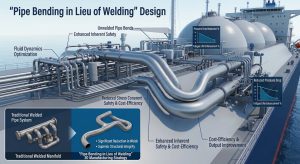
隨著 ASME B31J 規範對高能與關鍵管線強制導入更為嚴密的應力強度因子(SIF)計算準則,LNG 運輸船甲板管系採用「以彎代銲」的三維製造策略不再僅是經濟考量,更是法規與工程安全升級的必然趨勢25。以下由專案全生命週期各利害關係人視角,深度剖析 1.5D 電銲彎頭與 3D/5D 冷作彎管工法之實務差異。 With the ASME B31J code mandating more rigorous Stress Intensification Factor (SIF) calculation criteria for high-energy and critical piping, adopting a “bend-instead-of-weld” 3D manufacturing strategy for LNG carrier deck piping is no longer merely an economic consideration, but an inevitable trend for regulatory compliance and engineering safety upgrades25. The following section deeply analyzes the practical differences between 1.5D welded elbows and 3D/5D cold bending methods from the perspectives of stakeholders across the project’s full life cycle.
6.1 業主對於LNG 運輸船甲板管系管線銲道與冷作彎管維護管理及營運決策 / 6.1 Owner’s Maintenance Management and Operational Decisions Regarding Welds and Cold Bends in LNG Carrier Deck Piping
從船東與投資方(業主)的宏觀營運角度出發,甲板深冷管系的長期可靠度直接與高昂的營運支出(OPEX)及船期延誤風險掛鉤。傳統 1.5D 電銲彎頭因存在熱影響區(HAZ),在長達數十年的極地嚴寒與赤道高溫交替、以及裝卸貨的 -163°C 熱應力循環下,銲縫老化與晶間腐蝕的風險逐年攀升。From the macro-operational perspective of shipowners and investors (owners), the long-term reliability of deck cryogenic piping is directly linked to high operational expenditures (OPEX) and risks of schedule delays. Traditional 1.5D welded elbows harbor heat-affected zones (HAZ). Under decades of alternating extreme polar cold and equatorial heat, as well as -163°C thermal stress cycles during cargo handling, the risks of weld aging and intergranular corrosion escalate annually.
為此,業主在營運決策上日益傾向要求降低全船的銲口總量(Weld-count minimization)。採用 3D/5D 冷作彎管,消滅了管線轉向處的物理斷點與潛在微洩漏源,大幅削減了船舶在 5 年期特檢(Special Survey)進塢時所需耗費的非破壞檢測與銲道修補成本,為業主創造出更長效的安全營運週期。For this reason, owners increasingly favor requiring a reduction in the total weld-count across the ship in their operational decisions. Employing 3D/5D cold bends eradicates physical breakpoints and potential micro-leakage sources at piping turns, drastically cutting the NDT and weld repair costs incurred during 5-year Special Surveys in drydock, thus creating a longer-lasting safe operational cycle for owners.
6.2 EPC承包商設計單位對於考量LNG 運輸船甲板管系管線彎頭或冷作彎管空間佈置與實務考量 / 6.2 EPC Contractors and Design Units’ Spatial Layout and Practical Considerations for Elbows or Cold Bends
新規範廢除了過去單一純量的 SIF 計算,強制採用三維 SIF 解耦矩陣(區分面內 ii、面外 io 與扭轉 it)27。對 EPC 設計單位而言,這是一次嚴峻的工程典範轉移。 The new code abolishes the previous scalar SIF calculations, mandating a decoupled 3D SIF matrix (differentiating in-plane ii, out-of-plane io, and torsional it)27. For EPC design units, this marks a severe engineering paradigm shift.
傳統 1.5D 銲接彎頭在新規範下的 SIF 數值居高不下,使得管網熱應力分析極易超標,迫使設計者必須增加大量的支撐架(Pipe supports)或補償器,導致甲板空間更加擁擠。相反地,3D/5D 冷作彎管在 ASME B31J 框架下的 SIF 近似於完美直管(i≈1.0)29。儘管 5D 彎管在局部佈置上需要較大的轉彎半徑,但 EPC 設計端可透過如 EPA-star 演算法等三維空間佈局優化,換取整體驗算應力的斷崖式下降,進一步減少支架數量,達到總體設計的輕量化與合規性30。 The persistently high SIF values of traditional 1.5D welded elbows under the new code make piping network thermal stress analyses easily exceed limits, forcing designers to add numerous pipe supports or compensators, leading to even more congested deck space. Conversely, the SIF of 3D/5D cold bends under the ASME B31J framework approximates that of a perfectly straight pipe (i≈1.0)29. Although 5D bends require larger turning radii locally, the EPC design side can utilize 3D spatial layout optimization, such as the EPA-star algorithm, to achieve a precipitous drop in overall verification stresses, further reducing support quantities and realizing lightweight and compliant overall designs30.
6.3 以船務管理者角度來看待對於LNG 運輸船甲板管系管線銲道與冷作彎管要求 / 6.3 Fleet Managers’ Requirements for Welds and Cold Bends in Deck Piping
船務管理者與駐船驗船師(Superintendents)最關注的是船舶在航行期間的「本質安全」與日常巡檢的便利性。LNG 甲板管系密佈於人員活動與設備運轉的開放空間,任何一處銲道的微洩漏都可能在局部形成爆炸性氣體雲32。 Fleet managers and Superintendents are most concerned with the “inherent safety” of the vessel during voyages and the convenience of daily inspections. LNG deck piping is densely packed in open areas with personnel activity and equipment operation; any micro-leakage from a weld could form an explosive gas cloud locally32.
從管理者實務出發,冷作彎管提供了極佳的結構整體性。由於沒有銲縫,就沒有超聲波或射線探傷歷史紀錄中那些「合格但存在的微小夾渣或氣孔」演變成疲勞裂紋的擔憂。這不僅降低了船員在惡劣海況下進行管線巡檢與氣體偵測的壓力,也簡化了船舶日常的預防性維護(Preventive Maintenance)程序。From a managerial practice standpoint, cold bends offer excellent structural integrity. Without welds, there are no concerns about “acceptable but present minor slag or porosity” in ultrasonic or radiographic historical records evolving into fatigue cracks. This not only relieves crew pressure when conducting pipeline inspections and gas detection in harsh sea conditions but also simplifies the ship’s Preventive Maintenance procedures.
6.4 以冷作彎管施作協力廠商角度來看對於LNG 運輸船甲板管系管線要求及因應策略 / 6.4 Subcontractors’ Requirements and Response Strategies for Executing Cold Bends
對負責在工廠預製的協力廠商而言,將 316L 等奧氏體不銹鋼進行大管徑、高厚度的 3D/5D 冷作彎曲,是一項極具挑戰的冶金成形任務。奧氏體不銹鋼具備強烈的應變硬化效應,極易產生彈性迴彈與成形應力集中。For subcontractors responsible for factory prefabrication, performing 3D/5D cold bending on large-diameter, thick-walled austenitic stainless steel like 316L is a highly challenging metallurgical forming task. Austenitic stainless steel features a strong strain-hardening effect, easily generating elastic springback and forming stress concentrations.
協力廠商的實務因應策略必須涵蓋嚴格的參數控制:首先是計算管壁減薄率的極限值,確保選用的起始原管壁厚(tstart)在歷經最大 12.5% (5D) 或 18% (3D) 的減薄後,仍能滿足 ASME B31.3 的最低承壓厚度要求16。其次,必須配備高精度的 CNC 芯棒(Mandrel)與多維度輔助推力彎管設備,以強制將彎管截面的橢圓度(Ovality)控制在 8% 甚至更嚴苛的 4% 以下,防止流體輸送時的應力集中與壓力降異常18。 The subcontractors’ practical response strategy must encompass strict parameter control: first, calculating the limit value of wall thinning to ensure the selected starting raw pipe thickness (tstart) still meets the minimum pressure-bearing thickness requirement of ASME B31.3 after undergoing a maximum 12.5% (5D) or 18% (3D) thinning16. Secondly, they must be equipped with high-precision CNC mandrels and multi-dimensional auxiliary thrust bending equipment to forcefully control the ovality of the bend cross-section to under 8% or even a stricter 4%, preventing stress concentrations and abnormal pressure drops during fluid transport18.
6.5 導入潁璋工程(能彎不銲)之三合一工法管理核心價值優化 / 6.5 Optimization of the Core Value of Ying-Zhang Engineering’s “Three-in-One” Bend-Instead-of-Weld Method
導入潁璋工程(Ying-Zhang Engineering)所提倡的「三合一工法」(3D/5D CNC 大半徑冷作彎管 + IH-PBHT 單管感應亞臨界彎後熱處理 + QR Code 雲端數位履歷),是發揮大半徑優勢的唯一解方26。此工法管理的核心價值在於徹底落實「能彎不銲」的設計理念,從源頭將易受流體沖刷與疲勞破壞的銲縫轉化為連續平滑的母材彎曲段26。針對 LNG 運輸船甲板管系「以彎代銲」的三維製造策略,此工法的執行不僅是製造手段的升級,更是嚴格對接 ASME B31.1 與 B31J 規範的合規性展現35。 Introducing the “Three-in-One Method” (3D/5D CNC large-radius cold bending + IH-PBHT single-pipe induction subcritical post-bend heat treatment + QR Code cloud digital resume) advocated by Ying-Zhang Engineering is the sole solution to fully leverage the advantages of large radii26. The core management value of this method lies in completely realizing the “bend-instead-of-weld” design philosophy, transforming welds susceptible to fluid erosion and fatigue failure into continuous, smooth base metal bends right from the source26. For the 3D manufacturing strategy of LNG carrier deck piping, implementing this method is not just an upgrade in manufacturing means, but a demonstration of strict compliance bridging ASME B31.1 and B31J codes35.
其三大核心技術板塊如下 (Its three core technological pillars are as follows):
- CNC 3D/5D 數控大半徑冷作彎管 / CNC 3D/5D Large-Radius Cold Bending:透過高精度數控技術成型,直接消除傳統1.5D 彎頭帶來的環向對接銲縫與熱影響區(HAZ),有效抵抗流體加速腐蝕(FAC),並在管網佈局上發揮最大的幾何柔性26。 Through high-precision CNC forming, it directly eliminates the circumferential butt welds and HAZ brought by traditional 1.5D elbows, effectively resisting Flow-Accelerated Corrosion (FAC) and maximizing geometric flexibility in piping network layout26.
- IH-PBHT 單管感應亞臨界彎後熱處理 / IH-PBHT Subcritical Post-Bend Heat Treatment:針對奧氏體不銹鋼在冷作彎管後伴隨的加工硬化與殘餘應力問題,利用中頻感應加熱技術進行局部熱處理。此步驟精準控制溫度,消除材料內部的應力極限值,恢復拉森-米勒參數(LMP)至安全區間,確保深冷環境下的夏比衝擊韌性與抗腐蝕能力26。 Addressing the strain hardening and residual stresses accompanying cold bending of austenitic stainless steel, mid-frequency induction heating technology is utilized for localized heat treatment. This step precisely controls the temperature, eliminates internal stress limit values, restores the Larson-Miller Parameter (LMP) to a safe zone, and ensures Charpy impact toughness and corrosion resistance in cryogenic environments26.
- QR Code 雲端數位履歷 / QR Code Cloud Digital Resume:將每段管線的材料爐號、減薄率、橢圓度、IH-PBHT 溫度曲線等數據上傳雲端並綁定 QR Code,實現產品的全生命週期可追溯性,完美契合了現代化 EPC 管理與工業4.0 趨勢,滿足驗船師的嚴格審查要求37。 Uploading data such as material heat numbers, thinning rates, ovality, and IH-PBHT temperature curves for each pipe segment to the cloud and binding them with a QR Code achieves full life-cycle traceability of the product, perfectly aligning with modern EPC management and Industry 4.0 trends, satisfying the rigorous review requirements of surveyors37.
6.6 落實以冷作彎管來導入設計(能彎不銲)之核心理念執行與LNG 運輸船甲板管系管線之潁璋工程冷作彎管三合一工法之合規 / 6.6 Execution of the “Bend-Instead-of-Weld” Core Concept and Compliance of Ying-Zhang Engineering’s Three-in-One Method in LNG Carrier Deck Piping
將潁璋工程的「三合一工法」應用於 LNG 運輸船甲板管系,是落實「能彎不銲」核心理念最具體的實踐。從合規性角度檢視:Applying Ying-Zhang Engineering’s “Three-in-One Method” to LNG carrier deck piping is the most concrete practice of the “bend-instead-of-weld” core concept. Examined from a compliance perspective:
在 ASME B31J 強制導入的法規背景下,舊有 B31.3 Appendix D 的經驗公式已被正式淘汰38。新法規強制要求使用應力強度因子(SIF)解耦矩陣來精確計算動態疲勞與靜態極限。潁璋工程的三合一工法產出的 3D/5D 冷作彎管,其 SIF 數值遠低於傳統 1.5D 銲接彎頭,大幅優化了管口負載(Nozzle Load)並降低了整體剛度7。 Against the regulatory backdrop of ASME B31J’s mandatory implementation, the old empirical formulas of B31.3 Appendix D have been officially phased out38. The new code strictly requires the use of decoupled SIF matrices to accurately calculate dynamic fatigue and static limits. The 3D/5D cold bends produced by Ying-Zhang’s Three-in-One method possess SIF values far lower than traditional 1.5D welded elbows, substantially optimizing nozzle loads and reducing overall stiffness7.
此外,依據 ASME B31.1 Code Case 183-2 中關於冷作成型應變極限值的規範精神(應變率5%≤ϵ≤20%),IH-PBHT 工法能夠以局部亞臨界熱處理合法取代全管正常化。既確保了冶金微觀組織的修復,又避免了無謂的熱處理成本與變形風險。結合 QR Code 數位履歷,為各大船級社提供了透明、不可篡改的品質保證紀錄,使「能彎不銲」能夠在嚴苛造船法規下真正落地生根。 Furthermore, in accordance with the regulatory spirit of ASME B31.1 Code Case 183-2 regarding cold forming strain limit values (strain rate 5%≤ϵ≤20%), the IH-PBHT method legally substitutes full-pipe normalizing with localized subcritical heat treatment. This ensures the restoration of the metallurgical microstructure while avoiding unnecessary heat treatment costs and deformation risks. Combined with the QR Code digital resume, it provides major classification societies with a transparent, tamper-proof Quality Assurance (QA/QC) record, enabling “bend-instead-of-weld” to truly take root under rigorous shipbuilding regulations.
七、 2026 年規範全面導入後之 ASME B31J 未來演進:全數位化、高精度分析與前沿製造之整合 / VII. Future Evolution of ASME B31J Post-2026 Mandatory Implementation: Integration of Full Digitalization, High-Precision Analysis, and Advanced Manufacturing
隨著 2026 年版 ASME B31.1 與 B31.3 規範將 B31J 正式確立為計算 SIF 與柔性因子的唯一合法標準,並全面刪除沿用七十餘年的 Appendix D 經驗公式,高能管線與深冷管系的工程設計迎來了史無前例的典範轉移26。ASME B31J 的未來演進方向,正高度聚焦於「全數位化」、「高精度分析」與「前沿製造技術」的深度整合。 With the 2026 editions of ASME B31.1 and B31.3 officially establishing B31J as the sole legal standard for calculating SIFs and flexibility factors, and fully removing the empirical formulas of Appendix D used for over 70 years, the engineering design of high-energy and cryogenic piping has ushered in an unprecedented paradigm shift26. The future evolution of ASME B31J heavily focuses on the deep integration of “full digitalization”, “high-precision analysis”, and “advanced manufacturing technologies”.
7.1 全數位化與數位雙生 (Digital Twin) 的深度融合 / 7.1 Deep Fusion of Full Digitalization and Digital Twins
在法規強制作業標準升級的推波助瀾下,傳統靜態的應力模型正迅速向「活體」的數位雙生(Digital Twin)架構轉型,邁入「Pipe Stress 4.0」時代39。未來的 LNG 運輸船管系不再只是圖紙上的三維座標,而是融合了雲端履歷與即時感測數據的動態系統。透過綁定單管 QR Code,每一支冷作彎管的成形履歷(包含材料批號、橢圓度、減薄率)以及 IH-PBHT 熱電偶感測器擷取並透過邊緣運算回傳的溫度曲線,都能無縫匯入系統中33。這種全數位化追溯機制,使得 AI 輔助合規稽核(AI compliance agents)得以自動比對現場數據與 B31J 規範極限值,從而實現無人化、高效率的品質監管39。 Propelled by the mandatory upgrade of regulatory operational standards, traditional static stress models are rapidly transforming into “living” Digital Twin architectures, entering the “Pipe Stress 4.0” era39. Future LNG carrier piping systems will no longer be mere 3D coordinates on blueprints, but dynamic systems integrating cloud resumes and real-time sensory data. By binding a QR Code to individual pipes, the forming resume of each cold bend (including material batch, ovality, thinning rate) and the temperature curve captured by IH-PBHT thermocouples and transmitted via edge computing can be seamlessly imported into the system33. This fully digitalized traceability mechanism allows AI compliance agents to automatically compare field data with B31J code limit values, thereby realizing unmanned, high-efficiency quality oversight39.
7.2 高精度有限元素分析 (FEA) 與流固耦合力學 / 7.2 High-Precision Finite Element Analysis (FEA) and Fluid-Structure Interaction (FSI) Mechanics
2026 版 B31J 的核心精神在於將靜態塑性崩塌與局部動態疲勞機制進行物理「解耦(Decoupling)」,徹底終結了以往因人為保守假設所造成的設計盲區。未來的管線應力分析必須仰賴高精度的有限元素分析(FEA)與三維空間應力解析技術27。 The core spirit of the 2026 edition of B31J lies in the physical “decoupling” of static plastic collapse and localized dynamic fatigue mechanisms, thoroughly ending the design blind spots previously caused by conservative human assumptions. Future pipeline stress analyses must rely on high-precision Finite Element Analysis (FEA) and 3D spatial stress resolution technologies27.
對於輸送高壓 LNG 或是面臨頻繁啟停(Cycling)的高能管系,流固耦合(FSI)所引發的震動與疲勞破壞成為評估重點38。高精度的 FEA 能夠真實還原 3D/5D 數控大半徑冷作彎管在面對次級渦流與熱應力時的優異表現,科學地驗證大曲率彎管對釋放系統幾何柔性、降低管口負載的絕對優勢7。 For high-energy piping systems transporting high-pressure LNG or facing frequent cycling, vibrations and fatigue failures induced by fluid-structure interaction (FSI) become the focal point of evaluation38. High-precision FEA can authentically simulate the superior performance of 3D/5D CNC large-radius cold bends when facing secondary vortices and thermal stresses, scientifically validating the absolute advantages of large-curvature bends in releasing system geometric flexibility and reducing nozzle loads7.
7.3 前沿製造技術 (Advanced Manufacturing) 的無縫接軌 / 7.3 Seamless Integration with Advanced Manufacturing Technologies
ASME B31J 新規範不僅改變了設計端的計算準則,更直接引導了工廠預製端的前沿製造升級。傳統 1.5D 電銲彎頭所伴隨的幾何突變與熱影響區(HAZ),在 B31J 嚴苛的高精度疲勞驗算下,往往難以滿足現代深冷管系長效安全運轉的要求。為此,「能彎不銲」三合一工法(CNC 數控冷作彎管 + IH-PBHT + 數位履歷)成為對接新規範的最佳前沿製造解方。透過精密機械力學控制管壁成形,並利用物聯網(IoT)架構監控中頻感應熱處理,造船廠與 EPC 承包商能夠以極高的良率量產符合法規極限值的管系組件,實現從「虛擬應力分析」到「實體精密預製」的完美閉環33。 The new ASME B31J code not only changes the calculation criteria on the design end but also directly guides the advanced manufacturing upgrades on the factory prefabrication end. The geometric abruptions and heat-affected zones (HAZ) accompanying traditional 1.5D welded elbows often fail to meet the requirements for the long-term safe operation of modern cryogenic piping under the rigorous high-precision fatigue verification of B31J. For this reason, the “Three-in-One” bend-instead-of-weld method (CNC cold bending + IH-PBHT + digital resume) becomes the optimal advanced manufacturing solution to interface with the new codes. By controlling pipe wall forming through precision mechanical kinetics and utilizing Internet of Things (IoT) architectures to monitor mid-frequency induction heat treatment, shipyards and EPC contractors can mass-produce piping components meeting regulatory limit values with extremely high yields, achieving a perfect closed-loop from “virtual stress analysis” to “physical precision prefabrication”33.
八、 結論與建議 / VIII. Conclusions and Recommendations
本研究立足於現代高階造船工程實務,針對 LNG 運輸船甲板管系在 IGC Code 嚴苛規範下所面臨的製造效率與品質成本困境,進行了系統性的工程優化分析。研究深度剖析了 316L/304L 奧氏體不銹鋼在深冷環境下的冶金特性及其數控冷作彎管之力學行為,並成功構建了融合銲接 NDT 經濟懲罰的改進型 EPA-star 三維佈線數學模型。Grounded in modern high-end shipbuilding engineering practices, this study conducted a systematic engineering optimization analysis targeting the manufacturing efficiency and quality cost dilemmas faced by LNG carrier deck piping under the stringent IGC Code. The study deeply analyzed the metallurgical characteristics and CNC cold bending mechanics of 316L/304L austenitic stainless steel in cryogenic environments, and successfully constructed an improved EPA-star 3D routing mathematical model integrating welding NDT economic penalties.
研究的綜合分析結論如下 (The comprehensive analysis conclusions of the study are as follows):
- 突破 IGC 規範檢驗瓶頸的解方 / Solution to Breakthrough IGC Code Inspection Bottlenecks:以一體成型的 3D/5D 大半徑冷作彎管取代傳統的1.5D 電銲彎頭,是唯一能夠合法消除管系對接銲縫的根本策略。這不僅實現了直接檢驗成本與銲縫修補成本的斷崖式下降,更透過免除輻射管制區,徹底解放了工廠與甲板多工種平行作業的時間與空間限制。 Replacing traditional 1.5D welded elbows with integrally formed 3D/5D large-radius cold bends is the only fundamental strategy to legally eliminate butt welds in the piping system. This not only achieves a precipitous drop in direct inspection and weld repair costs but also completely liberates the spatiotemporal constraints of multi-trade parallel operations in factories and on decks by eliminating radiation exclusion zones.
- 法規強制導入與實務工法升級 / Mandatory Code Implementation and Practical Method Upgrades:在 2026 版 ASME B31J 規範的推動下,3D/5D 冷作彎管在應力強度因子(SIF)上展現出壓倒性優勢。結合「潁璋工程」提倡之「能彎不銲」三合一工法(CNC 冷作彎管 + IH-PBHT + QR Code 雲端數位履歷),不僅解決了冷作彎管的殘餘應力問題,更提供了高度透明的品保追溯性,完美應對了業主、EPC 設計端、船務管理及製造工廠面的多方實務需求。 Driven by the 2026 ASME B31J code, 3D/5D cold bends demonstrate overwhelming advantages in Stress Intensification Factors (SIF). Combined with Ying-Zhang Engineering’s “bend-instead-of-weld” Three-in-One method (CNC cold bending + IH-PBHT + QR Code cloud digital resume), it not only resolves the residual stress issues of cold bends but also provides highly transparent QA traceability, perfectly addressing the multifaceted practical needs of owners, EPC designers, fleet managers, and manufacturing factories.
- 擁抱全數位化與高精度製造的未來 / Embracing the Future of Full Digitalization and High-Precision Manufacturing:ASME B31J 的未來演進確立了以數位雙生與高精度 FEA 為核心的 Pipe Stress 4.0 時代。將前沿製造的感測數據與應力模型無縫對接,將從結構根源上大幅降低船舶發生深冷液體洩漏(LOCA)的長期風險,並賦予管線更優越的抗疲勞壽命與節能運轉效率。 The future evolution of ASME B31J establishes the Pipe Stress 4.0 era centered on Digital Twins and high-precision FEA. Seamlessly docking sensory data from advanced manufacturing with stress models will drastically reduce the long-term risk of Loss of Coolant Accidents (LOCA) from structural roots, endowing pipelines with superior fatigue life and energy-efficient operational performance.
總結而言,推動 LNG 運輸船甲板管系「以彎代銲」的三維製造策略,不僅是一項降本增效的工法變革,更是提升船舶本質安全(Inherent Safety)的戰略升級。In summary, promoting the 3D manufacturing strategy of “bend-instead-of-weld” for LNG carrier deck piping is not merely a method revolution for cost reduction and efficiency enhancement, but a strategic upgrade enhancing the vessel’s Inherent Safety.
建議現代大型造船企業與設計院,應盡速將具備冷彎製造邏輯的自動佈線演算法導入初期 3D 設計系統中,並積極採用符合 2026 年新規範的冷作彎管熱處理一體化工法,為建造更高標準、全數位化監管的次世代液化天然氣運輸船奠定領先的工程基礎。It is recommended that modern large-scale shipbuilding enterprises and design institutes promptly introduce automated routing algorithms with cold-bending manufacturing logic into initial 3D design systems, and actively adopt integrated cold bending and heat treatment methods compliant with the new 2026 codes, thereby laying a leading engineering foundation for constructing higher-standard, fully digitally regulated next-generation LNG carriers.
參考文獻 / References
- IGC Code Overview for Liquefied Gas Carriers | PDF | Ships – Scribd, https://www.scribd.com/document/934489527/IGC-Code-Summary
- RESOLUTION MSC.370(93) (adopted on 22 May 2014, https://wwwcdn.imo.org/localresources/en/KnowledgeCentre/IndexofIMOResolutions/MSCResolutions/MSC.370(93).pdf
- Chapter 5 — Process Pressure Vessels and Liquid, Vapour and, https://www.imorules.com/GUID-308BD9B1-9675-415D-B1CE-073E615A1C44.html
- Radiographic Testing — Sources, Technique, Acceptance, https://atlantisndt.com/blog/radiographic-testing-complete-guide
- Offshore Energies Glossary, https://oeuk.org.uk/offshore-energies-glossary/
- adnoc group projects and engineering, https://www.adnoc.ae/-/media/adnoc-v2/files/specs/2021/engineering-standards-and-specifications-october14th/structural-steel-supply-fabrication–erection-specification.ashx
- Reliability of Piping System Components -Volume 3, https://www.stralsakerhetsmyndigheten.se/contentassets/3787f46f8b8445fe979944f5f734dfa6/199560-reliability-of-piping-system-components–volume-3-a-bibliography-of-technical-papers-and-reports-related-to-piping-reliability
- Reliability of Piping System Components Volume 3 A Bibliography, https://www.scribd.com/document/767627769/199560-reliability-of-piping-system-components-volume-3-a-bibliography-of-technical-papers-and-reports-related-to-piping-reliability
- Process Pressure Vessels and Liquid, Vapour and … – imorules, https://www.imorules.com/GUID-993A86F3-4D27-40A2-89A3-C7F09B60D60A.html
- NDT Examination Methods for Ships Undergoing Classification – TWI, https://www.twi-global.com/technical-knowledge/published-papers/a-review-of-nondestructive-examination-methods-for-new-building-ships-undergoing-classification-society-survey/
- Chapter 6 – Materials of Construction and Quality Control – imorules, https://www.imorules.com/GUID-D0390C2C-2408-4827-97DB-AADF0575A1BC.html
- International Code for the Construction and Equipment of Ships, https://treaties.fcdo.gov.uk/data/Library2/pdf/1998-TS0015.pdf
- 2 Material requirements, https://www.imorules.com/GUID-90ADB7C2-BF10-44DD-86D8-E062E8415C0F.html
- 316l stainless steel For Real-World Corrosion, Welding, And Cost, https://xtj-cnc.com/blogs/news/316l-stainless-steel
- The wrinkle problem of stainless steel elbow and its preventive, https://www.steeljrv.com/the-wrinkle-problem-of-stainless-steel-elbow-and-its-preventive-measures.html
- Calculating Pipe Wall Thinning and Minimum Bend Radius per B31.3, https://industrialmonitordirect.com/blogs/knowledgebase/calculating-pipe-wall-thinning-and-minimum-bend-radius-per-b313
- 雙向鋼管線冷作彎管工法規範與冶金風險分析報告(Duplex Stainless, https://yz-pipe-bending.com.tw/%E9%9B%99%E5%90%91%E9%8B%BCdss%E7%AE%A1%E7%B7%9A%E5%86%B7%E4%BD%9C%E5%BD%8E%E7%AE%A1%E5%B7%A5%E6%B3%95%E8%A6%8F%E7%AF%84%E8%88%87%E5%86%B6%E9%87%91%E9%A2%A8%E9%9A%AA%E5%88%86%E6%9E%90%E5%A0%B1/
- Stainless Steel Helical Coil Tube – TeCarve, https://tecarvepipes.com/products/stainless-steel-helical-coil-tube/
- Effect of ovality and variable wall thickness on collapse loads in pipe, https://www.researchgate.net/publication/256699211_Effect_of_ovality_and_variable_wall_thickness_on_collapse_loads_in_pipe_bends_subjected_to_in-plane_bending_closing_moment
- Ship pipeline collaborative layout optimization based on EPA-star, https://www.researching.cn/ArticlePdf/m00142/2024/19/6/161_EN.pdf
- Ship Pipe Layout Based on Grid Normalized Astar Algorithm, https://www.researchgate.net/publication/402621657_Ship_Pipe_Layout_Based_on_Grid_Normalized_Astar_Algorithm
- Application of reinforcement learning based on curriculum learning, https://academic.oup.com/jcde/article/10/1/318/6972374
- Hydraulic Designs of Pipelines, Intakes and Outlets [1, https://dokumen.pub/hydraulic-designs-of-pipelines-intakes-and-outlets-1nbsped-1032606517-9781032606514.html
- Induction Bending Pipe for Piping Systems – abter steel, https://www.abtersteel.com/pipe-fittings/induction-bending-pipe-for-piping-systems/
- 現代高能動力管線「以彎代銲」之技術經濟評估:從傳統配管到大, https://yz-pipe-bending.com.tw/%E7%8F%BE%E4%BB%A3%E9%AB%98%E8%83%BD%E5%8B%95%E5%8A%9B%E7%AE%A1%E7%B7%9A%E3%80%8C%E4%BB%A5%E5%BD%8E%E4%BB%A3%E9%8A%B2%E3%80%8D%E4%B9%8B%E6%8A%80%E8%A1%93%E7%B6%93%E6%BF%9F%E8%A9%95%E4%BC%B0%EF%BC%9A/
- 2026版ASME B31J 強制導入下高能管線工程之典範轉移:基於1, https://yz-pipe-bending.com.tw/2026%E7%89%88-asme-b31j-%E5%BC%B7%E5%88%B6%E5%B0%8E%E5%85%A5%E4%B8%8B%E9%AB%98%E8%83%BD%E7%AE%A1%E7%B7%9A%E5%B7%A5%E7%A8%8B%E4%B9%8B%E5%85%B8%E7%AF%84%E8%BD%89%E7%A7%BB%EF%BC%9A%E5%9F%BA%E6%96%BC-b31/
- 基於2026 ASME B31J 規範之大型CCPP 專案管線工法優化, https://yz-pipe-bending.com.tw/%E5%9F%BA%E6%96%BC-2026-asme-b31j-%E8%A6%8F%E7%AF%84%E4%B9%8B%E5%A4%A7%E5%9E%8B-ccpp-%E5%B0%88%E6%A1%88%E7%AE%A1%E7%B7%9A%E5%B7%A5%E6%B3%95%E5%84%AA%E5%8C%96%EF%BC%9Aepc-%E4%BB%8B%E9%9D%A2%E5%8D%94/
- 基於2025/2026 ASME B31.1 與B31J 最新規範複循環機組動力管線冷, https://yz-pipe-bending.com.tw/%E5%9F%BA%E6%96%BC-2025-2026-asme-b31-1-%E8%88%87-b31j-%E6%9C%80%E6%96%B0%E8%A6%8F%E7%AF%84%E8%A4%87%E5%BE%AA%E7%92%B0%E6%A9%9F%E7%B5%84%E5%8B%95%E5%8A%9B%E7%AE%A1%E7%B7%9A%E5%86%B7%E4%BD%9C%E5%BD%8E/
- CCPP廠高能廢熱回收管線之冷作彎管與電銲彎頭差異化分析、結構, https://yz-pipe-bending.com.tw/ccpp%E5%BB%A0%E9%AB%98%E8%83%BD%E5%BB%A2%E7%86%B1%E5%9B%9E%E6%94%B6%E7%AE%A1%E7%B7%9A%E4%B9%8B%E5%86%B7%E4%BD%9C%E5%BD%8E%E7%AE%A1%E8%88%87%E9%9B%BB%E9%8A%B2%E5%BD%8E%E9%A0%AD%E5%B7%AE%E7%95%B0/
- 基於ASME B31J (2024-2026) 規範演進之高能管線佈局最佳化:3D, https://yz-pipe-bending.com.tw/%E5%9F%BA%E6%96%BC-asme-b31j-2024-2026-%E8%A6%8F%E7%AF%84%E6%BC%94%E9%80%B2%E4%B9%8B%E9%AB%98%E8%83%BD%E7%AE%A1%E7%B7%9A%E4%BD%88%E5%B1%80%E6%9C%80%E4%BD%B3%E5%8C%96%EF%BC%9A3d-5d-%E5%86%B7%E4%BD%9C/
- 基於2026版ASME B31.1與B31J規範CCPP高壓動力管線工程優化研究, https://yz-pipe-bending.com.tw/%E5%9F%BA%E6%96%BC2026%E7%89%88asme-b31-1%E8%88%87b31j%E8%A6%8F%E7%AF%84ccpp%E9%AB%98%E5%A3%93%E5%8B%95%E5%8A%9B%E7%AE%A1%E7%B7%9A%E5%B7%A5%E7%A8%8B%E5%84%AA%E5%8C%96%E7%A0%94%E7%A9%B6%EF%BC%9A/
- Part 7 Ships of Special Service (Ch 5, 6) Part 7 Ships of Special, https://www.krs.co.kr/KRRules/KRRules2025/data/data_part/english/PART%207(CH%205,%20CH%206)_2025.pdf
- 基於2026 ASME B31J 規範之CCPP 高能管線銲接彎頭與3D/5D 冷作, https://yz-pipe-bending.com.tw/%E5%9F%BA%E6%96%BC-2026-asme-b31j-%E8%A6%8F%E7%AF%84%E4%B9%8B-ccpp-%E9%AB%98%E8%83%BD%E7%AE%A1%E7%B7%9A%E9%8A%B2%E6%8E%A5%E5%BD%8E%E9%A0%AD%E8%88%87-3d-5d-%E5%86%B7%E4%BD%9C%E5%BD%8E%E7%AE%A1%E7%B5%90/
- CCPP主蒸汽高能管線之支管線(4吋含以下)在熱應力循環下之失效, https://yz-pipe-bending.com.tw/ccpp%E4%B8%BB%E8%92%B8%E6%B1%BD%E9%AB%98%E8%83%BD%E7%AE%A1%E7%B7%9A%E4%B9%8B%E6%94%AF%E7%AE%A1%E7%B7%9A4%E5%90%8B%E5%90%AB%E4%BB%A5%E4%B8%8B%E5%9C%A8%E7%86%B1%E6%87%89%E5%8A%9B%E5%BE%AA%E7%92%B0/
- 冶金風險與強制性彎後熱處理技術報告(TP347H Cold Bending, https://yz-pipe-bending.com.tw/tp347h-%E5%86%B7%E4%BD%9C%E5%BD%8E%E7%AE%A1%E6%96%BC%E9%AB%98%E8%83%BD%E7%B3%BB%E7%B5%B1%E4%B9%8B%E8%A6%8F%E7%AF%84%E8%A6%81%E6%B1%82%E3%80%81%E5%86%B6%E9%87%91%E9%A2%A8%E9%9A%AA%E8%88%87%E5%BC%B7/
- 潁璋工程興業有限公司– 冷作彎管, https://yz-pipe-bending.com.tw/
- ASME B31.1/B31J規範下高強度合金熱處理循環時間之極限值研究, https://yz-pipe-bending.com.tw/asme-b31-1-b31j%E8%A6%8F%E7%AF%84%E4%B8%8B%E9%AB%98%E5%BC%B7%E5%BA%A6%E5%90%88%E9%87%91%E7%86%B1%E8%99%95%E7%90%86%E5%BE%AA%E7%92%B0%E6%99%82%E9%96%93%E4%B9%8B%E6%A5%B5%E9%99%90%E5%80%BC%E7%A0%94/
- How to calculate pipe stress analysis – Fluxiss, https://www.fluxiss.com/blogs/how-to-calculate-pipe-stress-analysis/
- Smart Compliance: Automating ASME B31.3 & Section VIII Audits, https://learning.malyomar.com/automated-asme-compliance-ai-audits/
- Pipe Stress 4.0: Integrating AI Agents with CAESAR II for, https://learning.malyomar.com/caesar-ii-ai-agent-stress-analysis/
- 基於2026 年版ASME B31.1 與B31J 規範變革之大林CCPP 專案「去, https://yz-pipe-bending.com.tw/%E5%9F%BA%E6%96%BC-2026-%E5%B9%B4%E7%89%88-asme-b31-1-%E8%88%87-b31j-%E8%A6%8F%E7%AF%84%E8%AE%8A%E9%9D%A9%E4%B9%8B%E5%A4%A7%E6%9E%97-ccpp-%E5%B0%88%E6%A1%88%E3%80%8C%E5%8E%BB%E9%8A%B2%E6%8E%A5/
- 2026 ASME B31J 規範下冷作彎管曲率半徑(R值)選用準則與實務應用, https://yz-pipe-bending.com.tw/%E9%AB%98%E9%BB%8F%E5%BA%A6%E9%9D%9E%E7%89%9B%E9%A0%93%E6%B5%81%E9%AB%94%E7%AE%A1%E7%B7%9A%E8%BC%B8%E9%80%81%E4%B9%8B%E6%B5%81%E5%9B%BA%E8%80%A6%E5%90%88%E8%88%87%E5%8A%9B%E5%AD%B8%E6%9C%80%E4%BD%B3/