
摘要 / Abstract
在全球能源轉型的宏觀背景下,再生能源(如風力、太陽能)的高佔比與間歇性特質,促使現代複循環發電廠(Combined Cycle Power Plant, CCPP)必須肩負起電網調度與負載平衡的核心角色。這種頻繁的起停(Start-Stop)與負載急遽升降,使得廠內高能管線(High Energy Piping, HEP)長期暴露於嚴苛的熱應力循環、劇烈溫度梯度與高溫潛變(Creep)的交疊作用中。傳統管線建廠工程(EPC)在轉彎處大量依賴1.5D電銲彎頭(Welded Elbows),其周向銲縫所伴隨的熱影響區(Heat-Affected Zone, HAZ)已成為P91與P92等潛變強度增強型鐵素體鋼(CSEF)最脆弱的環節,極易引發第四型潛變破裂(Type IV Cracking)與嚴重工安事故。Under the macroeconomic backdrop of global energy transition, the high proportion and intermittent nature of renewable energy sources (such as wind and solar) compel modern Combined Cycle Power Plants (CCPP) to shoulder the core role of grid dispatch and load balancing. The resulting frequent start-stop operations and rapid load fluctuations expose the in-plant High Energy Piping (HEP) systems to a severe combination of thermal stress cycles, extreme temperature gradients, and high-temperature creep. Traditional Engineering, Procurement, and Construction (EPC) piping designs rely heavily on 1.5D welded elbows at turning points. The Heat-Affected Zone (HAZ) accompanying their circumferential welds has become the most vulnerable link for Creep Strength Enhanced Ferritic (CSEF) steels like P91 and P92, making them highly susceptible to Type IV cracking and severe industrial accidents.
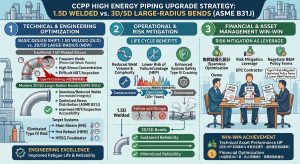
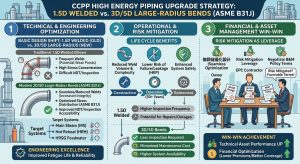
本研究報告針對「以彎代銲」(Bend rather than weld)之大半徑(3D/5D)冷作彎管與感應加熱彎管工法進行深度學術剖析。研究焦點首先置於CCPP建廠專案中,電銲彎頭與以彎代銲在建廠工序(Construction Processes)上的顯著差異,探討其對銲接檢驗、熱處理與模組化之影響。隨後,透過ASME B31J規範下的應力強化係數(SIF)流固耦合分析、冶金材料科學的微觀退化機制,以及鍋爐與機械(B&M)保險費率風險模型,全面量化無銲縫設計的生命週期效益。結合台灣大林電廠、通霄電廠更新計畫及國際先進超超臨界機組與核能反應爐之實際案例,本研究證實以彎代銲能從根本上拔除HAZ,大幅降低營運期之非破壞性檢測(NDE)負擔與保險溢價,並極大化機組應對間歇性調度時的系統妥善率。This research report provides an in-depth academic analysis of large-radius (3D/5D) cold bending and induction heating bend methods under the “bend rather than weld” concept. The research initially focuses on the significant differences in construction processes between welded elbows and bends in CCPP projects, exploring their impacts on welding inspection, heat treatment, and modularization. Subsequently, the lifecycle benefits of seamless designs are comprehensively quantified through Stress Intensification Factor (SIF) fluid-structure interaction analysis under the ASME B31J code, micro-degradation mechanisms in metallurgical materials science, and risk models for Boiler and Machinery (B&M) insurance premiums. By integrating actual case studies from Taiwan’s Dalin and Tongxiao power plant renewal projects, as well as international advanced ultra-supercritical units and nuclear reactors, this study proves that “bend rather than weld” can fundamentally eradicate the HAZ, drastically reduce Non-Destructive Examination (NDE) burdens and insurance premiums during the operational phase, and maximize overall system availability when coping with intermittent renewable dispatch.
一、緒論與產業營運環境變革 / 1. Introduction and Changes in Industrial Operating Environments
現代發電產業正面臨前所未有的營運模式重塑。傳統發電廠多設計為基載(Base Load)長期穩定運轉,其管線系統主要承受穩態的高溫與高壓。然而,隨著電網中再生能源比例的攀升,為了維持電網頻率與電壓的穩定,現代CCPP的運轉模式已轉變為每日頻繁起停(Two-shifting)與深度負載追隨(Deep Load Following)的尖載或中載任務。The modern power generation industry is facing an unprecedented reshaping of its operating models. Traditional power plants were mostly designed for base-load, long-term stable operations, where piping systems primarily withstood steady-state high temperatures and pressures. However, with the rising penetration of renewable energy in the grid, modern CCPP operating models have shifted toward daily two-shifting and deep load-following tasks (peaking or intermediate load) to maintain grid frequency and voltage stability.
在這種動態運轉模式下,主蒸汽管線與高能廢熱回收系統(HRSG)管線必須承受極端的高溫(通常介於550°C至600°C之間)與超過百大氣壓的高壓。在機組頻繁起停過程中,管線會經歷劇烈的溫度梯度變化與熱膨脹位移,這導致管線系統不僅受到高溫潛變的持續性損傷,更疊加了熱應力引發的低週疲勞(Low-Cycle Fatigue, LCF)破壞。這兩種損傷機制的非線性耦合,即潛變疲勞交互作用(Creep-Fatigue Interaction, CFI),成為決定現代CCPP高能管線剩餘壽命(Remaining Useful Life)的絕對主因1。 Under this dynamic operating mode, main steam piping and High Energy Heat Recovery Steam Generator (HRSG) piping must endure extreme high temperatures (typically between 550°C and 600°C) and high pressures exceeding a hundred atmospheres. During frequent unit start-stops, piping undergoes drastic temperature gradients and thermal expansion displacements. Consequently, the piping system suffers not only from continuous high-temperature creep damage but also from Low-Cycle Fatigue (LCF) induced by thermal stresses. The nonlinear coupling of these two damage mechanisms, known as Creep-Fatigue Interaction (CFI), has become the absolute determining factor for the Remaining Useful Life (RUL) of modern CCPP high-energy piping1.
在傳統管線工程設計中,為了節省空間、簡化管材採購與適應現場安裝,管線轉向處極度依賴標準化的1.5D短半徑或長半徑電銲彎頭(依據ASME B16.9標準製造)3。然而,這種設計在現代CCPP的嚴苛條件下暴露出了系統性的工程瓶頸。彎頭與直管連接處必須進行現場的周向對接銲接(Circumferential Butt Welding),高溫的銲接熱循環不可避免地會改變母材的微觀晶體結構,形成物理與機械性質皆顯著劣化的熱影響區(HAZ)6。同時,1.5D彎頭因曲率半徑過小,在承受彎矩與內壓時會產生嚴重的截面橢圓化(Ovalization),並伴隨流體動力學上的渦流沖刷現象9。 In traditional piping engineering design, to save space, simplify material procurement, and accommodate field installation, changes in piping direction relied heavily on standardized 1.5D short-radius or long-radius welded elbows (manufactured per ASME B16.9)3. However, under the severe conditions of modern CCPPs, this design exposes a systemic engineering bottleneck. The joints between elbows and straight pipes require on-site circumferential butt welding. The high-temperature welding thermal cycles inevitably alter the base metal’s micro-crystal structure, creating a Heat-Affected Zone (HAZ) with significantly degraded physical and mechanical properties6. Concurrently, because the 1.5D elbow has a small radius of curvature, it suffers from severe cross-sectional ovalization when subjected to bending moments and internal pressure, accompanied by turbulent eddy erosion in fluid dynamics9.
為徹底克服此一瓶頸,國際工程界開始強烈提倡「以彎代銲」工法,採用3D或5D大半徑的冷作彎管(Cold Bending)或熱感應彎管(Induction Bending)直接一體成型地取代銲接彎頭與直管的組合2。此舉將轉彎處的周向銲縫完全消弭,將不可避免的銲接接點推移至系統應力較低的直管區域。本研究將以此技術為核心,展開跨領域的深度剖析。 To thoroughly overcome this bottleneck, the international engineering community has strongly advocated the “bend rather than weld” methodology, utilizing 3D or 5D large-radius cold bending or induction bending to integrally replace the combination of welded elbows and straight pipes2. This approach completely eliminates circumferential welds at turning points, shifting unavoidable welding joints to straight pipe sections with lower system stresses. This research will center on this technology to conduct a deep, cross-disciplinary analysis.
二、建廠工序差異化研究—電銲彎頭與以彎代銲之對比 / 2. Construction Process Differentiation: Welded Elbows vs. “Bend Rather Than Weld”
在EPC(工程、採購與建造)建廠專案的生命週期中,管線施工佔據了龐大的工時與預算。傳統採用1.5D電銲彎頭與採用以彎代銲(大半徑彎管)的工法,在施工程序、品質保證(QA/QC)、檢驗測試計畫(ITP)與現場管理上有著根本性的差異。Throughout the lifecycle of an EPC (Engineering, Procurement, and Construction) project, piping construction consumes immense man-hours and budgets. The traditional methodology using 1.5D welded elbows versus the “bend rather than weld” (large-radius bend) approach exhibits fundamental differences in construction procedures, Quality Assurance/Quality Control (QA/QC), Inspection and Test Plans (ITP), and site management.
2.1 傳統電銲彎頭工序之繁複性與高風險性 / 2.1 Complexity and High Risk of Traditional Welded Elbow Processes
在CCPP主蒸汽等高能管線中,母材多採用P91或P92等潛變強度增強型鐵素體鋼(偶有涉及耐高溫之特殊不銹鋼材質等應用)。這類高合金鋼材對熱處理歷史極度敏感,其現場銲接工序不僅繁複,且容錯率極低。傳統採用1.5D彎頭的工序通常包含以下高風險步驟:In CCPP main steam and other high-energy piping systems, the base metal is predominantly Creep Strength Enhanced Ferritic (CSEF) steel such as P91 or P92 (occasionally involving special high-temperature stainless steel applications). These high-alloy steels are extremely sensitive to their thermal history; their on-site welding procedures are not only complex but also have an extremely low tolerance for error. The traditional 1.5D elbow process usually involves the following high-risk steps:
首先是管材切割與坡口加工(Beveling)。彎頭與直管的管壁厚度與橢圓度公差必須嚴格匹配,任何錯邊(Mismatch)都會在後續服役中形成嚴重的應力集中源。接著,在進行銲接前,必須執行嚴格的預熱(Preheating)程序。依據ASME B31.1規範,P91材料的銲前預熱溫度通常需達到一定標準,若省略或溫度不均,會直接導致熱影響區產生氫致開裂(Hydrogen-induced cracking)15。 First is pipe cutting and beveling. The wall thickness and ovality tolerances of the elbow and the straight pipe must be strictly matched; any mismatch will create severe stress concentrators during subsequent service. Next, strict preheating procedures must be executed prior to welding. According to the ASME B31.1 code, the preheating temperature for P91 materials must reach a certain standard; omitting this or applying uneven temperatures directly leads to hydrogen-induced cracking in the HAZ15.
進入銲接階段後,無論是採用鎢極氣體保護電弧銲(GTAW)進行打底,還是保護氣體金屬電弧銲(SMAW)進行填充,銲工必須嚴格控制層間溫度(Interpass temperature)。一旦溫度超標,母材的微觀組織將發生不可逆的粗化。銲接完成後,不能立即冷卻至室溫,必須進行氫烤出(Hydrogen Bakeout)處理,隨後將溫度降至馬氏體轉變溫度以下,再啟動至關重要的銲後熱處理(Post-Weld Heat Treatment, PWHT)15。 Entering the welding phase, whether using Gas Tungsten Arc Welding (GTAW) for the root pass or Shielded Metal Arc Welding (SMAW) for the fill passes, welders must strictly control the interpass temperature. Once the temperature exceeds limits, the base metal’s microstructure will undergo irreversible coarsening. After welding is completed, it cannot be immediately cooled to room temperature; a hydrogen bakeout must be performed, followed by cooling below the martensite transformation temperature before initiating the crucial Post-Weld Heat Treatment (PWHT)15.
PWHT的執行與監控是ITP(檢驗與測試計畫)中的關鍵查核點。保溫帶(Band)的寬度必須至少為管壁最大厚度的三倍,且需採用連續的熱電偶(Thermocouple)進行溫度追蹤記錄。單一熱電偶的讀數或操作員的手寫日誌在稽核時缺乏防禦力,必須依賴連續的溫度與時間曲線數據15。一旦PWHT的升溫速率、持溫時間或降溫速率偏離了銲接程序規範(WPS),該銲道周邊的晶界便可能析出有害相,直接決定了管線未來的潛變壽命。 The execution and monitoring of PWHT represent critical hold points in the ITP. The heating band width must be at least three times the maximum pipe wall thickness, and continuous thermocouples must be used for temperature tracking. A single thermocouple reading or an operator’s handwritten log is indefensible during an audit; continuous time-temperature curve data is mandatory15. If the heating rate, holding time, or cooling rate of the PWHT deviates from the Welding Procedure Specification (WPS), harmful phases may precipitate at the grain boundaries near the weld, directly sealing the fate of the pipe’s future creep life.
最後,每一道高能管線的周向銲縫皆需接受極高等級的非破壞性檢測(NDE),包括全滲透的射線檢測(RT)或超聲波檢測(UT),以確保融合線(Fusion lines)沿線無潛藏的微小裂紋或夾雜物4。這些繁雜的工序不僅耗費大量工時,現場狹窄的空間亦增加了施工難度與工安風險。 Finally, every circumferential weld in high-energy piping must undergo the highest level of Non-Destructive Examination (NDE), including full-penetration Radiographic Testing (RT) or Ultrasonic Testing (UT), ensuring no hidden micro-cracks or inclusions exist along the fusion lines4. These tedious processes not only consume massive man-hours, but the confined field spaces also escalate construction difficulty and safety risks.
2.2 以彎代銲工法與模組化之工序優勢 / 2.2 Process Advantages of “Bend Rather Than Weld” and Modularization
相對於傳統工序的繁冗,以彎代銲工法將高度依賴現場人工技藝的「現場銲接」,轉化為具備高度自動化與參數監控的「工廠製造」。In stark contrast to the cumbersome traditional processes, the “bend rather than weld” method shifts the highly manual skill-dependent “field welding” into a “factory manufacturing” environment equipped with high automation and parameter monitoring.
在製造工廠內,整支無縫鋼管透過感應加熱彎管(Induction Bending)或冷作彎管(Cold Bending)設備進行一體成型。冷作彎管通常在低於材料下臨界溫度(Lower critical temperature)56°C的環境下進行,而感應彎曲則是透過局部高頻感應加熱,將母管推過加熱圈成型3。在整個彎曲過程中,設備能精確控制推進速度、加熱溫度與冷卻速率,確保管壁的減薄率(Thinning)與橢圓度(Ovality)嚴格控制在ASME B31.1或B31.3允許的公差範圍內(例如B31.4規定管徑縮減不得超過2.5%)3。 In the manufacturing plant, an entire seamless steel pipe is integrally formed using Induction Bending or Cold Bending equipment. Cold bending is typically performed in an environment at least 56°C below the material’s lower critical temperature, whereas induction bending pushes the mother pipe through a heating coil using localized high-frequency induction heating3. Throughout the bending process, equipment precisely controls the push speed, heating temperature, and cooling rate, ensuring that wall thinning and ovality are strictly kept within the tolerances permitted by ASME B31.1 or B31.3 (e.g., B31.4 mandates diameter reduction must not exceed 2.5%)3.
更關鍵的工序變革在於熱處理。管線在工廠完成彎曲後,製造商可將整支彎管(包含內弧、外弧與直管過渡段)送入大型溫控爐中進行整體熱處理,而非現場局部的保溫毯加熱。這確保了材料能獲得極度均勻的正常化與回火(Normalize and Temper, N&T)或彎後熱處理(PBHT),徹底消除冷作或熱作所引入的殘餘應力(Residual stress),並重塑完美的馬氏體基體15。 A more critical process revolution lies in heat treatment. After bending is completed in the factory, manufacturers can place the entire bent pipe (including the intrados, extrados, and straight transition sections) into large temperature-controlled furnaces for global heat treatment, rather than relying on localized heating blankets on-site. This ensures the material achieves extremely uniform Normalizing and Tempering (N&T) or Post-Bend Heat Treatment (PBHT), thoroughly eradicating residual stresses introduced by cold or hot working, and reconstructing a flawless martensitic matrix15.
在EPC現場安裝階段,以彎代銲工法可結合「三合一模組化」(3-in-1 Methodology)設計。透過將多個彎角整合於一根長管上,現場人員僅需進行少數的直管對接銲接,完全免除了在轉彎處(通常為系統應力最高點)搭設鷹架、預熱、銲接與NDE檢測的需求。這不僅大幅縮減了建廠期程,降低了現場鷹架搭設與高空作業的風險,更從物理層面拔除了管線系統中最難以維持品質的轉角銲縫13。 During the EPC field installation phase, the “bend rather than weld” method can be combined with a “3-in-1 Modularization” methodology. By integrating multiple bends onto a single long pipe, site personnel only need to perform a few straight-pipe butt welds. This completely eliminates the need for scaffolding, preheating, welding, and NDE at turning points (which are typically the points of highest system stress). This not only drastically shortens the construction schedule and mitigates risks associated with scaffolding and working at heights but also physically eradicates the corner welds that are the most difficult to quality-control in a piping system13.
| 工序指標 / Process Metrics | 傳統1.5D電銲彎頭設計 / Traditional 1.5D Welded Elbow Design | 3D/5D 以彎代銲設計 / 3D/5D Bend-Rather-Than-Weld Design | 專案績效影響 / Project Performance Impact |
| 現場銲接數量 / Field Weld Quantity | 極高(每個轉彎處需兩道周向銲縫) / Extremely High (Two circumferential welds per turn) | 極低(轉彎處無銲縫,僅直管對接) / Extremely Low (No welds at turns, straight butt welds only) | 降低現場動火作業風險與氬氣消耗 / Reduces hot work risks and argon consumption25 |
| PWHT品質控制 / PWHT Quality Control | 困難(受限於現場空間、氣候與局部加熱均勻度) / Difficult (Limited by space, weather, and local heating uniformity) | 極佳(工廠大型溫控爐整體熱處理) / Excellent (Global heat treatment in large factory furnaces) | 確保P91/P92微觀組織均勻,無局部劣化 / Ensures uniform P91/P92 microstructure, no local degradation11 |
| NDE檢測負擔 / NDE Burden | 沉重(每道銲縫需進行100% UT/RT及硬度測試) / Heavy (100% UT/RT and hardness testing per weld) | 減輕(依據銲縫消除比例大幅減少檢測量) / Lightened (Drastically reduced based on weld elimination ratio) | 縮短工期,降低高階檢驗技師之人事成本 / Shortens schedule, cuts personnel costs for senior NDE techs17 |
| 模組化潛力 / Modularization Potential | 低(彎頭為標準件,需逐一拼接) / Low (Elbows are standard fittings requiring piece-by-piece splicing) | 高(單一長管可進行多角度三維彎折) / High (Single long pipes can be bent in multi-angles/3D) | 優化現場佈局,減少干涉與吊裝次數 / Optimizes site layout, reduces interference and lifting ops11 |
三、工程規範演進與流固耦合下的應力強化分析 / 3. Code Evolution and Stress Intensification Analysis Under Fluid-Structure Interaction
要充分理解以彎代銲的力學優勢,必須深入探討ASME規範體系在應力評估上的演進,特別是應力強化係數(Stress Intensification Factor, SIF)在評估管線幾何不連續性時的核心地位。To fully comprehend the mechanical advantages of “bend rather than weld,” one must delve into the evolution of stress evaluation within the ASME code system, specifically the central role of the Stress Intensification Factor (SIF) when assessing piping geometric discontinuities.
3.1 ASME B31.1與B31.3之設計哲學與壁厚補償 / 3.1 Design Philosophies and Wall Thickness Compensation of ASME B31.1 and B31.3
在CCPP的設計範疇中,高溫高壓的主蒸汽管線、鍋爐給水與排污系統等鍋爐外部管線(Boiler External Piping)受到ASME B31.1(動力管線規範)管轄;而相鄰的其他製程管線則可能適用ASME B31.3(製程管線規範)15。 In the design scope of CCPPs, high-temperature, high-pressure main steam piping, boiler feedwater, and blowdown systems are classified as Boiler External Piping governed by ASME B31.1 (Power Piping); adjacent process piping may be governed by ASME B31.3 (Process Piping)15.
ASME B31.1的設計哲學極為保守。其假設動力管線一旦發生高壓蒸汽破裂,將導致災難性的人員傷亡與大規模停電(損害後果極高)。因此,B31.1傾向於規定性(Prescriptive)法則,採用較高的安全係數(歷史上接近4),對冷作彎管的壁厚與熱處理設下嚴格的觸發門檻20。相對而言,ASME B31.3則傾向於性能導向(Performance-Based),其針對腐蝕性或劇毒流體,允許製造商透過應變計算證明熱處理豁免,並明確依據彎曲半徑與管徑比(R/D)給予容許減薄百分比(如R≥5D容許10%減薄)20。 ASME B31.1 possesses a highly conservative design philosophy. It assumes that a high-pressure steam rupture in power piping would lead to catastrophic casualties and large-scale power outages (extremely high consequence of failure). Thus, B31.1 leans towards prescriptive rules, employing a higher safety factor (historically nearing 4), setting strict trigger thresholds for the wall thickness and heat treatment of cold bends20. Relatively speaking, ASME B31.3 is more performance-based; addressing corrosive or highly toxic fluids, it allows manufacturers to prove heat treatment exemptions via strain calculations and explicitly grants allowable thinning percentages based on the bend radius-to-diameter ratio (R/D) (e.g., R≥5D allows 10% thinning)20.
無論採用何種規範,彎管在成型過程中外弧(Extrados)會拉伸減薄,內弧(Intrados)會擠壓增厚。然而,在承受內部流體壓力時,內弧所承受的環向應力實際上大於外弧。因此,規範引入了幾何修正係數(I factor)來決定彎管各部位所需的最小壁厚(tm)27: Regardless of the code applied, the extrados of a bend stretches and thins during forming, while the intrados compresses and thickens. However, when subjected to internal fluid pressure, the hoop stress borne by the intrados is actually greater than that on the extrados. Therefore, the codes introduce a geometric correction factor (I factor) to dictate the required minimum wall thickness (tm) at various parts of the bend27:
Iintrados=[4(R/D)-1]/[4(R/D)-2]
Iextrados=[4(R/D)+1]/[4(R/D)+2]
tm=[P⋅D/2(S⋅E⋅W/I+(P⋅y))] +A
當採用1.5D短半徑彎頭時,R/D數值極小,導致Iintrados顯著增大,這意味著該處需要遠超直管的壁厚才能抵禦內壓,工程師往往被迫選擇更重的公稱壁厚等級(Schedule)來補償 28。反之,當採用3D或5D的大半徑彎管時,R/D數值較大,使得Iintrados與Iextrados大幅趨近於1.0,這代表大半徑彎管的內壓包容能力極度接近完美的直管,消除了過度設計的重量與成本浪費11。 When utilizing a 1.5D short-radius elbow, the small (R/D) ratio causes Iintrados to increase significantly. This implies that the intrados requires a wall thickness far exceeding that of a straight pipe to withstand internal pressure, often forcing engineers to select a heavier nominal wall thickness schedule as compensation28. Conversely, when employing a 3D or 5D large-radius bend, the larger (R/D) ratio brings both Iintrados and Iextrados dramatically closer to 1.0. This denotes that the internal pressure containment capacity of a large-radius bend is exceptionally close to that of a perfect straight pipe, eliminating the weight and cost waste associated with over-design11.
3.2 ASME B31J導入與SIF指數級衰減效應 / 3.2 Introduction of ASME B31J and the Exponential Decay of SIF
在管線應力分析中,工程師必須評估系統在熱膨脹位移下產生的二次應力(Secondary Stress)。彎管在承受彎矩時,由於截面會發生橢圓化(Ovalization),其管壁內產生的實際彎曲應力遠大於根據簡單梁理論計算出的名目應力。這兩者的比值即為應力強化係數(SIF),其最小值為1.0(代表完美直管)9。 In piping stress analysis, engineers must evaluate the secondary stress generated by the system under thermal expansion displacement. When a bend is subjected to bending moments, cross-sectional ovalization occurs, causing the actual bending stress generated within the pipe wall to be far greater than the nominal stress calculated via simple beam theory. The ratio between these two is the Stress Intensification Factor (SIF), with a minimum value of 1.0 (representing a perfect straight pipe)9.
近年來,ASME B31J《管線與管線組件之應力強化係數與柔性係數》規範逐漸成為高能管線設計的強制標準。該規範透過大量的有限元素分析(FEA)與實體試驗,重新校正了各種管線組件的SIF值。根據B31J模型,彎管的柔性特徵(Flexibility Characteristic, h)與SIF的計算公式如下29: In recent years, the ASME B31J code (“Stress Intensification Factors (i-Factors) and Flexibility Factors (k-Factors) for Metallic Piping Components”) has gradually become a mandatory standard for high-energy piping design. Through extensive Finite Element Analysis (FEA) and physical testing, this standard recalibrated the SIF values for various piping components. According to the B31J model, the flexibility characteristic (h) and SIF formulas for a pipe bend are as follows29:
h=T⋅R1/r22
SIFin-plane=0.9/h2/3
SIFout-plane=0.75/h2/3
其中,T為彎管壁厚,R1為彎曲半徑,r2為管材平均半徑。公式清楚揭示了SIF值與彎曲半徑R1成反比。當R1從1.5D增加至3D或5D時,h值顯著增大,導致SIF值呈指數級衰減,最終逼近直管的理論極限值1.014。 Where T is the bend wall thickness, R1 is the bend radius, and r2 is the mean radius of the matching pipe. The formulas clearly reveal that the SIF value is inversely proportional to the bend radius R1 . When R1 increases from 1.5D to 3D or 5D, h increases significantly, leading to an exponential decay of the SIF value until it finally approaches the theoretical limit of a straight pipe, 1.014.
這項科學驗證無情地揭露了傳統1.5D銲接彎頭極度危險的高應力集中本質。在CAESAR II或AutoPIPE等高階流固耦合與應力分析軟體中導入B31J後,分析結果顯示1.5D彎頭在系統熱膨脹與設備振動位移下,無可避免地成為全線最易發生疲勞失效的應力熱點2。透過將1.5D彎頭升級為3D/5D冷作彎管,系統能夠將局部破壞性能量透過更長的安全幾何過渡區進行耗散,從根本上優化了整廠高能管線的柔性配置與抗震性能9。 This scientific validation mercilessly unmasked the extremely dangerous high-stress concentration inherent in traditional 1.5D welded elbows. After importing B31J into advanced fluid-structure interaction and stress analysis software like CAESAR II or AutoPIPE, analysis results show that 1.5D elbows inevitably become the stress hotspots most prone to fatigue failure under system thermal expansion and equipment vibration displacements2. By upgrading 1.5D elbows to 3D/5D cold bends, the system dissipates localized destructive energy through a longer, safe geometric transition zone, fundamentally optimizing the flexibility layout and seismic performance of the entire plant’s high-energy piping9.
四、微觀冶金學挑戰與熱影響區(HAZ)之根除 / 4. Micro-Metallurgical Challenges and the Eradication of the Heat-Affected Zone (HAZ)
高能管線在承受巨觀應力的同時,其微觀晶體結構亦在極端環境下經歷著緩慢而致命的退化。探討以彎代銲的優越性,必須深入微觀冶金領域,解析熱影響區(HAZ)如何成為CCPP管線壽命的阿基里斯腱。While high-energy piping withstands macroscopic stresses, its micro-crystal structure also undergoes slow and fatal degradation in extreme environments. To explore the superiority of “bend rather than weld,” one must dive deep into the realm of micro-metallurgy and analyze how the Heat-Affected Zone (HAZ) has become the Achilles’ heel of CCPP piping lifespans.
4.1 P91/P92材料之微觀結構與相變脆弱性 / 4.1 Microstructure and Phase Transformation Vulnerability of P91/P92 Materials
為了因應高溫高壓,現代主蒸汽與熱再熱管線廣泛採用ASME P-No. 15E材料組群中的潛變強度增強型鐵素體鋼(CSEF),尤以P91與P92最為常見28。這類材料的卓越高溫潛變抗力,並非單純來自化學成分的堆疊,而是建立在其極度敏感且精確的熱處理歷史(Thermal History)之上22。 To cope with high temperatures and pressures, modern main steam and hot reheat piping widely utilizes Creep Strength Enhanced Ferritic (CSEF) steels from the ASME P-No. 15E material group, with P91 and P92 being the most common28. The extraordinary high-temperature creep resistance of these materials stems not merely from the stacking of chemical compositions, but is built upon their extremely sensitive and precise thermal history22.
在完美狀態下,P91/P92的微觀結構呈現為回火馬氏體(Tempered Martensite),其基體內部布滿了高密度的差排(Dislocations),並有細小的富釩/鈮碳氮化物(MX相)與富鉻碳化物(M23C6)均勻析出於晶界(Grain boundaries)與次晶界上。這些細微析出物發揮了強大的「釘紮效應」(Pinning Effect),有效阻擋了高溫下晶界的滑移與差排的運動,賦予材料極高的潛變強度36。 In a pristine state, the microstructure of P91/P92 presents as tempered martensite, whose matrix is packed with a high density of dislocations. Fine V/Nb-rich carbonitrides (MX phase) and Cr-rich carbides (M23C6) precipitate uniformly along the grain boundaries and sub-grain boundaries. These fine precipitates exert a powerful “pinning effect,” effectively hindering grain boundary sliding and dislocation movement at high temperatures, thereby endowing the material with immense creep strength36.
然而,當這類材料經過高溫電銲加工時,銲道兩側的母材會經歷一場非平衡的極端熱循環,形成熱影響區(HAZ)。HAZ依據最高受熱溫度可細分為粗晶區(CGHAZ)、細晶區(FGHAZ)與臨界晶間區(ICHAZ)。研究表明,經過20,000小時以上的服役後,P91銲接接頭周圍的馬氏體板條特徵會逐漸消失,分解為塊狀鐵素體,並伴隨有害的Laves相析出36。Laves相不僅會消耗基體中的固溶強化元素(如鉬與鎢),其本身的高硬度更使其與周圍較軟的基體產生變形不協調,成為潛變孔洞(Creep Cavities)成核的絕佳應力集中點。 However, when these materials undergo high-temperature arc welding, the base metal on both sides of the weld bead experiences a non-equilibrium, extreme thermal cycle, forming a Heat-Affected Zone (HAZ). Depending on the peak temperature reached, the HAZ can be subdivided into the Coarse-Grained HAZ (CGHAZ), Fine-Grained HAZ (FGHAZ), and Intercritical HAZ (ICHAZ). Research indicates that after over 20,000 hours of service, the martensitic lath features around P91 weld joints gradually disappear, decomposing into blocky ferrite, accompanied by the precipitation of the detrimental Laves phase36. The Laves phase not only depletes the matrix of solid-solution strengthening elements (like Mo and W), but its inherent high hardness also creates deformation incompatibility with the surrounding softer matrix, serving as an excellent stress concentration site for creep cavities nucleation.
4.2 第四型潛變破裂(Type IV Cracking)的致命威脅 / 4.2 The Fatal Threat of Type IV Creep Cracking
在CSEF銲接件中,最令工程界擔憂的失效模式即為「第四型潛變破裂」。這種破裂專門發生在ICHAZ與FGHAZ交界處。由於該區域在銲接熱循環中,剛好被加熱至AC1與AC3相變溫度之間,導致原有的強化析出物(如MX相)部分溶解並粗化,失去了阻擋差排運動的能力,形成一個顯著軟化的脆弱帶7。 In CSEF weldments, the failure mode that most concerns the engineering community is “Type IV Cracking.” This cracking occurs exclusively at the boundary between the ICHAZ and FGHAZ. As this region is heated exactly between the AC1 and AC3 phase transformation temperatures during the welding thermal cycle, the original strengthening precipitates (like the MX phase) partially dissolve and coarsen. They lose their ability to block dislocation movement, forming a significantly softened, vulnerable zone7.
在長期的系統靜載荷(內壓)與動態彎矩(系統熱膨脹)交疊作用下,該軟化帶會優先產生微小的潛變孔洞,孔洞隨時間長大並連結成微裂紋,最終導致管線在遠低於母材設計壽命的情況下發生無預警的巨觀斷裂7。大量的微觀檢測證實,P91銲接件的潛變破裂壽命在某些加載條件下,僅為未受熱影響母材壽命的40%至70%7。 Under the prolonged, superimposed effects of systemic static loads (internal pressure) and dynamic bending moments (system thermal expansion), this softened zone preferentially generates minute creep cavities. Over time, these cavities grow and link into micro-cracks, eventually causing the piping to experience sudden macroscopic rupture far below the base metal’s design life7. Extensive micro-inspections have verified that the creep rupture life of P91 weldments under certain loading conditions is merely 40% to 70% of the unaffected base metal’s life7.
4.3 潛變與疲勞的交互作用(Creep-Fatigue Interaction) / 4.3 Creep-Fatigue Interaction (CFI)
CCPP為了配合再生能源而頻繁起停,使得轉彎處的銲接接頭不僅承受穩態的高溫潛變,還承受起停過程中的熱應力低週疲勞。To complement renewable energy, CCPPs undergo frequent start-stops, subjecting the welded joints at turning points not only to steady-state high-temperature creep but also to thermal stress-induced low-cycle fatigue during the start-stop cycles.
透過奈米壓痕(Nanoindentation)與掃描電子顯微鏡(SEM)測試,研究發現P92鋼在高應變率下的斷裂機制偏向疲勞主導;但在長週期的保載(Hold time/Dwell time)階段,靜水壓應力成分的增加會急遽加速HAZ區域潛變應變的累積與微裂紋的萌生1。日本大阪大學針對大型銲接熱水管結構進行了彎矩與扭矩複合加載(Bending-torsion loading)的有限元素預測與試驗。結果證實,相較於純彎曲或純扭轉,複合加載下的潛變疲勞壽命大幅縮減,且裂紋毫無例外地皆起始於熱影響區(HAZ),證明了複雜應力狀態對銲縫退化機制的催化作用6。 Through nanoindentation and Scanning Electron Microscope (SEM) testing, research has found that the fracture mechanism of P92 steel under high strain rates is fatigue-dominated; however, during the long-cycle hold time (dwell time) phase, the increase in the hydrostatic pressure stress component drastically accelerates the accumulation of creep strain and the initiation of micro-cracks in the HAZ region1. Osaka University in Japan conducted FEA predictions and experiments on a large-scale welded hot-water pipe structure subjected to combined bending-torsion loading. Results confirmed that, compared to pure bending or pure torsion, the creep-fatigue life under combined loading is substantially reduced, and cracks universally initiated in the HAZ. This proves the catalytic effect of complex stress states on weld degradation mechanisms6.
4.4 以彎代銲:從根本上的冶金救贖 / 4.4 “Bend Rather Than Weld”: A Fundamental Metallurgical Salvation
採用3D/5D冷作彎管或精確溫控的感應彎管,其最大的冶金貢獻就是「將轉彎高應力處的周向銲縫直接消弭」。由於整支鋼管是一體成型,且彎曲後強制進行全管體的整體熱處理(PBHT或N&T),這確保了整個彎曲部位(包含應力最集中的內弧與外弧)的微觀組織重新恢復為均勻、無缺陷的回火馬氏體結構7。這意味著管線轉彎處徹底根除了ICHAZ軟化帶與Type IV Cracking的溫床,讓整個系統的潛變疲勞抗力回歸至母材本身的高水準,實現了冶金學上的完美救贖。 The greatest metallurgical contribution of utilizing 3D/5D cold bends or precisely temperature-controlled induction bends is the direct elimination of circumferential welds at high-stress turning points. Because the entire steel pipe is integrally formed and globally heat-treated (PBHT or N&T) across the full body after bending, it ensures that the microstructure of the entire bent section (including the most stress-concentrated intrados and extrados) is restored to a uniform, defect-free tempered martensitic structure7. This means the piping turning points completely eradicate the ICHAZ softened zone and the breeding ground for Type IV Cracking, returning the entire system’s creep-fatigue resistance to the high baseline of the base metal itself—achieving perfect metallurgical salvation.
五、流體動力學優化與流體加速腐蝕(FAC)的抑制 / 5. Fluid Dynamics Optimization and the Suppression of Flow-Accelerated Corrosion (FAC)
除了固體力學與冶金學的防護外,以彎代銲在流體動力學領域同樣具有極高的附加價值,這對於保護管線內部免受物理化學沖刷至關重要。Beyond the protections offered in solid mechanics and metallurgy, “bend rather than weld” holds tremendous added value in the realm of fluid dynamics, which is crucial for protecting the pipe interior from physico-chemical erosion.
5.1 邊界層剝離與系統動能損耗 / 5.1 Boundary Layer Separation and System Kinetic Energy Loss
當高壓蒸汽或高溫給水行經管線轉彎處時,流體微團受到強烈的離心力作用,會在管線截面內部誘發二次流(Secondary Flow,如Dean Vortex渦流現象)。When high-pressure steam or high-temperature feedwater traverses a piping turn, fluid parcels are subjected to intense centrifugal forces, inducing secondary flows (such as Dean vortices) within the pipe cross-section.
在傳統1.5D短半徑或長半徑彎頭中,轉彎極度急促與劇烈。這種銳角的幾何構型會迫使高速流體在彎管內側發生嚴重的邊界層剝離(Boundary Layer Separation),形成巨大的尾流區(Wake region)與能量耗散,宏觀上表現為顯著的壓力降(Pressure Drop)。為補償這種壓降,系統的飼水幫浦或壓縮機必須輸出更多額外功,不僅增加能耗,也降低了CCPP整廠的熱循環效率3。 In traditional 1.5D short or long radius elbows, the turn is extremely abrupt and severe. This sharp geometric configuration forces high-speed fluids to undergo severe boundary layer separation on the inner side of the bend, forming a massive wake region and dissipating energy, which macroscopically manifests as a significant pressure drop. To compensate for this pressure drop, the system’s feedwater pumps or compressors must output extra work, which not only increases energy consumption but also degrades the overall thermal cycle efficiency of the CCPP plant3.
相反地,3D或5D大半徑彎管提供了極其平滑且漸進的幾何過渡空間。流場在通過大半徑彎管時,流線(Streamlines)的分佈更加平順均勻,大幅抑制了二次流渦旋的強度與邊界層剝離現象,使流體動能得以完整保留3。 Conversely, 3D or 5D large-radius bends provide extremely smooth and gradual geometric transition spaces. When the flow field passes through a large-radius bend, streamline distribution becomes much smoother and uniform, drastically suppressing the intensity of secondary flow vortices and boundary layer separation, allowing fluid kinetic energy to be completely preserved3.
5.2 流體加速腐蝕(FAC)的緩解機制 / 5.2 Mitigation Mechanism for Flow-Accelerated Corrosion (FAC)
在CCPP的廢熱回收鍋爐(HRSG)與給水系統中,流體加速腐蝕(Flow-Accelerated Corrosion, FAC)是導致管壁意外極度減薄與爆管的主要元兇。FAC的物理化學機制在於:碳鋼或低合金鋼管壁表面生成的保護性氧化層(如磁鐵礦 Fe3O4),在高速、高紊流的流體持續剪切力(Shear stress)沖刷下,不斷溶解或機械性剝落。隨後,裸露新鮮母材再次被氧化,再遭剝落,形成無止盡的惡性循環34。 In the HRSG and feedwater systems of CCPPs, Flow-Accelerated Corrosion (FAC) is the primary culprit behind unexpected, extreme wall thinning and pipe bursts. The physico-chemical mechanism of FAC is that the protective oxide layer (such as magnetite, Fe3O4) formed on carbon or low-alloy steel walls is continuously dissolved or mechanically spalled off by the sustained shear stress of high-speed, highly turbulent fluids. Subsequently, the freshly exposed base metal oxidizes again and is stripped away once more, forming an endless vicious cycle34.
1.5D銲接彎頭內部極度紊亂的流場與渦流,正是剝除保護性氧化層的完美利器,導致其外弧側常被檢測出極端的壁厚減薄速率,成為漏氣與爆管的常客11。透過將1.5D彎頭升級為一體成型的3D/5D彎管,流場趨於層流化,管壁所承受的流體剪切應力大幅降低。保護性氧化層因此得以穩定附著於管壁表面,阻止了母材金屬粒子的繼續溶解,從根本上遲滯了FAC的退化機制,極大化了管線在惡劣流體環境下的使用壽命11。 The highly chaotic flow fields and vortices inside a 1.5D welded elbow act as the perfect tool for stripping away the protective oxide layer, often causing its extrados to exhibit extreme wall thinning rates, making it a frequent victim of leaks and bursts11. By upgrading a 1.5D elbow to an integrally-formed 3D/5D bend, the flow field approaches laminar flow, and the fluid shear stress borne by the pipe wall is drastically reduced. Consequently, the protective oxide layer can adhere stably to the wall surface, halting further dissolution of base metal particles, fundamentally delaying the FAC degradation mechanism, and maximizing the piping’s service life in harsh fluid environments11.
六、營運期檢測負擔與鍋爐與機械(B&M)保險費率之財務模型 / 6. Financial Model for Operational Inspection Burden and Boiler & Machinery (B&M) Insurance Premiums
工程技術的升級,最終必須轉化為企業全生命週期資產管理(Asset Management)的財務紅利。將「以彎代銲」導入CCPP專案,不僅能提升初期的建廠品質,更能為後續數十年的營運期帶來龐大的經濟效益,特別是在維護成本與風險轉嫁(保險)兩個維度。Engineering technology upgrades must ultimately translate into financial dividends for enterprise full-lifecycle Asset Management. Introducing “bend rather than weld” into CCPP projects not only elevates initial construction quality but also yields massive economic benefits for the ensuing decades of operations, particularly across two dimensions: maintenance costs and risk transfer (insurance).
6.1 歲修與在役檢查(ISI)負擔的大幅減免 / 6.1 Substantial Reduction in Outage and In-Service Inspection (ISI) Burdens
在法規與安全雙重考量下,各國壓力容器法規通常要求高能管線在進入營運期後,必須定期實施在役檢查(In-Service Inspection, ISI),針對所有高風險銲道進行超聲波(UT)、射線(RT)或磁粉(MT)等非破壞性檢測。Under the dual imperatives of regulations and safety, pressure vessel codes worldwide typically mandate that high-energy piping undergo periodic In-Service Inspections (ISI) during its operational phase, subjecting all high-risk welds to non-destructive testing such as UT, RT, or MT.
由於以彎代銲技術將轉彎處的周向銲縫直接消弭(韓國研究顯示可減少高達75%的銲縫4),這意味著營運階段的NDE檢測數量呈等比例的大幅下降。電廠在年度歲修(Annual Outage)期間,維修團隊無需再為這些難以搭設施工架、空間狹窄且可能帶有環境風險的轉角銲道進行檢驗。這不僅節省了龐大的高階檢測技師人事成本與儀器租賃費用,更直接縮短了歲修工期,使機組能更快併聯發電,提升了系統妥善率與發電收益。 Because the “bend rather than weld” technology directly eliminates circumferential welds at turning points (South Korean studies show up to a 75% reduction in welds4), this signifies a proportionally drastic drop in NDE quantities during the operational phase. During Annual Outages, maintenance teams no longer need to inspect these corner welds, which are notoriously difficult to scaffold, situated in confined spaces, and fraught with environmental risks. This not only saves massive personnel costs for senior NDE technicians and equipment rental fees but also directly shortens outage durations, allowing units to synchronize to the grid faster, thus boosting system availability and power generation revenues.
6.2 鍋爐與機械保險(B&M Insurance)之風險溢價降低 / 6.2 Reduction in Boiler and Machinery (B&M) Insurance Risk Premiums
在商業保險市場中,發電廠為了轉嫁營運風險,必須投保財產險以及專屬的「鍋爐與機械保險」(Boiler and Machinery Insurance,亦稱設備故障險 Equipment Breakdown Insurance)。這至關重要,因為標準的商業財產險通常將「機械故障、電氣短路、內部壓力容器破裂或鍋爐爆炸(非外部火災引起)」列為除外不保事項45。 In the commercial insurance market, power plants must purchase property insurance and dedicated Boiler and Machinery Insurance (also known as Equipment Breakdown Insurance) to transfer operational risks. This is critical because standard commercial property insurance usually lists “mechanical breakdown, electrical short-circuits, internal pressure vessel ruptures, or boiler explosions (not caused by external fire)” as excluded perils45.
B&M保險填補了這一缺口,其承保範圍涵蓋了設備因內部原因引發突發且意外(Sudden and accidental)損壞的直接修復成本、加急費用(Expediting Expenses),以及最為關鍵的營業中斷損失(Business Interruption, BI)45。保險公司(如Swiss Re, Munich Re, Chubb等)在進行B&M保險的核保(Underwriting)與風險定價時,會高度關注設備的固有設計缺陷、維護紀錄與歷史檢測報告。磨損、漸進式劣化或已知的腐蝕通常被列為除外責任45。 B&M insurance bridges this gap. Its coverage encompasses direct repair costs, expediting expenses, and most crucially, Business Interruption (BI) losses stemming from equipment breakdown triggered suddenly and accidentally by internal causes45. When insurance companies (e.g., Swiss Re, Munich Re, Chubb) conduct B&M underwriting and risk pricing, they pay close attention to the equipment’s inherent design flaws, maintenance records, and historical inspection reports. Wear and tear, gradual deterioration, or known corrosion are typically excluded45.
如果高能管線在應力最高的轉彎處存在高風險的HAZ與周向銲縫,這將被保險工程師與健康安全執行局(HSE)評估為高風險熱點。因為這些部位極易發生第四型潛變破裂或FAC導致的無預警爆管,進而引發災難性的蒸汽爆炸、周邊設備損毀與人員傷亡49。這種高風險結構將直接推高保險單的風險溢價(Risk Premium)。 If high-energy piping retains high-risk HAZs and circumferential welds at the highest-stress turning points, insurance engineers and health/safety executives (HSE) will evaluate these as high-risk hotspots. These areas are highly susceptible to sudden bursts caused by Type IV creep cracking or FAC, triggering catastrophic steam explosions, collateral equipment damage, and casualties49. Such high-risk structures directly drive up the policy’s risk premium.
反之,採用「以彎代銲」設計的電廠,徹底消除了潛變破裂的熱點與FAC的誘發因子,並透過SIF衰減優化了系統整體的抗震與熱膨脹承受力。業主能向保險公司提出強而有力的風險降低(Risk Mitigation)科學證據,爭取到更優惠的B&M保險費率折扣(Premium Discounts),顯著減少營運期固定支出(OPEX)45。同時,因管線系統可靠度的大幅提升,避免了潛在非計劃性停機所導致的龐大營業中斷損失,確保了對電網調度的履約能力。 Conversely, a power plant designed with “bend rather than weld” comprehensively eradicates creep rupture hotspots and FAC trigger factors, optimizing the system’s overall seismic and thermal expansion resilience through SIF attenuation. Owners can present robust scientific evidence of Risk Mitigation to insurers to negotiate more favorable B&M Premium Discounts, significantly cutting operational fixed expenditures (OPEX)45. Simultaneously, the drastic improvement in piping system reliability avoids massive Business Interruption losses caused by potential unplanned downtimes, safeguarding the plant’s ability to fulfill grid dispatch commitments.
| 財務與營運風險指標 / Financial & Operational Risk Indicators | 傳統1.5D電銲彎頭設計 / Traditional 1.5D Welded Elbow Design | 3D/5D 以彎代銲設計 / 3D/5D Bend-Rather-Than-Weld Design | 全生命週期財務影響 / Lifecycle Financial Impact |
| ISI 在役檢查費用 / ISI In-Service Inspection Costs | 高(銲道數量多,檢測時間長,歲修成本高) / High (Many welds, long testing times, high outage costs) | 極低(轉角無銲縫,檢查點少) / Extremely Low (No corner welds, fewer check points) | 大幅節省NDE檢測費用與歲修工時,提升發電營收 / Drastically saves NDE costs & outage time, boosts revenue |
| 突發性故障機率 / Sudden Breakdown Probability | 較高(HAZ潛變破裂、FAC導致管壁減薄爆管) / Higher (HAZ creep cracks, FAC-induced bursting) | 極低(無HAZ、平滑過渡流場減緩FAC) / Extremely Low (No HAZ, smooth flow mitigates FAC) | 避免災難性工安事故與周邊設備連帶損毀 / Prevents catastrophic accidents & collateral damage16 |
| B&M保險核保評級 / B&M Insurance Underwriting Rating | 較差(存在已知的高應力與冶金缺陷熱點) / Poorer (Known high-stress & metallurgical defect hotspots) | 優良(消除固有設計風險,應力分佈均勻化) / Excellent (Eliminates inherent design risks, uniform stress) | 爭取保險費率折扣,減少營運期固定支出(OPEX) / Earns premium discounts, reduces operational OPEX |
| 營業中斷 (BI) 損失 / Business Interruption (BI) Losses | 高風險(非計劃性停機引發龐大收入損失) / High Risk (Unplanned downtime causes massive revenue loss) | 極低風險(系統妥善率與可靠度極高) / Extremely Low Risk (System availability & reliability are extremely high) | 穩定發電收益,提升資產回報率(ROI) / Stabilizes revenue, increases ROI45 |
七、國內外CCPP建廠與高能設施實際案例綜合評估 / 7. Comprehensive Assessment of Actual CCPP and High-Energy Facility Cases Domestically and Internationally
為了驗證以彎代銲工法在實務工程中的可行性與績效,本研究盤點了台灣與國際間多個指標性電廠建廠案例,以實證數據支撐理論分析。To validate the feasibility and performance of the “bend rather than weld” methodology in practical engineering, this study inventories several benchmark power plant construction cases in Taiwan and internationally, supporting the theoretical analysis with empirical data.
7.1 台灣大林電廠更新改建計畫之模組化實踐 / 7.1 Modularization Practice in Taiwan’s Dalin Power Plant Renewal Project
在全球能源轉型的浪潮下,台灣大林發電廠在其複循環機組的高能管線建置中,若導入了基於ASME B31J規範與流固耦合分析的創新設計。該計畫特別針對P91/P92等高強度材料,採用了「三合一」的大半徑冷作彎管模組化(3-in-1 Methodology)工法13。 Amidst the wave of global energy transition, Taiwan’s Dalin Power Plant introduced innovative designs based on ASME B31J and fluid-structure interaction analysis into the high-energy piping construction of its combined cycle units. Targeting high-strength materials like P91/P92, the project specifically employed the “3-in-1 Methodology” modular large-radius cold bending technique13.
透過將三個獨立的1.5D彎頭取代為單一連續的大半徑冷彎結構,大林專案成功實現了雙重目標。首先,在EPC階段的佈局與施工中,完全克服了現場銲接空間狹小、預熱困難與品質難以控制的窘境;其次,透過無銲縫設計,徹底封殺了FAC引發的局部減薄,並針對P91/P92材料提供了完美的潛變疲勞防護(Creep-Fatigue Protection)51。該案例證實,初期投資於先進彎管技術,能帶來生命週期內極端長效的疲勞壽命延展(Fatigue life extension)。 By replacing three independent 1.5D elbows with a single, continuous large-radius cold-bent structure, the Dalin project successfully achieved dual objectives. First, during the EPC layout and construction phase, it completely overcame the dilemmas of confined site welding spaces, preheating difficulties, and uncontrollable quality. Second, through its seamless design, it thoroughly blocked FAC-induced localized thinning and provided perfect Creep-Fatigue Protection for the P91/P92 materials51. This case validates that an initial investment in advanced bending technology yields extremely long-lasting fatigue life extensions over the system’s lifecycle.
7.2 台灣通霄電廠第二期更新計畫之動態應力克服 / 7.2 Overcoming Dynamic Stresses in Taiwan’s Tongxiao Power Plant Phase II Renewal Project
通霄電廠第二期計畫同樣面臨新一代高能廢熱回收管線(HRSG)在瞬態流體力學(Transient Fluid Dynamics)上的嚴峻挑戰43。在頻繁起停的調度需求下,瞬態的水錘效應(Water Hammer)與極端熱衝擊對管線系統產生巨大的動態載荷。 The Tongxiao Power Plant Phase II project faced similarly grueling challenges regarding Transient Fluid Dynamics in new-generation high-energy HRSG piping43. Under dispatch requirements for frequent start-stops, transient water hammer effects and extreme thermal shocks inflict massive dynamic loads on the piping system.
專案研究顯示,若沿用過去的動態SIF計算方式並搭配傳統1.5D彎頭,強烈的應力集中將導致管線支撐系統(Pipe Supports & Hangers)的設計異常龐大且昂貴23。透過全面導入3D/5D冷作彎管,使動態SIF值顯著衰減並逼近1.0的理論極限值,不僅大幅簡化了管架設計與建造成本,更從流體力學層面消弭了流體加速腐蝕的誘發因子,成為台灣近代CCPP建廠專案在管線工法最佳化上的典範轉移23。 Project research showed that if legacy dynamic SIF calculations paired with traditional 1.5D elbows were retained, intense stress concentrations would result in an anomalously massive and expensive pipe support and hanger design23. By comprehensively implementing 3D/5D cold bends, dynamic SIF values were significantly attenuated to approach the theoretical limit of 1.0. This not only drastically simplified pipe support design and slashed construction costs but also eradicated the triggers for FAC from a fluid dynamics standpoint, marking a paradigm shift in piping process optimization for modern CCPP projects in Taiwan23.
7.3 國際超超臨界機組與PGSFR反應爐之極端驗證 / 7.3 Extreme Validation in International Ultra-Supercritical Units and the PGSFR Reactor
在國際範疇,極端高溫材料的挑戰更為劇烈。針對超超臨界(Ultra-Supercritical, USC)鍋爐的管線系統,諸多國際文獻明確指出,管線至彎頭的銲接處(Pipe to elbow welds)無可避免地成為系統中最脆弱的環節,其結構誘導應力(Structural induced stress)與潛變疲勞交互作用導致頻繁失效36。為此,國際鍋爐大廠早已強烈建議在嚴苛高溫環境中限制使用短半徑銲接彎頭,轉而推廣一體成型的無縫彎管。 In the international arena, challenges posed by extreme high-temperature materials are even more intense. Regarding piping systems in Ultra-Supercritical (USC) boilers, numerous international literatures clearly point out that pipe-to-elbow welds inevitably become the weakest links in the system. Structural induced stresses interacting with creep-fatigue lead to frequent failures36. Consequently, major international boiler manufacturers have long strongly recommended restricting the use of short-radius welded elbows in severe high-temperature environments, promoting integrally-formed seamless bends instead.
此外,韓國在開發原型第四代鈉冷快中子反應爐(PGSFR)時,面臨著與CCPP極度相似的困境:頻繁的巨大熱應力與核能級別龐大的檢測需求。研究團隊針對大徑厚比的P91管線進行感應彎管工法分析,並執行高溫(550°C)疲勞測試。結果證實,經過彎曲與熱處理後的P91彎管,其外弧、內弧與中性軸的拉伸強度、屈服強度與衝擊韌性均優越地超越了ASME Code要求。且在歷經高溫疲勞循環後,採用非破壞性檢驗確認無任何疲勞裂紋產生25。最重要的是,PGSFR專案證實此工法成功將周向銲縫數量銳減75%,為核能級別的在役檢測(ISI)省下天文數字的維護與保險成本。 Furthermore, while developing the prototype Generation IV Prototype Gen-IV Sodium-Cooled Fast Reactor (PGSFR), South Korea faced a predicament remarkably similar to CCPPs: frequent massive thermal stresses coupled with immense nuclear-grade inspection demands. The research team analyzed the induction bending process on P91 piping with large diameter-to-thickness ratios and conducted high-temperature (550°C) fatigue testing. Results confirmed that the bent and heat-treated P91 pipe possessed tensile strength, yield strength, and impact toughness at the extrados, intrados, and neutral axis that excellently exceeded ASME Code requirements. Moreover, after undergoing high-temperature fatigue cycling, NDE confirmed the absence of any fatigue cracks25. Most importantly, the PGSFR project proved that this method successfully slashed the number of circumferential welds by 75%, saving astronomical maintenance and insurance costs for nuclear-grade ISI.
八、 2026版 ASME B31J 強制導入下之 CCPP 廠實務決策與工法差異化深度分析 / 8. In-Depth Analysis of CCPP Practical Decisions and Process Differentiation Under the Mandatory Implementation of 2026 ASME B31J
隨著 2026 版 ASME B31J 成為高能管線應力評估的強制標準,工程界對於 1.5D 電銲彎頭與 3D/5D 大半徑冷作彎管的選擇,已從單純的「施工偏好」上升為關乎整廠妥善率的「戰略決策」。本章節將分別從業主/廠務、EPC 承包商以及協力廠商的視角,深入解析管線實務上的要求、空間佈置挑戰,以及物理破壞機制下的熱處理合規性。As the 2026 edition of ASME B31J becomes the mandatory standard for high-energy piping stress evaluation, the engineering community’s choice between 1.5D welded elbows and 3D/5D large-radius cold bends has escalated from a mere “construction preference” to a “strategic decision” dictating plant-wide availability. This chapter delves into the practical piping requirements, spatial layout challenges, and heat treatment compliance under physical failure mechanisms from the distinct perspectives of Owners/Plant Management, EPC Contractors, and Subcontractors.
8.1 業主與廠務管理者視角:營運決策與維護管理 / 8.1 Owner and Plant Management Perspective: Operational Decisions and Maintenance Management
對 CCPP 電廠業主與廠務管理者而言,高能蒸汽管線(如主蒸汽、熱再熱)的維護管理直接與電廠的營收、OPEX(營運支出)以及工安風險掛鉤。For CCPP plant owners and operations managers, the maintenance management of high-energy steam piping (e.g., main steam, hot reheat) is directly tied to plant revenues, OPEX (Operational Expenditures), and industrial safety risks.
在傳統採用 1.5D 銲接彎頭的設計中,廠務管理者面臨著巨大的營運壓力。由於轉彎處應力集中,加上銲縫熱影響區(HAZ)的本質脆弱,這些高風險熱點必須列入在役檢查(ISI)的強制查核清單。每次歲修皆須投入龐大的資源搭設施工架、移除保溫層並執行耗時的高階無損檢測(NDE),一旦發現 Type IV 潛變裂紋或 FAC 減薄,隨之而來的非計劃性停機與鍋爐與機械(B&M)保險理賠爭議,將造成天文數字的營業中斷(BI)損失45。 In designs traditionally employing 1.5D welded elbows, plant managers face immense operational pressures. Due to stress concentrations at turns combined with the inherently fragile HAZ of welds, these high-risk hotspots must be listed on mandatory ISI checklists. Every outage requires vast resources to erect scaffolding, remove insulation, and perform time-consuming advanced NDE. Should Type IV creep cracks or FAC thinning be discovered, the ensuing unplanned downtime and B&M insurance claims disputes will trigger astronomical Business Interruption (BI) losses45.
反之,透過 2026 版 ASME B31J 規範科學驗證,3D/5D 冷作彎管的 SIF 值大幅衰減並逼近直管極限 1.028。廠務管理者積極推動「以彎代銲」,其營運決策的核心在於「從源頭消滅維護熱點」。無銲縫設計不僅讓歲修的 NDE 檢查負擔呈指數級下降,更為業主向保險機構爭取 B&M 設備故障險的低保費溢價提供了強而有力的科學背書。 Conversely, verified scientifically by the 2026 ASME B31J code, the SIF values of 3D/5D cold bends attenuate dramatically, approaching the straight pipe limit of 1.028. Plant managers aggressively advocate “bend rather than weld,” rooting their operational decisions in “eradicating maintenance hotspots at the source.” A seamless design not only exponentially drops outage NDE burdens but also provides powerful scientific backing for owners to negotiate lower premium markups for B&M Equipment Breakdown insurance.
8.2 EPC 承包商設計單位視角:空間佈置與實務考量 / 8.2 EPC Contractor Design Unit Perspective: Spatial Layout and Practical Considerations
對 EPC 統包商的配管與應力工程師而言,1.5D 彎頭的最大優勢在於其「緊湊的幾何尺寸」,在空間受限的廠區佈局中具有極大的設計便利性。相對地,採用 3D/5D 大半徑冷作彎管,其彎曲半徑顯著增加,必然會佔用更大的三維空間佈置足跡(Footprint)。To the piping and stress engineers of EPC contractors, the greatest advantage of 1.5D elbows lies in their “compact geometric dimensions,” offering tremendous design convenience in space-constrained plant layouts. In contrast, using 3D/5D large-radius cold bends inevitably occupies a larger 3D spatial footprint due to the significantly increased bend radius.
然而,在 2026 版 ASME B31J 的嚴苛框架下,強行使用 1.5D 彎頭會導致極高的 SIF 放大效應,迫使 EPC 必須在管線周邊增設極其龐大且昂貴的阻尼器(Snubbers)或恆力彈簧吊架(Constant Spring Hangers)來吸收系統位移。However, under the stringent framework of the 2026 ASME B31J code, forcibly using 1.5D elbows triggers an extremely high SIF magnification effect. This forces EPCs to install massively oversized and expensive snubbers or constant spring hangers around the piping to absorb system displacements.
實務上,EPC 設計單位透過導入如 PDMS 或 SP3D 等高階 3D 建模軟體,在建廠初期即將 3D/5D 彎管的幾何矩陣納入空間干涉檢討中24。設計單位發現,雖然大半徑彎管本身佔用較大空間,但由於它完全免除了轉彎處現場銲接所需的施工鷹架空間、預熱保溫毯的操作空間以及 NDE 技師的檢測空間,整體空間利用率反而在「三合一模組化」的設計下得到了極佳的優化與平衡55。 In practice, EPC design units leverage high-end 3D modeling software like PDMS or SP3D to incorporate the geometric matrix of 3D/5D bends into clash detection during early construction phases24. Design units discovered that while large-radius bends themselves occupy more space, because they completely eliminate the need for scaffolding clearance, preheat blanket operating room, and NDE technician access space at turning points, the overall spatial utilization is excellently optimized and balanced under the “3-in-1 Modularization” design55.
8.3 協力廠商視角與潁璋工程「三合一工法」之管理核心價值 / 8.3 Subcontractor Perspective and the Core Management Value of Ying-Zhang Engineering’s “3-in-1 Methodology”
從專業冷作彎管協力廠商的角度來看,P9x 高能管線的製造極度考驗數控設備與冶金品管能力。為徹底解決傳統電銲彎頭的先天缺陷,產業界指標如「潁璋工程(Ying-Zhang Engineering)」積極提倡「能彎不銲」的核心設計理念,並成功將其具體化為成熟的「三合一工法」10。 From the viewpoint of professional cold-bending subcontractors, manufacturing P9x high-energy piping severely tests CNC equipment and metallurgical QA/QC capabilities. To thoroughly resolve the innate defects of traditional welded elbows, industry benchmarks like “Ying-Zhang Engineering” actively champion the core design philosophy of “bend rather than weld,” successfully manifesting it into a mature “3-in-1 Methodology”10.
此工法乃是發揮大半徑優勢的唯一解方,其三大技術支柱為:「3D/5D CNC 大半徑冷作彎管」+「IH-PBHT 單管感應亞臨界彎後熱處理」+「QR Code 雲端數位履歷」。此工法管理的核心價值在於徹底落實「能彎不銲」的設計理念,從源頭將易受流體沖刷(如FAC)與疲勞破壞的銲縫與熱影響區,直接轉化為連續平滑的母材彎曲段11。 This methodology is the sole solution to unlocking the full potential of large radii. Its three technological pillars are: “3D/5D CNC Large-Radius Cold Bending” + “IH-PBHT (Induction Heating Post-Bend Heat Treatment) Subcritical Processing on a Single Pipe” + “QR Code Cloud Digital Traceability.” The core management value of this methodology lies in rigorously enforcing the “bend rather than weld” concept, directly transforming welds and HAZs—which are highly susceptible to fluid erosion (like FAC) and fatigue failure—into continuous, smooth base-metal bends right from the source11.
同時,透過「QR Code 雲端數位履歷」系統的導入,每一支管件的生產參數(包含精準的CNC成型應變率、IH-PBHT的升降溫曲線與持溫時間)皆被完整記錄並上傳雲端建立數位身份。這使得原本高度依賴現場人為技藝且充滿不確定性的銲接變數,成功轉化為廠內可 100% 追溯的數位化查核點(Hold points),為EPC與業主創造了極高的資產生命週期風險控制價值35。 Simultaneously, by introducing the “QR Code Cloud Digital Traceability” system, the production parameters of every single pipe fitting (including precise CNC forming strain rates, IH-PBHT heating/cooling curves, and hold times) are completely recorded and uploaded to the cloud to establish a digital identity. This successfully converts welding variables—which originally relied heavily on human field skills and were riddled with uncertainties—into 100% traceable digital hold points inside the factory, generating exceedingly high asset lifecycle risk-control value for EPCs and owners35.
8.4 落實「能彎不銲」設計與潁璋工程三合一工法對 P9x 管線之 ASME 法規合規性 / 8.4 Implementing “Bend Rather Than Weld” and the ASME Code Compliance of Ying-Zhang’s 3-in-1 Method for P9x Piping
針對極度嚴苛的 P91/P92 高階馬氏體材料,落實「以彎代銲」不僅是單純的製造手段升級,更是嚴格對接最新規範的合規性展現。在 ASME B31.1(動力管線)與 2026 版 ASME B31J 的雙重檢驗下,潁璋工程的三合一工法展現了無懈可擊的法規適應性53。 For exceedingly demanding high-grade martensitic materials like P91/P92, implementing “bend rather than weld” is not merely an upgrade in manufacturing techniques but a display of strict compliance seamlessly interfacing with the latest codes. Under the dual scrutiny of ASME B31.1 (Power Piping) and the 2026 ASME B31J, Ying-Zhang Engineering’s 3-in-1 methodology exhibits impeccable code adaptability53.
透過高精度的 CNC 3D/5D 大半徑冷作彎曲,確保了管壁減薄率與 SIF 值完美的符合設計理論值,甚至將高風險區的 SIF 強制收斂並逼近直管理想下限值 1.010。此外,傳統 1.5D 彎頭因為必須進行現場周向銲接,不可避免地會受到規範強制施加的銲接強度折減係數(WSRF)懲罰,導致工程師被迫增加管線厚度,這反過來又惡化了管線系統的熱膨脹柔性。透過實踐「能彎不銲」的無銲縫冷作彎管,順利解耦了「強度需求」與「柔性需求」的矛盾,實現了合規性與結構完整性的雙贏,成為高能管線設計的最佳實務對接24。 High-precision CNC 3D/5D large-radius cold bending ensures that wall thinning rates and SIF values perfectly match design theories, even forcibly converging the SIF in high-risk zones down towards the ideal straight-pipe lower limit of 1.010. Furthermore, because traditional 1.5D elbows require field circumferential welding, they inevitably suffer the Weld Strength Reduction Factor (WSRF) penalty mandated by the code, forcing engineers to increase pipe thickness, which paradoxically degrades the piping system’s thermal expansion flexibility. By realizing the “bend rather than weld” seamless cold bend, the conflict between “strength requirements” and “flexibility requirements” is smoothly decoupled. This achieves a win-win for compliance and structural integrity, rendering it the ultimate best-practice interface for high-energy piping design24.
8.5 物理瞬態與熱循環破壞下之應變率(5%~20%)放寬與 IH-PBHT 深度解析 / 8.5 Deep Dive into the 5%~20% Strain Rate Relaxation and IH-PBHT Under Physical Transient and Thermal Cycle Damage
在現代 CCPP 機組因再生能源調度而頻繁起停的極端環境中,管線承受著低週疲勞(LCF)與潛變損傷耦合的物理瞬態破壞(CFI)。要賦予 P91/P92 管件抗擊 CFI 的能力,其彎管成型的「應變率控制」與「二次熱處理」是兩大生死關鍵。In the extreme environments of modern CCPP units undergoing frequent start-stops for renewable dispatch, piping endures coupled physical transient damage from Low-Cycle Fatigue (LCF) and creep (CFI). To endow P91/P92 fittings with CFI-resisting capabilities, “strain rate control” during bend forming and “secondary heat treatment” are the two life-or-death keys.
依據成型應變率公式ϵ=ro/R1 ×100% 計算,若採用 5D 大半徑彎管,其外弧極端纖維的最大應變率約落在 10% 左右,這恰好完美落入 ASME B31.1 規範所界定的 5% 至 20% 黃金容許區間43。 Based on the forming strain rate formula ϵ=ro/R1 ×100%, if a 5D large-radius bend is used, the maximum strain rate at the extreme fibers of the extrados lands at roughly 10%. This perfectly hits the golden allowable window of 5% to 20% defined by the ASME B31.1 code43.
在此 5%~20% 應變率條件下,法規給予了一項極為關鍵的「放寬」:允許施作次臨界感應加熱彎後熱處理(Subcritical IH-PBHT),而免除了極高風險且極難實施的全件正火與回火(N&T)要求2。 Under this 5%~20% strain rate condition, the code grants an extremely crucial “relaxation”: It permits the application of Subcritical Induction Heating Post-Bend Heat Treatment (IH-PBHT), exempting the extremely risky and practically difficult requirement for full-body Normalizing and Tempering (N&T)2.
這種 IH-PBHT 工法對 P91/P92 具有深遠的微觀冶金意義:This IH-PBHT method holds profound micro-metallurgical significance for P91/P92:
- 透過精密的感應線圈加熱,將溫度嚴格控制在 705°C 至 760°C 之間,確保絕不越過材料的下臨界轉變溫度(AC1)57。Through precise induction coil heating, temperatures are strictly maintained between 705°C and 760°C, ensuring they never surpass the material’s lower critical transformation temperature (AC1)57.
- 充沛的熱活化能使冷作變形過程中堆積的差排(位錯)發生攀緣與多邊形化,徹底釋放了足以誘發應力腐蝕與疲勞裂紋的巨觀殘餘應力。Abundant thermal activation energy allows the dislocations piled up during cold deformation to undergo climb and polygonization, thoroughly releasing the macroscopic residual stresses capable of inducing stress corrosion and fatigue cracks.
- 最重要的是,次臨界溫控完美保留了 P91/P92 基體中至關重要的奈米級強化相——分佈於晶界上的 M23C6 碳化物與散佈於晶內的 MX 碳氮化物網絡。Most importantly, subcritical temperature control perfectly preserves the vital nano-scale strengthening phases within the P91/P92 matrix—namely, the M23C6 carbides on the grain boundaries and the MX carbonitride networks dispersed intra-granularly.
相較於 1.5D 電銲彎頭不可避免會產生的 Type IV 軟化帶與 Laves 相粗化,落實 5%~20% 應變率控制並搭配精準 IH-PBHT 的 3D/5D 冷作彎管,從微觀層面上完全封殺了冶金退化的途徑。這賦予了 CCPP 高能管線在應對未來電網頻繁起停時,最為卓越的潛變疲勞抗力。Compared to the unavoidable Type IV softened zones and Laves phase coarsening produced by 1.5D welded elbows, the 3D/5D cold bends executing 5%~20% strain rate control paired with precise IH-PBHT completely seal off the avenues for metallurgical degradation at the microscopic level. This bestows CCPP high-energy piping with unparalleled creep-fatigue resistance when confronting frequent future grid start-stops.
九、ASME B31J 全面導入後之未來展望:全數位化、高精度分析與數位雙生整合 / 9. Future Outlook After the Full Implementation of ASME B31J: Full Digitalization, High-Precision Analysis, and Digital Twin Integration
在 2026 年 ASME B31J 作為高能管線強制標準全面導入後,管線工程設計與實務已邁入了一個全新的紀元58。放眼即將迎來的 2028 年改版計畫,規範的演進藍圖正高度聚焦於「高精度有限元素分析(FEA)」與「數位雙生(Digital Twin)」的深度整合,旨在將前沿製造技術與全生命週期管理進行物理與數位的閉環連結。 Following the full mandatory implementation of ASME B31J for high-energy piping in 2026, piping engineering design and practice have crossed into a brand-new epoch58. Looking ahead to the upcoming 2028 revision plan, the code’s evolutionary blueprint heavily focuses on the deep integration of “High-Precision Finite Element Analysis (FEA)” and “Digital Twins,” aiming to forge a cyber-physical closed loop connecting frontier manufacturing technologies with full-lifecycle management.
9.1 邁向高精度分析:非線性 FEA 與虛擬測試的標準化 / 9.1 Moving Toward High-Precision Analysis: Standardization of Non-Linear FEA and Virtual Testing
傳統的 B31J 應力強化係數(SIF)與柔性因子(k-Factors)多依賴於經驗公式與查表法,但在面對極端受限空間下的特殊厚壁冷作彎管或非標準幾何元件時,常顯得力有未逮。Traditional B31J Stress Intensification Factors (SIF) and flexibility factors (k-Factors) relied heavily on empirical formulas and lookup tables, which often fall short when dealing with specially thick-walled cold bends or non-standard geometric components in extremely confined spaces.
未來的規範演進明確賦予了高精度非線性有限元素分析(Non-linear FEA)更核心的法定地位32。透過建立「虛擬測試樣本(Virtual test specimen)」32,工程師能夠精確模擬冷作彎管在承受面內(In-plane)與面外(Out-of-plane)彎矩時的截面橢圓化及應力集中效應61。結合「兩倍彈性斜率極限(Twice elastic slope limit)」的分析概念62,FEA 不僅能提供超越傳統查表法的精準 SIF 值,更能將複雜管線組件的疲勞壽命預測提升至科學量化的新高度,徹底消弭過去因設計裕度過於保守所造成的工程浪費。 Future code evolution explicitly grants high-precision non-linear Finite Element Analysis (FEA) a more central, legal stature32. By constructing a “Virtual test specimen”32, engineers can accurately simulate the cross-sectional ovalization and stress concentration effects of cold bends when subjected to in-plane and out-of-plane bending moments61. Combined with the analytical concept of the “Twice elastic slope limit”62, FEA not only provides precise SIF values that surpass traditional lookup tables but also elevates the fatigue life prediction of complex piping components to new heights of scientific quantification, entirely eliminating the engineering waste caused by overly conservative design margins of the past.
9.2 全數位化轉型與 ASME 數位雙生任務小組 / 9.2 Full Digital Transformation and the ASME Digital Twin Task Group
為因應工業 4.0 的浪潮,ASME 已經正式成立「數位雙生任務小組(Digital Twin Task Group)」,專門研擬將實體系統的數位分身整合至工程營運中的指導方針63。數位雙生並非僅是 3D 模型的展示,而是透過連續接收來自實體管線的即時運轉數據(Continuous live data),進行動態校準與預測64。 To address the Industry 4.0 wave, ASME has officially established the “Digital Twin Task Group,” specifically tasked with developing guidelines for integrating digital replicas of physical systems into engineering operations63. A Digital Twin is not merely a 3D model display; it involves dynamic calibration and prediction by continuously receiving “live data” from the physical piping64.
在 CCPP 廠的應用中,導入 B31J 高精度 FEA 模型作為基底的數位雙生系統,能夠即時監控因頻繁起停引發的劇烈熱應力與振動65。這使得廠務管理得以從傳統的「故障後維修」轉變為「預測性維護(Predictive Maintenance)」,能在微裂紋萌生或材料劣化前發出預警,大幅提高系統妥善率並減少意外停機的經濟損失68。 In CCPP plant applications, a Digital Twin system founded on B31J high-precision FEA models can monitor in real-time the violent thermal stresses and vibrations triggered by frequent start-stops65. This allows plant management to transition from traditional “run-to-failure maintenance” to “Predictive Maintenance,” issuing warnings before micro-cracks initiate or materials degrade, thereby vastly improving system availability and reducing the economic losses of unexpected downtimes68.
9.3 數位履歷與實體製造的物理-數位閉環控制 / 9.3 Digital Traceability and the Cyber-Physical Closed-Loop Control of Physical Manufacturing
在製造實務端,如潁璋工程所提倡的「三合一工法」,其內建的「QR Code 雲端數位履歷」正是接軌未來數位雙生架構的最佳前沿製造實踐。On the manufacturing practice front, methodologies like Ying-Zhang Engineering’s “3-in-1 Methodology,” with its built-in “QR Code Cloud Digital Traceability,” serve as the optimal frontier manufacturing practices to interface with future Digital Twin architectures.
每一支 3D/5D 冷作彎管的精密 CNC 彎曲成型參數(如精確的應變率)、以及 IH-PBHT 的即時感應加熱與降溫溫控曲線,都能無縫匯入 EPC 的數位雙生平台中67。這種數據的無縫對接,成功建立起從製造端到營運端的「物理-數位閉環(Cyber-Physical closed loop)」65。當數位模型擁有了最真實的初始製造冶金狀態與殘餘應力數據後,未來的疲勞壽命演算將更具針對性與準確度,進一步極大化了「以彎代銲」在全生命週期內的技術紅利與資產價值。 The precise CNC bend-forming parameters (such as the exact strain rate) and the real-time IH-PBHT heating/cooling control curves of every single 3D/5D cold bend can be seamlessly imported into the EPC’s Digital Twin platform67. This seamless data interfacing successfully establishes a “Cyber-Physical closed loop” from the manufacturing end to the operational end65. When the digital model possesses the most authentic initial manufacturing metallurgical states and residual stress data, future fatigue life calculations will be vastly more targeted and accurate, further maximizing the technological dividends and asset value of “bend rather than weld” throughout the lifecycle.
十、結論與建議 / 10. Conclusions and Recommendations
本綜合評估研究透過建廠工序、力學規範、微觀冶金、流體力學、財務保險及數位化未來等多維度的深度分析,證實「以彎代銲」(採用 3D/5D 大半徑冷作或感應彎管)在 CCPP 高能管線建廠專案中具有無可比擬的系統性優勢。其關鍵結論如下:Through multidimensional, in-depth analyses encompassing construction processes, mechanical codes, micro-metallurgy, fluid dynamics, financial insurance, and digital futures, this comprehensive evaluation study proves that “bend rather than weld” (utilizing 3D/5D large-radius cold or induction bends) possesses incomparable, systemic advantages in CCPP high-energy piping construction projects. The key conclusions are as follows:
- 建廠工序優化與品質確保: 以彎代銲工法將高風險的現場管線銲接、複雜的保溫預熱與 PWHT 控制,轉移至環境穩定的製造工廠內進行,大幅降低了現場施工風險與工時,並為模組化(如三合一設計)提供了極大的發展潛力。Construction Process Optimization and Quality Assurance: The “bend rather than weld” method transfers high-risk field welding, complex preheating, and PWHT controls into a stable manufacturing factory environment, slashing field construction risks and man-hours, and offering immense development potential for modularization (like the 3-in-1 design).
- 微觀冶金機制的根本救贖: 針對現代 CCPP 最常採用的 P91/P92 材料,以彎代銲技術成功消除了應力集中處的熱影響區(HAZ)。這從根本上拔除了因 Laves 相析出與晶界劣化所引發的第四型潛變破裂(Type IV Cracking)威脅,賦予管線抵抗頻繁起停熱應力循環的卓越潛變疲勞(Creep-Fatigue)抗力。Fundamental Salvation of Micro-Metallurgical Mechanisms: Targeting the most common P91/P92 materials in modern CCPPs, the “bend rather than weld” technique successfully eliminates HAZs at stress concentrators. This fundamentally uproots the threat of Type IV Cracking caused by Laves phase precipitation and grain boundary degradation, endowing piping with extraordinary creep-fatigue resistance against frequent start-stop thermal stress cycles.
- 應力與流體動力學雙重防護: 依據 ASME B31J 規範之實證,3D/5D 彎管的應力強化係數(SIF)呈指數級衰減,大幅消弭了傳統1.5D 彎頭造成的應力熱點。同時,平滑的幾何過渡維持了流體動能,抑制了邊界層剝離,有效阻斷了流體加速腐蝕(FAC)的物理化學剝除機制。Dual Protection in Stress and Fluid Dynamics: Validated by the ASME B31J code, the SIF of 3D/5D bends attenuates exponentially, vastly eliminating the stress hotspots caused by traditional 1.5D elbows. Concurrently, the smooth geometric transition preserves fluid kinetic energy and suppresses boundary layer separation, effectively halting the physico-chemical stripping mechanisms of Flow-Accelerated Corrosion (FAC).
- 營運期經濟效益與保險風險管控: 消弭轉角銲縫直接帶來了營運期法規在役檢查(ISI)負擔的銳減。從資產管理的宏觀視角,消除固有高危設計缺陷能向保險機構證明風險的大幅降低,進而獲取更優惠的鍋爐與機械保險(B&M Insurance)核保費率;同時,極高的系統妥善率避免了災難性的營業中斷(BI)損失。Operational Economic Benefits and Insurance Risk Control: Eliminating corner welds directly induces a sharp decline in regulatory ISI burdens during operations. From a macroeconomic asset management perspective, removing inherent high-risk design flaws proves substantial risk reduction to insurers, thereby unlocking more favorable underwriting rates for B&M Insurance. Simultaneously, extremely high system availability avoids catastrophic Business Interruption (BI) losses.
- 實務設計與工法最佳化(ASME B31J 2026 影響): 透過導入潁璋工程「能彎不銲」之三合一工法(3D/5D CNC 大半徑冷作彎管 + IH-PBHT 單管感應亞臨界彎後熱處理 + QR Code 雲端數位履歷),不僅在設計端有效克服 3D/5D 彎管的空間佈置挑戰,更透過完整數位履歷確保 100% 的法規合規性;在冶金防護上,精準控制成型應變率於 5%~20% 之間,並搭配次臨界感應加熱彎後熱處理(IH-PBHT),完美保留了 P9x 鋼材的強化相,確保了高能蒸汽系統在應對再生能源間歇調度時的高妥善率。Practical Design and Process Optimization (Impact of ASME B31J 2026): By adopting Ying-Zhang Engineering’s “bend rather than weld” 3-in-1 methodology (3D/5D CNC large-radius cold bending + IH-PBHT subcritical processing on a single pipe + QR Code cloud digital traceability), design teams not only effectively overcome spatial layout challenges of 3D/5D bends but also ensure 100% code compliance via comprehensive digital traceability. For metallurgical protection, precisely controlling forming strain rates between 5% and 20% alongside IH-PBHT perfectly retains the strengthening phases of P9x steel, guaranteeing high availability for high-energy steam systems during intermittent renewable dispatch.
- 全數位化的前瞻佈局: 面向未來 ASME B31J 的演進,高精度非線性 FEA 與數位雙生(Digital Twin)的整合將成為主流。提早採用無銲縫冷彎技術並建立數位履歷,是電廠邁向預測性維護與智能化資產管理的最關鍵基石。Forward-Looking Full Digitalization Layout: Facing the future evolution of ASME B31J, the integration of high-precision non-linear FEA and Digital Twins will become mainstream. Early adoption of seamless cold-bending technologies and the establishment of digital traceability form the most critical cornerstone for power plants advancing toward predictive maintenance and intelligent asset management.
工程與營運建議:Engineering and Operational Recommendations:
在未來的 CCPP 建廠工程與高能管線更新專案中,業主與 EPC 統包商應在基本設計(Basic Design)階段即全面揚棄傳統的 1.5D 銲接彎頭思維。工程團隊應主動擁抱 ASME B31J 的評估方法,將 3D/5D 大半徑彎管列為高溫高壓管線(如主蒸汽、熱再熱、HRSG 給水系統)的強制標準規範。此外,業主與財務部門應將此無銲縫優化設計作為與保險經紀人協商 B&M 保單條件的重要風險緩解(Risk Mitigation)籌碼,實現工程技術卓越與企業財務資產管理的雙贏目標。For future CCPP construction projects and high-energy piping renewals, Owners and EPC Contractors should comprehensively abandon the traditional 1.5D welded elbow mindset right from the Basic Design phase. Engineering teams should proactively embrace the ASME B31J evaluation methodology, establishing 3D/5D large-radius bends as the mandatory standard for high-temperature and high-pressure piping (e.g., main steam, hot reheat, HRSG feedwater systems). Furthermore, Owners and financial departments should leverage this seamless optimized design as a vital Risk Mitigation bargaining chip when negotiating B&M insurance policy terms with brokers, achieving a win-win for both engineering excellence and corporate financial asset management.
參考文獻 / References
- A Study of the Creep-Fatigue Damage Mechanism of a P92 Welded, https://www.mdpi.com/2075-4701/15/1/53
- CCPP廠高能廢熱回收管線之冷作彎管與電銲彎頭差異化分析、結構, https://yz-pipe-bending.com.tw/ccpp%E5%BB%A0%E9%AB%98%E8%83%BD%E5%BB%A2%E7%86%B1%E5%9B%9E%E6%94%B6%E7%AE%A1%E7%B7%9A%E4%B9%8B%E5%86%B7%E4%BD%9C%E5%BD%8E%E7%AE%A1%E8%88%87%E9%9B%BB%E9%8A%B2%E5%BD%8E%E9%A0%AD%E5%B7%AE%E7%95%B0/
- Piping and Pipeline Bends – EPCM Holdings, https://epcmholdings.com/piping-and-pipeline-bends/
- Welded Plate Elbows in High Temperature Applications, https://www.babcock.com/assets/PDF-Downloads/Plant-Service-Bulletins/Welded-Plate-Elbows-in-High-Temperature-Applications-PSB-23.pdf
- 複循環發電廠脫硝與碳捕捉管線系統採用3D/5D 冷作彎管工法取代, https://yz-pipe-bending.com.tw/%E8%A4%87%E5%BE%AA%E7%92%B0%E7%99%BC%E9%9B%BB%E5%BB%A0%E8%84%AB%E7%A1%9D%E8%88%87%E7%A2%B3%E6%8D%95%E6%8D%89%E7%AE%A1%E7%B7%9A%E7%B3%BB%E7%B5%B1%E6%8E%A1%E7%94%A8-3d-5d-%E5%86%B7%E4%BD%9C%E5%BD%8E/
- Creep-fatigue life prediction of a welded pipe structure under, https://ir.library.osaka-u.ac.jp/repo/ouka/all/102746/WeldWorld.pdf
- Creep Properties of P91 Pipe Welds | PDF – Scribd, https://www.scribd.com/document/697411421/1464420041579544
- 03 23814 Mvola | PDF | Stainless Steel | Welding – Scribd, https://www.scribd.com/document/312456452/03-23814-mvola
- Non Linear Behavior of Elbows and Straight Pipes Under Pressure, https://www.ukessays.com/essays/engineering/non-linear-behavior-of-elbows-and-straight-pipes-under-pressure-thermal-cycles-and-bending-loading.php
- Mechanical behavior of large-diameter pipe elbows under low-cyclic, https://commons.yildiz.edu.tr/cgi/viewcontent.cgi?article=1094&context=jscmt
- 傳統電銲配管工程與冷作彎管模組化對於專案績效之多維度影響分析, https://yz-pipe-bending.com.tw/%E5%82%B3%E7%B5%B1%E9%9B%BB%E9%8A%B2%E9%85%8D%E7%AE%A1%E5%B7%A5%E7%A8%8B%E8%88%87%E5%86%B7%E4%BD%9C%E5%BD%8E%E7%AE%A1%E6%A8%A1%E7%B5%84%E5%8C%96%E5%B0%8D%E6%96%BC%E5%B0%88%E6%A1%88%E7%B8%BE%E6%95%88/
- ASME B31.3 Induction Bend Pipe vs Elbow: Compliance Guide, https://industrialmonitordirect.com/blogs/knowledgebase/asme-b313-induction-bend-pipe-vs-elbow-compliance-guide
- 現代電廠高能管線(5D vs. 5D 彎管)之全方位最佳化設計:流體, https://yz-pipe-bending.com.tw/%E7%8F%BE%E4%BB%A3%E9%9B%BB%E5%BB%A0%E9%AB%98%E8%83%BD%E7%AE%A1%E7%B7%9A%EF%BC%881-5d-vs-5d-%E5%BD%8E%E7%AE%A1%EF%BC%89%E4%B9%8B%E5%85%A8%E6%96%B9%E4%BD%8D%E6%9C%80%E4%BD%B3%E5%8C%96%E8%A8%AD/
- 2026 ASME B31J 規範下冷作彎管曲率半徑(R值)選用準則與實務應用, https://yz-pipe-bending.com.tw/%E9%AB%98%E9%BB%8F%E5%BA%A6%E9%9D%9E%E7%89%9B%E9%A0%93%E6%B5%81%E9%AB%94%E7%AE%A1%E7%B7%9A%E8%BC%B8%E9%80%81%E4%B9%8B%E6%B5%81%E5%9B%BA%E8%80%A6%E5%90%88%E8%88%87%E5%8A%9B%E5%AD%B8%E6%9C%80%E4%BD%B3/
- CODE AWARENESS ASME B 31.1: Universal Engineering Services, https://www.universalengineeringconsultants.com/post/code-awareness-asme-b-31-1
- What Are the Key Steps in Installing an Industrial Coal-Fired Boiler?, https://coalbiomassboiler.com/installing-industrial-coal-fired-boiler-steps/
- ASME B31.1 Power Piping: Welding, Examination & Acceptance, https://www.therness.com/blog/asme-b31-1-power-piping-welding-examination-acceptance-guide/
- ASME B31.1-2024: Power Piping [New] [Changes] – The ANSI Blog, https://blog.ansi.org/ansi/asme-b31-1-2024-power-piping-changes/
- Induction Bending vs Hot Bending for Carbon Steel Pipe, https://www.huaxia-steel.com/news/induction-bending-vs-hot-bending-carbon-steel-pipe.html
- ASME B31.1 與ASME B31.3 在冷作彎管要求上差異分析研究(A, https://yz-pipe-bending.com.tw/asme-b31-1-%E8%88%87-asme-b31-3-%E5%9C%A8%E5%86%B7%E4%BD%9C%E5%BD%8E%E7%AE%A1%E8%A6%81%E6%B1%82%E4%B8%8A%E7%9A%84%E5%B7%AE%E7%95%B0%E5%88%86%E6%9E%90%E7%A0%94%E7%A9%B6-a-comparative-analysis-of-cold/
- Welding of Field Segmented Induction Bends – INGAA, https://ingaa.org/wp-content/uploads/2012/04/18182.pdf
- 基於ASME B31J與流固耦合分析之CCPP高能管線(P91/P92)流體加速, https://yz-pipe-bending.com.tw/%E5%9F%BA%E6%96%BCasme-b31j%E8%88%87%E6%B5%81%E5%9B%BA%E8%80%A6%E5%90%88%E5%88%86%E6%9E%90%E4%B9%8Bccpp%E9%AB%98%E8%83%BD%E7%AE%A1%E7%B7%9Ap91-p92%E6%B5%81%E9%AB%94%E5%8A%A0%E9%80%9F%E8%85%90/
- 潁璋重型彎管工程added a new photo. – Facebook, https://www.facebook.com/100057434619150/photos/383565645347882/
- 基於2026 ASME B31J 規範之大型CCPP 專案管線工法優化, https://yz-pipe-bending.com.tw/%E5%9F%BA%E6%96%BC-2026-asme-b31j-%E8%A6%8F%E7%AF%84%E4%B9%8B%E5%A4%A7%E5%9E%8B-ccpp-%E5%B0%88%E6%A1%88%E7%AE%A1%E7%B7%9A%E5%B7%A5%E6%B3%95%E5%84%AA%E5%8C%96%EF%BC%9Aepc-%E4%BB%8B%E9%9D%A2%E5%8D%94/
- (PDF) Applicability of the induction bending process to the P91 pipe, https://www.researchgate.net/publication/346709992_Applicability_of_the_induction_bending_process_to_the_P91_pipe_of_the_PGSFR
- ASME B 31.1 & ASME B 31.3 CODE COMPARISON, https://www.littlepeng.com/single-post/asme-b-31-1-asme-b-31-3-code-comparison
- Pipe Bend Minimum Wall Thickness Calculator (B31.3 ¶304.2.1), https://pipingtoolset.com/calculators/pipe-bend-wall-thickness/
- 基於2026 ASME B31J 規範之CCPP 高能管線銲接彎頭與3D/5D 冷作, https://yz-pipe-bending.com.tw/%E5%9F%BA%E6%96%BC-2026-asme-b31j-%E8%A6%8F%E7%AF%84%E4%B9%8B-ccpp-%E9%AB%98%E8%83%BD%E7%AE%A1%E7%B7%9A%E9%8A%B2%E6%8E%A5%E5%BD%8E%E9%A0%AD%E8%88%87-3d-5d-%E5%86%B7%E4%BD%9C%E5%BD%8E%E7%AE%A1%E7%B5%90/
- Understanding SIF for Piping Elbows | PDF | Stress (Mechanics), https://www.scribd.com/document/961304255/Pipe-ELbow-SIF
- Piping Elbow or Bend SIF (Stress Intensification Factor), https://whatispiping.com/bend-sif/
- ASME B31J (2023) Stress Intensification Factors, https://docs.bentley.com/LiveContent/web/AutoPIPE-v2026/Help/en/Topics/Codes/ASME_B31J_2023_Stress_Intensification_Factors.html
- Stress Intensity Factor (SIF) For Special Geometries in Piping Stress, https://cadeengineering.com/study-case/stress-intensity-factor-sif-for-special-geometries-in-piping-stress-analyisis/
- 2026版ASME B31J 強制導入下高能管線工程之典範轉移:基於1, https://yz-pipe-bending.com.tw/2026%E7%89%88-asme-b31j-%E5%BC%B7%E5%88%B6%E5%B0%8E%E5%85%A5%E4%B8%8B%E9%AB%98%E8%83%BD%E7%AE%A1%E7%B7%9A%E5%B7%A5%E7%A8%8B%E4%B9%8B%E5%85%B8%E7%AF%84%E8%BD%89%E7%A7%BB%EF%BC%9A%E5%9F%BA%E6%96%BC-b31/
- 5D電銲彎頭沖蝕現象綜合分析、退化機制與3D/5D冷作彎管系統化, https://yz-pipe-bending.com.tw/1-5d%E9%9B%BB%E9%8A%B2%E5%BD%8E%E9%A0%AD%E6%B2%96%E8%9D%95%E7%8F%BE%E8%B1%A1%E7%B6%9C%E5%90%88%E5%88%86%E6%9E%90%E3%80%81%E9%80%80%E5%8C%96%E6%A9%9F%E5%88%B6%E8%88%873d-5d%E5%86%B7%E4%BD%9C%E5%BD%8E/
- CCPP主蒸汽高能管線之支管線(4吋含以下)在熱應力循環下之失效, https://yz-pipe-bending.com.tw/ccpp%E4%B8%BB%E8%92%B8%E6%B1%BD%E9%AB%98%E8%83%BD%E7%AE%A1%E7%B7%9A%E4%B9%8B%E6%94%AF%E7%AE%A1%E7%B7%9A4%E5%90%8B%E5%90%AB%E4%BB%A5%E4%B8%8B%E5%9C%A8%E7%86%B1%E6%87%89%E5%8A%9B%E5%BE%AA%E7%92%B0/
- Significant reduction in creep life of P91 steam pipe elbow caused, https://pmc.ncbi.nlm.nih.gov/articles/PMC10909855/
- Kee Bong Yoon PhD Professor Emeritus at Chung-Ang University, https://www.researchgate.net/profile/Kee-Bong-Yoon
- Additively Manufactured Graded Composite Transition Joints (AM, https://netl.doe.gov/sites/default/files/netl-file/23FECM_19_Liu2.pdf
- Creep-Fatigue Life Property of P91 Welded Piping Subjected to, https://www.researchgate.net/publication/372528500_Creep-Fatigue_Life_Property_of_P91_Welded_Piping_Subjected_to_Bending_and_Torsional_Moments_at_High_Temperature
- a Practical pipe structure in a thermal power plant, b analysis flow,, https://www.researchgate.net/figure/a-Practical-pipe-structure-in-a-thermal-power-plant-b-analysis-flow-and-c-welded-joint_fig1_395011378
- 基於ASME B31J 規範與冶金損傷機制之CCPP P9x 高能管線「以彎代, https://yz-pipe-bending.com.tw/%E5%9F%BA%E6%96%BC-asme-b31j-%E8%A6%8F%E7%AF%84%E8%88%87%E5%86%B6%E9%87%91%E6%90%8D%E5%82%B7%E6%A9%9F%E5%88%B6%E4%B9%8B-ccpp-p9x-%E9%AB%98%E8%83%BD%E7%AE%A1%E7%B7%9A%E3%80%8C%E4%BB%A5%E5%BD%8E/
- Induction pipe bending and steel elbow fittings differences, https://www.abtersteel.com/pipe-fittings/induction-bending-and-steel-elbow-fittings/
- 基於ASME B31J規範之動力管線暫態流體力學與流體加速腐蝕(FAC, https://yz-pipe-bending.com.tw/%E5%9F%BA%E6%96%BCasme-b31j%E8%A6%8F%E7%AF%84%E4%B9%8B%E5%8B%95%E5%8A%9B%E7%AE%A1%E7%B7%9A%E6%9A%AB%E6%85%8B%E6%B5%81%E9%AB%94%E5%8A%9B%E5%AD%B8%E8%88%87%E6%B5%81%E9%AB%94%E5%8A%A0%E9%80%9F%E8%85%90/
- Elbow Pipe Optimization for Power Plant – Tai & Chyun, https://www.taichyun.com.tw/case-studies/elbow-pipe-optimization-for-power-plant/
- Boiler and Machinery Insurance – HUB International, https://www.hubinternational.com/en-us/insurance-glossary/b/boiler-and-machinery-insurance/
- Boiler & Machinery – Legacy Risk and Insurance Services, https://legacyrisk.aleragroup.com/commercial-insurance/boiler-machinery
- Boiler and Machinery Insurance – Total CSR Insurance Glossary, https://totalcsr.com/insurance-glossary/boiler-and-machinery-insurance/
- Machinery insurance | Swiss Re, https://www.swissre.com/dam/jcr:67af69c6-4cd5-4938-8bff-b287897c5d91/pub_machinery_insurance_en.pdf
- Boiler & Pressure Vessel Insurance: High-Risk Equipment – Insure24, https://www.insure24.co.uk/blog/boiler-and-pressure-vessel-insurance-high-risk-equipment/
- Boiler and machinery insurance – Britannica, https://www.britannica.com/topic/boiler-and-machinery-insurance
- Effect of Structural Induced Stress on Creep of P92 Steel Pipe to, https://www.mdpi.com/2075-4701/12/11/1792
- Applicability analysis of induction bending process to P91 piping of, https://koreascience.kr/article/JAKO202412243203412.page
- 基於2026版ASME B31.1與B31J規範CCPP高壓動力管線工程優化研究, https://yz-pipe-bending.com.tw/%E5%9F%BA%E6%96%BC2026%E7%89%88asme-b31-1%E8%88%87b31j%E8%A6%8F%E7%AF%84ccpp%E9%AB%98%E5%A3%93%E5%8B%95%E5%8A%9B%E7%AE%A1%E7%B7%9A%E5%B7%A5%E7%A8%8B%E5%84%AA%E5%8C%96%E7%A0%94%E7%A9%B6%EF%BC%9A/
- 基於ASME B31J (2024-2026) 規範演進之高能管線佈局最佳化:3D, https://yz-pipe-bending.com.tw/%E5%9F%BA%E6%96%BC-asme-b31j-2024-2026-%E8%A6%8F%E7%AF%84%E6%BC%94%E9%80%B2%E4%B9%8B%E9%AB%98%E8%83%BD%E7%AE%A1%E7%B7%9A%E4%BD%88%E5%B1%80%E6%9C%80%E4%BD%B3%E5%8C%96%EF%BC%9A3d-5d-%E5%86%B7%E4%BD%9C/
- 複循環火力發電廠高溫高壓主蒸氣管線在頻繁起停運轉下的劣化機制, https://yz-pipe-bending.com.tw/%E8%A4%87%E5%BE%AA%E7%92%B0%E7%81%AB%E5%8A%9B%E7%99%BC%E9%9B%BB%E5%BB%A0%E9%AB%98%E6%BA%AB%E9%AB%98%E5%A3%93%E4%B8%BB%E8%92%B8%E6%B0%A3%E7%AE%A1%E7%B7%9A%E5%9C%A8%E9%A0%BB%E7%B9%81%E8%B5%B7%E5%81%9C/
- 潁璋工程興業有限公司– 冷作彎管, https://yz-pipe-bending.com.tw/
- P91高合金耐熱鋼二次熱處理之潛變退化機制與CCPP高能管線以彎代, https://yz-pipe-bending.com.tw/p91%E9%AB%98%E5%90%88%E9%87%91%E8%80%90%E7%86%B1%E9%8B%BC%E4%BA%8C%E6%AC%A1%E7%86%B1%E8%99%95%E7%90%86%E4%B9%8B%E6%BD%9B%E8%AE%8A%E9%80%80%E5%8C%96%E6%A9%9F%E5%88%B6%E8%88%87ccpp%E9%AB%98%E8%83%BD/
- ASME B31J-2023, https://www.asme.org/getmedia/6514398f-744e-445f-9ed6-2d6ef046707e/toc_b31j_2023.pdf
- 2026 ASME新修訂規範:ASME B31.1&B31.3 前後版次細部設計規劃, https://yz-pipe-bending.com.tw/2026-asme%E6%96%B0%E4%BF%AE%E8%A8%82%E8%A6%8F%E7%AF%84%EF%BC%9Aasme-b31-1b31-3-%E5%89%8D%E5%BE%8C%E7%89%88%E6%AC%A1%E7%B4%B0%E9%83%A8%E8%A8%AD%E8%A8%88%E8%A6%8F%E5%8A%83%E5%B7%AE%E7%95%B0%E5%8C%96/
- ASME B31J: I & K Factors in Pipe Analysis, https://www.cortexsoftware.com.au/blog/understanding-asme-b31j-methods-i-factors-and-k-factors-in-piping-stress-analysis
- ASME B31J-2023 Overview: Stress Intensification Factor (SIF) and, https://fengshecad.com/795/
- Workshop: Application of ASME B31J and flexibilities with FEA, https://www.engineeringtrainer.com/course/workshop-application-of-asme-b31j-and-flexibilities-with-fea
- Digital Twin – ASME, https://www.asme.org/codes-standards/about-standards/technology-highlights/digital-twin
- Model Updating and Data Assimilation in Engineering Digital Twins, https://journals.esn-press.com/ijdtde/article/download/5/4
- (PDF) Digital Twins for the Future Power System: An Overview and a, https://www.researchgate.net/publication/369321687_Digital_Twins_for_the_Future_Power_System_An_Overview_and_a_Future_Perspective
- Digital twins, https://www.hslu.ch/-/media/campus/common/files/dokumente/ta/ta-forschung/fmhm/digital-twins-recent-advances-and-future-direc-2025-intelligent-systems-wit.pdf?sc_lang=en
- Integrating Digital Twins and Cyber-Physical Systems for Flexible, https://www.mdpi.com/2079-9292/13/24/4964
- Digital twin integration in metalworking: enhancing efficiency and, https://www.researchgate.net/publication/394775772_Digital_twin_integration_in_metalworking_enhancing_efficiency_and_predictive_maintenance
- Digital twin integration in metalworking: enhancing efficiency and, https://www.frontiersin.org/journals/mechanical-engineering/articles/10.3389/fmech.2025.1655565/full