
摘要 / Abstract
在全球能源轉型與追求極致熱力學效率的宏觀背景下,超超臨界(USC)燃煤機組與新世代複循環發電廠(CCPP)的運轉溫度與壓力屢創新高。此趨勢促使具備優異高溫潛變抗性的 P91 (Grade 91)潛變強度強化鐵素體鋼(CSEF)成為高能管線(HEP)的主力材質1。然而,P91 材質對熱循環極度敏感,傳統依賴銲接彎頭與現場對接銲口的管線建構工法,不可避免地會在熱影響區(HAZ)引入微觀組織劣化,進而誘發高溫組件最致命的第四型破裂(Type IV Cracking)2。同時,嚴苛的現場銲後熱處理(PWHT)條件極易因合金元素(如鎳與錳)抑制相變點而導致材料局部奧氏體化或過度回火,衍生出巨大的工程品質風險與專案進度瓶頸。 Against the macro-backdrop of global energy transition and the pursuit of extreme thermodynamic efficiency, the operating temperatures and pressures of Ultra-Supercritical (USC) coal-fired units and next-generation Combined Cycle Power Plants (CCPP) continue to reach new highs. This trend has established P91 (Grade 91) Creep Strength Enhanced Ferritic (CSEF) steel, known for its excellent high-temperature creep resistance, as the primary material for High-Energy Piping (HEP)1. However, P91 is highly sensitive to thermal cycling. Traditional piping construction methods relying on welded elbows and field butt welds inevitably introduce microstructural degradation in the Heat-Affected Zone (HAZ), thereby inducing Type IV Cracking—the most fatal failure mechanism for high-temperature components2. Simultaneously, stringent field Post-Weld Heat Treatment (PWHT) conditions often lead to local re-austenitization or over-tempering due to alloying elements (such as nickel and manganese) suppressing the transformation temperature, resulting in massive engineering quality risks and project schedule bottlenecks.
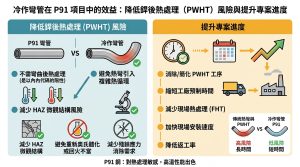
本研究基於最新版 ASME B31J 管線應力分析規範,深度探討並論證 3D/5D 冷作彎管全面取代傳統 1.5D 銲接彎頭在結構力學與冶金上的優勢4。透過消弭高風險的現場銲道,並結合精確的次臨界彎後熱處理(Subcritical IH-PBHT)與正常化加回火(N&T)重構技術,冷作彎管不僅徹底根絕了 HAZ 帶來的早期潛變失效風險,更在 B31J 精確的應力強度因子(SIF)解耦模型中,展現出極低的疲勞應力集中效應3。綜合效益分析表明,導入高階預製冷彎管工法能有效降維 P91 的現場施工風險,巨幅縮減無損檢測(NDT)與 PWHT 工時,改善流體動力學特性,進而實現專案進度最佳化與全生命週期可靠度的飛躍式提升。 Based on the latest ASME B31J piping stress analysis standard, this study deeply explores and demonstrates the structural mechanics and metallurgical advantages of completely replacing traditional 1.5D welded elbows with 3D/5D cold bending4. By eliminating high-risk field welds and integrating precise Subcritical Induction Heating Post-Bend Heat Treatment (IH-PBHT) or Normalizing & Tempering (N&T) microstructural reconstitution technologies, cold bending not only eradicates the early creep failure risks associated with the HAZ but also exhibits extremely low fatigue stress concentration in the decoupled Stress Intensification Factor (SIF) models of B31J3. Comprehensive benefit analysis indicates that introducing advanced prefabricated cold bending methods can effectively reduce P91 field construction risks, drastically cut Non-Destructive Testing (NDT) and PWHT man-hours, improve fluid dynamics, and ultimately achieve project schedule optimization and a leap in lifecycle reliability.
一、 緒論與高能管線面臨之產業挑戰 / 1. Introduction and Industrial Challenges of High-Energy Piping
為因應全球氣候變遷與淨零碳排目標,現代電力產業正經歷深刻的結構性轉型。發電廠為了追求更高的熱力學轉換效率,主蒸汽與高溫再熱蒸汽管線通常必須承受超過 600°C 的極端高溫與超高壓運行環境。另一方面,隨著風力與太陽能等間歇性再生能源大規模併網,傳統的基載電廠(特別是 CCPP 機組)必須轉型為負載跟隨模式,這意味著機組必須頻繁進行快速啟動、停機與急遽升降載。 To meet global climate change and net-zero carbon emission targets, the modern power industry is undergoing a profound structural transformation. To achieve higher thermodynamic conversion efficiency, main steam and hot reheat piping must typically withstand extreme operating environments exceeding 600°C and ultra-high pressures. On the other hand, with the large-scale grid integration of intermittent renewable energy sources such as wind and solar, traditional baseload power plants (especially CCPP units) must transition to load-following modes, meaning these units must frequently execute rapid startups, shutdowns, and drastic load ramping.
這種頻繁切換運轉模式的過程,對電廠核心管線系統施加了極其嚴苛的物理衝擊。在急遽升降溫的瞬間,管壁內外將產生巨大的溫度梯度,引發劇烈的熱分層現象與交變熱應力。在此極端環境下,傳統依賴 1.5D 短半徑銲接彎頭的施工範式暴露出嚴重的不適應性。銲接過程引入的劇烈熱循環會在母材與銲道之間形成微觀組織極度不均勻的熱影響區,針對 P91 等高階潛變強化合金,此區域往往成為高溫潛變與低循環熱疲勞的致命突破口2。 The process of frequently switching operational modes imposes severely harsh physical impacts on the plant’s core piping systems. During rapid temperature transients, enormous temperature gradients occur across the pipe wall, triggering severe thermal stratification and alternating thermal stresses. Under these extreme conditions, the traditional construction paradigm relying on 1.5D short-radius welded elbows reveals serious inadequacies. The intense thermal cycles introduced by welding form highly non-uniform microstructures in the heat-affected zone between the base metal and the weld bead. For advanced creep-enhanced alloys like P91, this zone frequently becomes the fatal breach point for high-temperature creep and low-cycle thermal fatigue2.
同時,管線應力分析的工程規範也經歷了一場深刻的典範轉移。長期以來,業界仰賴 ASME B31.1 與 B31.3 規範中的附錄 D (Appendix D) 進行應力計算,但其源自 1950 年代的 Markl 疲勞方程式在面對現代大口徑、薄壁化高能管件時,已顯露出極大的理論盲點與保守性。ASME B31J 標準的誕生與強制導入,透過有限元素分析與實體疲勞測試,為管線組件提供了高精度的應力強度因子解耦算法5。本研究即在此規範框架下,系統性解析 P91 鋼的冶金退化機制,數量化評估冷作彎管工法在力學結構與專案管理上的全方位優勢。 Concurrently, engineering codes for piping stress analysis have undergone a profound paradigm shift. For a long time, the industry relied on Appendix D in the ASME B31.1 and B31.3 codes for stress calculations. However, its 1950s-era Markl fatigue equations exhibit significant theoretical blind spots and excessive conservatism when applied to modern large-diameter, thin-walled high-energy piping. The creation and mandatory adoption of the ASME B31J standard, utilizing finite element analysis and physical fatigue testing, provided highly accurate decoupled algorithms for Stress Intensification Factors5. Within this standard framework, this study systematically analyzes the metallurgical degradation mechanisms of P91 steel and quantitatively evaluates the comprehensive advantages of the cold bending prefabrication method in structural mechanics and project management.
二、 P91 高階合金材料特性與熱影響區之冶金退化機制 / 2. Material Characteristics of P91 Advanced Alloy and Metallurgical Degradation Mechanisms in the HAZ
2.1 P91 合金之微觀強化哲學與相變基礎 / 2.1 Microstructural Strengthening Philosophy and Phase Transformation Basis of P91 Alloy
Grade 91 (ASTM A335 P91) 的優異高溫潛變強度,並非單純仰賴合金元素的固溶強化,而是源自於極度精密的微觀組織控制。該鋼種在出廠前,必須經歷嚴格的正常化(完全奧氏體化)與回火熱處理程序,造就了其特有的均勻高密度板條狀回火馬氏體基體1。真正阻擋高溫潛變變形的關鍵,在於沿著原奧氏體晶界與板條次晶界析出的細小 M23C6 碳化物,以及均勻彌散的奈米級碳氮化物。這些析出相形成了強大的釘紮效應,能有效阻礙位錯滑移,賦予 P91 卓越的性能2。 The excellent high-temperature creep strength of Grade 91 (ASTM A335 P91) does not merely rely on the solid solution strengthening of alloying elements, but rather stems from highly precise microstructural control. Before leaving the factory, this steel grade must undergo a rigorous Normalizing (full austenitization) and Tempering heat treatment process, which creates its unique matrix of uniform, high-density lath tempered martensite1. The true key to resisting high-temperature creep deformation lies in the fine M23C6 carbides precipitated along the prior austenite grain boundaries and lath sub-boundaries, as well as uniformly dispersed nanoscale carbonitrides. These precipitates form a powerful pinning effect that effectively impedes dislocation slip, granting P91 its superior performance2.
2.2 熱影響區(HAZ)之相變退化與應變局部化 / 2.2 Phase Transformation Degradation and Strain Localization in the HAZ
當 P91 鋼管進行現場銲接時,銲道周圍的母材被迫經歷非平衡的快速加熱與冷卻。其中最為致命的是峰值溫度恰好落於 Ac1 與 Ac3 相變點之間的臨界熱影響區(ICHAZ)與細晶區(FGHAZ)2。在此狹窄區間內,材料經歷不完全的奧氏體化,原本提供釘紮作用的碳化物部分溶解。隨後在極快的冷卻速率下,該區域轉變為晶粒異常細化、硬度顯著低於兩側母材的軟弱組織3。這道軟弱夾層在面對龐大的系統軸向應力時,會產生嚴重的應變局部化,直接引發潛變孔洞的快速成核3。 When P91 steel pipes undergo field welding, the base metal surrounding the weld bead is forced to endure non-equilibrium rapid heating and cooling. The most fatal regions are the Intercritical HAZ (ICHAZ) and Fine-Grained HAZ (FGHAZ), where the peak temperature falls exactly between the Ac1 and Ac3 transformation points2. Within this narrow band, the material undergoes incomplete austenitization, and the carbides that originally provided pinning effects partially dissolve. Subsequently, under an extremely fast cooling rate, this region transforms into a soft zone characterized by abnormally refined grains and significantly lower hardness compared to the adjacent base metal3. When facing massive systemic axial stresses, this soft layer produces severe strain localization, directly triggering the rapid nucleation of creep cavities3.
2.3 第四型破裂(Type IV Cracking)之潛伏與爆發特徵 / 2.3 Incubation and Eruption Characteristics of Type IV Cracking
HAZ 軟化區與應變局部化的最終產物,即是電廠工程界聞之色變的第四型破裂2。此類損傷在組件潛變壽命的前 70% 至 80% 階段,僅在微觀下表現為極度微小的孤立潛變孔洞,管線外觀不會出現明顯變形,傳統非破壞檢測(NDT)極難在早期察覺3。然而,一旦孔洞累積密度跨越臨界極限值,便會沿著軟化區晶界迅速連結演化為巨觀裂紋,導致管線發生災難性的貫穿洩漏或爆裂3。治本之道唯有在設計與製造階段直接消弭 HAZ。 The ultimate product of HAZ soft zones and strain localization is Type IV Cracking, a highly feared phenomenon in the power plant engineering community2. During the first 70% to 80% of a component’s creep life, this damage manifests only as microscopically tiny, isolated creep cavities. The piping exterior shows no obvious deformation, making it extremely difficult for traditional Non-Destructive Testing (NDT) to detect early on3. However, once the accumulated cavity density crosses a critical threshold, they rapidly link along the grain boundaries of the soft zone, evolving into macroscopic cracks and leading to catastrophic through-wall leaks or ruptures3. The only fundamental cure is to eliminate the HAZ entirely during the design and fabrication stages.
三、 現場銲後熱處理(PWHT)之工程風險與品質驗證盲區 / 3. Engineering Risks and Quality Verification Blind Spots of Field PWHT
為了部分恢復 HAZ 韌性並消解殘餘應力,ASME 規範強制要求 P91 管件在銲接後必須執行 PWHT。然而,現場 PWHT 的操作窗口極端狹窄,充滿了可能導致管線報廢的冶金陷阱。 To partially restore HAZ toughness and relieve residual stresses, ASME codes mandate that P91 piping components must undergo PWHT after welding. However, the operational window for field PWHT is extremely narrow, fraught with metallurgical traps that could lead to the scrapping of pipelines.
3.1 鎳與錳(Ni+Mn)對 Ac1 臨界溫度之抑制與過溫風險 / 3.1 Suppression of the Ac1 Critical Temperature by Ni+Mn and Overheating Risks
PWHT 溫度的選擇直接決定了碳化物的析出與馬氏體的回火程度。若溫度超越了銲材的 AC1 下臨界相變溫度,將引發災難性的局部重奧氏體化。為了提升銲道低溫韌性,部分銲材會添加微量的鎳(Ni)與錳(Mn)。鎳作為強大的奧氏體穩定劑,會急遽拉低材料的 Ac1 溫度,若管控不當,極易在正常的熱處理區間內導致銲道報廢。 The choice of PWHT temperature directly determines carbide precipitation and the tempering degree of martensite. If the temperature exceeds the filler metal’s Ac1 lower critical transformation point, it triggers catastrophic localized re-austenitization. To enhance weld low-temperature toughness, some filler metals add trace amounts of nickel (Ni) and manganese (Mn). As a powerful austenite stabilizer, nickel drastically lowers the material’s Ac1 temperature. If improperly managed, this easily ruins the weld bead even within normal heat treatment ranges.
| 銲道金屬(Ni+Mn)含量限制/ Weld Metal (Ni+Mn) Limit | 對AC1下臨界相變溫度之影響/ Impact on Lower Critical Temp (AC1) | 規範容許之最高PWHT溫度界限/ Code Allowable Max PWHT Temp | 潛在相變風險與工程挑戰描述/ Potential Phase Risk & Engineering Challenge |
| (Ni+Mn) ≦ 1.0%/ | AC1相對穩定,通常大於800°C/ Ac1 is relatively stable, usually >800°C | 790°C (Max)/ 790°C (Max) | 保有30°C~50°C的安全裕度,能有效防止熱處理期間發生重奧氏體化。/ Retains a 30°C~50°C safety margin, effectively preventing re-austenitization. |
| 1.0% < (Ni+Mn) ≦ 1.2% | AC1發生顯著降低效應/ Ac1 exhibits significant suppression | 780°C (Max)/ 780°C (Max) | 安全裕度遭嚴重縮減,現場需配備高精度溫控設備以絕對避免局部超溫。/ Safety margin is severely compressed; high-precision temp control is required. |
| (Ni+Mn) > 1.2% | AC1溫度急遽逼近常規PWHT溫度/ Ac1 rapidly approaches standard PWHT temp | 不建議使用/ Not Recommended | 極易在正常760°C熱處理區間內引發部分奧氏體化,導致材料報廢。/ Highly likely to induce partial austenitization within the 760°C range. |
3.2 現場熱質量效應與硬度驗收之侷限性 / 3.2 Field Thermal Mass Effects and Limitations of Hardness Acceptance Testing
在現場執行 PWHT 時,高能厚壁管線極大的熱質量使得包裹於管外的電阻加熱毯難以確保內外溫度均勻。若升降溫速率控制不當,甚至會在相鄰母材引入額外的熱應力。更甚者,因 (Ni+Mn) 超標而經歷局部重奧氏體化的銲道,可能在當天仍順利通過常規硬度測試與 NDT 檢驗。這種深層損傷在服役數年後才會以突發性破裂展現,造成極大安全威脅。 When executing field PWHT, the massive thermal mass of high-energy thick-walled piping makes it difficult for external resistance heating blankets to ensure uniform internal and external temperatures. Improper heating/cooling rates can even introduce additional thermal stress into adjacent base metals. Worse still, a weld bead that underwent localized re-austenitization due to excessive (Ni+Mn) might still pass standard hardness tests and NDT inspections on the day of treatment. This deep damage will only manifest as a sudden rupture after years of service, posing an immense safety threat.
四、 管線應力分析框架之典範轉移:從 Appendix D 到 ASME B31J / 4. Paradigm Shift in Piping Stress Analysis: From Appendix D to ASME B31J
面對 P91 鋼在現場銲接的不可控風險,透過預製工法改變幾何設計以消弭現場銲口成為治本之道。ASME 規範體系的變革,為冷作彎管取代傳統銲接彎頭提供了堅實的理論基礎4。 Faced with the uncontrollable risks of P91 steel during field welding, altering geometric design via prefabrication to eliminate field welds has become the fundamental solution. Changes in the ASME code framework provide a robust theoretical foundation for replacing traditional welded elbows with cold bends4.
4.1 傳統 Markl 理論與附錄 D 之結構性侷限 / 4.1 Structural Limitations of Traditional Markl Theory and Appendix D
過去,工程師高度依賴 ASME B31.1 與 B31.3 附錄 D 進行應力計算6。然而,源自 1950 年代的疲勞方程式並未嚴格區分面內彎矩與面外彎矩的作用差異,強行賦予彎頭單一的應力強度因子(SIF)。實際上,面內與面外彎矩會導致彎管截面發生不同形式的橢圓化變形,產生的應力集中位置與幅度截然不同。此外,舊版規範忽略了扭轉力矩的貢獻,這在現代大口徑、薄壁化高能管線分析中是極度危險的簡化6。 In the past, engineers heavily relied on Appendix D in ASME B31.1 and B31.3 for stress calculations6. However, the 1950s-era fatigue equations did not strictly differentiate the effects of in-plane and out-of-plane bending moments, forcibly assigning a single Stress Intensification Factor (SIF) to elbows. In reality, in-plane and out-of-plane moments cause different forms of cross-sectional ovalization, producing completely different stress concentration locations and magnitudes. Furthermore, legacy codes ignored the contribution of torsional moments—a highly dangerous oversimplification in modern large-diameter, thin-walled high-energy piping analysis6.
4.2 ASME B31J 核心算法解析與柔性特徵值 / 4.2 B31J Core Algorithms and the Flexibility Characteristic
ASME B31J 標準為管線組件提供了高精度的精確解4。B31J 的核心在於引入無因次參數「柔性特徵值」(h),用以量化幾何尺寸與管件抵抗橢圓化變形能力的關係(B31J 標準適用於徑厚比 D/T≤100的管件)6。 The ASME B31J standard provides high-precision exact solutions for piping components4. The core of B31J lies in introducing the dimensionless parameter “Flexibility Characteristic” (h) to quantify the relationship between geometric dimensions and the component’s ability to resist ovalization (the B31J standard is applicable to piping components with a diameter-to-thickness ratio D/T≤100)6.
對於平滑冷作彎管,柔性特徵值定義為: For smooth cold bends, the flexibility characteristic is defined as:
h=T⋅R1/r22
其中,T 為管件標稱壁厚,R1 為彎曲半徑,r2 為平均截面半徑(r2=(OD-T)/2)。彎曲半徑越小(如 1.5D 彎頭),h 值越低,代表管件受力時極易發生橢圓化。 Where T is the nominal wall thickness, R1 is the bend radius, and r2 is the mean cross-sectional radius (r2=(OD-T)/2). A smaller bend radius (like a 1.5D elbow) yields a lower h value, indicating the component is highly susceptible to ovalization under stress.
彎管的柔性因子 k 與柔性特徵 h 呈現反比關係: The flexibility factor k and flexibility characteristic h present an inversely proportional relationship:
k=1.65/h
採用 3D 或 5D 冷作彎管時,h 值顯著提升,使管件更為「僵硬」,大幅抑制了危險的截面變形。B31J 將 SIF 進行了嚴密解耦,面內與面外應力強度因子精確定義為5: When utilizing 3D or 5D cold bends, the h value increases significantly, making the component “stiffer” and drastically suppressing dangerous cross-sectional deformation. B31J strictly decoupled the SIFs, precisely defining the in-plane and out-of-plane factors as5:
ii = 0.9/h2/3
io = 0.75/h2/3
此外,B31J 允許導入壓力強化效應,將查表所得之 k 值除以修正係數 1+6(P/E) (R/T)7/3 (R1/R)1/3,以獲得更貼近真實服役的評估結果,避免設計浪費。 Additionally, B31J allows the introduction of the Pressure Stiffening Effect by dividing the tabulated k values by a correction factor 1+6(P/E) (R/T)7/3 (R1/R)1/3 to obtain evaluations closer to actual service conditions, thereby preventing design waste.
五、 冷作彎曲成型技術之應變極限與 PBHT 重構最佳化 / 5. Strain Limits of Cold Bending Technologies and PBHT Optimization
儘管 3D/5D 冷作彎管在消弭現場銲口上具備優勢,但冷作彎曲本質上屬於極為劇烈的巨觀塑性變形。對於 P91 鋼而言,高達 10% 乃至 16.7% 的冷成型應變會轉化為嚴重的晶格畸變。若未經適當的彎後熱處理(PBHT)修復,將不可逆地破壞材料的潛變延展性9。 Although 3D/5D cold bends offer advantages in eliminating field welds, cold bending is inherently an extremely intense macroscopic plastic deformation. For P91 steel, forming strains reaching 10% to 16.7% translate into severe lattice distortion. If not repaired by appropriate Post-Bend Heat Treatment (PBHT), it will irreversibly destroy the material’s creep ductility9.
5.1 大曲率 5D 彎管與次臨界消除應力處理 / 5.1 Large-Radius 5D Bends and Subcritical Stress Relief
採用 5D 大半徑冷彎管時,應變通常控制在 10% 左右。此時可施行低於 Ac1 臨界溫度的次臨界 PBHT(最佳化目標約 760°C)。此程序能驅動位錯滑移,消解殘餘應力並穩定碳化物。現代預製廠廣泛導入感應加熱(IH-PBHT)技術,確保管壁 360 度絕對均溫,並將製程參數數位化,防範相變不足的風險9。 When employing 5D large-radius cold bends, strain is typically controlled around 10%. Here, subcritical PBHT below the Ac1 critical temperature (optimal target ~760°C) can be applied. This procedure drives dislocation slip, relieves residual stresses, and stabilizes carbides. Modern prefabrication facilities widely adopt Induction Heating (IH-PBHT) to ensure absolute 360-degree temperature uniformity and digitize process parameters to prevent under-transformation risks9.
5.2 高應變 3D 彎管與完全正常化加回火 / 5.2 High-Strain 3D Bends and Full Normalizing and Tempering
當採用 3D 彎曲半徑時,冷作應變可達 16.7%,P91 鋼的原始微觀特徵遭到徹底破壞。此時規範強制要求執行完全的正常化加回火(N&T)處理。首先加熱至 1040°C 至 1080°C 區間實現微觀組織的完全重構,隨後於 730°C 至 780°C 區間進行嚴密回火,徹底恢復材料卓越的潛變延展性,確保其免疫於第四型破裂3。 When utilizing 3D bend radii, cold strain can reach 16.7%, completely destroying P91 steel’s original microstructural features. Codes mandate full Normalizing and Tempering (N&T) in this scenario. The component is first heated to 1040°C–1080°C for complete microstructural reconstitution, then rigorously tempered between 730°C and 780°C to fully restore excellent creep ductility and ensure immunity to Type IV cracking3.
六、 冷作彎管預製工法之專案排程最佳化與全生命週期效益 / 6. Project Schedule Optimization and Lifecycle Benefits of the Cold Bend Prefabrication Method
6.1 根絕現場對接銲口,巨幅縮減 PWHT 與 NDT 工時 / 6.1 Eliminating Field Butt Welds to Drastically Reduce PWHT and NDT Man-Hours
傳統 1.5D 銲接彎頭需要進行大量全滲透對接銲,繁複的預熱、PWHT 與 NDT 檢驗占據了龐大的銲工人力,並直接卡死專案排程。導入 3D/5D 冷彎管技術能將多個連續轉向整合於單一無縫直管,免除海量的現場高空作業與 NDT 需求,極大化壓縮安裝工期10。 Traditional 1.5D welded elbows require numerous full penetration butt welds. Complex preheating, PWHT, and NDT occupy massive welding labor and directly bottleneck the project schedule. Introducing 3D/5D cold bend technology integrates multiple directional changes into a single seamless straight pipe, eliminating vast amounts of field high-altitude work and NDT requirements, thereby maximizing schedule compression10.
6.2 改善流體動力學與減緩沖刷腐蝕 / 6.2 Improving Fluid Dynamics and Mitigating Erosion-Corrosion
平滑過渡的冷彎管能引導高溫蒸汽平順轉向,相較於急彎設計可降低顯著的流體壓降,提升發電效率。同時,消除了銲道內部餘高所產生的局部渦流,減緩了流體誘發振動與內壁沖刷腐蝕。結合殘餘應力的徹底釋放,更從根本切斷了應力腐蝕破裂的生成要件。 Smoothly transitioning cold bends guide high-temperature steam gracefully, significantly lowering fluid pressure drops compared to sharp-bend designs and boosting power generation efficiency. Concurrently, they eliminate localized vortices caused by weld root reinforcement, slowing flow-induced vibration and internal erosion. Combined with complete residual stress relief, they fundamentally sever the preconditions for stress corrosion cracking.
七、 實務應用與專案工程決策分析 / 7. Practical Applications and Project Engineering Decision Analysis
7.1 業主對於 P91 管線之維護管理及營運決策 / 7.1 Owner’s Maintenance Management and Operational Decisions for P91 Piping
P91 鋼的第四型破裂多為「壽命晚期」的失效機制,事前幾乎無明顯徵兆,使依賴定檢的業主面臨極高營運風險3。冷作彎管將轉向處的高風險銲縫徹底消弭,熱疲勞壽命重置回無縫母材標準,這直接削減了大量的預防性檢驗工作,降低了非預期停機機率,為長期穩定供電提供保障。 Type IV cracking in P91 steel is predominantly a “late-life” failure mechanism with almost no prior warning signs, exposing owners relying on periodic inspections to high operational risks3. Cold bends completely eradicate high-risk welds at turns, resetting thermal fatigue life to seamless base metal standards. This directly slashes vast amounts of preventive inspection work, lowering the probability of unplanned outages and guaranteeing long-term stable power supply.
7.2 EPC 承包商設計單位之空間排列與實務考量 / 7.2 EPC Designers’ Spatial Layout and Practical Considerations
儘管大曲率半徑冷彎管在空間佈置上需要較大的掃掠空間,但採用 ASME B31J 規範進行評估時,EPC 設計單位將發現冷彎管極低的疲勞應力集中因子優勢。更重要的是,它能有效消弭現場為配合非標準洩水坡度所強行對位產生的角錯位應力(Km),使工程師能更游刃有餘地通過嚴苛的應力驗證5。 Although large-radius cold bends require larger sweep spaces for layout, EPC designers evaluating them under ASME B31J will discover the massive advantage of their extremely low fatigue stress concentration factors. More importantly, they effectively eliminate angular misalignment stresses (Km) caused by forced field alignments for non-standard drainage slopes, allowing engineers to pass stringent stress verifications with greater ease5.
7.3 導入潁璋工程「三合一工法」之預製與品質管控效益 / 7.3 Prefabrication and QA/QC Benefits of Implementing Ying-Zhang Engineering’s “3-in-1 Method”
針對 P91 等高階合金管線加工的嚴苛要求,國內實務上如潁璋工程提出了「三合一工法」的整合性解決方案10。該工法深度結合了三個核心程序:(1) 高精度 CNC 數控冷作彎管機,確保幾何成型精準度;(2) 局部感應加熱管線彎後熱處理(IH-PBHT),防範相變不足或過度回火;(3) 數位化模組管理與去磁技術。此工法不僅減少彎頭物料採購與倉儲費用,降低對配管工及銲接技術工的依賴,更大幅減少 RT 檢測及剷修後再次檢測的費用,完美保留材料原有的高溫強度與潛變抗力9。 To meet the stringent processing requirements of P91 advanced alloy piping, domestic practices such as Ying-Zhang Engineering have proposed an integrated solution known as the “3-in-1 Method”10. This method deeply integrates three core procedures: (1) High-precision CNC cold bending machines to ensure geometric accuracy; (2) Localized Induction Heating Post-Bend Heat Treatment (IH-PBHT) to prevent under-transformation or over-tempering; (3) Digital module management and demagnetization technologies. This method not only reduces procurement and warehousing costs for elbow materials but also lessens reliance on pipefitters and welders, drastically cutting costs associated with Radiographic Testing (RT) and re-testing after repairs, while perfectly retaining the material’s original high-temperature and creep strength9.
7.4 傳統 P91 對銲彎頭配管工程之潛在不安定因素與人為風險 / 7.4 Potential Unstable Factors and Human Risks in Traditional P91 Butt-Welded Elbow Piping Engineering
在實務工程中,傳統 P91 銲接彎頭的高度現場依賴性,暴露出諸多因「人為變數」而生的隱性殺手:
(1) 現場施工人員專業素養參差不齊,缺乏對嚴苛溫控的實務沉澱;
(2) 分包商資質浮濫,難以落實標準化管理;
(3) 材料特性認知匱乏與圖說識讀障礙,極易誤用銲材;
(4) 管工對於等角圖與平面圖轉譯能力不足,導致強迫對位,在管線上施加龐大的角錯位應力(Km);
(5) 當素質不佳的團隊遭遇極難控制的現場 PWHT 時,材料內部往往已埋藏深層品質隱患。導入冷彎預製工法能將這些高度依賴「人為可靠度」的變數徹底抽離10。
In practical engineering, the high field-dependency of traditional P91 welded elbows exposes numerous hidden killers born from “human variables”:
(1) Uneven professionalism of field personnel lacking experience in strict temperature control;
(2) Proliferation of unqualified subcontractors failing to implement standardized management;
(3) Lack of material knowledge and blueprint reading deficiencies, easily leading to filler misuse;
(4) Inadequate spatial plan and isometric drawing translation skills leading to forced alignments that inflict massive angular misalignment stresses (Km);
(5) When low-quality teams tackle extremely difficult field PWHT, the material internals often harbor deep hidden flaws. Introducing cold bending prefabrication completely abstracts away these variables that heavily depend on “human reliability”10.
7.5 現場安裝難易度與專案排程之實務考量 / 7.5 Practical Considerations of On-Site Installation Difficulty and Project Scheduling
傳統 P91 現場對接銲口施工需要架設複雜的防護鷹架、執行高溫預熱,以及耗時極長的現場 PWHT。一旦發生瑕疵,切除重銲代價高昂。相對而言,3D/5D 冷彎管在工廠內已預製為單一空間管段,施工團隊不再受制於高階銲工素質參差不齊的痛點與熱處理排程,不僅降低了安裝難度,更直接將處於專案要徑上的管線施工期大幅壓縮10。 Traditional P91 field butt welding requires complex protective scaffolding, high-temperature preheating, and extremely time-consuming field PWHT. Should flaws occur, cut-and-reweld costs are exorbitant. In contrast, 3D/5D cold bends are factory-prefabricated into single spatial spools. Construction teams are no longer bottlenecked by uneven high-tier welder quality and heat treatment schedules, which not only lowers installation difficulty but directly and massively compresses the piping construction period on the critical path10.
八、 結論 / 8. Conclusion
隨著發電產業持續向極端高溫、高壓與頻繁快速啟停的運轉模式邁進,P91 等鋼材的結構完整性已成為電廠安全營運的基石。針對高能管線採用冷作彎管取代傳統銲接彎頭,本研究得出以下關鍵結論: As the power generation industry continues advancing towards operating modes characterized by extreme temperatures, pressures, and frequent rapid startups/shutdowns, the structural integrity of steels like P91 has become the cornerstone of safe plant operations. Regarding the substitution of traditional welded elbows with cold bends for high-energy piping, this study draws the following key conclusions:
- 徹底解構第四型破裂風險: 傳統銲接彎頭不可避免地引入 HAZ 軟化區,誘發災難性的第四型破裂2。一體成型冷彎管根絕了轉向處銲道,將熱疲勞壽命重置回無縫母材標準。 Complete Deconstruction of Type IV Cracking Risks: Traditional welded elbows inevitably introduce HAZ soft zones, inducing catastrophic Type IV cracking2. Integrally formed cold bends eliminate welds at turns, resetting thermal fatigue life to seamless base metal standards.
- 克服現場 PWHT 冶金盲區: 冷作彎管將應力消除程序轉移至受控的工廠端,藉由高精度的感應加熱(IH-PBHT)或完全正常化加回火(N&T),確保微觀晶格完美重構與數位可追溯性。Overcoming Field PWHT Metallurgical Blind Spots: Cold bending shifts stress relief to the controlled factory setting. Utilizing high-precision induction heating (IH-PBHT) or full N&T, it ensures perfect micro-lattice reconstitution and digital traceability.
- ASME B31J 力學優勢之量化實證: B31J 透過引入柔性特徵值(h)精確解耦應力強度因子,證實大半徑冷彎管具備極佳的抗橢圓化剛度,並消除了現場強制錯位所衍生的惡性應力乘數效應5。 Quantitative Validation of ASME B31J Mechanical Advantages: By introducing the flexibility characteristic (h) to precisely decouple SIFs, B31J confirms that large-radius cold bends possess excellent anti-ovalization stiffness and eliminate vicious stress multipliers derived from forced field misalignments5.
- 實務應用與專案排程之雙贏: 全面導入如潁璋工程「三合一工法」的高階預製技術,能將不可控的「人為變數」轉化為標準化工廠品質控制,巨幅削減現場檢驗與銲接工時,為電廠帶來全生命週期成本下降的戰略紅利10。 Win-Win for Practical Application and Project Scheduling: Comprehensively introducing advanced prefabrication technologies like Ying-Zhang Engineering’s “3-in-1 Method” transforms uncontrollable “human variables” into standardized factory quality control, drastically slashing field inspection and welding man-hours, and bringing strategic lifecycle cost reduction dividends to power plants10.
參考文獻
- EPRI Best Practice Guidelines For P91 1023199 | PDF – Scribd, https://www.scribd.com/doc/246144971/EPRI-Best-Practice-Guidelines-for-P91-1023199
- Type IV Cracking of Weldments in Enhanced Ferritic Steels – TWI Ltd, https://www.twi-global.com/technical-knowledge/published-papers/review-of-type-iv-cracking-of-weldments-in-9-12cr-creep-strength-enhanced-ferritic-steels/
- Review of Type IV Cracking in Piping Welds – EPRI, https://restservice.epri.com/publicdownload/TR-108971/0/Product
- ASME B31J-2023 – Stress Intensification Factors (i … – ANSI Webstore, https://webstore.ansi.org/standards/asme/asmeb31j2023
- Using ASME B31J Stress Intensification Factors (SIFs) to Improve A, https://www.researchgate.net/publication/385845310_Using_ASME_B31J_Stress_Intensification_Factors_SIFs_to_Improve_A_BS_7608_Fatigue_Analysis
- ASME B31J: I & K Factors in Pipe Analysis, https://www.cortexsoftware.com.au/blog/understanding-asme-b31j-methods-i-factors-and-k-factors-in-piping-stress-analysis
- 結合最新ASME B31J 規範之高壓蒸汽管線非標準洩水坡度設計下的銲, https://yz-pipe-bending.com.tw/%E7%B5%90%E5%90%88%E6%9C%80%E6%96%B0-asme-b31j-%E8%A6%8F%E7%AF%84%E4%B9%8B%E9%AB%98%E5%A3%93%E8%92%B8%E6%B1%BD%E7%AE%A1%E7%B7%9A%E9%9D%9E%E6%A8%99%E6%BA%96%E6%B4%A9%E6%B0%B4%E5%9D%A1%E5%BA%A6%E8%A8%AD/
- Recommendation for Creep and Creep-fatigue assessment for P91, https://publications.jrc.ec.europa.eu/repository/bitstream/JRC94508/jrc94508_matter_4-6_creep-fatigue.pdf
- 針對P91 &P92合金鋼材,熱彎曲與冷彎曲加工有何差異不同?, https://yz-pipe-bending.com.tw/%E9%87%9D%E5%B0%8Da335-p91-p92%E5%90%88%E9%87%91%E9%8B%BC%E6%9D%90%E5%85%B6%E7%86%B1%E5%BD%8E%E6%9B%B2%E8%88%87%E5%86%B7%E5%BD%8E%E6%9B%B2%E6%9C%89%E4%BD%95%E5%B7%AE%E7%95%B0%E4%B8%8D%E5%90%8C/
- 冷作彎管之配管工程化 – 潁璋工程興業有限公司, https://yz-pipe-bending.com.tw/test/
- 複循環電廠高能管線「彎管工法」整合研究:聲學共振抑制, https://yz-pipe-bending.com.tw/%E8%A4%87%E5%BE%AA%E7%92%B0%E9%9B%BB%E5%BB%A0%E9%AB%98%E8%83%BD%E7%AE%A1%E7%B7%9A%E3%80%8C%E5%BD%8E%E7%AE%A1%E5%B7%A5%E6%B3%95%E3%80%8D%E6%95%B4%E5%90%88%E7%A0%94%E7%A9%B6%EF%BC%9A%E8%81%B2%E5%AD%B8/