
摘要 / Abstract
現代高能管線系統(High-Energy Piping, HEP)廣泛應用於複循環火力發電廠(CCPP)、超臨界蒸汽系統以及石化重工業中。此類系統長期暴露於極端高溫、高壓、交變熱應力與流體誘發振動的嚴苛服役環境下,確保管線結構的長期完整性為工程設計之首要考量。傳統配管工程普遍依賴符合 ASME B16.9 標準的 1.5D 對銲彎頭(Butt-Welded Elbows)進行管線轉向;然而,此工法在應用潛變強度強化鐵素體鋼(如 P91、P92)時,暴露出極大的冶金缺陷與專案管理瓶頸。大量的銲接熱影響區(HAZ)極易引發第四型潛變破裂(Type IV Cracking),且單一銲口需耗費極長週期進行預熱、銲接、氫釋放處理、銲後熱處理(PWHT)及非破壞性檢驗(NDE),嚴重拖延專案進度並推升建造成本。Modern High-Energy Piping (HEP) systems are widely used in Combined Cycle Power Plants (CCPP), supercritical steam systems, and heavy petrochemical industries. Since these systems are exposed to extreme high temperatures, high pressures, alternating thermal stresses, and fluid-induced vibrations over long periods, ensuring the long-term structural integrity of the piping is the primary concern in engineering design. Traditional piping engineering generally relies on 1.5D Butt-Welded Elbows complying with the ASME B16.9 standard for piping redirection; however, when applied to Creep Strength Enhanced Ferritic Steels (such as P91 and P92), this method exposes significant metallurgical defects and project management bottlenecks. The massive Heat-Affected Zones (HAZ) from welding are highly prone to initiating Type IV Cracking. Furthermore, a single welded joint requires an extremely long cycle of preheating, welding, hydrogen release treatment, Post-Weld Heat Treatment (PWHT), and Non-Destructive Examination (NDE), severely delaying project schedules and driving up construction costs.
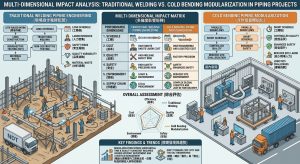
本研究報告重新思定高能管線的工程風險本質,基於冶金學、固體力學(ASME B31J)、流體動力學與工程專案管理的跨領域視角,深度剖析傳統電銲配管工程與 3D/5D 冷作彎管(Cold Bending)模組化技術的核心差異。研究不僅涵蓋對專案時程、生命週期成本、品質控制及工業安全的影響,更進一步延伸至業主營運決策與 EPC 承包商的空間佈局策略,剖析了傳統現場配管工程的人為不安定因素,並探討了結合 3D/5D 冷彎與先進熱處理的「三合一工法」。分析結果證實,從現場施銲轉向工廠模組化,不僅從根本上解除了 HAZ 潛變退化的威脅並維持系統柔性,更是將不可控的人為變數轉化為可控數據的工程典範轉移。This research report redefines the essence of engineering risks in HEP systems. Based on an interdisciplinary perspective encompassing metallurgy, solid mechanics (ASME B31J), fluid dynamics, and project management, it deeply analyzes the core differences between traditional butt-welded piping engineering and 3D/5D cold bending modularization technologies. The study covers impacts on project schedule, lifecycle cost, quality control, and industrial safety. It further extends to owner operational decision-making, EPC contractor spatial layout strategies, dissects the human instability factors of traditional on-site piping engineering, and explores the “Three-in-One Method” that integrates 3D/5D cold bending with advanced heat treatment. The analysis confirms that shifting from on-site welding to factory modularization not only fundamentally eliminates the threat of HAZ creep degradation while maintaining system flexibility but also represents an engineering paradigm shift—transforming uncontrollable human variables into controllable data.
一、前言 / I. Introduction
隨著全球產業對能源轉換效率與減碳目標的要求日益嚴格,發電廠與石化製程設備的運行參數不斷向極端化發展。現代超臨界火力發電及複循環發電廠(CCPP)的主蒸汽與再熱蒸汽管線,通常需承受高達 590°C 以上的高溫與超過 250 bar(或 > 1000 psi)的超高內部壓力1。為了在如此極端的熱力學條件下維持管線的結構強度並減輕系統總重,工程界已廣泛採用潛變強度強化鐵素體鋼(Creep Strength Enhanced Ferritic Steels, CSEF),例如 ASTM A335 P91(X10CrMoVNb9-1)與 P92 等不銹鋼與合金鋼材3。相較於傳統的低合金鋼(如 P22),P91 與 P92 憑藉其獨特的微觀組織,能夠將管線壁厚大幅縮減高達 60%3。As global industries enforce stricter requirements on energy conversion efficiency and carbon reduction targets, the operational parameters of power plants and petrochemical process equipment continue to push towards extremes. Main steam and reheat steam pipelines in modern supercritical thermal power plants and CCPPs often withstand high temperatures exceeding 590°C and ultra-high internal pressures over 250 bar (or > 1000 psi)1. To maintain pipeline structural strength and reduce total system weight under such extreme thermodynamic conditions, the engineering community has widely adopted Creep Strength Enhanced Ferritic Steels (CSEF), such as ASTM A335 P91 (X10CrMoVNb9-1) and P92 stainless steels and alloy steels3. Compared to traditional low-alloy steels (like P22), P91 and P92, by virtue of their unique microstructures, can significantly reduce piping wall thickness by up to 60%3.
然而,高強度合金的應用也帶來了製造與施工上的嚴峻挑戰。在傳統的配管工程佈局中,管線的轉向與幾何過渡多半採用 1.5D 預製對銲彎頭3。由於每一個對銲彎頭均需透過兩道環向銲縫(Girth Welds)與直管相連,這使得管線系統在應力最集中的轉折區域,人為地引入了大量的銲接熱影響區(HAZ)。對於 P9x 系列材料而言,經歷銲接熱循環的 HAZ 是材料潛變強度與低週疲勞抗性最脆弱的節點。此外,複雜且耗時的銲後熱處理(PWHT)亦使得現場施工的難度與風險急遽攀升。However, the application of high-strength alloys also brings severe challenges in manufacturing and construction. In traditional piping layouts, changes in direction and geometric transitions mostly utilize 1.5D prefabricated butt-welded elbows3. Because every butt-welded elbow must be connected to straight pipes via two girth welds, a large amount of welding heat-affected zones (HAZ) is artificially introduced into the system’s most stress-concentrated transition areas. For P9x series materials, the HAZ that has undergone welding thermal cycles is the most vulnerable node regarding material creep strength and low-cycle fatigue resistance. Additionally, the complex and time-consuming Post-Weld Heat Treatment (PWHT) causes the difficulty and risks of on-site construction to escalate sharply.
為克服此一工程瓶頸,採用數控(CNC)冷作彎管技術將直管直接成形為 3D 或 5D 大半徑彎管的「模組化無銲接轉向策略」,逐漸受到國際 EPC(工程、採購與建造)統包商的重視。本文將從底層的冶金與力學理論出發,進而剖析其對專案績效的實質影響,最後探討實務上的決策與前瞻工法整合,全面梳理這兩種管線轉向策略在工程全生命週期中的多維度差異。To overcome this engineering bottleneck, the “modular weld-free redirection strategy,” which uses Computer Numerical Control (CNC) cold bending technology to directly form straight pipes into 3D or 5D large-radius bends, is increasingly valued by international EPC (Engineering, Procurement, and Construction) contractors. This paper will start from underlying metallurgical and mechanical theories, analyze their substantial impact on project performance, and finally explore practical decision-making and forward-looking method integration, comprehensively outlining the multi-dimensional differences between these two piping redirection strategies throughout the engineering lifecycle.
二、文獻探討 / II. Literature Review
在具體評估專案績效之前,必須先從材料科學的微觀視角切入,並逐步延伸至固體力學、流體動力學與國際法規,為後續的績效對比與實務分析奠定堅實的理論基礎。Before specifically evaluating project performance, it is necessary to start from the microscopic perspective of materials science and gradually extend to solid mechanics, fluid dynamics, and international codes, establishing a solid theoretical foundation for subsequent performance comparisons and practical analyses.
2.1 冶金微觀組織演變與第四型潛變破裂機制 / 2.1 Metallurgical Microstructure Evolution and Type IV Creep Cracking Mechanism
P91 與 P92 等 9-12% 鉻鐵素體鋼的卓越高溫抗潛變能力,主要建立在其回火馬氏體(Tempered Martensite)基體中散佈的 M23C6 碳化物及極細小的釩/鈮碳氮化物(MX)析出物上6。現代合金如 P92 更進一步添加了 1-2 wt% 的鎢(Tungsten)元素,透過固溶強化與延緩 M23C6 碳化物的粗化,進一步提升了長期的潛變壽命6。The outstanding high-temperature creep resistance of 9-12% chromium ferritic steels like P91 and P92 is primarily based on M23C6 carbides and ultra-fine vanadium/niobium carbonitride (MX) precipitates dispersed within their tempered martensite matrix6. Modern alloys like P92 further add 1-2 wt% tungsten, enhancing long-term creep life through solid solution strengthening and retarding the coarsening of M23C6 carbides6.
當採用傳統電銲工法時,銲接電弧引入的高熱輸入會不可避免地改變母材的微觀組織,形成微觀結構梯度極大的熱影響區(HAZ)。HAZ 可細分為粗晶區(CGHAZ)、細晶區(FGHAZ)、跨臨界區(ICHAZ)與過度回火區(OTHAZ)6。學界廣泛指出,CSEF 鋼的銲接接頭極易發生所謂的第四型潛變破裂(Type IV Cracking)6。When adopting traditional arc welding methods, the high heat input introduced by the welding arc inevitably alters the base metal’s microstructure, forming a Heat-Affected Zone (HAZ) with an extreme microstructural gradient. The HAZ can be subdivided into the coarse-grained zone (CGHAZ), fine-grained zone (FGHAZ), intercritical zone (ICHAZ), and over-tempered zone (OTHAZ)6. The academic community widely points out that welded joints of CSEF steels are highly susceptible to what is known as Type IV Cracking6.
第四型破裂通常萌生於 ICHAZ 或 FGHAZ8。在銲接過程中,ICHAZ 經歷了介於下臨界溫度( AC1)與上臨界溫度(AC3)之間的峰值溫度。在這種不完全的奧氏體化過程中,碳化物僅部分溶解,導致冷卻後形成的馬氏體缺乏足夠的碳化物沉澱強化,產生嚴重的局部熱軟化9。儀器化壓痕測試顯示,ICHAZ 表現出跨越整個銲接接頭中最低的硬度與最大的潛變位移率10。基體晶粒因鉻濃度分佈不均而產生的局部變形差異,配合管線內壓帶來的高應力三軸性(Stress Triaxiality),極大化地促進了潛變空洞(Creep Cavities)沿晶界成核。Type IV cracking typically initiates in the ICHAZ or FGHAZ8. During the welding process, the ICHAZ experiences peak temperatures between the lower critical temperature (AC1) and upper critical temperature (AC3). During this incomplete austenitization process, carbides only partially dissolve, causing the martensite formed upon cooling to lack sufficient carbide precipitation strengthening, resulting in severe localized thermal softening9. Instrumented indentation tests reveal that the ICHAZ exhibits the lowest hardness and the largest creep displacement rate across the entire welded joint10. Localized deformation variations of matrix grains caused by uneven chromium concentration distribution, combined with high stress triaxiality brought on by internal piping pressure, greatly accelerate the nucleation of creep cavities along grain boundaries.
Type IV 破裂的致命性在於其潛伏期極長且破裂迅速。在長達 150,000 小時以上的服役過程中,直至壽命週期的 70% 至 80% 前,材料內部僅存在微觀的孤立空洞;一旦空洞密度突破極限值,便會迅速相互連結形成宏觀裂紋,導致管線在毫無預警的情況下發生災難性的管壁破裂9。相對於此,冷作彎管完全排除了轉向處的銲縫,從物理根源上徹底消除了 HAZ 與 Type IV 潛變破裂的威脅。The lethality of Type IV cracking lies in its extremely long incubation period and rapid rupture. Throughout a service life exceeding 150,000 hours, up until 70% to 80% of the lifecycle, only microscopic isolated cavities exist inside the material; once the cavity density breaches the threshold limit, they rapidly link together to form macroscopic cracks, leading to catastrophic pipe wall ruptures without warning9. In contrast, cold bends completely eliminate welds at directional changes, thoroughly eradicating the threat of HAZ and Type IV creep cracking at its physical root.
2.2 ASME B31J 應力強化係數與管線柔性分析理論 / 2.2 ASME B31J Stress Intensification Factors and Piping Flexibility Theory
除了冶金層面的先天弱點,管線系統在熱膨脹時產生的彎曲應力,更將大幅加速破裂的發生。因此,必須從固體力學的視角探討應力分佈。在高能管線的熱膨脹與柔性分析中,管件在承受彎矩時會發生截面「橢圓化」(Ovalization)。雖然橢圓化能夠吸收角位移以增加系統柔性,但同時也會在管壁內部產生強烈的環向彎曲應力。ASME B31J-2026 規範引入了基於高階有限元素分析與應變計實測的應力強化係數(Stress Intensification Factor, SIF)與柔性特徵模型。Beyond inherent metallurgical weaknesses, bending stresses generated during the thermal expansion of the piping system significantly accelerate cracking. Therefore, stress distribution must be explored from a solid mechanics perspective. In the thermal expansion and flexibility analysis of HEP, components experience cross-sectional “ovalization” when subjected to bending moments. Although ovalization can absorb angular displacement to increase system flexibility, it simultaneously generates intense circumferential bending stresses inside the pipe wall. The ASME B31J-2026 code introduced Stress Intensification Factors (SIF) and flexibility characteristic models based on high-order Finite Element Analysis and empirical strain gauge measurements.
無因次柔性特徵(Flexibility Characteristic, h)嚴格定義為: The dimensionless Flexibility Characteristic (h) is strictly defined as:
h=T⋅R1/r22
其中,T 為管件公稱壁厚,R1 為彎曲半徑, r2為匹配直管的平均截面半徑(r2=(D-T)/2)。 Where T is the nominal wall thickness of the component, R1 is the bend radius, and r2 is the mean cross-sectional radius of the matching straight pipe (r2=(D-T)/2).
柔性係數(Flexibility Factor, k)則與 h 呈反比關係: The Flexibility Factor (k) is inversely proportional to h:
k=1.65/h
此外,ASME B31J 將 SIF 進行方向性解耦,其面內應力強化係數(In-Plane SIF, ii)與面外應力強化係數(Out-of-Plane SIF, io)分別定義為: Furthermore, ASME B31J decouples the SIF directionally. The In-Plane SIF (ii) and Out-of-Plane SIF (io) are defined respectively as:
ii = 0.9/h2/3
io = 0.75/h2/3
對於 P91/P92 管線而言,由於其具備高潛變強度,設計壁厚 T 可大幅縮減。由上述公式可知,薄壁將導致 h 值急遽下降,這意味著管件極易發生橢圓化,進而使得 k 值與 SIF 值大幅飆升(k 值甚至可達 6.6 以上),產生嚴重的應力集中。For P91/P92 piping, possessing high creep strength allows for a significant reduction in design wall thickness T. As seen from the above formulas, a thinner wall causes the h value to drop sharply, meaning the component is highly susceptible to ovalization. This, in turn, causes the k value and SIF values to soar (with k values potentially reaching 6.6 or more), generating severe stress concentrations.
在傳統對銲彎頭工法中,為了彌補銲縫在高溫下的潛變強度折損,規範強制要求在設計公式中引入「銲縫強度折減係數」(Weld Strength Reduction Factor, W)。設計師為補償 W 係數帶來的應力懲罰,往往被迫增加管線的全線壁厚。然而,增加壁厚 T 雖然提升了內壓承受力,卻會導致 h 值上升,進而降低柔性係數 k。這種「為補強銲縫而增加厚度」的做法,在固體力學上產生了不良的二階效應:管線系統變得異常僵硬,無法有效吸收頻繁起停造成的熱膨脹位移,最終推高了終端設備所承受的推力與力矩,惡化了熱疲勞問題。冷作彎管因無環向銲縫,完美規避了 W 係數的降級懲罰,能在維持較薄壁厚的同時,保有最佳的系統柔性。In the traditional butt-welded elbow method, to compensate for the loss of creep strength at the weld under high temperatures, codes mandate the introduction of a “Weld Strength Reduction Factor” (W) in design formulas. To offset the stress penalty imposed by the W factor, designers are often forced to increase the pipeline’s overall wall thickness. However, while increasing thickness T improves internal pressure containment, it causes the h value to rise, consequently lowering the flexibility factor k. This practice of “increasing thickness to reinforce welds” creates an adverse second-order effect in solid mechanics: the piping system becomes abnormally stiff, unable to effectively absorb thermal expansion displacements caused by frequent start-ups and shutdowns. This ultimately drives up the thrusts and moments borne by terminal equipment, exacerbating thermal fatigue issues. Cold bends, lacking circumferential welds, perfectly bypass the W factor downgrade penalty, retaining optimal system flexibility while maintaining thinner walls.
2.3 流體動力學與等效長度差異 / 2.3 Fluid Dynamics and Equivalent Length Differences
在結構完整性之外,管件內部的流體動力學特徵亦是評估專案長期營運績效的關鍵。較大的彎曲半徑能夠提供更平順的流體轉向,大幅減少壓力降(Pressure Drop)。工程上通常以等效長度(Equivalent Length, L/D)來量化管件的流阻。根據流體力學數據,5D 彎管的等效長度極低,約為 12-15;3D 彎管為 15-20;而傳統的 1.5D 長半徑(LR)對銲彎頭則高達 20-30,甚至 1D 短半徑彎頭可達 30-5011。這意味著傳統彎頭對內部流場造成的擾動與壓降,是 5D 彎管的兩倍以上。Beyond structural integrity, internal fluid dynamics characteristics of the components are also crucial for evaluating long-term operational project performance. A larger bend radius provides smoother fluid redirection, significantly reducing pressure drop. In engineering, flow resistance of components is typically quantified by Equivalent Length (L/D). According to fluid dynamics data, the equivalent length of a 5D bend is extremely low, around 12-15; a 3D bend is 15-20; whereas a traditional 1.5D long radius (LR) butt-welded elbow reaches 20-30, and a 1D short radius elbow can even hit 30-5011. This indicates that the turbulence and pressure drop caused by traditional elbows in the internal flow field are more than twice that of a 5D bend.
流場不穩定的另一項嚴重後果是加速了沖蝕與流動加速腐蝕(Flow-Accelerated Corrosion, FAC)。在超高壓蒸汽管線或雙相流體系統中,高速流體與液滴在 1.5D 彎頭極小的曲率半徑處產生猛烈的撞擊,反覆剝離管壁表面的保護性氧化層,導致管壁迅速減薄2。採用 3D 或 5D 冷作彎管,可有效舒緩流體衝擊角度,顯著降低 FAC 的發生機率。Another severe consequence of flow instability is the acceleration of erosion and Flow-Accelerated Corrosion (FAC). In ultra-high-pressure steam pipelines or two-phase fluid systems, high-speed fluids and droplets violently impact the extremely small curvature radius of a 1.5D elbow, repeatedly stripping away the protective oxide layer on the pipe wall surface, causing rapid wall thinning2. Utilizing 3D or 5D cold bends effectively eases the fluid impact angle, significantly reducing the probability of FAC occurrence.
2.4 工程設計規範的風險管理策略:ASME B31.1 與 B31.3 / 2.4 Risk Management Strategies in Engineering Codes: ASME B31.1 and B31.3
除了力學與流體特性,冷作彎管在消除銲縫的同時亦會帶來物理變形。為此,國際兩大主流配管規範對此採取了不同的風險管理策略,這也直接影響了工程的品管標準: Beyond mechanical and fluid characteristics, while cold bends eliminate welds, they also introduce physical deformations. Consequently, the two major international piping codes adopt different risk management strategies for this, directly influencing engineering quality control standards:
- ASME B31.1 動力配管規範 / Power Piping Code: 主要應用於發電廠,面對高溫高壓及高能量釋放風險,1 採取了極度保守的「厚度導向」設計。其基本安全係數高達 4.0,針對超過 750°F 的管線,強制要求超音波測厚(UT)驗證13。 (Primarily applied in power plants dealing with high-temperature, high-pressure, and high-energy release risks, B31.1 takes an extremely conservative “thickness-oriented” design approach. Its basic safety factor is 4.0, and for pipes exceeding 750°F, Ultrasonic Testing (UT) for thickness verification is mandatory.)
- ASME B31.3 製程配管規範 / Process Piping Code: 主要應用於石化工廠,安全係數為0,對冷作彎管提供了非常明確的量化公差限制。 (Primarily applied in petrochemical plants, with a safety factor of 3.0, it provides very specific quantified tolerance limits for cold bends.)
| 幾何參數限制 / Geometric Parameter Limits | ASME B31.3 製程管線規範要求 / ASME B31.3 Process Piping Requirements |
| 最大壁厚減薄率 / Max Wall Thinning Rate | 彎曲半徑R≥5D 容許 10% 減薄; R≤3D容許 21% 減薄15。 (Bend radius R≥5D allows 10% thinning; R≤3D allows 21% thinning.) |
| 最大橢圓度 / Max Flattening (Ovality) | 內壓服務下不得超過公稱外徑的 8%;外壓服務嚴格收緊至 3%15。 (Under internal pressure, must not exceed 8% of nominal OD; external pressure service tightens strictly to 3%.) |
| 內弧皺褶深度 / Intrados Wrinkle Depth | 深度(從波峰到波谷測量)不得超過公稱管線直徑(NPS)的 1.5%16。 (Depth, measured from crest to trough, must not exceed 1.5% of the Nominal Pipe Size (NPS).) |
值得強調的是,ASME B31.3 對於彎後熱處理(PBHT)採用了基於應變與性能導向的標準。如果製造商能證明,在特定彎曲工法下,經歷最嚴重應變的材料仍能保留至少 10% 的伸長率(Elongation),則可以豁免進行 PBHT16。這項豁免條款賦予了冷作彎管極大的經濟優勢。It is worth emphasizing that ASME B31.3 adopts a strain and performance-oriented standard for Post-Bend Heat Treatment (PBHT). If the manufacturer can prove that, under a specific bending method, the material experiencing the most severe strain still retains at least 10% elongation, the PBHT requirement can be exempted16. This exemption clause grants cold bends a tremendous economic advantage.
三、分析與討論 / III. Analysis and Discussion
基於第二章所述的理論基礎,本章將進一步將冶金與力學的影響轉化為具體的專案管理指標,深入分析傳統電銲配管與冷作彎管模組化在工程實務四大維度上所產生的連鎖效應。Based on the theoretical foundations detailed in Chapter II, this chapter will further translate metallurgical and mechanical impacts into specific project management metrics, deeply analyzing the cascading effects produced by traditional butt-welded piping and cold bending modularization across four major dimensions of engineering practice.
3.1 對專案時程的影響 / 3.1 Impact on Project Schedule
專案時程(Schedule)的精準掌控是大型 EPC 專案利潤的命脈,而在發電廠或石化工廠建廠工程中,高能管線的現場銲接工作往往佔據了建造階段的關鍵徑(Critical Path)。本節將深入拆解兩種工法的時程工序組成,並透過圖表進行時間總成分析。Precise control of the project schedule is the lifeblood of large EPC project profitability. In power plant or petrochemical plant construction projects, on-site welding of HEP lines often occupies the critical path of the construction phase. This section will deeply deconstruct the schedule process compositions of both methods and perform an aggregate time analysis via a chart.
3.1.1 傳統電銲彎頭的時程負擔與工序組成 / Schedule Burden and Process Composition of Traditional Butt-Welded Elbows:
使用 1.5D 銲接彎頭,每一個轉向處皆需執行兩道環向銲縫。對於厚壁且冶金敏感的 P9x 系列合金而言,這是一連串極度耗時且無法壓縮的線性工序。以單一彎頭兩道銲口為例,其標準現場工序如下: Using 1.5D welded elbows, two girth welds must be executed at every directional turn. For thick-walled, metallurgically sensitive P9x series alloys, this constitutes a series of extremely time-consuming and incompressible linear processes. Taking a single elbow with two welds as an example, the standard on-site process is as follows:
- 管口對位與打磨 (Fit-up and Grinding): 需人工微調與強制對口,以符合現場 1° 至 3° 的洩水坡度要求。 (Requires manual tweaking and forced fit-up to meet on-site 1° to 3° drainage slope requirements.)
- 銲前預熱 (Preheating): 緩慢升溫以符合合金規範,防止熱衝擊。 (Slow temperature elevation to comply with alloy codes, preventing thermal shock.)
- 現場施銲 (On-Site Welding): 採用鎢極氬銲(GTAW)打底及手工電弧銲(SMAW)進行多道次填料銲接。 (Utilizes GTAW for the root pass and SMAW for multi-pass fill welding.)
- 擴散氫釋放處理 (Hydrogen Bake-Out): 銲接完成後不能立即冷卻,需維持特定高溫以防止氫致裂紋。 (Cannot be cooled immediately after welding; specific high temperatures must be maintained to prevent hydrogen-induced cracking.)
- 銲後熱處理 / PWHT: 為了消除高達 450 Hv 的硬度,必須將溫度以極為精密的升溫速率加熱至 730°C 至 760°C 的狹窄區間,並依據管線壁厚維持數小時的恆溫,再緩慢降溫。 (To eliminate hardness up to 450 Hv, the temperature must be heated at an extremely precise rate to a narrow range of 730°C to 760°C, held for several hours depending on wall thickness, and then slowly cooled.)
- 非破壞性檢驗 / NDE: 待完全冷卻後,才能進行射線(RT)或超音波檢驗(UT)。 (Only after complete cooling can Radiographic (RT) or Ultrasonic Testing (UT) be performed.)
上述單一節點的完整作業週期,動輒長達 3 至 5 日。當系統包含上千個此類節點時,對進度的拖延呈現幾何級數放大。 The complete operational cycle for the single node described above easily takes 3 to 5 days. When a system contains thousands of such nodes, the delay to the schedule amplifies exponentially.
3.1.2 冷作彎管模組化的時程壓縮與工序組成 / Schedule Compression and Process Composition of Cold Bending Modularization:
相對於勞力密集的現場銲接,現代 CNC 冷作彎管技術展現了工業化製造的極致效率。冷作彎管將主要轉向工序轉移至工廠,採用自動化批次生產,大幅排除現場變數。其單一彎管廠內工序如下: Compared to labor-intensive on-site welding, modern CNC cold bending technology demonstrates the ultimate efficiency of industrialized manufacturing. Cold bending shifts the primary turning process to the factory, employing automated batch production, drastically eliminating on-site variables. Its single-bend in-factory process is as follows:
- 材料驗證與標記 (Material Verification and Marking): 依據圖面確認材質,並標示彎曲位置與角度17。 (Confirming materials based on drawings, and marking bend locations and angles.)
- 漸進式冷彎成形 (Incremental Cold Bending): 機台在液壓油缸推動下,每週期推進 1 至 3 英吋,並即時測量角度與進行回彈補償,直至達到目標角度17。 (Driven by hydraulic rams, the machine advances 1 to 3 inches per cycle, instantly measuring angles and performing springback compensation until the target angle is reached.)
- 幾何數據檢驗 / In-Process/Final QC: 量測彎頂與中點的橢圓度、沿外弧抽樣量測壁厚減薄率,並確保內弧無皺褶17。 (Measuring ovality at the apex and midpoint, sampling wall thinning along the extrados, and ensuring no wrinkles on the intrados.)
- 亞臨界彎後熱處理 / PBHT: 視規範條件在廠內執行(若符合 ASME B31.3 應變豁免則可省略)。 (Executed in-factory depending on code conditions; can be omitted if ASME B31.3 strain exemption is met.)
3.1.3 專案時程總成比較分析 / Project Schedule Aggregate Comparative Analysis:
為了更直觀地呈現兩者在關鍵徑上的差異,下表針對「單一管線轉向節點」及「專案批次交期」進行總耗時比較分析: To more intuitively present the differences between the two on the critical path, the table below conducts an aggregate time comparative analysis focusing on a “single piping turning node” and “project batch lead times”:
| 工序類別 / Process Category | 傳統對銲彎頭(現場施工) / Traditional Butt-Welded Elbows (On-Site) | 3D/5D冷作彎管(工廠預製) / 3D/5D Cold Bends (Factory Prefabricated) |
| 準備與成形 (對位) / Prep & Fit-up | 0.5至1天(人工切割、打磨、對口) / 0.5-1 day (manual cut, grind, fit-up) | 數小時(機台設定與CNC漸進推彎) / Hours (machine setup & CNC incremental bending) |
| 銲接與熱處理 / Welding & PWHT | 2至3天(預熱、施銲、氫釋放、PWHT) / 2-3 days (preheat, weld, bake-out, PWHT) | 0天(無環向銲縫,免除銲接與PWHT) / 0 days (no girth welds, avoids welding & PWHT) |
| 檢驗作業 / QC & NDE | 0.5至1天(等待冷卻、現場RT/UT檢測) / 0.5-1 day (cooling wait, on-site RT/UT) | 數小時(廠內幾何尺寸與超音波測厚) / Hours (in-factory geometric sizing & UT thickness) |
| 單一節點總耗時 / Single Node Total | 約3至5天(線性作業,無法壓縮) / Approx. 3-5 days (linear work, incompressible) | 少於1天(可於廠內進行大規模批次生產) / < 1 day (capable of large-scale batch production in-factory) |
| 專案批次交期 / Project Batch Lead Time | 總耗時依現場銲口數量呈幾何級數增加 / Total time increases exponentially with on-site weld count | 50口以內標準交期為5至7個工作日,急件可縮至2至3日17 / Standard lead time for <50 joints is 5-7 working days; expedites to 2-3 days |
總結而言,傳統工法因銲縫的存在,單一節點需耗費數天的現場工期,且大量銲口串聯在關鍵徑上,一旦遭遇天候不佳或 PWHT 溫度偏差即會造成嚴重延宕。相反地,冷作彎管模組化不僅將製程轉移至工廠,更以標準化的 CNC 批次生產取代現場施銲,能為大型 EPC 建廠專案大幅壓縮整體建造時程。In summary, due to the presence of welds, the traditional method requires several days of on-site time for a single node, and a large number of welds are strung along the critical path. Any bad weather or PWHT temperature deviation causes severe delays. Conversely, cold bending modularization not only shifts the process to the factory but replaces on-site welding with standardized CNC batch production, capable of drastically compressing the overall construction schedule for large EPC plant projects.
3.2 對專案成本的影響 / 3.2 Impact on Project Cost
在確切掌握時程差異後,對專案成本的評估必須採取全生命週期成本(Lifecycle Costing, LCC)的宏觀視角,這需要綜合考量初期的建造投入與長期的營運支出。After accurately grasping schedule differences, assessing project cost must take the macroscopic perspective of Lifecycle Costing (LCC), requiring a comprehensive consideration of initial construction investments and long-term operational expenditures.
3.2.1 初期資本支出(CAPEX)的移轉與節省 / Transfer and Savings of CAPEX:
若單純比較物料單價,由於 1.5D 彎頭屬標準化量產管件(ASME B16.9),在 NPS 12 以下的管徑,其採購價格通常低於需客製化製造的感應熱彎管或特定大口徑冷作彎管1。然而,傳統工法的隱藏成本極高。銲接 P9x 合金需要高薪聘請具備特種執照的銲工;每一道銲口都伴隨昂貴的 NDE 檢測費用;且為執行高空作業與 PWHT,必須頻繁搭設與拆除鷹架16。 If comparing unit material prices alone, since 1.5D elbows are standardized mass-produced fittings (ASME B16.9), their procurement price for pipe diameters below NPS 12 is typically lower than custom-manufactured induction bends or specific large-diameter cold bends1. However, the hidden costs of the traditional method are exceptionally high. Welding P9x alloys requires hiring highly paid welders with special licenses; every weld is accompanied by expensive NDE testing fees; and to execute high-altitude work and PWHT, scaffolding must be frequently erected and dismantled16.
根據管線無銲接工法(如 Pyplok 或 Tube-Mac 系統)的產業比較數據,雖然管件物料成本本身可能高出傳統材料,但在計入勞工安裝、X 光檢驗、系統沖洗與工時後,無銲接或少銲接系統的整體安裝成本往往能節省約 30%(在某案例中節省高達 152,000 美元),並減少約 1,521 個工時16。若針對大口徑管線(NPS 16 以上),冷作彎管的成本優勢更為明顯,因為大型彎頭需要極其昂貴的鍛造與加工製程11。根據報價結構,CNC 冷彎的基準成本為 1.0x,而預製感應彎管則高達 2.5x 至 3.5x,斜切銲接管件亦達 1.8x 至 2.5x 且附帶額外的檢驗負擔17。 According to industry comparison data for weld-free piping methods (like Pyplok or Tube-Mac systems), although the component material cost itself may be higher than traditional materials, after factoring in labor installation, X-ray inspection, system flushing, and man-hours, weld-free or reduced-weld systems often save about 30% on overall installation costs (saving up to $152,000 in a specific case) and reduce approximately 1,521 man-hours16. For large-diameter piping (NPS 16 and above), the cost advantage of cold bends is even more obvious, as large elbows require extremely expensive forging and machining processes11. Based on pricing structures, the baseline cost of CNC cold bending is 1.0x, while prefabricated induction bends are up to 2.5x to 3.5x, and mitered welded fittings are 1.8x to 2.5x with additional inspection burdens attached17.
3.2.2 長期營運支出(OPEX)的能源與維護效益 / Energy and Maintenance Benefits of OPEX:
進入長期營運階段後,冷作彎管的流體動力學優勢將直接轉化為財務收益。誠如流體力學分析所述,5D 彎管的壓降(L/D 12-15)遠低於 1.5D 彎頭(L/D 20-30)。對於長距離傳輸或需維持高流速的主蒸汽/飼水管線而言,減少壓力損失意味著能顯著降低泵浦或壓縮機的驅動能耗。研究指出,這種持續性的能源節省,往往能在 2 至 5 年內完全回收採用大半徑彎管所產生的初期溢價成本1。 Entering the long-term operational phase, the fluid dynamics advantages of cold bends directly translate into financial returns. As described in the fluid dynamics analysis, the pressure drop of 5D bends (L/D 12-15) is far lower than 1.5D elbows (L/D 20-30). For long-distance transmission or main steam/feedwater pipelines needing to maintain high flow rates, reducing pressure loss means significantly lowering pump or compressor driving energy consumption. Research indicates this continuous energy saving can often fully recoup the initial premium cost generated by adopting large-radius bends within 2 to 5 years1.
同時,無銲縫的內壁亦消除了局部腐蝕與應力集中源,大幅降低了未來的停機維修與銲道剷修頻率,從根本上控制了後續的維護預算。 Simultaneously, the weld-free inner wall eliminates localized corrosion and stress concentration sources, substantially reducing future downtime maintenance and weld-gouging repair frequencies, fundamentally controlling subsequent maintenance budgets.
3.3 對廠內檢驗與品質控制的影響 / 3.3 Impact on In-Factory Inspection and Quality Control
品質控制的穩定性直接決定了高能管線系統的長期可靠度。透過模組化技術,專案能將高度不確定的現場品質變數,順利轉移至環境可控的工廠內。The stability of quality control directly determines the long-term reliability of HEP systems. Through modularization technology, projects can smoothly transfer highly uncertain on-site quality variables into a controllable factory environment.
3.3.1 傳統銲接檢驗的侷限與隱性風險 / Limitations and Hidden Risks of Traditional Weld Inspection:
P9x 系列材料對熱處理溫度極度敏感。在現場執行 PWHT 時,若保溫毯包覆不均勻、熱電偶設置位置偏移,或遭遇環境強風,導致局部溫度偏差僅 15°C,或是溫度不慎超過下臨界溫度(約 810°C),銲縫金屬與母材的微觀結構將遭到不可逆的毀滅性破壞,其潛變破裂強度可能瞬間銳減 50% 以上3。在發電廠複雜的立體建築架構中,對成百上千個散佈在高空的管口進行精密溫控,實務上風險極高。 P9x series materials are extremely sensitive to heat treatment temperatures. When executing PWHT on-site, if insulation blankets are wrapped unevenly, thermocouple placements drift, or environmental strong winds are encountered, causing a localized temperature deviation of just 15°C, or if the temperature inadvertently exceeds the lower critical temperature (~810°C), the microstructures of the weld metal and base metal suffer irreversible, devastating damage, and creep rupture strength can plummet by over 50% instantly3. In the complex 3D architectural frameworks of power plants, conducting precise temperature control on hundreds or thousands of high-altitude pipe joints entails extremely high practical risks.
更為棘手的是,常規的非破壞性檢驗(RT 或 UT)主要針對氣孔、夾渣或宏觀裂紋,對於微觀組織退化引發的 Type IV 潛變損傷幾乎無能為力。Type IV 裂紋在材料壽命的前 70% 至 80% 階段,僅表現為晶界上的奈米級潛變空洞,常規 NDE 無法早期偵測。這使得傳統銲接管線在服役後期成為工廠內的隱形定時炸彈。 More troubling is that conventional Non-Destructive Examinations (RT or UT) primarily target porosity, slag inclusions, or macroscopic cracks, and are practically powerless against Type IV creep damage caused by microstructural degradation. During the first 70% to 80% of the material’s life, Type IV cracks only manifest as nano-scale creep cavities on grain boundaries, which conventional NDE cannot detect early. This makes traditional welded pipelines invisible time bombs inside the plant in their later service stages.
3.3.2 冷作彎管的數據化幾何控制 / Data-Driven Geometric Control of Cold Bending:
相較之下,冷作彎管將品管重心移至工廠內的 CNC 成形階段,大幅排除了現場人為失誤。優質的彎管供應商擁有標準化的在製檢驗(In-Process Inspection)與最終檢驗流程。品質指標明確且數據化,主要聚焦於: In contrast, cold bending shifts the center of gravity of QC to the in-factory CNC forming stage, largely eliminating on-site human errors. High-quality bending suppliers possess standardized In-Process Inspection and final inspection workflows. Quality metrics are explicit and data-driven, focusing primarily on:
- 橢圓度控制 (Ovality Control): 在彎曲頂點、中點及末端進行測量,確保符合 ASME B31.3 的 8% 上限15。 (Measured at the bend apex, midpoint, and ends to ensure compliance with ASME B31.3’s 8% upper limit.)
- 壁厚減薄管理 (Wall Thinning Management): 彎曲過程中,外弧側承受拉伸應力導致壁厚減薄。製造商利用超音波測厚儀沿外弧抽樣量測。例如,業界標準會設定嚴格的管制界線:最大減薄極限值為公稱壁厚的 8%,達到 6% 時觸發製程審查警告,超過 10% 則直接拒收並要求工程評估17。 (During bending, the extrados experiences tensile stress leading to wall thinning. Manufacturers use UT gauges to sample measure along the extrados. For instance, industry standards set strict control limits: a maximum thinning threshold limit of 8% of nominal wall thickness; hitting 6% triggers a process review warning, and exceeding 10% dictates outright rejection requiring engineering evaluation.)
- 無皺褶保證 (Wrinkle-Free Guarantee): 透過目視與量測,確保內弧側的皺褶不超過公稱管線直徑的5%16。 (Through visual and metric checks, ensuring wrinkles on the intrados do not exceed 1.5% of the nominal pipe diameter.)
這種基於客觀幾何數據量測(角度、壁厚、橢圓度)以及硬度/延展性測試的工廠 QA/QC 流程,遠比依賴現場氣候與銲工手感的高空 PWHT 更加穩定可控。 This factory QA/QC process based on objective geometric data measurements (angle, wall thickness, ovality) and hardness/ductility testing is far more stable and controllable than high-altitude PWHT, which relies on on-site weather and welder intuition.
3.4 對現場安裝效率與工業安全的影響 / 3.4 Impact on On-Site Installation Efficiency and Industrial Safety
將品管與主要製造工序移至工廠後,現場不僅省下了大量的施工時間,更直接促成了安裝效率與工業安全的雙重提升。在空間極度受限、管線密集的建廠環境中,這兩者具有密不可分的因果關係。By shifting QC and major manufacturing processes to the factory, the site not only saves massive amounts of construction time but directly facilitates dual improvements in installation efficiency and industrial safety. In highly space-constrained, pipe-dense plant construction environments, these two are inextricably linked.
3.4.1 「強迫對口」應力與非標準角度的克服 / Overcoming “Forced Fit-Up” Stresses and Non-Standard Angles:
傳統 1.5D 彎頭的幾何具有「絕對僵化」的特性,其出廠角度被嚴格固定為標準的 45° 或 90°1。然而,在實際的高能蒸汽系統佈管中,為確保冷凝水能順利排出以避免水錘效應,設計上經常要求管線具備 1° 至 3° 的洩水坡度(Drainage slopes)3。為了強行讓 90° 的彎頭對接帶有坡度的直管,現場銲工往往必須使用倒鏈(Chain blocks)或千斤頂進行人為拉扯與微調。這種「強迫對口」無可避免地破壞了良好的對口間隙,並在系統中引入了巨大的強迫組裝殘餘應力。這些殘餘應力與幾何不連續性疊加,將大幅削弱管件的疲勞壽命3。 Traditional 1.5D elbows possess a geometry of “absolute rigidity,” with factory angles strictly fixed at standard 45° or 90°1. However, in actual HEP system routing, to ensure smooth condensate drainage avoiding water hammer, designs frequently require piping to have 1° to 3° drainage slopes3. To force a 90° elbow to mate with a sloped straight pipe, on-site welders often must use chain blocks or jacks for manual pulling and tweaking. This “forced fit-up” inevitably destroys a good fit-up gap and introduces massive residual forced assembly stresses into the system. These residual stresses, superimposed with geometric discontinuities, drastically weaken the fatigue life of the component3.
相反地,CNC 冷作彎管能夠精確製造出任何客製化的非標準角度(例如 88°、89.5° 或 92°)1。這種量身打造的幾何彈性,使彎管能完美契合現場的洩水坡度與微小施工偏差,實現自然且無應力的現場對位,徹底消除了強迫組裝帶來的隱患。 Conversely, CNC cold bending can accurately manufacture any customized non-standard angle (e.g., 88°, 89.5°, or 92°)1. This tailored geometric flexibility allows the bend to perfectly match on-site drainage slopes and minor construction deviations, achieving natural and stress-free on-site alignment, thoroughly eliminating the hidden dangers brought by forced assembly.
3.4.2 工業安全風險的實質性降級 / Substantial Downgrading of Industrial Safety Risks:
大型工業專案的現場工安風險,主要集中在「高空作業」與「動火作業(Hot Work)」。傳統配管模式需在現場搭建大量繁複的鷹架,供銲工、檢驗員及熱處理技師在危險的半空中進行數週的作業。動火作業產生的高溫電弧、飛濺金屬及易燃氣體,亦大幅推升了現場火災與爆炸的機率。 On-site industrial safety risks in large industrial projects are primarily concentrated in “high-altitude work” and “Hot Work.” Traditional piping modes require erecting vast amounts of complex scaffolding on-site for welders, inspectors, and heat treatment technicians to work dangerously in mid-air for weeks. High-temperature arcs, flying molten metal, and flammable gases generated by hot work also significantly elevate the probability of on-site fires and explosions.
冷作彎管模組化(Prefabricated Spools)將高達 50% 以上的轉向與連接工作轉移至平面的預製工廠。抵達現場的管線模組已具備完整的立體構型,現場僅需進行少數幾個基準點的對接。這不僅大幅減少了高空動火工作許可(Hot work permits)的申請與消防監視人員(Fire watch personnel)的配置16,更以高效率的模組化吊裝取代了大量零散的高空拼裝作業,從根本上重塑了現場的安全環境。 Cold bending modularization (Prefabricated Spools) shifts upwards of 50% of redirection and connection work to the flat grounds of prefabrication factories. The piping modules arriving on-site already possess complete 3D configurations, requiring only a few reference point connections on-site. This not only drastically reduces the application for high-altitude hot work permits and the deployment of fire watch personnel16 but also replaces a massive amount of scattered high-altitude assembly work with highly efficient modular hoisting, fundamentally reshaping the site’s safety environment.
四、實務應用與決策考量 / IV. Practical Applications and Decision-Making Considerations
理論與專案績效數據最終必須落實於工程實務的決策中。本章將轉換視角,針對業主(Owner)與 EPC 承包商,進一步探討傳統工法與冷作彎管模組化在維護管理、空間佈局、現場人為變數管理及先進工法整合上的具體應用策略。Theory and project performance data must ultimately manifest in engineering practical decision-making. Changing perspectives, this chapter will further explore specific application strategies for Owners and EPC contractors regarding traditional methods versus cold bending modularization in maintenance management, spatial layout, management of on-site human variables, and integration of advanced methods.
4.1 業主對於維護管理及營運決策之考量 / 4.1 Owner’s Considerations for Maintenance and Operational Decision-Making
在專案生命週期的營運階段,業主的核心訴求在於系統的長期穩定性、維護成本的最小化與能源效率的最佳化。 In the operational phase of the project lifecycle, the owner’s core demands lie in the system’s long-term stability, minimization of maintenance costs, and optimization of energy efficiency.
- 管線清潔與通管器(Pigging)作業 / Pipeline Cleaning and Pigging Operations: 許多高能管線在營運或大修期間需要進行智能通管器檢測與清潔。傳統5D 彎頭因轉彎半徑過小,極易造成通管器卡阻;工程實務中曾發生因錯用彎頭導致通管器卡死,造成高達 45,000 美元損失的案例1。3D 或 5D 冷作彎管因具備平緩的過渡半徑,是確保通管器順利運行的必要設計1。 (Many HEP lines require smart pigging inspection and cleaning during operations or overhauls. Traditional 1.5D elbows, due to their excessively small turn radius, easily cause pigs to get stuck; in engineering practice, a case occurred where mistakenly using elbows led to a jammed pig, causing up to $45,000 in losses1. 3D or 5D cold bends, possessing a gentle transition radius, are a necessary design to ensure smooth pig operations1.)
- 沖刷腐蝕(FAC)的防治 / Prevention of Flow-Accelerated Corrosion (FAC): 在高壓疏水管線或高流速環境中,流體與液滴的高速衝擊會不斷剝離金屬表面的保護層。傳統彎頭由於內部流體擾動劇烈,大幅加速了管壁的沖刷腐蝕與減薄14。採用大半徑的 3D/5D 冷作彎管能有效舒緩流體的衝擊角度與亂流,從而降低 FAC 的風險,延長管線壽命。 (In high-pressure drain lines or high-velocity environments, high-speed impacts of fluids and droplets continuously strip the protective layer on metal surfaces. Traditional elbows, due to violent internal fluid turbulence, severely accelerate wall erosion and thinning14. Adopting large-radius 3D/5D cold bends effectively softens fluid impact angles and turbulence, thereby reducing FAC risks and extending pipeline lifespan.)
- 整體營運支出(OPEX)的降低 / Reduction of Overall Operational Expenditure (OPEX): 業主採用大半徑冷作彎管雖可能面臨初期模組化加工費用,但 3D/5D 彎管所帶來的極低等效長度(L/D),將持續降低泵浦的驅動能耗。同時,減少現場銲口意味著未來無需編列大筆預算進行定期的 RT(射線檢驗)或剷修作業18,整體維護與能源成本的回報往往只需數年便可顯現。 (Although owners adopting large-radius cold bends may face initial modular machining costs, the extremely low equivalent length (L/D) brought by 3D/5D bends continuously lowers pump driving energy consumption. Moreover, fewer on-site welds mean no future need to budget heavily for periodic RT or gouging repair operations18; the return on overall maintenance and energy costs usually becomes apparent in just a few years.)
4.2 EPC 承包商設計單位之空間排列與實務考量 / 4.2 EPC Contractor Design Unit’s Spatial Arrangement and Practical Considerations
對 EPC 承包商而言,如何在工廠有限的空間內兼顧管線柔性與銲口消除,是設計單位面臨的最大挑戰。傳統 3D 前端配管設計經常與後端的模組化製造存在「落差」13。 For EPC contractors, balancing piping flexibility with weld elimination within the limited space of a factory is the greatest challenge facing design units. Traditional 3D front-end piping design frequently has a “gap” with back-end modular manufacturing13.
- 基於管徑的冷彎佈局策略 / Pipe Size-Based Cold Bending Layout Strategy: 針對廠房空間干涉與柔性需求的平衡,實務設計已發展出明確的指導原則。針對 5 英吋至 8 英吋的中管徑系統,全面採用 3D 冷作彎管,以避免 5D 彎管佔用過多廠房空間而引發干涉13。而針對 2 英吋及以下的小管徑儀表或洩水系統,由於其剛性極大且空間配置相對靈活,則統一採用 5D 彎管以極大化系統吸收位移的能力13。 (Regarding the balance of plant space interference and flexibility needs, practical design has developed clear guiding principles. For medium-diameter systems of 5 to 8 inches, 3D cold bends are universally adopted to prevent 5D bends from occupying excessive plant space and triggering clashes13. For small-diameter instrumentation or drain systems of 2 inches and below, due to their extreme rigidity and relatively flexible spatial layout, 5D bends are uniformly adopted to maximize the system’s ability to absorb displacement13.)
- 軟體規範與設計防呆機制 / Software Code and Design Fool-Proofing Mechanisms: 由於 ASME B31.1 對於厚度要求極為保守,為確保冷作彎管在減薄後仍符合規範,先進的設計單位會強制在 3D 配管軟體中啟用「管線彎曲可製造性規則」,嚴禁設計師隨意關閉13。此外,必須依據 3D/5D 彎管的特性設定最小切線長度(如L≥5D),當設計過短時軟體會自動阻擋出圖,以防呆機制確保實務製造的可行性13。 (Because ASME B31.1’s thickness requirements are extremely conservative, to ensure cold bends still meet the code post-thinning, advanced design units mandate the activation of “Piping Bending Manufacturability Rules” in 3D piping software, strictly prohibiting designers from turning them off13. Furthermore, minimum tangent lengths must be set based on 3D/5D bend characteristics (e.g., L≥2.5D); when designs are too short, the software automatically blocks drawing generation, using a fool-proofing mechanism to ensure practical manufacturing feasibility13.)
4.3 傳統現場電銲配管工程之不安定因素與實務隱患 / 4.3 Instability Factors and Practical Hidden Dangers of Traditional On-Site Welded Piping
傳統配管工程高度依賴現場施工作業,然而在實務專案管理中,EPC 承包商往往面臨嚴重的人為變數與結構性問題。這些「不安定因素」在應用 P9x 等敏感高強度合金時,極易轉化為災難性的工安與營運危機: Traditional piping engineering highly depends on on-site construction work; however, in practical project management, EPC contractors often face severe human variables and structural issues. When applying sensitive high-strength alloys like P9x, these “instability factors” easily translate into disastrous industrial safety and operational crises:
- 現場施工人員技術斷層與專業素養參差不齊 / Technical Disconnect and Uneven Professionalism of On-Site Construction Personnel: 現代高能管線的施工需要極高階的冶金常識與銲接技藝。然而,目前現場配管與銲接人員面臨嚴重的技術斷層。許多僅具備一至兩年基礎經驗的從業人員便自詡為專業技師,缺乏對高溫合金熱循環敏感性的敬畏與深刻理解。這種專業度不足直接導致現場對口不良或熱處理溫度失控,埋下 Type IV 潛變破裂的隱患。 (Construction of modern HEP lines requires extremely high-level metallurgical knowledge and welding skills. However, current on-site piping and welding personnel face a severe technical disconnect. Many practitioners with only one or two years of basic experience boast themselves as professional technicians, lacking reverence and profound understanding of the thermal cycle sensitivity of high-temperature alloys. This lack of professionalism directly leads to poor on-site fit-ups or loss of heat treatment temperature control, planting hidden dangers for Type IV creep cracking.)
- 承包商資質門檻過低與發包結構鬆散 / Excessively Low Contractor Qualification Thresholds and Loose Contracting Structures: 工程實務中常見層層轉包的現象,導致基層承包商的設立門檻極低。這類阿貓阿狗皆可組建、缺乏完善品質保證與品質管制(QA/QC)體系的工程團隊,往往在接獲專案後才四處招募人員。這種鬆散的組織結構無法確實執行標準化作業程序(SOP),使得百萬美元級別的管線品質,完全取決於當日工人的手感與態度,極大化了專案不可控風險。 (The phenomenon of multi-tiered subcontracting is common in engineering practice, leading to extremely low establishment thresholds for grassroots contractors. Such engineering teams—where literally anyone can form a company—lacking sound QA/QC systems, often scramble to recruit personnel only after securing a project. This loose organizational structure cannot reliably execute Standard Operating Procedures (SOPs), leaving the quality of million-dollar pipelines entirely dependent on the “feel” and attitude of the workers on that day, maximizing uncontrollable project risks.)
- 冶金材料知識匱乏與規範解讀能力低落 / Lack of Metallurgical Material Knowledge and Poor Code Interpretation Ability: 高壓管線的設計圖面包含了極其複雜的材料規格(如 P-Number、銲材匹配)、熱處理要求及特殊施工註解。然而,基層施工人員往往對管線材料科學知識嚴重不足,甚至無法正確解讀圖面上的說明與工程規範。這極易導致誤用銲材、忽略預熱程序或遺漏關鍵的檢驗步驟。 (Design drawings for high-pressure pipelines contain extremely complex material specifications (like P-Numbers, filler metal matching), heat treatment requirements, and special construction notes. Yet, grassroots construction workers often severely lack pipeline materials science knowledge, and cannot even correctly read the explanations and engineering codes on the drawings. This easily leads to misusing filler metals, ignoring preheating procedures, or omitting critical inspection steps.)
- 空間識圖能力不足與強迫組裝應力 / Insufficient Spatial Blueprint Reading Ability and Forced Assembly Stress: 高能管線的立體佈局極為複雜。許多現場配管工對 2D 平面圖及管線等角圖(Isometric Drawings)的 3D 空間轉化能力不足,導致管線預組裝時尺寸發生嚴重偏差。為掩蓋放樣錯誤或強行配合洩水坡度,施工人員常濫用千斤頂等外力進行「強迫對口」,在系統中人為引入了極大的殘餘彎曲與扭轉應力,這在 B31J 應力解析中是極其致命的疲勞破壞源3。 (The 3D layout of HEP lines is highly complex. Many on-site pipefitters lack the ability to mentally convert 2D planar drawings and Isometric Drawings into 3D space, causing severe dimensional deviations during pipeline pre-assembly. To cover up lofting errors or forcibly match drainage slopes, construction workers frequently abuse external forces like jacks for “forced fit-up,” artificially introducing massive residual bending and torsional stresses into the system, which are extremely lethal fatigue failure sources in B31J stress analysis3.)
綜合上述不安定因素,傳統 1.5D 彎頭的現場密集施銲模式,實質上是將最脆弱的工程節點暴露在最不可控的人為環境中。採用 3D/5D 冷作彎管模組化,正是將這些高風險的現場變數,移轉至工廠內部由自動化機台與專業品管體系進行嚴格把關的最佳解方。 Synthesizing the above instability factors, the intensive on-site welding mode of traditional 1.5D elbows essentially exposes the most vulnerable engineering nodes to the most uncontrollable human environment. Adopting 3D/5D cold bending modularization is exactly the best solution to transfer these high-risk on-site variables to the inside of a factory, rigorously gatekept by automated machinery and professional QC systems.
4.4 潁璋工程「三合一工法」之實務搭配效益 / 4.4 Practical Synergy Benefits of Ying-Zhang Engineering’s “Three-in-One Method”
為徹底解決前述現場施工的種種隱患,現代 EPC 專案正積極導入模組化與先進製程。針對 P91、P92 等厚壁且熱處理極度敏感的高強度合金,傳統現場的火烤彎管或不可控的局部熱處理往往會導致材料的毀滅性劣化21。因此,結合 3D/5D 冷作彎管與專業廠家的先進整合工法,已成為突破極限工況的最佳實踐。 To thoroughly solve the various hidden dangers of the aforementioned on-site construction, modern EPC projects are actively introducing modularization and advanced manufacturing processes. For thick-walled and extremely heat-treatment-sensitive high-strength alloys like P91 and P92, traditional on-site fire-roasting bends or uncontrollable localized heat treatments often lead to devastating material degradation21. Therefore, combining 3D/5D cold bends with advanced integrated methods from professional manufacturers has become the best practice to break through extreme working conditions.
- 三合一工法的核心架構 / Core Architecture of the Three-in-One Method: 以國內潁璋工程推行的「三合一工法」為例,該工法針對 3D/5D 彎管系統性地整合了三大技術支柱:(1) 精密數控冷彎(CNC Cold Bending),以自動化設備排除人為誤差,確保幾何成型(橢圓度、減薄率)的絕對精準;(2) ASME B31J 應力解析,優化管線柔性並驗證消除銲縫後的應力分配;(3) 亞臨界彎後熱處理(PBHT)及去磁技術,安全釋放冷作變形產生的殘餘應力3。 (Taking the “Three-in-One Method” promoted by Ying-Zhang Engineering domestically as an example, this method systematically integrates three major technological pillars for 3D/5D bends: (1) CNC Cold Bending, eliminating human errors with automated equipment, ensuring absolute geometric forming precision (ovality, thinning rate); (2) ASME B31J Stress Analysis, optimizing piping flexibility and verifying stress distribution after eliminating welds; (3) Sub-Critical PBHT and Degaussing Technology, safely releasing residual stresses generated from cold deformation3.)
- 實務效益 / Practical Benefits: 相較於傳統在現場依賴素質參差不齊的工人拼裝5D 對銲彎頭,三合一工法徹底實現了無銲口設計的優勢。透過工廠內標準化的數控加工與嚴格的亞臨界局部感應加熱(IH)彎後熱處理,不僅完美規避了現場圖面識讀錯誤與材料誤用的風險,大幅提升了高壓管線系統的長期安全性,更實質且有效地降低了現場高空施工、動火作業與複雜檢驗的專案負擔3。 (Compared to the traditional reliance on workers of uneven caliber to assemble 1.5D butt-welded elbows on-site, the Three-in-One Method thoroughly realizes the advantages of a weld-free design. Through standardized CNC machining in the factory and strict sub-critical localized Induction Heating (IH) PBHT, it not only perfectly evades the risks of on-site drawing misinterpretation and material misuse, massively boosting the long-term safety of high-pressure piping systems, but also substantially and effectively reduces the project burdens of high-altitude construction, hot work, and complex inspections3.)
五、結論 / V. Conclusion
本研究透過冶金材料科學、ASME 固體力學規範、流體動力學與工程專案管理的多維度交叉分析,深度評估了傳統電銲配管(1.5D 彎頭)與冷作彎管模組化(3D/5D 彎管)在高能管線系統中的應用差異。綜合分析得出以下關鍵結論: Through a multi-dimensional cross-analysis of metallurgical materials science, ASME solid mechanics codes, fluid dynamics, and project management, this study deeply evaluated the application differences between traditional butt-welded piping (1.5D elbows) and cold bending modularization (3D/5D bends) in HEP systems. The comprehensive analysis yields the following key conclusions:
- 根除冶金缺陷,延長潛變與疲勞壽命 (Eradicating Metallurgical Defects, Extending Creep & Fatigue Life): 在應用 P91/P92 高強度合金的高溫高壓環境中,傳統銲接不可避免地產生跨臨界熱影響區(ICHAZ),成為誘發致命性 Type IV 潛變破裂的溫床。冷作彎管從根本上排除了轉向處的環向銲縫,免除了 ASME B31J 規範中銲縫強度折減係數(W)的懲罰,不僅阻止了為補償強度而增加壁厚所導致的系統僵化,更在極端交變熱應力下,極大地維持了系統柔性與疲勞容限。 (In high-temp/high-pressure environments applying P91/P92 high-strength alloys, traditional welding inevitably produces the intercritical HAZ (ICHAZ), becoming a hotbed for inducing lethal Type IV creep cracking. Cold bending fundamentally eliminates girth welds at directional turns, exempting the penalty of the Weld Strength Reduction Factor (W) in the ASME B31J code. This prevents system stiffening caused by increasing wall thickness to compensate for strength, and vastly maintains system flexibility and fatigue tolerance under extreme alternating thermal stresses.)
- 重塑專案時程與生命週期成本結構 (Reshaping Project Schedule and Lifecycle Cost Structure): 儘管大口徑冷作彎管的初期設備門檻較高,但其徹底免除了現場耗時的預熱、多道次銲接、PWHT 與 NDE 檢驗,將專案關鍵徑時程壓縮數週之多。從全生命週期成本(LCC)視角觀之,冷作彎管大幅削減了高昂的高空勞工、鷹架與檢驗成本。同時,其 12-15 L/D 的低等效長度極大地減少了管內壓力降,所節省的泵浦與壓縮機運轉能耗,通常能在數年內完全回收初期成本。 (Although large-diameter cold bends have a higher initial equipment threshold, they completely bypass on-site time-consuming preheating, multi-pass welding, PWHT, and NDE, compressing critical path schedules by weeks. From an LCC perspective, cold bends massively slash exorbitant costs for high-altitude labor, scaffolding, and inspections. Meanwhile, their low equivalent length of 12-15 L/D greatly reduces internal pressure drops; the saved pump and compressor operating energy usually fully recoups initial costs within a few years.)
- 從「現場依賴」到「工廠決策」的安全與品質升級 (Safety and Quality Upgrades from “Site Dependency” to “Factory Decision-Making”): 冷作彎管將高度不確定的現場人為品質控制,轉化為可由 CNC 機台量化控制與超音波檢測的幾何公差(如橢圓度≤8%與嚴格的壁厚減薄極限值)。此舉不僅解決了 Type IV 潛變裂紋難以早期偵測的隱患,更憑藉客製化的非標準角度完美消化了洩水坡度帶來的強迫對口應力。同時,模組化大幅減少了現場高空動火作業,實質性地提升了工業安全等級。 (Cold bending converts highly uncertain on-site human QC into quantifiable tolerances controllable by CNC machines and UT checks (like ovality ≤8% and strict wall thinning limits). This solves the hidden danger of Type IV creep cracks being hard to detect early, and perfectly absorbs forced fit-up stress from drainage slopes via customized non-standard angles. Additionally, modularization massively reduces on-site high-altitude hot work, substantially elevating industrial safety grades.)
- 工程實務與決策的前瞻佈局 (Forward-Looking Layout for Engineering Practice and Decision-Making): 傳統現場配管工程普遍面臨專業技術斷層、承包商資質參差不齊、材料知識匱乏以及識圖能力低落等嚴重的結構性與人為不安定因素,極大地增加了專案的隱形風險。因此,將製程轉移至工廠端已成必然趨勢。結合「三合一工法」等先進製程,進一步整合了數控成形、B31J 應力解析與亞臨界熱處理,完美解決了現場人為誤差的問題,將模組化優勢發揮至極致。 (Traditional on-site piping engineering commonly faces severe structural and human instability factors—such as technical disconnects, uneven contractor qualifications, lack of material knowledge, and poor blueprint reading skills—vastly increasing invisible project risks. Therefore, shifting manufacturing to the factory side has become an inevitable trend. Incorporating advanced processes like the “Three-in-One Method” further integrates CNC forming, B31J stress analysis, and sub-critical heat treatment, perfectly solving on-site human error problems and maximizing modularization advantages.)
總結而言,面對現代超臨界發電廠與石化製程日益嚴苛的操作條件與 EPC 成本壓力,從傳統「現場密集銲接 1.5D 彎頭」轉向「工廠 3D/5D 冷作彎管模組化」,已非單純的物料或施工方法替換,而是將「不可控的人為現場」轉變為「可控的數據化工廠」,實為管線工程設計理念與風險管理策略的重大典範轉移。未來的專案規劃應自 3D 佈管設計初期即導入冷彎策略與前瞻工法整合,以最大化技術革新帶來的綜合經濟與安全效益。 In summary, facing the increasingly severe operating conditions and EPC cost pressures of modern supercritical power plants and petrochemical processes, the shift from traditional “intensive on-site welded 1.5D elbows” to “factory 3D/5D cold bending modularization” is no longer merely a material or construction method substitution. It transforms the “uncontrollable human site” into a “controllable data-driven factory,” representing a major paradigm shift in pipeline engineering design philosophy and risk management strategy. Future project planning should introduce cold bending strategies and forward-looking method integrations from the very early stages of 3D routing design, maximizing the comprehensive economic and safety benefits brought by technological innovation.
參考文獻 / References
- Pipe Bend vs Elbow – A Buyer’s Guide to 5 Key Differences and, https://www.slpipeline.com/choose-between-bend-and-elbow.html
- 超高壓蒸氣管線(300 kg/cm²/600°C )沖蝕機制與防護工法研究, https://yz-pipe-bending.com.tw/%E8%B6%85%E9%AB%98%E5%A3%93%E8%92%B8%E6%B0%A3%E7%AE%A1%E7%B7%9A%EF%BC%88300-kg-cm%C2%B2-600c-%EF%BC%89%E6%B2%96%E8%9D%95%E6%A9%9F%E5%88%B6%E8%88%87%E9%98%B2%E8%AD%B7%E5%B7%A5%E6%B3%95%E7%A0%94/
- 基於2026 ASME B31J 規範之P9x 高壓蒸汽管線設計與工法解析, https://yz-pipe-bending.com.tw/%E5%9F%BA%E6%96%BC-2026-asme-b31j-%E8%A6%8F%E7%AF%84%E4%B9%8B-p9x-%E9%AB%98%E5%A3%93%E8%92%B8%E6%B1%BD%E7%AE%A1%E7%B7%9A%E8%A8%AD%E8%A8%88%E8%88%87%E5%B7%A5%E6%B3%95%E8%A7%A3%E6%9E%90%EF%BC%9A/
- 高能氣體與氨/胺液管線採用3D/5D 冷作彎管對CCPP 頻繁起停條件下, https://yz-pipe-bending.com.tw/%E9%AB%98%E8%83%BD%E6%B0%A3%E9%AB%94%E8%88%87%E6%B0%A8-%E8%83%BA%E6%B6%B2%E7%AE%A1%E7%B7%9A%E6%8E%A1%E7%94%A8-3d-5d-%E5%86%B7%E4%BD%9C%E5%BD%8E%E7%AE%A1%E5%B0%8D-ccpp-%E9%A0%BB%E7%B9%81%E8%B5%B7/
- Elbows vs. Bends in Piping Systems | PDF – Scribd, https://www.scribd.com/document/243734422/Piping-Elbows-and-Bends-pdf
- Type IV cracking in ferritic power plant steels, https://www.tandfonline.com/doi/pdf/10.1179/174328406X148778
- The Effect of Normalizing Temperature on the Short-Term Creep, https://www.mdpi.com/2075-4701/8/12/1072
- Creep Rupture of the Simulated HAZ of T92 Steel Compared to that, https://pmc.ncbi.nlm.nih.gov/articles/PMC5459100/
- Review of Type IV Cracking in Piping Welds – EPRI, https://restservice.epri.com/publicdownload/TR-108971/0/Product
- (PDF) Insight into Type IV cracking in Grade 91 steel weldments, https://www.researchgate.net/publication/339358586_Insight_into_Type_IV_cracking_in_Grade_91_steel_weldments
- Pipe Bend vs Elbow: When to Use Each – Projectmaterials, https://blog.projectmaterials.com/quick-answers/pipes/pipe-bend-vs-elbow/
- Elbow Pipe vs Bend: What’s the Engineering Difference? – RAYOUNG, https://blog.hb-steel.com/elbow-pipe-vs-bend-what-s-the-engineering-difference
- 冷作彎管3D(2.5”~8”)/5D(2”以下)設計理念與圖面彎管製作的鴻溝隔閡, https://yz-pipe-bending.com.tw/%E5%86%B7%E4%BD%9C%E5%BD%8E%E7%AE%A13d2-58-5d2%E4%BB%A5%E4%B8%8B%E8%A8%AD%E8%A8%88%E7%90%86%E5%BF%B5%E8%88%87%E5%9C%96%E9%9D%A2%E5%BD%8E%E7%AE%A1%E8%A3%BD%E4%BD%9C%E7%9A%84%E9%B4%BB/
- 核电站碳钢管道壁厚减薄原因 – 国家材料腐蚀与防护科学数据中心, https://corrdata.org.cn/dhTJDAOHANG/xinxiziyuan/qita/2013-06-29/4938.html
- ASME B31.1 與ASME B31.3 在冷作彎管要求上差異分析研究(A, https://yz-pipe-bending.com.tw/asme-b31-1-%E8%88%87-asme-b31-3-%E5%9C%A8%E5%86%B7%E4%BD%9C%E5%BD%8E%E7%AE%A1%E8%A6%81%E6%B1%82%E4%B8%8A%E7%9A%84%E5%B7%AE%E7%95%B0%E5%88%86%E6%9E%90%E7%A0%94%E7%A9%B6-a-comparative-analysis-of-cold/
- Cost Comparison Charts – Tube-Mac Piping Technologies, https://tube-mac.com/resources/cost-comparison-charts/
- JSW Pipeline Cold Bending Services, https://www.pipetechservice.com/pipeline-cold-bending/
- 冷作彎管之配管工程化 – 潁璋工程興業有限公司, https://yz-pipe-bending.com.tw/test/
- Pipe Bend vs Elbow: Key Differences and How to Choose the Right, https://www.finegosteel.com/newsdetail/pipe-bend-vs-elbow-differences.html
- Piping and Pipeline Bends – EPCM Holdings, https://epcmholdings.com/piping-and-pipeline-bends/
- 複循環電廠高能管線「彎管工法」整合研究:聲學共振抑制, https://yz-pipe-bending.com.tw/%E8%A4%87%E5%BE%AA%E7%92%B0%E9%9B%BB%E5%BB%A0%E9%AB%98%E8%83%BD%E7%AE%A1%E7%B7%9A%E3%80%8C%E5%BD%8E%E7%AE%A1%E5%B7%A5%E6%B3%95%E3%80%8D%E6%95%B4%E5%90%88%E7%A0%94%E7%A9%B6%EF%BC%9A%E8%81%B2%E5%AD%B8/
- 基於ASME B31J 柔性分析之P5/P11/P22 中高溫管線潛變壽命預測暨, https://yz-pipe-bending.com.tw/%E5%9F%BA%E6%96%BC-asme-b31j-%E6%9F%94%E6%80%A7%E5%88%86%E6%9E%90%E4%B9%8B-p5-p11-p22-%E4%B8%AD%E9%AB%98%E6%BA%AB%E7%AE%A1%E7%B7%9A%E6%BD%9B%E8%AE%8A%E5%A3%BD%E5%91%BD%E9%A0%90%E6%B8%AC%E6%9A%A8/