
摘要 / Abstract
在現代複循環發電廠(Combined Cycle Power Plant, CCPP)的建廠與歲修工程中,高溫高壓蒸汽管線的變更設計是極具挑戰性的實務困境。特別是針對採用 P-No. 15E 潛變強化鐵素體鋼(如 Grade 91 / Grade 92)的 4″ XXS 特厚壁管線,傳統應對策略高度依賴 1.5D 對銲彎頭。然而,對銲彎頭不僅面臨長達數月的待料交期,其繁複的銲接工序、極度嚴苛的銲後熱處理(PWHT)要求,以及頻發的非破壞檢測(NDE)修補迴圈,往往成為延宕水壓試驗(Hydrotest)與機組試車要徑的致命瓶頸。In the construction and maintenance engineering of modern Combined Cycle Power Plants (CCPP), design modifications of high-temperature and high-pressure steam piping present a highly challenging practical dilemma. Specifically, for 4″ XXS extra-heavy wall piping utilizing P-No. 15E creep-strength-enhanced ferritic steels (such as Grade 91 / Grade 92), traditional mitigation strategies rely heavily on 1.5D butt-welded elbows. However, butt-welded elbows not only face lead times extending for months but also involve complex welding procedures, stringent post-weld heat treatment (PWHT) requirements, and frequent non-destructive examination (NDE) rework cycles. These factors often become fatal bottlenecks that delay hydrostatic testing and critical commissioning paths.
本研究依循 ASME B31.1 動力管線規範、ASME B31.3 製程管線規範與 ASME B31J 應力演算法,深入探討「以彎代銲」之大半徑冷作彎管(Cold Bending)策略。透過量化分析,傳統對銲彎頭工法在具備庫存的前提下,單一管件之預製與檢驗仍需耗費近百小時,且伴隨熱影響區(HAZ)的第四型潛變裂紋(Type IV Cracking)風險1。相對地,採用數控(CNC)冷彎搭配感應加熱次臨界彎後熱處理(IH-PBHT)技術,能將應變率精準控制於法規要求的 5% 至 20% 之間,並於數小時內完成物理成型與微觀組織修復,徹底消除環向銲縫3。此外,結合台灣重工業界近期導入的 QR Code 數位化履歷追蹤系統,能將熱處理動態曲線與材料檢驗報告無縫整合,大幅突破檢驗單位的放行瓶頸。本研究證實,冷作彎管工法不僅是因應突發變更設計的極佳「適時性」救火對策,更是根除高溫潛變破壞、提升全生命週期品質的最佳常態化工程策略。 Guided by ASME B31.1 Power Piping, ASME B31.3 Process Piping codes, and ASME B31J stress algorithms, this study delves into the large-radius cold bending strategy of “replacing welding with bending.” Quantitative analysis reveals that, even with inventory on hand, the prefabrication and inspection of a single traditional butt-welded elbow take nearly a hundred hours and carry the risk of Type IV Cracking in the heat-affected zone (HAZ)1. Conversely, adopting Computer Numerical Control (CNC) cold bending paired with Induction Heating Post-Bend Heat Treatment (IH-PBHT) can precisely control the strain rate between the code-mandated 5% and 20%, completing physical forming and microstructural restoration within hours while entirely eliminating circumferential welds3. Furthermore, integrating QR Code digital tracking systems recently adopted by Taiwan’s heavy industry seamlessly links dynamic heat treatment curves with material inspection reports, significantly overcoming inspection release bottlenecks. This research demonstrates that the cold bending method is not only an excellent “timeliness” firefighting countermeasure for sudden design changes but also the optimal normalized engineering strategy to eradicate high-temperature creep damage and enhance whole-life cycle quality.
一、緒論與實務困境 / I. Introduction and Practical Dilemmas
1.1 研究背景與 CCPP 產業之極端工況挑戰 / 1.1 Research Background and Extreme Operating Condition Challenges in the CCPP Industry
全球能源轉型與淨零碳排目標的推進,使得具備快速啟停能力與高熱效率的複循環發電廠(CCPP)成為基載與尖峰負載調節的核心主力。為了追求更高的熱效率,現代 CCPP 機組(如 M501JAC 等先進氣冷或水冷機組)的超臨界高溫高壓蒸汽系統(包含主蒸汽、高溫再熱蒸汽等)普遍採用了具備優異高溫潛變強度的 P-No. 15E 鋼材4。這類材料以 ASTM A335 P91(9Cr-1Mo-V)與 P92(9Cr-1.8W-0.5Mo-V-Nb-B)為代表,能在 550°C 至 620°C 的嚴苛環境下維持極高的容許應力,從而允許在相同設計壓力下減薄管壁厚度,降低系統的熱慣性與熱疲勞風險4。 The advancement of global energy transition and net-zero carbon emission goals has positioned Combined Cycle Power Plants (CCPP), with their rapid start-stop capabilities and high thermal efficiency, as the core force for baseload and peak load regulation. To pursue higher thermal efficiency, supercritical high-temperature and high-pressure steam systems (including main steam, hot reheat steam, etc.) in modern CCPP units (e.g., M501JAC advanced air-cooled or water-cooled units) widely adopt P-No. 15E steels with superior high-temperature creep strength4. Represented by ASTM A335 P91 (9Cr-1Mo-V) and P92 (9Cr-1.8W-0.5Mo-V-Nb-B), these materials maintain extremely high allowable stresses in severe environments of 550°C to 620°C, thereby allowing for reduced wall thicknesses under the same design pressure, lowering the system’s thermal inertia and thermal fatigue risks4.
然而,在 EPC(工程、採購、建造)統包工程的實務執行中,無論是新建廠區的 3D 模型碰撞、現場幾何干涉,或是既有機組歲修時的管線老化汰換,高能管線的「變更設計」幾乎是不可避免的常態。當高壓系統中的 4″ XXS(外徑 114.3 mm,壁厚達 17.12 mm)等特厚壁管線面臨走向調整時,工程團隊往往陷入極大的時程與技術困境。However, during the practical execution of EPC (Engineering, Procurement, and Construction) turnkey projects, “design modifications” of high-energy piping are almost an inevitable norm, whether due to 3D model clashes in new plant construction, on-site geometric interferences, or aging piping replacement during the maintenance of existing units. When extra-heavy wall piping in high-pressure systems, such as 4″ XXS (outer diameter 114.3 mm, wall thickness up to 17.12 mm), requires rerouting, engineering teams often face immense scheduling and technical dilemmas.
1.2 高能管線變更設計之實務困境與傳統對策之侷限 / 1.2 Practical Dilemmas of High-Energy Piping Modifications and Limitations of Traditional Countermeasures
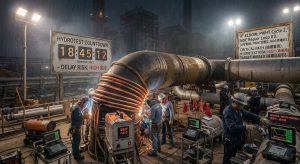
在面對管線走向變更或幾何干涉時,傳統配管工程的首選解決方案是切除既有直管,並插入標準的 1.5D 短半徑或長半徑鍛造對銲彎頭(Butt-Welded Elbow)來改變三維走向。然而,當管線規格涉及特厚壁合金鋼時,此一傳統決策將引發連鎖性的工程災難。When facing piping rerouting or geometric interference, the preferred traditional piping engineering solution is to cut the existing straight pipe and insert a standard 1.5D short-radius or long-radius forged butt-welded elbow to alter the three-dimensional routing. However, when piping specifications involve extra-heavy wall alloy steel, this traditional decision triggers a cascading engineering disaster.
首要困境在於待料交期(Lead Time)的絕對劣勢。P91/P92 特厚壁鍛造彎頭並非一般市面常備庫存品,且其製造涉及複雜的鍛造、成型與嚴格的整體正常化與回火(N&T)熱處理。若現場發生突發變更,重新向國外原廠下訂、製造、檢驗至海運抵達,交期通常以月為單位計算。這段漫長的「待料停工期」將直接導致該區段系統無法如期完成閉環,進而使最終的水壓試驗(Hydrotest)被迫展延,全面癱瘓後續的管線吹洗(Steam Blowing)與機組試車(Commissioning)進度。The primary dilemma lies in the absolute disadvantage of lead time. P91/P92 extra-heavy wall forged elbows are not standard off-the-shelf inventory. Their manufacturing involves complex forging, forming, and strict full Normalizing and Tempering (N&T) heat treatments. If sudden modifications occur on-site, re-ordering from overseas manufacturers, producing, inspecting, and shipping usually take months. This prolonged “waiting downtime” directly prevents the targeted system section from closing on schedule, forcing the delay of the final hydrostatic test (Hydrotest) and completely paralyzing subsequent steam blowing and unit commissioning progress.
次要困境則在於施工要徑上的致命影響。即便專案現場幸運地具備備品庫存,單純的 P91 現場銲接也是一項極度耗時且充滿不確定性的高風險工序。由於 P91 對熱循環極度敏感,其銲接必須嚴格遵循強制的預熱、層間溫度控制、去氫烘烤(Hydrogen Bake-out),以及冷卻至特定溫度區間後方能進行極度耗時的銲後熱處理(PWHT)5。更甚者,若非破壞檢測(如 X-ray 或 PAUT)發現體積性缺陷,則必須經歷刨除、重新預熱銲接與二次 PWHT 的惡性循環。這種將原本可控的製造業行為轉化為充滿機率性風險的現場施工,是專案進度失控的主因。基於上述困境,探尋一種具備極高適時性(Timeliness)、能利用現場既有直管庫存即刻成型,且能消弭銲接品質風險的替代方案,已成為現代 CCPP 專案管理的當務之急。 The secondary dilemma involves fatal impacts on the critical construction path. Even if the project site fortuitously has spare parts in stock, the simple on-site welding of P91 is an extremely time-consuming and uncertain high-risk operation. Because P91 is highly sensitive to thermal cycles, its welding must strictly follow mandatory preheating, interpass temperature control, hydrogen bake-out, and cooling to a specific temperature range before conducting the immensely time-consuming PWHT5. Furthermore, if volumetric defects are detected by NDE (e.g., X-ray or PAUT), a vicious cycle of gouging, re-preheating, re-welding, and secondary PWHT is triggered. Transforming what should be a controllable manufacturing process into an on-site operation filled with probabilistic risks is a primary cause of project schedule loss. Based on these dilemmas, finding an alternative solution with extreme timeliness—one that can utilize existing straight pipe inventory on-site for immediate forming while eliminating welding quality risks—has become a top priority for modern CCPP project management.
二、工法特性、冶金挑戰與規範要求 / II. Process Characteristics, Metallurgical Challenges, and Code Requirements
2.1 P91/P92 材質特性與第四型潛變裂紋(Type IV Cracking)風險 / 2.1 P91/P92 Material Characteristics and the Risk of Type IV Cracking
P91 與 P92 鋼材的優異高溫潛變強度,並非單純仰賴合金固溶強化,而是高度依賴其在常態化與回火(Normalize and Temper)後所形成的精密微觀結構:富含差排的回火麻田散鐵(Tempered Martensite)基體,以及沿著原奧斯田鐵晶界(PAGB)與次晶界均勻散布的奈米級 M23C6 碳化物與 MX 型(如 NbC, VN)碳氮化物6。這些微小且熱力學穩定的析出相透過齊納釘紮效應(Zener Pinning Effect),強烈阻礙了高溫服役期間差排的滑移與次晶界的遷移,從而賦予材料極佳的高溫潛變抗力。 The excellent high-temperature creep strength of P91 and P92 steels does not rely solely on alloy solid solution strengthening; it heavily depends on the precise microstructure formed after Normalizing and Tempering: a dislocation-rich tempered martensite matrix, and nano-scale M23C6 carbides and MX-type (e.g., NbC, VN) carbonitrides uniformly distributed along prior austenite grain boundaries (PAGB) and sub-boundaries6. Through the Zener pinning effect, these tiny and thermodynamically stable precipitates strongly impede dislocation slip and sub-boundary migration during high-temperature service, endowing the material with exceptional high-temperature creep resistance.
然而,這種精密的微觀組織在面臨傳統對銲彎頭的環向銲接熱循環時會遭到徹底破壞。銲接過程會在母材兩側形成不同層級的熱影響區(HAZ)。其中,峰值溫度介於下臨界相變溫度(AC1)與上臨界相變溫度(AC3)之間的相間臨界區(Intercritical HAZ, ICHAZ),以及略高於 AC3 的細晶區(Fine-Grained HAZ, FGHAZ),會經歷不完全的奧斯田鐵化與快速冷卻5。在此區域內,原本穩定釘紮的析出物會發生粗化、部分溶解或重新分佈,導致該區域的固溶強化效應與析出強化效應急遽衰退。 However, this precise microstructure is completely destroyed when subjected to the circumferential welding thermal cycles of traditional butt-welded elbows. The welding process forms different levels of Heat-Affected Zones (HAZ) on both sides of the base metal. The Intercritical HAZ (ICHAZ), where the peak temperature lies between the lower critical transformation temperature (AC1) and upper critical transformation temperature (AC3), and the Fine-Grained HAZ (FGHAZ), slightly above AC3 , experience incomplete austenitization and rapid cooling5. In these regions, originally stable pinning precipitates undergo coarsening, partial dissolution, or redistribution, causing a sharp decline in solid solution and precipitation strengthening effects.
在高溫高壓蒸汽的長期作用與系統三軸應力疊加的環境下,連續損傷力學模型(如 Kachanov-Rabotnov 蠕變損傷模型)已明確指出,應力與應變將高度集中於這些軟化帶。在長期服役中,Laves 相(如金屬間化合物Fe2Mo 或Fe2W)會在 ICHAZ 與 FGHAZ 異常析出並粗化,進一步消耗基體中的固溶強化元素。這些粗大的析出物介面成為蠕變空洞(Creep Voids)的最佳形核點2。隨著空洞迅速聚合,最終導致難以預警的第四型潛變裂紋(Type IV Cracking),使銲接接頭的潛變壽命巨幅縮減至母材的百分之二十至三十1。 Under the long-term action of high-temperature, high-pressure steam and the superposition of systemic triaxial stresses, continuum damage mechanics models (such as the Kachanov-Rabotnov creep damage model) clearly indicate that stress and strain highly concentrate in these softened zones. During long-term service, Laves phases (e.g., intermetallic compounds Fe2Mo or Fe2W ) abnormally precipitate and coarsen in the ICHAZ and FGHAZ, further depleting solid-solution strengthening elements in the matrix. The interfaces of these coarse precipitates become prime nucleation sites for creep voids2. As voids rapidly coalesce, they ultimately lead to unpredictable Type IV Cracking, drastically reducing the creep life of the welded joint to merely 20-30% of the base metal1.
2.2 冷作彎管之應變誘發析出硬化(SIPH)與 PBHT 規範 / 2.2 Strain-Induced Precipitation Hardening (SIPH) in Cold Bending and PBHT Codes
為了消除熱影響區與 Type IV 裂紋風險,採用大半徑冷作彎管(Cold Bending)取代對銲彎頭成為工程界極具潛力的替代方案。冷彎技術利用 CNC 設備在常溫下直接將直管施加純機械力彎曲成型,從源頭排除了銲接熱循環。然而,P91/P92 材料對冷作塑性變形極度敏感。冷作加工會在材料內部引入巨量的差排、雙晶界與堆疊層錯7。這些高能態的晶格缺陷會成為合金元素析出的形核點,導致應變誘發析出硬化(Strain-Induced Precipitation Hardening, SIPH)8。SIPH 機制會使微細的碳氮化物在晶粒內部大量異常析出,產生極高的局部屈服應力,同時在晶界處形成缺乏析出物強化的低強度貧化區。這意味著所有的潛變變形將被迫集中於狹窄的晶界網路,導致材料整體展現出極低的宏觀延展性與災難性的脆性斷裂風險7。 To eliminate the HAZ and Type IV cracking risks, adopting large-radius cold bending as a replacement for butt-welded elbows has become a highly promising engineering alternative. Cold bending technology utilizes CNC equipment to apply pure mechanical force to directly bend straight pipes at room temperature, eliminating the welding thermal cycle from the source. However, P91/P92 materials are extremely sensitive to cold plastic deformation. Cold working introduces massive amounts of dislocations, twin boundaries, and stacking faults into the material7. These high-energy lattice defects serve as nucleation sites for alloy element precipitation, leading to Strain-Induced Precipitation Hardening (SIPH)8. The SIPH mechanism causes massive abnormal precipitation of fine carbonitrides inside the grains, generating extremely high local yield stress, while simultaneously forming low-strength denuded zones lacking precipitation strengthening at the grain boundaries. This means all creep deformation is forced to concentrate in the narrow grain boundary network, resulting in extremely low macroscopic ductility and catastrophic brittle fracture risks for the material7.
為有效管控 SIPH,ASME 規範制定了嚴格的退應力防禦機制。根據 ASME B31.1 第 129.3.3.1 節及 ASME B31.3 的相關規定,針對 P-No. 15E 材料,冷彎成型應變率 ϵ 的計算公式為ϵ=50D/R%,其中 D 為管線名義外徑,R 為彎曲中心線半徑3。對於 4″ XXS 幾何尺寸,若進行 3D(R=3D)冷彎,其應變率高達 16.67%;若採用 5D(R=5D)冷彎,應變率則精準落在 10%。規範明訂,當高溫管線(設計溫度超過 600°C)的成型應變率介於 5% 至 20% 之間時,必須實施彎後熱處理(Post-Bend Heat Treatment, PBHT)3。 To effectively control SIPH, ASME codes have established strict stress relief defense mechanisms. According to ASME B31.1 section 129.3.3.1 and relevant ASME B31.3 provisions, for P-No. 15E materials, the cold bending forming strain rate ϵ is calculated by the formula ϵ=50D/R%, where D is the nominal outer diameter of the pipe and R is the centerline bend radius3. For 4″ XXS geometry, if a 3D (R=3D) cold bend is performed, the strain rate reaches 16.67%; if a 5D (R=5D) cold bend is used, the strain rate falls precisely at 10%. The code mandates that when the forming strain rate of high-temperature piping (design temperature > 600°C) is between 5% and 20%, a Post-Bend Heat Treatment (PBHT) must be implemented3.
2.3 ASME B31.1 / B31.3 之熱處理邊界條件與化學成分限制 / 2.3 Heat Treatment Boundary Conditions and Chemical Composition Limits of ASME B31.1 / B31.3
在執行 PWHT 或 PBHT 時,其冶金熱力學邊界極度嚴苛。ASME B31.3 Table 331.1.1 與 ASME B31.1 明確規定,P-No. 15E 的次臨界熱處理溫度區間嚴格鎖定於 705°C 至 775°C 之間(實務最佳化工法通常設定於 740°C 至 760°C),且持溫時間至少需滿足每英吋壁厚 1 小時之基準(最短不得低於 15 至 30 分鐘,視具體版本與管厚而定)4。 When executing PWHT or PBHT, the metallurgical thermodynamic boundaries are extremely stringent. ASME B31.3 Table 331.1.1 and ASME B31.1 explicitly stipulate that the subcritical heat treatment temperature range for P-No. 15E is strictly locked between 705°C and 775°C (practical optimized methods typically set it at 740°C to 760°C). The holding time must satisfy a baseline of 1 hour per inch of wall thickness (with a minimum not less than 15 to 30 minutes, depending on the specific edition and pipe thickness)4.
更關鍵的是,熱處理溫度絕對不可跨越下臨界相變溫度極限值(AC1)。一旦溫度超過 AC1,材料將開始發生部分奧斯田鐵化,並在隨後的冷卻過程中轉變為未經回火的新鮮脆性麻田散鐵,導致局部硬度飆升與衝擊韌性急遽喪失7。此外,ASME 規範特別強調了銲材或母材中鎳(Ni)與錳(Mn)含量的加總限制。研究證實,當Ni+Mn 含量超過 1.2% 或 1.5% 時,AC1 相變點會被強烈抑制並顯著降低,極大地壓縮了熱處理的安全視窗4。因此,規範嚴格要求 PBHT/PWHT 的最高溫度必須低於 AC1 至少 10°C,以確保微觀組織的完美修復7。 More critically, the heat treatment temperature must absolutely not cross the lower critical transformation temperature limit (AC1). Once the temperature exceeds AC1, the material begins to undergo partial austenitization and transforms into fresh, untempered, brittle martensite during subsequent cooling, leading to localized hardness spikes and a sharp loss of impact toughness7. Furthermore, ASME codes specifically emphasize limits on the combined Nickel (Ni) and Manganese (Mn) content in the weld metal or base metal. Research confirms that when Ni+Mn content exceeds 1.2% or 1.5%, the AC1 transformation point is strongly suppressed and significantly lowered, vastly compressing the safe heat treatment window4. Thus, the code strictly requires the maximum PBHT/PWHT temperature to be at least 10°C below AC1 to ensure perfect microstructural restoration7.
2.4 ASME B31J 規範下之 SIF 評估與幾何力學解耦 / 2.4 SIF Evaluation and Geometric Mechanics Decoupling under ASME B31J Code
除了材料科學的挑戰,管線系統的三維應力評估亦面臨典範轉移。過去業界高度依賴 ASME B31 附錄 D 的經驗公式進行應力分析,但隨著 ASME B31J 規範的強制導入,管件的受力評估發生了根本性的改變。B31J 基於高解析度三維有限元素分析,將主導局部循環疲勞裂紋萌生的應力強度因子(Stress Intensification Factor, SIF)與主導靜態結構塑性崩塌的持續應力指數(Sustained Stress Index, SSI)在物理機制上徹底解耦7。 Beyond materials science challenges, the 3D stress evaluation of piping systems faces a paradigm shift. Historically, the industry relied heavily on the empirical formulas of ASME B31 Appendix D for stress analysis. However, with the mandatory implementation of the ASME B31J standard, stress evaluation of piping components has fundamentally changed. Based on high-resolution 3D Finite Element Analysis, B31J thoroughly decouples the physical mechanisms of the Stress Intensification Factor (SIF), which governs localized cyclic fatigue crack initiation, and the Sustained Stress Index (SSI), which governs static structural plastic collapse7.
根據 B31J 規範,彎管的局部柔性透過無因次柔性特徵值(Flexibility Characteristic, h)進行精確量化,其公式為h=T•R1/r22,其中 T 為管件名目壁厚,R1 為彎曲半徑,r2 為平均半徑7。當具備初始曲率的彎管受到外部彎矩作用時,橫截面會自發產生非線性的卡門橢圓化效應(Karman Ovalization Effect),從而吸收熱膨脹位移。 According to the B31J code, the local flexibility of a bend is precisely quantified through a dimensionless Flexibility Characteristic (h), formulated as h=T•R1/r22, where T is the nominal wall thickness, R1 is the bend radius, and r2 is the mean cross-sectional radius7. When a bend with initial curvature is subjected to an external bending moment, the cross-section spontaneously generates a non-linear Karman Ovalization Effect to absorb thermal expansion displacement.
然而,針對 4″ XXS 這種特厚壁管線,其徑厚比(Do/T)約僅 6.68,管壁極厚且剛性龐大,導致橢圓化效應被嚴重抑制。理論計算顯示,無論是 3D 冷作彎管或是 1.5D 對銲彎頭,其理論 SIF 皆遠低於 1.0。基於極端保守的安全極限值,ASME B31J 強制將兩者的 SIF 與 SSI 收斂至剛體下限基準值 1.0 7。這意味著在純彈性理論應力分析軟體中,兩者的局部應力集中因子看似相同,但 3D/5D 冷作彎管在宏觀尺度上仍具備更大的物理柔度。由於其彎曲半徑大,空間跨距長,能更平順地引導高壓蒸汽系統因頻繁啟停所引發的熱分層(Thermal Stratification)變形,極大地降低了系統熱循環產生的端點反力,有效保護旋轉設備(如汽輪機)管口免受過載損害7。 However, for 4″ XXS extra-heavy wall piping, the outer diameter-to-thickness ratio (Do/T) is only about 6.68. The extremely thick wall and massive rigidity severely suppress the ovalization effect. Theoretical calculations show that for both 3D cold-bent pipes and 1.5D butt-welded elbows, the theoretical SIF is far below 1.0. Based on extremely conservative safety limits, ASME B31J mandates forcing both SIF and SSI to converge at the rigid body lower-bound baseline of 1.0 7. This implies that in pure elastic theoretical stress analysis software, their local stress concentration factors appear identical. However, on a macroscopic scale, 3D/5D cold-bent pipes possess greater physical flexibility. Due to their large bend radii and longer spatial spans, they can more smoothly guide the deformation caused by Thermal Stratification induced by frequent start-stops in high-pressure steam systems. This greatly reduces endpoint reaction forces generated by system thermal cycles, effectively protecting rotating equipment nozzles (e.g., steam turbines) from overload damage7.
三、適時性與工期量化比較(工序模型分析) / III. Quantitative Comparison of Timeliness and Schedule (Process Model Analysis)
為客觀評估「冷作彎管取代對銲彎頭」之適時性效益,本章建立一套標準化工序量化模型。除了針對單一 4″ XXS 90 度 P91/P92 管件進行理論時間軸的展開,更進一步以專案變更規模(50 顆為基數)進行鉅觀分析,藉此彰顯工法轉換帶來的強烈對比。To objectively evaluate the timeliness benefits of “replacing butt-welded elbows with cold bending,” this chapter establishes a standardized process quantitative model. In addition to developing a theoretical timeline for a single 4″ XXS 90-degree P91/P92 pipe fitting, it further conducts a macroscopic analysis based on a project modification scale (a baseline of 50 elbows) to highlight the stark contrast brought by switching processes.
3.1 傳統配管與電銲作業之實務工時展開 / 3.1 Practical Hour Breakdown for Traditional Piping and Welding Operations
傳統配管工序高度繁雜,且極度受制於 P91 的冶金相變法則與嚴苛的銲接管制條件。若不計入長達數月的國外待料交期,僅以現場具備 1.5D 鍛造彎頭備品為前提,其「一次合格」的理論工時展開如下:Traditional piping procedures are highly complex and strictly constrained by P91’s metallurgical phase transformation rules and stringent welding control conditions. Excluding the months-long overseas lead time and assuming spare 1.5D forged elbows are available on-site, the theoretical timeline for a “first-time pass” is as follows:
- 坡口準備與幾何對心 (Bevel Preparation and Geometric Alignment):壁厚12 mm 之 P91 嚴禁傳統氣割,必須使用帶鋸機裁切,隨後以機械加工車製符合 ASME 規範的對銲坡口,耗時約 4 小時。 / P91 with a wall thickness of 17.12 mm strictly prohibits traditional oxy-fuel cutting. It must be cut with a bandsaw, followed by machining a butt-weld bevel compliant with ASME standards, taking about 4 hours.
- 強制預熱 (Mandatory Preheat):必須以電阻或感應加熱設備將接頭提升至絕對下限 204°C,確保氫氣逸散與降低冷卻速率,耗時約 2 小時。 / The joint must be heated to an absolute minimum of 204°C using electrical resistance or induction heating equipment to ensure hydrogen effusion and slow the cooling rate, taking about 2 hours.
- 多層多道銲接 (Multi-pass GTAW + SMAW Welding):針對特厚壁進行打底、熱銲、填充與蓋面,同時需嚴格監控道間溫度,兩道厚壁銲口總計約需 16 至 18 小時5。 / Root, hot, fill, and cap passes are applied to the extra-heavy wall while strictly monitoring interpass temperatures. Two heavy-wall welds take a total of 16 to 18 hours5.
- 去氫烘烤 (Hydrogen Bake-out):銲接完成後嚴禁直接降溫,需立即提升至 300°C~350°C 保溫 2 至 3 小時,徹底驅離潛在的擴散氫。 / Direct cooling is strictly prohibited post-welding. The temperature must immediately be raised to 300°C~350°C and held for 2 to 3 hours to thoroughly drive out potential diffusible hydrogen.
- 相變冷卻 (Phase Transformation Cool down to Mf):包裹保溫棉緩慢冷卻至 96°C 以下,確保奧斯田鐵 100% 轉變為麻田散鐵基體,耗時約 4 小時。 / Wrapping in insulation blankets, the joint is slowly cooled below 96°C to ensure 100% austenite to martensite matrix transformation, taking about 4 hours.
- 銲後熱處理 (PWHT):重新組裝加熱圈,以嚴格控管的升溫速率加熱至 740°C~760°C,依據壁厚持溫約 2 小時,隨後受控緩冷,整體循環耗時約 12 小時。 / Reassembling heating coils, the joint is heated to 740°C~760°C at a strictly controlled rate, held for about 2 hours based on wall thickness, and then subjected to controlled slow cooling. The entire cycle takes about 12 hours.
- 體積性非破壞檢測 (Volumetric NDE):執行射線檢驗(X-ray)或相陣列超音波檢測(PAUT)。X-ray 檢測涉及現場清場、輻射防護搭設與底片沖洗判讀,兩道銲口約需 8 小時。 / Executing X-ray or Phased Array Ultrasonic Testing (PAUT). X-ray testing involves clearing the site, erecting radiation barriers, and film development/interpretation, taking about 8 hours for two welds.
上述過程構成了一個極其漫長且脆弱的鏈條。一旦檢測發現體積性缺陷,便會觸發災難性的「N 次刨修重銲迴圈」。每一次修補皆需重複上述步驟 2 至 7,單次修補將額外耗費至少 30 小時5。 The above processes constitute an extremely long and fragile chain. Once volumetric defects are detected, a disastrous “N-cycle gouging and re-welding loop” is triggered. Every repair requires repeating steps 2 through 7, with a single repair adding at least 30 additional hours5.
3.2 數控冷作彎管工法之實務工時展開 / 3.2 Practical Hour Breakdown for CNC Cold Bending Process
冷作彎管工法的核心邏輯在於將不確定的「現場人為施工」轉變為高精度的「自動化機械製造」,從根本上削減流程變數:The core logic of the cold bending process lies in transforming uncertain “on-site manual construction” into high-precision “automated mechanical manufacturing,” fundamentally reducing process variables:
- 直管挪用即時性 (Immediacy of Straight Pipe Allocation):直接調用現場常備的 4″ XXS P91 直管進行加工,徹底消除鍛造彎頭的待料期。 / Directly allocating available 4″ XXS P91 straight pipes on-site for processing completely eliminates the lead time for forged elbows.
- CNC 數控成型 (CNC Cold Bending):將管件置於數控彎管機床,於常溫下施加強大機械力,數分鐘內即可精準完成 3D 或 5D 的 90 度成型。連同設備校正與參數設定,耗時僅約 1 小時7。 / Placing the pipe in a CNC bending machine and applying strong mechanical force at room temperature precisely completes a 3D or 5D 90-degree bend within minutes. Including equipment calibration and parameter setup, it takes only about 1 hour7.
- 感應加熱彎後熱處理 (IH-PBHT):成型完畢後,立即將彎管移入電磁感應加熱圈。由於無環向銲縫,無需經歷去氫烘烤與相變冷卻等待。IH 設備以受控速率直接升溫至 760°C,持溫 1 小時後緩冷。感應加熱技術能確保特厚壁管的內外徑升溫絕對均勻,完美消弭塑性變形殘餘應力並恢復冶金韌性,耗時約 6 小時7。 / Immediately after forming, the bent pipe is moved into electromagnetic induction heating coils. With no circumferential welds, hydrogen bake-out and phase transformation cooling waits are unnecessary. The IH equipment directly heats at a controlled rate to 760°C, holds for 1 hour, and then cools slowly. IH technology ensures absolutely uniform heating of the extra-heavy wall’s inner and outer diameters, perfectly eliminating plastic deformation residual stress and restoring metallurgical toughness, taking about 6 hours7.
- 表面與幾何確證檢測 (Surface and Geometric Verification):由於消除體積性銲接缺陷風險,法規僅要求進行表面液滲(PT)或磁粒(MT)檢測,並量測彎管的真圓度(Ovality)與外弧壁厚減薄率(Wall Thinning),確保符合 ASME B31.1 容許極限值,整體檢驗耗時約 2 小時。 / Because the risk of volumetric welding defects is eliminated, codes only require surface Liquid Penetrant (PT) or Magnetic Particle (MT) testing, along with measuring the pipe’s Ovality and outer arc Wall Thinning to ensure compliance with ASME B31.1 allowable limits. Overall inspection takes about 2 hours.
3.3 交叉比對:工期量化與魚骨圖差異化分析 / 3.3 Cross-Comparison: Schedule Quantification and Fishbone Differentiator Analysis
綜合前述單一管件的分析,將傳統配管電銲作業與機械化冷作彎管作業進行交叉比對,如表 3-1 所示。Combining the aforementioned single-fitting analysis, the traditional piping/welding operation and the mechanized cold bending operation are cross-compared in Table 3-1.
表 3-1:單件 1.5D 對銲彎頭與 CNC 冷作彎管之流程與工期比較
Table 3-1: Process and Schedule Comparison of a Single 1.5D Butt-Welded Elbow vs. CNC Cold-Bent Pipe
| 關鍵作業節點 / Key Operation Node | 傳統 1.5D 對銲彎頭工法 / Traditional 1.5D Butt-Welded Elbow (with 2 welds) | 3D/5D CNC 冷作彎管工法 / 3D/5D CNC Cold Bending Method | 差異化分析與適時性效益 / Differential Analysis & Timeliness Benefits |
| 備料與待料交期 / Lead Time | 60 至 90 天 (若無庫存需海外訂製) / 60 to 90 days (if no stock, overseas order required) | 0 天 / 0 Days (即時裁切現場直管 / immediate cutting of on-site straight pipe) | 冷作彎管具備絕對的零待料優勢,是解決建廠干涉的關鍵。 / Cold bending has an absolute zero-lead-time advantage, crucial for resolving construction interference. |
| 管端加工與成型 / End Prep & Forming | 4 小時 (帶鋸裁切 + 坡口車製) / 4 hours (Bandsaw cutting + Beveling) | 1 小時 (CNC 數控冷作彎曲) / 1 hour (CNC Cold Bending) | 捨棄繁複的坡口幾何對心,改由自動化機械力主導一體成型。 / Abandons complex bevel alignment, replaced by automated mechanical one-piece forming. |
| 預熱與銲接 / Preheat & Welding | 18 小時 (204°C 預熱 + 多道銲接) / 18 hours (204°C preheat + multipass weld) | 無此工序 / None (消除環向銲縫 / eliminates circumferential weld) | 根絕人為銲接缺陷風險,無熱輸入不均引發之微裂紋問題。 / Eradicates manual welding defect risks and micro-crack issues caused by uneven heat input. |
| 中間熱處理等待 / Intermediate Heat Treat Wait | 7 小時 (350°C 烘烤 + 緩冷至Mf ) / 7 hours (350°C bake + cool to Mf) | 無此工序 / None | 冷彎無氫脆風險,可直接升溫,不受制於麻田散鐵相變動力學。 / No hydrogen embrittlement risk; can heat directly, unconstrained by martensitic transformation kinetics. |
| 應力消除與修復 / Stress Relief & Restoration | 12 小時 (PWHT 局部加熱) / 12 hours (Local PWHT) | 6 小時 (IH-PBHT 感應加熱) / 6 hours (IH-PBHT) | IH-PBHT 熱穿透均勻,精確控制溫度於 760°C,完美消除 SIPH。 / IH provides uniform heat penetration, strictly controlled at 760°C, perfectly eliminating SIPH. |
| 非破壞檢測 (NDE) / NDE Inspection | 8 小時 (X-ray / PAUT,需清場) / 8 hours (X-ray/PAUT, site clearing needed) | 2 小時 (PT/MT + 橢圓度/減薄) / 2 hours (PT/MT + ovality/thinning) | 傳統工法檢測耗時且干擾現場;冷彎僅需物理幾何與表面確證。 / Traditional NDE is time-consuming and disruptive; cold bending needs only geometric and surface verification. |
| 重工風險時間 / Rework Risk Time | 若檢驗失敗,單次回圈增加 30 小時 / If failed, single loop adds 30 hrs | 幾乎為零 (純機械加工可預測性高) / Near zero (high predictability) | 傳統工法易陷入惡性迴圈;冷彎良率極高,時程掌握度佳。 / Traditional methods risk vicious loops; cold bending has extremely high yields and predictable schedules. |
| 實際作業總工時 / Actual Total Working Hours | 約 49 小時 (單次合格之理想狀態) / ~49 hours (Ideal 1st-time pass) | 約 9 小時 / ~9 hours | 實體施作效率提升超過 500%。 / Physical execution efficiency increases by over 500%. |
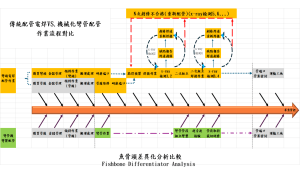
3.4 適時性之巨觀量化對比分析(以 50 件變更規模為基數) / 3.4 Macroscopic Quantitative Timeliness Comparison (Based on 50 Modifications)
為了更清晰地呈現上述兩種工法在專案級別上的時間衝擊,本節以 50 顆 4″ XXS P91/P92 管件的變更設計為想定基數,進行適時性的巨觀量化對比:To more clearly present the schedule impact of these two methods at a project level, this section uses a baseline scenario of 50 modifications of 4″ XXS P91/P92 fittings to conduct a macroscopic quantitative timeliness comparison:
- 絕對施作工時對比(一次合格之理想狀態) / Absolute Working Hours Comparison (Ideal First-Time Pass)
- 傳統1.5D 對銲彎頭 (Traditional 1.5D Butt-Welded Elbows):單件總耗時約 49 小時,若施作 50 顆彎頭,需歷經 100 道特厚壁銲口的繁複熱循環,總計需要高達 2,450 小時。 / A single piece takes about 49 hours. Executing 50 elbows requires enduring the complex thermal cycles of 100 extra-heavy wall welds, totaling a staggering 2,450 hours.
- 3D/5D CNC 冷作彎管 (3D/5D CNC Cold-Bent Pipes):單件總耗時約 9 小時,連續施作 50 顆彎管總計僅需 450 小時。 / A single piece takes about 9 hours. Processing 50 cold-bent pipes consecutively requires only 450 hours.
- 量化效益 (Quantitative Benefits):在不考慮重工的理想狀態下,冷作彎管工法可直接為專案省下 2,000 小時的現場實體作業時間(相當於單組人力超過 80 天的日夜連續趕工),整體施作效率提升高達4 倍。 / Ignoring rework in an ideal state, the cold bending method directly saves the project 2,000 hours of physical on-site work (equivalent to over 80 days of continuous 24/7 work for a single crew), boosting overall execution efficiency by 5.4 times.
- 待料交期(Lead Time)的時程風險 / Lead Time Schedule Risks
- 傳統工法 (Traditional Method):50 顆特厚壁鍛造彎頭並非常規庫存,若現場備品不足,重新下訂至海運抵達通常高達 60 至 90 天,這將導致整個試壓與試車排程被迫全面停擺。 / 50 extra-heavy wall forged elbows are non-standard inventory. If site spares are insufficient, reordering and ocean freight typically take 60 to 90 days, forcing the entire hydrotest and commissioning schedule to a complete halt.
- 冷作彎管工法 (Cold Bending Method):直接挪用現場常備的無縫直管庫存進行加工,待料時間為 0 天,徹底解除專案面臨的缺料危機。 / Directly utilizing on-site seamless straight pipe stock for processing yields a lead time of 0 days, thoroughly resolving the project’s material shortage crisis.
- 重工(Rework)與潛在工期暴增風險 / Rework and Potential Schedule Explosion Risks
- 傳統工法 (Traditional Method):50 顆彎頭意味著 100 道高難度的 P91 厚壁銲口。P91 的銲接熱循環各階段容錯率極低4。一旦檢測發現體積性缺陷,單次修補迴圈將額外耗費大量時間。若以保守的 10% 修補率計算(即 10 道銲口需重工),專案將不可預期地額外暴增 300 小時以上的工期。 / 50 elbows mean 100 highly difficult P91 heavy-wall welds. P91 welding thermal cycles have extremely low fault tolerance4. Once volumetric defects are found, a single repair loop adds massive time. Using a conservative 10% repair rate (10 welds needing rework), the project schedule will unpredictably explode by an additional 300+ hours.
- 冷作彎管工法 (Cold Bending Method):由於從物理幾何上徹底消除了環向銲縫,直接排除了銲接體積性缺陷的可能。只要應變率與 PBHT 參數精準執行,工期具備絕對的可預測性,N 次重工的時間成本趨近於零。 / Physically eliminating circumferential welds completely rules out volumetric welding defects. As long as strain rates and PBHT parameters are executed precisely, the schedule has absolute predictability, and the time cost for N-cycle rework approaches zero.
綜合上述巨觀分析,在 50 件管件變更的規模下,傳統工法不僅耗時甚鉅,更面臨極高的缺料與重工延宕風險;而冷作彎管工法則能為 CCPP 建廠或歲修的緊急變更提供極具壓倒性優勢的適時性對策。Summarizing this macroscopic analysis, at a scale of 50 fitting modifications, the traditional method is not only enormously time-consuming but also faces extreme risks of delay from material shortages and rework. Conversely, the cold bending method offers an overwhelmingly advantageous timeliness countermeasure for emergency modifications during CCPP construction or maintenance.
3.5 P91 缺料急迫性下在潁璋工程「三合一工法」實務操作效益 / 3.5 Practical Benefits of YZ Engineering’s “3-in-1 Process” Under P91 Material Shortage Urgency
在面臨上述缺料急迫性與工期壓力下,國內實務上導入了潁璋工程的「三合一工法」,將三項關鍵技術進行了深度的預製整合,將冷作彎管的適時性效益發揮至極致7: Facing the aforementioned material shortage urgencies and schedule pressures, domestic practices have introduced YZ Engineering’s “3-in-1 Process,” deeply integrating three key technologies in prefabrication to maximize the timeliness benefits of cold bending7:
- 數控冷彎 (CNC Cold Bending):直接挪用現場常備的直管,於受控工廠環境內利用自動化機械力進行 3D/5D 大半徑冷彎成形,精準掌控 5% 至 20% 的成型應變率,從幾何源頭徹底消除環向銲縫7。 / Directly using on-site straight pipes, applying automated mechanical force in a controlled factory environment for 3D/5D large-radius cold forming, precisely controlling forming strain rates between 5% and 20%, entirely eliminating circumferential welds at the geometric source7.
- 感應加熱管線彎後熱處理 (IH-PBHT):接續冷彎成形,立即運用電磁感應加熱進行精確的退應力熱處理(精準鎖定於 760°C)。感應加熱能確保厚壁管件內外徑升溫均勻,完美消弭塑性變形殘餘應力並恢復冶金韌性7。 / Following cold forming, electromagnetic induction heating is immediately applied for precise stress relief (locked precisely at 760°C). Induction heating ensures uniform temperature rise across the heavy wall’s inner and outer diameters, perfectly eliminating plastic residual stress and restoring metallurgical toughness7.
- 數位履歷與製造執行系統 (Digital Tracking and MES via QR Code):賦予每個管件獨立的數位履歷(QR Code),將材料試驗報告(MTR)、彎管參數與熱處理動態曲線無縫綁定,建立「設計—模擬—預製—熱處理」的品質閉環7。 / Assigning an independent digital profile (QR Code) to each fitting seamlessly links Material Test Reports (MTR), bending parameters, and dynamic heat treatment curves, establishing a “Design-Simulate-Prefab-Heat Treat” quality closed loop7.
透過此三合一工法,EPC 承包商能將數個月的待料期壓縮至單日內完成實體製造與數位品質確證,徹底解除 P91 缺料對試車時程的威脅。Through this 3-in-1 process, EPC contractors can compress months of lead time into a single day to complete physical manufacturing and digital quality verification, thoroughly neutralizing the threat of P91 material shortages on commissioning schedules.
四、品質確保、長期可靠度與數位化實務 / IV. Quality Assurance, Long-Term Reliability, and Digital Practices
4.1 貫徹「能彎不銲」策略之長期效益 / 4.1 Long-Term Benefits of the “Bend Instead of Weld” Strategy
冷作彎管不僅是工期上的救火對策,更是提升系統長期可靠度的核心戰略。如第二章所述,P91/P92 管線爆破的最主要元兇在於銲接引發的熱影響區(HAZ)細晶化與相間臨界區(ICHAZ)軟化2。 Cold bending is not just a firefighting countermeasure for schedules; it is a core strategy for enhancing long-term system reliability. As described in Chapter 2, the primary culprit for P91/P92 piping bursts is the HAZ grain refinement and ICHAZ softening induced by welding2.
透過「能彎不銲」策略,採用 3D/5D 大半徑冷彎一體成型,徹底從物理上消除了彎頭兩側的環向銲縫,意味著該管線轉向區域將不會存在軟化的 HAZ。在承受高溫蒸汽潛變應力與系統熱循環時,該區段保留了 100% 的母材潛變抗力。搭配精準控制於 760°C 的 IH-PBHT,材料內部的錯綜差排網路得以消散,微觀組織重構為穩定的回火麻田散鐵基體,徹底根絕了第四型潛變裂紋(Type IV Cracking)的萌生基礎,極大化了機組的全生命週期安全性7。 By executing the “Bend Instead of Weld” strategy using 3D/5D large-radius one-piece cold forming, the circumferential welds on both sides of the elbow are physically eliminated, meaning softened HAZ will not exist in this directional change section. When enduring high-temperature steam creep stress and system thermal cycles, this section retains 100% of the base metal’s creep resistance. Paired with IH-PBHT strictly controlled at 760°C, the tangled dislocation networks dissipate, and the microstructure is reconstituted into a stable tempered martensite matrix. This fundamentally eradicates the initiation basis of Type IV Cracking, maximizing the unit’s whole-life cycle safety7.
4.2 台灣重工業數位化追蹤與檢驗放行實務 / 4.2 Digital Tracking and Inspection Release Practices in Taiwan’s Heavy Industry
在台灣的重工業環境中,如台電大潭、通霄等 CCPP 建廠專案,以及高雄林園石化工業區的汽電共生廠,高溫高壓合金管線的品質放行高度依賴獨立第三方授權檢驗機構(AIA)與業主的嚴格書面審核。傳統配管作業往往因為材料試驗報告(MTR)、銲接程序規範(WPS)、非破壞檢測報告與類比式熱處理記錄圖表散落於不同次承包商手中,導致「實體工程已完工,但書面審查卡關無法試壓」的行政瓶頸。In Taiwan’s heavy industry environment—such as the construction of Taipower’s Datan and Tunghsiao CCPP projects, and cogeneration plants in the Linyuan Petrochemical Zone in Kaohsiung—quality release of high-temperature/high-pressure alloy piping relies heavily on strict documentation audits by Authorized Inspection Agencies (AIA) and owners. Traditional piping operations often scatter MTRs, Welding Procedure Specifications (WPS), NDE reports, and analog heat treatment charts across various subcontractors, resulting in an administrative bottleneck where “physical engineering is complete, but paperwork hurdles prevent hydrostatic testing.”
為解決此一痛點,全台灣先進的管線預製廠與 EPC 統包商已開始導入深度數位化追蹤與製造執行系統(MES),結合 QR Code 技術,打造了全新的數位品質閉環:To solve this pain point, advanced piping prefab shops and EPC contractors in Taiwan have begun implementing deep digital tracking and Manufacturing Execution Systems (MES) paired with QR Code technology, creating a brand new digital quality closed loop:
- 數位孿生與材料履歷綁定 (Digital Twin and Material Profile Binding):每一支欲進行冷彎的 4″ XXS P91 直管,在入廠檢驗與裁切前即賦予專屬 QR Code。該二維碼直接連結至雲端資料庫,綁定該管材原始爐號(Heat Number)的 MTR、化學成分分析報告(確保 Ni+Mn含量符合規範)與機械性質數據7。 / Every 4″ XXS P91 straight pipe slated for cold bending is assigned a unique QR Code before factory inspection and cutting. This code links directly to a cloud database, binding the material’s original Heat Number MTR, chemical composition report (ensuring Ni+Mn limits), and mechanical property data7.
- 參數自動化擷取與防呆機制 (Automated Parameter Capture and Error-Proofing):在受控工廠環境內進行 CNC 彎管機床作業時,系統自動將設備輸出的成型力矩、回彈角度與極限纖維伸長率(成型應變率)同步寫入該 QR Code 履歷中,杜絕人工抄寫錯誤,並由系統自動核對應變率是否合規(介於 5%~20% 之間)7。 / During CNC bending in a controlled environment, the system automatically writes the equipment’s forming torque, spring-back angle, and extreme fiber elongation (forming strain rate) into the QR Code profile. This prevents manual entry errors and allows the system to auto-verify if the strain rate complies (between 5% and 20%)7.
- 熱處理動態曲線即時整合 (Real-time Integration of Dynamic Heat Treatment Curves):在執行 IH-PBHT 時,貼附於彎管外弧、內弧與中性軸的多組熱電偶(Thermocouples)將溫度數據即時傳輸至邊緣運算主機。冷卻完成後,系統自動生成帶有數位簽章的時間-溫度動態曲線(Time-Temperature Curve),並無縫併入該彎管的數位履歷中,確證持溫時間與最高溫度絕對未跨越 AC1 禁區7。 / While executing IH-PBHT, multiple thermocouples attached to the outer arc, inner arc, and neutral axis transmit temperature data in real-time to edge computing hosts. Post-cooling, the system auto-generates a digitally signed Time-Temperature Curve, seamlessly appending it to the pipe’s digital profile, verifying that hold times were met and peak temperatures never crossed the AC1 restricted zone7.
這種高度整合的數位化管理模式,讓電廠業主與 AIA 檢驗工程師只需在現場持平板電腦掃描管件上的 QR Code,即可在數秒內調閱從材料來源、冷作參數到 PBHT 曲線的完整生產履歷。這項實務變革不僅將原先動輒數天的繁冗文書查驗時間壓縮至分鐘級別,更賦予了冷作彎管極高的資料透明度與品質可信度,成為加速檢驗放行、順利銜接水壓試驗與試車的關鍵推手。This highly integrated digital management model allows power plant owners and AIA inspectors on-site to simply scan the fitting’s QR Code with a tablet to access the complete production history—from material origin to cold bending parameters and PBHT curves—within seconds. This practical revolution condenses what used to be days of tedious paperwork auditing into minutes. Furthermore, it endows cold-bent pipes with immense data transparency and quality credibility, becoming a key driver in accelerating inspection releases and smoothly transitioning to hydrostatic testing and commissioning.
4.3 對於業主與 EPC 承包商之電廠全生命週期效益 / 4.3 Whole-Life Cycle Power Plant Benefits for Owners and EPC Contractors
冷作彎管策略的順利實施,除了能在短期解決變更設計的進度危機外,更在電廠未來的數十年服役期間,為 EPC 承包商與最終業主創造了顯著的全生命週期價值:The successful implementation of the cold bending strategy not only resolves short-term design modification schedule crises but also creates significant whole-life cycle value for EPC contractors and end-owners over the power plant’s future decades of service:
- EPC 承包商之建造成本與空間最佳化 (Construction Cost and Space Optimization for EPCs):以大半徑冷彎管取代零散的1.5D 鍛造彎頭,能將多個部件整合為單一大型預製管段,大幅降低了繁雜的倉儲管理與採購物料成本7。此外,由於冷作彎管能透過物理延展自發吸收熱膨脹位移,有效降低了廠房管架的空間需求達 15% 至 20%,進一步優化了廠房配置與初期建造成本7。無銲接的特性同時也省去了昂貴的體積性非破壞檢測費用。 / Replacing scattered 1.5D forged elbows with large-radius cold-bent pipes integrates multiple components into a single large prefabricated spool, drastically reducing complex warehousing and material procurement costs7. Moreover, because cold-bent pipes spontaneously absorb thermal expansion through physical flexibility, they reduce plant pipe rack space requirements by 15% to 20%, further optimizing plant layout and initial capital costs7. The weld-less nature also eliminates expensive volumetric NDE costs.
- 業主端之長期運行可靠度與設備保護 (Long-Term Operational Reliability and Equipment Protection for Owners):對於現代化 CCPP(如具備快速啟停能力之機組),高壓蒸汽管線內部極易產生熱分層現象(Thermal Stratification),進而誘發強烈的整體彎曲力矩。大半徑冷作彎管具備卓越的宏觀實體柔度,能夠平順地引導這些位移變形,極大地降低了系統熱循環產生的端點反力,從而有效保護旋轉設備(如汽輪機)的管口免受過載損害7。 / For modern CCPPs (e.g., units with rapid start-stop capabilities), high-pressure steam pipes are highly prone to Thermal Stratification, inducing strong global bending moments. Large-radius cold-bent pipes possess excellent macroscopic physical flexibility, smoothly guiding these displacement deformations. This drastically reduces endpoint reaction forces generated by system thermal cycles, effectively protecting rotating equipment nozzles (e.g., steam turbines) from overload damage7.
- 根絕第四型潛變破裂(Type IV Cracking)風險 (Eradication of Type IV Cracking Risks):物理上消除了 P91/P92 管線最脆弱的熱影響區(HAZ),避免了微觀蠕變空洞的快速形核與破裂1。這確保了管線系統的潛變壽命能夠完美匹配電廠的設計年限,大幅降低了業主在未來歲修中的非計畫性停機風險與高昂的檢修替換成本。 / Physically eliminating the most vulnerable HAZ of P91/P92 piping prevents the rapid nucleation and rupture of microscopic creep voids1. This ensures the piping system’s creep life perfectly matches the power plant’s design life, drastically reducing the owner’s risks of unscheduled outages and exorbitant maintenance replacement costs during future overhauls.
五、結論與建議 / V. Conclusions and Recommendations
本研究基於 ASME 規範框架與連續損傷力學理論,針對 CCPP 建廠與歲修期間高能管線的變更設計,深入剖析了傳統 4″ XXS P91/P92 對銲彎頭的困境與大半徑冷作彎管的絕對優勢。綜合工期量化模型、冶金品質確證與台灣實務案例分析,確立以下核心結論與建議:Based on ASME code frameworks and continuum damage mechanics theories, this study deeply analyzed the dilemmas of traditional 4″ XXS P91/P92 butt-welded elbows and the absolute advantages of large-radius cold-bent pipes for high-energy piping modifications during CCPP construction and maintenance. Synthesizing quantitative schedule models, metallurgical quality verification, and Taiwanese practical case studies, the following core conclusions and recommendations are established:
- 突破待料瓶頸,發揮極致適時性 (Breakthrough Lead Time Bottlenecks with Extreme Timeliness):
在面對現場突發的幾何干涉與變更設計時,特厚壁鍛造彎頭動輒數月的待料期是延宕專案的致命傷。如 50 件變更規模的分析所示,採用 CNC 冷作彎管技術能直接挪用現有直管,將待料期歸零,並將傳統近 2,450 小時的繁雜工期極度壓縮至 450 小時內。冷彎工法在應急救火與確保水壓試驗如期進行上,展現了無可匹敵的時效優勢。 / When facing sudden on-site geometric interferences and design modifications, the months-long lead time for extra-heavy wall forged elbows is fatal. As shown in the 50-modification analysis, adopting CNC cold bending technology directly utilizes existing straight pipes, nullifying lead times and compressing traditional complex schedules of nearly 2,450 hours down to just 450 hours. The cold bending method demonstrates unmatched schedule advantages for emergency firefighting and ensuring hydrostatic tests proceed as planned. - 落實「能彎不銲」,根絕第四型潛變破裂 (Implement “Bend Instead of Weld”, Eradicate Type IV Cracking): 從微觀冶金角度而言,傳統銲接產生的熱影響區(尤其是 ICHAZ)是 P91/P92 材料在高溫環境下的阿基里斯腱。冷作彎管從實體物理幾何上徹底消除了彎頭兩側的環向銲縫。配合精確控制於 760°C 的感應加熱次臨界回火(IH-PBHT),不僅完美釋放了應變誘發析出硬化(SIPH),更將轉向區的長期潛變壽命恢復至 100% 母材等級,從根本上拔除了 Type IV 裂紋的隱患1。 / From a microscopic metallurgical perspective, the HAZ (especially ICHAZ) generated by traditional welding is the Achilles’ heel of P91/P92 materials in high-temperature environments. Cold bending physically eliminates the circumferential welds on both sides of the elbow. Paired with IH-PBHT precisely controlled at 760°C, it not only perfectly releases SIPH but also restores the long-term creep life of the directional change zone to 100% of the base metal level, fundamentally uprooting the threat of Type IV cracking1.
- ASME B31J 應力解耦與宏觀柔性效益 (ASME B31J Stress Decoupling and Macroscopic Flexibility Benefits): 儘管特厚壁管線的低徑厚比抑制了橢圓化效應,導致 ASME B31J 保守地將冷作彎管與銲接彎頭的 SIF 同化為1.0,但 3D/5D 大半徑冷作彎管在宏觀物理空間中具備更大的幾何跨距。這賦予了系統更優越的實體柔度,能更平順地吸收機組快速啟停引發的熱分層位移,大幅降低旋轉設備管口的端點反力7。 / Although the low D/T ratio of extra-heavy wall piping suppresses ovalization, causing ASME B31J to conservatively homogenize the SIF of both cold-bent pipes and welded elbows to 1.0, 3D/5D large-radius cold-bent pipes possess larger geometric spans in macroscopic physical space. This grants the system superior physical flexibility, more smoothly absorbing thermal stratification displacements induced by rapid unit start-stops, and drastically reducing endpoint reaction forces at rotating equipment nozzles7.
- 數位化追蹤創造快速放行價值 (Digital Tracking Creates Rapid Release Value):
台灣重工業界導入的 MES 結合 QR Code 數位追蹤系統,成功將直管原始 MTR、冷彎參數與 PBHT 動態熱處理曲線無縫串聯。此舉消弭了資訊斷層,使 AIA 與業主的文書審查效率呈指數型提升,大幅加速了工程最後一哩路的放行速度。 / Taiwan’s heavy industry implementation of MES paired with QR Code digital tracking has successfully and seamlessly linked original straight pipe MTRs, cold bending parameters, and dynamic PBHT curves. This eliminates information gaps, exponentially increases AIA and owner document audit efficiency, and vastly accelerates the release speed in the final mile of engineering. - 常態化工程策略之建議 (Recommendations for Normalized Engineering Strategies):
本研究強烈建議,EPC 統包商與電廠業主應轉變傳統配管思維,不再僅將「冷作彎管」視為緊急變更時的權宜之計。在未來的 CCPP 設計與採購規劃階段,即應全面評估將高溫高壓蒸汽系統中的1.5D 鍛造對銲彎頭替換為 3D/5D 大半徑冷作彎管。此舉不僅能減少系統環向銲縫數量、降低初期建造成本與無損檢測(NDE)費用,更能極大化整座發電廠的全生命週期可靠度。 / This study strongly recommends that EPC contractors and plant owners shift their traditional piping mindset and no longer view “cold bending” merely as a stopgap measure during emergency modifications. In future CCPP design and procurement planning stages, comprehensive evaluations should be made to replace 1.5D forged butt-welded elbows in high-temperature/high-pressure steam systems with 3D/5D large-radius cold-bent pipes. This move not only reduces the number of circumferential system welds, lowering initial construction and NDE costs, but also maximizes the whole-life cycle reliability of the entire power plant.
(本報告內容之設計與技術評估係基於 ASME 工程規範與學術文獻進行之綜合分析。涉及特定工業機組或高能壓力管線之變更設計與熱處理參數訂定,仍須交由具備執業資格之專業工程師(PE)或授權檢驗機構(AIA)依據實際工況進行最終核可。)(The design and technical evaluations in this report are based on a comprehensive analysis of ASME engineering codes and academic literature. Design modifications and heat treatment parameter settings involving specific industrial units or high-energy pressure piping must still be submitted to a qualified Professional Engineer (PE) or Authorized Inspection Agency (AIA) for final approval based on actual operating conditions.)
參考文獻 / References
- Type IV cracking in a P91 header | John Brear – Plant Integrity, https://johnbrear-plantintegrity.com/?page_id=578
- Review of Type IV Cracking in Piping Welds – EPRI, https://restservice.epri.com/publicdownload/TR-108971/0/Product
- EPRI Best Practice Guidelines For P91 1023199 | PDF – Scribd, https://www.scribd.com/doc/246144971/EPRI-Best-Practice-Guidelines-for-P91-1023199
- Growing experience with P91/T91 forcing essential code changes, https://www.ccj-online.com/growing-experience-with-p91-t91-forcing-essential-code-changes/
- Investigation Of Weld Repair Without Post-Weld Heat Treatment For, https://www.twi-global.com/technical-knowledge/published-papers/investigation-of-weld-repair-without-post-weld-heat-treatment-for-p91
- Transition from Type IV to Type I cracking in heat-treated grade 91, https://www.scilit.com/publications/dfe4ab6533cb5ed1852292a9275fd036
- 基於ASME B31J 規範之P91/P92 高強度合金冷作彎管工法應力解析與, https://yz-pipe-bending.com.tw/%E5%9F%BA%E6%96%BC-asme-b31j-%E8%A6%8F%E7%AF%84%E4%B9%8B-p91-p92-%E9%AB%98%E5%BC%B7%E5%BA%A6%E5%90%88%E9%87%91%E5%86%B7%E4%BD%9C%E5%BD%8E%E7%AE%A1%E5%B7%A5%E6%B3%95%E6%87%89%E5%8A%9B%E8%A7%A3%E6%9E%90/
- ASME B31.1/B31J 動力管線成型機制與冶金策略演進:P91 熱彎急冷, https://yz-pipe-bending.com.tw/asme-b31-1-b31j-%E5%8B%95%E5%8A%9B%E7%AE%A1%E7%B7%9A%E6%88%90%E5%9E%8B%E6%A9%9F%E5%88%B6%E8%88%87%E5%86%B6%E9%87%91%E7%AD%96%E7%95%A5%E6%BC%94%E9%80%B2%EF%BC%9Ap91-%E7%86%B1%E5%BD%8E%E6%80%A5%E5%86%B7/
- 基於2026 版ASME B31J 與1 規範之動力管線應力解耦與合規挑戰, https://yz-pipe-bending.com.tw/%E5%9F%BA%E6%96%BC-2026-%E7%89%88-asme-b31j-%E8%88%87-b31-1-%E8%A6%8F%E7%AF%84%E4%B9%8B%E5%8B%95%E5%8A%9B%E7%AE%A1%E7%B7%9A%E6%87%89%E5%8A%9B%E8%A7%A3%E8%80%A6%E8%88%87%E5%90%88%E8%A6%8F%E6%8C%91/
- P91 合金鋼冷作彎管與IH-PBHT 全生命週期品質管控, https://yz-pipe-bending.com.tw/a335-p91-%E5%90%88%E9%87%91%E9%8B%BC%E5%86%B7%E4%BD%9C%E5%BD%8E%E7%AE%A1%E8%88%87-ih-pbht-%E5%85%A8%E7%94%9F%E5%91%BD%E9%80%B1%E6%9C%9F%E5%93%81%E8%B3%AA%E7%AE%A1%E6%8E%A7%EF%BC%9A%E5%9F%BA%E6%96%BC-a/
- 基於2026 ASME B31J 規範:P91 高壓蒸汽管線洩水坡度設計採取對, https://yz-pipe-bending.com.tw/%E5%9F%BA%E6%96%BC-2026-asme-b31j-%E8%A6%8F%E7%AF%84%EF%BC%9Ap91-%E9%AB%98%E5%A3%93%E8%92%B8%E6%B1%BD%E7%AE%A1%E7%B7%9A%E6%B4%A9%E6%B0%B4%E5%9D%A1%E5%BA%A6%E8%A8%AD%E8%A8%88%E6%8E%A1%E5%8F%96%E5%B0%8D/