
摘要 / Abstract
現代複循環發電廠(Combined Cycle Power Plant, CCPP)與石化煉製設施中的高能管線(High-Energy Piping, HEP)系統,長期面臨極端高溫、高壓以及頻繁熱循環載荷的嚴苛考驗。過去數十年間,管線工程界在管線方向轉折的設計上,高度依賴工廠預製的 1.5D 離散電銲彎頭(Welded Elbows)。然而,此傳統工法在潛變強度增強型鐵素體鋼(Creep Strength Enhanced Ferritic Steels, CSEF, 如 P91、P92)的應用上,暴露出極為嚴重的第四型潛變破裂(Type IV Cracking)與流動加速腐蝕(Flow-Accelerated Corrosion, FAC)等致命弱點,成為威脅廠區結構完整性與運行安全的核心隱患。Modern Combined Cycle Power Plants (CCPP) and petrochemical refining facilities feature High-Energy Piping (HEP) systems that endure severe conditions of extreme high temperatures, high pressures, and frequent thermal cycling loads. Over the past few decades, the piping engineering sector has heavily relied on shop-fabricated 1.5D discrete welded elbows for directional changes. However, the application of this traditional methodology on Creep Strength Enhanced Ferritic Steels (CSEF, such as P91 and P92) has exposed fatal vulnerabilities, including severe Type IV Cracking and Flow-Accelerated Corrosion (FAC), posing a core threat to structural integrity and operational safety.
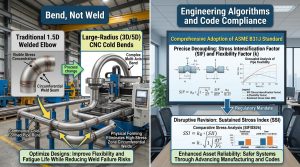
為突破此工程瓶頸,國際管線設計思維正經歷一場深度的典範轉移。在實體製造與施工端,業界開始倡導「能彎不銲(Bend instead of weld)」理念,採用大曲率(3D/5D)數控冷作彎管(CNC Cold Bends)取代傳統的 1.5D 電銲彎頭,藉由物理成型徹底消除高應力區的環向銲縫;同時,在工程演算法規端,全面導入 ASME B31J 標準,精確解耦應力強化因子(Stress Intensification Factor, SIF)與柔性因子(Flexibility Factor, k),並顛覆性地修正了持續載荷應力指數(Sustained Stress Index, SSI)。本研究旨在從規範邊界、冶金力學、成型應變、流體動力學,以及基於 CAESAR II 的全域應力分析等多重維度,極度詳盡地剖析此一技術變革的理論基礎、數學機制與工程實務價值,為未來高能管線的設計最佳化提供學術與實務兼具的指導論述。To overcome this engineering bottleneck, international piping design is undergoing a profound paradigm shift. On the physical manufacturing and construction front, the industry is advocating the “bend instead of weld” philosophy, replacing traditional 1.5D welded elbows with large-radius (3D/5D) CNC cold bends, completely eliminating girth welds in high-stress zones through physical forming. Simultaneously, on the engineering algorithm and code front, the ASME B31J standard is being comprehensively adopted to accurately decouple Stress Intensification Factors (SIF) and Flexibility Factors (k), while disruptively revising the Sustained Stress Index (SSI). This study aims to exhaustively analyze the theoretical foundation, mathematical mechanisms, and practical engineering value of this technological shift from multiple dimensions—including code boundaries, metallurgical mechanics, forming strains, fluid dynamics, and CAESAR II-based global stress analysis—providing comprehensive academic and practical guidance for the optimization of future high-energy piping designs.
一、 緒論與高能管線產業困境探討 / I. Introduction and the Dilemma of the High-Energy Piping Industry
高能管線系統,特別是發電廠中的主蒸汽(Main Steam)與熱再熱蒸汽(Hot Reheat)管線,堪稱現代工業設施的動脈。隨著機組熱效率的極限追求,蒸汽參數已普遍提升至超臨界(Supercritical)甚至超超臨界狀態,操作溫度常逾越 600°C,壓力可達 20 MPa 以上1。在此極端環境下,管線材質已由早期的 P22 低合金鋼,全面轉向具備卓越高溫潛變抗力的 P91、P92 甚至 P93 等高合金耐熱鋼3。 High-energy piping systems, particularly Main Steam and Hot Reheat piping in power plants, are the arteries of modern industrial facilities. Driven by the pursuit of maximum thermal efficiency, steam parameters have generally escalated to supercritical or even ultra-supercritical states, with operating temperatures frequently exceeding 600°C and pressures reaching over 20 MPa1. Under such extreme environments, piping materials have comprehensively transitioned from early P22 low-alloy steels to high-alloy heat-resistant steels such as P91, P92, and even P93, which possess superior high-temperature creep resistance3.
在傳統的管線設計與施工框架中,管線方向轉換主要依賴 ASME B16.9 規範下標準化的 1.5D 短或長半徑對銲彎頭6。此作法導致管線系統中存在極高密度的環向銲縫(Girth Welds)。對於 P91/P92 材料而言,銲接過程中的熱循環會對母材的微觀組織造成不可逆的熱損傷,特別是在熱影響區(Heat-Affected Zone, HAZ)形成結構脆弱的交界帶,引發提早失效2。此外,1.5D 彎頭的急遽幾何轉折不僅造成極高的局部幾何應力集中,更會在管內引發強烈的流體邊界層分離與擾流,大幅加速管壁金屬的流動加速腐蝕(FAC)進程9。 In traditional piping design and construction frameworks, changes in piping direction primarily rely on standardized 1.5D short or long-radius butt-welded elbows governed by the ASME B16.9 code6. This practice results in an extremely high density of girth welds within the piping system. For P91/P92 materials, the thermal cycling during the welding process causes irreversible thermal damage to the microstructure of the base metal, forming a structurally vulnerable transition zone, particularly in the Heat-Affected Zone (HAZ), which induces premature failure2. Furthermore, the abrupt geometric turn of a 1.5D elbow not only creates extremely high local geometric stress concentrations but also triggers severe fluid boundary layer separation and turbulence within the pipe, drastically accelerating the Flow-Accelerated Corrosion (FAC) process of the metal wall9.
更為關鍵的是,傳統管線應力分析(如 ASME B31.1 或 B31.3 附錄 D)所依賴的數學模型,主要源自 1950 年代 A.R.C. Markl 的簡化彎曲疲勞測試。該模型將應力強化因子單一化且過度保守地估算,導致工程師在面對 1.5D 彎頭或三通時,被迫在系統中加入大量且昂貴的熱膨脹環(Thermal Expansion Loops)以降低理論應力12。這不僅增加了管材與銲道數量,更增加了傳遞至關鍵旋轉機械(如汽輪機)端點的噴嘴載荷,形成惡性循環13。 More critically, the mathematical models relied upon in traditional piping stress analysis (such as ASME B31.1 or B31.3 Appendix D) are primarily derived from A.R.C. Markl’s simplified bending fatigue tests in the 1950s. This model simplified and overly conservatively estimated Stress Intensification Factors (SIFs), forcing engineers dealing with 1.5D elbows or tees to insert large, expensive thermal expansion loops into the system to reduce theoretical stresses12. This not only increases the amount of piping material and weld seams but also amplifies the nozzle loads transmitted to critical rotating machinery terminals (such as steam turbines), creating a vicious cycle13.
面對上述多重挑戰,管線工程界正積極推動系統性的技術升級。透過導入 3D 或 5D 大曲率數控冷作彎管技術,不僅能從幾何與材料本質上拔除第四型潛變破裂的根源,更能配合 ASME B31J 的數值解耦矩陣,徹底改變管線應力分析的數學邊界條件,實現物理與數學層面的雙重解放4。 Faced with these multiple challenges, the piping engineering community is actively promoting systematic technological upgrades. By adopting 3D or 5D large-radius CNC cold bending technology, the root cause of Type IV creep cracking can be eliminated geometrically and metallurgically. Furthermore, coupled with the numerical decoupling matrix of ASME B31J, the mathematical boundary conditions of piping stress analysis are completely transformed, achieving a dual liberation on both physical and mathematical fronts4.
二、 規範邊界與彈性應力分析演進:ASME B31.1 與 B31.3 之深度比較 / II. Code Boundaries and Evolution of Elastic Stress Analysis: An In-Depth Comparison of ASME B31.1 and B31.3
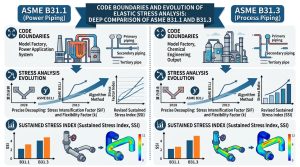
在探討應力優化之前,必須先釐清高能管線所屬的法規管轄邊界。理解 ASME B31.1(動力管線)與 ASME B31.3(製程管線)的管轄差異及數學基礎,是進行任何工業管線工程發展的首要步驟16。 Before delving into stress optimization, the jurisdictional boundaries of high-energy piping codes must be clarified. Understanding the differences in jurisdiction and mathematical foundations between ASME B31.1 (Power Piping) and ASME B31.3 (Process Piping) is the primary step in any industrial piping engineering development16.
2.1 管轄範圍與設施邊界 / 2.1 Jurisdictional Scopes and Facility Boundaries
ASME B31.1 主要涵蓋發電站、工業發電廠與區域供熱設施中的管線系統。其最關鍵的管轄區域為「鍋爐外部管線(Boiler External Piping, BEP)」,即直接連接至動力鍋爐,直至第一道隔離閥(Block Valve)為止的管線。此區域同時受 ASME 鍋爐與壓力容器規範(BPVC Section I)的強制約束,必須取得 ASME 鋼印16。相對地,ASME B31.3 的範圍更為廣泛,涵蓋煉油廠、石化工廠、製藥廠及 LNG 接收站內的所有製程管線。實務上,即使在同一座化學廠內,輔助蒸汽生成設備在到達電池界限(Battery Limit)隔離閥前,可能歸屬 B31.1 管轄,越過隔離閥後則無縫轉換為 B31.3 管轄17。若誤判這些邊界,將在鍋爐檢查員的稽核中導致嚴重的合規性延宕16。 ASME B31.1 primarily covers piping systems in electric power generating stations, industrial power plants, and district heating facilities. Its most critical jurisdictional area is “Boiler External Piping (BEP),” which is the piping connected directly to the power boiler up to the first block valve. This area is simultaneously governed by the ASME Boiler and Pressure Vessel Code (BPVC Section I) and mandates an ASME code stamp16. Conversely, the scope of ASME B31.3 is broader, covering all process piping within petroleum refineries, petrochemical plants, pharmaceutical plants, and LNG terminals. In practice, even within a single chemical plant, an auxiliary steam generation package may fall under B31.1 jurisdiction up to the battery limit block valve, seamlessly transitioning to B31.3 jurisdiction thereafter17. Misclassifying these boundaries can result in severe compliance delays during boiler inspector audits16.
工程實務法則指出:當動力鍋爐產生的蒸汽壓力高於 100 psig,或水溫超過 250°F 且壓力高於 160 psig 時,在第一道授權隔離邊界前,絕對受 ASME B31.1 BEP 規則管轄16。 An engineering rule of thumb dictates: whenever steam generated by a power boiler operates above 100 psig, or water exceeds 250°F and 160 psig, it is absolutely governed by ASME B31.1 BEP rules up to the first authorized isolation boundary16.
2.2 容許應力準則與安全裕度比較 / 2.2 Allowable Stress Criteria and Safety Margin Comparison
兩大規範在數學上的根本分歧,在於設計溫度下容許應力(Allowable Stress, S)的決定機制。B31.1 肩負發電廠長達 40 年設計壽命及龐大公共安全的責任,採用較為保守的設計裕度;過去其安全係數(Factor of Safety)設定為抗拉強度的 4.0 倍,近年則對齊 ASME Section II Part D,更新為 3.5 倍16。相反地,B31.3 面對瞬息萬變的石化製程,通常設定 20 至 30 年的設計壽命,允許較低的可靠度容忍值,其安全係數設定為抗拉強度的 3.0 倍(即容許應力取抗拉強度的三分之一與降伏強度的三分之二之較小者)18。 The fundamental mathematical divergence between the two codes lies in the determination mechanism for allowable stress (S) at design temperature. Bearing the responsibility for a 40-year design life and immense public safety in power plants, B31.1 adopts a more conservative design margin; historically, its factor of safety was set at 4.0 times the tensile strength, and has recently been updated to 3.5 to align with ASME Section II Part D16. Conversely, facing the rapidly changing petrochemical processes, B31.3 typically targets a 20 to 30-year design life and tolerates slightly lower reliability, setting its safety factor at 3.0 times the tensile strength (i.e., allowable stress is the lesser of one-third of the tensile strength or two-thirds of the yield strength)18.
| 比較維度 / Comparison Dimension | ASME B31.1 (動力管線 / Power Piping) | ASME B31.3 (製程管線 / Process Piping) |
| 設計壽命 / Design Life | 典型 40 年,追求極高可靠度19
Typical 40 years, pursuing extreme reliability |
典型 20-30 年,容忍較低可靠度19
Typical 20-30 years, tolerating lower reliability |
| 安全係數 / Factor of Safety | 3.5 倍(歷史為 4.0 倍)16
3.5 times (historically 4.0) |
3.0 倍16
3.0 times |
| 容許應力基礎 / Allowable Stress Basis | 較低(保守估計)17
Lower (conservative estimate) |
較高(基於降伏 2/3 或抗拉 1/3)17
Higher (based on 2/3 yield or 1/3 tensile) |
| 扭轉應力 / Torsional Stress | 於持續載荷中強制納入扭轉應力20
Mandatorily included in sustained loads |
傳統上於持續載荷中忽略扭轉應力20
Traditionally ignored in sustained loads |
| 腐蝕裕度 / Corrosion Allowance | 僅警告週期負載下的腐蝕災難效應20
Only warns of disastrous effects under cyclic loading |
強制要求在計算持續或偶發應力前扣除腐蝕裕度20
Mandates deduction before calculating sustained/occasional stress |
2.3 熱膨脹應力範圍 (Allowable Expansion Stress Range, SA) 的差異 / 2.3 Differences in Allowable Expansion Stress Range (SA)
在熱彈性分析中,兩者對於熱膨脹容許應力範圍的計算邏輯亦有顯著不同。ASME B31.3 明確將持續載荷所產生的縱向應力(SL)納入考量,其公式為:In thermo-elastic analysis, the calculation logic for the allowable thermal expansion stress range differs significantly between the two. ASME B31.3 explicitly incorporates the longitudinal stress (SL) generated by sustained loads, with the formula being:
SA=f⋅[1.25(Sc+Sh )-SL]
其中 f 為應力範圍折減係數,SC 為冷態容許應力,Sh 為熱態容許應力16。此公式展現了「自由裕度轉移(Liberal Allowable)」的精神:若管線的持續應力 SL 較小,則剩餘的安全裕度可轉移給熱膨脹應力使用16。 Where f is the stress range reduction factor, SC is the basic allowable stress at cold temperature, and Sh is the basic allowable stress at hot temperature16. This formula demonstrates the “Liberal Allowable” spirit: if the sustained stress SL is low, the leftover safety margin can be transferred for thermal expansion use16.
相對地,B31.1 採用更為簡化與保守的獨立表達式,並要求若工程師企圖透過「冷拉(Cold Spring)」預留間隙來減緩膨脹應力,必須進行正式的法規驗證13。由於舊版規範對應力強化因子(SIF)處理過於粗糙,現今無論是 B31.1(於 2024 版刪除附錄 D)或 B31.3(於 2020 版刪除附錄 D),皆已全面強制轉向引用 ASME B31J 作為管件 SIF 與柔性因子的唯一合法計算來源21。 Conversely, B31.1 uses a more simplified and conservative independent expression, and requires formal code verification if engineers attempt to mitigate expansion stress using a pre-stretched “Cold Spring” gap13. Because legacy codes handled Stress Intensification Factors (SIF) too crudely, today both B31.1 (which deleted Appendix D in 2024) and B31.3 (which deleted Appendix D in 2020) mandatorily redirect users to ASME B31J as the sole legitimate source for calculating fitting SIFs and flexibility factors21.
三、 高合金鋼 (P91/P92) 之冶金力學與第四型潛變破裂 (Type IV Cracking) 機制 / III. Metallurgical Mechanics of High-Alloy Steels (P91/P92) and the Mechanism of Type IV Cracking
探究管線工程界為何急需淘汰 1.5D 離散電銲彎頭,必須深入剖析 CSEF 鋼種特有的微觀冶金劣化機制。P91(9Cr-1Mo-V-Nb)與 P92 鋼之所以能取代傳統低合金鋼以承受超臨界蒸汽的嚴苛考驗,並非單純仰賴固溶強化(Solid Solution Strengthening),而是建立在極度敏感的微觀組織之上4。 To explore why the piping engineering sector urgently needs to phase out 1.5D discrete welded elbows, one must deeply analyze the unique micro-metallurgical degradation mechanisms of CSEF steels. The reason P91 (9Cr-1Mo-V-Nb) and P92 steels can replace traditional low-alloy steels to withstand the severe tests of supercritical steam is not simply relying on Solid Solution Strengthening, but is built upon an extremely sensitive microstructure4.
3.1 P91/P92 的強化機制與微觀組織 / 3.1 Strengthening Mechanisms and Microstructure of P91/P92
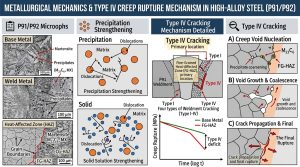
P91 鋼的優異潛變抗力,源於其正火加回火(Normalizing and Tempering)後形成的「板條狀回火馬氏體(Lath Tempered Martensite)」基體23。在此基體上,富鉻的M23C6 碳化物大量析出並釘紮(Pinning)於原奧氏體晶界(Prior Austenite Grain Boundaries, PAGB)與馬氏體板條邊界,有效阻礙高溫下晶界的滑移與位錯運動;同時,富釩與鈮的奈米級 MX 型碳氮化物均勻散佈於板條內部,進一步鎖死位錯4。這兩種析出物的協同釘紮效應構成了 P91 高溫潛變強度的基石,然而,這種高度組織化的微觀結構對熱循環極度敏感。 The superior creep resistance of P91 steel originates from its “Lath Tempered Martensite” matrix formed after Normalizing and Tempering23. Within this matrix, Cr-rich M23C6 carbides precipitate extensively and pin the Prior Austenite Grain Boundaries (PAGB) and martensite lath boundaries, effectively obstructing grain boundary sliding and dislocation movement at high temperatures. Simultaneously, V/Nb-rich nanoscale MX-type carbonitrides are uniformly distributed inside the laths, further locking dislocations4. The synergistic pinning effect of these two precipitates constitutes the foundation of P91’s high-temperature creep strength; however, this highly organized microstructure is extremely sensitive to thermal cycling.
3.2 銲接熱影響區 (HAZ) 的微觀組織退化 / 3.2 Microstructural Degradation in the Heat-Affected Zone (HAZ)
當採用 1.5D 彎頭拼接管線時,必然引入大量的環向銲縫。銲接過程的巨大熱量會在母材旁形成熱影響區(HAZ)。依據峰值溫度的不同,HAZ 由近至遠可細分為:粗晶區(CGHAZ)、細晶區(FGHAZ)與臨界過渡區(Intercritical HAZ, ICHAZ)1。其中,第四型潛變破裂的種子便深埋於 ICHAZ 之中。 When using 1.5D elbows to assemble piping, a large number of girth welds are inevitably introduced. The massive heat from the welding process forms a Heat-Affected Zone (HAZ) adjacent to the base metal. Depending on peak temperatures, the HAZ can be subdivided from near to far into: Coarse-Grained HAZ (CGHAZ), Fine-Grained HAZ (FGHAZ), and Intercritical HAZ (ICHAZ)1. The seeds of Type IV creep cracking are deeply buried within the ICHAZ.
在 ICHAZ 中,其經歷的峰值溫度剛好介於鋼材的 AC1(肥粒鐵開始轉變為奧氏體)與 AC3(完全轉變為奧氏體)相變溫度之間1。此溫床下的熱循環會導致母材發生部分奧氏體化(Partial Austenitization)。原本釘紮於晶界的 M23C6 碳化物會部分溶解入基體中,但由於銲接加熱時間極短,碳原子無法充分擴散均勻。在隨後的冷卻過程中,這些碳化物無法重新形成細小均勻的析出,反而發生嚴重的粗化(Coarsening)與聚集8。更致命的是,由於失去了細小析出物的釘紮效應,原奧氏體晶界(PAGB)發生回復與再結晶,形成細小且缺乏強化相的等軸鐵素體晶粒,使 ICHAZ 在微觀力學上徹底退化為一個「軟化帶(Soft Zone)」1。 In the ICHAZ, the peak temperature experienced lies exactly between the steel’s AC1 (ferrite begins transforming to austenite) and AC3 (complete transformation to austenite) phase transition temperatures1. Thermal cycling in this breeding ground causes partial austenitization of the base metal. The M23C6 carbides originally pinning the grain boundaries partially dissolve into the matrix; however, due to the extremely brief welding heating time, carbon atoms cannot diffuse evenly. During the subsequent cooling process, these carbides fail to reform as fine, uniform precipitates, instead undergoing severe coarsening and agglomeration8. More fatally, losing the pinning effect of fine precipitates causes the Prior Austenite Grain Boundaries (PAGB) to recover and recrystallize, forming fine equiaxed ferrite grains lacking strengthening phases. This completely degrades the ICHAZ micro-mechanically into a “Soft Zone”1.
3.3 第四型潛變破裂的力學觸發條件與孔洞演化 / 3.3 Mechanical Trigger Conditions and Void Evolution of Type IV Cracking
高解析度硬度測試證實了此一微觀退化:P91 母材的硬度通常維持在 220-250 HV 左右,銲縫金屬(Weld Metal)因合金成分差異強度更高,然而 ICHAZ 軟化帶的硬度會陡降至 180 HV 甚至更低1。 High-resolution hardness testing confirms this microstructural degradation: the hardness of the P91 base metal is typically maintained around 220-250 HV, and the Weld Metal is even stronger due to differing alloy compositions; however, the hardness in the ICHAZ soft zone plummets to 180 HV or even lower1.
在管線服役期間(如 600°C – 650°C),管線承受內部高壓及系統熱膨脹所產生的彎矩,此一極度狹窄的 ICHAZ 軟化帶被強行夾在強度與剛性較高的母材與銲縫之間。由於軟化帶的潛變變形率(Creep Rate)遠高於兩側(文獻實測指出 ICHAZ 的潛變變形率可達 174.6 μm/h,而周圍區域僅約 28-46 μm/h),兩側的剛性約束會在此微觀區域內引發高度的三軸應力態(Triaxial Stress State)1。 During piping service (e.g., 600°C – 650°C), the piping bears internal high pressure and bending moments generated by systemic thermal expansion. This extremely narrow ICHAZ soft zone is forcibly sandwiched between the stronger, more rigid base metal and weld metal. Because the creep rate of the soft zone is vastly higher than both sides (literature measurements indicate the ICHAZ creep rate can reach 174.6 μm/h, while surrounding areas are only about 28-46 μm/h), the rigid constraints from both sides induce a high degree of Triaxial Stress State within this micro-region1.
三軸應力不僅限制了材料的巨觀塑性變形,更會極大化靜水拉應力(Hydrostatic Tensile Stress)。在此應力驅動下,空位聚集,潛變孔洞(Creep Voids)在原奧氏體晶界及粗化的碳化物周圍快速形核並長大1。孔洞經歷初始、成長至互相串接(Coalescence),最終形成楔形(Wedge-type)微裂紋,導致管線在極小的巨觀變形下發生無預警的脆性斷裂1。此即為著名的 Type IV Cracking。統計與實驗表明,P91 銲接接頭在 650°C 下的潛變壽命,可能大幅縮水至母材壽命的五分之一甚至更低1。 Triaxial stress not only restricts the macroscopic plastic deformation of the material but also maximizes Hydrostatic Tensile Stress. Driven by this stress, vacancies agglomerate, and Creep Voids rapidly nucleate and grow along prior austenite grain boundaries and around coarsened carbides1. The voids progress from initiation to growth and eventual coalescence, ultimately forming wedge-type microcracks that cause the piping to undergo unpredicted brittle fracture with minimal macroscopic deformation1. This is the infamous Type IV Cracking. Statistics and experiments show that the creep life of a P91 weld joint at 650°C can dramatically shrink to one-fifth or even less of the base metal’s life1.
藉由導入 3D/5D 數控冷作彎管技術,管線轉向處不再需要進行環向銲接,徹底消滅了 ICHAZ 軟化帶的物理存在,從幾何與材料本質上拔除了第四型潛變破裂的根源,實現了管線全壽命週期的結構完整性4。 By implementing 3D/5D CNC cold bending technology, girth welding is no longer required at directional changes, completely physically eliminating the ICHAZ soft zone and uprooting the source of Type IV creep cracking geometrically and metallurgically, thereby realizing full life-cycle structural integrity of the piping4.
四、 流體動力學與流動加速腐蝕 (FAC) 抑制分析 / IV. Fluid Dynamics and Flow-Accelerated Corrosion (FAC) Suppression Analysis
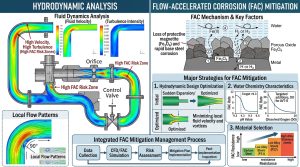
高能管線在承受高溫高壓與潛變威脅之外,管內高速流動的單相水或汽水兩相流(如凝結水、給水或廢熱回收管線)亦會對管壁造成嚴重的流動加速腐蝕(Flow-Accelerated Corrosion, FAC)。FAC 是一種結合化學溶解與流體剪應力沖刷的複合破壞機制。其核心在於:碳鋼或低合金鋼管壁表面原本會生成一層具保護性的磁鐵礦(Magnetite, Fe3O4)氧化膜,但在高速湍流(Turbulence)的強烈剪應力沖刷下,此保護膜被局部剝離或溶解,導致底層活性金屬持續暴露並氧化,最終引發管壁快速減薄甚至爆管11。 Beyond enduring high temperatures, high pressures, and creep threats, high-energy piping is also subjected to severe Flow-Accelerated Corrosion (FAC) caused by high-velocity single-phase water or two-phase steam-water flow (such as condensate, feedwater, or heat recovery piping). FAC is a complex failure mechanism combining chemical dissolution and fluid shear stress erosion. Its core lies in the fact that a protective magnetite (Fe3O4) oxide layer naturally forms on the surface of carbon or low-alloy steel pipes. However, under the intense shear stress erosion of high-velocity turbulence, this protective layer is locally stripped or dissolved, leading to the continuous exposure and oxidation of the underlying active metal, ultimately causing rapid wall thinning and even burst pipes11.
4.1 阻力係數 (K-Factor) 與局部壓降之水力學差異 / 4.1 Resistance Coefficient (K-Factor) and Hydraulic Differences in Local Pressure Drop
管線彎曲半徑直接決定了流體流經該幾何突變處的局部水力阻力。在工程流體力學中,通常以局部阻力係數(Resistance coefficient, K)來量化由配件引起的動態壓降(Dynamic Pressure Drop, ΔP)。達西–魏斯巴赫(Darcy-Weisbach)等效公式表示為:The bend radius of a pipe directly determines the local hydraulic resistance as fluid flows through that geometric transition. In engineering fluid mechanics, dynamic pressure drop (ΔP) caused by fittings is typically quantified by the local resistance coefficient (K). The equivalent Darcy-Weisbach formula is expressed as:
ΔP=K⋅(ρv2)/2
其中 ρ 為流體密度,v 為平均核心流速10。或可轉換為等效直管長度 Le=(K⋅D)/f。 Where ρ is the fluid density and v is the mean core flow velocity10. Alternatively, it can be converted to an equivalent straight pipe length Le=(K⋅D)/f.
根據 Crane TP-410 方法及大量實驗數據,傳統的 1.5D 離散銲接彎頭(短半徑 1.0D 或標準長半徑 1.5D),其幾何轉折過於急促。流體流經時會產生強烈的慣性撞擊,其 90° 彎角的 K 值通常高達 0.75∼0.90(等效管長約L/D≈16∼20)10。相對地,當彎曲半徑擴展至 3D 甚至 5D 時,流道變得極為平滑和緩,流線(Streamlines)得以順暢轉向。此時 K 值可大幅下降至 0.20∼0.35左右,局部阻力減少了 15% 至 50%10。這意味著 3D/5D 彎管能以極低的局部壓降完成相同角度的轉向,大幅降低泵浦能耗並提升整廠熱力學效率30。 According to the Crane TP-410 method and extensive experimental data, traditional 1.5D discrete welded elbows (1.0D short radius or 1.5D standard long radius) possess overly abrupt geometric turns. When fluid flows through, strong inertial impacts occur; the K value for a 90° elbow typically reaches as high as 0.75∼0.90 (equivalent pipe length L/D≈16∼20)10. Conversely, when the bend radius is expanded to 3D or 5D, the flow path becomes exceptionally smooth and gentle, allowing streamlines to turn fluidly. At this point, the K value can drop significantly to around 0.20∼0.35, reducing local resistance by 15% to 50%10. This implies that 3D/5D bends can achieve the same directional change with an extremely low local pressure drop, drastically cutting pump energy consumption and enhancing overall plant thermodynamic efficiency30.
4.2 邊界層分離 (Boundary Layer Separation) 與 FAC 抑制機制 / 4.2 Boundary Layer Separation and FAC Suppression Mechanisms
在微觀流場結構上,流體在 1.5D 彎頭內部流動時,內弧側(Intrados)頂點下游會遭遇極為陡峭的逆壓梯度(Adverse Pressure Gradient)。這會強制引發流體邊界層嚴重分離,形成巨大的迴流渦旋區(Recirculating Eddy Regions)及強烈的二次流(Secondary Flow / Dean Vortices)10。這些高強度的近壁面湍流與渦漩會產生極大的壁面剪應力,迅速剝離金屬表面的 Fe3O4 氧化保護層;同時,局部壓降甚至可能引發空穴現象(Cavitation),使 1.5D 彎頭的內、外側及下游直管段成為 FAC 破裂與沖蝕的高危險區9。 In terms of micro-flow field structure, when fluid travels inside a 1.5D elbow, it encounters a remarkably steep Adverse Pressure Gradient downstream of the intrados apex. This forcefully triggers severe fluid boundary layer separation, forming massive Recirculating Eddy Regions and intense Secondary Flow (Dean Vortices)10. These high-intensity near-wall turbulences and vortices generate immense wall shear stress, rapidly stripping the Fe3O4 protective oxide layer on the metal surface. Simultaneously, local pressure drops may even induce cavitation, turning the intrados, extrados, and downstream straight pipe segments of 1.5D elbows into high-risk zones for FAC rupture and erosion9.
透過導入 3D/5D 大曲率冷作彎管,流體的流線得以完美貼合管壁,逆壓梯度被大幅平緩,邊界層分離現象被極大程度地抑制,二次迴流強度急遽下降且尾流(Wake)區域縮小10。這從流體力學的根源上減緩了 FAC 的質傳速率(Mass Transfer Rate),消除了管壁的異常沖刷,大幅延長高能管線在汽水兩相流條件下的安全服役壽命,並且能保證管內智慧型清管器(ILI Pig)的順暢通行而不卡阻10。 By incorporating 3D/5D large-curvature cold bends, fluid streamlines perfectly hug the pipe wall, the adverse pressure gradient is vastly smoothed out, boundary layer separation is suppressed to the greatest extent, secondary recirculation intensity drops sharply, and the wake region shrinks10. This mitigates the FAC Mass Transfer Rate from a fundamental fluid dynamics level, eliminates abnormal wall erosion, substantially extends the safe service life of high-energy piping under two-phase flow conditions, and guarantees the smooth passage of In-Line Inspection (ILI) Pigs without jamming10.
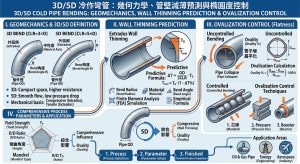
五、 3D/5D 冷作彎管之幾何力學、管壁減薄預測與橢圓度控制 / V. Geometric Mechanics, Wall Thinning Prediction, and Ovality Control of 3D/5D Cold Bends
雖然 3D/5D 彎管在冶金與流體動力學上具備壓倒性優勢,但金屬管材在室溫下的冷塑性變形過程中,必然伴隨管壁減薄與截面橢圓化(Ovality)等幾何畸變。工程上普遍採用數控旋轉拉彎(CNC Rotary Draw Bending)搭配芯棒(Mandrel)與助推裝置來精密成形3。必須透過嚴格的力學模型與 ASME 規範進行預估與補償,方能確保成型後的實體滿足高壓承載要求。 Although 3D/5D bends hold overwhelming metallurgical and fluid-dynamic advantages, the cold plastic deformation process of metal pipes at room temperature inevitably entails geometric distortions like wall thinning and cross-sectional ovality. Industrially, CNC Rotary Draw Bending paired with a mandrel and booster system is widely used for precision forming3. Strict mechanical models and ASME codes must be applied for prediction and compensation to ensure the formed product meets high-pressure load-bearing requirements.
5.1 彎曲過程中的應力狀態與應變分布 / 5.1 Stress States and Strain Distribution During the Bending Process
在旋轉拉彎力矩的作用下,管截面的中性軸(Neutral Axis)會向內弧側(Intrados)偏移。中性軸外側的纖維(Extrados)承受切線方向的拉應力(Tensile Stress),發生顯著的塑性伸長,導致管壁減薄(Wall Thinning);而內弧側纖維則承受壓應力(Compressive Stress),管壁發生擠壓增厚。若機台模具支撐力不足,內弧側甚至會引發起皺(Wrinkling),這在受壓管線中是絕對不被允許的瑕疵,因其會產生應力集中點並阻礙管內流動34。最大纖維應變率(ϵ)的理論估算公式為: Under the influence of rotary draw bending moments, the pipe cross-section’s Neutral Axis shifts toward the intrados. Fibers on the outside of the neutral axis (Extrados) bear tangential Tensile Stress, undergoing significant plastic elongation that causes Wall Thinning. Conversely, intrados fibers bear Compressive Stress, causing the wall to compress and thicken. If machine tooling support is insufficient, the intrados may even suffer wrinkling, a flaw strictly prohibited in pressure piping as it creates stress concentration points and obstructs internal flow34.The theoretical estimation formula for the maximum fiber strain rate (ϵ) is:
ϵ=r/R_1 ×100%
其中,r 為管材外徑的一半(即OD/2),R1 為彎曲中心線半徑(Centerline Radius, CLR)4。依此公式,對於一個標準的 3D 彎管(R1 = 3D),其理論最大應變率高達 16.7%;而對於 5D 彎管(R1 = 5D),其應變率則為: Where r is half the pipe’s outside diameter (OD/2), and R1 is the bend Centerline Radius (CLR)4.Based on this formula, for a standard 3D bend (R1 = 3D), the theoretical maximum strain rate is as high as 16.7%; for a 5D bend (R1 = 5D), the strain rate is:
ϵ=(D/2)/5D×100%=10%
此 10% 的應變極限在後續的熱處理規範中具有決定性的法規觸發意義4。 This 10% strain limit holds decisive regulatory triggering significance in subsequent heat treatment codes4.
5.2 管壁減薄預測與 ASME B31.3 規範補償 / 5.2 Wall Thinning Prediction and ASME B31.3 Code Compensation
為了確保減薄後的彎管外弧側仍能承受設計內壓,ASME B31.3 第 304.2.1 節定義了彎管各部位所需的最小壁厚 tm,並引入了極為關鍵的幾何修正係數 I(Lorenz factor)37。彎管內壓應力會重新分布,內弧側需要承受比直管更高的壓力應力,而外弧側則較為寬鬆。規範規定的修正係數如下: To ensure that the thinned extrados of the bend can still withstand design internal pressure, ASME B31.3 paragraph 304.2.1 defines the minimum wall thickness tm required at various sections of the bend and introduces the highly critical geometric correction factor I (Lorenz factor)37. Pressure stress inside a bend redistributes; the intrados must bear higher pressure stress than a straight pipe, while the extrados is relatively relaxed. The correction factors prescribed by the code are:
內弧側(Intrados)修正係數Iintrados / Intrados correction factor Iintrados:
Iintrados=[4(R/D)-1]/[4(R/D)-2]
外弧側(Extrados)修正係數 Iextrados / Extrados correction factor Iextrados:
Iextrados=[4(R/D)+1]/[4(R/D)+2]
內壓作用下的最小需求壁厚公式則修正為 / The minimum required wall thickness formula under internal pressure is modified to:
tm (I)=[P⋅D/2(S⋅E⋅W/I+P⋅Y)]+A
其中 P 為設計內部表壓,S 為容許應力,E 為縱向銲縫品質係數,W 為銲縫強度減弱係數,Y 為溫度係數,A 為腐蝕裕度17。 Where P is the design internal gauge pressure, S is the allowable stress, E is the longitudinal weld joint quality factor, W is the weld joint strength reduction factor, Y is the temperature coefficient, and A is the corrosion allowance17.
以一個 5D 彎管(R/D = 5)為例:Taking a 5D bend (R/D = 5) as an example:
Iintrados=19/18≈1.055,意味著內弧側需要比直管厚 5.5% 以抵抗較高的應力。 Iextrados=21/22≈0.954,意味著外弧側的應力狀態相對寬鬆,需求厚度較低37。Iintrados=19/18≈1.055, meaning the intrados needs to be 5.5% thicker than straight pipe to resist higher stresses . Iextrados=21/22≈0.954, meaning the extrados stress state is relatively relaxed, thus demanding less thickness37.
然而,在實際冷彎工法中,外弧側的物理減薄量往往高達 9% 至 14.3%(依材質與工法而異,簡化估算式為t2≈t1×R/(R+OD/2))39。為了抵銷此不可逆的物理減薄,工程設計上常需提高直管母材的採購壁厚(Schedule,例如由 SCH80 提升至 SCH160),以確保成型後的外弧側最薄點仍大於法規要求的 tm(Iextrados )37。 However, in practical cold bending, physical wall thinning at the extrados frequently reaches 9% to 14.3% (depending on material and process; a simplified estimate is t2≈t1×R/(R+OD/2)))39. To offset this irreversible physical thinning, engineering designs often require purchasing base straight pipes with higher wall thickness (Schedule, e.g., upgrading from SCH80 to SCH160) to ensure the thinnest point on the formed extrados remains greater than the code-mandated tm(Iextrados )37.
5.3 橢圓度 (Ovality) 控制極限 / 5.3 Ovality Control Limits
冷作彎管的另一關鍵品質指標為截面扁平化,即橢圓度。過度的橢圓度不僅降低管線抗外壓與抗彎矩屈曲(Buckling)的能力,更會對應力集中造成負面影響10。橢圓度計算公式為 : Another critical quality metric for cold bends is cross-sectional flattening, or ovality. Excessive ovality not only degrades the pipe’s ability to resist external pressure and bending moment buckling but also negatively impacts stress concentration10.The ovality calculation formula is:
Ovality (%)=(ODmax-ODmin)/(ODnominal )×100%
依據 API 5L 與 ASME B31 規範,通常將高壓管線(或允許通球的管線)的橢圓度嚴格限制在 2% 至 3% 以內(對於高壓氣體傳輸有時甚至要求 ≦ 1.5% 或最大 8%)35。透過多球芯棒(Multi-ball Mandrel)與防皺板(Wiper Die)的精確支撐調控,現代 CNC 冷彎機能在極端的外徑對壁厚比(D/t Ratio)下,將 3D/5D 彎管的橢圓度穩定控制於規範極限內35。 According to API 5L and ASME B31 codes, ovality for high-pressure pipelines (or piggable lines) is typically strictly limited to within 2% to 3% (sometimes even requiring ≦ 1.5% or up to a maximum 8% for high-pressure gas transmission)35. With precise support adjustments using multi-ball mandrels and wiper dies, modern CNC cold benders can stably control 3D/5D bend ovality within code limits even under extreme outer diameter-to-wall thickness (D/t) ratios35.
六、 冷成形應變極限與次臨界成型後熱處理 (IH-PBHT) 策略 / VI. Cold Forming Strain Limits and Subcritical Post-Bend Heat Treatment (IH-PBHT) Strategies
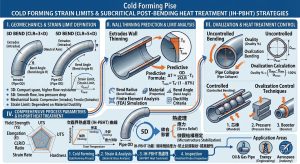
由前述力學推導可知,5D 彎管的成型應變率約為 10%,3D 彎管則高達 16.7%34。如此劇烈的巨觀塑性變形,會導致金屬晶格內部累積龐大的位錯密度(Dislocation Density),引發嚴重的加工硬化(Strain Hardening),並大幅降低材料的延展性與衝擊韌性14。對於微觀組織極度敏感的高合金 P91/P92 材料而言,這將劇烈增加服役期間應力腐蝕開裂(SCC)與氫脆的風險。 From the preceding mechanical derivations, the forming strain rate is roughly 10% for a 5D bend, and up to 16.7% for a 3D bend34. Such dramatic macroscopic plastic deformation causes massive dislocation density accumulation within the metal lattice, inducing severe strain hardening, and significantly reducing material ductility and impact toughness14. For highly microstructure-sensitive high-alloy P91/P92 materials, this drastically increases the risks of Stress Corrosion Cracking (SCC) and hydrogen embrittlement during service.
6.1 ASME B31.3 第 332.4 節之強制法規界定 / 6.1 Mandatory Code Definitions in ASME B31.3 Paragraph 332.4
在 ASME B31.3 (2024/2026 版) 第 332.4 節(Cold Bending and Forming)中,針對冷作彎管設定了嚴格的法規門檻。規範 Table 332.4.2a (Post-Cold-Forming Strain Limits and Heat Treatment) 明確指出,對於 P-No. 15E(即 P91、P92 等合金鋼)材料,當冷成形的最嚴重殘餘應變(Maximum calculated strain)觸及特定極限時,成型後熱處理(Post-Bend Heat Treatment, PBHT)將成為法定的強制義務13。 In ASME B31.3 (2024/2026 Editions) paragraph 332.4 (Cold Bending and Forming), strict regulatory thresholds are established for cold bends. Code Table 332.4.2a (Post-Cold-Forming Strain Limits and Heat Treatment) explicitly states that for P-No. 15E materials (i.e., P91, P92 alloy steels), when the maximum calculated strain from cold forming reaches specific limits, Post-Bend Heat Treatment (PBHT) becomes a mandatory legal obligation13.
具體而言,針對 P91/P92 管材,一旦應變率觸及或超過 10% 極限值(如 5D 彎管的邊界值或更緊湊的 3D 彎管),嚴禁直接服役,必須透過熱處理機制釋放殘餘應力並恢復材料延展性2。 Specifically, for P91/P92 piping, once the strain rate hits or exceeds the 10% limit (such as the boundary value for 5D bends or tighter 3D bends), direct service is strictly prohibited; a heat treatment mechanism must be utilized to relieve residual stress and restore material ductility2.
6.2 次臨界熱處理 (IH-PBHT) 與 正火加回火 (N+T) 之冶金抉擇 / 6.2 Metallurgical Choice: Subcritical Heat Treatment (IH-PBHT) vs. Normalizing and Tempering (N+T)
對於 P91/P92 材料的 PBHT,熱處理溫度的選擇是決定管線高溫潛變壽命的絕對關鍵。傳統的熱推彎管(Hot Induction Bending)由於在成型過程中將材料加熱至奧氏體化溫度(約 950°C-1050°C)進行熱塑性變形,完全破壞了鋼廠出廠時的原始組織,因此成型後必須進行完整的「正火加回火(Normalizing and Tempering, N+T)」熱處理,以重新建立回火馬氏體組織24。然而,若管件僅為局部加熱(如中頻感應加熱),N+T 處理會在加熱區與非加熱區的過渡段再次產生類似銲接 HAZ 的軟化帶,造成多重過度回火(Over-tempered)區域,極大化了提早破裂的風險38。 For the PBHT of P91/P92 materials, the choice of heat treatment temperature is the absolute key deciding the pipeline’s high-temperature creep life. Because traditional Hot Induction Bending heats the material to austenitizing temperatures (approx. 950°C-1050°C) for thermoplastic deformation, it completely destroys the original microstructure established at the steel mill. Consequently, a complete “Normalizing and Tempering (N+T)” heat treatment must be performed post-forming to re-establish the tempered martensitic structure24. However, if the fitting is only locally heated (like mid-frequency induction heating), the N+T process will once again create a soft zone similar to a welding HAZ in the transition area between heated and non-heated sections. This creates multiple over-tempered zones, maximizing the risk of premature failure38.
相反地,室溫冷作彎管(Cold Bending)在物理成形過程中並未改變材料的相態,僅改變了晶粒的幾何形狀並累積內應力。因此,對應冷彎工法最佳的熱處理策略是採用「次臨界感應加熱成型後熱處理(Subcritical Induction Heating Post-Bend Heat Treatment, IH-PBHT)」2。 In contrast, room-temperature Cold Bending does not alter the material’s phase during physical forming; it merely alters grain geometry and accumulates internal stress. Therefore, the optimal heat treatment strategy for the cold bending process is “Subcritical Induction Heating Post-Bend Heat Treatment (IH-PBHT)”2.
該熱處理過程將峰值溫度嚴格控制在下臨界相變溫度 AC1 以下(通常介於 730°C 至 780°C 之間,視具體鋼廠建議而定,如 740°C 或 760°C)24。在此次臨界溫度下持溫(通常遵循每英吋壁厚持溫一小時的原則),熱能足以促使材料內部的位錯發生攀移與湮滅(Annihilation),有效釋放宏觀殘餘應力並軟化加工硬化基體;更重要的是,此溫度完全避免了奧氏體相變的發生,原有的 M23C6 與 MX 析出物不會大量溶解,完美保留了鋼廠賦予的最佳微觀晶界結構與潛變抗力4。此工法精準迴避了溫度過衝引發的相變危機,使 5D 冷彎管的力學性能幾近等同於完美母材4。 This heat treatment strictly controls the peak temperature below the lower critical phase transition temperature AC1 (typically between 730°C and 780°C, depending on steel mill recommendations, e.g., 740°C or 760°C)24. Soaking at this subcritical temperature (generally following a rule of one hour per inch of wall thickness) provides enough thermal energy to induce dislocation climb and annihilation, effectively releasing macroscopic residual stresses and softening the strain-hardened matrix. Crucially, this temperature entirely avoids austenitic phase transformation, meaning the original M23C6 and MX precipitates do not dissolve en masse, perfectly preserving the optimal microscopic grain boundary structure and creep resistance imparted by the steel mill4. This method precisely evades the phase change crisis caused by temperature overshoot, rendering the mechanical performance of a 5D cold bend virtually identical to pristine base metal4.
七、 ASME B31J 規範演進與應力強化因子 (SIF) 之解耦優化 / VII. ASME B31J Code Evolution and the Decoupling Optimization of Stress Intensification Factors (SIF)
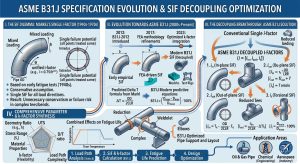
隨著實體硬體工法轉向 3D/5D 彎管,管線彈性應力分析的數學模型與規範也迎來了半世紀以來最大的變革。長期以來,高能管線的分析遵循 ASME B31.1 或 ASME B31.3 附錄 D。然而,這些舊版規範的數據源自 1950 年代 Markl 所進行的簡化彎曲疲勞測試。測試涵蓋管件種類稀少,且推導的數學模型過於粗糙與保守,已無法反映現代管件真實的力學行為12。 As physical hardware methodologies pivot towards 3D/5D bends, the mathematical models and codes for elastic piping stress analysis have also witnessed their greatest revolution in half a century. For a long time, high-energy piping analysis adhered to ASME B31.1 or ASME B31.3 Appendix D. However, the data in these legacy codes stemmed from Markl’s simplified bending fatigue tests in the 1950s. These tests covered few fitting types, and the derived mathematical models were too coarse and conservative, no longer reflecting the true mechanical behavior of modern fittings12.
7.1 舊版 Appendix D 之數學侷限性 / 7.1 Mathematical Limitations of Legacy Appendix D
在傳統規範中,為了涵蓋不確定性,應力強化因子(SIF, i)的取法極為保守。以 B31.1 為例,對於面內(In-plane)與面外(Out-of-plane)彎矩,規範一律強制選用兩者中較大的一個 SIF 值套用於全域三維矩陣,並同時將扭轉應力納入持續載荷計算中18。B31.3 雖然區分了面內外 SIF,但對於許多複雜管件(如對銲三通)的柔性因子皆強制作為 k = 1.0(即視為絕對剛體),完全忽略了真實金屬薄殼體在受力時所發生的局部橢圓變形(Ovalization)對吸收與釋放應變能的貢獻13。 In legacy codes, to encompass uncertainties, the extraction of Stress Intensification Factors (SIF, i) was exceedingly conservative. Taking B31.1 as an example, for both in-plane and out-of-plane bending moments, the code forced the selection of the larger SIF value of the two to be applied across the global 3D matrix, and simultaneously mandated the inclusion of torsional stress in sustained load calculations18. Although B31.3 differentiated in-plane and out-of-plane SIFs, it forced the flexibility factor k = 1.0 (treating them as absolute rigid bodies) for many complex fittings (like welded tees), entirely ignoring the contribution to strain energy absorption and release provided by local ovalization that occurs when real metal shells bear loads13.
這種將 SIF 視為單一幾何絕對函數且忽略空間方向差異的作法,導致工程師在進行管線應力分析時,經常遭遇「數學上應力嚴重超標,但物理上絕對安全」的系統悖論。這迫使設計者盲目增加大體積的熱膨脹環或剛性支撐,反而使管線系統過於僵硬,將無解的熱推力轉移至端點設備上42。 This approach of treating the SIF as a single geometric absolute function and ignoring spatial directional differences led engineers performing piping stress analysis to frequently encounter a systemic paradox: “mathematically severely overstressed, but physically absolutely safe.” This forced designers to blindly insert bulky thermal expansion loops or rigid supports, making the piping system overly stiff and transferring unresolvable thermal thrusts onto terminal equipment42.
7.2 ASME B31J 的數值解耦矩陣與 SIF 計算 / 7.2 ASME B31J Numerical Decoupling Matrix and SIF Calculations
為解決此一數學失真,ASME 推出並強制導入了 B31J (Standard Test Method for Determining Stress Intensification Factors for Metallic Piping Components) 規範(B31.3 於 2020 年,B31.1 於 2024 年正式刪除附錄 D 並要求引用 B31J)21。B31J 揚棄了單一 SIF 的概念,利用高解析度有限元素分析(FEA)結合現代真實驗證,將管件的力學行為在三個空間自由度上進行解耦12。 To resolve this mathematical distortion, ASME released and mandatorily integrated the B31J (Standard Test Method for Determining Stress Intensification Factors for Metallic Piping Components) code (B31.3 formally deleted Appendix D in 2020, and B31.1 in 2024, requiring B31J citations)21. B31J abandons the single SIF concept, utilizing high-resolution Finite Element Analysis (FEA) combined with modern empirical validation to decouple the mechanical behavior of fittings across three spatial degrees of freedom12.
以彎管(Elbow / Bend)為例,B31J 首先計算核心幾何參數——柔性特徵值(Flexibility Characteristic, h):Using bends (Elbow/Bend) as an example, B31J first calculates the core geometric parameter—Flexibility Characteristic (h):
h=T⋅R1/r22 其中 T 為管壁厚,R1 為彎曲半徑,r2 為管材平均半徑50。 (Where T is the nominal wall thickness, R1 is the bend radius, and r2 is the mean radius of the matching pipe50.)
基於 h,B31J 解耦定義了彎管的 SIF 與柔性因子:Based on h, B31J decouples and defines the bend’s SIF and flexibility factors:
- 面內應力強化因子 / In-plane SIF: ii=0.9/h2/3
- 面外應力強化因子 / Out-of-plane SIF: io=0.75/h2/3
- 扭轉應力強化因子 / Torsional SIF: it=0
- 柔性因子 / Flexibility Factor: k=1.65/h(規範嚴格強調:任何情況下,計算出的 SIF 與 k 值若小於0,皆必須以直管基準值 1.0 作為下限)4。 (The code strictly emphasizes: under no circumstances shall calculated SIF and k values be less than the straight pipe baseline value of 1.0)4.
從數學公式可以輕易洞察:當工程採用 3D 或 5D 彎管時,其彎曲半徑 R1 急遽增加(相對於 1.5D 彎頭),導致柔性特徵參數 h 大幅上升。隨著 h 值的顯著增大,ii 與 io 的計算值會以非線性幅度急遽下降,直至觸及法規底線 1.0。這意味著 3D/5D 彎管不僅在物理上消除了銲縫弱點,在數學應力矩陣中的應力集中乘數也極大幅度地被削弱50。 From the mathematical formula, it is easy to deduce: when engineering employs 3D or 5D bends, their bend radius R1 increases sharply (relative to 1.5D elbows), causing the flexibility characteristic parameter h to rise substantially. As the h value significantly increases, the calculated values for ii and io drop sharply in a non-linear fashion until they hit the regulatory floor of 1.0. This means that 3D/5D bends not only physically eliminate weld vulnerabilities but also massively weaken the stress concentration multiplier within the mathematical stress matrix50.
7.3 持續載荷應力指數 (SSI) 的顛覆性修正 / 7.3 Disruptive Revision of the Sustained Stress Index (SSI)
B31J 對於高溫高壓管線最深遠的力學變革,在於重新定義了「持續載荷應力指數(Sustained Stress Index, SSI)」。在舊版 Appendix D 的年代,計算自重與內壓等不可逆持續載荷(Sustained Loads, SL)時,其應力乘數通常被粗暴地綁定為 0.75i(或至少為 1.0)4。由於某些管件的 i 值極高,乘以 0.75 後依然龐大,這導致系統在純靜態載荷下,極易被判定為超過降伏強度引發塑性坍塌(Plastic Collapse)而失效52。 The most profound mechanical revolution brought by B31J for high-temperature/high-pressure piping is the redefinition of the “Sustained Stress Index (SSI).” In the legacy Appendix D era, when calculating irreversible sustained loads (SL) like weight and internal pressure, the stress multiplier was typically crudely bound to 0.75i (or at least 1.0)4. Because the i values of certain fittings were extremely high, multiplying by 0.75 still left a massive figure, causing systems to easily be judged as failing via Plastic Collapse under purely static loads for exceeding yield strength52.
B31J 基於嚴謹的極限載荷(Limit Load)塑性力學與 FEA 驗證,指出由幾何不連續引起的局部峰值應力,並不會導致整個截面厚度的巨觀塑性崩塌。因此,B31J 的通用註解 General Note (d) 明確規範,對於大部分符合厚壁條件的彎管與交界處,其計算持續應力的 SSI 可直接取為 1.0,完全脫鉤於處理交變疲勞的 SIF 值12。這一修正(從極度保守的 0.75i 斷崖式下降至 1.0)瞬間為系統釋放了超過 20% 至 40% 的安全裕度,讓持續應力的計算回歸物理常理,避免了虛假的法規報警13。 Based on rigorous Limit Load plasticity mechanics and FEA validation, B31J points out that local peak stresses caused by geometric discontinuities do not lead to macroscopic plastic collapse across the entire section thickness. Therefore, B31J’s General Note (d) explicitly stipulates that for most bends and intersections meeting thick-wall criteria, the SSI used to calculate sustained stress can be taken directly as 1.0, completely decoupling it from the SIF values used for alternating fatigue12. This revision (a cliff-drop from the overly conservative 0.75i down to 1.0) instantly frees up over 20% to 40% of safety margin for the system, returning sustained stress calculation to physical common sense and avoiding false regulatory alarms13.
此外,配合 ASME B31.3 近年版本的更新,疲勞壽命因子(f)亦由舊版的f=6.0N-0.2 修正為更符合真實金屬物理特性的 f=20N-0.333(將疲勞曲線斜率調整為 3:1)。結合 B31J 大幅下降的 SIF,5D 冷彎管的理論疲勞損傷累積率呈現指數級的降低54。 Additionally, aligned with recent ASME B31.3 updates, the fatigue life factor (f) was revised from the old f=6.0N-0.2 to a more physically realistic f=20N-0.333 (adjusting the fatigue curve slope to 3:1). Combined with the significantly lowered SIFs in B31J, the theoretical fatigue damage accumulation rate of 5D cold bends shows an exponential decrease54.
| 評估維度 / Evaluation Dimension | 傳統 ASME B31.3 / B31.1 (Appendix D) | 現代 ASME B31J 理論架構 / Modern ASME B31J Framework | 物理與工程實質意義 / Physical & Engineering Significance |
| SIF方向性區分 / SIF Directionality | B31.1採最大值;B31.3僅部分區分
B31.1 takes max; B31.3 partially differentiates |
全面解耦面內(ii)、面外(io)、扭轉(it)
Fully decoupled In-plane(ii), Out-of-plane(io), Torsion(it) |
準確反映空間中不同彎矩方向的真實破壞潛力12
Accurately reflects true failure potential of varying moment directions |
| 柔性因子(k) / Flexibility Factor | 三通等複雜交界管件強制設為 1.0 (視為剛體)
Forced 1.0 (rigid) for complex tees |
依據幾何特徵計算 6 自由度獨立之 k 值
Calculates independent k across 6 DOF based on geometry |
解放管件局部橢圓化之真實變形能力,降低全域管線剛度13
Liberates true ovalization capability, lowering global pipe stiffness |
| 持續應力指數(SSI) / Sustained Stress Index | 綁定疲勞強化因子,通常取 0.75i
Bound to fatigue SIF, usually 0.75i |
獨立的 SSI (通常依 General Note d 直接取 1.0)
Independent SSI (usually 1.0 per General Note d) |
避免管件在純靜態內壓與自重下發生虛假的塑性坍塌預警4
Prevents false plastic collapse alarms under pure static load |
| 扭轉應力處理 / Torsion Stress Handling | B31.3忽略;B31.1計算但不精確
B31.3 ignores; B31.1 calculates imprecisely |
強制納入獨立扭轉 SIF (it) 參與矩陣運算
Mandates independent torsional SIF(it) in matrix computation |
顯著提升大位移三維立體管線配置的計算精確度與安全性19
Significantly improves accuracy/safety for high-displacement 3D routing |
八、 基於 CAESAR II 之全域管線應力分析與載荷實務優化 / VIII. Global Piping Stress Analysis and Practical Load Optimization Based on CAESAR II
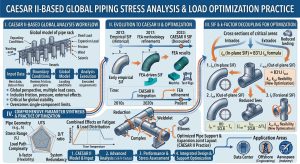
前述所有微觀冶金與數學理論的演進,最終必須落實於主流的管線應力分析軟體(如 Hexagon CAESAR II)中進行全域矩陣求解,方能發揮巨大的工程價值。當高能管線由 1.5D 銲接彎頭全面升級為 3D/5D 冷作彎管,並在軟體中啟動 B31J 演算法後,系統的宏觀力學行為將發生根本性優化51。 All the aforementioned evolutions in microscopic metallurgy and mathematical theory must ultimately be implemented in mainstream piping stress analysis software (like Hexagon CAESAR II) for global matrix solving to realize their immense engineering value. When high-energy piping comprehensively upgrades from 1.5D welded elbows to 3D/5D cold bends, and the B31J algorithm is activated in the software, the system’s macroscopic mechanical behavior undergoes fundamental optimization51.
8.1 載荷組合 (Load Cases) 的重構與檢核 / 8.1 Reconstruction and Verification of Load Cases
在 CAESAR II 的分析矩陣中,基礎載荷工況包含自重(Weight, W)、內部流體壓力(Pressure, P)、熱膨脹溫度(Temperature, T)以及偶發載荷(Occasional loads, U,如地震或風載)。為了滿足 ASME 規範,必須精準定義以下應力檢核載荷步階:In the CAESAR II analysis matrix, basic load cases include Weight (W), internal fluid Pressure (P), thermal expansion Temperature (T), and Occasional loads (U, such as seismic or wind). To satisfy ASME codes, the following stress verification load steps must be precisely defined:
- 持續工況 (Sustained Load Case, SUS): W + P,旨在檢核管線是否會因靜力載荷發生屈服與塑性崩潰。在此工況下,CAESAR II 內部演算法會啟用 B31J 的 SSI(取代舊有的 75i),確保 3D/5D 彎管的計算應力真實反映管壁承載力,大幅提高了一次應力(Primary Stress)的合格率58。 Sustained Load Case (SUS): W + P. Aimed at verifying if piping will suffer yielding and plastic collapse due to static loads. In this case, CAESAR II’s internal algorithm activates B31J’s SSI (replacing the old 0.75i), ensuring the calculated stress of 3D/5D bends truly reflects wall bearing capacity, vastly improving Primary Stress pass rates58.
- 操作工況 (Operating Load Case, OPE): W + P + T1,模擬管線真實熱態位移。此為非應力檢核工況,但其解出的支撐點反力及端點位移,是用於評估汽輪機、幫浦等旋轉設備噴嘴載荷(Nozzle Loads)與支撐架彈簧選型的絕對依據34。 Operating Load Case (OPE): W + P + T1. Simulates true hot displacement. This is a non-stress-check case, but its solved support reactions and terminal displacements are the absolute basis for evaluating nozzle loads on rotating equipment (turbines, pumps) and selecting spring hangers34.
- 膨脹工況 (Expansion Load Case, EXP): (W + P + T1) – (W + P)(代數差),評估由系統熱脹冷縮引起的二次交變應力範圍(Secondary Stress Range)。此處 B31J 精確且大幅降低的ii 與 io,結合 3D/5D 彎管龐大的 h 值,將使膨脹應力(SE)計算值呈現斷崖式下降13。 Expansion Load Case (EXP): (W + P + T1) – (W + P) (algebraic difference). Evaluates the Secondary Stress Range caused by thermal expansion/contraction. Here, B31J’s precise and drastically lowered ii and io, combined with the massive h value of 3D/5D bends, cause the calculated expansion stress (SE) to plummet13.
8.2 管線幾何配置的系統級優化效益 / 8.2 System-Level Optimization Benefits of Piping Geometric Routing
由於 3D/5D 冷作彎管賦予了管線本質上的高柔性(High Flexibility, 透過更大的柔性因子 k 值),且 B31J 消除了舊法規帶來的虛假應力集中盲點,工程師得以進行深度的管線路徑優化。過去為使管線通過 Appendix D 的膨脹應力檢核,工程師被迫在廠區的有限空間內,迂迴增設龐大的Ω 型或 U 型熱膨脹環13。這不僅浪費了極度昂貴的 P91/P92 重壁厚合金鋼材(如高溫不銹鋼或高合金耐熱材料),增加了無數道現場環向銲縫,亦連帶增加了系統壓力降與保溫施作成本13。 Because 3D/5D cold bends inherently endow piping with High Flexibility (via larger k factors), and B31J eliminates the false stress concentration blind spots brought by legacy codes, engineers can perform deep piping routing optimization. In the past, to pass Appendix D expansion stress checks, engineers were forced to detour and add massive Ω-shaped or U-shaped thermal expansion loops within limited plant space13. This not only wasted extremely expensive P91/P92 heavy-wall alloy steel (such as high-temp stainless or superalloys) and added countless field girth welds but also concurrently increased system pressure drops and insulation costs13.
在 B31J 與 3D/5D 彎管的雙重解放下,這些為迎合舊算式而存在的膨脹環得以被全數刪減。高能管線佈局變得更為緊湊直接,大幅縮短了施工安裝期(Schedule)42。更深遠的影響在於,管線剛度(Stiffness)的下降使得系統在極端熱態下傳遞至端點設備(Turbine Nozzles)的推力(Forces)與彎矩(Moments)顯著卸載13。這對於保護造價高昂的高速旋轉機械之動平衡,以及延長對接異種金屬銲縫(Dissimilar Metal Weld, DMW)的低週期熱疲勞壽命,具有無可取代的工程貢獻13。 Under the dual liberation of B31J and 3D/5D bends, these expansion loops—existing merely to appease legacy formulas—can be entirely removed. High-energy piping layouts become more compact and direct, substantially shortening construction schedules42. A more profound impact is that the drop in pipe stiffness causes the thermal thrusts (Forces) and Moments transmitted to terminal equipment (Turbine Nozzles) during extreme hot states to be significantly unloaded13. This offers irreplaceable engineering contributions toward protecting the dynamic balance of highly expensive high-speed rotating machinery and extending the low-cycle thermal fatigue life of Dissimilar Metal Welds (DMW)13.
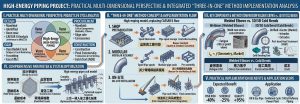
九、 高能管線專案之實務多維度視角與三合一工法導入分析 / IX. Practical Multi-Dimensional Perspectives of High-Energy Piping Projects and the Integration of the Three-in-One Methodology
在理論與法規邊界確立後,將「冷作彎管」與「B31J 規範」導入 CCPP 或石化專案,需要整合業主、設計端(EPC)、廠務維護以及製造端的多方實務考量。同時,必須依賴系統性的先進工法與實際工程數據,方能確保技術落地並發揮最大的全生命週期效益。After establishing theoretical and code boundaries, introducing “Cold Bending” and the “B31J Code” into CCPP or petrochemical projects requires integrating practical considerations from owners, design (EPC), plant maintenance, and manufacturing ends. Simultaneously, it relies on systematic advanced methodologies and actual engineering data to ensure technology lands and maximizes full life-cycle benefits.
9.1 業主、廠務與 EPC 統包商之多維度專案管理視角 / 9.1 Multi-Dimensional Project Management Perspectives for Owners, Plant Operations, and EPC Contractors
業主營運決策與廠務管理觀點 / Owner’s Operational Decision and Plant Management Viewpoint: 從資產持有者與廠務維護的角度而言,高能管線(尤其是 P91/P92 材質)的環向銲縫是全廠風險最高且維護成本最昂貴的區域。傳統電銲彎頭極易在交界處引發第四型潛變破裂(Type IV Cracking)與嚴重的流動加速腐蝕(FAC)11。透過將實體管線由電銲轉向冷作彎管,業主不僅能從物理上徹底消滅這些致命的劣化機制,更能斷崖式地降低建造與大修期間的非破壞性檢測(NDE / NDT)費用及重工成本60。此外,3D/5D 彎管帶來的低壓降優勢能提升全廠泵浦流體傳輸效率,並且保證未來智慧型清管器(ILI Pig)能順暢通行而不卡阻10,是實現電廠長期運轉可靠度(Reliability)的核心決策。 From the perspective of asset holders and plant maintenance, the girth welds of high-energy piping (especially P91/P92) are the highest-risk and most expensive areas to maintain across the plant. Traditional welded elbows easily trigger Type IV Cracking and severe Flow-Accelerated Corrosion (FAC) at junctions11. By transitioning physical piping from welding to cold bends, owners not only physically eradicate these fatal degradation mechanisms but also precipitously drop Non-Destructive Examination (NDE/NDT) and rework costs during construction and overhauls60. Additionally, the low pressure drop advantages of 3D/5D bends enhance plant-wide pump fluid transmission efficiency and guarantee the smooth, unjammed passage of In-Line Inspection (ILI) Pigs in the future, making it a core decision for realizing long-term plant operational reliability10.
EPC 承包商設計單位之實務佈置考量與風險量化 / EPC Contractor Design Practical Routing and Risk Quantification: 對於負責整廠設計與施工的 EPC 承包商而言,管線的空間佈置(Routing)與現場施作難易度是影響專案時程的關鍵。面對全球最嚴苛的 ASME B31.1 動力配管規範,EPC 團隊將設計標準轉向採用 3D/5D 冷作彎管並結合 B31J 優化後,工程師得以全數刪除為了應付舊法規而設計的龐大熱膨脹環,使管線佈局更為緊湊直接,大幅節省廠區寶貴的三維空間42。在風險管控層面,此工法不僅減少了現場銲口的品質管控風險,更能顯著降低 EPC 專案在施工與試車期間的保險風險62。透過消除高風險銲口、斷崖式降低 NDE 檢測數量,EPC 得以徹底重塑專案的成本結構並確保如期完工60。 For EPC contractors responsible for entire plant design and construction, piping Routing and field execution difficulty are keys affecting project schedules. Facing the globally stringent ASME B31.1 Power Piping code, once EPC teams shift design standards to 3D/5D cold bends combined with B31J optimization, engineers can completely delete the massive expansion loops designed to cope with legacy codes, making layouts more compact and saving precious 3D plant space42. On a risk control level, this method not only reduces field weld quality control risks but significantly lowers EPC insurance risks during construction and commissioning62. By eliminating high-risk welds and cliff-dropping NDE quantities, EPCs can thoroughly reshape the project’s cost structure and ensure on-time completion60.
9.2 實務工程案例:次世代重型氣渦輪機 (SGT6-9000HL 與 GE 7HA.03) 之極端條件考驗 / 9.2 Practical Engineering Cases: Extreme Condition Challenges of Next-Generation Heavy-Duty Gas Turbines (SGT6-9000HL and GE 7HA.03)
為因應能源轉型與高效率發電需求,當今 EPC 專案面臨的熱力學邊界條件已達極限,這使得傳統銲接管線的脆弱性被無限放大:To meet energy transition and high-efficiency power generation demands, the thermodynamic boundary conditions faced by today’s EPC projects have reached their limits, infinitely magnifying the vulnerabilities of traditional welded piping:
- Siemens Energy SGT6-9000HL 氣渦輪機 / Gas Turbine:專為 60Hz 電網設計,在 1×1 複循環配置下,其總發電輸出達 655 MW,總熱效率突破 64%。更為嚴苛的是,其排氣溫度高達 675°C (1,247°F),且具備高達 85 MW/min 的驚人升載速率64。 Designed specifically for 60Hz grids, under a 1×1 combined cycle configuration, its gross plant output reaches 655 MW with gross efficiency breaking 64%. Even more severely, its exhaust temperature peaks at 675°C (1,247°F), and it features a staggering ramp-up rate of 85 MW/min64.
- GE Vernova 7HA.03 氣渦輪機 / Gas Turbine:單機簡單循環輸出高達 430 MW,同樣具備超過0% 的聯合循環效率,升降載速率達 75 MW/min,排氣溫度約為 627°C65。 Its simple cycle output reaches 430 MW, also boasting a combined cycle efficiency exceeding 64.0%, a ramp rate of 75 MW/min, and an exhaust temperature of approximately 627°C65.
在上述極端運作條件下,主蒸汽與熱再熱蒸汽的溫度普遍超越 600°C。如此劇烈且快速的升溫,易使 P91/P92 管壁產生龐大的暫態熱應力。若採用傳統 1.5D 銲接彎頭,循環熱疲勞與高溫潛變的雙重作用會迅速在熱影響區的「軟化區」萌生空孔,加劇 Type IV 潛變裂紋的風險64。這使得轉向冷作彎管工法成為這些頂級氣渦輪機專案中不可或缺的技術決策。 Under the aforementioned extreme operating conditions, Main Steam and Hot Reheat steam temperatures universally exceed 600°C. Such fierce and rapid heating easily generates massive transient thermal stresses in P91/P92 walls. If traditional 1.5D welded elbows are used, the dual effects of cyclic thermal fatigue and high-temperature creep will rapidly spawn voids in the HAZ “soft zone,” exacerbating the risk of Type IV creep cracking64. This makes the transition to cold bending methodologies an indispensable technical decision for these top-tier gas turbine projects.
9.3 冷作彎管施作協力廠商之技術因應與挑戰 / 9.3 Technical Responses and Challenges for Cold Bending Subcontractors
針對 SGT6-9000HL 或 7HA.03 這類次世代發電機組,其高能管線常採用極厚的 XXS 或 SCH160 規格(例如 D/t 比極低的合金鋼管)。由傳統管件廠轉向專案冷作彎管協力廠商,面臨著極大的物理與技術挑戰。For next-gen generating units like the SGT6-9000HL or 7HA.03, their high-energy piping often utilizes extremely thick XXS or SCH160 specifications (e.g., alloy pipes with very low D/t ratios). Transitioning from a traditional fitting manufacturer to a project cold bending subcontractor involves tremendous physical and technical challenges.
協力廠必須具備高階的 CNC 旋轉拉彎(Rotary Draw Bending)技術,利用多球芯棒與防皺板精確控制成形過程,以克服金屬回彈(Springback)與材料低延展性帶來的破裂風險34。此外,協力廠必須嚴格監控加工過程中的幾何畸變,確保彎管外弧側(Extrados)的管壁減薄率(Wall Thinning)與截面橢圓度(Ovality)符合 ASME B31 規範的嚴苛極限值(例如橢圓度需控制在 2%~3% 內),這對機台的推進力矩與模具設計提出了極高的工程要求21。 Subcontractors must possess high-level CNC Rotary Draw Bending technology, utilizing multi-ball mandrels and wiper dies to precisely control the forming process, overcoming metal springback and rupture risks caused by low material ductility34. Furthermore, they must strictly monitor geometric distortions during processing to ensure the extrados Wall Thinning and Ovality meet the stringent limits of ASME B31 codes (e.g., ovality controlled within 2%-3%), which places exceptionally high engineering demands on the machine’s booster torque and tooling design21.
9.4 解析應變率 (5%~20%) 放寬與次臨界 IH-PBHT 適用之法規深度理路 / 9.4 In-Depth Code Rationale for Strain Rate Relaxation (5%~20%) and the Application of Subcritical IH-PBHT
在處理 P91/P92 鋼的冷作成型後熱處理(PBHT)時,應變率的計算與熱處理溫度的選擇是決定管線潛變壽命的命脈。依據過去的 ASME 規範,若冷作成型應變率超過 20%(或特定高溫設計下超過 25%),則強制要求必須對管件進行完整的「正火加回火(Normalizing & Tempering, N&T)」67。然而,N&T 會徹底破壞鋼廠出廠時的最佳化晶粒組織。 When handling PBHT for P91/P92 steels, calculating the strain rate and selecting the heat treatment temperature is the lifeline determining the piping’s creep life. According to past ASME codes, if cold forming strain rates exceeded 20% (or 25% under specific high-temp designs), it mandatorily required a complete “Normalizing & Tempering (N&T)” on the fitting67. However, N&T thoroughly destroys the optimized grain structure from the steel mill.
現代工程實務中,3D 與 5D 冷作彎管的成型應變率通常落在 10% 至 16.7% 之間。依據 ASME B31.1 Code Case 183-2 以及 ASME B31.3 Para 332.4.2a 的最新修訂,針對應變率精準落於 5% 至 20% 這個過渡區間內的高能管線,法規作出了極具科學意義的放寬:允許採用次臨界彎後熱處理(Subcritical PBHT),而不必進行高風險的 N&T4。 In modern engineering practice, the forming strain rates for 3D and 5D cold bends typically land between 10% and 16.7%. Based on the latest revisions in ASME B31.1 Code Case 183-2 and ASME B31.3 Para 332.4.2a, for high-energy piping with strain rates precisely falling within the 5% to 20% transition zone, the code has made a highly scientifically significant relaxation: allowing the use of Subcritical PBHT, circumventing the high-risk N&T4.
其冶金物理意義在於:利用這 5%~20% 的適度冷作應變所儲存的變形能作為驅動力,並透過感應加熱技術(IH-PBHT)將溫度精確且嚴格地鎖定在下臨界相變溫度 AC1 之下(如 740°C 至 770°C 之間的極窄安全視窗)2。這不僅能促使錯位攀移並釋放殘餘應力,更完美保留了原本富鉻碳化物與 MX 析出物對晶界的釘紮效應,確保彎管擁有與母材同等的極致潛變抗力2。 Its metallurgical and physical significance lies here: it uses the stored deformation energy from this 5%-20% moderate cold strain as a driving force, while induction heating (IH-PBHT) locks the temperature strictly and precisely below the lower critical phase transition temperature AC1 (e.g., in an extremely narrow safety window between 740°C and 770°C)2. This not only promotes dislocation climb and releases residual stress but perfectly retains the original pinning effect of Cr-rich carbides and MX precipitates on grain boundaries, ensuring the bend possesses extreme creep resistance identical to the base metal2.
9.5 導入潁璋工程「能彎不銲」三合一工法之管理核心與合規優化 / 9.5 Core Management and Compliance Optimization through the Integration of Ying-Zhang Engineering’s “Bend-Instead-of-Weld” Three-in-One Methodology
為落實前述的各項理論、規範與實務要求,導入潁璋工程(Ying-Zhang Engineering)所提倡的「三合一工法」(3D/5D CNC 大半徑冷作彎管 + IH-PBHT 單管感應亞臨界彎後熱處理 + QR Code 雲端數位履歷),是發揮大半徑優勢的唯一解方14。 To implement the aforementioned theoretical, regulatory, and practical requirements, adopting the “Three-in-One Methodology” (3D/5D CNC large-radius cold bends + IH-PBHT single-tube induction subcritical post-bend heat treatment + QR Code cloud digital pedigree) advocated by Ying-Zhang Engineering is the unique solution to fully leverage large radius advantages14.
此工法管理的核心價值在於徹底落實「能彎不銲(Bend-instead-of-weld)」的設計理念,從源頭將易受流體沖刷與疲勞破壞的銲縫轉化為連續平滑的母材彎曲段,徹底打破傳統管線製造的組織路徑依賴57。針對高能管線,此工法的執行不僅是製造手段的升級,更是嚴格對接 ASME B31.1 與 B31J 規範的合規性展現60。 The core value of this methodology’s management is thoroughly implementing the “Bend-instead-of-weld” design philosophy, transforming welds susceptible to fluid erosion and fatigue damage at the source into continuous, smooth base-metal bends, thoroughly breaking the organizational path dependency of traditional pipe manufacturing57. For high-energy piping, executing this method is not just an upgrade in manufacturing means, but a demonstration of strict compliance with ASME B31.1 and B31J codes60.
在製造端,透過 CNC 設備確保幾何與應變率合規,並精確執行次臨界 IH-PBHT 解決了 P91/P92 的冶金痛點2。實務上,該感應加熱技術利用交變磁場產生體積加熱效應(Volumetric Heating),確保 XXS 厚壁管內外壁溫度極度均勻;同時採用「紅外線測溫儀(IR)為主、電熱偶(Thermocouple)為輔」的雙重溫控機制,毫秒級響應杜絕溫度過衝,將回火溫度精確鎖定於 740°C–770°C 內64。 On the manufacturing end, ensuring geometric and strain rate compliance via CNC equipment, and precisely executing subcritical IH-PBHT resolves the metallurgical pain points of P91/P922. In practice, this induction heating technology utilizes alternating magnetic fields to generate Volumetric Heating, ensuring extreme temperature uniformity across XXS thick inner and outer walls. It simultaneously employs a dual temperature control mechanism—”Infrared (IR) primary, Thermocouple auxiliary”—providing millisecond-level response to eliminate temperature overshoot, locking the tempering temperature precisely between 740°C–770°C64.
而在專案管理端,最為關鍵的是引入了 QR Code 數位履歷。透過建立跨部門綁定的「數位產品護照(Digital Product Passport, DPP)」與數位雙生(Digital Twin)雲端平台,從 FEED 設計階段、工廠製造參數(如減薄量、橢圓度、應變率)、IH-PBHT 的熱處理溫度曲線紀錄,直到現場安裝,皆被完整封裝於一組唯一的 QR Code 中60。這使得業主與第三方檢驗機構僅需透過掃描條碼,即可立即追溯該彎管的全生命週期數據,徹底實現了無縫接軌的法規合規性證明,為大型 CCPP(如 SGT6-9000HL 或 7HA.03 專案)與石化廠帶來了成本重塑與品質追溯的雙重顛覆性優化60。 On the project management end, the crucial introduction is the QR Code Digital Pedigree. By establishing an inter-departmentally bound “Digital Product Passport (DPP)” and Digital Twin cloud platform, everything from the FEED design phase, factory manufacturing parameters (thinning, ovality, strain rate), IH-PBHT thermal curve records, up to field installation, are completely encapsulated into a single unique QR Code60. This allows owners and third-party inspectors to instantly trace the bend’s full life-cycle data by simply scanning the barcode, thoroughly achieving seamless code compliance proof, and bringing disruptive optimization in cost reshaping and quality traceability to massive CCPP (like SGT6-9000HL or 7HA.03 projects) and petrochemical plants60.
十、 結論 / X. Conclusion
綜上所述,高能管線系統由傳統 1.5D 離散電銲彎頭轉向 3D/5D 數控冷作彎管,並在設計端同步導入 ASME B31J 應力優化演算法,絕非單純的工法替換,而是管線工程領域一次深度的物理與數學典範轉移。本研究之綜合結論如下:In summary, the transition of high-energy piping systems from traditional 1.5D discrete welded elbows to 3D/5D CNC cold bends, synchronized with the adoption of the ASME B31J stress optimization algorithm at the design stage, is by no means a simple methodological swap. It is a profound physical and mathematical paradigm shift within the piping engineering domain. The comprehensive conclusions of this study are as follows:
- 冶金可靠度之飛躍 / Leap in Metallurgical Reliability:面對如 SGT6-9000HL 般極端的熱力條件,透過冷作彎管技術徹底消除轉折處高風險的環向銲縫,從物理實體上拔除了 ICHAZ/FGHAZ 軟化帶的存在,一勞永逸地免疫了困擾 P91/P92 鋼種多年的第四型潛變破裂(Type IV Cracking)危機。配合次臨界感應加熱成型後熱處理(IH-PBHT),精準利用 5%~20% 應變率法規放寬視窗與紅外線/電熱偶雙重溫控,迴避了相變溫度的風險,確保冷彎管保有與完美母材同等的極致高溫潛變強度。Facing extreme thermal conditions like the SGT6-9000HL, cold bending technology completely eliminates high-risk girth welds at turns, physically uprooting the existence of the ICHAZ/FGHAZ soft zone, and permanently immunizing against the Type IV Cracking crisis that has plagued P91/P92 steels for years. Coupled with subcritical induction heating post-bend heat treatment (IH-PBHT), accurately utilizing the 5%~20% strain rate regulatory relaxation window alongside IR/Thermocouple dual temperature control evades phase-change temperature risks, ensuring cold bends retain ultimate high-temperature creep strength identical to perfect base metal.
- 流體動力與熱力學之優化 / Optimization of Fluid Dynamics and Thermodynamics:3D/5D 大曲率半徑有效平緩了逆壓梯度,抑制了管內的邊界層分離與二次迴流渦旋。局部阻力係數(K-Factor)的大幅下降,不僅減少了系統的流動壓降與幫浦能耗,更極大程度減緩了磁鐵礦保護層被剝離的速率,全面抑制流動加速腐蝕(FAC)的質傳破壞機制。The 3D/5D large curvature radius effectively smoothens the adverse pressure gradient, suppressing internal boundary layer separation and secondary recirculating vortices. The massive drop in local resistance coefficients (K-Factor) not only reduces system flow pressure drops and pump energy consumption but drastically slows the stripping rate of the magnetite protective layer, comprehensively suppressing the mass transfer failure mechanism of Flow-Accelerated Corrosion (FAC).
- 數學模型之精確化與解耦 / Precision and Decoupling of Mathematical Models:ASME B31J 全面取代了陳舊保守的附錄 D。透過空間三自由度解耦的應力強化因子(ii, io, it)、釋放管件真實變形能力的動態柔性因子(k),以及脫鉤疲勞因子的持續應力指數(SSI=1.0),徹底終結了過去半世紀以來導致系統過度僵硬的數學失真。ASME B31J completely supersedes the antiquated and conservative Appendix D. Through Stress Intensification Factors decoupled across three spatial degrees of freedom (ii, io, it), dynamic flexibility factors (k) that release the true deformation capability of fittings, and a Sustained Stress Index (SSI=1.0) decoupled from fatigue factors, it thoroughly ends the mathematical distortion that caused excessive system stiffness over the past half-century.
- 實務導入與全生命週期管理 / Practical Integration and Full Life-Cycle Management:將冷作彎管與 B31J 理論整合至 CAESAR II 進行全域求解,能有效解放系統空間、刪減熱膨脹環並卸載旋轉設備端點負載。透過導入潁璋工程「能彎不銲」三合一工法,將 CNC 製造、IH-PBHT 與 QR Code 數位產品護照(DPP)完美結合,為 EPC 統包商與業主帶來了初期建置成本與保險風險降低、銲口及 NDE 檢驗大幅減少,以及全生命週期品質追溯透明化的巨大綜合效益。Integrating cold bending and B31J theory into CAESAR II for global solving effectively liberates system space, deletes thermal expansion loops, and unloads terminal loads on rotating equipment. By adopting Ying-Zhang Engineering’s “Bend-instead-of-weld” Three-in-One Methodology, perfectly combining CNC manufacturing, IH-PBHT, and QR Code Digital Product Passports (DPP), it brings EPC contractors and owners immense comprehensive benefits, including lower initial construction costs and insurance risks, massive reductions in welds and NDE inspections, and transparent quality traceability throughout the full life-cycle.
參考文獻 / References
- (PDF) Insight into Type IV cracking in Grade 91 steel weldments, https://www.researchgate.net/publication/339358586_Insight_into_Type_IV_cracking_in_Grade_91_steel_weldments
- 基於ASME B31J與流固耦合分析之CCPP高能管線(P91/P92)流體加速, https://yz-pipe-bending.com.tw/%E5%9F%BA%E6%96%BCasme-b31j%E8%88%87%E6%B5%81%E5%9B%BA%E8%80%A6%E5%90%88%E5%88%86%E6%9E%90%E4%B9%8Bccpp%E9%AB%98%E8%83%BD%E7%AE%A1%E7%B7%9Ap91-p92%E6%B5%81%E9%AB%94%E5%8A%A0%E9%80%9F%E8%85%90/
- 高溫高壓管線Type IV 潛變損傷與動態衝擊之複合破壞風險, https://yz-pipe-bending.com.tw/%E9%AB%98%E6%BA%AB%E9%AB%98%E5%A3%93%E7%AE%A1%E7%B7%9A-type-iv-%E6%BD%9B%E8%AE%8A%E6%90%8D%E5%82%B7%E8%88%87%E5%8B%95%E6%85%8B%E8%A1%9D%E6%93%8A%E4%B9%8B%E8%A4%87%E5%90%88%E7%A0%B4%E5%A3%9E%E9%A2%A8/
- 基於2026 ASME B31J規範之P91/P92/P93高壓蒸汽高能管線應力解耦, https://yz-pipe-bending.com.tw/%E5%9F%BA%E6%96%BC2026-asme-b31j%E8%A6%8F%E7%AF%84%E4%B9%8Bp91-p92-p93%E9%AB%98%E5%A3%93%E8%92%B8%E6%B1%BD%E9%AB%98%E8%83%BD%E7%AE%A1%E7%B7%9A%E6%87%89%E5%8A%9B%E8%A7%A3%E8%80%A6%E3%80%81%E4%B8%89/
- EPRI Best Practice Guidelines For P91 1023199 | PDF – Scribd, https://www.scribd.com/doc/246144971/EPRI-Best-Practice-Guidelines-for-P91-1023199
- Types and Uses of Pipe Fittings – Scribd, https://www.scribd.com/document/868721455/Pipe-Fittings-Type
- Pipe Elbow Dimensions: Complete ASME B16.9 Chart (mm & inch), https://aienginear.com/pipe-elbow-dimensions/
- Microstructure Evolution of Fine-Grained Heat-Affected Zone in Type, https://www.researchgate.net/publication/288840159_Microstructure_Evolution_of_Fine-Grained_Heat-Affected_Zone_in_Type_IV_Failure_of_P91_Welds
- (PDF) Study on the influence of elbow with different curvature radii, https://www.researchgate.net/publication/355342029_Study_on_the_influence_of_elbow_with_different_curvature_radii_on_pipeline_leak_location
- Long Radius (LR) vs Short Radius (SR) 90-Degree Elbows, https://www.thesteelcenter.com/blog/long-radius-lr-vs-short-radius-sr-90-degree-elbows-flow-dynamics-compared//
- 5D電銲彎頭沖蝕現象綜合分析、退化機制與3D/5D冷作彎管系統化, https://yz-pipe-bending.com.tw/1-5d%E9%9B%BB%E9%8A%B2%E5%BD%8E%E9%A0%AD%E6%B2%96%E8%9D%95%E7%8F%BE%E8%B1%A1%E7%B6%9C%E5%90%88%E5%88%86%E6%9E%90%E3%80%81%E9%80%80%E5%8C%96%E6%A9%9F%E5%88%B6%E8%88%873d-5d%E5%86%B7%E4%BD%9C%E5%BD%8E/
- Mastering ASME B31J Piping Stress Analysis for Plant Integrity, https://epcland.com/asme-b31j-piping-stress-analysis/
- 複循環發電廠316L 輔助蒸汽系統之熱膨脹應力異常解析, https://yz-pipe-bending.com.tw/%E8%A4%87%E5%BE%AA%E7%92%B0%E7%99%BC%E9%9B%BB%E5%BB%A0-316l-%E8%BC%94%E5%8A%A9%E8%92%B8%E6%B1%BD%E7%B3%BB%E7%B5%B1%E4%B9%8B%E7%86%B1%E8%86%A8%E8%84%B9%E6%87%89%E5%8A%9B%E7%95%B0%E5%B8%B8%E8%A7%A3/
- 2026版ASME B31J 強制導入下高能管線工程之典範轉移:基於1, https://yz-pipe-bending.com.tw/2026%E7%89%88-asme-b31j-%E5%BC%B7%E5%88%B6%E5%B0%8E%E5%85%A5%E4%B8%8B%E9%AB%98%E8%83%BD%E7%AE%A1%E7%B7%9A%E5%B7%A5%E7%A8%8B%E4%B9%8B%E5%85%B8%E7%AF%84%E8%BD%89%E7%A7%BB%EF%BC%9A%E5%9F%BA%E6%96%BC-b31/
- 基於ASME B31J 規範之發電廠高能管線降解與防護, https://yz-pipe-bending.com.tw/%E5%9F%BA%E6%96%BC-asme-b31j-%E8%A6%8F%E7%AF%84%E4%B9%8B%E7%99%BC%E9%9B%BB%E5%BB%A0%E9%AB%98%E8%83%BD%E7%AE%A1%E7%B7%9A%E9%99%8D%E8%A7%A3%E8%88%87%E9%98%B2%E8%AD%B7%EF%BC%9A%E9%8A%B2%E6%8E%A5%E5%BD%8E/
- ASME B31.3 vs ASME B31.1: Code Comparison & Engineering Guide, https://www.deepoceanengineeringtech.com/engineering-insights/asme-b31-3-vs-asme-b31-1
- ASME B31.1 vs. ASME B31.3: Key Differences in Industrial Piping, https://arvengtraining.com/en/asme-b31-1-vs-asme-b31-3-design-differences/
- ASME B 31.1 & ASME B 31.3 CODE COMPARISON, https://www.littlepeng.com/single-post/asme-b-31-1-asme-b-31-3-code-comparison
- ASME B31.1 vs B31.3: Key Differences | PDF – Scribd, https://www.scribd.com/document/319947657/31-1-VS-31-3
- ASME B31.1 vs B31.3 Code Comparison | PDF | Stress (Mechanics), https://www.scribd.com/document/371422258/Comaprison-B31-1-B31-3-Piping
- ASME B31J SIFs & k-Factors: Why B31.3 Deleted Appendix D, https://pipingtoolset.com/guides/b31j-stress-intensification-factors/
- SIF & Flexibility Factors — ASME B31J-2023 & NM.1 HDPE, https://pipingtoolset.com/tools/sif-flexibility-factors/
- (PDF) Welding Procedures and Type IV Phenomena – ResearchGate, https://www.researchgate.net/publication/254416895_Welding_Procedures_and_Type_IV_Phenomena
- Impact toughness dependence upon post-weld cooling temperature, https://www.researchgate.net/publication/389250738_Impact_toughness_dependence_upon_post-weld_cooling_temperature_in_P91_steel_weldments
- An example of in-service Type IV cracking at a reinforced connection,, https://www.researchgate.net/figure/An-example-of-in-service-Type-IV-cracking-at-a-reinforced-connection-note-that-when-this_fig4_279017729
- Chemical composition (in mass %) of the P91 steel and the weld, https://www.researchgate.net/figure/Chemical-composition-in-mass-of-the-P91-steel-and-the-weld_tbl1_264715376
- 針對ASME B31.1 與3 規範中高合金鋼(P91/P92) 銲接接頭係數, https://yz-pipe-bending.com.tw/%E9%87%9D%E5%B0%8D-asme-b31-1-%E8%88%87-b31-3-%E8%A6%8F%E7%AF%84%E4%B8%AD%E9%AB%98%E5%90%88%E9%87%91%E9%8B%BC-p91-p92-%E9%8A%B2%E6%8E%A5%E6%8E%A5%E9%A0%AD%E4%BF%82%E6%95%B8-wc-wl-%E5%8F%8A/
- Influence of heat input and post-weld heat treatment on boiler steel, https://www.researchgate.net/publication/272223845_Influence_of_heat_input_and_post-weld_heat_treatment_on_boiler_steel_P91_9Cr-1Mo-V-Nb_weld_joints_Part_2_-_Mechanical_properties
- CCPP電廠P9x高能管線曲率半徑(5D規格品銲接彎頭與3D/5D冷作, https://yz-pipe-bending.com.tw/ccpp%E9%9B%BB%E5%BB%A0p9x%E9%AB%98%E8%83%BD%E7%AE%A1%E7%B7%9A%E6%9B%B2%E7%8E%87%E5%8D%8A%E5%BE%91%EF%BC%881-5d%E8%A6%8F%E6%A0%BC%E5%93%81%E9%8A%B2%E6%8E%A5%E5%BD%8E%E9%A0%AD%E8%88%873d-5d%E5%86%B7/
- Butt Weld Elbow — ASME B16.9 90°/45° LR & SR – Synbase Steel, https://synbasesteel.com/steel-pipe-fittings/butt-weld-elbow/
- Seamless Pipe Bending – Sunny Steel, https://www.sunnysteel.com/seamless-pipe-bending.php/pdf/7d-pipe-bending.php
- Pipe Fittings Types (ASME B16.9) – Projectmaterials, https://blog.projectmaterials.com/pipe-fittings/buttweld-fittings/asme-b16-9-bw-fittings-types/
- 針對CCPP汽水兩相流管路中5D至5D彎管曲率半徑優化配置與抗沖, https://yz-pipe-bending.com.tw/%E9%87%9D%E5%B0%8Dccpp%E6%B1%BD%E6%B0%B4%E5%85%A9%E7%9B%B8%E6%B5%81%E7%AE%A1%E8%B7%AF%E4%B8%AD1-5d%E8%87%B35d%E5%BD%8E%E7%AE%A1%E6%9B%B2%E7%8E%87%E5%8D%8A%E5%BE%91%E5%84%AA%E5%8C%96%E9%85%8D%E7%BD%AE/
- 2026 ASME 規範架構下1 & B31.3 成型應變率之深度剖析:5D, https://yz-pipe-bending.com.tw/2026-asme-%E8%A6%8F%E7%AF%84%E6%9E%B6%E6%A7%8B%E4%B8%8B-b31-1-b31-3-%E6%88%90%E5%9E%8B%E6%87%89%E8%AE%8A%E7%8E%87%E4%B9%8B%E6%B7%B1%E5%BA%A6%E5%89%96%E6%9E%90%EF%BC%9A5d-%E5%86%B7%E4%BD%9C%E5%BD%8E/
- What is Tube Bending? Working, Types, and Industrial Applications, https://epcland.com/what-is-tube-bending/
- JSW Pipeline Cold Bending Services, https://www.pipetechservice.com/pipeline-cold-bending/
- Pipe Bend Wall Thickness Calculator — ASME B31.3 ¶304.2.1, https://pipingtoolset.com/calculators/pipe-bend-wall-thickness/
- ASME B31.3 Induction Bend Pipe vs Elbow: Compliance Guide, https://industrialmonitordirect.com/blogs/knowledgebase/asme-b313-induction-bend-pipe-vs-elbow-compliance-guide
- How to Determine Steel Pipe Bending Radius: Requirements for, https://asperasteel.com/how-to-determine-steel-pipe-bending-radius-requirements-for-different-pipe-diameters/
- 40NB SCH160 S31803 Pipe Coiling: Bend Radius Limits, https://industrialmonitordirect.com/blogs/knowledgebase/40nb-sch160-s31803-pipe-coiling-bend-radius-limits
- Stress Analysis of Thin-Walled Pipes in CAESAR II | PDF – Scribd, https://pt.scribd.com/document/754641894/Applicability-of-Caesar-II-for-stress-analysis-of-lines-having-D
- 基於2026 ASME B31J 規範之大型CCPP 專案管線工法優化, https://yz-pipe-bending.com.tw/%E5%9F%BA%E6%96%BC-2026-asme-b31j-%E8%A6%8F%E7%AF%84%E4%B9%8B%E5%A4%A7%E5%9E%8B-ccpp-%E5%B0%88%E6%A1%88%E7%AE%A1%E7%B7%9A%E5%B7%A5%E6%B3%95%E5%84%AA%E5%8C%96%EF%BC%9Aepc-%E4%BB%8B%E9%9D%A2%E5%8D%94/
- 2026 ASME B31J 規範下冷作彎管曲率半徑(R值)選用準則與實務應用, https://yz-pipe-bending.com.tw/%E9%AB%98%E9%BB%8F%E5%BA%A6%E9%9D%9E%E7%89%9B%E9%A0%93%E6%B5%81%E9%AB%94%E7%AE%A1%E7%B7%9A%E8%BC%B8%E9%80%81%E4%B9%8B%E6%B5%81%E5%9B%BA%E8%80%A6%E5%90%88%E8%88%87%E5%8A%9B%E5%AD%B8%E6%9C%80%E4%BD%B3/
- Heat Treatments in Welding: Annealing to Tempering – WeldFabWorld, https://www.weldfabworld.com/heat-treatments-welding-annealing-normalizing-quenching-tempering/
- 2026 ASME 規範下高合金鋼(P91/P92)冷作彎管工法與IH-PBHT, https://yz-pipe-bending.com.tw/2026-asme-%E8%A6%8F%E7%AF%84%E4%B8%8B%E9%AB%98%E5%90%88%E9%87%91%E9%8B%BC%EF%BC%88p91-p92%EF%BC%89%E5%86%B7%E4%BD%9C%E5%BD%8E%E7%AE%A1%E5%B7%A5%E6%B3%95%E8%88%87-ih-pbht-%E6%95%B8%E4%BD%8D%E5%8C%96/
- FABRICATION & PROCESSING OF GRADE 91 MATERIAL, http://www.iimtiruchy.org/pdf/FAB%2091%20Final.pdf
- ASTM A335/A335M – Sanon Pipe, https://www.sanonpipe.com/uploads/ASTM-A335-2019-ASTM-%E6%A0%87%E5%87%86%E5%85%A8%E6%96%87%E4%B8%8B%E8%BD%BD.pdf
- 2026 ASME B31J 演算法框架下P91/P92 5D 冷作彎管之幾何力學, https://yz-pipe-bending.com.tw/2026-asme-b31j-%E6%BC%94%E7%AE%97%E6%B3%95%E6%A1%86%E6%9E%B6%E4%B8%8B-p91-p92-5d-%E5%86%B7%E4%BD%9C%E5%BD%8E%E7%AE%A1%E4%B9%8B%E5%B9%BE%E4%BD%95%E5%8A%9B%E5%AD%B8%E3%80%81%E6%BD%9B%E8%AE%8A%E9%80%80/
- Stress Intensity Factor (SIF), Flexibility Factor: ASME B31.3 vs ASME, https://whatispiping.com/stress-intensity-factor-sif-flexibility-factor-asme-b-31j/
- Understanding SIF for Piping Elbows | PDF | Stress (Mechanics), https://www.scribd.com/document/961304255/Pipe-ELbow-SIF
- 基於2026 ASME B31J 規範之CCPP 高能管線銲接彎頭與3D/5D 冷作, https://yz-pipe-bending.com.tw/%E5%9F%BA%E6%96%BC-2026-asme-b31j-%E8%A6%8F%E7%AF%84%E4%B9%8B-ccpp-%E9%AB%98%E8%83%BD%E7%AE%A1%E7%B7%9A%E9%8A%B2%E6%8E%A5%E5%BD%8E%E9%A0%AD%E8%88%87-3d-5d-%E5%86%B7%E4%BD%9C%E5%BD%8E%E7%AE%A1%E7%B5%90/
- Sustained Stress Indices (SSI) in The B31.3 2010 Edition – Scribd, https://www.scribd.com/document/372066988/Sustained-Stress-Indices-SSI-in-the-B31-3-2010-Edition
- 基於ASME B31.1 與B31J 規範之管線應力強化研究:無積水區設計, https://yz-pipe-bending.com.tw/%E5%9F%BA%E6%96%BC-asme-b31-1-%E8%88%87-b31j-%E8%A6%8F%E7%AF%84%E4%B9%8B%E7%AE%A1%E7%B7%9A%E6%87%89%E5%8A%9B%E5%BC%B7%E5%8C%96%E7%A0%94%E7%A9%B6%EF%BC%9A%E7%84%A1%E7%A9%8D%E6%B0%B4%E5%8D%80%E8%A8%AD/
- ASME B31.3 Stress Range Factor: The 2022 Revision and Why It, https://blog.vibrationdata.com/2026/07/18/asme-b31-3-piping-fatigue/
- ASME B31J 導入對高溫高壓動力管線(1)與製程管線(B31.3, https://yz-pipe-bending.com.tw/asme-b31j-%E5%B0%8E%E5%85%A5%E5%B0%8D%E9%AB%98%E6%BA%AB%E9%AB%98%E5%A3%93%E5%8B%95%E5%8A%9B%E7%AE%A1%E7%B7%9A%EF%BC%88b31-1%EF%BC%89%E8%88%87%E8%A3%BD%E7%A8%8B%E7%AE%A1%E7%B7%9A%EF%BC%88b31-3%EF%BC%89/
- CAESAR II Software: Pipe Stress Analysis Guide – EveryEng, https://www.everyeng.com/engineering-tools/caesar-ii
- ASME B31J 導入對高溫高壓動力管線(1)與製程管線(B31.3, https://yz-pipe-bending.com.tw/asme-b31j-
- Load Cases for Caesar II Stress Analysis | PDF – Scribd, https://www.scribd.com/document/807157163/Load-Cases-for-Stress-Analysis-of-a-Critical-Piping-System-Using-Caesar-II-PDF
- How to calculate pipe stress analysis – Fluxiss, https://www.fluxiss.com/blogs/how-to-calculate-pipe-stress-analysis/
- 總部戰略決策報告:打破組織路徑依賴與極大化EPC 專案投資回報, https://yz-pipe-bending.com.tw/%E7%B8%BD%E9%83%A8%E6%88%B0%E7%95%A5%E6%B1%BA%E7%AD%96%E5%A0%B1%E5%91%8A%EF%BC%9A%E6%89%93%E7%A0%B4%E7%B5%84%E7%B9%94%E8%B7%AF%E5%BE%91%E4%BE%9D%E8%B3%B4%E8%88%87%E6%A5%B5%E5%A4%A7%E5%8C%96-epc/
- 冷作彎管技術運用:綠色工程、經濟發展與ESG領導力之策略藍圖, https://yz-pipe-bending.com.tw/%E5%86%B7%E4%BD%9C%E5%BD%8E%E7%AE%A1%E6%8A%80%E8%A1%93%E9%81%8B%E7%94%A8%E7%B6%A0%E8%89%B2%E5%B7%A5%E7%A8%8B%E3%80%81%E7%B6%93%E6%BF%9F%E7%99%BC%E5%B1%95%E8%88%87esg%E9%A0%98%E5%B0%8E%E5%8A%9B/
- ASME B31J規範升級高能管線應力最佳化:潁璋工程三合一工法與, https://yz-pipe-bending.com.tw/asme-b31j%E8%A6%8F%E7%AF%84%E5%8D%87%E7%B4%9A%E9%AB%98%E8%83%BD%E7%AE%A1%E7%B7%9A%E6%87%89%E5%8A%9B%E6%9C%80%E4%BD%B3%E5%8C%96%EF%BC%9A%E6%BD%81%E7%92%8B%E5%B7%A5%E7%A8%8B%E4%B8%89%E5%90%88%E4%B8%80/
- 高合金鋼管線冷作彎管工法降低應力集中與EPC 專案保險風險之關聯, https://yz-pipe-bending.com.tw/%E9%AB%98%E5%90%88%E9%87%91%E9%8B%BC%E7%AE%A1%E7%B7%9A%E5%86%B7%E4%BD%9C%E5%BD%8E%E7%AE%A1%E5%B7%A5%E6%B3%95%E9%99%8D%E4%BD%8E%E6%87%89%E5%8A%9B%E9%9B%86%E4%B8%AD%E8%88%87-epc-%E5%B0%88%E6%A1%88/
- 西門子能源SGT6-9000HL 氣渦輪機與潁璋工程Cold Bending+IH, https://yz-pipe-bending.com.tw/%E8%A5%BF%E9%96%80%E5%AD%90%E8%83%BD%E6%BA%90-sgt6-9000hl-%E6%B0%A3%E6%B8%A6%E8%BC%AA%E6%A9%9F%E8%88%87%E6%BD%81%E7%92%8B%E5%B7%A5%E7%A8%8B-cold-bendingih-pbht-%E6%95%B4%E5%90%88%E5%B7%A5%E6%B3%95/
- 基於2026 年版ASME 規範之5D 彎徑冷彎管技術與HA, https://yz-pipe-bending.com.tw/ccpp%E5%B0%8F%E7%AE%A1%E5%BE%91%E9%85%8D%E7%AE%A1%E8%A8%AD%E8%A8%88%E5%88%86%E6%9E%90%EF%BC%9A%E5%9F%BA%E6%96%BC-2026-%E5%B9%B4%E7%89%88-asme-%E8%A6%8F%E7%AF%84%E4%B9%8B-5d-%E5%BD%8E%E5%BE%91%E5%86%B7/
- 技術分析報告:GE 最先進7HA 級燃氣渦輪機與潁璋工程Cold, https://yz-pipe-bending.com.tw/%E6%8A%80%E8%A1%93%E5%88%86%E6%9E%90%E5%A0%B1%E5%91%8A%EF%BC%9Age-%E6%9C%80%E5%85%88%E9%80%B2-7ha-%E7%B4%9A%E7%87%83%E6%B0%A3%E6%B8%A6%E8%BC%AA%E6%A9%9F%E8%88%87%E6%BD%81%E7%92%8B%E5%B7%A5%E7%A8%8B-co/
- P91高合金耐熱鋼二次熱處理之潛變退化機制與CCPP高能管線以彎代, https://yz-pipe-bending.com.tw/p91%E9%AB%98%E5%90%88%E9%87%91%E8%80%90%E7%86%B1%E9%8B%BC%E4%BA%8C%E6%AC%A1%E7%86%B1%E8%99%95%E7%90%86%E4%B9%8B%E6%BD%9B%E8%AE%8A%E9%80%80%E5%8C%96%E6%A9%9F%E5%88%B6%E8%88%87ccpp%E9%AB%98%E8%83%BD/
- CCPP廠高能廢熱回收管線之冷作彎管與電銲彎頭差異化分析、結構, https://yz-pipe-bending.com.tw/ccpp%E5%BB%A0%E9%AB%98%E8%83%BD%E5%BB%A2%E7%86%B1%E5%9B%9E%E6%94%B6%E7%AE%A1%E7%B7%9A%E4%B9%8B%E5%86%B7%E4%BD%9C%E5%BD%8E%E7%AE%A1%E8%88%87%E9%9B%BB%E9%8A%B2%E5%BD%8E%E9%A0%AD%E5%B7%AE%E7%95%B0/
- 2026 ASME 規範下複循環發電廠先進耐熱鋼(P91/P92/P93)高能, https://yz-pipe-bending.com.tw/2026-asme-%E8%A6%8F%E7%AF%84%E4%B8%8B%E8%A4%87%E5%BE%AA%E7%92%B0%E7%99%BC%E9%9B%BB%E5%BB%A0%E5%85%88%E9%80%B2%E8%80%90%E7%86%B1%E9%8B%BC%EF%BC%88p91-p92-p93%EF%BC%89%E9%AB%98%E8%83%BD%E7%AE%A1/
- 複循環電廠高能管線「彎管工法」整合研究:聲學共振抑制, https://yz-pipe-bending.com.tw/%E8%A4%87%E5%BE%AA%E7%92%B0%E9%9B%BB%E5%BB%A0%E9%AB%98%E8%83%BD%E7%AE%A1%E7%B7%9A%E3%80%8C%E5%BD%8E%E7%AE%A1%E5%B7%A5%E6%B3%95%E3%80%8D%E6%95%B4%E5%90%88%E7%A0%94%E7%A9%B6%EF%BC%9A%E8%81%B2%E5%AD%B8/