
摘要與研究背景 / Abstract and Research Background
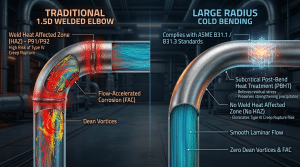
在現代高溫高壓發電廠,特別是燃氣複循環發電廠(Combined Cycle Power Plant, CCPP)與超超臨界(USC)機組的技術演進過程中,高能動力管線(High Energy Piping, HEP)系統的結構完整性,直接決定了電廠的全生命週期與資產可靠度。過去,管線系統的幾何佈局與空間方向轉換,高度依賴於 1.5D(曲率半徑為公稱管徑之 1.5 倍)的短半徑對銲彎頭(Butt-Welded Elbows)。然而,隨著次世代管線的設計溫度突破 600°C 且操作壓力日益攀升,傳統銲接彎頭不僅在流體動力學上易引發極為嚴重的流體加速腐蝕(Flow-Accelerated Corrosion, FAC),其銲道熱影響區(Heat-Affected Zone, HAZ)更成為第四型潛變破裂(Type IV Creep Cracking)與熱疲勞失效的溫床1。In the technological evolution of modern high-temperature and high-pressure power plants, particularly Combined Cycle Power Plants (CCPP) and Ultra-Supercritical (USC) units, the structural integrity of High Energy Piping (HEP) systems directly determines the plant’s entire life cycle and asset reliability. Historically, the geometric layout and spatial directional changes of piping systems relied heavily on 1.5D (curvature radius of 1.5 times the nominal pipe diameter) short-radius butt-welded elbows. However, as the design temperatures of next-generation piping exceed 600°C and operating pressures continue to climb, traditional welded elbows not only easily induce severe Flow-Accelerated Corrosion (FAC) in terms of fluid dynamics, but their Heat-Affected Zones (HAZ) also become breeding grounds for Type IV Creep Cracking and thermal fatigue failures1.
為突破傳統銲接管件在物理力學與微觀冶金上的雙重極限,國際管線工程界正經歷一場深刻的典範轉移——全面導入大半徑 3D 與 5D 數控冷作彎管(CNC Cold Bending)技術,以實現「以彎代銲」(Bending instead of Welding)的模組化預製施工4。與此同時,作為管線應力分析最高指導準則的 ASME B31.1(動力管線)與 ASME B31.3(製程管線)亦發生了結構性的重大變革。ASME B31J 規範已全面取代沿用半世紀之久的 Appendix D 經驗公式,為管線的應力強度因子(Stress Intensification Factor, SIF)與柔性係數(Flexibility Factor, k)提供了基於嚴謹有限元素分析(Finite Element Analysis, FEA)與實體驗證的精確指引5。To break through the dual limits of traditional welded fittings in physical mechanics and micro-metallurgy, the international piping engineering sector is undergoing a profound paradigm shift—comprehensively introducing large-radius 3D and 5D CNC Cold Bending technology to achieve modular prefabricated construction of “Bending instead of Welding”4. Concurrently, ASME B31.1 (Power Piping) and ASME B31.3 (Process Piping), the highest guiding codes for piping stress analysis, have also undergone major structural transformations. The ASME B31J code has fully replaced the half-century-old Appendix D empirical formulas, providing precise guidelines for Stress Intensification Factors (SIF) and Flexibility Factors (k) based on rigorous Finite Element Analysis (FEA) and physical testing verifications5.
本研究報告旨在提供一份窮盡細節的綜合性論述,深度剖析現代高能動力管線採用「以彎代銲」技術的理論基礎與實務應用。本論述將結合 ASME 規範放寬冷作應變率與彎後熱處理(Post-Bend Heat Treatment, PBHT)極限值之機制,從結構應力解析、材料冶金退化機制、流體動力學行為、施工期程優化與非破壞性檢驗(NDE)成本等多維視角,嚴謹論證冷彎工法的不可替代性。同時,本報告將長期營運可靠度的分析焦點,深度聚焦於面臨頻繁啟停(Cycling)與極端海岸高鹽害環境的台灣 CCPP 發電廠,為未來的能源轉型基礎建設提供具備高度前瞻性的工程科學決策依據。This research report aims to provide an exhaustive and comprehensive discourse, deeply analyzing the theoretical foundation and practical applications of adopting the “bending instead of welding” technology in modern high-energy piping. This discussion will integrate ASME code mechanisms regarding the relaxation of cold forming strain and Post-Bend Heat Treatment (PBHT) limits, rigorously demonstrating the indispensability of the cold bending method from multi-dimensional perspectives, including structural stress analysis, metallurgical degradation mechanisms, fluid dynamic behaviors, construction schedule optimization, and Non-Destructive Examination (NDE) costs. Furthermore, the analysis of long-term operational reliability will deeply focus on Taiwan’s CCPP power plants, which face frequent cycling and extreme coastal high-salinity environments, thereby providing a highly forward-looking engineering science decision-making basis for future energy transition infrastructures.
一、 理論基礎與規範演進:ASME B31J 之應力解析典範轉移 / I. Theoretical Foundation and Code Evolution: The Paradigm Shift of Stress Analysis under ASME B31J
在探討大半徑冷作彎管的力學優勢前,必須先釐清管線應力分析法規的歷史演進。半個世紀以來,管線應力工程師皆依賴 ASME B31.1 與 B31.3 附錄 D(Appendix D)中,基於 1950 年代 Markl 疲勞測試數據的封閉式解(Closed-form solutions)來進行系統彈性與應力計算5。然而,面對現代高溫高壓、大口徑、薄壁化(高徑厚比D/T)且材質多樣的高能管線,Markl 疲勞方程式暴露出極大的理論盲點與過度的保守性5。Before exploring the mechanical advantages of large-radius cold bends, the historical evolution of piping stress analysis codes must be clarified. For half a century, piping stress engineers have relied on closed-form solutions based on 1950s Markl fatigue test data found in Appendix D of ASME B31.1 and B31.3 for system flexibility and stress calculations5. However, when confronted with modern high-temperature, high-pressure, large-diameter, thin-walled (high D/T ratio), and multi-material high-energy piping, Markl’s fatigue equations have exposed massive theoretical blind spots and excessive conservatism5.
1.1 傳統 Markl 理論與 Appendix D 的結構性侷限 / 1.1 Structural Limitations of Traditional Markl Theory and Appendix D
舊版 Appendix D 的核心缺陷,在於其對複雜空間受力狀態的過度簡化。傳統規範對於彎頭與三通管(Tees)強行賦予單一的應力強度因子(SIF),並未區分面內(In-Plane)與面外(Out-of-Plane)彎矩的作用差異5。實際上,當彎矩施加於管件時,由於元件幾何會發生非對稱性塑性變形,面內彎矩(使彎管兩端靠攏或張開)與面外彎矩(使一端移出其原本所在的平面)會產生截然不同位置與幅度的局部應力集中。其次,舊版規範完全忽略了扭轉力矩(Torsional moment)對剪應力集中的貢獻,一律預設扭轉 SIF 為it=1.0 5。The core defect of the legacy Appendix D lies in its oversimplification of complex spatial stress states. Traditional codes forced a single stress intensification factor (SIF) onto elbows and tees, failing to differentiate between the effects of In-Plane and Out-of-Plane bending moments5. In reality, when a bending moment is applied to a fitting, due to the component’s asymmetrical plastic deformation, in-plane moments (which bring the ends closer or further apart) and out-of-plane moments (which move one end out of its original plane) produce local stress concentrations of completely different locations and magnitudes. Secondly, legacy codes completely ignored the contribution of torsional moments to shear stress concentration, uniformly defaulting the torsional SIF to it=1.0 5.
在這種簡化模型下,柔性特徵值(Flexibility Characteristic, h)的計算容易導致工程師產生指派錯誤8。例如,若將彎頭的經驗公式直接套用於銲接三通管,會導致面外應力強度因子被嚴重低估達 20%(因 0.9/0.75=1.2),形成潛在的斷裂風險5。此外,1.5D 短半徑彎頭往往會產生高達 3.0 至 5.0 的極高 SIF 值。這意味著在相同的系統熱膨脹位移下,1.5D 彎頭處的局部疲勞應力將被不合理地放大數倍,迫使設計者必須增加大量的膨脹環(Expansion loops)、彈簧吊架或結構鋼材來吸收應力,導致建廠成本與空間佔用急遽上升。Under this simplified model, the calculation of the flexibility characteristic (h) easily led to assignment errors by engineers8. For instance, directly applying the elbow’s empirical formula to a welded tee results in a severe 20% underestimation of the out-of-plane SIF (since 0.9/0.75=1.2), creating potential fracture risks5. Furthermore, 1.5D short-radius elbows often generate extremely high SIF values ranging from 3.0 to 5.0. This implies that under the same system thermal expansion displacement, the local fatigue stress at the 1.5D elbow will be unreasonably amplified several times, forcing designers to add numerous expansion loops, spring hangers, or structural steel to absorb the stress, causing construction costs and spatial footprints to skyrocket.
1.2 ASME B31J-2023 規範下之多維應力強度與柔性分析 / 1.2 Multi-Dimensional Stress Intensification and Flexibility Analysis under ASME B31J-2023
為徹底修正此一歷史偏差,ASME 正式發布了 ASME B31J-2023(Stress Intensification Factors, Flexibility Factors, and Their Determination for Metallic Piping Components)標準,並在 ASME B31.1(2024 年版)與 ASME B31.3(2020 年版)中正式刪除 Appendix D,強制全面導入 B31J 的數值模型6。To completely correct this historical deviation, ASME officially issued the ASME B31J-2023 (Stress Intensification Factors, Flexibility Factors, and Their Determination for Metallic Piping Components) standard. It formally deleted Appendix D in ASME B31.1 (2024 Edition) and ASME B31.3 (2020 Edition), mandating the comprehensive implementation of the B31J numerical model6.
ASME B31J 基於大規模實體疲勞實驗與有限元素分析,為管線組件導入了空間方向性的 SIF 解析,明確定義了面內應力強度因子(ii)、面外應力強度因子(io)與扭轉應力強度因子(it)6。在 B31J 的精確計算框架下,3D 與 5D 大半徑冷作彎管(其彎曲半徑R1=3.0Do 或5.0Do)因具備幾何上的連續性與和緩的曲率,其 ii 與 io 數值大幅收斂,甚至直接趨近或等於理論下限值 1.011。Based on large-scale physical fatigue tests and finite element analysis, ASME B31J introduced spatial directional SIF analysis for piping components, clearly defining the in-plane SIF (ii), out-of-plane SIF (io), and torsional SIF (it)6. Under B31J’s precise calculation framework, 3D and 5D large-radius cold bends (bend radius R1=3.0Do or 5.0Do) feature geometric continuity and gentle curvature, allowing their ii and io values to significantly converge, even approaching or equalling the theoretical lower limit of 1.011.
在 B31J 的規範定義中,針對持續應力指數(Sustained Stress Index, SSI),規定必須採用0.75i(並設有下限值 1.0),因為承受持續負載下的塑性塌陷(Plastic collapse)極限狀態,遠不如承受交變應力的疲勞極限狀態來得嚴苛7。針對瞬間動態水錘效應(Transient dynamic water hammer events),新規範則引入了 2.0i 的放大係數。此外,B31J 明確規範其應力指數之有效性僅建立在徑厚比D/T≦100超出此範圍或為非鐵金屬,設計者必須謹慎評估12。Within B31J’s definitions, for the Sustained Stress Index (SSI), a value of 0.75i a minimum limit of 1.0) must be applied, because the plastic collapse limit state under sustained loads is far less severe than the fatigue limit state under alternating stresses7. For transient dynamic water hammer events, the new code introduces a multiplier of 2.0i itionally, B31J specifies that the validity of its stress indices is limited to metallic fittings with a diameter-to-thickness ratio D/T≦100; for ratios outside this range or for non-ferrous materials, designers must evaluate with caution12.
採用 SIF 趨近於 1.0 的 5D 冷作彎管,代表該部位的疲勞抗力幾乎等同於無縫母材直管(Seamless base metal)。這不僅從根本上消除了傳統 1.5D 銲接彎頭為了配合現場洩水坡度(Drainage Slope)而強行組裝所導致的角度錯位應力疊加效應(Km),更賦予了管線極高的柔性係數(k,使其能以更精簡的佈局吸收龐大的熱膨脹應變11。Utilizing a 5D cold bend with an SIF approaching 1.0 means the fatigue resistance at the bend is almost equivalent to a seamless base metal straight pipe. This not only fundamentally eliminates the vicious superposition effect of the angular misalignment stress concentration factor (Km aused by forcing traditional 1.5D welded elbows to fit non-standard field drainage slopes, but also grants the piping an extremely high flexibility factor (k, allowing it to absorb massive thermal expansion strains with a more streamlined layout11.
| 應力參數與特性 / Stress Parameters & Characteristics | 傳統 1.5D 短半徑銲接彎頭 (B31.3 舊版 Appendix D) / Traditional 1.5D Welded Elbow (Legacy B31.3 Appendix D) | 現代 5D 數控冷作彎管 (ASME B31J-2023) / Modern 5D CNC Cold Bend (ASME B31J-2023) |
| 面內/面外 SIF (ii , io) / In-Plane/Out-of-Plane SIF | 極高(常大於 3.0,將疲勞應力放大數倍),且不分方向性。 / Extremely high (often >3.0, amplifying fatigue stress), lacks directionality. | 極低(趨近於理論下限 1.0),精確區分面內外方向性應力8。 / Extremely low (approaching theoretical limit 1.0), precisely distinguishes directional stresses8. |
| 柔性係數 (k 因子) / Flexibility Factor (k) | 相對較低,需龐大膨脹環設計補償。 / Relatively low, requires massive expansion loops for compensation. | 顯著提升,能有效引導並吸收系統熱膨脹位移6。 / Significantly enhanced, effectively guides and absorbs thermal expansion displacement6. |
| 扭轉應力強度 (it) / Torsional SIF (it) | 強制設定為 1.0,忽略扭轉剪應力極值。 / Forced to 1.0, ignoring extreme torsional shear stress. | 依據管件幾何進行動態評估,大幅提高模型真實性9。 / Dynamically evaluated based on geometry, greatly improving model realism9. |
| 持續應力指數 (SSI) / Sustained Stress Index (SSI) | 依幾何應力集中效應單一估算。 / Single estimation based on geometric stress concentration. | 採 0.75i(下限 1.0),防止塑性塌陷並減少保守過度設計7。 / Applies 0.75i (min 1.0), prevents plastic collapse and reduces over-conservative design7. |
| 疲勞壽命預估 / Fatigue Life Estimation | 易受角度錯位 (Km) 疊加效應影響,熱疲勞極限低。 / Vulnerable to Km superposition effects; low thermal fatigue limit. | 抗疲勞壽命大幅延長,可達傳統錯位彎頭之數十倍以上11。 / Fatigue life is drastically extended, up to dozens of times that of misaligned traditional elbows11. |
二、 傳統 1.5D 銲接彎頭之冶金退化與流體動力學失效機制/ II. Metallurgical Degradation and Fluid Dynamic Failure Mechanisms of Traditional 1.5D Welded Elbows
在確認冷作彎管的巨觀力學優勢後,我們必須深入微觀與流體力學層面,理解傳統 1.5D 銲接彎頭在現代 CCPP 高溫高壓的極端環境下為何逐漸被淘汰。其失效機制主要源於流場擾動所引發的沖蝕減薄,以及銲接熱循環導致的材料雙重冶金退化1。After confirming the macroscopic mechanical advantages of cold bends, we must delve into the microscopic and fluid dynamic levels to understand why traditional 1.5D welded elbows are gradually becoming obsolete in the extreme high-temperature and high-pressure environments of modern CCPPs. Their failure mechanisms primarily stem from erosion-thinning caused by flow disturbances and the dual metallurgical degradation of materials caused by welding thermal cycles1.
2.1 迪安渦流物理學與流體加速腐蝕 (FAC) 效應 / 2.1 Dean Vortex Physics and Flow-Accelerated Corrosion (FAC) Effects
當高壓蒸汽或高能汽水兩相流進入 1.5D 短半徑彎頭時,受限於極端的幾何邊界約束,流體微粒會受到強大離心力的驅動。管中心區域的高速流體因具備較高動能,被迫強烈推向彎頭外彎壁(Extrados);與此同時,近壁處的低速流體受到逆向壓力梯度(Adverse pressure gradients)的影響,沿著管壁向內彎壁(Intrados)強行回流,形成極其強烈的二次流(Secondary Flow)與高頻剪切擾動。When high-pressure steam or high-energy two-phase flow enters a 1.5D short-radius elbow, constrained by extreme geometric boundaries, fluid particles are driven by strong centrifugal forces. The high-speed fluid in the pipe’s center, possessing higher kinetic energy, is strongly pushed toward the extrados; simultaneously, the low-speed fluid near the wall is affected by adverse pressure gradients, forcing it to flow back toward the intrados along the pipe wall, forming an extremely intense secondary flow and high-frequency shear disturbances.
這種二次流的強度可由無因次的流體力學參數「迪安數」(Dean Number, De)加以精確量化。迪安數的物理定義為雷諾數(Reynolds Number, Re)與彎曲管件曲率比(D/2Rc)平方根的乘積1: The intensity of this secondary flow can be precisely quantified by the dimensionless Dean Number (De). The Dean number is defined as the product of the Reynolds Number (De) and the square root of the curvature ratio (D/2Rc)1:
De=Re√D/2Rc
公式清楚揭示,當曲率半徑 Rc 越小(如 1.5D 甚至 1.0D),迪安數便會呈指數級別攀升。透過多物理場耦合軟體(如 COMSOL 結合 Volume of Fluid 與 Discrete Element Method)的計算流體動力學(CFD)數值模擬證實,1.5D 彎頭極端的迪安渦流會導致流體邊界層在彎頭下游發生嚴重的流場分離(Flow Separation),產生龐大的逆壓梯度與渦流滯留區(Recirculation zones)。The formula clearly reveals that the smaller the curvature radius Rc (e.g., 1.5D or even 1.0D), the Dean number will rise exponentially. Computational Fluid Dynamics (CFD) numerical simulations using multiphysics coupling software (like COMSOL combined with VOF and DEM) confirm that the extreme Dean vortices of 1.5D elbows cause severe flow separation in the boundary layer downstream of the elbow, generating massive adverse pressure gradients and recirculation zones.
高頻率且高強度的邊界層剪切應力,會直接從物理上剝離含碳鋼或低合金鋼管內壁自然生成的緻密磁鐵礦(Magnetite, Fe3O4)保護膜。保護膜一旦破壞,新鮮的金屬基體便會持續暴露於高溫高壓流體中,進而引發極為嚴重的流體加速腐蝕(FAC)與局部沖蝕減薄現象15。相對而言,採用大半徑的 3D 或 5D 冷作彎管,其平緩的曲率能使流線始終保持貼壁流動,大幅抑制迪安渦流的生成,並可將系統的流體壓降(Pressure Drop)顯著降低 20% 至 30%,從根本的熱傳與流體機制上消弭了 FAC 的物理驅動力15。The high-frequency and high-intensity boundary layer shear stress will physically strip away the dense magnetite (Fe3O4) protective film naturally formed on the inner walls of carbon or low-alloy steel pipes. Once this film is destroyed, the fresh metal matrix is continuously exposed to the high-temp, high-pressure fluid, thereby triggering extremely severe Flow-Accelerated Corrosion (FAC) and localized erosion-thinning phenomena15. In contrast, using 3D or 5D large-radius cold bends provides a gentle curvature that keeps the flow lines consistently attached to the wall, significantly suppressing the generation of Dean vortices, reducing system pressure drop by 20% to 30%, and fundamentally eradicating the physical driving force of FAC from heat transfer and fluid mechanisms15.
2.2 細晶熱影響區退化與第四型潛變破裂 (Type IV Creep Cracking) / 2.2 Fine-Grained HAZ Degradation and Type IV Creep Cracking
為承受 600°C 以上之超高溫,現代 CCPP 主蒸汽管線大量採用 P91、P92、P93 等高階潛變強化鐵素體鋼(Creep Strength Enhanced Ferritic Steels, CSEF)。這類先進合金鋼極度依賴其內部獨特的回火馬氏體板條(Tempered Martensite Laths)以及奈米級的碳氮化物(如釩、鈮所形成的 M23C6碳化物與 MX 析出相)來提供高溫潛變抗力3。To withstand ultra-high temperatures above 600°C, modern CCPP main steam piping heavily utilizes Creep Strength Enhanced Ferritic Steels (CSEF) like P91, P92, and P93. These advanced alloy steels rely heavily on their unique tempered martensite laths and nano-scale carbonitrides (such as M23C6 carbides and MX precipitates formed by vanadium and niobium) to provide high-temperature creep resistance3.
傳統 1.5D 彎頭在現場安裝時,必須依靠環向對銲(Girth Welds)連接母管。銲接過程產生的龐大熱輸入(Heat Input),會不可避免地在緊鄰母材熔合線(Fusion Line)的外側,形成微觀結構極度不均勻且脆弱的熱影響區(HAZ)。其中最致命的區域,是經歷峰值溫度介於鋼材相變點 AC1與 AC3 之間的細晶熱影響區(Fine-Grained HAZ, FGHAZ)與臨界熱影響區(Intercritical HAZ, ICHAZ)。When traditional 1.5D elbows are installed on-site, they must rely on girth welds to connect to the main pipe. The massive heat input generated during the welding process inevitably forms an extremely microstructurally uneven and fragile Heat-Affected Zone (HAZ) right outside the fusion line. The most fatal regions are the Fine-Grained HAZ (FGHAZ) and Intercritical HAZ (ICHAZ), which experience peak temperatures between the steel’s AC1 and AC3 transformation points.
在這些狹窄的次區域內,材料經歷了不完全的沃斯田鐵化(Incomplete Austenitization):原本提供強大釘紮作用(Pinning effects)的奈米析出物發生了部分溶解;隨後在快速冷卻時,該區域未能恢復強韌的馬氏體組織,反而轉變為位錯密度大幅下降、晶粒異常細化且硬度極低的軟弱組織。Within these narrow sub-regions, the material undergoes incomplete austenitization: the nano-precipitates that originally provided a strong pinning effect from the steel mill partially dissolve; subsequently, during rapid cooling, the region fails to recover the tough martensite structure, instead transforming into a soft, weak microstructure with a massively decreased dislocation density and abnormally refined grains.
當管線進入後續的銲後熱處理(PWHT)或長期高溫高壓服役階段時,FGHAZ 內部剩餘的析出物會迅速失去熱力學穩定性並發生粗化(如 Laves 相的異常長大與聚合,或 Z-phase 的過早析出),徹底喪失對位錯滑移與晶界移動的阻礙能力。在系統內部壓力與高溫熱膨脹所產生的多軸應力拘束(Triaxial Stress Constraint)作用下,FGHAZ 內部的晶界滑移將急遽惡化。根據 Rice-Tracey 空孔成長模型,微觀蠕變空孔(Creep Cavities)會沿著弱化的晶界迅速成核、成長,並相互連結成宏觀微裂紋。As the piping enters the subsequent Post-Weld Heat Treatment (PWHT) or long-term high-temp, high-pressure service stages, the remaining precipitates inside the FGHAZ rapidly lose thermodynamic stability and coarsen (e.g., abnormal growth and agglomeration of the Laves phase, or premature Z-phase precipitation), completely losing their ability to hinder dislocation slip and grain boundary movement. Under the Triaxial Stress Constraint generated by internal system pressure and high-temperature thermal expansion, grain boundary sliding within the FGHAZ will sharply worsen. According to the Rice-Tracey void growth model, microscopic creep cavities will rapidly nucleate, grow along the weakened grain boundaries, and interconnect into macroscopic microcracks.
這種劣化機制極其隱蔽,最終導致管線在遠低於設計壽命的時間內,於 HAZ 發生毫無預警的巨觀脆性斷裂,此即工程界聞之色變的「第四型潛變破裂」(Type IV Creep Cracking)。一旦發生,往往引發災難性的高壓蒸汽爆裂事故。因此,以彎代銲工法的最大冶金貢獻,便在於透過一體成型的製程,徹底移除了位於高彎矩、高應力集中區的環向銲道,從源頭拔除了引發 Type IV 破裂的幾何與冶金根源2。This degradation mechanism is extremely stealthy, ultimately causing the piping to experience a completely unpredicted macroscopic brittle fracture at the HAZ in a time far shorter than its design life—this is the dreaded “Type IV Creep Cracking” in the engineering field. Once it occurs, it often triggers catastrophic high-pressure steam bursts. The greatest metallurgical contribution of the “bending instead of welding” method is that, through its one-piece fabrication process, it completely removes the girth welds located in high-bending-moment, high-stress concentration areas, physically and metallurgically uprooting the source of Type IV cracking risks2.
此外,在涉及異種金屬銲接(Dissimilar Metal Welds)時(例如將高合金鐵素體鋼與 316LN 沃斯田鐵不銹鋼相接),傳統銲接更面臨致命的碳遷移效應(Carbon Migration)與熱膨脹係數失配(Thermal Expansion Mismatch)。由於兩側母材鉻含量差異巨大,高溫服役期間碳原子會受化學勢梯度驅動,從鐵素體側越過熔合線向高鉻側擴散,導致鐵素體側形成弱化的脫碳帶,而沃斯田鐵側則形成極脆的碳化物密集帶。同時,沃斯田鐵鋼的熱膨脹係數比鐵素體高出約 30%,在 CCPP 機組頻繁啟停的熱循環下,會於熔合線周遭產生龐大的交變剪切應力,進一步加速裂紋的萌生。Furthermore, in cases involving Dissimilar Metal Welds (DMW)—such as joining high-alloy ferritic steel with 316LN austenitic stainless steel—traditional welding faces the fatal Carbon Migration effect and Thermal Expansion Mismatch. Due to the massive difference in chromium content (austenite has ~18% Cr, ferrite ~9%), carbon atoms are driven by a chemical potential gradient during high-temperature service to diffuse from the low-chromium ferritic side across the fusion line to the high-chromium side. This results in a severely weakened decarburized zone on the ferritic side and an extremely hard, brittle carbon-rich Type I Carbide zone on the austenitic side. Concurrently, the thermal expansion coefficient of austenitic steel is about 30% higher than ferritic steel, generating massive alternating shear stresses around the fusion line under the frequent thermal cycling of CCPP units, further accelerating crack initiation.
三、 大半徑冷作彎曲技術 (3D/5D) 之製造動力學與幾何控制規範 / III. Manufacturing Dynamics and Geometric Control Codes of Large-Radius Cold Bending Technology (3D/5D)
要實現「以彎代銲」的工程願景,製造商必須克服一項極限物理挑戰:將厚壁高合金管材在室溫或次臨界溫度下進行巨幅塑性變形。為確保承壓完整性,ASME B31.1 與 B31.3 對於冷彎成型過程中的幾何變異有著極其嚴格的科學約束。To realize the engineering vision of “bending instead of welding,” manufacturers must overcome an extreme physical challenge: subjecting thick-walled high-alloy pipes to massive plastic deformation at room or subcritical temperatures. To ensure pressure-boundary integrity, ASME B31.1 and B31.3 impose highly strict scientific constraints on geometric variations during the cold forming process.
3.1 壁厚減薄 (Wall Thinning) 管控與預留裕度法則 / 3.1 Wall Thinning Control and Allowance Rules
當彎徑比介於 3≦R/D≦5時,屬於緊密半徑的冷作彎曲工法。在成型過程中,彎管外側(Extrados)承受極大拉伸應變,必然發生壁厚減薄(Wall Thinning);而內側(Intrados)則承受壓縮應變而增厚,且中性軸(Neutral axis)會發生偏移1。根據 ASME B31.1 的規定,直管在內壓下的最小設計壁厚 tm 計算公式為: When the bend radius ratio is between 3≦R/D≦5, it is considered a tight-radius cold bending process. During forming, the extrados (outer arc) of the bend sustains massive tensile strain, inevitably causing wall thinning; whereas the intrados (inner arc) sustains compressive strain and thickens, shifting the neutral axis1. According to ASME B31.1, the minimum design wall thickness tm for straight pipe under internal pressure is calculated as:
tm=[PDo/2(SE+Py)]+A
在進行彎管前,依據 ASME B31.1 規範第 102.4.5 節(Table 102.4.5)的強制規定,設計者必須根據預定的彎曲半徑,精確給予彎曲減薄補償裕度(Bend Thinning Allowance),以確保彎曲後最薄處的實際壁厚仍大於或等於 tm 1。規範明確指出: Prior to bending, per the mandatory requirements of ASME B31.1 Section 102.4.5 (Table 102.4.5), designers must accurately apply a Bend Thinning Allowance based on the intended bend radius, ensuring that the actual wall thickness at the thinnest point post-bending remains greater than or equal to tm 1. The code explicitly dictates:
- 彎曲半徑≧ 6D 時:需預留 6% 的額外壁厚( 1.06 tm)。 / Bend radius ≧ 6D: requires a 6% extra thickness allowance (1.06 tm).
- 彎曲半徑 5D 時:需擴增至 8% 的補償裕度(1.08 tm)。 / Bend radius 5D: requires an 8% allowance (1.08 tm).
- 彎曲半徑 4D 與 3D 時:必須分別預留高達 14%(1.14 tm)與 25%(1.25 tm)的餘裕15。 / Bend radius 4D and 3D: mandates extreme allowances of 14% (1.14 tm) and 25% (1.25 tm), respectively15.
在工程實務中,3D 比例的冷作彎曲可能引發高達 15% 至 18% 的局部減薄,甚至超出規範容許極限;然而,5D 彎曲工法的減薄率則可穩定控制在 8% 左右1。這意味著,5D 彎管能在完全不需採購特製超厚母管(Extra-heavy parent pipe)的前提下,完美符合承壓邊界完整性要求,兼具了管線整體減重與原料成本優化的雙重優勢。In engineering practice, 3D proportioned cold bending can induce local thinning up to 15% to 18%, sometimes exceeding code tolerances; however, the thinning rate of the 5D cold bending process can be stably controlled around 8%1. This implies that 5D bends can perfectly meet pressure boundary integrity requirements without needing to procure customized extra-heavy parent pipes, delivering a dual advantage of overall piping weight reduction and raw material cost optimization.
3.2 扁平率與橢圓度 (Ovality) 之精密控制 / 3.2 Precision Control of Flattening and Ovality
彎曲過程中的中性軸偏移與應力不對稱分配,會導致管件橫截面產生非期望的扁平化(Flattening)。橢圓度 U 的精確定義公式為:Neutral axis deviation and asymmetrical stress distribution during the bending process cause undesired flattening of the fitting’s cross-section. The precise definition formula for Ovality U is:
U=200×(damax-damin)/(damax +damin) [%]
依據 ASME B31.3 (Para 332.2.1) 與相關規範,承受內部壓力的管線,其最大允許橢圓度被嚴格限制在 8.0% 以內;若該管線需承受外部壓力,則容忍極限更緊縮至 3.0%19。 According to ASME B31.3 (Para 332.2.1) and related standards, for piping subjected to internal pressure, the maximum allowable ovality is strictly limited to within 8.0%; if the pipe must withstand external pressure, the tolerance tightens to 3.0%19.
若橢圓度嚴重超標,不僅會在管內引發流體擾動與壓降損失,更會從根本上改變管件的截面慣性矩(Moment of Inertia),使得前述 B31J 的 SIF 與 k 因子分析產生嚴重失真。現代 CNC 冷彎技術透過管內精密控制的內部芯棒(Mandrel Bending)提供強大支撐,並輔以精密伺服機構對抗材料在卸載時的彈性回彈(Springback,對於鋼管的 90° 彎曲通常介於 0.8° 至 1.5° 之間),可將成型後的橢圓度穩定控制在極為優異的 3% 以內18。 If ovality severely exceeds limits, it not only induces fluid disturbance and pressure drop losses but fundamentally alters the fitting’s moment of inertia, severely distorting the aforementioned SIF and k factor analysis under B31J. Modern CNC cold bending technology utilizes a precisely controlled internal mandrel (Mandrel Bending) to provide robust support, complemented by precision servomechanisms to counter the material’s springback upon unloading (which typically ranges from 0.8° to 1.5° for steel pipes), thereby stably controlling the post-forming ovality to an outstanding <3%18.
相較於傳統感應彎曲(Induction Bending)容易因高溫塑性流動而產生壁厚過度流失,冷彎工法憑藉著金屬在室溫下較高的降伏強度(Yield Strength)與應變硬化效應,保留了極佳的幾何精準度與表面光潔度18。 Compared to traditional induction bending, which is prone to excessive wall loss due to high-temperature plastic flow, cold bending leverages the metal’s higher yield strength and strain hardening effect at room temperature to preserve excellent geometric precision and surface finish18.
| 評估參數 / Evaluation Parameter | 傳統感應熱彎 (Induction Bending) / Traditional Induction Bending | CNC 大半徑冷彎 (Cold Bending) / CNC Large Radius Cold Bending |
| 橢圓度控制 (Ovality) / Ovality Control | 表現優異,但缺乏內部芯棒支撐20。 / Excellent, but lacks internal mandrel support20. | 極佳 (典型 < 3%),具備芯棒支撐與彈性回彈補償18。 / Outstanding (typically < 3%), with mandrel support and springback compensation18. |
| 微觀組織衝擊 / Microstructural Impact | 局部晶粒長大,淬火易產生未回火馬氏體,需全面 N&T20。 / Localized grain growth, untempered martensite post-quench, requires full N&T20. | 產生加工硬化,透過適當的次臨界 PBHT 即可恢復韌性20。 / Induces strain hardening, easily restored via subcritical PBHT20. |
| 壁厚減薄 (Thinning) / Wall Thinning | 8% – 15% (受制於熱膨脹與塑性流動)20。 / 8% – 15% (Limited by thermal expansion & plastic flow)20. | 嚴格受控於冷作應變與材料室溫強度,5D 彎曲僅需 8% 補償15。 / Strictly controlled by cold strain & yield strength, 5D requires only 8% allowance15. |
| 氫致開裂 (HIC) 風險 / HIC Risk | 降低碳當量 (CE) 導致 HIC 敏感度上升20。 / Reduced carbon equivalent (CE) increases HIC sensitivity20. | 保留原始碳當量,冶金穩定性高20。 / Preserves original CE, high metallurgical stability20. |
四、 ASME 應變率極限與彎後熱處理 (PBHT) 極限值機制 / IV. ASME Strain Limits and Post-Bend Heat Treatment (PBHT) Threshold Mechanisms
大半徑冷作彎管在外半徑處會積累極高的冷作變形與殘餘拉伸應力。在含氧或高溫蒸汽的腐蝕環境中,高殘餘應力是誘發應力腐蝕裂紋(SCC)的絕對關鍵因素。Large-radius cold bends accumulate extremely high cold deformation and residual tensile stress at the extrados. In corrosive environments containing oxygen or high-temperature steam, high residual stress is an absolute key factor in inducing Stress Corrosion Cracking (SCC).
4.1 冷作應變率 (Cold Forming Strain) 的計算與微觀損害 / 4.1 Calculation and Micro-Damage of Cold Forming Strain
彎曲應變率的理論極限可由純幾何關係近似求得:The theoretical limit of bending strain can be approximated by pure geometric relationships:
ε≈Do/2Rc×100%
依據此公式推算,對於 R=5D的彎管,理論最大拉伸應變約高達 10.0%;而對於 R=3D 的緊密彎管,冷應變更可飆升至 16.7%1。在如此劇烈的微觀晶格扭曲與位錯增殖下,P91/P92 等材料原有的回火馬氏體組織特徵會遭到嚴重破壞,引發應變時效(Strain Aging),並導致材料的衝擊韌性(Impact Toughness)急遽下降至危險邊緣。 Based on this formula, for an R=5D bend, the theoretical maximum tensile strain reaches up to 10.0%; for an R=3D tight bend, cold strain can surge to 16.7%1. Under such intense microscopic lattice distortion and dislocation multiplication, the original tempered martensite characteristics of materials like P91/P92 are severely destroyed, triggering Strain Aging and causing the Impact Toughness of the material to plummet to dangerous levels.
4.2 ASME 放寬應變率與彎後熱處理極限值之設計準則 / 4.2 ASME Design Rules for Strain Rate and PBHT Thresholds
為消除龐大的殘餘拉伸應力並恢復金屬延展性,必須執行嚴格的彎後熱處理(PBHT)。相較於針對銲道熱處理(PWHT)的豁免條款(如 ASME B31.3 Table 331.1.3 的規定21),針對冷作成型的熱處理,ASME 規範體系提出了更為細緻的極限值劃分: To eliminate massive residual tensile stresses and restore metal ductility, strict Post-Bend Heat Treatment (PBHT) must be executed. Compared to the exemption clauses for Post-Weld Heat Treatment (PWHT) (e.g., ASME B31.3 Table 331.1.321), the ASME code system proposes much more detailed threshold classifications for cold forming heat treatments:
- ASME B31.1 第3 節 (Table 129.3.1-1):針對 P91 等高階材料,明確定義了冷成型後的應變極限與熱處理要求。若應變率超出規範極限值,或是發生超過 25% 的極端減薄,則強制要求執行 PBHT22。 ASME B31.1 Section 129.3 (Table 129.3.1-1): Clearly defines post-cold-forming strain limits and heat-treatment requirements for advanced materials like P91. If the strain rate exceeds code limits, or if extreme thinning exceeding 25% occurs, executing PBHT is mandatory22.
- ASME B31.3 第4.2 節 (Para 332.4.2a):強制要求彎曲成型後,應變最劇烈的區域必須保留至少 10% 的殘餘延伸率(Retained Elongation)。若低於 10%,則該管材嚴禁直接使用,必須透過熱處理恢復延展性19。 ASME B31.3 Section 332.4.2 (Para 332.4.2a): Mandates that after forming, the most severely strained region must retain at least 10% Retained Elongation. If it falls below 10%, the pipe is strictly prohibited from direct use and must undergo heat treatment to restore ductility19.
PBHT 策略的科學選擇:次臨界熱處理 (Subcritical IH-PBHT) vs. 正常化與回火 (N&T) / Scientific Selection of PBHT Strategies: Subcritical IH-PBHT vs. Normalizing and Tempering (N&T)
傳統感應彎曲因必須將材料加熱至沃斯田鐵化溫度以上,成型後微觀組織發生了相變,因此彎後必須進行全面性的「正常化與回火」(N&T)以重新建構晶粒組織11。然而,全面的 N&T 工法若溫度與冷卻速率控制不當,極易導致晶粒異常粗大或微觀硬度不均4。 Traditional induction bending requires heating the material above the austenitizing temperature, causing phase transformation during forming, hence requiring full “Normalizing and Tempering” (N&T) post-bending to reconstruct the grain structure11. However, if the temperature and cooling rates of full N&T are poorly controlled, it easily leads to abnormally coarse grains or uneven micro-hardness4.
反之,針對採用 5D 比例之 CNC 室溫冷作彎管,其應變率落在法規允許的臨界調控區間內。針對 P91/P92 厚壁管材,ASME 規範允許採用次臨界感應加熱彎後熱處理(Subcritical IH-PBHT),將熱處理溫度精確控制在 705°C 至 760°C 之間(嚴格低於 AC1 下臨界溫度)1。此先進工法能在不誘發材料發生相變的前提下,完美消除冷作加工硬化與殘餘應力,同時避免破壞母材原有的精細碳氮化物強化析出相,徹底保障了 CSEF 鋼材在服役期間的長期潛變韌性1。 Conversely, for CNC room-temperature cold bends utilizing 5D proportions, the strain rate falls within the code’s allowable critical control range. For P91/P92 thick-walled pipes, ASME codes permit Subcritical Induction Heating Post-Bend Heat Treatment (Subcritical IH-PBHT), precisely controlling the temperature between 705°C and 760°C (strictly below the AC1 lower critical temperature)1. This advanced method perfectly eliminates cold work hardening and residual stresses without inducing material phase changes, whilst avoiding damage to the base metal’s original fine carbonitride strengthening precipitates, thoroughly guaranteeing the long-term creep toughness of CSEF steels during service1.
| 材料牌號 (ASME) / Material Grade | 晶體結構與強化機制 / Crystal Structure & Strengthening Mechanism | 高溫極端環境下之主要優勢 / Main Advantages in High-Temp Environments | 潛在微觀退化與冷應變失效風險 / Potential Micro-Degradation & Failure Risks |
| 316LN (P-No. 8) | 沃斯田鐵、間隙固溶強化(超低碳+氮) / Austenitic, interstitial solid solution (ultra-low C + N) | 優異的高溫低週疲勞壽命、極佳的抗點蝕與抗 Cl-SCC 能力3。 / Excellent high-temp LCF life, superb pitting & Cl-SCC resistance3. | 劇烈冷應變導致動態應變時效 (DSA),延展性下降;需精密 PBHT 恢復3。 / Severe cold strain causes DSA, reducing ductility; requires precise PBHT3. |
| 347H (P-No. 8) | 沃斯田鐵、高碳穩定化設計(含鈮 Nb) / Austenitic, high-carbon stabilized (Nb-bearing) | 600°C 以上具有極高之潛變破裂強度;抗高溫蒸汽氧化3。 / High creep rupture strength >600°C; good steam oxidation resistance3. | 銲接 HAZ 極易發生應力鬆弛開裂 (SRC) 與再熱裂紋,消除銲道為唯一解方3。 / HAZ highly prone to SRC and reheat cracking; eliminating welds is the only cure3. |
| P93 (Code Case 2839) | 回火馬氏體、次晶界釘紮(含鈷 Co、硼 B) / Tempered martensite, subgrain boundary pinning (Co, B) | 允許極限薄壁設計,大幅降低熱分層應力,650°C 潛變壽命卓越3。 / Allows extreme thin-wall design, lowering thermal stratification stress; peerless creep life at 650°C3. | 銲接細晶區 (FGHAZ) 易萌生第四型潛變破裂 (Type IV);對氫脆化敏感3。 / FGHAZ easily initiates Type IV creep cracking; sensitive to hydrogen embrittlement3. |
五、 台灣 CCPP 發電廠之長期營運可靠度實證分析 / V. Empirical Analysis of Long-term Operational Reliability in Taiwan CCPP Power Plants
全球能源轉型驅使台灣的發電結構正快速轉向以燃氣複循環(CCPP)為主。然而,台灣獨特的地理與氣候環境,對電廠高能動力管線提出了極其嚴苛的挑戰。從長期營運可靠度(Long-term Operational Reliability)的宏觀視角檢視,以彎代銲技術對於台灣 CCPP 機組具有不可替代的戰略防護價值。The global energy transition is driving Taiwan’s power generation structure rapidly toward Combined Cycle Power Plants (CCPP). However, Taiwan’s unique geographic and climatic environment poses extremely harsh challenges for power plant high-energy piping. Viewed from the macroscopic perspective of Long-term Operational Reliability, the “bending instead of welding” technology holds irreplaceable strategic protection value for Taiwan’s CCPP units.
5.1 抵抗海岸高鹽害環境下的氯離子應力腐蝕開裂 (Cl-SCC) / 5.1 Resistance to Chloride Stress Corrosion Cracking (Cl-SCC) in High-Salinity Coastal Environments
台灣多數大型 CCPP 發電廠(如大潭、國光等電廠)皆建置於高鹽分的海岸地區或迎風面3。大氣環境中高濃度的氯離子(Chloride ions)結合海鹽飛沫,極易穿透防護層並附著於高溫管線表面。 Most large-scale CCPP power plants in Taiwan (such as Datan and Kuokuang) are built in high-salinity coastal areas or windward sides3. High concentrations of chloride ions in the atmosphere, combined with sea salt spray, can easily penetrate protective layers and adhere to high-temp pipe surfaces.
在傳統銲接管線中,銲道與熱影響區必然殘留高達材料降伏強度的龐大銲接殘餘拉伸應力。在高溫服役與局部殘餘拉力的耦合作用下,活性氯離子會破壞金屬鈍化膜,引發微觀點蝕(Pitting holes)。這些點蝕坑會迅速演化為應力集中源,進一步誘發極具破壞性的氯離子應力腐蝕開裂(Cl-SCC)3。在裂紋擴展階段,裂紋尖端的微環境酸化會使 pH 值驟降,加速金屬陽極溶解,導致裂紋沿著晶界(Intergranular)或穿透晶粒(Transgranular)快速擴展,造成突發性破裂3。 In traditional welded piping, the weld bead and HAZ inevitably retain massive welding residual tensile stresses matching the material’s yield strength. Under the coupled effects of high-temperature service and localized residual tension, active chloride ions destroy the metal passivation film, inducing micro pitting holes. These pits rapidly evolve into stress concentration sources, further inducing highly destructive Chloride Stress Corrosion Cracking (Cl-SCC)3. During the crack propagation stage, localized acidification at the crack tip plummets the pH, accelerating anodic metal dissolution and causing the crack to propagate rapidly along grain boundaries (intergranular) or through grains (transgranular), resulting in sudden rupture3.
導入 3D/5D 冷作彎管並搭配精密的次臨界 PBHT,不僅從幾何上徹底消除了銲道所帶來的不連續性,更透過熱處理將殘餘拉應力釋放殆盡。平滑無銲道的金屬表面讓氯化物失去了附著成核的溫床,從物理防護與冶金穩定性的雙重維度上,極大地提升了管線對抗 Cl-SCC 的天然免疫力。Introducing 3D/5D cold bends paired with precise subcritical PBHT not only thoroughly eliminates the geometric discontinuity brought by welds but also fully releases residual tensile stresses via heat treatment. The smooth, weld-free metal surface deprives chlorides of a breeding ground for attachment and nucleation, vastly enhancing the piping’s natural immunity against Cl-SCC from the dual dimensions of physical protection and metallurgical stability.
5.2 頻繁啟停 (Cycling) 負載下的熱疲勞防護與延壽 / 5.2 Thermal Fatigue Protection and Life Extension under Frequent Cycling Loads
隨著太陽能與風力等再生能源併網比例大幅增加,台灣的 CCPP 機組被迫頻繁承擔「削峰填谷」(Peak-shaving)的電網調節重任,進入嚴苛的每日啟停(Daily Start-Stop)與快速升降載操作模式11。 As the grid integration ratio of renewable energies like solar and wind massively increases, Taiwan’s CCPP units are forced to frequently shoulder the grid-balancing burden of “peak-shaving,” entering harsh daily start-stop and rapid ramp-up/down operational modes11.
這種頻繁的運轉模式切換,會讓管線系統經歷劇烈的溫度梯度,引發極端熱瞬態(Thermal transients)與熱分層現象(Thermal stratification)11。傳統 1.5D 短半徑彎頭因應力強度因子(SIF)極高,其銲道區域無可避免地成為低週疲勞(LCF)裂紋萌生的最脆弱環節。根據 ASME B31J 規範分析,採用 5D 大半徑冷作彎管可將 SIF 收斂至趨近於 1.0,大幅提升了整個管線系統的熱膨脹吸收能力與柔性係數(k)。在嚴格的多軸損傷疲勞壽命預測模型中,無銲道且具備平緩曲率的 5D 彎管,其抵抗熱循環疲勞的極限壽命可達傳統角度錯位 1.5D 銲接彎頭的數十倍以上,完美契合現代電網的高機動性要求11。 This frequent switching of operational modes subjects the piping system to intense temperature gradients, triggering extreme thermal transients and thermal stratification11. Because the SIF of traditional 1.5D short-radius elbows is extremely high, their weld zones inevitably become the most vulnerable links for Low-Cycle Fatigue (LCF) crack initiation. According to ASME B31J analysis, using a 5D large-radius cold bend converges the SIF to near 1.0, massively elevating the system’s thermal expansion absorption capability and flexibility factor (k). In rigorous multiaxial damage fatigue life prediction models, the weld-free, gently curved 5D bend exhibits an ultimate thermal cycling fatigue life up to dozens of times longer than traditional misaligned 1.5D welded elbows, perfectly meeting the high-agility demands of modern power grids11.
5.3 迎戰新世代能源載體:混加氫燃氣之氫脆化 (Hydrogen Embrittlement) 風險 / 5.3 Facing Next-Gen Energy Carriers: Hydrogen Embrittlement Risks in Hydrogen-Blended Gas
展望未來的能源淨零藍圖,台灣 CCPP 機組勢必邁向「混加氫燃燒」(Hydrogen-blended gas turbines)的減碳路線。然而,富氫環境對高階合金鋼(特別是高強度馬氏體鋼如 P91/P93)帶來了極為嚴峻的氫脆化(Hydrogen Embrittlement, HE)威脅。Looking toward the future net-zero energy blueprint, Taiwan’s CCPP units are bound to move toward the carbon-reduction route of “hydrogen-blended gas turbines.” However, hydrogen-rich environments pose a severe Hydrogen Embrittlement (HE) threat to high-grade alloy steels (especially high-strength martensitic steels like P91/P93).
微小的氫原子極易在銲道的微觀缺陷、非金屬介雜物邊界,以及淬火冷卻時產生的高硬度未回火馬氏體區大量聚集,引發氫致開裂(HIC)。3D/5D 數控冷作彎管透過一體成型的室溫變形工法,保留了母材在鋼廠級別的微觀均勻性,徹底避免了銲道熔合線兩側的碳遷移與 HAZ 區的微觀硬度突變2。這為未來轉換至混氫燃燒體系的超高壓管線,提供了材料防護的終極解答。 Tiny hydrogen atoms easily accumulate in massive quantities within weld micro-defects, non-metallic inclusion boundaries, and high-hardness untempered martensite zones formed during quenching, triggering Hydrogen-Induced Cracking (HIC). 3D/5D CNC cold bends, via a one-piece room-temperature forming process, preserve the steel-mill-grade micro-uniformity of the base metal, completely avoiding carbon migration across the weld fusion line and micro-hardness spikes in the HAZ2. This provides the ultimate material protection solution for ultra-high-pressure piping transitioning to hydrogen-blended combustion systems in the future.
六、 宏觀技術經濟評估:從施工期程、檢驗成本到全生命週期優化 / VI. Macroscopic Technical-Economic Evaluation: From Construction Schedules and NDE Costs to Life-Cycle Optimization
「以彎代銲」技術雖在工廠製造端需投入高昂的 CNC 巨型冷彎機具與精密感應熱處理設備,但若將決策視角拉高至電廠建置與全生命週期(Life Cycle Cost, LCC)營運階段時,其產生的龐大經濟效益無可匹敵。Although “bending instead of welding” technology requires hefty upfront investments in giant CNC cold bending machines and precision induction heat treatment equipment at the manufacturing end, elevating the decision-making perspective to the plant construction and entire Life Cycle Cost (LCC) operational phases reveals unmatched, massive economic benefits.
6.1 施工期程的革命性縮短與直接建廠成本下降 / 6.1 Revolutionary Shortening of Construction Schedules and Direct Plant Cost Reduction
傳統的 1.5D 彎頭施工高度勞力密集且極度依賴現場環境條件。每增加一個彎頭,便意味著必須在凌空的管架上增加兩道現場環向銲口。對於如 P91 這類超厚壁、對熱輸入極度敏感的高能管材,每一道現場銲口皆需要執行嚴格的預熱、耗時數天的多層多道銲接,以及極度耗能且繁瑣的 PWHT。Traditional 1.5D elbow construction is highly labor-intensive and extremely dependent on site conditions. Adding just one elbow means adding two field girth welds on suspended pipe racks. For ultra-thick, heat-input-sensitive high-energy pipes like P91, every field weld requires strict preheating, multi-layer multi-pass welding taking days, and highly energy-consuming, tedious PWHT.
採用 5D 冷作彎管的模組化預製(Spooling)工法,將複雜的空間轉向直接在工廠內部整合至單一無縫管材中4。這直接消除了現場搭設高空施工架、反覆預熱與保溫的工作負擔。根據國際工程實務數據,採用「以彎代銲」工法,可將現場管線組裝與銲接的總工期縮短達 40% 以上,大幅減輕了電廠統包工程(EPC)建置階段的排程壓力與勞安風險。 Adopting the modular spooling method with 5D cold bends integrates complex spatial directional changes directly into a single seamless pipe within the factory4. This directly eliminates the burden of erecting high-altitude scaffolding, repetitive preheating, and insulation on-site. According to international engineering practice data, using the “bending instead of welding” method can shorten the total schedule for field pipe assembly and welding by over 40%, drastically reducing schedule pressure and labor safety risks during the EPC plant construction phase.
6.2 檢驗成本 (NDE) 銳減與 API 570 法規遵循優勢 / 6.2 NDE Cost Slashing and API 570 Compliance Advantages
高能動力管線受到國家法規最高級別的安全管制。在建廠與試俥期間,管線上每一道承壓銲口皆需進行 100% 的體積型射線探傷(RT)或相陣列超音波檢測(PAUT),以及表面探傷與硬度測試。直接消除高壓彎角處的銲口,即意味著徹底免除這些龐大且昂貴的非破壞性檢驗(NDE)成本。High-energy piping is subject to the highest level of national safety regulations. During plant construction and commissioning, every pressure-bearing weld must undergo 100% volumetric Radiographic Testing (RT) or Phased Array Ultrasonic Testing (PAUT), alongside surface flaw detection and hardness testing. Eliminating the weld at the high-pressure bend directly implies the complete removal of these massive and expensive Non-Destructive Examination (NDE) costs.
更深遠的經濟效益體現在電廠進入長期商業運轉之後。依據美國石油學會 API 570 規範,電廠在每一次大修期間,必須對高能管線的銲口進行定期的在役檢測(In-service Inspection, ISI)1。檢測前,廠方必須花費巨資拆除外部厚重的保溫層、搭設臨時高空平台,檢測後再行復原,極大地佔據了發電機組歲修停機(Outage time)的時程。以彎代銲工法將應力集中的轉向區段銲道徹底消除,不僅大幅降低了法規要求的強制抽檢頻率,更顯著減少了歲修期間的檢驗支出,為電廠帶來持續數十年的巨大維護成本節省。 Deeper economic benefits manifest after the plant enters long-term commercial operation. According to API 570 codes, plants must conduct regular In-Service Inspections (ISI) on high-energy piping welds during every major turnaround1. Prior to inspection, the plant must spend heavily to strip thick external insulation and erect temporary high-altitude platforms, then restore everything post-inspection, taking up massive amounts of generator outage time. The “bending instead of welding” method entirely eliminates the weld in the highly stressed directional change segment, drastically reducing code-mandated inspection frequencies and significantly lowering inspection expenditures during turnarounds, bringing decades of massive maintenance cost savings to the plant.
七、 高能管線「以彎代銲」之多維度實務視角與決策剖析/ VII. Multi-Dimensional Practical Perspectives and Decision Analysis of “Bending Instead of Welding” in High-Energy Piping
為全面衡量大半徑冷作彎管取代傳統銲接彎頭的綜合價值,必須跨越單一的力學理論,深入探討產業鏈中不同利害關係人(Stakeholders)面臨的實務痛點與決策邏輯。To comprehensively weigh the integrated value of large-radius cold bends replacing traditional welded elbows, one must leap beyond singular mechanical theories and deeply explore the practical pain points and decision logic faced by different stakeholders in the industry chain.
7.1 業主之維護管理與營運決策:著眼全生命週期成本 (LCC) 與資產可靠度 / 7.1 Owner’s Maintenance and Operational Decisions: Focusing on LCC and Asset Reliability
從大型能源集團的資產持有者角度出發,初期建廠成本(CAPEX)固然重要,但長達 30 至 40 年的營運與維護成本(OPEX)才是影響穩定供電的絕對關鍵。業主的決策核心在於「風險可控」與「降低停機損失」。傳統 1.5D 高壓銲口極易誘發 Type IV 潛變破裂,業主積極導入 5D 冷作彎管的最大誘因,便在於從源頭「移除風險」,使高應力轉向區段回歸無縫狀態。此外,免除彎角區域的高空銲口檢測,可大幅縮減大修排程,直接提升機組的可用率(Availability)。From the asset owner’s perspective of a large energy conglomerate, while initial Capital Expenditure (CAPEX) is important, the 30-to-40-year Operational and Maintenance (OPEX) costs are the absolute key to stable power supply. The owner’s decision core revolves around “controllable risk” and “reducing outage losses.” Traditional 1.5D high-pressure welds easily trigger Type IV creep cracking; the biggest incentive for owners to actively introduce 5D cold bends is to “remove risk” at the source, returning highly stressed turning sections to a seamless state. Moreover, bypassing high-altitude weld inspections in corner areas drastically shortens turnaround schedules, directly boosting unit Availability.
7.2 EPC 承包商設計單位:空間排列、B31J 應力解析與實務考量 / 7.2 EPC Contractor Design: Spatial Layout, B31J Stress Analysis, and Practicalities
對 EPC 承包商而言,5D 彎管佔用的實體物理空間顯著大於 1.5D 彎頭,要求設計師在 3D 建模階段就提早進行精確的碰撞偵測(Clash Detection)。然而,在應力工程師視角中,5D 彎管帶來了極大的設計餘裕。當啟用 ASME B31J-2023 引擎時6,5D 彎管極低的 SIF 與高柔性係數,會讓系統的計算應力大幅下降。這使得 EPC 能夠勇敢刪除原本必須增設的大型膨脹環,並減少昂貴的彈簧吊架。透過模組化預製,EPC 能有效降低專案風險,達到設計精簡與工期縮短的雙重目標。 For EPC contractors, a 5D bend occupies significantly more physical space than a 1.5D elbow, requiring designers to conduct precise Clash Detection early in the 3D modeling phase. However, from a stress engineer’s perspective, 5D bends offer immense design margins. When enabling the ASME B31J-2023 engine6, the extremely low SIF and high flexibility factor of 5D bends drastically drop calculated system stresses. This allows the EPC to boldly delete large expansion loops that would otherwise be necessary, reducing expensive spring hangers. Via modular spooling, EPCs can effectively lower project risks, achieving the dual goals of lean design and shortened schedules.
7.3 廠務管理者之現場營運視角:熱疲勞防禦、壓降優化與安全要求 / 7.3 Plant Operator’s Site Perspective: Thermal Fatigue Defense, Pressure Drop Optimization, and Safety
身處第一線的廠務主管,面臨的是每日真實的機組調度。針對頻繁啟停的電網調度,廠務端最頭痛的問題莫過於管線熱分層引發的銲口熱疲勞洩漏。對廠務而言,冷作彎管代表著「沒有銲口就沒有洩漏點」的極致安全感。此外,5D 大半徑平緩的流線設計能大幅降低流體壓降,並徹底消除能剝離保護膜的高頻迪安渦流,降低了給水泵的耗能,更根除了 FAC 爆管威脅,極大地減輕了現場巡視的壓力。Front-line plant managers face daily, real-world unit dispatches. With frequent start-stop grid dispatching, the most headache-inducing issue for the plant is thermal-fatigue leakage at welds caused by piping thermal stratification. To the plant, a cold bend represents the ultimate security of “no weld, no leak point.” Additionally, the 5D large-radius gentle streamline design drastically reduces fluid pressure drop and completely eliminates high-frequency Dean vortices that strip protective films, lowering feedwater pump energy consumption and eradicating FAC blowout threats, greatly relieving site inspection pressures.
7.4 冷作彎管施作協力廠商:製造極限、精細控制與因應策略 / 7.4 Cold Bending Subcontractors: Manufacturing Limits, Precision Control, and Strategies
要將理論轉化為實體,壓力全落在 CNC 冷作彎管協力廠商肩上。面對高降伏強度的厚壁合金鋼,製造廠必須於室溫下克服龐大的彈性回彈並精準控制塑性變形18。協力廠商必須全面採用帶有內部芯棒支撐的數控機具,將橢圓度死守在規範允許的 8% 甚至 3% 以內。同時,為滿足 ASME 壁厚減薄規定,必須指導 EPC 採購具備足夠餘裕的母管。最關鍵的挑戰在於配備高精度的感應加熱設備,嚴格將次臨界 PBHT 溫度控制於極窄區間內,確保釋放殘餘應力的同時保留法規要求的延展性。 Translating theory into reality places all the pressure on CNC cold bending subcontractors. Facing high-yield-strength, thick-walled alloy steel, manufacturers must overcome massive springback at room temperature and precisely control plastic deformation18. The subcontractor must comprehensively employ CNC machines with internal mandrel support, defending an ovality strictly within the code-allowed 8% or even <3%. Simultaneously, to satisfy ASME wall thinning rules, they must guide the EPC to procure parent pipes with sufficient margins. The most critical challenge lies in equipping high-precision induction heating gear to strictly control subcritical PBHT temperatures within an ultra-narrow window, ensuring residual stress is released while preserving code-mandated ductility.
7.5 導入潁璋工程「能彎不銲」之三合一工法管理核心價值優化 / 7.5 Core Value Optimization via Ying Zhang Engineering’s “Three-in-One” Method
在實踐「以彎代銲」的進程中,製造端的技術壁壘是決定專案成敗的關鍵。以國內具代表性的潁璋工程為例,其所倡導的「能彎不銲」理念並非單純代工,而是昇華為系統性的「三合一工法」管理模式28。該工法整合了:In the process of implementing “bending instead of welding,” manufacturing technical barriers determine project success. Taking Taiwan’s representative Ying Zhang Engineering as an example, its advocated “Bend, Don’t Weld” philosophy isn’t mere toll manufacturing, but is elevated into a systematic “Three-in-One” management model28. This method integrates:
- 高精度 CNC 數控冷作彎曲成型:精確對抗材料回彈,確保幾何精準度與壁厚減薄率符合 ASME 規範。High-precision CNC cold bending forming: Accurately counters material springback, ensuring geometric precision and wall thinning rates comply with ASME codes.
- 精確受控之感應熱處理(IH-PBHT):採用中頻感應加熱,將升溫、持溫與降溫曲線與微觀冶金需求完美貼合,不破壞馬氏體板條與析出相。Precisely controlled Induction Heating (IH-PBHT): Utilizes medium-frequency induction heating to perfectly align heating, soaking, and cooling curves with micro-metallurgical needs, preserving martensite laths and precipitates.
- 非破壞性檢驗(NDE)與一站式預製管理:在廠內完成彎曲與熱處理後直接進行探傷,並預製成模組化管段(Spool)。NDE and One-Stop Spooling: Conducts flaw detection directly in-factory after bending and heat treatment, prefabricating them into modular spools.
這種將複雜工序高度集中於受控工廠環境的模式,從源頭消弭了現場施工風險,為業主提供了一步到位的完整解決方案。This model, which highly concentrates complex procedures into a controlled factory environment, eliminates field construction risks at the source, providing owners with a comprehensive, one-step solution.
7.6 國際發電機組原廠 (OEM) 之設計理念:以 GE、三菱電力與西門子為例 / 7.6 Design Philosophies of International OEMs: GE, Mitsubishi, and Siemens
全球頂尖的發電機組原廠(如 GE、三菱電力與西門子)早將「以彎代銲」深植於其次世代機組的核心設計理念之中。現代 CCPP 的設計哲學聚焦於「操作靈活性」,要求機組具備極快的升降載率與頻繁啟停能力。這些 OEM 原廠採用大半徑冷作彎管的核心理念在於:Top-tier global generator OEMs (like GE, Mitsubishi Power, and Siemens) have long embedded “bending instead of welding” into the core design philosophy of their next-gen units. Modern CCPP design philosophy focuses on “Operational Flexibility,” requiring units to possess ultra-fast ramp rates and frequent start-stop capabilities. The core concepts behind these OEMs adopting large-radius cold bends are:
- 極大化系統柔性:利用 5D 彎管極低的 SIF,在侷限空間內佈局出具備高位移吸收能力的管線。Maximizing system flexibility: Using the ultra-low SIF of 5D bends to lay out piping with high displacement absorption capabilities within confined spaces.
- 根除疲勞熱點:冷彎維持了母材的無縫連續性,大幅延長抗疲勞壽命,契合原廠對機組啟停次數的保證值。Eradicating fatigue hot spots: Cold bends maintain the seamless continuity of the base metal, drastically extending anti-fatigue life, aligning with the OEM’s guaranteed cycle counts.
- 全球供應鏈模組化:透過受控環境下的預製,大幅降低全球不同統包商在現場銲接高階材料時的品質不確定性,是確保設備最終可靠度的關鍵風險管理策略。Global supply chain spooling: Through prefabrication in controlled environments, it drastically reduces the quality uncertainty of different global EPCs welding high-grade materials on-site, serving as a key risk management strategy to ensure ultimate equipment reliability.
八、 結論 / VIII. Conclusion
現代高能動力管線「以彎代銲」技術(3D/5D 數控冷作彎管),絕非僅是管線成型工法的微幅改良,而是一場深度結合了 ASME B31J 先進應力解析、精確材料冶金控制(PBHT)以及多物理場流體優化的系統性工程革命。The modern high-energy piping “bending instead of welding” technology (3D/5D CNC cold bending) is by no means a minor tweak to pipe-forming methods, but a systematic engineering revolution deeply integrating ASME B31J advanced stress analysis, precise metallurgical control (PBHT), and multiphysics fluid optimization.
本報告的窮盡性論證明確指出,大半徑冷彎工法透過優化幾何曲率,徹底消除了傳統 1.5D 彎頭所引發的迪安渦流與流體加速腐蝕(FAC);同時,透過移除高應力區的銲道熱影響區(HAZ),從物理與微觀根源上拔除了 P91/P92 等高階合金鋼易發生的第四型潛變破裂風險。結合 ASME B31.1 與 B31.3 規範的科學約束與次臨界彎後熱處理機制,冷作彎管能在不破壞材料強化析出相的前提下,完美釋放加工殘餘應力並符合嚴苛的幾何極限。This report’s exhaustive discourse clearly points out that large-radius cold bending methods optimize geometric curvature to completely eliminate Dean vortices and Flow-Accelerated Corrosion (FAC) caused by traditional 1.5D elbows. Simultaneously, by removing the HAZ in high-stress zones, it physically and microscopically uproots the Type IV creep cracking risks prevalent in high-grade alloys like P91/P92. Combined with the scientific constraints of ASME B31.1 and B31.3 codes and the subcritical PBHT mechanism, cold bends can perfectly release residual forming stresses and meet harsh geometric limits without destroying the material’s strengthening precipitates.
透過多維度實務視角的深度剖析,更凸顯了該技術在產業鏈中的全方位價值:為業主省下鉅額的 API 570 在役檢測與停機維護成本;賦予 EPC 設計端精簡管架佈局的空間;為廠務端提供抗熱疲勞與抗沖蝕的絕對安全;同時驅動製造協力廠商在工法上的升級。進一步透過潁璋工程的「三合一工法」實務驗證,以及國際大廠將冷作彎管納入應對頻繁啟停核心設計的戰略,皆印證了此技術的無可取代性。對於面臨極端高鹽害環境與頻繁調度的台灣 CCPP 發電廠而言,大半徑冷作彎管賦予了管線無與倫比的熱疲勞抗力與抗氯離子應力腐蝕免疫力,必將成為確保新世代高能動力管線長期營運可靠度的最終防線。Deep analysis through multi-dimensional practical perspectives further highlights the technology’s all-encompassing value across the industry chain: saving owners massive API 570 in-service inspection and downtime maintenance costs; granting EPC designers the space to streamline pipe rack layouts; providing plant operators absolute security against thermal fatigue and erosion; and driving manufacturing subcontractors’ method upgrades. Furthermore, practical verification via Ying Zhang Engineering’s “Three-in-One” method, and international OEMs’ strategy of integrating cold bends into core designs to handle frequent cycling, both confirm this technology’s indispensability. For Taiwan’s CCPP power plants facing extreme high-salinity environments and frequent dispatching, large-radius cold bends endow piping with unparalleled thermal fatigue resistance and Cl-SCC immunity, inevitably becoming the final line of defense ensuring the long-term operational reliability of next-generation high-energy piping.
參考文獻 / References
- 5D電銲彎頭沖蝕現象綜合分析、退化機制與3D/5D冷作彎管系統化, https://yz-pipe-bending.com.tw/1-5d%E9%9B%BB%E9%8A%B2%E5%BD%8E%E9%A0%AD%E6%B2%96%E8%9D%95%E7%8F%BE%E8%B1%A1%E7%B6%9C%E5%90%88%E5%88%86%E6%9E%90%E3%80%81%E9%80%80%E5%8C%96%E6%A9%9F%E5%88%B6%E8%88%873d-5d%E5%86%B7%E4%BD%9C%E5%BD%8E/
- 燃煤氣電共生廠改裝混加氫燃氣複循環系統:高能蒸汽管線P91/P92, https://yz-pipe-bending.com.tw/%E7%87%83%E7%85%A4%E6%B0%A3%E9%9B%BB%E5%85%B1%E7%94%9F%E5%BB%A0%E6%94%B9%E8%A3%9D%E6%B7%B7%E5%8A%A0%E6%B0%AB%E7%87%83%E6%B0%A3%E8%A4%87%E5%BE%AA%E7%92%B0%E7%B3%BB%E7%B5%B1%EF%BC%9A%E9%AB%98%E8%83%BD/
- 高合金鋼與穩定型不銹鋼(316LN、347H 與P93 )在極端環境下之劣化, https://yz-pipe-bending.com.tw/%E9%AB%98%E5%90%88%E9%87%91%E9%8B%BC%E8%88%87%E7%A9%A9%E5%AE%9A%E5%9E%8B%E4%B8%8D%E9%8A%B9%E9%8B%BC316ln%E3%80%81347h-%E8%88%87-p93-%E5%9C%A8%E6%A5%B5%E7%AB%AF%E7%92%B0%E5%A2%83%E4%B8%8B%E4%B9%8B/
- 大林CCPP 專案中3D/5D 冷作彎管去銲接化與模組化決策深度分析, https://yz-pipe-bending.com.tw/%E5%A4%A7%E6%9E%97-ccpp-%E5%B0%88%E6%A1%88%E4%B8%AD-3d-5d-%E5%86%B7%E4%BD%9C%E5%BD%8E%E7%AE%A1%E5%8E%BB%E9%8A%B2%E6%8E%A5%E5%8C%96%E8%88%87%E6%A8%A1%E7%B5%84%E5%8C%96%E6%B1%BA%E7%AD%96%E6%B7%B1/
- 複循環發電廠脫硝與碳捕捉管線系統採用3D/5D 冷作彎管工法取代, https://yz-pipe-bending.com.tw/%E8%A4%87%E5%BE%AA%E7%92%B0%E7%99%BC%E9%9B%BB%E5%BB%A0%E8%84%AB%E7%A1%9D%E8%88%87%E7%A2%B3%E6%8D%95%E6%8D%89%E7%AE%A1%E7%B7%9A%E7%B3%BB%E7%B5%B1%E6%8E%A1%E7%94%A8-3d-5d-%E5%86%B7%E4%BD%9C%E5%BD%8E/
- SIF & Flexibility Factors — ASME B31J-2023 & NM.1 HDPE, https://pipingtoolset.com/tools/sif-flexibility-factors/
- ASME B31.1-2024 Stress Intensification Factors (SIFs) — FAQ, https://pipingtoolset.com/faq/b311-stress-intensification-factors/
- Mastering ASME B31J Piping Stress Analysis for Plant Integrity, https://epcland.com/asme-b31j-piping-stress-analysis/
- Stress Intensity Factor (SIF), Flexibility Factor: ASME B31.3 vs ASME, https://whatispiping.com/stress-intensity-factor-sif-flexibility-factor-asme-b-31j/
- Asme B31J-2023 | PDF – Scribd, https://www.scribd.com/document/1032927762/ASME-B31J-2023
- 高能氣體與氨/胺液管線採用3D/5D 冷作彎管對CCPP 頻繁起停條件下, https://yz-pipe-bending.com.tw/%E9%AB%98%E8%83%BD%E6%B0%A3%E9%AB%94%E8%88%87%E6%B0%A8-%E8%83%BA%E6%B6%B2%E7%AE%A1%E7%B7%9A%E6%8E%A1%E7%94%A8-3d-5d-%E5%86%B7%E4%BD%9C%E5%BD%8E%E7%AE%A1%E5%B0%8D-ccpp-%E9%A0%BB%E7%B9%81%E8%B5%B7/
- ASME B31J (2023) Stress Intensification Factors, https://docs.bentley.com/LiveContent/web/AutoPIPE-v2026/Help/en/Topics/Codes/ASME_B31J_2023_Stress_Intensification_Factors.html
- 基於ASME B31J 規範之電廠高能管線預製工法最佳化, https://yz-pipe-bending.com.tw/%E5%9F%BA%E6%96%BC-asme-b31j-%E8%A6%8F%E7%AF%84%E4%B9%8B%E9%9B%BB%E5%BB%A0%E9%AB%98%E8%83%BD%E7%AE%A1%E7%B7%9A%E9%A0%90%E8%A3%BD%E5%B7%A5%E6%B3%95%E6%9C%80%E4%BD%B3%E5%8C%96%EF%BC%9A%E5%86%B7%E4%BD%9C/
- 針對CCPP汽水兩相流管路中5D至5D彎管曲率半徑優化配置與抗沖, https://yz-pipe-bending.com.tw/%E9%87%9D%E5%B0%8Dccpp%E6%B1%BD%E6%B0%B4%E5%85%A9%E7%9B%B8%E6%B5%81%E7%AE%A1%E8%B7%AF%E4%B8%AD1-5d%E8%87%B35d%E5%BD%8E%E7%AE%A1%E6%9B%B2%E7%8E%87%E5%8D%8A%E5%BE%91%E5%84%AA%E5%8C%96%E9%85%8D%E7%BD%AE/
- https://yz-pipe-bending.com.tw/2026-asme-%E8%A6%8F%E7%AF%84%E4%B8%8B-b31-1-%E5%8B%95%E5%8A%9B%E7%AE%A1%E7%B7%9A%E6%96%BD%E5%B7%A5%E5%B7%A5%E6%B3%95%E4%B9%8B%E6%B7%B1%E5%BA%A6%E5%89%96%E6%9E%90%EF%BC%9A5d-%E5%86%B7%E4%BD%9C%E5%BD%8E/
- 複循環發電廠支管蒸氣配管工程中5D/3D/5D彎管對流場擾動、管壁, https://yz-pipe-bending.com.tw/%E8%A4%87%E5%BE%AA%E7%92%B0%E7%99%BC%E9%9B%BB%E5%BB%A0%E6%94%AF%E7%AE%A1%E8%92%B8%E6%B0%A3%E9%85%8D%E7%AE%A1%E5%B7%A5%E7%A8%8B%E4%B8%AD1-5d-3d-5d%E5%BD%8E%E7%AE%A1%E5%B0%8D%E6%B5%81%E5%A0%B4%E6%93%BE/
- 針對P92 與316LN 在3D/5D 冷作彎管後之消除應力熱處理(PBHT, https://yz-pipe-bending.com.tw/%E9%87%9D%E5%B0%8D-p92-%E8%88%87-316ln-%E5%9C%A8-3d-5d-%E5%86%B7%E4%BD%9C%E5%BD%8E%E7%AE%A1%E5%BE%8C%E4%B9%8B%E6%B6%88%E9%99%A4%E6%87%89%E5%8A%9B%E7%86%B1%E8%99%95%E7%90%86-pbht-%E6%A9%9F%E5%88%B6/
- Pipe Bending Machine – Max Pipe Diameter 76 mm, https://ems-metalworking.com/pipe-bending-machine-max-pipe-diameter-76-mm/
- Cold Bending of Pipes: Linde Standard LS 142 | PDF – Scribd, https://www.scribd.com/document/635109586/LS-142-05-T02-3-Cold-Bending-of-Pipes-Manufacture-and-Testing-EN
- What is Induction Bending and How Does It Compare? – EPCLand, https://epcland.com/what-is-induction-bending-hot-vs-cold/
- PWHT Exemptions in ASME B31.3 | PDF – Scribd, https://www.scribd.com/document/424943378/ASME-B31-3-2018-Process-Piping-108
- Post Bending Heat Treatment Procedure | PDF – Scribd, https://www.scribd.com/document/938922031/Doc-No-PA1-SSB-51357-00-Rev-0-PBHT-for-Tube-Bends
- Asme B31.1 (2022) | PDF – Scribd, https://www.scribd.com/document/842921466/ASME-B31-1-2022
- ASME B31.1 Power Piping Code 2024: Design & Standards – Studylib, https://studylib.net/doc/27709358/asme-b31-1-2024year
- NPS 2.5~5_XXS P91 : 3D/5D管線冷成型工法、應變極限分析與, https://yz-pipe-bending.com.tw/nps-2-55_xxs-p91-3d-5d%E7%AE%A1%E7%B7%9A%E5%86%B7%E6%88%90%E5%9E%8B%E5%B7%A5%E6%B3%95%E3%80%81%E6%87%89%E8%AE%8A%E6%A5%B5%E9%99%90%E5%88%86%E6%9E%90%E8%88%87%E7%86%B1%E8%99%95%E7%90%86%E5%84%AA/
- 2026 ASME 規範架構下1 & B31.3 成型應變率之深度剖析:5D, https://yz-pipe-bending.com.tw/2026-asme-%E8%A6%8F%E7%AF%84%E6%9E%B6%E6%A7%8B%E4%B8%8B-b31-1-b31-3-%E6%88%90%E5%9E%8B%E6%87%89%E8%AE%8A%E7%8E%87%E4%B9%8B%E6%B7%B1%E5%BA%A6%E5%89%96%E6%9E%90%EF%BC%9A5d-%E5%86%B7%E4%BD%9C%E5%BD%8E/
- Standard Operating Procedure Carbon Steel Bending SOP No. 5.047, https://safety.therma.com/5-047-carbon-steel-bending/
- 複循環電廠高能管線「彎管工法」整合研究:聲學共振抑制, https://yz-pipe-bending.com.tw/%E8%A4%87%E5%BE%AA%E7%92%B0%E9%9B%BB%E5%BB%A0%E9%AB%98%E8%83%BD%E7%AE%A1%E7%B7%9A%E3%80%8C%E5%BD%8E%E7%AE%A1%E5%B7%A5%E6%B3%95%E3%80%8D%E6%95%B4%E5%90%88%E7%A0%94%E7%A9%B6%EF%BC%9A%E8%81%B2%E5%AD%B8/