
摘要 / Abstract
隨著全球能源轉型的進程加速,再生能源在現代電網中的滲透率急遽攀升,導致「鴨子曲線(Duck Curve)」現象日益顯著。此趨勢迫使過去長期擔任基載(Base-load)的複循環燃氣機組(Combined Cycle Power Plant, CCPP),必須轉型為肩負負載隨動(Load-following)與頻繁日常起停(Daily Start-Stop / Two-shifting)任務的調度主力。這種從穩態至極端非穩態的運轉模式轉換,使機組的高能管線(High Energy Piping, HEP)與熱回收蒸汽產生器(HRSG)等關鍵厚壁組件,承受了前所未見的物理流態瞬變與熱力學衝擊。With the accelerating pace of the global energy transition, the penetration rate of renewable energy in modern power grids has risen sharply, leading to an increasingly pronounced “Duck Curve” phenomenon. This trend forces Combined Cycle Power Plants (CCPP), which have historically served as base-load generators, to transform into the primary dispatching force for load-following and frequent daily start-stop (two-shifting) tasks. This paradigm shift from steady-state to extreme non-steady-state operating modes subjects key thick-walled components, such as High Energy Piping (HEP) and Heat Recovery Steam Generators (HRSG), to unprecedented physical fluid transients and thermodynamic shocks.
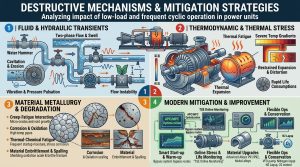
本研究深度剖析機組在低負載與頻繁起停循環下所引發的四個維度破壞性機制:一、流體與水力瞬態;二、熱力學與熱應力瞬態;三、材料冶金與劣化;四、現代化防範與改進策略。研究結合台灣燃氣發電廠之實務案例,比較機組在低負載與滿載運轉時微觀與宏觀上的物理差異。同時,基於 2026 年最新 ASME B31J 規範之柔性分析、MARBN 高溫合金鋼之冶金創新,以及 EPRI 循環水化學指引,提出具體的預測性維護(PdM)與工程最佳化解決方案,以期在再生能源高佔比的時代,確保 CCPP 機組的結構完整性與長期運轉可靠度。This study comprehensively analyzes the destructive mechanisms triggered by low-load and frequent start-stop cycling across four dimensions: 1. Hydraulic & Fluid Transients; 2. Thermodynamic & Stress Transients; 3. Metallurgical Degradation & Creep-Fatigue; 4. Modern Mitigation Measures. By integrating practical case studies from gas-fired power plants in Taiwan, this research compares the micro- and macroscopic physical differences between low-load and base-load operations. Furthermore, based on the flexibility analysis of the latest 2026 ASME B31J code, the metallurgical innovation of MARBN high-temperature alloy steel, and the EPRI cycle chemistry guidelines, this paper proposes concrete predictive maintenance (PdM) and engineering optimization solutions. The ultimate goal is to ensure the structural integrity and long-term operational reliability of CCPP units in an era of high renewable energy penetration.
一、 產業背景與運轉模式之典範轉移 / I. Industry Background and Paradigm Shift in Operating Modes
1.1 鴨子曲線效應與電網調度挑戰 / 1.1 The Duck Curve Effect and Grid Dispatch Challenges
在全球邁向淨零碳排的目標下,太陽光電與風力發電已成為能源政策的核心。以台灣的能源轉型為例,政府設定再生能源發電佔比須達 20% 以上1。然而,再生能源受限於氣候與日照,具備高度的間歇性與不可控性。當日間太陽能發電量達到顛峰時,電網淨負載(Net Load)會大幅下降;而至傍晚日落時分,太陽能發電量驟降,導致淨負載急遽上升。這種劇烈波動的電力需求曲線在圖表上呈現出獨特的「鴨子曲線」輪廓1。Driven by the global objective of net-zero carbon emissions, solar and wind power have become the core of energy policies. Taking Taiwan’s energy transition as an example, the government has set a target for renewable energy generation to exceed 20%1. However, being constrained by weather and sunlight, renewable energy is highly intermittent and uncontrollable. When solar generation peaks during the day, the grid’s net load drops significantly; at sunset, solar generation plummets, causing the net load to surge rapidly. This violently fluctuating power demand curve presents a unique “Duck Curve” silhouette on a chart1.
為了填補傍晚急遽擴大的淨負載缺口並維持電網頻率穩定,電網營運商高度仰賴具備快速升降載能力的複循環燃氣機組。現代先進 CCPP 甚至被要求在短短 30 分鐘內,完成從冷態啟動至滿載的極端調度操作4。這種操作模式迫使發電機組出力必須在午後至晚間進行極陡峭的爬升,對廠內高溫高壓傳輸管線與蒸汽產生系統帶來了嚴苛的考驗。To bridge the rapidly expanding net load gap in the evening and maintain grid frequency stability, grid operators heavily rely on Combined Cycle Power Plants (CCPP) capable of rapid ramping. Modern advanced CCPPs are even required to perform extreme dispatch operations from a cold start to full load within a mere 30 minutes4. This operating mode forces the power generation units to undergo steep output climbs from the afternoon into the evening, imposing severe tests on the plant’s high-temperature, high-pressure transmission piping and steam generation systems.
1.2 低負載與滿載運轉之本質差異與經濟衝擊 / 1.2 Essential Differences and Economic Impacts Between Low-Load and Base-Load Operations
滿載運轉的物理特徵為「高溫、高壓、恆定流場與穩態熱傳」。在穩定負載下,高能管線與設備的主要材料損傷機制,主要受控於長時間高溫應力下的均勻穩態潛變(Steady-state Creep)與高溫氧化5。相對於此,低負載運轉與頻繁起停過程則充滿了高度的「非線性、非對稱與多相流」特徵。管內流體的流速與壓力呈現劇烈震盪,且流體與金屬管壁之間會在極短時間內產生巨大溫差,誘發強烈的熱衝擊(Thermal Shock)與過渡熱應力(Transient Thermal Stress)。The physical characteristics of base-load operations are defined by “high temperature, high pressure, constant flow field, and steady-state heat transfer.” Under stable load, the primary material damage mechanisms for high-energy piping and equipment are dictated by uniform steady-state creep and high-temperature oxidation under prolonged high-temperature stress5. Conversely, low-load operations and frequent start-stop processes are characterized by highly “non-linear, asymmetrical, and multiphase flow” phenomena. The fluid velocity and pressure inside the pipes fluctuate violently, and a massive temperature differential between the fluid and the metal pipe wall occurs in a very short timeframe, inducing severe thermal shock and transient thermal stress.
根據美國電力研究院(EPRI)的研究指出,當電網中再生能源滲透率達到 30% 時,起停次數的增加與負載的頻繁波動,將使 CCPP 機組的循環相關生產與維護成本(Cycling Costs)增加超過 100%7。燃氣渦輪機的啟動斜率(Ramp rates)甚至可逼近每小時 3000°F 的極端變化,導致熱疲勞損傷急遽攀升。這些因素不僅縮短了部件的使用壽命,更大幅增加了備用容量與旋轉備用(Spinning Reserve)的維持成本8。表 1 清晰比較了滿載與低負載運轉在各物理維度上的根本差異。According to research by the Electric Power Research Institute (EPRI), when renewable energy penetration in the grid reaches 30%, the increased number of start-stops and frequent load fluctuations will cause CCPP cycling-related production and maintenance costs to rise by more than 100%7. The startup ramp rates of gas turbines can approach extreme changes of 3000°F per hour, leading to a sharp escalation in thermal fatigue damage. These factors not only curtail the service life of components but also significantly inflate the maintenance costs of backup capacity and spinning reserve8. Table 1 clearly juxtaposes the fundamental differences between base-load and low-load operations across various physical dimensions.
(表1 / Table 1)
| 比較維度 / Comparison Dimension | 連續滿載運轉 / Base-load Operation | 頻繁起停與低負載運轉 / Cycling & Low-load | 物理意義與影響 / Physical Significance & Impact |
| 流場特性 / Flow Field | 穩態單相流,流速與壓力恆定 / Steady single-phase flow, constant velocity and pressure | 劇烈紊流、兩相流交替、流場分離 / Severe turbulence, alternating two-phase flow, flow separation | 低負載時易引發熱層流分層,急變載時誘發聲學共振與水鎚 / Low loads induce thermal stratification; rapid load changes induce acoustic resonance and water hammer |
| 熱力學邊界 / Thermodynamics | 穩態熱傳導,管壁內外溫差小 / Steady-state heat conduction, small temperature gradient | 極端瞬態熱對流,管壁厚度方向溫差巨大 / Extreme transient thermal convection, massive temperature gradient | 產生高額過渡熱應力、拘束應力與淬冷熱衝擊,導致熱疲勞 / Generates high transient thermal stress, restraint stress, and quenching, leading to thermal fatigue |
| 損傷機制 / Damage Mechanism | 單純的高溫潛變(Creep)、氧化 / Pure high-temperature creep and oxidation | 蠕變-疲勞交互作用(Creep-Fatigue Interaction) / Creep-Fatigue Interaction | 疲勞提供微裂紋,潛變加速晶界孔洞成長,壽命呈指數級衰退 / Fatigue provides microcracks, creep accelerates grain boundary cavity growth; exponential life decay |
| 維護成本 / Maintenance Cost | 成本可預期,基於運轉時數 / Predictable costs based on Equivalent Operating Hours (EOH) | 維護成本倍增,受啟動次數與負載變化率主導 / Costs double, driven by start-up frequency and load ramp rates | 需導入線上狀態監測,傳統定期大修策略已無法防範突發破裂 / Requires online CMS; traditional periodic overhaul strategies fail to prevent sudden ruptures |
二、 流態與水力瞬態之破壞力學(Hydraulic & Fluid Transients) / II. Destructive Mechanics of Hydraulic & Fluid Transients
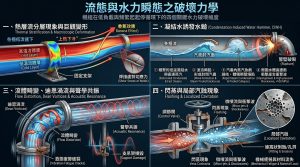
在機組起停或待機期間,系統流量往往遠低於設計額定值,或在極短時間內經歷巨大的流量突變。這些動態流場變化與相變,是引發結構振動、管線位移與局部沖蝕的首要物理機制。During unit start-stop or standby periods, system flow often drops far below the design rated value or experiences massive flow spikes in extremely short durations. These dynamic flow field changes and phase transitions are the primary physical mechanisms triggering structural vibration, piping displacement, and local erosion.
2.1 熱層流分層現象(Thermal Stratification)與巨觀變形 / 2.1 Thermal Stratification and Macroscopic Deformation
在機組暖管期或低流量熱待機狀態下,長距離水平配置的高能蒸汽管線內部極易發生熱層流分層。由於流速過低,無法形成充分的紊流混合,高溫且密度較低的蒸汽或熱水會因浮力作用集中於管線上半部,而冷凝水或較冷空氣則沉積於下半部。這種熱力學分層會導致同一管截面的上下管壁產生超過 100°C 的巨大溫度梯度5。During the unit warming period or low-flow hot standby state, thermal stratification is highly prone to occur inside long, horizontally routed high-energy steam piping. Because the flow velocity is too low to facilitate sufficient turbulent mixing, high-temperature, lower-density steam or hot water accumulates in the upper half of the pipe due to buoyancy, while cooler condensate or air settles in the lower half. This thermodynamic stratification causes a massive temperature gradient exceeding 100°C between the upper and lower walls of the same pipe cross-section5.
非對稱的溫度分佈引發了非對稱的熱膨脹,上半部管壁的膨脹量遠大於下半部,導致水平管段在宏觀幾何上產生「香蕉效應(Bananaing Effect)」,即管線整體向上弓起5。此幾何變形會產生強大的次級彎曲應力,不僅可能造成彈簧吊架脫載或過載,還會導致法蘭接合面傾斜洩漏,甚至使設備接口(如汽機外殼端點)承受遠超設計容許極限的終端負載,引發嚴重的結構變形。This asymmetrical temperature distribution induces asymmetrical thermal expansion, where the expansion of the upper wall is substantially greater than that of the lower wall, causing the horizontal pipe section to macroscopically deform into a “Bananaing Effect” (bowing upwards)5. This geometric deformation generates formidable secondary bending stress, which can cause spring hangers to unload or overload, lead to flange face tilting and leakage, and even subject equipment interfaces (e.g., turbine casing terminals) to terminal loads far exceeding design limits, resulting in severe structural deformation.
2.2 凝結水誘發水鎚(Condensation Induced Water Hammer, CIWH) / 2.2 Condensation Induced Water Hammer (CIWH)
頻繁起停的 HRSG 系統若未能落實充分的疏水(Drainage)程序,冷凝水極易積聚於管線低窪處或盲端(Dead legs)。當機組重新啟動,高溫高壓蒸汽迅速注入管線並接觸到過冷凝結水時,蒸汽會瞬間冷凝,體積以極高頻率收縮,在局部形成近乎絕對真空的低壓區。If frequently cycled HRSG systems fail to implement adequate drainage procedures, condensate is highly likely to accumulate in pipe depressions or dead legs. When the unit restarts and high-temperature, high-pressure steam is rapidly injected into the piping and contacts subcooled condensate, the steam condenses instantaneously. Its volume shrinks at a high rate, forming a near-absolute vacuum low-pressure zone locally.
在管線兩端巨大壓差的瞬間驅動下,兩側水柱會以極高速度相向運動並劇烈相撞,產生高達數十至數百 bar 的瞬態高壓衝擊波5。這種凝結水誘發水鎚(CIWH)的破壞能量遠大於常規閥門關閉引發的水鎚。CIWH 產生的強大動能會直接撕裂管線支承結構、拉斷彎管銲道,並造成管線永久性位移,是 CCPP 系統中最具毀滅性的流體瞬態事件之一。Driven instantaneously by the immense pressure differential at both ends of the pipe, water columns on both sides propel towards each other at extreme speeds and collide violently, generating a transient high-pressure shockwave ranging from tens to hundreds of bars5. The destructive energy of this high-frequency impact from Condensation Induced Water Hammer (CIWH) vastly exceeds that of standard water hammer caused by valve closure. The kinetic energy unleashed by CIWH can directly rupture pipe support structures, tear welded bends, and cause permanent piping displacement, rendering it one of the most devastating fluid transient events in CCPP systems.
2.3 流體畸變、迪恩渦流與聲學共振(Acoustic Resonance) / 2.3 Fluid Distortion, Dean Vortices, and Acoustic Resonance
當機組為了追隨電網負載而急升或急降載時,蒸汽流速大幅急遽變化,極易在管線幾何不連續處(如傳統 1.5D 短半徑鍛造彎頭、三通管、減溫閥下游,或安全閥旁支管口)引發強烈的渦流脫落(Vortex Shedding)與流場分離(Flow Separation)4。流體行經短曲率彎頭時,受離心力影響自內側拋向外側,會在壁面引發廣泛的流場分離,並誘發強烈的二次流,即迪恩渦流(Dean Vortices),進一步加劇壓力脈動與紊流能量4。When a unit rapidly ramps up or down to follow grid loads, abrupt fluctuations in steam velocity easily trigger intense vortex shedding and flow separation at geometric discontinuities in piping (such as traditional 1.5D short-radius forged elbows, tees, downstream of desuperheating valves, or safety valve branch connections)4. As fluid navigates short-radius elbows, centrifugal force propels it from the intrados to the extrados, triggering extensive flow separation along the wall and inducing robust secondary flows, known as Dean Vortices, which further amplify pressure pulsations and turbulent kinetic energy4.
流體誘發振動(FIV)與聲學共振的核心評估參數為斯楚哈爾數(Strouhal Number, St),其定義為: The core evaluation parameter for Flow-Induced Vibration (FIV) and acoustic resonance is the Strouhal Number (St), defined as:
St=f•D/v
其中 f 為渦流脫落頻率,D 為特徵幾何長度(如管徑或分支口直徑),v 為流速。在 30 分鐘冷態快升滿載的過程中,蒸汽流速 v 急劇上升,系統的 St 值必然會掃過 0.4 至 0.5 的狹窄且致命的共振區間。當渦流脫落頻率與管柱內部的氣柱固有聲學頻率重合時,即會觸發「頻率鎖定(Frequency Lock-in)」,產生能量耦合效率極高的聲學共振4。這種高頻共振會沿著管線傳遞,並在結構較弱的小口徑儀表分支管(Impulse Lines)根部銲口造成嚴重的應力集中,最終引發高週疲勞(HCF)斷裂。Where f is the vortex shedding frequency, D is the characteristic geometric length (e.g., pipe diameter or branch diameter), and v is the flow velocity. During a 30-minute cold-to-full-load ramp, the steam velocity v surges sharply, and the system’s St value inevitably sweeps through the narrow and lethal resonance range of 0.4 to 0.5. When the vortex shedding frequency aligns with the inherent acoustic frequency of the air column inside the pipe, it triggers “Frequency Lock-in,” producing acoustic resonance with extraordinarily high energy coupling efficiency4. This high-frequency resonance propagates along the piping and provokes severe stress concentration at the root welds of structurally weaker small-bore impulse lines, ultimately culminating in High Cycle Fatigue (HCF) failure.
2.4 閃蒸與局部汽蝕現象(Flashing & Cavitation) / 2.4 Flashing and Localized Cavitation
在低負載運轉或起停階段,系統的旁路閥(Bypass Valves)與高壓疏水閥常需頻繁作動以調節系統壓力。當高溫高壓的水流通過閥芯時,流道截面積急遽縮小導致流速瞬間飆升,根據白努利定律,靜壓將隨之急降。一旦局部壓力降至低於該流體溫度對應的飽和蒸汽壓,液態水將瞬間汽化形成大量汽泡,此即閃蒸現象。若流體流經閥門後壓力逐漸回升並超過飽和蒸汽壓,這些汽泡將在瞬間內爆破裂,產生汽蝕5。During low-load operations or start-stop phases, system bypass valves and high-pressure drain valves frequently actuate to regulate system pressure. When high-temperature, high-pressure water surges through the valve trim, the abrupt reduction in flow area causes an instantaneous spike in velocity, resulting in a precipitous drop in static pressure according to Bernoulli’s principle. Once the local pressure drops below the saturation vapor pressure corresponding to the fluid’s temperature, liquid water vaporizes instantly to form massive volumes of bubbles, a phenomenon known as flashing. If the pressure recovers and exceeds the saturation vapor pressure downstream of the valve, these bubbles will violently implode, engendering cavitation5.
汽泡破裂的瞬間會產生極高壓的微射流(Micro-jets),以極高速度衝擊閥芯、閥座及下游管壁。長期的汽蝕作用不僅伴隨高頻噪音,更會將金屬表面材料微粒逐一剝離,造成局部壁厚嚴重沖蝕減薄(Erosion-Corrosion)與海綿狀的空化坑洞,導致閥門內漏或管線破裂5。The implosion of bubbles generates ultra-high-pressure micro-jets that bombard the valve trim, seat, and downstream pipe walls at extreme velocities. Long-term cavitation not only manifests with high-frequency noise but also continuously strips metal surface particles, resulting in severe local wall thinning (Erosion-Corrosion) and sponge-like cavitation pits, which eventually precipitate internal valve leakage or pipe rupture5.
三、 熱力學與過渡熱應力現象(Thermodynamic & Stress Transients) / III. Thermodynamic and Transient Thermal Stress Phenomena
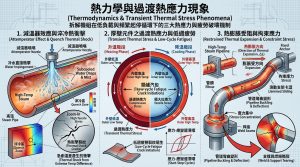
CCPP 機組為了追求極致的熱效率,主蒸汽與高溫再熱蒸汽溫度常設計於 600°C 以上的極端條件9。在起停過程中,材料結構所經歷的最嚴重破壞,多源自於劇烈且極不均勻的溫度梯度所引發的熱應力。To pursue maximal thermal efficiency, CCPP units often design main steam and hot reheat steam temperatures under extreme conditions exceeding 600°C9. During the start-stop process, the most severe structural damage experienced by materials is predominantly derived from thermal stresses induced by drastic and highly uneven temperature gradients.
3.1 減溫器效應與淬冷熱衝擊(Thermal Shock & Quenching) / 3.1 Attemperator Effects and Thermal Shock & Quenching
在機組負載劇烈變化時,為精確控制進入蒸汽輪機的主蒸汽與再熱蒸汽溫度,減溫器(Attemperator)的噴水閥會頻繁開關。減溫過程的熱傳效率與安全性,取決於噴嘴的霧化性能與流場動態。根據數值模擬與流體力學研究指出,液滴的蒸發動力學受到韋伯數(Weber Number)與液滴間相互作用的強烈影響;先進的數值求解器如尖銳介面代數流體體積法(SA-VOF),證實了液滴的碎裂與分散對熱交換效率至關重要11。When unit loads fluctuate sharply, the attemperator’s spray valves frequently actuate to precisely regulate the main and reheat steam temperatures entering the steam turbine. The heat transfer efficiency and safety of the desuperheating process hinge on the nozzle’s atomization performance and flow field dynamics. According to numerical simulations and fluid dynamics studies, droplet evaporation dynamics are strongly influenced by the Weber Number and inter-droplet interactions; advanced numerical solvers, such as the sharp-interface algebraic volume of fluid (SA-VOF) method, validate that droplet breakup and dispersion are critical for heat exchange efficiency11.
若減溫水噴霧霧化不良,或減溫器下游留設的直管蒸發段(Evaporation Distance)長度不足,導致大粒徑的水滴未能在蒸汽中完全汽化,過冷的凝結水滴將直接接觸並撞擊高溫的管內壁與集管箱5。在接觸瞬間,管壁內表面急冷並強烈收縮,但管外壁仍維持高溫膨脹狀態,這在管壁內部產生了極大的雙軸拉應力。反覆的淬冷循環會使管內壁表面產生微觀的「熱疲勞龜紋(Thermal Crazing)」;這些龜紋在後續的高溫運轉中成為應力集中點,並在交變熱應力的驅動下迅速沿徑向發展為貫穿性開裂5。If the desuperheating water spray is inadequately atomized, or if the straight evaporation distance downstream of the attemperator is insufficient, large droplets fail to fully vaporize in the steam. These subcooled condensate droplets directly contact and impinge upon the high-temperature inner pipe walls and headers5. Upon contact, the inner surface of the pipe wall cools precipitously and shrinks intensely, while the outer wall remains in a high-temperature expanded state. This disparity generates massive biaxial tensile stress inside the pipe wall. Recurrent quenching cycles induce microscopic “Thermal Crazing” on the inner surface; these crazes subsequently act as stress concentrators during high-temperature operation and, propelled by alternating thermal stresses, rapidly propagate radially into through-wall cracks5.
3.2 厚壁元件之過渡熱應力與低週疲勞(Transient Thermal Stress) / 3.2 Transient Thermal Stress and Low Cycle Fatigue in Thick-Walled Components
在急起急停的瞬態升降溫階段,厚壁管線、閥體、三通與集管箱(Headers)因金屬的熱傳導率限制,會在其厚度方向(內壁至外壁)產生巨大的溫度梯度。同時,在幾何不連續處(如主管與分支管的交界點),亦會因體積熱容量的差異而產生局部溫差。During the transient heating and cooling phases of rapid start-stops, thick-walled pipes, valve bodies, tees, and headers experience massive temperature gradients across their thickness (from inner to outer walls) owing to the limited thermal conductivity of metals. Concurrently, at geometric discontinuities (such as the junction between a main pipe and a branch), localized temperature differentials emerge due to variations in volumetric heat capacity.
這些過渡期的巨大溫差會產生額外的彎曲應力與拘束應力(Restraint Stress),迫使材料進入塑性變形區間。此種熱機疲勞(Thermo-Mechanical Fatigue, TMF)的損傷程度可透過 Coffin-Manson 方程式進行量化評估: These massive transient temperature differentials formulate additional bending and restraint stresses, compelling the material into the plastic deformation regime. The damage extent of this Thermo-Mechanical Fatigue (TMF) can be quantitatively assessed using the Coffin-Manson equation:
(Δεp/2)*Ncf=εf‘
其中,Δεp 為塑性應變範圍,Ncf 為疲勞裂紋萌生所需之循環次數,εf‘ 為疲勞延性係數14。在頻繁的急升急降負載下,每次起停即完成一個大應變循環,快速消耗材料的低週疲勞(LCF)壽命,加速厚壁接頭處的塑性形變與微裂紋萌生5。Where Δεp is the plastic strain range, Ncf is the number of cycles to fatigue crack initiation, and εf‘ is the fatigue ductility coefficient14. Under frequent rapid load ramps, each start-stop operation completes a large strain cycle, rapidly depleting the material’s Low Cycle Fatigue (LCF) life and accelerating plastic deformation and microcrack initiation at thick-walled joints5.
3.3 熱膨脹受阻與拘束應力(Restrained Thermal Expansion) / 3.3 Restrained Thermal Expansion and Restraint Stress
CCPP 管線在每日起停過程中,經歷大幅度的熱脹冷縮,累積了巨大的系統位移。在此動態過程中,若管線的滑動支座卡死、導向支架偏移,或恆力彈簧吊架因長期的香蕉效應變形而鎖死,管線的熱膨脹應變將無法被系統的柔性(Flexibility)所吸收與釋放5。During daily start-stop cycles, CCPP piping undergoes substantial thermal expansion and contraction, accumulating massive system displacements. Throughout this dynamic process, if sliding supports jam, guide supports deviate, or constant effort spring hangers lock up due to protracted bananaing deformation, the piping’s thermal expansion strain cannot be absorbed and released by the system’s flexibility5.
熱膨脹受阻會將本應釋放的二次變形應變,強制轉化為管線內部積聚的極大次級應力。這些應力沿著管線傳遞,最終會集中於剛性較大的彎頭、三通或設備接頭處,導致局部區域產生嚴重的塑性變形,甚至誘發熱疲勞裂紋的提前爆發5。Restrained thermal expansion forcibly translates what should be released secondary deformation strains into enormous secondary stresses stockpiled within the pipe. These stresses propagate along the piping and ultimately concentrate at highly rigid elbows, tees, or equipment connections, causing severe localized plastic deformation and potentially triggering premature outbreaks of thermal fatigue cracks5.
四、 材料冶金劣化與蠕變疲勞交互作用(Metallurgical Degradation & Creep-Fatigue) / IV. Metallurgical Degradation and Creep-Fatigue Interaction
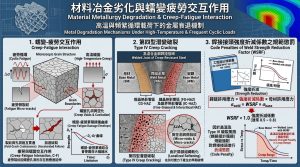
現代 CCPP 為達到更高的熱效率,其高溫管線與 HRSG 過熱器段廣泛採用 9-12% 鉻系高溫合金鋼(如 ASME P91, P92 等蠕變強化鐵素體鋼 CSEF)。這些鋼材在連續運轉下的優異高溫強度,主要依賴於回火馬氏體(Tempered Martensite)基體的高差排密度,以及晶界上奈米級的 M23C6 碳化物與 MX(碳氮化物)析出物所提供的釘紮(Pinning)作用17。然而,在頻繁起停條件下,其微觀組織的劣化速率呈現出毀滅性的加速。To attain superior thermal efficiency, modern CCPPs extensively employ 9-12% Chromium high-temperature alloy steels (e.g., ASME P91, P92 Creep Strength Enhanced Ferritic (CSEF) steels) for high-energy piping and HRSG superheater sections. The stellar high-temperature strength of these steels under continuous operation relies fundamentally on the high dislocation density of the tempered martensite matrix, coupled with the pinning effect provided by nanoscale M23C6 carbides and MX (carbonitrides) precipitates on the grain boundaries17. However, under frequent cycling conditions, the degradation rate of their microstructure accelerates destructively.
4.1 蠕變-疲勞交互作用(Creep-Fatigue Interaction, CFI) / 4.1 Creep-Fatigue Interaction (CFI)
對於連續運轉的機組,材料主要承受恆定的應力與溫度,其損傷機制為穩態潛變(Steady-state Creep),裂紋多在壽命末期才迅速擴展。但在頻繁起停條件下,機組在啟停階段承受因熱應力與壓力波動帶來的低週疲勞(LCF)循環載荷,而在滿載運轉的高溫階段(>540°C)又處於潛變持載(Dwell time)環境5。For base-load units, materials predominantly endure constant stress and temperature, with the primary damage mechanism being steady-state creep, where cracks typically propagate rapidly only toward the end of life. Nevertheless, under cycling conditions, the unit sustains Low Cycle Fatigue (LCF) cyclic loading during start-stop phases due to thermal stresses and pressure fluctuations, whilst concurrently enduring creep dwell time environments during high-temperature phases (>540°C) at full load5.
這兩種損傷機制並非單純的線性疊加,而是產生了極具破壞性的「蠕變-疲勞交互作用」。疲勞交變應力會在晶粒表面或幾何不連續處產生微裂紋;而在後續的高溫持載期間,這些微裂紋尖端成為應力高度集中區,極大化了空位(Vacancies)的擴散速率,促使潛變孔洞(Creep Cavitation)在晶界上加速成核與成長。反之,密集的潛變孔洞又提供了疲勞裂紋快速擴展的捷徑5。這種「1+1>2」的交互加速效應,使得 P91/P92 高溫管線在彎管彎背及銲接熱影響區的實際服役壽命,往往被大幅截斷至原始設計壽命的三分之一以下5。These two damage mechanisms are not a mere linear superposition but forge a highly destructive “Creep-Fatigue Interaction.” Alternating fatigue stresses nucleate microcracks on the grain surface or at geometric discontinuities; during subsequent high-temperature dwell periods, the tips of these microcracks evolve into highly concentrated stress zones, maximizing vacancy diffusion rates and accelerating the nucleation and growth of creep cavitation on grain boundaries. Conversely, dense creep cavities offer a shortcut for rapid fatigue crack propagation5. This “1+1>2” interactive acceleration effect severely truncates the actual service life of P91/P92 high-temperature piping at elbow extrados and weld Heat-Affected Zones (HAZ), frequently reducing it to less than one-third of the original design life5.
4.2 第四型潛變破裂(Type IV Cracking)的微觀演變 / 4.2 Microstructural Evolution of Type IV Cracking
9-12% Cr 鋼系最大的致命弱點在於其銲接熱影響區(HAZ)。在傳統銲接過程中,HAZ 的不同區域經歷了峰值溫度各異的熱循環。其中,相間臨界區(ICHAZ)與細晶熱影響區(FGHAZ)的峰值溫度剛好介於 AC1 與AC3相變溫度之間,或略高於 AC3 20。此特殊的熱循環導致該區域的原始奧氏體晶粒(PAG)未及長大即被淬火,形成極細小晶粒;同時,部分固溶的碳化物在隨後的銲後熱處理(PWHT)中重新析出。The most fatal vulnerability of the 9-12% Cr steel series resides in its weld Heat-Affected Zone (HAZ). During conventional welding, discrete sub-zones of the HAZ experience varying peak temperature thermal cycles. Among them, the peak temperatures of the Intercritical HAZ (ICHAZ) and Fine-Grained HAZ (FGHAZ) fall precisely between the AC1 and AC3 phase transformation temperatures, or marginally above AC3 20. This specific thermal cycle dictates that the prior austenite grains (PAG) in this region are quenched before they can grow, forming exceedingly fine grains; simultaneously, partially dissolved carbides reprecipitate during subsequent Post-Weld Heat Treatment (PWHT).
在後續的高溫服役環境中,此一軟化區(Soft Zone)會發生劇烈的微觀組織退化。首先,晶界上的 M23C6 碳化物會迅速粗化,失去對晶界滑移的釘紮作用;其次,鎢(W)與鉬(Mo)等關鍵固溶強化元素會從基體中析出,大量聚集形成粗大且脆性的 Laves 相或 Z 相18。Laves 相在晶界上的異常成長(甚至聚集達 3.4 μm)不僅掏空了基體的固溶強化效果,其與基體間的剛性差異更會在潛變變形時引發嚴重的應力與應變集中,成為潛變微孔洞成核的溫床19。During ensuing high-temperature service, this Soft Zone undergoes drastic microstructural degradation. Primarily, M23C6 carbides on the grain boundaries coarsen rapidly, forfeiting their pinning effect against grain boundary sliding. Secondly, critical solid-solution strengthening elements like Tungsten (W) and Molybdenum (Mo) precipitate from the matrix, agglomerating heavily to form coarse and brittle Laves phase or Z phase18. The anomalous growth of the Laves phase on grain boundaries (even aggregating up to 3.4 μm) not only depletes the solid-solution strengthening effect of the matrix, but its rigidity disparity with the matrix also induces severe stress and strain concentration during creep deformation, acting as a hotbed for creep cavity nucleation19.
這些晶界微孔洞在局部應力作用下逐漸相互連結,最終在 ICHAZ/FGHAZ 形成宏觀微裂縫,此即為工程界聞之色變的第四型潛變破裂(Type IV Cracking)。其可怕之處在於,裂紋往往在材料總體變形量極小的狀況下,於次表面無預警萌生並迅速貫穿。且隨著運轉溫度超過 600°C,P91/P92 鋼材對 Type IV 裂紋的敏感度呈現急遽上升的趨勢17。Impelled by localized stress, these grain boundary micro-cavities progressively interlink, eventually forging macroscopic microcracks in the ICHAZ/FGHAZ—this is the engineering nightmare renowned as Type IV Cracking. Its peril lies in the fact that the crack often initiates without warning in the sub-surface and penetrates rapidly under ostensibly low overall material deformation (low ductility). Furthermore, as operating temperatures surpass 600°C, the sensitivity of P91/P92 steels to Type IV cracking escalates sharply17.
4.3 銲接接頭強度折減係數(WSRF)之規範懲罰 / 4.3 Code Penalties of the Weld Strength Reduction Factor (WSRF)
為應對 Type IV 裂紋帶來的強度衰減,國際管線設計規範(如 ASME B31.1 Power Piping Code 與 B31.3 Process Piping Code)強制引入了銲接接頭強度折減因子(Weld Strength Reduction Factor, WSRF 或 W-Factor)。根據規範,當 P91 鋼在長時間高溫服役時,其銲道的容許應力必須乘上一個小於 1 的折減係數(極端條件下可能低至 0.5)。這意味著為了彌補銲接造成的強度損失,管線設計必須大幅增加管壁厚度24。然而,增加壁厚又會反向增加系統的剛性,導致熱瞬態期間的過渡熱應力上升,形成惡性循環。To counteract the strength degradation precipitated by Type IV cracking, international piping design codes (e.g., ASME B31.1 Power Piping Code and B31.3 Process Piping Code) imperatively introduced the Weld Strength Reduction Factor (WSRF or W-Factor). Per the codes, when P91 steel resides in long-term high-temperature service, the allowable stress of its weld must be multiplied by a reduction coefficient less than 1 (which can plunge to 0.5 under extreme conditions). This implies that to compensate for the strength deficit caused by welding, piping design must substantially augment the pipe wall thickness24. Paradoxically, escalating wall thickness amplifies system rigidity, culminating in elevated transient thermal stresses during thermal transients, thereby orchestrating a vicious cycle.
五、 台灣燃氣發電廠實務破壞案例與維護經驗 / V. Practical Failure Case Studies and Maintenance Experience in Taiwan Gas-Fired Power Plants
針對台灣地區的運轉經驗,電網的高彈性調度需求與海島型高濕鹽環境,進一步放大了 CCPP 機組的劣化特徵。Pertaining to operational experiences in Taiwan, the grid’s mandate for highly flexible dispatch coupled with the island’s high-humidity, high-salinity environment further exacerbates the degradation characteristics of CCPP units.
5.1 通霄電廠 M501JAC 機組高能管線最佳化案例 / 5.1 High-Energy Piping Optimization Case at Tongxiao Power Plant M501JAC Unit
台灣通霄電廠引進了世界最先進的 Mitsubishi Power M501JAC 氣冷式複循環機組,具備渦輪入口溫度達 1600°C 的極端熱力學條件,並被賦予快速升降載的調度重任。在如此嚴苛的環境下,若高溫高壓附屬管線(如空氣冷卻系統)採用傳統 1.5D 鍛造對銲彎頭,不僅將因劇烈的流場畸變誘發聲學共振,其密集的現場環向銲道更會成為 Type IV 裂紋的潛在爆發點4。Taiwan’s Tongxiao Power Plant introduced the world’s most advanced Mitsubishi Power M501JAC air-cooled combined cycle unit, which boasts extreme thermodynamic conditions with a turbine inlet temperature reaching 1600°C, and is entrusted with the grid dispatch responsibility of rapid load ramping. Under such stringent operating conditions, if its high-temperature, high-pressure auxiliary piping (like the air cooling system) utilized traditional 1.5D forged butt-welded elbows, it would not only provoke Acoustic Induced Vibration (AIV) due to severe flow distortion, but its dense field circumferential welds would also manifest as potential outbreak epicenters for Type IV cracking4.
實務解方與維護經驗:Practical Solution and Maintenance Experience:
為徹底解決此一工程瓶頸,台灣潁璋工程在該專案中導入了符合 ASME B31J 規範的大曲率「連續冷作彎管(3D/5D CNC Cold Bending)」技術,並嚴格搭配 705°C 至 760°C 的感應加熱銲後熱處理(IH-PBHT)。此「以彎代銲」策略在實務上獲得巨大成功: To conclusively resolve this engineering bottleneck, Taiwan’s Ying-Zhang Engineering integrated large-curvature “Continuous CNC Cold Bending (3D/5D)” technology compliant with the ASME B31J code for this project, meticulously paired with Induction Heating Post-Bend Heat Treatment (IH-PBHT) at 705°C to 760°C. This “bending instead of welding” strategy attained resounding practical success:
- 消弭聲學共振 / Elimination of Acoustic Resonance:
一體成形的平滑內壁移除了幾何突變,並藉由大曲率半徑降低了流體通過時的逆壓梯度,延遲流場分離,成功將系統的斯楚哈爾數移出 0.4 至 0.5 的致命共振區間4。 The integral, seamless inner wall eradicated geometric abruptions, and the extensive curvature radius mitigated the adverse pressure gradient during fluid transit, delaying flow separation and successfully shifting the system’s Strouhal Number away from the lethal 0.4 to 0.5 resonance zone4.
- 徹底根除 Type IV 裂紋 / Eradication of Type IV Cracking:
在物理結構上完全排除了轉折處的熱影響區(HAZ),使材料免受相間臨界區(ICHAZ)基體軟化與碳化物溶解的威脅,確保了 P91/P92 鋼材的長期潛變韌性,完美規避了 ASME 規範中 WSRF 的厚度折減懲罰9。 The physical construct entirely eliminated the Heat-Affected Zone (HAZ) at the bends, insulating the material from matrix softening and carbide dissolution in the Intercritical HAZ (ICHAZ). This guaranteed the long-term creep toughness of P91/P92 steel and impeccably circumvented the thickness reduction penalty of WSRF in ASME codes9.
5.2 HRSG 系統的流動加速腐蝕(FAC)與腐蝕疲勞 / 5.2 Flow-Accelerated Corrosion (FAC) and Corrosion Fatigue in HRSG Systems
根據 EPRI 的廣泛研究與國內電廠實務經驗,頻繁起停導致 HRSG 系統,特別是低壓蒸發器(LP Evaporator)與省煤器(Economizer)內的流體動力學與水化學平衡遭到嚴重破壞13。According to comprehensive EPRI research and practical maintenance exposure in domestic power plants, frequent start-stops severely destabilize the fluid dynamics and water chemistry equilibrium within the HRSG system, particularly in the Low-Pressure (LP) Evaporator and Economizer13.
在低負載時,流速降低破壞了管壁內部的保護性磁鐵礦(Magnetite)氧化層;當機組快速升載時,兩相流的局部高流速、高紊流與蒸汽乾度變化,會產生強大流體剪應力,加速氧化層溶解與剝離,導致嚴重的流動加速腐蝕(Flow-Accelerated Corrosion, FAC)27。此外,非穩態熱傳頻繁引發汽包(Drum)管座與降水管交界處的高應力集中,在腐蝕性水環境催化下,極易發展為深層的腐蝕疲勞(Corrosion Fatigue)裂紋,造成管線突發性破管13。During low loads, diminished flow velocity degrades the protective magnetite oxidation layer inside the pipe wall; as the unit ramps up rapidly, localized high velocity, elevated turbulence, and steam quality perturbations in the two-phase flow generate robust fluid shear stress. This expedites the dissolution and stripping of the oxide layer, culminating in severe Flow-Accelerated Corrosion (FAC)27. Furthermore, unsteady heat transfer repeatedly induces high stress concentration at the junction of the drum nozzles and downcomers. Catalyzed by the corrosive aqueous environment, this is remarkably prone to evolve into deep Corrosion Fatigue cracks, inciting sudden tube ruptures13.
5.3 多維度利害關係人之實務考量與應對策略 / 5.3 Practical Considerations and Response Strategies of Multi-Dimensional Stakeholders
在 CCPP 機組頻繁起停的實務運作中,針對 P9x 級高能管線的設計、建置與維護,不同領域的利害關係人面臨著各自的工程挑戰與決策考量: In the practical execution of frequent CCPP unit start-stops, regarding the design, construction, and maintenance of P9x-grade high-energy piping, stakeholders across diverse domains confront their respective engineering challenges and decision-making imperatives:
- 業主端(Owner)的維護管理及營運決策 / 1. Owner’s Maintenance Management and Operational Decisions
業主深知在再生能源高佔比環境下,機組頻繁起停將導致維護與營運成本(O&M Costs)大幅攀升。傳統基於等效運轉時數(EOH)的定期大修策略,已無法有效防範 P9x 級鋼材無預警的第四型潛變破裂。因此,業主決策逐漸轉向「預測性維護(PdM)」,要求引進高階非破壞檢測技術(如相控陣超音波 PAUT、飛行時間繞射 TOFD、金相覆膜檢驗),並結合 API 579 適用性評估(FFS)與小衝孔潛變測試(Small Punch Impression Creep),精確追蹤微觀組織變化與壽命消耗狀態6。在管線升級時,業主更傾向於初期增加小幅資本支出(CAPEX)採用一體成形的冷作彎管,以換取長期免除頻繁銲道檢驗與提早抽換管線的龐大潛在成本。Owners are acutely cognizant that in an environment with high renewable energy penetration, frequent unit start-stops will propel Operation and Maintenance (O&M) costs to skyrocket. Traditional periodic overhaul strategies predicated on Equivalent Operating Hours (EOH) are no longer potent against unpredictable Type IV creep cracking in P9x-grade steels. Consequently, owner paradigms are progressively shifting towards “Predictive Maintenance (PdM)”, mandating the incorporation of advanced Non-Destructive Testing (NDT) technologies (like Phased Array Ultrasonic Testing PAUT, Time-of-Flight Diffraction TOFD, and replica metallography). These are synergized with API 579 Fitness-For-Service (FFS) assessments and Small Punch Impression Creep tests to meticulously track microstructural alterations and life consumption6. During piping retrofits, owners increasingly favor a marginal initial CAPEX elevation to adopt monolithic cold bends, bartering it for the colossal long-term savings of eschewing recurrent weld inspections and premature pipe replacements.
- EPC 承包商設計單位的空間排列與實務考量 / 2. EPC Contractor Design Unit’s Spatial Arrangement and Practical Considerations
對於 EPC 設計單位而言,現代 CCPP 廠房高度仰賴「模組化預製(Modularization)」與高密度空間佈局。傳統 1.5D 鍛造彎頭在狹窄的模組內極易發生現場環向銲口干涉。為解決此問題,EPC 廣泛利用 3D 或 5D 連續冷作彎管的自由成形能力達成「高密度空間解耦」。冷作彎管較大的柔性特徵(Flexibility Characteristic)能巨幅降低管線自重應力與熱膨脹應力峰值,使 EPC 能簡化甚至免除厚重鋼構支撐與昂貴的恆力彈簧吊架設計,進而優化整體建置成本34。For EPC (Engineering, Procurement, and Construction) design units, modern CCPP facilities depend heavily on “Modularization” and high-density spatial topologies. Traditional 1.5D forged elbows are acutely susceptible to on-site girth weld spatial interference in constrained modules. To circumvent this, EPCs extensively harness the free-forming versatility of 3D or 5D continuous cold bends to realize “high-density spatial decoupling.” The amplified Flexibility Characteristic of cold bends drastically suppresses peak self-weight and thermal expansion stresses, enabling EPCs to streamline or entirely dispense with heavy steel structures and exorbitant constant effort spring hangers, thereby optimizing holistic construction expenditures34.
- 電廠管理者的要求及改善策略 / 3. Plant Manager’s Requirements and Improvement Strategies
電廠管理者的首要任務是確保機組在「30 分鐘內從冷態至滿載」的極端調度下維持高可靠度。針對頻繁起停帶來的流體瞬態破壞與水化學失衡,管理者必須嚴格執行 EPRI 的綜合循環化學指引,將傳統還原性全揮發處理(AVT(R))轉為氧化性全揮發處理(AVT(O))或加氧處理(OT),以在管壁生成緻密的三氧化二鐵保護層,防範流動加速腐蝕與腐蝕疲勞27。同時需優化機組的暖管與智慧化疏水程序,防範熱層流分層與凝結水誘發水鎚。A plant manager’s paramount objective is to guarantee high reliability under the extreme dispatch exigencies of transitioning “from cold to full load in 30 minutes.” To counteract fluid transient attrition and water chemistry disequilibrium induced by frequent cycling, managers must rigorously enforce EPRI’s Comprehensive Cycle Chemistry Guidelines. This entails pivoting from traditional All-Volatile Treatment (Reducing) (AVT(R)) to AVT (Oxidizing) (AVT(O)) or Oxygenated Treatment (OT) to cultivate a dense Hematite (Fe2O3) protective stratum, thwarting FAC and corrosion fatigue27. Concurrently, unit warming and intelligent drainage protocols must be optimized to preclude thermal stratification and Condensation Induced Water Hammer (CIWH).
- 發電機組設計製造商(OEMs)之設計核心理念優化 / 4. OEMs’ Optimization of Core Design Philosophies
全球三大燃氣渦輪機原廠(GE、西門子、三菱)針對最新世代機組,紛紛從源頭設計端全面導入 5D 連續冷作彎管: The world’s premier triad of gas turbine OEMs (GE, Siemens, Mitsubishi) have comprehensively integrated 5D continuous cold bends from the foundational design tier for their latest-generation units:
- GE Vernova (HA 級/HA-class):
著重於「聲學共振控制與流場平滑化」。在燃料氣體分配網絡採用 5D 彎管,確保流體通道極致平滑,防止流場畸變誘發極具破壞性的燃燒室聲學共振(Humming)4。 Emphasizes “Acoustic resonance control and flow field smoothing.” 5D bends are deployed in the fuel gas distribution network to secure exceptionally smooth fluid conduits, preventing flow distortion from sparking catastrophic combustor acoustic resonance (Humming)4.
- Siemens Energy (HL 級/HL-class):
著重於「高密度空間解耦與模組化預製」。輔助系統(AIP 模組)藉由 5D 連續冷彎工法的自由三維成形能力,成功在狹小模組內消除大量現場銲口,提升預製模組完整性與安裝效率4。 Emphasizes “High-density spatial decoupling and modularization.” The auxiliary system (AIP module) leverages the 3D forming agility of 5D cold bending to eradicate copious field welds in confined modules, augmenting pre-fab integrity and installation efficiency4.
- Mitsubishi Power (JAC 級/JAC-class):
著重於「抗極端熱衝擊與降解低週疲勞」。增強型空氣冷卻系統(EACS)高度依賴 5D 彎管極低的應力強度因子(SIF),有效吸收頻繁起停帶來的大尺度熱膨脹,降低低週疲勞破壞速率4。 Emphasizes “Resistance to extreme thermal shock and LCF degradation.” The Enhanced Air Cooling System (EACS) relies critically on the extraordinarily low SIF of 5D bends to absorb massive thermal expansion from frequent cycling, arresting LCF damage propagation4.
- 管線施作協力廠商導入「能彎不銲」之管理核心價值優化 / 5. Piping Subcontractor’s Optimization of Core Management Values through “Bending instead of Welding”
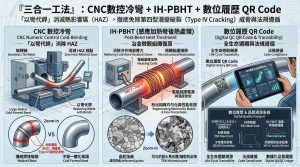
面對 2026 年最新 ASME B31J 規範針對 P9x 級高能管線銲道的嚴格要求(如強制實施銲道強度折減係數 WSRF),管線施作協力廠商(如潁璋工程)導入「能彎不銲」技術,推動了工程管理核心價值的全面升級: Confronting the stringent stipulations of the latest 2026 ASME B31J code for P9x welds (e.g., mandatory WSRF implementation), piping subcontractors (such as Ying-Zhang Engineering) have pioneered “bending instead of welding” technology, catalyzing a comprehensive elevation in engineering management core values:
- 合乎 ASME B31.1 & B31J 應變率規範與 IH-PBHT 冶金優化 / Compliance with ASME B31.1 & B31J Strain Rate Codes and IH-PBHT Metallurgical Optimization:
面對 2026 年最新 ASME B31.1 與 B31J 規範,管線冷彎加工的「應變率(Strain Rate)」與後續熱處理要求成為工程設計的核心焦點。根據物理幾何原理,冷彎應變率的近似計算公式為 ε=r/R*100(其中 r 為管材外半徑,R為彎曲半徑)35。對於高壓厚壁的 P9x 高能管線,當採用緊湊的 3D 或 5D 彎曲半徑進行冷彎成形時,外弧(拉伸側)的塑性應變極易突破 15% 甚至高達 20%35。 大量的實驗數據與 EPRI 研究證實,P9x 鋼對冷變形極度敏感;高達 20% 的塑性應變會引發嚴重的加工硬化(Work Hardening),促使晶格內位錯密度(Dislocation Density)急遽上升。在高溫服役時,這些高密度位錯網絡會成為擴散通道,加速 M23C6 碳化物的粗化與相聚集,破壞沉澱強化機制,從而大幅削弱材料的長期潛變斷裂強度35。 為此,ASME B31.1 規範嚴格規定,當冷作應變率超過 5% 時,必須執行特定條件的消除應力熱處理。為完全合乎新規範並克服 5%~20% 極端應變率帶來的微觀組織退化風險,潁璋工程的「三合一工法」導入了精確控制的感應加熱銲後/彎後熱處理(IH-PBHT)。透過將加工後的管線精確加熱至 705°C 至 760°C 的次臨界溫度區間,IH-PBHT 能夠完美消除高達 20% 塑性應變所累積的冷彎加工硬化與殘餘應力,且不破壞原有 M23C6與 MX 析出相的強化效果35。 Facing the latest 2026 ASME B31.1 and B31J codes, the “Strain Rate” of pipe cold bending and ensuing heat treatment prerequisites have emerged as the epicenter of engineering design. Dictated by physical geometry, the approximate calculation formula for cold bending strain rate is ε=r/R*100 (where r is the pipe’s outer radius and R is the bend radius)35. For high-pressure, thick-walled P9x high-energy piping, when compact 3D or 5D bend radii are executed, the plastic strain on the outer arc (tension side) effortlessly eclipses 15% or even scales up to 20%35. Extensive experimental data and EPRI research corroborate that P9x steels are exceptionally hypersensitive to cold deformation. Plastic strains ascending to 20% provoke severe work hardening, inducing a precipitous surge in dislocation density within the crystal lattice. During high-temperature service, these high-density dislocation networks function as diffusion channels, accelerating the coarsening and agglomeration of M23C6 carbides. This dismantles the precipitation strengthening mechanism, thereby drastically attenuating the material’s long-term creep rupture strength35. Consequently, the ASME B31.1 code rigorously mandates that when the cold working strain rate exceeds 5%, a specific stress-relief heat treatment must be executed. To achieve absolute compliance with the new codes and surmount the microstructural degradation risks posed by extreme strain rates of 5%~20%, Ying-Zhang Engineering’s “Three-in-One Method” incorporates meticulously controlled Induction Heating Post-Bend Heat Treatment (IH-PBHT). By precisely elevating the formed pipe to a subcritical temperature bandwidth of 705°C to 760°C, IH-PBHT flawlessly neutralizes the cold bending work hardening and residual stresses accumulated from up to 20% plastic strain, entirely without compromising the strengthening efficacy of the native M23C6 and MX precipitates35.
- 製程標準化與風險前置化 / Process Standardization and Front-loading Risk Management:
此一「三合一工法」(CNC 數控冷彎 + IH-PBHT + 數位履歷 QR Code)不僅在物理結構上透過「以彎代銲」徹底消滅了轉折處的熱影響區(HAZ),從根本上免除了誘發第四型潛變破裂(Type IV Cracking)的威脅,更在冶金科學與法規遵循上完美契合了規範要求26。管線從母材批號、冷彎成形參數到熱處理溫度曲線皆具備 100% 可追溯性。這不僅省下了為補償銲道強度而增加的特殊管壁厚度與材料成本(規避 WSRF 懲罰),更在機組長達 30 年的生命週期中,省去了無數次強制性銲道檢驗與潛在停機維修的隱性成本,確保了管線在頻繁起停下的極致安全與全生命週期效益(LCC)。 This “Three-in-One Method” (CNC cold bending + IH-PBHT + Digital QR Code) not only physically obliterates the Heat-Affected Zone (HAZ) at the bends via “bending instead of welding”—fundamentally extirpating the threat of Type IV Cracking—but also immaculately aligns with code strictures in terms of metallurgical science and regulatory compliance26. Piping commands 100% traceability from base metal batch and bending parameters through to heat treatment curves. This not only conserves material expenditures for uniquely thicker pipes intended to compensate for weld strength (circumventing the WSRF penalty) but also averts the latent costs of innumerable mandatory weld inspections and prospective downtime repairs over the unit’s 30-year life cycle, guaranteeing paramount safety and Life Cycle Cost (LCC) dividends under frequent cycling.
六、 現代 CCPP 廠的前瞻防範策略與創新改進方向 / VI. Forward-Looking Mitigation Strategies and Innovative Improvement Directions for Modern CCPP Plants
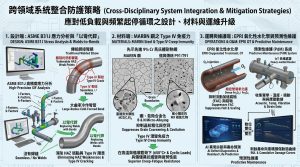
面對鴨子曲線帶來的全方位物理與冶金挑戰,現代工程界在規範標準、材料冶金、運轉化學與線上檢測上提出了系統性的防護策略。 Confronting the omnipresent physical and metallurgical challenges ushered in by the duck curve, modern engineering has postulated systematic protection strategies spanning codes and standards, metallurgy, operational chemistry, and online monitoring.
6.1 規範革命與應力強化係數(SIF)最佳化:ASME B31J / 6.1 Code Revolution and SIF Optimization: ASME B31J
傳統 ASME B31.1 與 B31.3 規範沿用半世紀的附錄 D(Appendix D),其經驗公式對於現代大徑厚比(D/T > 100)薄壁管線與複雜幾何,暴露出極大的保守性與理論盲點;例如強行賦予彎頭單一的 SIF 數值,未能區分面內(In-Plane)與面外(Out-of-Plane)彎矩差異。若將彎頭公式誤用於銲接三通,甚至會導致面外 SIF 被嚴重低估 20%(0.9 / 0.75 = 1.2)25。The legacy Appendix D of the ASME B31.1 and B31.3 codes, perpetuated for half a century, betrays profound conservatism and theoretical blind spots for modern thin-walled piping with elevated diameter-to-thickness ratios (D/T > 100) and intricate geometries. For instance, capriciously assigning a monolithic SIF value to elbows fails to disambiguate between In-Plane and Out-of-Plane bending moments. Applying elbow formulas fallaciously to welded tees can even precipitate a perilous 20% underestimation of the out-of-plane SIF (0.9 / 0.75 = 1.2)25.
因應策略:Response Strategy:
最新的 2026 年版 ASME B31.1 與 B31.3 規範已全面廢除附錄 D,強制要求導入 ASME B31J 規範進行管線柔性分析。B31J 基於大規模有限元素分析(FEA),重新定義了管件的柔性特徵(Flexibility Characteristic, h)與極度精細化的方向性 SIF(詳見表 2)。 The vanguard 2026 editions of ASME B31.1 and B31.3 have unequivocally abrogated Appendix D, decreeing the adoption of ASME B31J for piping flexibility analysis. Anchored on large-scale Finite Element Analysis (FEA), B31J redefines the Flexibility Characteristic (h) of components and proffers exquisitely refined directional SIFs (see Table 2).
h=T⋅R1/r22
採用 3D 或 5D 冷作連續彎管,能將彎曲半徑增加 2 至 3 倍,使得 h 值呈線性增大,進而顯著降低應力強度因子。這不僅巨幅降低了管線的自重應力與疲勞熱點,更大幅節省了配置厚重鋼構的資本支出4。Adopting 3D or 5D cold continuous bends magnifies the bend radius by 2 to 3 times, propelling a linear augmentation in the h value and thus precipitously lowering the Stress Intensification Factor (SIF). This not only drastically truncates the piping’s self-weight stress and fatigue hotspots but also substantially curtails CAPEX on formidable steel supports4.
(表2 / Table 2)
| 比較參數 / Comparison Parameter | 傳統 1.5D 鍛造對銲彎頭 / Traditional 1.5D Forged Butt-Weld Elbow | 3D/5D 冷作連續彎管 / 3D/5D Cold Continuous Bend | 物理意義與影響 / Physical Significance & Impact |
| 柔性特徵 (h) / Flexibility Characteristic (h) | 極小(因彎曲半徑僅為 1.5 倍管徑) / Extremely small (radius is only 1.5x pipe diameter) | 顯著增大(彎曲半徑增為 3 至 5 倍管徑) / Significantly enlarged (radius is 3-5x pipe diameter) | h 值越大,表示管件在吸收熱膨脹時的截面橢圓化應力越低 / A larger h signifies lower cross-sectional ovalization stress when absorbing thermal expansion |
| 應力強度因子 (SIF) / Stress Intensification Factor (SIF) | 極高,且未細分受力方向,易致指派錯誤 / Extremely high, lacks directional breakdown, prone to errors | 大幅降低,明確拆解面內、面外與扭轉 SIF / Drastically reduced, explicitly separating in-plane, out-of-plane, and torsional SIFs | 5D 彎管可有效避開疲勞熱點,提升系統容許循環次數 / 5D bends effectively bypass fatigue hotspots, amplifying allowable system cycles |
| 銲道與 HAZ 懲罰 / Weld & HAZ Penalty | 承受嚴厲的銲道強度折減係數(W-Factor)懲罰 / Subject to strict Weld Strength Reduction Factor (W-Factor) penalty | 一體成形,無環向銲道,免除 W-Factor 懲罰 / Monolithic structure, no girth welds, immune to W-Factor | 允許採用更薄的母材壁厚,降低剛性與熱過渡應力 / Permits thinner base metal walls, ameliorating rigidity and transient thermal stress |
6.2 冶金工程之創新解方:MARBN 合金鋼 / 6.2 Innovative Metallurgical Solution: MARBN Alloy Steel
為徹底克服 9-12% Cr 鋼系在銲接 HAZ 軟化與 Type IV 裂紋的宿命,材料科學界開發了新世代的馬氏體硼氮強化鋼(MARBN, Martensitic Boron-Nitrogen strengthened steel)40。 To definitively conquer the predestination of HAZ softening and Type IV cracking in 9-12% Cr steels, materials science engineered a next-generation Martensitic Boron-Nitrogen strengthened steel (MARBN)40.
- 微觀強化機制 / Microscopic Strengthening Mechanism:MARBN 鋼透過精確控制硼(90~130 ppm)與極低氮的添加,使硼原子富集於原奧氏體晶界與 M23C6碳化物內部。硼的加入極大提高了碳化物的熱穩定性,抑制了潛變過程中的粗化現象,並顯著阻礙了細晶熱影響區(FGHAZ)的形成41。 MARBN steel orchestrates Boron enrichment at the prior austenite grain boundaries and inside M23C6 carbides via the precise infusion of Boron (90~130 ppm) and ultra-low Nitrogen. Boron monumentally elevates carbide thermal stability, stifles coarsening during creep, and significantly impedes the genesis of the Fine-Grained HAZ (FGHAZ)41.
- 抗破裂表現 / Fracture Resistance Performance:長期潛變測試數據顯示,由於特殊微觀組織的維持,MARBN 鋼的銲接接頭成功達成了對第四型潛變破裂的免疫(Immunity to Type IV cracking),其潛變強度幾乎與母材相當,為未來高效 CCPP 廠的高溫管線提供了革命性的材料解答40。 Protracted creep testing data unequivocally demonstrates that, owing to the preservation of this distinctive microstructure, MARBN steel welds successfully achieve immunity to Type IV cracking. Its creep strength is virtually commensurate with the base metal, dispensing a revolutionary metallurgical riposte for high-temperature piping designs in forthcoming high-efficiency CCPP plants40.
6.3 運轉水化學優化:EPRI 循環化學指引 / 6.3 Operational Water Chemistry Optimization: EPRI Cycle Chemistry Guidelines
為防範 HRSG 在頻繁起停過程中的 FAC 與腐蝕疲勞,必須嚴格遵循 EPRI 發布的《綜合循環化學指引》27。傳統的還原性全揮發處理(AVT(R))已不適用於現代 CCPP,工程界全面改採氧化性全揮發處理(AVT(O))或加氧處理(OT)3。透過精準控制給水中的氨濃度以維持適當 pH 值,並保留或注入適量溶解氧,能在管壁表面生成一層極為緻密且低溶解度的三氧化二鐵(Fe2O3)保護層。此氧化層不僅能有效抑制金屬基體的離子擴散,更能抵禦因流速突變所帶來的沖刷與 FAC 侵蝕27。To preempt FAC and corrosion fatigue in HRSGs during incessant start-stops, operators must stringently adhere to EPRI’s Comprehensive Cycle Chemistry Guidelines27. The traditional All-Volatile Treatment (Reducing) (AVT(R)) is empirically obsolete for modern CCPPs; the industry has categorically pivoted to AVT (Oxidizing) (AVT(O)) or Oxygenated Treatment (OT)3. By impeccably calibrating ammonia concentration in feedwater to sustain an optimal pH and retaining or injecting commensurate dissolved oxygen, a highly dense and low-solubility Hematite (Fe2O3) protective pellicle can be cultivated on the pipe walls. This oxide layer not only stifles ion diffusion within the metal matrix but also staunchly withstands erosion and FAC incursion precipitated by velocity spikes27.
6.4 預測性維護(PdM)與先進狀態監測技術 / 6.4 Predictive Maintenance (PdM) and Advanced Condition Monitoring Technology
面對隱蔽的蠕變與疲勞損傷,必須導入先進的非破壞檢測(NDT)與線上狀態監測(CMS)。 Confronting insidious creep and fatigue damage, advanced Non-Destructive Testing (NDT) and Condition Monitoring Systems (CMS) must be deployed.
- 線上壽命消耗追蹤 / Online Life Consumption Tracking:建置 CMS 系統即時擷取動態數據。透過直接直流電位降(DCPD)量測技術並結合機器學習模型,可精準預測材料處於 20%~80% 潛變壽命區間內的微觀演化狀態5。 Architecting CMS to harvest dynamic data in real-time. By leveraging Direct Current Potential Drop (DCPD) measurement technology allied with machine learning algorithms, the microstructural evolutionary state of materials can be unerringly predicted within the 20%~80% creep life fraction window5.
- 高階 NDT 檢測技術 / High-End NDT Technologies:針對最易爆發 Type IV 裂紋的銲道 ICHAZ,改採相控陣超音波(PAUT)與飛行時間繞射(TOFD)技術進行高解析度 3D 微裂紋檢測。並定期配合現場金相覆膜檢驗碳化物粗化程度,以及小衝孔潛變測試評估局部軟化區殘餘強度,及早介入修補21。 For the weld ICHAZ, the most notorious locus for Type IV cracking eruptions, traditional radiography is supplanted by Phased Array Ultrasonic Testing (PAUT) and Time-of-Flight Diffraction (TOFD) for high-resolution 3D internal microcrack detection. Harmonizing this with routine on-site replica metallography to audit carbide coarsening and Small Punch Impression Creep tests to benchmark residual strength in localized soft zones expedites early intervention21.
七、 結論 / VII. Conclusion
能源轉型的時代浪潮賦予了複循環燃氣機組維持電網穩定之重責大任,然而頻繁起停與低負載運轉模式,徹底重塑了機組的破壞力學邊界。本研究證實,物理流態的瞬變(如熱層流分層、水鎚與聲學共振)為管路系統帶來了巨大的機械破壞力;而熱力學上的淬冷熱衝擊與過渡熱應力,則與高溫環境結合,誘發了極具破壞性的「蠕變-疲勞交互作用」。此效應加速了 P91/P92 鋼材熱影響區內晶界碳化物的粗化與脆性 Laves 相的析出,最終引爆了致命的第四型潛變破裂(Type IV Cracking)。The epoch of energy transition has entrusted Combined Cycle Power Plants (CCPP) with the monumental mandate of preserving grid stability; however, the frequent start-stop and low-load (Cycling) paradigms induced by the Duck Curve have radically recalibrated the destructive mechanical boundaries of the units. This study corroborates that fluid transient phenomena (such as thermal stratification, water hammer, and acoustic resonance) impart colossal mechanical destructive forces upon the piping infrastructure. Concurrently, thermodynamic thermal quenching and transient thermal stresses, alloyed with high-temperature environments, spawn a highly destructive “Creep-Fatigue Interaction.” This synergy accelerates the coarsening of grain boundary carbides and the precipitation of brittle Laves phases within the HAZ of P91/P92 steels, inexorably triggering fatal and unheralded Type IV Cracking.
透過台灣通霄電廠等前瞻工程實務與國際規範的演進,明確揭示被動修補已無法滿足現代化機組的安全基準。未來的工程防護必須採取跨領域的系統整合策略:在設計端,應全面導入 ASME B31J 規範進行高精度應力強度因子分析,並採用大曲率冷作彎管「以彎代銲」消除 HAZ 弱點;在材料端,積極評估具備 Type IV 免疫力之 MARBN 鋼的應用潛力;在運轉與維護端,需嚴守 EPRI 氧化性水化學指引,並落實預測性維護(PdM)系統。唯有透過流體動力學、材料冶金科學與數位化狀態監測的深度結合,方能在再生能源高度滲透的嚴苛環境中,確保燃氣發電廠之資產完整性與極致的調度可靠度。Through forward-looking engineering praxis at Taiwan’s Tongxiao Power Plant and the progression of international codes, it is unequivocally manifest that passive remediation can no longer satisfy the safety benchmarks of modernized units. Prospective engineering fortification must embrace cross-disciplinary system integration strategies: At the design vanguard, ASME B31J must be ubiquitously instituted for high-fidelity SIF analysis, adopting large-curvature cold bends to “bend instead of weld” to nullify HAZ vulnerabilities; at the materials frontier, the application potential of MARBN steel with Type IV immunity must be proactively evaluated; at the operational and maintenance nexus, stringent adherence to EPRI oxidizing water chemistry guidelines and the operationalization of PdM systems are imperative. Only through the profound confluence of fluid dynamics, metallurgical science, and digital condition monitoring can the asset integrity and extreme dispatch reliability of gas-fired power plants be safeguarded in an unforgiving environment permeated by high renewable energy.
參考文獻 / References
- 面對疫情仍要淨零,臺灣以綠能導向的能源轉型之路,必須堅定向前, https://www.greenpeace.org/taiwan/update/25033/%E9%9D%A2%E5%B0%8D%E7%96%AB%E6%83%85%E4%BB%8D%E8%A6%81%E6%B7%A8%E9%9B%B6%EF%BC%8C%E8%87%BA%E7%81%A3%E4%BB%A5%E7%B6%A0%E8%83%BD%E5%B0%8E%E5%90%91%E7%9A%84%E8%83%BD%E6%BA%90%E8%BD%89%E5%9E%8B%E4%B9%8B/
- 關於鴨子曲線,你需要知道的一切, https://www.pilotech.ai/zh-ct/blogs/everything-you-need-to-know-about-the-duck-curve/
- 行政院原子能委員會委託研究計畫研究報告 – 核能安全委員會, https://www.nusc.gov.tw/share/file/information/uqIIZgBUgeIj7JOxyOK~-A__.pdf?v=2019101427
- https://yz-pipe-bending.com.tw/%E8%A4%87%E5%BE%AA%E7%92%B0%E9%9B%BB%E5%BB%A0%E9%AB%98%E8%83%BD%E7%AE%A1%E7%B7%9A%E3%80%8C%E5%BD%8E%E7%AE%A1%E5%B7%A5%E6%B3%95%E3%80%8D%E6%95%B4%E5%90%88%E7%A0%94%E7%A9%B6%EF%BC%9A%E8%81%B2%E5%AD%B8/
- 整理CCPP 頻繁起停所有現象彙整.xlsx
- Online Creep and Fatigue Monitoring in Power Plants, https://trepo.tuni.fi/bitstream/123456789/22478/3/Pesonen.pdf
- Operating ratio and cost of coal power generation, https://usea.org/sites/default/files/Operating%20ratio%20and%20cost%20of%20coal%20power%20generation%20-%20ccc272-1.pdf
- (PDF) Combined Cycle – Academia.edu, https://www.academia.edu/30729312/Combined_Cycle
- https://yz-pipe-bending.com.tw/%E9%AB%98%E5%90%88%E9%87%91%E9%8B%BC%E8%88%87%E7%A9%A9%E5%AE%9A%E5%9E%8B%E4%B8%8D%E9%8A%B9%E9%8B%BC316ln%E3%80%81347h-%E8%88%87-p93-%E5%9C%A8%E6%A5%B5%E7%AB%AF%E7%92%B0%E5%A2%83%E4%B8%8B%E4%B9%8B/
- MM EPIC-2 Subsea Project Scope & Design | PDF – Scribd, https://www.scribd.com/document/924845206/1020-Appendix-a-Scope-of-Work
- Full article: Numerical simulation and orthogonal optimization of, https://www.tandfonline.com/doi/full/10.1080/19942060.2026.2661451
- HRSG Lifing Brief | PDF | Fatigue (Material) | Creep (Deformation), https://www.scribd.com/document/429247337/HRSG-Lifing-Brief
- Heat Recovery Steam Generator Technology [1st Edition, https://dokumen.pub/heat-recovery-steam-generator-technology-1st-edition-9780081019412-9780081019405.html
- A Dictionary of Mechanical Engineering 9780199587438 – Scribd, https://www.scribd.com/document/548410579/dokumen-pub-a-dictionary-of-mechanical-engineering-9780199587438
- A Dictionary of Mechanical Engineering 9780199587438, https://dokumen.pub/a-dictionary-of-mechanical-engineering-9780199587438.html
- CODE STRESS REQUIREMENTS – ASME Digital Collection, https://asmedigitalcollection.asme.org/ebooks/book/chapter-pdf/2794871/802854_ch4.pdf
- APPROCCIO LOCALE NELLA STIMA DELLA PROPAGAZIONE, https://www.researchgate.net/publication/336798964_APPROCCIO_LOCALE_NELLA_STIMA_DELLA_PROPAGAZIONE_DELLA_CRICCA_IN_UN_ACCIAIO_PER_ALTE_TEMPERATURE
- An assessment of creep deformation and rupture behaviour of 9Cr, https://www.researchgate.net/publication/278716590_An_assessment_of_creep_deformation_and_rupture_behaviour_of_9Cr-18W-05Mo-VNb_ASME_grade_92_steel
- Study of the creep cavitation behavior of P91 steel under different, https://www.researchgate.net/publication/361889394_Study_of_the_creep_cavitation_behavior_of_P91_steel_under_different_stress_states_and_its_effect_on_high-temperature_creep_properties
- Review of Type IV Cracking in Piping Welds – EPRI, https://restservice.epri.com/publicdownload/TR-108971/0/Product
- Correlation Between Intercritical Heat-Affected Zone and Type IV, https://www.researchgate.net/publication/322940634_Correlation_Between_Intercritical_Heat-Affected_Zone_and_Type_IV_Creep_Damage_Zone_in_Grade_91_Steel
- Type IV cracking behaviour of modified 9Cr-1Mo steel weld joints, https://www.researchgate.net/publication/300089140_Type_IV_cracking_behaviour_of_modified_9Cr-1Mo_steel_weld_joints
- An assessment of the risk of type IV cracking in welds to header, https://www.researchgate.net/publication/288128785_An_assessment_of_the_risk_of_type_IV_cracking_in_welds_to_header_pipework_and_turbine_components_constructed_from_the_advanced_ferritic_9_and_12_chromium_steel
- Weld Joint Strength Reduction Factor — ASME B31.3 – WeldFabWorld, https://www.weldfabworld.com/weld-joint-strength-reduction-factor-w/
- 基於ASME B31J 柔性分析之P5/P11/P22 中高溫管線潛變壽命預測暨, https://yz-pipe-bending.com.tw/%E5%9F%BA%E6%96%BC-asme-b31j-%E6%9F%94%E6%80%A7%E5%88%86%E6%9E%90%E4%B9%8B-p5-p11-p22-%E4%B8%AD%E9%AB%98%E6%BA%AB%E7%AE%A1%E7%B7%9A%E6%BD%9B%E8%AE%8A%E5%A3%BD%E5%91%BD%E9%A0%90%E6%B8%AC%E6%9A%A8/
- CCPP電廠P9x高能管線曲率半徑(5D規格品銲接彎頭與3D/5D冷作, https://yz-pipe-bending.com.tw/ccpp%E9%9B%BB%E5%BB%A0p9x%E9%AB%98%E8%83%BD%E7%AE%A1%E7%B7%9A%E6%9B%B2%E7%8E%87%E5%8D%8A%E5%BE%91%EF%BC%881-5d%E8%A6%8F%E6%A0%BC%E5%93%81%E9%8A%B2%E6%8E%A5%E5%BD%8E%E9%A0%AD%E8%88%873d-5d%E5%86%B7/
- EPRI 3002001381 Comprehensive Cycle Chemistry Guidelines For, https://pdfcoffee.com/epri-3002001381-comprehensive-cycle-chemistry-guidelines-for-combined-cycle-heat-recovery-steam-generators-hrsgs-pdf-free.html
- EHF2024: Highlighting new challenges for HRSG reliability, https://www.ccj-online.com/ehf2024-highlighting-new-challenges-for-hrsg-reliability/
- Heat Exchangers. Volume III: Operation, Performance, and, https://dokumen.pub/heat-exchangers-volume-iii-operation-performance-and-maintenance-3nbsped-9781003352068.html
- Combustion Turbine Combined Cycle Technology Developments, https://www.scribd.com/document/400352015/Combustion-Turbine-Combined-Cycle-Technology-Developments-Reliability-Issues-and-Related-Market-Conditions-pdf
- ASME B31.1 Power Piping — Examination, Testing … – Atlantis NDT, https://atlantisndt.com/blog/asme-b31-1-power-piping-code-explained
- A Review of Methods to Estimate Creep Damage in Low‐Alloy Steel, https://scispace.com/pdf/a-review-of-methods-to-estimate-creep-damage-in-low-alloy-1rwrn2d9nn.pdf
- Phase Transformation of P91 Steels upon Cooling after Short Term, https://www.researchgate.net/publication/269379303_Phase_Transformation_of_P91_Steels_upon_Cooling_after_Short_Term_Overheating_above_Ac1_and_Ac3_Temperature
- 複循環發電廠脫硝與碳捕捉管線系統採用3D/5D 冷作彎管工法取代, https://yz-pipe-bending.com.tw/%E8%A4%87%E5%BE%AA%E7%92%B0%E7%99%BC%E9%9B%BB%E5%BB%A0%E8%84%AB%E7%A1%9D%E8%88%87%E7%A2%B3%E6%8D%95%E6%8D%89%E7%AE%A1%E7%B7%9A%E7%B3%BB%E7%B5%B1%E6%8E%A1%E7%94%A8-3d-5d-%E5%86%B7%E4%BD%9C%E5%BD%8E/
- 基於2026 ASME B31J 規範之P9x 高壓蒸汽管線設計與工法解析, https://yz-pipe-bending.com.tw/%E5%9F%BA%E6%96%BC-2026-asme-b31j-%E8%A6%8F%E7%AF%84%E4%B9%8B-p9x-%E9%AB%98%E5%A3%93%E8%92%B8%E6%B1%BD%E7%AE%A1%E7%B7%9A%E8%A8%AD%E8%A8%88%E8%88%87%E5%B7%A5%E6%B3%95%E8%A7%A3%E6%9E%90%EF%BC%9A/
- 高溫高壓管線銲道潛變失效型態(Type I-IV)之演變特徵, https://yz-pipe-bending.com.tw/%E9%AB%98%E6%BA%AB%E9%AB%98%E5%A3%93%E7%AE%A1%E7%B7%9A%E9%8A%B2%E9%81%93%E6%BD%9B%E8%AE%8A%E5%A4%B1%E6%95%88%E5%9E%8B%E6%85%8B%EF%BC%88type-i-iv%EF%BC%89%E4%B9%8B%E6%BC%94%E8%AE%8A%E7%89%B9%E5%BE%B5/
- SIF & Flexibility Factors — ASME B31J-2023 & NM.1 HDPE, https://pipingtoolset.com/tools/sif-flexibility-factors/
- 1 – Welding Elbow (ASME B31J 2017), https://docs.bentley.com/LiveContent/web/AutoPIPE-v2026.0.1/Help/en/Topics/Codes/b31j_Welding_Elbow.html
- What’s New in CAESAR II v13, https://projektowanie-rurociagow.pl/wp-content/uploads/2022/10/Whats-new-in-CAESAR-II-v13.pdf
- Type IV Cracking of Weldments in Enhanced Ferritic Steels – TWI Ltd, https://www.twi-global.com/technical-knowledge/published-papers/review-of-type-iv-cracking-of-weldments-in-9-12cr-creep-strength-enhanced-ferritic-steels/
- Creep and damage investigation of advanced martensitic chromium, https://www.researchgate.net/publication/276248251_Creep_and_damage_investigation_of_advanced_martensitic_chromium_steel_weldments_for_high_temperature_applications_in_thermal_power_plants
- (PDF) Improvement of type IV creep cracking resistance of 9Cr heat, https://www.researchgate.net/publication/237769280_Improvement_of_type_IV_creep_cracking_resistance_of_9Cr_heat_resisting_steels_by_boron_addition
- A Review of Austenite Memory Effect in HAZ of B Containing 9% Cr, https://www.mdpi.com/2075-4701/9/11/1233
- Evolution of phases in P91 steel in various heat treatment conditions, https://www.researchgate.net/publication/301234924_Evolution_of_phases_in_P91_steel_in_various_heat_treatment_conditions_and_their_effect_on_microstructure_stability_and_mechanical_properties