
一、 緒論與研究背景 / 1. Introduction and Research Background
在現代能源轉型的過渡期,複循環發電廠(Combined Cycle Power Plant, CCPP)扮演著穩定電網基載與調節再生能源間歇性的關鍵角色。為了追求更高的熱力學效率與降低碳排放,新一代 CCPP 機組與超超臨界(USC)發電廠的運轉溫度與壓力不斷攀升,主蒸汽與高溫再熱蒸汽管線往往需承受超過 600°C 的高溫與 200 bar 以上的高壓。這對管線系統的材料完整性與全生命週期可靠度提出了極為嚴苛的挑戰1。特別是在台灣特殊的地理與氣候環境下,建置於高海拔山區或高鹽害沿海地區的 CCPP 工廠,其高能管線(High Energy Piping, HEP)不僅需承受極端的操作應力,更面臨著高濃度氯離子侵蝕、鹽霧點蝕、頻繁啟停所引發的熱分層(Thermal Stratification)熱疲勞,以及因局部腐蝕與應力集中所誘發的氫脆化(Hydrogen Embrittlement)等多重外部與內部威脅4。During the transition period of modern energy transformation, Combined Cycle Power Plants (CCPP) play a critical role in stabilizing the baseload of the power grid and regulating the intermittency of renewable energy. To pursue higher thermodynamic efficiency and reduce carbon emissions, the operating temperatures and pressures of next-generation CCPP units and ultra-supercritical (USC) power plants continue to rise. Main steam and high-temperature reheat steam piping often must withstand high temperatures exceeding 600°C and pressures over 200 bar. This poses extremely severe challenges to the material integrity and full-lifecycle reliability of piping systems 1. Particularly in Taiwan’s unique geographic and climatic environment, CCPP plants built in high-altitude mountainous areas or high-salinity coastal regions face extreme operational stresses on their High Energy Piping (HEP). Furthermore, they are confronted with multiple external and internal threats, including high-concentration chloride ion erosion, salt spray pitting, thermal fatigue induced by thermal stratification from frequent start-ups, and hydrogen embrittlement triggered by localized corrosion and stress concentration 4.
傳統管線建構高度仰賴斜切對銲(Miter Welds)或銲接彎頭(Welded Elbows)來實現空間轉向。然而,銲接過程不可避免地會引入劇烈的熱循環,在母材與銲道之間形成微觀組織極度不均勻的熱影響區(Heat-Affected Zone, HAZ)7。研究表明,HAZ 的冶金退化往往成為高溫潛變(Creep)、疲勞(Fatigue)與環境輔助開裂(Environmentally Assisted Cracking, EAC)的薄弱破口。例如,9% 鉻系合金鋼在細晶熱影響區(FGHAZ)易發生第四型潛變破裂(Type IV Cracking),而穩定型不銹鋼則面臨應力鬆弛開裂(Stress Relaxation Cracking, SRC)的風險7。Traditional piping construction relies heavily on miter welds or welded elbows to achieve spatial directional changes. However, the welding process inevitably introduces intense thermal cycles, forming a heat-affected zone (HAZ) with extremely uneven microstructures between the base metal and the weld bead 7. Studies have shown that metallurgical degradation in the HAZ often becomes a vulnerable breach for high-temperature creep, fatigue, and environmentally assisted cracking (EAC). For example, 9% chromium alloy steels are prone to Type IV cracking in the fine-grained heat-affected zone (FGHAZ), while stabilized stainless steels face the risk of stress relaxation cracking (SRC) 7.
為了解決銲接所帶來的結構性瓶頸,工業界與學術界開始大規模導入進階材料,如 P93 潛變強度強化鐵素體鋼、316LN 氮合金化沃斯田鐵不銹鋼,以及 347H 鈮穩定型不銹鋼,並探討以三維或五維(3D/5D)數控冷作彎管(CNC Cold Bending)技術取代傳統銲接的防護效益1。本研究報告旨在深度剖析上述進階材料在極端服役環境下的冶金特性與劣化機制,並結合 ASME B31.1 與 B31J 壓力配管規範之理論框架,論證冷作彎管工法搭配後續消除應力熱處理(PBHT)如何藉由保持母材微觀組織的完整性,大幅降低氫脆化與晶界腐蝕之風險,從而全面提升台灣極端環境下 CCPP 管線的安全邊際與服役壽命。To address the structural bottlenecks brought about by welding, the industry and academia have begun to widely introduce advanced materials, such as P93 creep strength enhanced ferritic steel, 316LN nitrogen-alloyed austenitic stainless steel, and 347H niobium-stabilized stainless steel. They are also exploring the protective benefits of replacing traditional welding with three-dimensional or five-dimensional (3D/5D) CNC cold bending technology 1. This research report aims to deeply analyze the metallurgical characteristics and degradation mechanisms of these advanced materials in extreme service environments. Combined with the theoretical framework of ASME B31.1 and B31J pressure piping codes, it demonstrates how the cold bending method, coupled with post-bend heat treatment (PBHT), can significantly reduce the risks of hydrogen embrittlement and intergranular corrosion by maintaining the integrity of the base metal’s microstructure, thereby comprehensively enhancing the safety margin and service life of CCPP piping in Taiwan’s extreme environments.
二、 台灣極端環境對 CCPP 管線之複合性威脅機制 / 2. Complex Threat Mechanisms of Taiwan’s Extreme Environments on CCPP Piping
台灣地處亞熱帶海島,擁有綿長的海岸線與高聳的中央山脈。這種獨特的地理特徵使得發電設施面臨著複合性的環境破壞力。高溫高壓蒸汽管線在這種環境下,其劣化機制不再是單一的潛變或疲勞,而是機械應力與環境因子深度耦合的結果。Situated as a subtropical island, Taiwan features a long coastline and towering central mountain ranges. These unique geographical characteristics expose power generation facilities to complex environmental destructive forces. In such environments, the degradation mechanism of high-temperature and high-pressure steam piping is no longer a single issue of creep or fatigue, but the result of deep coupling between mechanical stress and environmental factors.
2.1 高鹽害海岸環境之氯離子點蝕與應力腐蝕開裂 / 2.1 High-Salinity Coastal Environments: Chloride Pitting and Stress Corrosion Cracking
台灣沿海地區空氣中常年懸浮著高濃度的海鹽飛沫(Sea Salt Aerosols),其主要成分為氯化鈉與氯化鎂。當這些鹽霧透過風力沉降並滲透進入保溫層下方,或直接附著於暴露的大氣管線表面時,會吸濕形成具有極高導電率與侵蝕性的氯離子電解質液膜5。對於沃斯田鐵不銹鋼(如 316LN 與 347H)而言,其卓越的抗腐蝕能力依賴於表面生成的奈米級緻密富鉻鈍化膜(Chromium Oxide Passive Layer)。然而,氯離子(Cl–)具有極小的離子半徑與極強的穿透力,能夠與鈍化膜中的金屬陽離子發生自催化反應,局部破壞鈍化膜,引發嚴重的點蝕(Pitting Corrosion)與縫隙腐蝕(Crevice Corrosion)5。The air in Taiwan’s coastal areas is perennially suspended with high concentrations of sea salt aerosols, primarily composed of sodium chloride and magnesium chloride. When this salt spray settles via wind and penetrates beneath the insulation layer, or directly adheres to exposed atmospheric piping surfaces, it absorbs moisture to form a highly conductive and corrosive chloride electrolyte liquid film 5. For austenitic stainless steels (such as 316LN and 347H), their superior corrosion resistance relies on a nanoscale, dense chromium-rich passive layer formed on the surface. However, the chloride ion (Cl–) has a tiny ionic radius and extremely strong penetrating power. It can undergo autocatalytic reactions with metal cations in the passive layer, locally destroying the film and triggering severe pitting corrosion and crevice corrosion 5.
在高溫與局部拉伸應力(如銲接殘餘應力、幾何不連續處的應力集中或系統熱膨脹應力)的共同作用下,微小的點蝕坑會迅速演變為應力集中源,進一步誘發氯離子應力腐蝕開裂(Cl-SCC)。在 SCC 的傳播階段,裂紋尖端的局部酸化現象會將 pH 值降至極低,加速陽極金屬溶解,使得裂紋沿著晶界(Intergranular)或穿晶(Transgranular)迅速向管壁深處擴展6。傳統銲接熱影響區由於常伴隨碳化鉻析出導致的敏化現象(Sensitization)或粗大晶粒結構,往往是 SCC 萌生的高危險區,極易在無預警狀態下導致高壓蒸汽外洩。Under the combined effects of high temperature and localized tensile stress (such as welding residual stress, stress concentration at geometric discontinuities, or system thermal expansion stress), microscopic pitting holes rapidly evolve into stress concentration sources, further inducing chloride stress corrosion cracking (Cl-SCC). During the propagation stage of SCC, localized acidification at the crack tip drops the pH to extremely low levels, accelerating anodic metal dissolution, causing the crack to propagate rapidly intergranularly or transgranularly deep into the pipe wall 6. Due to the sensitization caused by chromium carbide precipitation or coarse grain structures that often accompany traditional welding HAZs, these areas are high-risk zones for SCC initiation, easily leading to unpredicted high-pressure steam leaks.
2.2 高海拔氣候變遷與頻繁啟停下之熱分層效應 / 2.2 High-Altitude Climate Variations and Thermal Stratification under Frequent Start-Ups
高海拔地區具有日夜溫差劇烈的微氣候特徵。同時,隨著台灣電網大量併入太陽能與風力等間歇性再生能源,CCPP 機組必須頻繁進行熱啟停(Two-shifting)與大範圍的負載跟隨(Load Following),以維持電網頻率穩定。在機組處於熱待機(Hot Standby)、低流量運轉,或冷凝水排放斜度(如 1° 至 3° 洩水坡度)設計不良時,水平敷設的高能管線內部極易發生嚴重的熱分層現象(Thermal Stratification)1。High-altitude regions exhibit microclimate characteristics of drastic day-and-night temperature differences. Concurrently, as Taiwan’s power grid integrates a large amount of intermittent renewable energy like solar and wind, CCPP units must frequently perform thermal start-ups/shut-downs (two-shifting) and wide-range load following to maintain grid frequency stability. When the unit is in hot standby, low-flow operation, or when the condensate drainage slope (e.g., 1° to 3° slope) is poorly designed, horizontally laid HEP is highly susceptible to severe thermal stratification1.
熱分層係指管內流體因密度與浮力差異,導致高溫蒸汽或熱水聚集於管線上半部,而較重的冷凝水或低溫流體沉積於下半部4。這種顯著的上下溫差梯度會導致管線截面產生極大的非對稱熱膨脹。上半部受熱膨脹受阻產生軸向壓應力,下半部則產生軸向拉應力,引發管線宏觀上的「香蕉型」彎曲變形(Bowing Deformation)1。熱分層所產生的次級彎曲應力(Secondary Bending Stress)具有高度的交變特性。當其與管線內壓產生的一次應力疊加時,會在管件的固定端、彎頭或銲道處引發嚴重的熱疲勞(Thermal Fatigue)與熱-機疲勞(Thermo-Mechanical Fatigue, TMF)裂紋14。Thermal stratification refers to the phenomenon where, due to differences in fluid density and buoyancy within the pipe, high-temperature steam or hot water accumulates in the upper half of the pipe, while heavier condensate or low-temperature fluid deposits in the lower half 4. This significant top-to-bottom temperature gradient causes immense asymmetrical thermal expansion across the pipe cross-section. Restricted thermal expansion in the upper half generates axial compressive stress, while the lower half generates axial tensile stress, inducing a macroscopic “bowing deformation” of the pipeline1. The secondary bending stress produced by thermal stratification has highly alternating characteristics. When superimposed with the primary stress generated by internal pressure, it triggers severe thermal fatigue and thermo-mechanical fatigue (TMF) cracks at fixed ends, elbows, or weld seams 14.
2.3 流速加速腐蝕(FAC)與局部氫脆化之深度耦合 / 2.3 Deep Coupling of Flow-Accelerated Corrosion (FAC) and Localized Hydrogen Embrittlement
在 CCPP 的熱回收蒸汽發生器(HRSG)與低中壓汽鼓系統中,流體的高速擾動與壓力波動會導致流速加速腐蝕(Flow-Accelerated Corrosion, FAC)。FAC 是一種由於局部高湍流(Turbulence)不斷剝離並帶走金屬表面保護性磁鐵礦(Magnetite)或赤鐵礦(Hematite)氧化膜,進而加速基材鐵離子溶解的機制14。在傳統銲接接頭處,由於內部常存在銲瘤、錯邊(Misalignment)或幾何不連續,會產生強烈的局部渦流(Eddy Currents),使得銲道及其鄰近區域成為 FAC 的重災區,甚至在數天或數週內即造成管壁減薄與穿孔洩漏。In the Heat Recovery Steam Generators (HRSG) and low/medium-pressure drum systems of CCPP, high-speed fluid disturbances and pressure fluctuations lead to Flow-Accelerated Corrosion (FAC). FAC is a mechanism where localized high turbulence continuously strips away and carries off the protective magnetite or hematite oxide film on the metal surface, subsequently accelerating the dissolution of base material iron ions 14. At traditional welded joints, the frequent presence of weld spatter, misalignment, or geometric discontinuities generates intense localized eddy currents, making the weld bead and its adjacent areas prime targets for FAC, which can even cause wall thinning and perforation leakage within days or weeks.
此外,在 FAC 或點蝕的陰極反應過程中,水分子或氫離子被還原,會釋放出初生態氫原子(H+)。這些體積極小的氫原子極易滲透進入金屬晶格,特別是向著具有高靜水拉應力(Hydrostatic Tensile Stress)的區域(如銲接微裂紋尖端、錯位密集區或晶界)擴散聚集16。對於高強度的潛變強度強化鐵素體鋼(如 P91、P92、P93),其馬氏體基體對氫脆化(Hydrogen Embrittlement, HE)的敏感性遠高於沃斯田鐵不銹鋼。氫原子會透過降低金屬原子鍵結力(Hydrogen-Enhanced Decohesion, HEDE)或促進局部塑性變形(Hydrogen-Enhanced Localized Plasticity, HELP),導致材料在遠低於宏觀降伏應力的狀態下發生無預警的脆性斷裂16。Furthermore, during the cathodic reaction process of FAC or pitting, water molecules or hydrogen ions are reduced, releasing nascent hydrogen atoms (H+). These extremely small hydrogen atoms easily permeate into the metal lattice, especially diffusing and accumulating in areas with high hydrostatic tensile stress (such as welding micro-crack tips, dense dislocation areas, or grain boundaries) 16. For high-strength creep strength enhanced ferritic steels (like P91, P92, P93), their martensitic matrix is much more sensitive to Hydrogen Embrittlement (HE) than austenitic stainless steels. Hydrogen atoms lead to unpredicted brittle fractures at stress levels far below the macroscopic yield stress by reducing metallic atomic bond strength (Hydrogen-Enhanced Decohesion, HEDE) or promoting localized plastic deformation (Hydrogen-Enhanced Localized Plasticity, HELP) 16.
三、 進階管線材料之高溫高壓冶金特性解析 / 3. Metallurgical Analysis of Advanced Piping Materials under High Temperature and Pressure
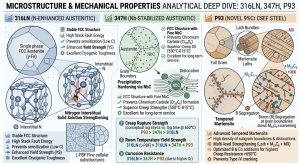
為應對 CCPP 管線在極端環境下所面臨的潛變、疲勞與腐蝕威脅,工程設計上逐漸汰換傳統的碳鋼或低合金鋼(如 P11、P22),轉而選用不同冶金體系的進階高合金與穩定型材料。以下針對 316LN、347H 與 P93 之微觀組織與力學特性進行深度學術解析。To counter the threats of creep, fatigue, and corrosion faced by CCPP piping in extreme environments, engineering designs are gradually replacing traditional carbon steels or low-alloy steels (such as P11, P22) with advanced high-alloy and stabilized materials from different metallurgical systems. The following provides an in-depth academic analysis of the microstructures and mechanical properties of 316LN, 347H, and P93.
3.1 316LN 沃斯田鐵不銹鋼:氮合金化之疲勞抗力與動態應變時效 / 3.1 316LN Austenitic Stainless Steel: Nitrogen Alloying for Fatigue Resistance and Dynamic Strain Aging
316LN(ASME P-No. 8)為在經典 316L 基礎上,嚴格控制超低碳含量(最大 0.03 wt.%)並添加 0.10% 至 0.16% 氮(N)元素的進階沃斯田鐵不銹鋼。氮作為強烈的間隙固溶強化(Interstitial Solid Solution Strengthening)元素,不僅能顯著提升材料的宏觀降伏強度與抗拉強度,更能有效擴大並穩定沃斯田鐵相區,極大程度地降低基體的層錯能(Stacking Fault Energy, SFE)19。316LN (ASME P-No. 8) is an advanced austenitic stainless steel based on the classic 316L, with strictly controlled ultra-low carbon content (max 0.03 wt.%) and the addition of 0.10% to 0.16% nitrogen (N). As a strong interstitial solid solution strengthening element, nitrogen not only significantly enhances the material’s macroscopic yield strength and tensile strength but also effectively expands and stabilizes the austenite phase region, profoundly lowering the matrix’s Stacking Fault Energy (SFE) 19.
從微觀疲勞動力學角度分析,極低的層錯能會阻礙螺旋位錯的交滑移(Cross-slip),使得塑性變形過程中的位錯運動高度受限,傾向於侷限在特定的滑移面上進行平面滑移(Planar Slip)。這種微觀變形模式大幅延緩了疲勞滑移帶的形成以及疲勞微裂紋的成核與早期擴展19。研究數據顯示,根據 Paris 裂紋擴展方程式( da/dN=C(ΔK)m),在 600°C 且存在應力集中的條件下,316LN 的疲勞裂紋擴展速率顯著低於一般的 316L 不銹鋼,展現出極為優異的抗高溫潛變-疲勞交互作用(Creep-Fatigue Interaction, CFI)能力。此外,晶粒尺寸亦扮演關鍵角色,實驗指出具備較大晶粒尺寸(如 126µm)的 316LN,其抗疲勞裂紋擴展能力優於細晶粒(86µm)材料19。Analyzed from a microscopic fatigue dynamics perspective, extremely low SFE impedes the cross-slip of screw dislocations, highly restricting dislocation movement during plastic deformation, tending to confine it to planar slip on specific slip planes. This microscopic deformation mode drastically delays the formation of fatigue slip bands and the nucleation and early propagation of fatigue micro-cracks 19. Research data indicates that, according to the Paris crack growth equation (da/dN=C(ΔK)m), under 600°C conditions with stress concentration, the fatigue crack growth rate of 316LN is significantly lower than that of general 316L stainless steel, demonstrating exceptionally excellent resistance to high-temperature Creep-Fatigue Interaction (CFI). Furthermore, grain size plays a crucial role; experiments show that 316LN with a larger grain size (e.g., 126µm) possesses better fatigue crack growth resistance than fine-grained (86µm) material 19.
然而,316LN 在 300°C 至 600°C 的中高溫區間極易發生動態應變時效(Dynamic Strain Aging, DSA)。DSA 是指間隙溶質原子(氮、碳)的擴散速率與運動位錯的滑移速率相近時,溶質原子氣團(Cottrell Atmospheres)會反覆釘紮與脫離位錯,造成應力-應變曲線上的鋸齒狀流動(Serrated Flow)20。DSA 現象會導致局部應變硬化異常加劇,並使得材料的宏觀延展性與衝擊韌性出現低谷,增加了局部應力集中的風險。在耐腐蝕性方面,超低碳設計從根本上抑制了銲接熱循環中碳化鉻(M23C6)在晶界的沉澱,賦予 316LN 優越的抗敏化與抗晶界腐蝕(IGC)能力25。但在長達數萬小時的極端高溫服役後,材料內部仍可能析出脆性的 Sigma 相或 Laves 相,影響其長期可靠度28。However, 316LN is highly prone to Dynamic Strain Aging (DSA) in the medium-high temperature range of 300°C to 600°C. DSA occurs when the diffusion rate of interstitial solute atoms (nitrogen, carbon) is close to the slip rate of moving dislocations, causing solute atom clouds (Cottrell atmospheres) to repeatedly pin and unpin dislocations, resulting in serrated flow on the stress-strain curve 20. The DSA phenomenon leads to an abnormal intensification of localized strain hardening and creates a trough in the material’s macroscopic ductility and impact toughness, increasing the risk of localized stress concentration. Regarding corrosion resistance, the ultra-low carbon design fundamentally inhibits the precipitation of chromium carbides (M23C6) at grain boundaries during welding thermal cycles, granting 316LN superior resistance to sensitization and intergranular corrosion (IGC) 25. Yet, after tens of thousands of hours of extreme high-temperature service, brittle Sigma phases or Laves phases may still precipitate internally, affecting its long-term reliability 28.
3.2 347H 穩定型不銹鋼:鈮碳氮化物之潛變強化與晶界脆化 / 3.2 347H Stabilized Stainless Steel: Creep Strengthening of Niobium Carbonitrides and Grain Boundary Embrittlement
347H(ASME P-No. 8)屬於鈮(Nb)穩定型高碳沃斯田鐵不銹鋼,其碳含量控制在 0.04% 至 0.10% 之間,以確保高溫下的基礎潛變強度25。347H 的核心冶金設計在於添加含量為碳含量十倍以上的鈮元素(通常為 Nb ≧ 10*C)。鈮具有極強的碳親和力,在高溫下會優先與碳、氮結合,形成極其穩定的奈米級 NbC 或 Nb(C,N) 碳氮化物25。347H (ASME P-No. 8) is a niobium (Nb) stabilized high-carbon austenitic stainless steel, with its carbon content controlled between 0.04% and 0.10% to ensure basic creep strength at high temperatures 25. The core metallurgical design of 347H lies in the addition of niobium at levels more than ten times the carbon content (typically Nb ≧ 10*C ). Niobium has an extremely strong affinity for carbon, preferentially combining with carbon and nitrogen at high temperatures to form highly stable nanoscale NbC or Nb(C,N) carbonitrides 25.
這種微合金化設計發揮了雙重防護作用:首先,穩定的鈮碳化物固定了基體中的自由碳,防止其與鉻反應,從而保留了晶界附近的鉻濃度,維持了高溫抗氧化性與抗晶界腐蝕能力;其次,細小彌散分佈的 Nb(C,N) 析出物能強烈釘紮(Pinning)運動位錯與晶界,阻礙位錯的攀移(Climb)與晶界滑移(Grain Boundary Sliding),賦予 347H 極其卓越的長期穩定態潛變抗力與熱強性30。This micro-alloying design exerts a dual protective function: First, stable niobium carbides fix the free carbon in the matrix, preventing it from reacting with chromium, thereby preserving the chromium concentration near the grain boundaries and maintaining high-temperature oxidation resistance and intergranular corrosion resistance. Second, fine, finely dispersed Nb(C,N) precipitates strongly pin moving dislocations and grain boundaries, impeding dislocation climb and grain boundary sliding, thus endowing 347H with exceptionally outstanding long-term steady-state creep resistance and thermal strength 30.
儘管 347H 在高溫高壓蒸汽管線與超熱器管材中應用廣泛,但其微觀相穩定性對長期熱暴露極度敏感。在長期的超高溫(大於 550°C)服役下,347H 內部會發生複雜的相轉變。原本提供強化的細小 NbC 析出物可能會逐漸粗化並轉變為 Z 相(CrNbN),降低基體強度;同時,富鐵鉻的 Sigma 相(σ-phase)會於晶界或三叉晶界處成核生長30。Sigma 相是一種堅硬但極度脆化的金屬間化合物,它的廣泛析出會急遽降低材料的斷裂韌性(Fracture Toughness)。當 CCPP 機組進行啟停機產生熱衝擊時,佈滿 Sigma 相的晶界無法吸收應變能,極易引發災難性的脆性熱疲勞開裂34。Although 347H is widely used in high-temperature and high-pressure steam piping and superheater tubing, its micro-phase stability is extremely sensitive to long-term thermal exposure. Under prolonged ultra-high temperature (greater than 550°C) service, complex phase transformations occur within 347H. The fine NbC precipitates that originally provided strengthening may gradually coarsen and transform into Z-phase (CrNbN), reducing matrix strength. Simultaneously, the iron-chromium-rich Sigma phase (σ-phase) will nucleate and grow at grain boundaries or triple junctions 30. The Sigma phase is a hard but extremely brittle intermetallic compound; its widespread precipitation drastically reduces the material’s fracture toughness. When CCPP units generate thermal shock during start-up and shut-down, grain boundaries laden with Sigma phase cannot absorb strain energy, making them highly susceptible to catastrophic brittle thermal fatigue cracking 34.
3.3 P93 潛變強度強化鐵素體鋼 (CSEF):精確微合金化與組織重構 / 3.3 P93 Creep Strength Enhanced Ferritic Steel (CSEF): Precise Micro-alloying and Microstructural Reconstruction
P93(ASME Code Case 2839,UNS K91560 變種)代表了當今 9% 鉻系潛變強度強化鐵素體鋼(Creep Strength Enhanced Ferritic Steels, CSEF)的最尖端冶金成就3。相較於主導上一世代 USC 電廠的 P91(9Cr-1Mo-V)與 P92(9Cr-2W-0.5Mo-V),P93 在化學成分上進行了極為精密的微合金化(Micro-alloying)調整,主要導入了約 3.0 wt.% 的鈷(Co)與百萬分之幾等級的硼(B),同時優化鎢(W)與鉬(Mo)的固溶比例3。P93 (ASME Code Case 2839, a UNS K91560 variant) represents the cutting-edge metallurgical achievement of today’s 9% chromium series Creep Strength Enhanced Ferritic Steels (CSEF) 3. Compared to P91 (9Cr-1Mo-V) and P92 (9Cr-2W-0.5Mo-V), which dominated the previous generation of USC power plants, P93 has undergone extremely precise micro-alloying adjustments in its chemical composition. It primarily introduces about 3.0 wt.% cobalt (Co) and parts-per-million levels of boron (B), while optimizing the solid solution ratio of tungsten (W) and molybdenum (Mo) 3.
高鉻含量的鐵素體鋼在常規高溫冶煉下,容易在基體中殘留高溫 Delta 鐵素體(δ-ferrite)。Delta 鐵素體是一種缺乏析出強化的軟弱相,會嚴重削弱材料的高溫潛變破裂強度。P93 透過添加強烈的沃斯田鐵穩定元素——鈷(Co),成功且徹底地抑制了 Delta 鐵素體的生成。鈷不僅擴大了沃斯田鐵相區,更確保材料在經歷標準的正常化與高溫回火(N&T,約 1040°C 正常化與 760°C 回火)後,能獲得 100% 均勻、堅韌且全馬氏體轉變的回火馬氏體(Tempered Lath Martensite)結構3。High-chromium ferritic steels easily retain high-temperature Delta ferrite (δ-ferrite) in the matrix under conventional high-temperature smelting. Delta ferrite is a soft phase lacking precipitation strengthening, which severely weakens the material’s high-temperature creep rupture strength. By adding a strong austenite stabilizing element—cobalt (Co)—P93 successfully and thoroughly inhibits the formation of Delta ferrite. Cobalt not only expands the austenite phase region but also ensures that the material achieves a 100% uniform, tough, fully martensitic-transformed tempered lath martensite structure after standard normalizing and high-temperature tempering (N&T, approx. 1040°C normalizing and 760°C tempering) 3.
另一方面,微量硼(B)元素的加入是 P93 達成極致潛變壽命的核心機制。硼原子尺寸較小,傾向於偏析至原沃斯田鐵晶界(Prior Austenite Grain Boundaries, PAGB)與馬氏體板條邊界,並優先溶入 M23C6 碳化物的晶格中。這種富硼的碳化物在高達 650°C 的環境下具有極低的粗化速率(Coarsening Rate),能夠長期維持細小尺寸,有效地釘紮晶界,強烈阻礙晶界滑移與潛變空孔(Creep Cavities)的核化3。On the other hand, the addition of trace amounts of boron (B) is the core mechanism for P93 to achieve ultimate creep life. The boron atom, being small in size, tends to segregate to the Prior Austenite Grain Boundaries (PAGB) and martensite lath boundaries, preferentially dissolving into the lattice of M23C6 carbides. Such boron-rich carbides have an extremely low coarsening rate in environments up to 650°C, capable of maintaining a fine size long-term, effectively pinning grain boundaries, and strongly impeding grain boundary sliding and the nucleation of creep cavities 3.
憑藉上述微觀組織重構,根據 Larson-Miller Parameter (LMP) 潛變壽命預測模型,P93 的 650°C 長期潛變斷裂強度較 P92 提升了顯著的幅度。對於工程設計而言,這項額外的強度裕度直接轉化為管線壁厚(Wall Thickness)的大幅縮減。薄壁化的物理優勢極為關鍵:它能顯著降低蒸汽溫度瞬變時管壁內外表面的熱傳導溫度梯度(ΔT),從而極大地減輕了機組快速負載變化所帶來的熱膨脹應力與熱疲勞損害,完美契合了現代 CCPP 機組頻繁循環運轉的需求1。Relying on this microstructural reconstruction, according to the Larson-Miller Parameter (LMP) creep life prediction model, P93’s long-term creep rupture strength at 650°C is significantly enhanced compared to P92. For engineering design, this extra strength margin translates directly into a substantial reduction in pipe wall thickness. The physical advantage of thin-wall design is crucial: it significantly reduces the thermal conduction temperature gradient (ΔT) between the inner and outer surfaces of the pipe wall during steam temperature transients, thereby greatly alleviating thermal expansion stress and thermal fatigue damage caused by rapid load changes. This perfectly aligns with the frequent cyclic operation demands of modern CCPP units 1.
| 材料牌號 / 標準 (Material / Standard) | 晶體結構與基礎強化機制 (Crystal Structure & Basic Strengthening Mechanism) | 關鍵合金元素與特殊微觀機制 (Key Alloying Elements & Special Micro-mechanisms) | 高溫極端環境下之主要優勢 (Main Advantages in High-Temp Extreme Environments) | 潛在微觀退化與失效風險 (Potential Micro-Degradation & Failure Risks) |
| 316LN
(ASME P-No. 8) |
沃斯田鐵 / Austenitic
間隙固溶強化、超低碳設計 / Interstitial solid solution strengthening, ultra-low carbon design |
氮 (N): 降低層錯能,促使平面滑移,阻礙交滑移,延緩疲勞裂紋擴展。 / Lowers SFE, promotes planar slip, impedes cross-slip, delays fatigue crack growth. | 優異的高溫低週疲勞壽命、極佳的抗點蝕與抗氯離子應力腐蝕開裂能力。 / Excellent high-temp LCF life, superb pitting and Cl-SCC resistance. | 中高溫區間易發生動態應變時效 (DSA) 導致延展性下降;長期時效易析出 Laves 相。 / Prone to DSA in mid-high temps reducing ductility; Laves phase precipitates during long-term aging. |
| 347H
(ASME P-No. 8) |
沃斯田鐵 / Austenitic
析出強化、高碳穩定化設計 / Precipitation strengthening, high carbon stabilized design |
鈮 (Nb): 形成極穩定之 Nb(C,N),強烈釘紮位錯與晶界;固定自由碳防敏化。 / Forms stable Nb(C,N), strongly pins dislocations & grain boundaries; fixes free C preventing sensitization. | 600°C 以上具有極高之穩定態潛變破裂強度;優良之抗高溫蒸汽氧化性。 / Extremely high steady-state creep rupture strength above 600°C; good high-temp steam oxidation resistance. | 熱影響區 (HAZ) 極易發生應力鬆弛開裂 (SRC) 與再熱裂紋;長期服役有 Sigma 相脆化風險。 / HAZ highly prone to SRC and reheat cracking; risk of Sigma phase embrittlement in long-term service. |
| P93 (CSEF)
(Code Case 2839) |
回火馬氏體 / Tempered Martensite
固溶強化、次晶界釘紮 / Solid solution strengthening, subgrain boundary pinning |
鈷 (Co): 抑制 δ-ferrite 軟化相。
硼 (B): 穩定晶界 M23C6 碳化物抗粗化。 / Co: Inhibits δ-ferrite soft phase. B: Stabilizes grain boundary M23C6 carbides against coarsening. |
650°C 下潛變壽命冠絕同儕;允許極限薄壁設計,大幅降低熱分層與熱疲勞應力。 / Peerless creep life at 650°C; permits extreme thin-wall design, significantly reducing thermal stratification and thermal fatigue stress. | 銲接熱影響區之細晶/臨界區易萌生第四型潛變破裂 (Type IV);對氫脆化極度敏感。 / FGHAZ/ICHAZ easily initiates Type IV creep cracking; highly sensitive to Hydrogen Embrittlement. |
四、 傳統銲接工法與熱影響區(HAZ)之劣化破口分析 / 4. Analysis of Degradation Vulnerabilities in Traditional Welding Methods and Heat-Affected Zones (HAZ)
在 CCPP 的高能管線(High Energy Piping, HEP)系統建置中,傳統上依賴斜切對銲(Miter Welds)或銲接預製彎頭(Welded Elbows)來適應複雜的工廠空間與管線轉向需求。然而,無論銲接工法(如 GTAW, SMAW 或 SAW)如何精進,金屬局部熔融與急冷凝固所不可避免引入的超高溫熱循環,徹底破壞了母材精心調控的冶金平衡。這使得銲接熱影響區(Heat-Affected Zone, HAZ)與熔合線(Fusion Line)成為整體管線系統中最脆弱的力學與冶金鏈條,並衍生出三大致命劣化機制。In the construction of High Energy Piping (HEP) systems for CCPPs, traditional practices rely on miter welds or welded pre-fabricated elbows to adapt to complex factory space and piping directional requirements. However, regardless of how advanced the welding methods (e.g., GTAW, SMAW, or SAW) become, the ultra-high thermal cycles inevitably introduced by localized metal melting and rapid quenching completely destroy the carefully tuned metallurgical balance of the base metal. This makes the Heat-Affected Zone (HAZ) and the fusion line the most vulnerable mechanical and metallurgical links in the entire piping system, spawning three fatal degradation mechanisms.
4.1 P9X 系列之細晶區退化與第四型潛變破裂 (Type IV Cracking) / 4.1 Type IV Creep Cracking in the Fine-Grained Zone of P9X Series
對於如同 P92 與 P93 這類高度依賴回火馬氏體板條與極細小碳氮化物析出強化的 CSEF 鋼材,其潛變抗力對微觀組織的完整性極度敏感。在銲接的熱循環中,HAZ 內部會依據距離熔池的遠近,經歷不同的峰值溫度區間,形成組織與硬度截然不同的次區域7。For CSEF steels like P92 and P93, which highly rely on tempered martensite laths and ultra-fine carbonitride precipitation strengthening, their creep resistance is extremely sensitive to the integrity of the microstructure. During the thermal cycle of welding, the interior of the HAZ experiences different peak temperature ranges depending on the distance from the weld pool, forming sub-regions with drastically different microstructures and hardness 7.
其中最為致命的是峰值溫度介於AC1 與 AC3 相變點之間的細晶熱影響區(Fine-Grained HAZ, FGHAZ)與臨界熱影響區(Intercritical HAZ, ICHAZ)7。在這些狹窄的區域內,材料經歷了不完全的沃斯田鐵化:原始提供強大釘紮作用的微細碳氮化物(如釩、鈮析出物)發生部分溶解;隨後在快速冷卻時,未能恢復原始的強韌馬氏體,而是轉變為硬度較低、位錯密度大幅下降且晶粒異常細化的軟弱組織9。The most fatal among these are the Fine-Grained HAZ (FGHAZ) and the Intercritical HAZ (ICHAZ), where peak temperatures fall between the AC1 and AC3 transformation points7. Within these narrow zones, the material undergoes incomplete austenitization: the original fine carbonitrides (like vanadium and niobium precipitates) providing strong pinning effects partially dissolve. Subsequently, during rapid cooling, it fails to recover the original tough martensite, instead transforming into a soft structure with lower hardness, a significantly reduced dislocation density, and abnormally refined grains 9.
當管線進入後續的銲後熱處理(PWHT)或高溫高壓服役階段時,這些退化區域內剩餘的析出物會迅速失去穩定性並發生粗化(如 Laves 相的異常長大與聚合),徹底喪失對位錯滑移與晶界移動的阻礙能力9。在系統內部壓力與熱膨脹所產生的多軸應力拘束(Triaxial Stress Constraint)作用下,FGHAZ 內部的晶界滑移加劇。根據 Rice-Tracey 空孔成長模型,微觀蠕變空孔(Creep Cavities)會沿著晶界迅速成核、成長並相互連結成宏觀微裂紋7。這種劣化發展極其隱蔽,最終會導致管線在遠低於設計壽命的時間內,於 HAZ 區域發生毫無預警的巨觀脆性斷裂,此即工程界聞之色變的「第四型潛變破裂(Type IV Cracking)」。一旦發生,往往引發災難性的高壓蒸汽爆裂事故。When the piping enters subsequent Post-Weld Heat Treatment (PWHT) or high-temperature, high-pressure service stages, the remaining precipitates in these degraded zones rapidly lose stability and coarsen (such as the abnormal growth and agglomeration of the Laves phase), completely losing their ability to impede dislocation slip and grain boundary movement 9. Under the triaxial stress constraint generated by system internal pressure and thermal expansion, grain boundary sliding within the FGHAZ intensifies. According to the Rice-Tracey void growth model, microscopic creep cavities rapidly nucleate, grow, and interconnect along the grain boundaries into macroscopic micro-cracks7. The development of this degradation is extremely insidious, ultimately causing the pipeline to experience unpredicted macroscopic brittle fracture in the HAZ well below its design life—this is the feared “Type IV Cracking” in the engineering community. Once it occurs, it often triggers catastrophic high-pressure steam burst accidents.
4.2 347H 應力鬆弛開裂 (SRC) 與晶界應變局部化 / 4.2 Stress Relaxation Cracking (SRC) and Grain Boundary Strain Localization in 347H
347H 穩定型不銹鋼雖然具備優異的高溫潛變破裂強度,但其銲接熱影響區在銲後或高溫服役初期,極易發生應力鬆弛開裂(Stress Relaxation Cracking, SRC),這亦被稱為再熱裂紋(Reheat Cracking)8。其根本的物理失效機制在於微觀應變局部化與晶界脆化的交互作用。Although 347H stabilized stainless steel possesses excellent high-temperature creep rupture strength, its welding HAZ is highly prone to Stress Relaxation Cracking (SRC), also known as reheat cracking, during the post-weld or early high-temperature service stages 8. Its fundamental physical failure mechanism lies in the interaction between microscopic strain localization and grain boundary embrittlement.
在銲接緊鄰熔池的超高溫熱循環下,HAZ 內的原始粗大 NbC 析出物會大量溶解,並以過飽和的形式固溶於沃斯田鐵基體中。當管線進入高溫服役階段(約 550°C – 700°C)或執行消除應力的 PWHT 時,固溶的鈮與碳會重新在晶粒內部(Intragranular)以極細小的 Nb(C,N) 奈米顆粒形式大量彌散析出。這種二次析出過程會產生兩個致命後果:第一,析出物體積較基體小,導致晶粒內部發生體積收縮(Volumetric Shrinkage),增加內部微觀應力;第二,大量奈米顆粒極大程度地強化了晶粒內部,使得晶內的屈服強度與變形抗力遠大於晶界10。Under the ultra-high thermal cycle immediately adjacent to the weld pool, original coarse NbC precipitates within the HAZ dissolve massively and solid-solve into the austenitic matrix in a supersaturated form. When the piping enters the high-temperature service stage (approx. 550°C – 700°C) or undergoes stress-relieving PWHT, the dissolved niobium and carbon will re-precipitate abundantly intragranularly as extremely fine Nb(C,N) nanoscale particles. This secondary precipitation process produces two fatal consequences: first, the precipitate volume is smaller than the matrix, leading to volumetric shrinkage within the grains, increasing internal microscopic stress; second, a massive amount of nanoparticles vastly strengthens the grain interior, making the intragranular yield strength and deformation resistance far greater than that of the grain boundaries 10.
當銲接所引入的巨觀殘餘拉應力試圖透過高溫下的潛變或微塑性變形來進行應力鬆弛時,由於晶內過於堅硬,所有的塑性應變被迫集中在相對軟弱的晶界上(即所謂的應變局部化,Strain Localization)。若此時晶界周圍存在因溶質消耗而形成的無析出物帶(Precipitate-Free Zone, PFZ),晶界滑移將無法被周圍基體有效容納8。應變過度集中進而在三叉晶界或殘存的粗大碳化物邊緣萌生蠕變空孔,最終沿著晶界發生撕裂,形成典型的沿晶斷裂(Intergranular Fracture)8。研究透過 Gleeble 熱力模擬機重現了 347H 的 HAZ 熱循環,並在應力鬆弛測試中證實,其 HAZ 在高殘餘應力下表現出極高的 SRC 敏感度,成為高溫失效的主要根源10。When macroscopic residual tensile stresses introduced by welding attempt to undergo stress relaxation through creep or micro-plastic deformation at high temperatures, all plastic strains are forced to concentrate on the relatively weak grain boundaries (i.e., strain localization) because the grain interior is too hard. If a Precipitate-Free Zone (PFZ) formed by solute depletion exists around the grain boundary at this time, grain boundary sliding cannot be effectively accommodated by the surrounding matrix 8. Excessive strain concentration leads to the nucleation of creep cavities at triple junctions or along the edges of residual coarse carbides, eventually resulting in tearing along the grain boundaries, forming typical intergranular fracture 8. Research has reproduced the HAZ thermal cycle of 347H via Gleeble thermo-mechanical simulators, and stress relaxation tests confirmed that its HAZ exhibits extremely high SRC susceptibility under high residual stress, becoming a primary root cause of high-temperature failure 10.
4.3 異種金屬銲接 (DMW) 之冶金與力學多重不相容性 / 4.3 Metallurgical and Mechanical Incompatibilities in Dissimilar Metal Welds (DMW)
在 CCPP 的熱回收蒸汽發生器(HRSG)系統中,由於經濟性與溫度的階梯分佈,經常需要將鐵素體鋼(如 T/P92, P93)與沃斯田鐵不銹鋼(如 316LN 或 347H)進行異種金屬銲接(Dissimilar Metal Welds, DMW),並通常以鎳基合金(如 Alloy 82/182)作為填充金屬。DMW 結合面是眾多物理與化學失效機制的複雜交匯點16。In the HRSG systems of CCPP, due to economic factors and stepped temperature distributions, it is often necessary to perform Dissimilar Metal Welds (DMW) between ferritic steels (e.g., T/P92, P93) and austenitic stainless steels (e.g., 316LN or 347H), typically using nickel-based alloys (e.g., Alloy 82/182) as the filler metal. The DMW interface is a complex intersection of numerous physical and chemical failure mechanisms 16.
首先是致命的碳遷移效應(Carbon Migration)。由於兩側母材鉻含量(沃斯田鐵含鉻約 18%,鐵素體約 9%)與碳活度(Carbon Activity)存在巨大差異,在高溫服役或高溫 PWHT 期間,碳原子會受到化學勢梯度的驅動,從低鉻的鐵素體側越過熔合線(Fusion Line),向高鉻的銲材或沃斯田鐵側擴散。這導致鐵素體緊鄰熔合線處形成一條嚴重弱化的脫碳帶(Decarburized Zone),而沃斯田鐵側則形成極硬且脆的富碳過渡層或碳化物密集帶(Type I Carbides)47。The first is the fatal Carbon Migration effect. Due to a massive difference in chromium content (austenite ~18% Cr, ferrite ~9% Cr) and carbon activity between the base metals on either side, carbon atoms are driven by a chemical potential gradient to diffuse from the low-chromium ferritic side across the fusion line toward the high-chromium filler or austenitic side during high-temperature service or high-temperature PWHT. This leads to the formation of a severely weakened decarburized zone on the ferritic side immediately adjacent to the fusion line, while an extremely hard and brittle carbon-rich transition layer or carbide dense zone (Type I Carbides) forms on the austenitic side 47.
其次是嚴重的熱膨脹係數失配(Thermal Expansion Mismatch)。沃斯田鐵鋼與鎳基合金的熱膨脹係數比鐵素體鋼高出約 30% 45。在 CCPP 機組頻繁啟停、負載升降的熱循環下,熱膨脹與收縮的顯著差異會在熔合線周遭產生龐大的交變剪切應力。The second is a severe Thermal Expansion Mismatch. The coefficient of thermal expansion for austenitic steel and nickel-based alloys is about 30% higher than that of ferritic steel 45. Under the thermal cycles of frequent CCPP unit start-ups/shut-downs and load ramps, the significant differences in expansion and contraction generate massive alternating shear stresses around the fusion line.
這兩種破壞機制的深度耦合,加上前述熱分層所帶來的宏觀彎曲應力,使得 DMW 的鐵素體側脫碳帶極易發生潛變與疲勞的複合損傷。微觀空洞沿著弱化的晶界與碳化物陣列成核、擴展並連成一氣,導致管線接頭在遠低於預期設計壽命的時數內發生災難性的界面斷裂45。此外,成分突變區也容易形成強烈的電偶電池(Galvanic Cell),在停機保養期間若有冷凝水聚積,極易誘發嚴重的局部電偶腐蝕與氫致開裂16。The deep coupling of these two destructive mechanisms, combined with the macroscopic bending stress brought about by the aforementioned thermal stratification, makes the decarburized zone on the ferritic side of the DMW highly prone to composite creep and fatigue damage. Microscopic cavities nucleate, propagate, and coalesce along weakened grain boundaries and carbide arrays, leading to catastrophic interfacial fracture of the pipe joint in a fraction of its expected design life 45. Moreover, the abrupt composition change zone easily forms a strong galvanic cell; if condensate accumulates during shutdown maintenance, it highly induces severe localized galvanic corrosion and hydrogen-induced cracking 16.
五、 冷作彎管工法之防護效益與 ASME B31J 應力解析 / 5. Protective Benefits of Cold Bending Methods and ASME B31J Stress Analysis
面對傳統銲接工法在極端環境下所衍生的諸多冶金與力學致命缺陷,全球高能管線工程界逐漸將設計典範轉向「以彎代銲」策略。透過導入先進的三維或五維(3D/5D)大半徑數控冷作彎管(CNC Cold Bending)技術,利用材料的巨觀物理塑性變形來改變管線走向,徹底從管線系統中消除了最脆弱的銲道與 HAZ。然而,冷作彎管的終極防護效益必須建立在現代化精準的應力分析以及完善的彎管後熱處理(PBHT)之上。Faced with the numerous fatal metallurgical and mechanical flaws derived from traditional welding methods in extreme environments, the global high-energy piping engineering community is gradually shifting its design paradigm toward a “bend-instead-of-weld” strategy. By introducing advanced three- or five-dimensional (3D/5D) large-radius CNC Cold Bending technology, this strategy utilizes macroscopic physical plastic deformation of materials to change the piping direction, thoroughly eliminating the most vulnerable weld seams and HAZs from the piping system. However, the ultimate protective benefits of cold bending must be founded upon modern precise stress analysis and comprehensive Post-Bend Heat Treatment (PBHT).
5.1 ASME B31J 理論框架下之柔性與應力解耦分析 / 5.1 Flexibility and Stress Decoupling Analysis under the ASME B31J Theoretical Framework
長期以來,管線應力分析工程師評估彎管疲勞壽命時,多依賴 ASME B31.1 或 B31.3 附錄中基於 1950 年代 Markl 疲勞測試所推導出的單一應力強化係數(Stress Intensification Factor, SIF)與 Lorenz 方程式1。然而,隨著最新版 ASME B31J(管線組件應力強化係數與柔性因子標準方法)規範的全面實施,工程界對彎管在三維空間下的力學特徵有了更為細緻與解耦(Decoupling)的精準定義。For a long time, piping stress analysis engineers relied primarily on the single Stress Intensification Factor (SIF) and Lorenz equations derived from Markl’s fatigue tests in the 1950s—found in the appendices of ASME B31.1 or B31.3—to evaluate the fatigue life of bends 1. However, with the full implementation of the latest ASME B31J code (Standard Method for Determining Stress Intensification Factors and Flexibility Factors for Piping Components), the engineering community now has a more detailed and decoupled precise definition of the mechanical characteristics of bends in three-dimensional space.
ASME B31J 引入了無因次的柔性特徵值 h,其計算公式為:ASME B31J introduces the dimensionless flexibility characteristic h, calculated as:
h=T⋅R1/r22
(其中 T 為管件名義壁厚,R1 為彎曲中心線半徑,r2 為管件平均截面半徑)。這個參數本質上量化了管件截面抵抗卡門橢圓化(Kármán Ovalization)變形的能力1。當管線系統受到熱膨脹位移推擠時,彎頭會透過自身截面的輕微橢圓變形來吸收位移能,表現出比同等長度直管更高的柔性。B31J 將其定義為柔性因子 k,公式為:(where T is the nominal wall thickness, R1 is the bend centerline radius, and r2 is the mean cross-sectional radius). This parameter essentially quantifies the cross-section’s ability to resist Kármán ovalization deformation 1. When the piping system is pushed by thermal expansion displacement, the elbow absorbs displacement energy through slight ovalization of its own cross-section, demonstrating higher flexibility than a straight pipe of equivalent length. B31J defines this as the flexibility factor k, with the formula:
k=1.65/h
在 5D 冷作彎管(彎曲半徑為公稱管徑的 5 倍)的幾何設計中,由於彎曲半徑 R1 極大,其 h 值顯著提升,這導致其 k 值相較於短半徑銲接彎頭(如 1.5D)急遽下降。這在物理意義上代表 5D 彎管具有更高的結構剛度(Stiffness)1。In the geometric design of a 5D cold bend (bend radius is 5 times the nominal pipe diameter), because the bend radius R1 is extremely large, its h value increases significantly. This causes its k value to drop sharply compared to short-radius welded elbows (like 1.5D). In a physical sense, this indicates that a 5D bend possesses higher structural stiffness 1.
更關鍵的是,B31J 將傳統單一的應力強化係數(SIF)解耦為方向性獨立的分量:More crucially, B31J decouples the traditionally singular Stress Intensification Factor (SIF) into direction-independent components:
- 面內應力強化係數(In-Plane SIF):iin=0.9/h2/3
- 面外應力強化係數(Out-of-Plane SIF):iout=0.75/h2/3
依據上述公式,隨著大半徑 5D 彎管的 h 值增大,其 iin 與 iout 均會大幅下降7。這意味著 3D/5D 冷作彎管在宏觀流體力學上維持了完美的內部幾何連續性,完全消除了銲接彎頭或斜切銲道常見的銲瘤、錯邊與銳角轉折,徹底移除了偏心載荷與幾何不連續帶來的局部應力集中係數(SCF)。從根本上極大地降低了由熱分層次級彎矩與系統熱膨脹位移所驅動的疲勞損傷累積率。According to the above formulas, as the h value of a large-radius 5D bend increases, both its iin and iout decrease significantly 7. This implies that 3D/5D cold bends maintain perfect internal geometric continuity in macroscopic fluid dynamics, completely eliminating the weld spatter, misalignment, and sharp-angle turns common in welded elbows or miter cuts. It thoroughly removes the localized Stress Concentration Factor (SCF) brought about by eccentric loads and geometric discontinuities. Fundamentally, it greatly reduces the fatigue damage accumulation rate driven by thermal stratification secondary bending moments and system thermal expansion displacements.
5.2 冷作應變之微觀組織演變與殘餘應力風險 / 5.2 Microstructural Evolution of Cold Strain and Residual Stress Risks
儘管冷作彎管在宏觀幾何應力分佈上具有無可比擬的優勢,但其冷成型過程本質上是一次發生在室溫環境下的劇烈巨觀塑性變形。以 3D 彎管為例,根據幾何推導,理論最大冷成型應變高達約 16.7%,而 5D 彎管亦達 10.0% 9。這種變形會造成管線截面產生不均勻的厚度變化:彎曲背弧側(Extrados)承受極大拉伸而顯著減薄,腹弧側(Intrados)則承受極大壓縮而增厚,並伴隨一定程度的截面橢圓化9。Although cold bending possesses unparalleled advantages in macroscopic geometric stress distribution, its cold forming process is essentially a violent macroscopic plastic deformation occurring in a room-temperature environment. Taking a 3D bend as an example, according to geometric derivation, the theoretical maximum cold forming strain reaches up to about 16.7%, and a 5D bend reaches 10.0% 9. This deformation causes uneven thickness changes across the pipe cross-section: the extrados undergoes extreme tension and significantly thins, while the intrados undergoes extreme compression and thickens, accompanied by a certain degree of cross-sectional ovalization 9.
從微觀物理冶金學角度觀之,高達 10%~16% 的巨大塑性應變會引發極為嚴重的應變硬化(Strain Hardening),材料內部的位錯(Dislocations)密度呈指數級暴增,形成密集的交錯滑移帶與位錯糾結網絡:From the perspective of microscopic physical metallurgy, massive plastic strain up to 10%~16% induces extremely severe strain hardening. The internal dislocation density of the material increases exponentially, forming dense cross-slip bands and dislocation tangle networks:
- 對於 P93 (CSEF 鋼):高密度的位錯網絡會強行切割原本整齊的回火馬氏體板條。若帶著這種充滿高能晶格缺陷態與龐大殘餘應力的狀態直接投入 600°C 的高溫高壓服役,高密度位錯將成為合金元素(如鎢、鉬、鈷)的「管線擴散」(Pipe Diffusion)快速通道。這會大幅降低析出反應的活化能,誘發金屬間化合物(如 Laves 相與 Z 相)以非均勻成核的方式異常加速析出與快速粗化,導致原本精心設計的微觀釘紮機制崩潰,潛變壽命面臨雪崩式衰退。此外,極高的殘餘拉應力也會使材料對前述的氫脆化極度敏感。For P93 (CSEF Steel): The high-density dislocation network forcibly cuts through the originally neat tempered martensite laths. If put directly into 600°C high-temp/high-pressure service carrying this state—filled with high-energy lattice defects and massive residual stresses—the high-density dislocations will act as fast “pipe diffusion” channels for alloying elements (like W, Mo, Co). This drastically lowers the activation energy for precipitation reactions, inducing intermetallic compounds (like Laves and Z phases) to abnormally accelerate precipitation and rapidly coarsen via heterogeneous nucleation. This leads to the collapse of the originally carefully designed microscopic pinning mechanism, causing a cascading decline in creep life. Additionally, extremely high residual tensile stress makes the material highly sensitive to the aforementioned hydrogen embrittlement.
- 對於 316LN 與 347H:劇烈的冷作應變會顯著降低沃斯田鐵的穩定性,催化應變誘發馬氏體(Strain-Induced Martensite, SIM)的局部生成,並大幅加速晶界碳化物的析出動力學。對於 316LN,這會破壞鈍化膜的穩定性,嚴重削弱其抗點蝕與抗氯離子應力腐蝕開裂的能力9;對於 347H,冷加工留下的高殘餘應力與應變硬化基體,會急遽拉高 SRC 再熱裂紋的敏感度,甚至使其在啟停機的較低溫度下即表現出沿晶脆性斷裂的特徵33。For 316LN and 347H: Severe cold strain significantly reduces the stability of austenite, catalyzes the localized formation of Strain-Induced Martensite (SIM), and massively accelerates the precipitation kinetics of grain boundary carbides. For 316LN, this destroys the stability of the passive film, severely weakening its resistance to pitting and Cl-SCC 9. For 347H, high residual stresses left by cold working and the strain-hardened matrix sharply elevate its SRC reheat cracking susceptibility, even causing it to exhibit intergranular brittle fracture characteristics at the lower temperatures of start-up/shut-down cycles 33.
5.3 消除應力熱處理(PBHT/SRHT)之臨界規範與微觀修復機制 / 5.3 Critical Specifications and Microstructural Restoration Mechanisms of Post-Bend Heat Treatment (PBHT/SRHT)
為了釋放冷作彎管成型過程中所累積的龐大殘餘應力,並修復因劇烈變形而被破壞的微觀組織,執行精確且規範化的彎管後熱處理(Post-Bend Heat Treatment, PBHT)或退應力熱處理(Stress Relief Heat Treatment, SRHT)是維持管線全生命週期可靠度絕對不可或缺的防護工序。To release the massive residual stresses accumulated during the cold bend forming process and restore the microstructure damaged by severe deformation, executing a precise and standardized Post-Bend Heat Treatment (PBHT) or Stress Relief Heat Treatment (SRHT) is an absolutely indispensable protective procedure to maintain the lifecycle reliability of the piping.
美國機械工程師學會(ASME)在 B31.1(動力配管)與 B31.3(製程配管)兩大規範中,對於冷作彎管強制執行熱處理的判定哲學有所不同,這反映了對材料劣化的不同評估角度:The American Society of Mechanical Engineers (ASME), in its two major codes B31.1 (Power Piping) and B31.3 (Process Piping), has different philosophical approaches for determining when PBHT is mandatory for cold bends, reflecting different evaluation perspectives on material degradation:
| 比較項目 (Comparison Item) | ASME B31.1 (動力配管 / Power Piping) | ASME B31.3 (製程配管 / Process Piping) |
| 判定模型基礎 (Basis of Judgment Model) | 尺寸驅動模型 (Size-Driven):偏向保守預防,依據管件壁厚與管徑大小判定。 / Leans toward conservative prevention, judged by pipe wall thickness and diameter. | 應變驅動模型 (Strain-Driven):偏向性能基礎,依據實際塑性變形量與纖維伸長率判定。 / Performance-based, judged by actual plastic deformation and fiber elongation. |
| 鐵素體合金鋼 (如 P93) 熱處理門檻 (Heat Treatment Threshold for Ferritic Alloy Steels e.g., P93) | 公稱管徑 NPS ≧ 4 吋,或公稱壁厚 t ≧ 1/2 吋 (13mm),即強制要求 SRHT。 / Mandatory SRHT if Nominal Pipe Size NPS ≧ 4 inch, or nominal wall thickness t ≧ 1/2 inch (13mm). | 外側纖維伸長率超過材料指定最小伸長率的 50%,即強制 SRHT。 / Mandatory SRHT if outer fiber elongation exceeds 50% of the material’s specified minimum elongation. |
| 低溫/衝擊韌性要求材料門檻 (Threshold for Materials Requiring Low-Temp/Impact Toughness) | 無單獨應變門檻(依尺寸判定)。 / No separate strain threshold (judged by size). | 最大計算纖維應變只要 > 5%,即無條件強制執行 SRHT,以防脆斷。 / Mandatory SRHT if max calculated fiber strain is > 5%, to prevent brittle fracture. |
在實際的 CCPP 超高溫工程應用中,為確保 P93 在 600°C 以上的微觀穩定性,業界嚴格規範在冷作彎曲後必須進行精確控溫的高溫 PBHT,目標溫度通常設定在 760°C 左右9。此一精確的溫度區間能提供足夠的熱激活能,驅使位錯產生攀移(Climb)與相互湮滅,並促使碎化的馬氏體板條進行多邊形化(Polygonization)與回復(Recovery)。同時,760°C 嚴格限制在AC1 相變點之下,確保了母材不會發生重新沃斯田鐵化而喪失既有強度,從而完美恢復均勻的高韌性回火馬氏體組織,徹底消除殘餘拉應力,將氫脆化與氯離子 SCC 的風險降至最低。In practical CCPP ultra-high temperature engineering applications, to ensure the micro-stability of P93 above 600°C, the industry strictly mandates precisely temperature-controlled high-temp PBHT post cold bending, typically targeting around 760°C 9. This precise temperature range provides sufficient thermal activation energy to drive dislocation climb and mutual annihilation, promoting polygonization and recovery of the fragmented martensite laths. Simultaneously, 760°C is strictly kept below the AC1 phase transformation point, ensuring the base metal does not re-austenitize and lose its inherent strength. This perfectly restores a uniform, high-toughness tempered martensite structure, thoroughly eliminates residual tensile stress, and minimizes the risks of hydrogen embrittlement and Cl-SCC.
對於沃斯田鐵不銹鋼 316LN 與 347H,則強制實施高溫固溶化退火處理(Solution Annealing,通常在 1050°C 以上)。此高溫過程能使應變誘發的晶界碳化物、SIM 或先期析出的脆性 Sigma/Laves 相重新完全溶入沃斯田鐵基體中。隨後的快速淬火能將合金元素凍結在固溶體內,徹底恢復材料抗腐蝕鈍化膜的化學完整性,並重塑其優異的低層錯能疲勞延展性9。必須強調的是,唯有在嚴格執行上述高標準 PBHT 的前提下,ASME B31J 應力模型所賦予彎管的低應力強度因子(SIF)優勢才能被真實兌現;否則,管件內部潛藏的龐大冷作殘餘應力將導致 B31J 線性彈性分析模型的嚴重失真與非保守估計。For austenitic stainless steels 316LN and 347H, high-temperature Solution Annealing (typically above 1050°C) is mandatory. This high-temperature process enables strain-induced grain boundary carbides, SIM, or prematurely precipitated brittle Sigma/Laves phases to completely redissolve into the austenitic matrix. Subsequent rapid quenching freezes the alloying elements in the solid solution, thoroughly restoring the chemical integrity of the material’s anti-corrosion passive film and reshaping its excellent low-SFE fatigue ductility 9. It must be emphasized that only under the premise of strictly executing the above high-standard PBHT can the low SIF advantages granted to bends by the ASME B31J stress model be truly realized; otherwise, the massive cold-worked residual stresses hidden within the fitting will lead to severe distortion and non-conservative estimates in the B31J linear elastic analysis model.
六、 非破壞檢測(NDT)與管線全生命週期(LCC)可靠度之躍升 / 6. Leap in Non-Destructive Testing (NDT) and Piping Lifecycle Cost (LCC) Reliability
冷作彎管工法取代傳統銲接的另一個巨大效益,體現在管線全生命週期成本(Lifecycle Cost, LCC)的降低與檢測可靠度的躍升。Another immense benefit of replacing traditional welding with cold bending methods is reflected in the reduction of piping Lifecycle Cost (LCC) and a leap in inspection reliability.
傳統的高壓蒸汽管線銲道檢測,為了克服射線照相檢測(RT)的游離輻射危害與效率低落,現今多採用先進的相位陣列超音波(PAUT)與飛時測距繞射超音波(TOFD)檢測技術55。雖然 PAUT 具有優異的體積型缺陷(如氣孔、夾渣)成像能力,而 TOFD 在垂直裂紋(如疲勞裂紋、熱影響區 SRC)的尖端深度量測上具備極高精準度,但這兩種技術在檢測銲道時仍面臨不可克服的物理限制55。For traditional high-pressure steam piping weld inspections, to overcome the ionizing radiation hazards and low efficiency of Radiographic Testing (RT), advanced Phased Array Ultrasonic Testing (PAUT) and Time-of-Flight Diffraction (TOFD) are now predominantly used 55. Although PAUT possesses excellent imaging capabilities for volumetric defects (like porosity and slag inclusions), and TOFD features extremely high precision in measuring the tip depth of vertical cracks (like fatigue cracks and HAZ SRC), both technologies still face insurmountable physical limitations when inspecting welds 55.
例如,TOFD 技術在銲道近表面(管壁內外兩側)存在嚴重的「盲區(Dead Zones)」,這恰好是熱分層疲勞裂紋與點蝕最容易萌生的位置;而 PAUT 則受限於銲道內部複雜的粗大柱狀晶與金屬相變(如 347H 沃斯田鐵銲道),會產生嚴重的超音波衰減與聲束偏移,導致微小裂紋被雜訊掩蓋55。For instance, TOFD technology has severe “Dead Zones” near the weld surface (on both the inner and outer walls), which coincidentally are the easiest locations for thermal stratification fatigue cracks and pitting to initiate. PAUT, on the other hand, is restricted by the complex coarse columnar crystals and metallurgical phase changes within the weld (such as 347H austenitic welds), causing severe ultrasonic attenuation and beam skewing, resulting in micro-cracks being masked by noise 55.
採用 3D/5D 冷作彎管徹底去除了這些必須仰賴 PAUT/TOFD 進行反覆監測的複雜銲接體積與熱影響區。這不僅免除了銲接施工初期的昂貴檢測成本與極高的修補率(Repair Rate),更排除了檢測盲區所帶來的潛在安全隱患。在長達數十年的電廠服役週期中,減少高風險的銲道數量,意味著大幅降低了停機檢修(Turnaround)的時間與檢測負擔,實現了真正意義上的全生命週期成本最佳化與運轉可靠度極大化55。Adopting 3D/5D cold bending completely removes these complex welding volumes and HAZs that must rely on repeated PAUT/TOFD monitoring. This not only avoids the expensive inspection costs and extremely high repair rates during initial welding construction but also eliminates the potential safety hazards brought about by inspection dead zones. Over decades of power plant service life, reducing the number of high-risk welds means drastically lowering turnaround time and inspection burdens, achieving optimization of lifecycle costs and maximization of operational reliability in the truest sense 55.
七、 實務工程與營運決策:3D/5D冷作彎管之應用與三合一預製工法效益 / 7. Practical Engineering and Operational Decisions: Application of 3D/5D Cold Bending and the Benefits of the 3-in-1 Prefabrication Method
7.1 業主對於高能管線(HEP)與穩定型不銹鋼管線之維護管理及營運決策 / 7.1 Owners’ Maintenance and Operational Decisions for HEP and Stabilized Stainless Steel Piping
對於發電廠業主而言,高能管線(HEP)與穩定型不銹鋼管線的長期可靠度直接關係到電廠的全生命週期成本(OPEX)與營運安全。傳統採用 1.5D 銲接彎頭的管線系統,其銲道與熱影響區(HAZ)是潛變破裂(如 Type IV 開裂)與應力腐蝕開裂的高危險群。業主在營運決策上,將管線由 1.5D 銲接彎頭升級為 3D/5D 冷作彎管,能夠帶來決定性的維護優勢。For power plant owners, the long-term reliability of High Energy Piping (HEP) and stabilized stainless steel piping is directly related to the plant’s operational expenditure (OPEX) and operational safety over its full lifecycle. In piping systems traditionally utilizing 1.5D welded elbows, the weld beads and heat-affected zones (HAZ) are high-risk areas for creep rupture (such as Type IV cracking) and stress corrosion cracking. By upgrading piping from 1.5D welded elbows to 3D/5D cold bends as an operational decision, owners gain decisive maintenance advantages.
首先,3D/5D 冷作彎管徹底消除了高達 80% 的現場銲口,這意味著在長達數十年的營運期內,業主可大幅削減歲修期間針對複雜銲道所必須進行的昂貴非破壞檢測(如 PAUT 或 TOFD)費用與停機時間。其次,消弭銲口即消除了 HAZ 軟化區與氯離子應力腐蝕的破口,極大化了管線資產的安全性,避免無預警爆管與非計畫性停機(Unplanned Outages)所造成的鉅額營業損失59。從投資回報(ROI)角度分析,雖然 3D/5D 彎管在初期的某些管材採購上可能增加(因需較長管材),但去銲接化策略的資本支出(CAPEX)與營運支出(OPEX)成本轉折點在建置期即可達成黃金交叉,完美契合現代電廠重視 ESG 與永續營運的指標1。Firstly, 3D/5D cold bending completely eliminates up to 80% of field welds, meaning that over decades of operation, owners can drastically cut down the expensive non-destructive testing (such as PAUT or TOFD) costs and downtime necessary for complex welds during annual turnarounds. Secondly, eliminating welds means eliminating HAZ softened zones and chloride stress corrosion vulnerabilities, maximizing piping asset safety, and avoiding massive revenue losses caused by unexpected tube bursts and unplanned outages 59. Analyzed from a Return on Investment (ROI) perspective, although 3D/5D bends may increase some initial pipe material procurement costs (due to the need for longer pipes), the breakeven point between the Capital Expenditure (CAPEX) and Operational Expenditure (OPEX) of this weldless strategy is achieved right during the construction phase. This perfectly aligns with modern power plants’ focus on ESG and sustainable operational metrics1.
7.2 EPC統包商設計單位之空間排列與實務考量 / 7.2 Spatial Arrangement and Practical Considerations for EPC Contractors
在建廠初期,EPC(Engineering, Procurement, Construction)統包商的設計單位面臨著極大的空間配置與規範審查壓力。採用 3D/5D 冷作彎管取代傳統 1.5D 短半徑彎頭,在實務設計上需要進行幾何與物理的雙重權衡。In the early stages of plant construction, the design units of EPC (Engineering, Procurement, Construction) contractors face immense pressure regarding spatial layout and code compliance reviews. Replacing traditional 1.5D short-radius elbows with 3D/5D cold bends requires a dual trade-off of geometry and physics in practical design.
在空間排列上,3D/5D 彎管因具有較大的曲率半徑,相較於 1.5D 彎頭需要更大的佈管空間。設計工程師必須在三維模型建構時,精確計算彎管的佔位空間,避免與周邊鋼構、電纜架或其他管線發生干涉。然而,大半徑彎管在宏觀流體力學上提供了極佳的內部幾何連續性,能顯著降低流體阻力與流速加速腐蝕(FAC)的風險48。In terms of spatial arrangement, 3D/5D bends require a larger piping layout footprint compared to 1.5D elbows due to their larger radius of curvature. Design engineers must precisely calculate the spatial envelope of the bends during 3D modeling to prevent interference with surrounding steel structures, cable trays, or other piping. However, large-radius bends offer excellent internal geometric continuity in macroscopic fluid dynamics, which can significantly reduce fluid resistance and the risk of Flow-Accelerated Corrosion (FAC) 48.
在應力分析實務上,根據 ASME B31J 規範,3D/5D 彎管展現出優異的柔性與極低的面內/面外應力強度因子(SIF),這讓設計工程師在處理複雜的熱膨脹位移與熱分層效應時,擁有更大的彈性空間來優化彈簧吊架與支撐系統的配置52。此外,導入工廠標準化冷彎預製,能直接繞過 ASME 新版規範對現場銲接與熱處理的嚴苛限制與繁瑣審查,大幅降低設計變更與重工報廢的風險1。In the practice of stress analysis, according to the ASME B31J code, 3D/5D bends exhibit excellent flexibility and extremely low in-plane/out-of-plane Stress Intensification Factors (SIF). This gives design engineers greater flexibility to optimize the layout of spring hangers and support systems when handling complex thermal expansion displacements and thermal stratification effects52. Moreover, introducing standardized factory cold bending prefabrication can directly bypass the strict limitations and cumbersome reviews imposed by the new ASME codes on field welding and heat treatment, significantly reducing the risks of design changes and rework scrapping 1.
7.3 潁璋工程「三合一工法」於預製廠製作之搭配效益 / 7.3 Application Benefits of the Ying Zhang Engineering “3-in-1 Prefabrication Method”
為了將 3D/5D 冷作彎管的防護潛力發揮到極致,業界(如潁璋工程)針對高能管線與穩定型不銹鋼管線,發展出「三合一預製工廠整合工法」,此工法結合了高精度 CNC 冷作彎管、感應加熱彎後熱處理(IH-PBHT)以及數位化模組管理,為管線預製帶來顯著效益1。To maximize the protective potential of 3D/5D cold bends, the industry (e.g., Ying Zhang Engineering) has developed a “3-in-1 Prefabrication Factory Integrated Method” targeted at HEP and stabilized stainless steel piping. This method combines high-precision CNC cold bending, Induction Heating Post-Bend Heat Treatment (IH-PBHT), and digital modular management, bringing significant benefits to piping prefabrication 1.
第一,高精度 CNC 冷作彎管技術:採用旋轉拉彎成型(Rotary Draw Bending),並配合穿心軸與防皺模系統,可將管材變形過程中的橢圓度嚴格控制在 8% 以下,背弧減薄率優於 ASME 動力管線規範標準,確保 3D/5D 彎管的幾何完美度1。First, High-precision CNC cold bending technology: Utilizing Rotary Draw Bending, combined with mandrel and wiper die systems, can strictly control the ovality during pipe deformation to under 8%. The extrados thinning rate outperforms the ASME power piping code standards, ensuring geometric perfection for 3D/5D bends 1.
第二,感應加熱彎後熱處理(IH-PBHT):這是根除冶金隱患的核心。對於 P93 等高階合金鋼或 347H 穩定型不銹鋼,冷作應變會引入龐大殘餘應力與位錯。IH-PBHT 利用交變磁場激發渦電流進行體積型均質加熱,能精準鎖定恆溫區間(如 P91/P92/P93 的 730°C 至 760°C),徹底消除傳統陶瓷加熱片導致的內外層溫度梯度不均問題,使微觀組織完美復原,根除潛變開裂與應力鬆弛開裂(SRC)風險59。Second, Induction Heating Post-Bend Heat Treatment (IH-PBHT): This is the core for eradicating metallurgical hazards. For high-end alloy steels like P93 or stabilized stainless steel 347H, cold strain introduces massive residual stresses and dislocations. IH-PBHT uses an alternating magnetic field to excite eddy currents for volumetric uniform heating, precisely locking onto the soak temperature range (e.g., 730°C to 760°C for P91/P92/P93). This completely eliminates the inner-and-outer-layer temperature gradient unevenness caused by traditional ceramic heating pads, allowing microstructures to perfectly recover and eradicating the risks of creep cracking and Stress Relaxation Cracking (SRC) 59.
第三,數位化與模組化管理:導入數位孿生技術將三維圖紙直匯製造系統,實現自動化運算與零廢料生產。全製程的參數(如爐號、CNC 數據、IH-PBHT 溫控曲線)均綁定 QR Code 上傳雲端,提供透明的數位履歷1。對 EPC 廠商而言,這不僅省去了昂貴的鍛造彎頭採購費,更可將零散管線組裝為高精度模組,採 JIT(Just-In-Time)模式運抵現場,大幅降低對稀缺高階銲工的依賴,有效縮短工期並提升施工安全1。Third, Digital and modular management: Introducing digital twin technology allows 3D drawings to be directly imported into the manufacturing system, achieving automated calculation and zero-waste production. Full-process parameters (such as heat number, CNC data, IH-PBHT temperature control curves) are all bound to QR Codes and uploaded to the cloud, providing a transparent digital resume 1. For EPC contractors, this not only saves expensive forged elbow procurement fees but also allows scattered piping to be assembled into high-precision modules, delivered to the site in a JIT (Just-In-Time) model. This dramatically reduces reliance on scarce, high-tier certified welders, effectively shortening the construction schedule and enhancing construction safety 1.
八、 結論 / 8. Conclusion
台灣的複循環發電廠(CCPP)在面臨再生能源轉型壓力下,其建置於高海拔或高鹽害海岸環境的高能蒸汽管線,承受著極其複雜且嚴酷的物理化學破壞機制。高濃度氯離子所引發的深層點蝕與應力腐蝕開裂、因機組頻繁啟停與低載運轉所引發的熱分層次級彎曲疲勞,以及流速加速腐蝕(FAC)與氫脆化機制深度耦合,皆對管線系統的長期結構完整性構成嚴峻考驗。Under the pressure of transitioning to renewable energy, Taiwan’s Combined Cycle Power Plants (CCPPs)—built in high-altitude or high-salinity coastal environments—have their high-energy steam piping subjected to extremely complex and severe physical and chemical destructive mechanisms. Deep pitting and stress corrosion cracking triggered by high concentrations of chloride ions, thermal stratification secondary bending fatigue induced by frequent unit start-ups and low-load operations, and the deep coupling of Flow-Accelerated Corrosion (FAC) and hydrogen embrittlement mechanisms all pose severe tests to the long-term structural integrity of piping systems.
本研究之深度冶金分析確立了進階材料的防護價值:P93 藉由精確的鈷抑制 Delta 鐵素體與硼穩定晶界碳化物的微合金化,達成了卓越的 650°C 長期潛變破裂強度,並賦予管線抵抗熱疲勞的薄壁化設計空間;316LN 憑藉超低碳與氮元素固溶強化,顯著降低層錯能,提供了極佳的抗疲勞裂紋平面滑移擴展能力;而 347H 則透過鈮穩定化產生彌散的 Nb(C,N),發揮優異的潛變熱強性。The in-depth metallurgical analysis of this study establishes the protective value of advanced materials: Through precise micro-alloying where cobalt inhibits Delta ferrite and boron stabilizes grain boundary carbides, P93 achieves outstanding long-term creep rupture strength at 650°C, granting piping the thin-wall design space to resist thermal fatigue. Benefiting from ultra-low carbon and nitrogen solid solution strengthening, 316LN significantly lowers stacking fault energy, providing excellent planar slip propagation resistance to fatigue cracks. Meanwhile, 347H leverages niobium stabilization to generate dispersed Nb(C,N), exhibiting superb creep thermal strength.
然而,這些進階材料在遭遇傳統銲接製程時,皆會暴露出致命的熱影響區(HAZ)與熔合線退化破口。P9X 系列在細晶熱影響區(FGHAZ)無可避免的第四型潛變破裂、347H 因晶界應變局部化導致的應力鬆弛開裂(SRC),以及異種金屬銲接(DMW)中因碳遷移與熱膨脹失配所引發的界面撕裂,皆為導致管線無預警爆破的潛在肇因,且這些缺陷往往落入先進超音波檢測(PAUT/TOFD)的盲區。However, when these advanced materials encounter traditional welding processes, they all expose fatal degradation breaches at the Heat-Affected Zone (HAZ) and fusion line. The inevitable Type IV creep cracking in the FGHAZ of the P9X series, Stress Relaxation Cracking (SRC) caused by grain boundary strain localization in 347H, and interfacial tearing induced by carbon migration and thermal expansion mismatch in Dissimilar Metal Welds (DMW) are all potential root causes of unexpected pipeline bursting. Moreover, these defects often fall into the dead zones of advanced ultrasonic testing (PAUT/TOFD).
為徹底規避銲接所衍生的微觀組織破壞與檢測不確定性,導入先進的 3D/5D 數控冷作彎管工法展現出決定性的防護效益。根據最新 ASME B31J 規範的應力解耦理論,大半徑冷作彎管維持了完美的內部幾何連續性,大幅降低了面內與面外應力強度因子(SIF),從宏觀流體力學上消弭了熱分層次級彎矩與系統膨脹所帶來的應力集中。更為關鍵的是,冷作彎管工法必須嚴格搭配符合 ASME B31 規範且精確控溫的彎管後熱處理(PBHT/SRHT)(如 P93 的 760°C 回火或 316LN/347H 的高溫固溶退火)。此一不可或缺的熱處理工序能透過高溫熱激活機制,徹底湮滅冷成型所伴隨的高密度位錯網絡與龐大殘餘應力,抑制金屬間脆性相(如 Laves, Sigma 相)的異常析出,完美恢復母材卓越的冶金完整性與抗腐蝕鈍化能力。To completely circumvent the microstructural damage and inspection uncertainties derived from welding, introducing the advanced 3D/5D CNC cold bending method demonstrates decisive protective benefits. According to the stress decoupling theory of the latest ASME B31J code, large-radius cold bends maintain perfect internal geometric continuity, significantly lowering in-plane and out-of-plane Stress Intensification Factors (SIF), macrosopically eliminating stress concentrations brought by thermal stratification secondary bending moments and system expansion in fluid dynamics. Crucially, the cold bending method must be strictly paired with precise temperature-controlled Post-Bend Heat Treatment (PBHT/SRHT) complying with ASME B31 codes (e.g., 760°C tempering for P93 or high-temperature solution annealing for 316LN/347H). This indispensable heat treatment procedure, through high-temperature thermal activation mechanisms, completely annihilates the high-density dislocation networks and massive residual stresses accompanying cold forming. It inhibits the abnormal precipitation of brittle intermetallic phases (such as Laves, Sigma phases), perfectly restoring the base metal’s superior metallurgical integrity and anti-corrosion passivation capabilities.
總結而言,在面對台灣高鹽害與高頻繁熱啟停的極端威脅時,CCPP 工廠的高能管線設計應全面推行「以彎代銲」之先進工程策略。藉由結合高合金鋼材的本質抗力、冷作彎管的宏觀降應力物理優勢,以及嚴格的 PBHT 微觀組織重構修復,方能全面防堵氫脆化、第四型潛變與氯離子晶界腐蝕等複雜劣化風險,確保台灣電力基載設施之運轉極致安全與全生命週期長效可靠。In conclusion, when facing the extreme threats of high-salinity damage and frequent thermal start-ups/shut-downs in Taiwan, the HEP design of CCPP plants should comprehensively implement the advanced engineering strategy of “bend-instead-of-weld”. By combining the intrinsic resistance of high-alloy steels, the macroscopic stress-reduction physical advantages of cold bending, and strict PBHT microstructural reconstruction and repair, it is possible to comprehensively block complex degradation risks such as hydrogen embrittlement, Type IV creep cracking, and chloride intergranular corrosion, ensuring the ultimate operational safety and long-term lifecycle reliability of Taiwan’s power baseload facilities.
參考文獻 / References
- 基於2026 ASME B31J 規範之P9x 高壓蒸汽管線設計與工法解析, https://yz-pipe-bending.com.tw/%E5%9F%BA%E6%96%BC-2026-asme-b31j-%E8%A6%8F%E7%AF%84%E4%B9%8B-p9x-%E9%AB%98%E5%A3%93%E8%92%B8%E6%B1%BD%E7%AE%A1%E7%B7%9A%E8%A8%AD%E8%A8%88%E8%88%87%E5%B7%A5%E6%B3%95%E8%A7%A3%E6%9E%90%EF%BC%9A/
- material requirements and specifications for supercritical power plants, https://cdn.ymaws.com/www.vma.org/resource/resmgr/2017_tech_seminar_presentations/Henley_Specifications_for_Po.pdf
- Is Astm A335 P93 CR-Mo-V steel any better than previous P91 and, https://www.quora.com/Is-Astm-A335-P93-CR-Mo-V-steel-any-better-than-previous-P91-and-P92-grades-for-high-temperature-creep-applications
- Effects of Thermal Discharge from Coastal Nuclear Power Plants, https://www.semanticscholar.org/paper/Effects-of-Thermal-Discharge-from-Coastal-Nuclear-Huang-Lin/9b9d660d9bd0690c71e285b9bb62becc20429731
- Investigations on corrosion resistance of steel coated with chromium, https://pmc.ncbi.nlm.nih.gov/articles/PMC11268347/
- Mitigating Stress Corrosion Cracking of 304L and 316L Laser Welds, https://www.mdpi.com/2075-4701/13/11/1898
- 結合最新ASME B31J 規範之高壓蒸汽管線非標準洩水坡度設計下的銲, https://yz-pipe-bending.com.tw/%E7%B5%90%E5%90%88%E6%9C%80%E6%96%B0-asme-b31j-%E8%A6%8F%E7%AF%84%E4%B9%8B%E9%AB%98%E5%A3%93%E8%92%B8%E6%B1%BD%E7%AE%A1%E7%B7%9A%E9%9D%9E%E6%A8%99%E6%BA%96%E6%B4%A9%E6%B0%B4%E5%9D%A1%E5%BA%A6%E8%A8%AD/
- An investigation of reheat cracking in the weld heat affected zone of, https://www.researchgate.net/publication/253500399_An_investigation_of_reheat_cracking_in_the_weld_heat_affected_zone_of_type_347_stainless_steel
- https://yz-pipe-bending.com.tw/%E9%87%9D%E5%B0%8D-p92-%E8%88%87-316ln-%E5%9C%A8-3d-5d-%E5%86%B7%E4%BD%9C%E5%BD%8E%E7%AE%A1%E5%BE%8C%E4%B9%8B%E6%B6%88%E9%99%A4%E6%87%89%E5%8A%9B%E7%86%B1%E8%99%95%E7%90%86-pbht-%E6%A9%9F%E5%88%B6/
- Stress relaxation study of HAZ reheat cracking in Type 347 stainless, https://www.researchgate.net/publication/289944586_Stress_relaxation_study_of_HAZ_reheat_cracking_in_Type_347_stainless_steel
- Final thesis – Lili AN.pdf – University of Huddersfield Repository, https://eprints.hud.ac.uk/id/eprint/26237/1/Final%20thesis%20-%20Lili%20AN.pdf
- Corrosion Resistance Enhancement of the Materials Surface – MDPI, https://mdpi-res.com/bookfiles/book/7726/Corrosion_Resistance_Enhancement_of_the_Materials_Surface.pdf?v=1788570562
- Water & Wastewater Infrastructure: Energy Efficiency and, https://vancuaphai.com/wp-content/uploads/2023/09/Water-was_636815227293997204.pdf
- Flow Accelerated Corrosion in Nuclear Power Plants | Request PDF, https://www.researchgate.net/publication/288933673_Flow_Accelerated_Corrosion_in_Nuclear_Power_Plants
- 複循環電廠高壓蒸汽管線洩水坡度設計與管件工法比較:斜切對銲, https://yz-pipe-bending.com.tw/%E8%A4%87%E5%BE%AA%E7%92%B0%E9%9B%BB%E5%BB%A0%E9%AB%98%E5%A3%93%E8%92%B8%E6%B1%BD%E7%AE%A1%E7%B7%9A%E6%B4%A9%E6%B0%B4%E5%9D%A1%E5%BA%A6%E8%A8%AD%E8%A8%88%E8%88%87%E7%AE%A1%E4%BB%B6%E5%B7%A5%E6%B3%95/
- Dissimilar Metal Weld Cracking Types | PDF – Scribd, https://www.scribd.com/document/883287960/18-Dissimilar-Metal-Weld-Cracking
- A Complete Guide to Incoloy Alloys in 2025, https://seathertechnology.com/incoloy-alloys/
- Metallic Materials- Physical, Mechanical, and Corrosion Properties.pdf, https://iem.ca/pdf/resources/Metallic%20Materials-%20Physical,%20Mechanical,%20and%20Corrosion%20Properties.pdf
- Creep-Fatigue and Fatigue Crack Growth Properties of 316 LN, https://repository.lib.ncsu.edu/bitstreams/fc7fa23d-664f-4b24-8d14-cec0c73275cd/download
- Creep-Fatigue Interaction Behavior of 316LN Austenitic Stainless, https://www.researchgate.net/publication/281587347_Creep-Fatigue_Interaction_Behavior_of_316LN_Austenitic_Stainless_Steel_with_Varying_Nitrogen_Content
- high grade steels: Topics by Science.gov, https://www.science.gov/topicpages/h/high+grade+steels
- Corrosion fatigue life prediction of multiple austenitic stainless steel, https://pmc.ncbi.nlm.nih.gov/articles/PMC12606345/
- Mechanical properties and microstructure of austenitic stainless, https://www.researchgate.net/publication/299050077_Mechanical_properties_and_microstructure_of_austenitic_stainless_steel_after_welding_and_post-weld_heat_treatment
- Characterizing Localized Microstructural Deformation of Multiphase, https://www.researchgate.net/publication/358082858_Characterizing_Localized_Microstructural_Deformation_of_Multiphase_Steel_by_Crystal_Plasticity_Simulation_with_Multi-Constitutive_Law
- 316 vs. 316L vs. 316H Stainless Steel Explained – Seather, https://seathertechnology.com/316-vs-316l-vs-316h-stainless-steel/
- 4000 Stainless Steels: Properties – How To Weld Them, https://static.gasandsupply.com/docs/LIN_c64000.pdf
- A Short Review on Wrought Austenitic Stainless Steels at High, https://www.scielo.br/j/mr/a/CQhznVstLZfcP5HbDdJ6dys/?format=pdf&lang=en
- Investigation on the intergranular corrosion resistance of the AISI, https://www.researchgate.net/publication/222693392_Investigation_on_the_intergranular_corrosion_resistance_of_the_AISI_316LN_stainless_steel_after_long_time_creep_testing_at_600_C
- The Effect of Low-Temperature Annealing and Long-Term Operation, https://www.mdpi.com/2075-4701/16/5/500
- Growth of creep life of type-347H austenitic stainless steel by micro, https://www.researchgate.net/publication/251608373_Growth_of_creep_life_of_type-347H_austenitic_stainless_steel_by_micro-alloying_elements
- Atlas Steels Technical Handbook of Stainless Steels, https://atlassteels.com.au/wp-content/uploads/2021/08/Atlas-Steels-Technical-Handbook-of-Stainless-Steels-12-08-21.pdf
- Effect of Sigma Phase on Fracture Behavior of Steels and Weld, https://www.intechopen.com/chapters/57563
- Effect of Precipitates and Cold Working on the Reheat Cracking of, https://www.researchgate.net/publication/358377283_Effect_of_Precipitates_and_Cold_Working_on_the_Reheat_Cracking_of_STS_347_Austenitic_Stainless_Steel
- A case study on failure of AISI 347H stabilized stainless steel pipe in, https://www.researchgate.net/publication/318844003_A_case_study_on_failure_of_AISI_347H_stabilized_stainless_steel_pipe_in_a_petrochemical_plant
- ASTM A355 ALLOY STEEL PIPE – A335&P5/P11P12/P22P91, http://www.zcpipefittings.com/astm-a355-alloy-steel-pipe.html
- Experience of P93 manifold welding under fabrication conditions, https://www.researchgate.net/publication/368342364_Experience_of_P93_manifold_welding_under_fabrication_conditions
- Development of 9Cr Ferritic Steel Tube and Pipe SAVE12AD for, https://www.researchgate.net/publication/342465323_Development_of_9Cr_Ferritic_Steel_Tube_and_Pipe_SAVE12AD_for_Advanced_Power_Boilers
- (PDF) Effect of Carbon Content on the Creep Rupture Properties, https://www.researchgate.net/publication/349071969_Effect_of_Carbon_Content_on_the_Creep_Rupture_Properties_and_Microstructure_of_316H_Weld_Metals
- Chrome Pipe Guide: Types, Grades, Specs & Selection [2026], https://baling-steel.com/chrome-pipe/
- Microstructure and Creep Rupture … – Research Square, https://assets-eu.researchsquare.com/files/rs-5002207/v1/de9b237f-639e-4bff-890a-82294cb45641.pdf?c=1729058977
- Failure analysis of the TP347H austenitic stainless steel tube of, https://www.researchgate.net/publication/347457487_Failure_analysis_of_the_TP347H_austenitic_stainless_steel_tube_of_boiler_reheater_in_a_coal-fired_power_plant
- Stress relaxation cracking susceptibility evaluation in 347H stainless, https://www.researchgate.net/publication/377712135_Stress_relaxation_cracking_susceptibility_evaluation_in_347H_stainless_steel_welds
- (PDF) Stress Relaxation Cracking in 347H Stainless Steel Arc Welds, https://www.researchgate.net/publication/380086462_Stress_Relaxation_Cracking_in_347H_Stainless_Steel_Arc_Welds_Susceptibility_Evaluation_of_Heat-Affected_Zone
- (PDF) Quantifying the Susceptibility of 316H and 347H to Stress, https://www.researchgate.net/publication/386376661_Quantifying_the_Susceptibility_of_316H_and_347H_to_Stress_Relaxation_Cracking
- Dissimilar-Metal Weld (DMW) Failure – David N. French, https://www.davidnfrench.com/Dot_page.asp?Dotid=89
- Failure analysis of a reheater tube dissimilar metal weld failure in a, https://www.academia.edu/90734111/Failure_analysis_of_a_reheater_tube_dissimilar_metal_weld_failure_in_a_500_MW_power_plant
- Dissimilar Metal Weld Repairs: Best Practices and Case Study – Equity, https://e2g.com/industry-insights-ar/dissimilar-metal-weld-repairs-best-practices-and-case-study/
- (PDF) Failure Analysis of Dissimilar Metal Welds between Ferritic, https://www.researchgate.net/publication/382117257_Failure_Analysis_of_Dissimilar_Metal_Welds_between_Ferritic_Heat_Resistant_Steels_and_Austenitic_Stainless_Steels_in_Power_Plant
- 99 Diseases: Dissimilar Weld Metal (DMW) Cracking & Other Spec, https://inspectioneering.com/journal/2004-01-01/3013/99-diseases-of-pressure-equipm
- Development of Maintenance Guidelines for Dissimilar Metal Welds, https://www.mhi.com/technology/review/sites/g/files/jwhtju2326/files/tr/pdf/e583/e583060.pdf
- Power Piping: ASME B31.1 Guide – Studylib, https://studylib.net/doc/25763623/power-piping-the-complete-guide-to-asme-b31.1-by-becht
- 2026 ASME 規範下1 動力管線施工工法之深度剖析, https://yz-pipe-bending.com.tw/2026-asme-%E8%A6%8F%E7%AF%84%E4%B8%8B-b31-1-%E5%8B%95%E5%8A%9B%E7%AE%A1%E7%B7%9A%E6%96%BD%E5%B7%A5%E5%B7%A5%E6%B3%95%E4%B9%8B%E6%B7%B1%E5%BA%A6%E5%89%96%E6%9E%90%EF%BC%9A5d-%E5%86%B7%E4%BD%9C%E5%BD%8E/
- 基於ASME B31.3 規範之高黏度流體輸送管線研究:5D CNC 冷作彎, https://yz-pipe-bending.com.tw/%E5%9F%BA%E6%96%BC-asme-b31-3-%E8%A6%8F%E7%AF%84%E4%B9%8B%E9%AB%98%E9%BB%8F%E5%BA%A6%E6%B5%81%E9%AB%94%E8%BC%B8%E9%80%81%E7%AE%A1%E7%B7%9A%E7%A0%94%E7%A9%B6%EF%BC%9A5d-cnc-%E5%86%B7%E4%BD%9C%E5%BD%8E/
- Control of Relaxation Cracking in Austenitic Components – Scribd, https://www.scribd.com/document/380043580/Epri
- PAUT vs TOFD: Which Ultrasonic Testing Method Should You, https://www.wonderfulplc.com/paut-vs-tofd-which-ultrasonic-testing-method-should-you-choose-for-weld-inspection/
- PAUT vs TOFD: How to Choose the Right Advanced Ultrasonic, https://psccorp.ca/post/paut-vs-tofd-advanced-ultrasonic-inspection-bc
- PAUT vs TOFD: Key Differences in NDT Methods – OnestopNDT, https://www.onestopndt.com/ndt-articles/paut-vs-tofd-difference-in-ndt
- Volume II [1st ed. 2020] 978-3-030-22062-4, 978-3-030-22063-1, https://dokumen.pub/proceedings-of-the-5th-international-conference-on-industrial-engineering-icie-2019-volume-ii-1st-ed-2020-978-3-030-22062-4-978-3-030-22063-1.html
- 顛覆傳統管線工程:針對CCPP建廠業主與EPC統包商去銲接化與模組, https://yz-pipe-bending.com.tw/%E9%A1%9B%E8%A6%86%E5%82%B3%E7%B5%B1%E7%AE%A1%E7%B7%9A%E5%B7%A5%E7%A8%8B%EF%BC%9A%E9%87%9D%E5%B0%8Dccpp%E5%BB%BA%E5%BB%A0%E6%A5%AD%E4%B8%BB%E8%88%87epc%E7%B5%B1%E5%8C%85%E5%95%86%E5%8E%BB%E9%8A%B2/
- 先進CCPP 高能管線彎徑標準化設計——基於ASME B31J 應力解析與, https://yz-pipe-bending.com.tw/%E7%AA%81%E7%A0%B4%E6%A5%B5%E7%AB%AF%E5%B7%A5%E6%B3%81%EF%BC%9A%E5%85%88%E9%80%B2-ccpp-%E9%AB%98%E8%83%BD%E7%AE%A1%E7%B7%9A%E5%BD%8E%E5%BE%91%E6%A8%99%E6%BA%96%E5%8C%96%E8%A8%AD%E8%A8%88/