
一、 緒論 / 1. Introduction
在全球能源轉型的宏觀視角下,各國電網結構正經歷深刻的典範轉移。隨著太陽能與風力發電等間歇性再生能源(Intermittent Renewable Energy Sources, IRES)在系統中的滲透率急遽攀升,傳統火力發電廠的任務分工發生了根本性的改變。特別是具備快速起停特性的天然氣複循環發電廠(Combined Cycle Gas Turbine, CCGT),其運轉模式已從傳統的穩定基載(Base Load)轉變為負載追隨(Load-following)與極端的調峰操作(Peaking Operation)1。此種頻繁的起停循環與快速升降載需求,使得電廠內部的高能管線(High-Energy Piping, HEP)系統長期暴露於極端交變的瞬態熱應力與機械應力環境中,對其結構完整性構成前所未有的考驗1。 From the macroscopic perspective of global energy transition, the grid structures of various countries are undergoing a profound paradigm shift. With the rapid increase in the penetration rate of Intermittent Renewable Energy Sources (IRES) such as solar and wind power, the role of traditional thermal power plants has fundamentally changed. In particular, natural gas Combined Cycle Gas Turbine (CCGT) power plants, equipped with rapid start-stop capabilities, have shifted their operation modes from traditional Base Load to Load-following and extreme Peaking Operation1. Such frequent start-stop cycles and rapid ramp-up/down requirements expose the High-Energy Piping (HEP) systems within the plants to extremely alternating transient thermal and mechanical stresses over long periods, posing an unprecedented challenge to their structural integrity1.
為因應高溫高壓之嚴苛條件,現代超臨界與複循環發電廠之主蒸汽與熱再熱管線廣泛採用 9-12% 鉻(Cr)系的馬氏體耐熱鋼(如 P91、P92 蠕變強度增強型鐵素體鋼,CSEF),以滿足潛變強度(Creep Strength)、低線性膨脹係數與優異抗氧化能力之極致要求1。然而,在調峰操作的頻繁熱循環下,這些高級合金材料無可避免地會面臨熱-機械疲勞(Thermo-Mechanical Fatigue, TMF)與潛變-疲勞交互作用(Creep-Fatigue Interaction, CFI)的嚴峻損傷疊加3。工程實務中,高能管線系統的走向改變與幾何過渡傳統上多採用 1.5D(曲率半徑為管徑 1.5 倍)的熱壓或鍛造銲接彎頭。這些銲接組件在長期高溫服役下,其熱影響區(Heat-Affected Zone, HAZ)極易發生微觀組織劣化與應變局部化,進而引發致命且無預警的「第四型破裂」(Type IV Cracking),大幅縮短蒸汽系統的設計壽命,成為電廠營運的重大安全隱患2。 To cope with the severe conditions of high temperature and high pressure, the main steam and hot reheat piping of modern supercritical and combined cycle power plants widely utilize 9-12% Chromium (Cr) martensitic heat-resistant steels (e.g., P91, P92 Creep Strength Enhanced Ferritic steels, CSEF) to meet the ultimate requirements for Creep Strength, low linear expansion coefficient, and excellent oxidation resistance1. However, under the frequent thermal cycling of peaking operations, these advanced alloy materials inevitably face severe superimposed damage from Thermo-Mechanical Fatigue (TMF) and Creep-Fatigue Interaction (CFI)3. In engineering practice, directional changes and geometric transitions in high-energy piping systems traditionally rely on 1.5D (curvature radius equal to 1.5 times the pipe diameter) hot-pressed or forged welded elbows. Under long-term high-temperature service, the Heat-Affected Zone (HAZ) of these welded components is highly susceptible to microstructural degradation and strain localization, subsequently inducing fatal and unpredicted “Type IV Cracking,” drastically shortening the design life of the steam system and becoming a major safety hazard for plant operations2.
針對此一業界痛點,基於 ASME B31J 最新規範的大半徑(3D/5D)冷作彎管技術逐漸成為替代傳統銲接彎頭的前瞻性解決方案11。冷彎工法透過物理形變一體成型,徹底排除了高風險的銲道與熱影響區,並藉由精確的彎後熱處理(Post-Bend Heat Treatment, PBHT)重塑材料晶格,從而以幾何級數提升管線在低週疲勞與潛變耦合環境下的整體耐久性11。本研究旨在透過工程臨界評估(Engineering Critical Assessment, ECA)之視角,深度剖析 P91/P92 材料在調峰操作下之疲勞衰退冶金機制,並以嚴密的力學與斷裂力學理論,論證大半徑冷彎管對傳統銲接彎頭的絕對物理優勢。同時,本研究導入台灣複循環電廠的實際營運情境與電網「鴨子曲線」挑戰作為在地化實證,並結合各方利害關係人之實務觀點,為未來高能管線之延壽設計、應力分析優化與預防性維護策略提供厚實的理論基礎與實務指引。 In response to this industry pain point, large-radius (3D/5D) cold bending technology based on the latest ASME B31J code is progressively becoming a forward-looking solution to replace traditional welded elbows11. The cold bending process forms the component integrally through physical deformation, completely eliminating high-risk welds and heat-affected zones. Coupled with precise Post-Bend Heat Treatment (PBHT) to reconstruct the material lattice, this technology exponentially enhances the overall durability of piping in low-cycle fatigue and creep-coupled environments11. This study aims to conduct an in-depth analysis of the fatigue degradation metallurgical mechanisms of P91/P92 materials under peaking operation from the perspective of Engineering Critical Assessment (ECA), and to demonstrate the absolute physical superiority of large-radius cold bends over traditional welded elbows using rigorous mechanics and fracture mechanics theories. Concurrently, this research incorporates the practical operational scenarios of combined cycle power plants in Taiwan and the grid’s “Duck Curve” challenges as localized empirical evidence. By integrating the practical viewpoints of various stakeholders, it provides a solid theoretical foundation and practical guidelines for future life-extension design, stress analysis optimization, and preventive maintenance strategies of high-energy piping.
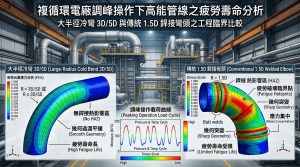
二、 高能管線之熱-機械疲勞與潛變耦合衰退機制 / 2. Thermo-Mechanical Fatigue and Creep-Fatigue Coupling Degradation Mechanisms in High-Energy Piping
複循環機組每日的起停或大幅度負載變化,會在厚壁管線的內外壁之間產生極大的瞬態溫度梯度,進而誘發顯著的熱應力。當此應力疊加內壓產生的機械應力並超過材料的局部屈服強度時,管件便會進入塑性應變區間,引發低週疲勞(Low-Cycle Fatigue, LCF)1。 The daily start-stops or significant load variations of combined cycle units generate massive transient temperature gradients between the inner and outer walls of thick-walled piping, thereby inducing significant thermal stresses. When these stresses, superimposed with mechanical stresses from internal pressure, exceed the material’s local yield strength, the component enters the plastic strain regime, triggering Low-Cycle Fatigue (LCF)1.
2.1 低週熱疲勞與 Coffin-Manson 應變壽命模型之理論構建 / 2.1 Theoretical Construction of Low-Cycle Thermal Fatigue and the Coffin-Manson Strain-Life Model
對於低週疲勞的壽命預測,工程與材料科學界廣泛採用 Coffin-Manson 應變-壽命方程式來描述塑性應變幅與斷裂循環次數之間的非線性冪律關係16。該模型的核心假設在於,材料的巨觀失效是由微觀塑性變形的不斷累積所驅動,其數學表達式為: For predicting the life of low-cycle fatigue, the engineering and materials science communities widely adopt the Coffin-Manson strain-life equation to describe the non-linear power-law relationship between the plastic strain amplitude and the number of cycles to fracture16. The core assumption of this model is that macroscopic material failure is driven by the continuous accumulation of microscopic plastic deformation. Its mathematical expression is:
Δϵp/2=ϵf‘(2Nf)c
式中,Δϵp/2 為塑性應變幅,2Nf 為失效反轉次數(一個完整循環包含張力與壓力兩次反轉),ϵf‘ 為疲勞延性係數(Fatigue Ductility Coefficient),c 則為疲勞延性指數(Fatigue Ductility Exponent)。文獻指出,對於絕大多數金屬材料,指數 c 恆為負值,通常介於 -0.4 至 -0.8 之間16。此指數特徵揭示了疲勞壽命對塑性應變幅的極度敏感性:當局部塑性應變幅因管線幾何突變或應力集中而倍增時,其疲勞壽命並非呈線性減半,而是以三次方的速率崩跌(例如當 c = -6時,應變加倍將導致壽命縮減至約三分之一)16。 Where Δϵp/2 is the plastic strain amplitude, 2Nf is the number of reversals to failure (one complete cycle contains two reversals: tension and compression), ϵf‘ is the Fatigue Ductility Coefficient, and c is the Fatigue Ductility Exponent. Literature indicates that for the vast majority of metallic materials, the exponent c is always negative, typically ranging from -0.4 to -0.816. This exponent characteristic reveals the extreme sensitivity of fatigue life to plastic strain amplitude: when the local plastic strain amplitude doubles due to abrupt piping geometry changes or stress concentration, the fatigue life is not halved linearly, but plummets at a cubic rate (for instance, when c = -6, doubling the strain reduces the life to approximately one-third)16.
將 Coffin-Manson 模型與描述彈性應變的 Basquin 定律相結合,即可構建涵蓋低週與高週疲勞的統一應變-壽命方程式2。然而,在 600°C 等高溫環境下進行的 P91 與 P92 鋼低週疲勞與熱-機械疲勞(TMF)測試顯示,材料呈現顯著且持續的「循環軟化」(Cyclic Softening)特徵1。這種軟化現象主要源於材料內部馬氏體板條(Martensitic lath)結構在交變應力下的破裂與多邊形化(Polygonization),以及高密度差排(Dislocations)的相互湮滅4。微觀力學模型表明,循環軟化會導致材料的屈服強度隨循環次數不斷下降;在應力控制條件下,這意味著每個熱循環中所累積的塑性應變將逐漸放大,進一步加速材料沿 Coffin-Manson 曲線向失效終點推進20。基於 Chaboche 黏塑性本構模型(Viscoplasticity model)的有限元素模擬亦證實,P91 鋼在同相(In-Phase, IP)與反相(Out-of-Phase, OP)加載下均呈現此一軟化軌跡,且 IP 加載對管件的破壞性最為劇烈1。 Combining the Coffin-Manson model with Basquin’s law for elastic strain allows the construction of a unified strain-life equation covering both low-cycle and high-cycle fatigue2. However, low-cycle fatigue and Thermo-Mechanical Fatigue (TMF) tests on P91 and P92 steels conducted in high-temperature environments such as 600°C show that the materials exhibit significant and continuous “Cyclic Softening” characteristics1. This softening phenomenon primarily originates from the fracture and polygonization of the internal Martensitic lath structure under alternating stress, as well as the mutual annihilation of high-density dislocations4. Micro-mechanical models suggest that cyclic softening causes the material’s yield strength to continuously decrease with cycle numbers. Under stress-controlled conditions, this means that the plastic strain accumulated in each thermal cycle will gradually amplify, further accelerating the material’s progression toward the failure endpoint along the Coffin-Manson curve20. Finite element simulations based on the Chaboche viscoplasticity model also confirm that P91 steel exhibits this softening trajectory under both In-Phase (IP) and Out-of-Phase (OP) loading, with IP loading being the most destructive to piping components1.
2.2 潛變-疲勞交互作用 (Creep-Fatigue Interaction, CFI) 之非線性疊加 / 2.2 Non-linear Superposition of Creep-Fatigue Interaction (CFI)
在複循環電廠的實際運行中,管線不僅承受起停時的應變循環,在滿載運轉的保載期(Dwell time)間,高溫與內壓更會促使材料發生時間依賴性的潛變(Creep)變形3。這種潛變與疲勞的耦合損傷,在物理機制上遠大於兩者的簡單線性疊加。 In the actual operation of combined cycle power plants, piping not only endures strain cycles during start-ups and shutdowns but also undergoes time-dependent Creep deformation driven by high temperature and internal pressure during the dwell time of full-load operations3. This coupled damage of creep and fatigue is physically far greater than the simple linear superposition of the two.
在應變控制的高溫潛變-疲勞試驗中,引入保載時間會大幅度削減 P91/P92 材料的循環壽命7。實驗數據表明,當引入拉伸保載時,疲勞壽命的折減係數可達純疲勞壽命的 0.3 倍;若考量存在組織不均勻性的銲接接頭,此壽命折減係數甚至會陡降至 0.2 3。傳統上工程設計規範多採用基於 Miner-Robinson 法則的線性損傷累積公式: In strain-controlled high-temperature creep-fatigue tests, introducing a dwell time drastically reduces the cyclic life of P91/P92 materials7. Experimental data show that when a tensile dwell is introduced, the fatigue life reduction factor can reach 0.3 times the pure fatigue life; if considering welded joints with microstructural heterogeneity, this life reduction factor can even plummet to 0.2 3. Traditionally, engineering design codes predominantly use the linear damage accumulation formula based on the Miner-Robinson rule:
∑Ni/Nfi +∑ti/tri =D
然而,大量先進的斷裂力學研究證實,在此複雜的交互作用下,傳統線性法則常顯得過度簡化且不夠保守3。在微觀層面,潛變導致的微孔洞(Creep cavitation)會在疲勞裂紋的尖端應力場中加速成核與結合;反之,疲勞載荷所產生的局部滑移帶(Slip bands)與差排堆積,亦為潛變空洞提供了極佳的優先成核位置與擴展通道21。研究發現,當應力狀態趨於複雜(如疊加扭轉與彎曲力矩)時,P91 鋼的斷裂機制會由單純的穿晶疲勞(Transgranular fatigue)主導,逐漸過渡為潛變-疲勞交互作用主導,並呈現顯著的沿晶斷裂(Intergranular fracture)特徵22。針對此現象,諸如延性耗竭模型(Ductility Exhaustion Method)與基於能量耗散的統一損傷模型逐漸被引入,以更精確地捕捉應力多軸性(Stress multiaxiality)下的損傷演化3。 However, extensive advanced fracture mechanics research confirms that under this complex interaction, the traditional linear rule often appears overly simplified and non-conservative3. At the microscopic level, creep cavitation accelerates nucleation and coalescence within the stress field at the tip of fatigue cracks; conversely, local slip bands and dislocation pile-ups generated by fatigue loads provide excellent preferential nucleation sites and propagation channels for creep voids21. Studies have found that when the stress state becomes complex (e.g., superimposed torsional and bending moments), the fracture mechanism of P91 steel transitions from being dominated by simple transgranular fatigue to being dominated by creep-fatigue interaction, exhibiting significant intergranular fracture characteristics22. Addressing this phenomenon, models such as the Ductility Exhaustion Method and unified damage models based on energy dissipation have been gradually introduced to more accurately capture damage evolution under stress multiaxiality3.
| 評估模型類別 / Evaluation Model Category | 代表性理論/方程式 / Representative Theory/Equation | 適用物理範疇與損傷機制捕捉 / Applicable Physical Scope & Damage Mechanism Capture |
| 純疲勞應變-壽命 / Pure Fatigue Strain-Life | Coffin-Manson 冪律關係 / Coffin-Manson power law5 | 低週疲勞 (LCF)、大塑性變形驅動、循環軟化影響 / LCF, large plastic deformation driven, cyclic softening effects |
| 線性損傷疊加 / Linear Damage Superposition | Miner-Robinson 法則 / Miner-Robinson rule7 | 潛變與疲勞損傷之基礎線性加總 (對 P91 常偏於不保守) / Basic linear summation of creep & fatigue damage (often non-conservative for P91) |
| 潛變裂紋擴展 / Creep Crack Growth | NSW (Nikbin-Smith-Webster) 模型 / NSW model27 | 基於 C* 積分,預測穩態潛變下裂紋的生長時間 / Based on C* integral, predicts crack growth time under steady-state creep |
| 交互作用非線性預測 / Non-linear Interaction Prediction | 延性耗竭法則 / Ductility Exhaustion rule22 | 引入應力多軸性修正,精準預測 HAZ 在保載下的提早破裂 / Introduces stress multiaxiality correction, accurately predicts early failure of HAZ under dwell loading |
三、 傳統銲接彎頭之失效本質:第四型破裂之冶金學與斷裂力學溯源 / 3. Failure Essence of Traditional Welded Elbows: Metallurgical and Fracture Mechanics Origins of Type IV Cracking
在釐清潛變與熱疲勞的破壞潛力後,必須將焦點轉向系統中最脆弱的環節——傳統 1.5D 銲接彎頭。這些彎頭透過多道次的環向對接銲縫(Girth welds)與直管相連,銲接過程中的劇烈且不均勻熱循環,會在 P91/P92 的母材(Base Metal, BM)與銲道(Weld Metal, WM)之間產生微觀異質性極高的熱影響區(HAZ),成為管線壽命的致命弱點2。 After clarifying the destructive potential of creep and thermal fatigue, the focus must shift to the most vulnerable link in the system—traditional 1.5D welded elbows. These elbows are connected to straight pipes through multi-pass girth welds. The intense and uneven thermal cycles during the welding process create a highly microstructurally heterogeneous Heat-Affected Zone (HAZ) between the Base Metal (BM) of P91/P92 and the Weld Metal (WM), which becomes the fatal weak point in the piping lifespan2.
3.1 銲接熱循環與熱影響區 (HAZ) 的多重組織劣化 / 3.1 Multiple Microstructural Degradations in the Heat-Affected Zone (HAZ) Induced by Welding Thermal Cycles
在 9-12% 鉻系合金的 HAZ 中,依據距離熔合線(Fusion line)的遠近及所經歷之峰值溫度差異,可細分為粗晶熱影響區(CGHAZ)、細晶熱影響區(FGHAZ)以及臨界熱影響區(ICHAZ)2。其中,FGHAZ 與 ICHAZ 是材料強度的致命弱點。在銲接過程中,此區域的峰值溫度恰好落於材料的下臨界溫度(AC1)與上臨界溫度(AC3)相變線之間。這種不完全的熱處理歷史,導致原有的回火馬氏體僅發生部分奧氏體化,不僅破壞了原始設計的最佳化晶粒尺寸,更未能將母材中負責固溶強化的微細碳氮化物(如 MX 相與 M23C6 碳化物)完全溶解2,為後續高溫服役埋下了結構隱患。 Within the HAZ of 9-12% Cr alloys, based on the distance from the fusion line and the peak temperatures experienced, the area can be subdivided into the Coarse-Grained HAZ (CGHAZ), Fine-Grained HAZ (FGHAZ), and Intercritical HAZ (ICHAZ)2. Among them, FGHAZ and ICHAZ are the fatal weak points in material strength. During welding, the peak temperature in these regions falls exactly between the material’s lower critical temperature (AC1) and upper critical temperature (AC3) transformation lines. This incomplete thermal history causes the original tempered martensite to undergo only partial austenitization. This not only destroys the originally designed optimized grain size but also fails to completely dissolve the fine carbonitrides (such as MX phases and M23C6 carbides) responsible for solid solution strengthening in the base metal2, thereby burying structural hidden dangers for subsequent high-temperature service.
3.2 第四型破裂 (Type IV Cracking) 的演進機制與力學驅動 / 3.2 Evolution Mechanisms and Mechanical Drivers of Type IV Cracking
HAZ 內部細晶區與臨界區微觀組織的先天衰退,直接導致了電力工業界高度關注的「第四型破裂」。這是一種典型且致命的高溫潛變失效機制,特指發生在 HAZ 細晶區或臨界區的早期脆性斷裂9。其演進機制可透過以下三個層次進行深度剖析: The inherent microstructural degradation of the fine-grained and intercritical regions within the HAZ directly leads to “Type IV Cracking,” a phenomenon highly scrutinized by the power industry. This is a typical and fatal high-temperature creep failure mechanism, specifically referring to the early brittle fracture occurring in the FGHAZ or ICHAZ9. Its evolution mechanism can be deeply analyzed through the following three levels:
首先,在巨觀力學層面存在著嚴重的「強度失配與應變局部化」。銲道金屬與未受影響的母材其潛變強度通常顯著高於狹窄的 HAZ,在銲接接頭處形成複雜的三軸應力狀態(Triaxial stress state)28。在機組滿載運轉的保載期間,由於「彈性隨動」(Elastic follow-up)效應的驅動,周圍強硬組織的應變會被迫轉移並高度集中於軟弱的 FGHAZ。這意味著儘管管線整體的公稱應力未超標,HAZ 內部卻承受著極度放大的局部變形。 First, at the macroscopic mechanical level, there is severe “strength mismatch and strain localization.” The creep strength of the weld metal and the unaffected base metal is usually significantly higher than that of the narrow HAZ, forming a complex triaxial stress state at the welded joint28. During the dwell period of full-load unit operation, driven by the “elastic follow-up” effect, strains from surrounding harder microstructures are forced to transfer and concentrate highly within the weaker FGHAZ. This means that although the nominal stress of the overall piping does not exceed limits, the interior of the HAZ bears extremely amplified local deformation.
其次,在微觀冶金層面,高溫服役促使「析出相粗化與亞晶界遷移」。HAZ 內原有的 M23C6 碳化物在熱應力驅動下會迅速粗化,喪失對亞晶界(Subgrain boundaries)與差排移動的釘扎效應(Pinning effect),導致馬氏體板條發生多邊形化,甚至轉變為毫無高溫強度的塊狀鐵素體(Blocky ferrite)26。此外,富含鉬(Mo)與鎢(W)的 Laves 相((Fe,Cr)2(Mo,W))在原奧氏體晶界上的過度析出與粗化,不僅大量消耗基體中的固溶強化元素,其粗大且硬脆的幾何特徵更成為微裂紋優先發源的應力集中點26。 Second, at the microscopic metallurgical level, high-temperature service promotes “precipitate coarsening and subgrain boundary migration.” Original M23C6 carbides within the HAZ rapidly coarsen driven by thermal stresses, losing their pinning effect on subgrain boundaries and dislocation movement. This causes martensitic laths to undergo polygonization and even transform into blocky ferrite completely lacking high-temperature strength26. Furthermore, the excessive precipitation and coarsening of Mo- and W-rich Laves phases ((Fe,Cr)2(Mo,W)) along prior austenitic grain boundaries not only massively deplete solid solution strengthening elements in the matrix, but their coarse and brittle geometric characteristics also act as stress concentration points for preferential microcrack initiation26.
最後,微觀缺陷的累積終將導致「微孔洞成核與巨觀破裂」。在應變局部化與晶界弱化的雙重打擊下,潛變空洞(Creep voids)會在 FGHAZ 快速成核,並沿著晶界彼此串聯。依據 NSW(Nikbin-Smith-Webster)模型的預測,在高三軸應力下,局部材料的破壞應變(Failure strain)將大幅降低。由於 FGHAZ 區域極為狹窄,巨觀上這種損傷往往在缺乏顯著塑性變形預警的情況下,突然發生災難性的斷裂9。電廠實績指出,P91 銲接接頭在 600°C 條件下的潛變-疲勞壽命,可能僅為未銲接母材的五分之一乃至十分之一26。 Finally, the accumulation of microscopic defects ultimately leads to “micro-void nucleation and macroscopic fracture.” Under the dual blows of strain localization and grain boundary weakening, creep voids rapidly nucleate in the FGHAZ and link together along grain boundaries. According to predictions by the NSW (Nikbin-Smith-Webster) model, the failure strain of the local material will significantly decrease under high triaxial stresses. Because the FGHAZ region is extremely narrow, this damage often occurs macroscopically as a sudden and catastrophic fracture without significant plastic deformation warning9. Power plant empirical records indicate that the creep-fatigue life of P91 welded joints at 600°C may only be one-fifth to one-tenth of that of unwelded base metal26.
四、 ASME B31J 規範與 3D/5D 冷作彎管之力學解析與破局 / 4. ASME B31J Code and Mechanical Analysis and Breakthrough of 3D/5D Cold Bends
要從根本上解決傳統銲接彎頭帶來的第四型破裂與熱疲勞壽命短缺,必須從工程幾何設計上徹底消除應力集中,並免除脆弱的熱影響區。近年來,基於 ASME B31J 規範的大半徑冷作彎管(3D/5D)技術,為此難題提供了極具突破性的力學與幾何解答12。 To fundamentally solve Type IV cracking and thermal fatigue life shortages caused by traditional welded elbows, stress concentration must be completely eliminated from the engineering geometric design, and the fragile heat-affected zone must be avoided. In recent years, large-radius (3D/5D) cold bending technology based on the ASME B31J code has provided a highly breakthrough mechanical and geometric answer to this dilemma12.
4.1 傳統 Markl 理論之盲點與 ASME B31J 應力強度因子 (SIF) 之解耦 / 4.1 Blind Spots of Traditional Markl Theory and Decoupling of Stress Intensification Factors (SIF) in ASME B31J
長達半個世紀以來,全球管線應力分析多依賴 ASME B31.1 或 B31.3 附錄 D,採用 1950 年代基於 Markl 疲勞方程式的經驗公式進行管系柔性分析。舊版規範在處理彎頭時,強制賦予單一的應力強度因子(SIF),完全忽略了面內(In-Plane)與面外(Out-of-Plane)彎矩在物理變形上的本質差異,亦將扭轉力矩的 SIF 預設為 1.0 13。對於現代發電廠承受極端溫差、大口徑且薄壁化的高能管件而言,這種經驗公式極度不精確,時常嚴重低估管線因截面橢圓化(Ovalization)而產生的局部高應力,掩蓋了真實的斷裂風險。 For half a century, global piping stress analysis has heavily relied on ASME B31.1 or B31.3 Appendix D, utilizing empirical formulas based on the 1950s Markl fatigue equations for piping flexibility analysis. When handling elbows, the legacy codes forced the assignment of a single Stress Intensification Factor (SIF), completely ignoring the essential differences in physical deformation caused by In-Plane and Out-of-Plane bending moments, and also presetting the SIF for torsional moments to 1.0 13. For modern power plant high-energy piping characterized by extreme temperature differentials, large diameters, and thin walls, such empirical formulas are highly inaccurate. They frequently severely underestimate local high stresses induced by cross-sectional ovalization, masking the true fracture risk.
ASME B31J-2023 標準的頒布標誌著管線應力分析的典範轉移。該規範透過大規模有限元素分析(FEA)與實體驗證,提出了高精度的 SIF 解耦算法,並為管線工程引入了「柔性特徵值」(Flexibility Characteristic, h)的核心概念12: The issuance of the ASME B31J-2023 standard marks a paradigm shift in piping stress analysis. Through large-scale Finite Element Analysis (FEA) and physical experimental validation, the code proposes a high-precision SIF decoupling algorithm and introduces the core concept of the “Flexibility Characteristic” (h) into piping engineering12:
h=T⋅R1/r22
式中,T 為管件的標稱壁厚,R1 為幾何彎曲半徑,r2 為平均截面半徑(定義為 (OD-T)/2)。Where T is the nominal wall thickness of the pipe, R1 is the geometric bend radius, and r2 is the mean cross-sectional radius (defined as (OD-T)/2).
基於此特徵值,B31J 規範將面內與面外的應力強度因子進行了嚴密的數學解耦:Based on this characteristic value, the B31J code performs rigorous mathematical decoupling of in-plane and out-of-plane stress intensification factors:
- 面內應力強度因子/ In-plane SIF (ii):
ii =0.9/h2/3
- 面外應力強度因子/ Out-of-plane SIF (io):
io =0.75/h2/3
- 柔性因子/ Flexibility Factor (k):
k = 1.65/h [cite: 31]
4.2 1.5D 銲接彎頭與 3D/5D 冷彎管之工程臨界比較 (ECA) / 4.2 Engineering Critical Assessment (ECA) between 1.5D Welded Elbows and 3D/5D Cold Bends
由 B31J 的演算法可知,彎曲半徑 R1 直接決定了柔性特徵值 h 的大小,而 h 值與代表應力集中的 SIF (ii , io) 呈現顯著的反比關係。若結合 API 579-1 適用性評價(Fitness-For-Service, FFS)中關於裂紋擴展與斷裂韌性的失效分析圖(Failure Analysis Diagram, FAD),可對兩種工法進行嚴格的工程臨界評估(ECA)32。 From the B31J algorithms, it is evident that the bend radius R1 directly determines the magnitude of the flexibility characteristic h, and the h value exhibits a significant inverse relationship with the SIFs (ii , io) representing stress concentration. By incorporating the Failure Analysis Diagram (FAD) concerning crack propagation and fracture toughness from the API 579-1 Fitness-For-Service (FFS) standard, a rigorous Engineering Critical Assessment (ECA) can be performed for both methods32.
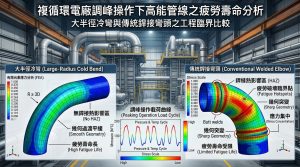
傳統 1.5D 彎頭的 R1 僅為管徑 1.5 倍,算出的 h 值極低。低 h 值意味著當管線在起停調峰承受巨大熱膨脹彎矩時,彎頭截面極易發生嚴重的橢圓化畸變。這種形狀改變不僅產生極高的局部塑性應變幅(Δϵp),更會使缺陷處的應力強度因子(KI)迅速逼近材料的斷裂韌性((KIC),大幅縮小臨界裂紋尺寸(Critical flaw size)。 For traditional 1.5D elbows, R1 is only 1.5 times the pipe diameter, resulting in an extremely low calculated h value. A low h value implies that when the piping sustains massive thermal expansion bending moments during start-stop peaking operations, the elbow cross-section is highly prone to severe ovalization distortion. This shape alteration not only generates an extremely high local plastic strain amplitude (Δϵp) but also causes the stress intensity factor (KI) at defects to rapidly approach the material’s fracture toughness (KIC), drastically reducing the critical flaw size.
反觀 3D 或 5D 的冷作彎管,幾何彎曲半徑倍增使得 h 值顯著提升。數值分析顯示,5D 冷彎管在幾何力學上的表現幾乎等同於理想直管,應力集中效應極低。較高的 h 值賦予管件極強的截面穩定性,能有效抵抗彎矩引發的截面畸變與橢圓化。將此力學優勢代回 Coffin-Manson 疲勞模型中:由於 3D/5D 冷彎管的 SIF 被大幅抑制,管壁承受的實際塑性應變幅 Δϵp急遽縮小。在疲勞延性指數 c 所賦予的非線性放大效應下,塑性應變幅的些微下降,即可換來熱疲勞壽命幾何級數的巨大增長12。 In contrast, for 3D or 5D cold bends, the multiplied geometric bend radius significantly elevates the h value. Numerical analysis indicates that the geometric mechanical performance of a 5D cold bend is nearly equivalent to an ideal straight pipe, exhibiting extremely low stress concentration effects. The higher h value endows the fitting with tremendous cross-sectional stability, effectively resisting cross-sectional distortion and ovalization induced by bending moments. Substituting this mechanical advantage back into the Coffin-Manson fatigue model: because the SIF of 3D/5D cold bends is substantially suppressed, the actual plastic strain amplitude Δϵp endured by the pipe wall shrinks abruptly. Under the non-linear amplification effect granted by the fatigue ductility exponent c, a slight decrease in plastic strain amplitude translates to an exponential and massive increase in thermal fatigue life12.
| 工程與力學評估指標 / Engineering & Mechanical Assessment Indicators | 傳統 1.5D 銲接彎頭 / Traditional 1.5D Welded Elbows | 3D / 5D 大半徑冷作彎管 / 3D/5D Large-Radius Cold Bends | 臨界分析與延壽效益解析 / Critical Analysis & Life Extension Benefit Breakdown |
| 幾何彎曲半徑 (R1) / Geometric Bend Radius (R1) | 極小 (僅 1.5 倍外徑) / Extremely small (only 1.5x OD) | 大幅增加 (3 倍至 5 倍外徑) / Substantially increased (3x to 5x OD) | R1 的幾何擴張直接提升系統對熱膨脹位移的容錯率。 / The geometric expansion of R1 directly enhances the system’s fault tolerance to thermal expansion displacement. |
| 柔性特徵值 (h) / Flexibility Characteristic (h) | 數值低 (極易發生橢圓化變形) / Low value (highly susceptible to ovalization) | 數值顯著增加 (具備極強截面穩定性) / Significantly increased value (possesses tremendous cross-sectional stability) | 高 h 值能有效抵抗高溫瞬態熱應力引發之幾何畸變。 / High h values effectively resist geometric distortion induced by high-temperature transient thermal stresses. |
| 應力強度因子 (SIF) / Stress Intensification Factor (SIF) | 數值高,導致應力與應變高度局部化 / High values, leading to highly localized stress and strain | 趨近於直管理論值,展現極低應力集中效應 / Approaches theoretical straight pipe values, exhibiting extremely low stress concentration | 大幅壓低Δϵp,透過 Coffin-Manson 定律指數級延長壽命。 / Drastically depresses Δϵp , exponentially extending lifespan via the Coffin-Manson law. |
| 微觀組織與熱影響區 / Microstructure & HAZ | 銲接必然產生 FGHAZ/ICHAZ 軟弱層 / Welding inevitably generates FGHAZ/ICHAZ weak layers | 一體成型,徹底消除銲道與 HAZ / Integral forming, completely eliminates welds and HAZ | 拔除應力失配區域,完美消弭第四型破裂 (Type IV Cracking) 風險9。 / Eradicates stress mismatch regions, perfectly eliminating Type IV Cracking risks9. |
五、 冷彎成型應變與彎後熱處理 (PBHT) 之最佳化策略 / 5. Optimization Strategies for Cold Bending Strain and Post-Bend Heat Treatment (PBHT)
儘管 3D/5D 冷彎在巨觀力學設計上具備壓倒性的優勢,並徹底消除了第四型破裂的 HAZ 溫床,但冷彎工法本質上伴隨著劇烈的塑性變形。依據計算,3D 彎管外弧區承受的最大拉伸應變可達約 16.7%,5D 彎管亦約有 10%12。對於高度依賴精確回火馬氏體基體與奈米級析出相來維持蠕變強度的 P91/P92 合金而言,未經修復的劇烈冷作變形會引入巨量晶格畸變與差排堆積,嚴重損害其高溫潛變延展性12。 Although 3D/5D cold bending possesses overwhelming advantages in macroscopic mechanical design and completely eliminates the HAZ hotbed for Type IV cracking, the cold bending process inherently involves intense plastic deformation. According to calculations, the maximum tensile strain endured by the extrados of a 3D bend can reach approximately 16.7%, and roughly 10% for a 5D bend12. For P91/P92 alloys, which heavily rely on an exact tempered martensitic matrix and nanoscale precipitates to maintain creep strength, un-repaired severe cold deformation introduces massive lattice distortions and dislocation pile-ups, severely impairing their high-temperature creep ductility12.
因此,實施大半徑冷彎後,必須搭配嚴密的彎後熱處理(Post-Bend Heat Treatment, PBHT)以重塑微觀組織。對此,ASME B31.1(動力管線)針對 P91 材料(P-No. 15E)採取了最嚴格的強制性指令:只要管徑大於等於 NPS 4 或壁厚大於等於 12.5mm,彎後熱處理即為絕對要求12。實務上主要採取兩種修復途徑: Therefore, after implementing large-radius cold bending, it must be paired with rigorous Post-Bend Heat Treatment (PBHT) to reconstruct the microstructure. In this regard, ASME B31.1 (Power Piping) mandates the strictest compulsory directives for P91 materials (P-No. 15E): as long as the pipe diameter is greater than or equal to NPS 4 or the wall thickness is greater than or equal to 12.5mm, PBHT is an absolute requirement12. In practice, two main restorative routes are primarily adopted:
5.1 完全正火與回火 (Normalization and Tempering, N&T) / 5.1 Normalization and Tempering (N&T)
對於經歷高應變(如 3D 彎管的 16.7% 塑性變形)的厚壁管件,業界公認最徹底的修復路徑是執行全週期的正火加回火(N&T)12。 For thick-walled fittings that have undergone high strains (such as 16.7% plastic deformation in 3D bends), the industry-recognized most thorough restorative path is to execute a full-cycle Normalization and Tempering (N&T)12.
- 正火階段 (Normalization)/ Normalization Phase:將管件加熱至遠高於上臨界溫度AC3 的區間(約 1040°C 至 1080°C),確保材料完全奧氏體化。此過程能透過原子擴散徹底抹除晶格畸變,並使碳氮化物重新固溶12。隨後空冷形成新鮮的未回火馬氏體。The fitting is heated to a range well above the upper critical temperature AC3 (approximately 1040°C to 1080°C) to ensure complete austenitization of the material. This process completely erases lattice distortions through atomic diffusion and allows carbonitrides to re-dissolve into solid solution12. Subsequent air cooling forms fresh untempered martensite.
- 回火階段 (Tempering)/ Tempering Phase:緊接著於 730°C 至 780°C 進行高溫回火,釋放相變內應力,促使 MX 相與 M23C6 碳化物均勻析出,完美恢復 P91 的高溫潛變強度與延展韌性。Immediately followed by high-temperature tempering between 730°C and 780°C to release internal stresses from the phase transformation, promoting the uniform precipitation of MX phases and M23C6 carbides, perfectly restoring the high-temperature creep strength and ductile toughness of P91.
5.2 次臨界熱處理與感應加熱工法 (IH-PBHT) 之潛在風險控管 / 5.2 Potential Risk Control of Subcritical Heat Treatment and Induction Heating Post-Bend Heat Treatment (IH-PBHT)
對於應變相對較低(如 5D 彎管)或尺寸極大難以進爐的管件,常採用感應加熱工法(IH-PBHT)進行次臨界熱處理12。其目標溫度設定在低於下臨界溫度 AC1 的區間(實務上約 760°C)15。 For fittings with relatively lower strain (such as 5D bends) or excessively large dimensions difficult to place into furnaces, the induction heating method (IH-PBHT) is often used for subcritical heat treatment12. Its target temperature is set in the range below the lower critical temperature AC1 (practically around 760°C)15.
然而,針對 P91 執行次臨界熱處理具有極高的冶金風險。由於 AC1 溫度會隨微量元素(如 Ni、Mn)波動15,若加熱不慎穿越 AC1 臨界點,將形成強度極低的「雙相」結構,導致抗潛變能力崩潰15。此外,若保溫時間或升降溫速率設定失當,殘存應力場可能加速高溫服役中 Laves 相的異常粗化,導致固溶強化失效,使潛變壽命縮減近兩個數量級26。為確保次臨界 PBHT 的有效性,現代工程已導入磁聲發射(MAE)等先進非破壞檢測技術,以監測熱處理成效並評估微觀組織的演變36。 However, executing subcritical heat treatment on P91 carries extremely high metallurgical risks. Because the AC1 temperature fluctuates with trace elements (e.g., Ni, Mn)15, inadvertently crossing the AC1 critical point during heating will form an extremely low-strength “dual-phase” structure, causing creep resistance to collapse15. Moreover, if hold times or heating/cooling rates are improperly set, residual stress fields may accelerate the anomalous coarsening of Laves phases during high-temperature service, causing solid solution strengthening to fail and shrinking creep life by nearly two orders of magnitude26. To ensure the effectiveness of subcritical PBHT, modern engineering has introduced advanced Non-Destructive Evaluation (NDE) technologies such as Magneto-Acoustic Emission (MAE) to monitor heat treatment efficacy and assess microstructural evolution36.
六、 高能管線之實務挑戰與各方利害關係人深度分析 / 6. Practical Challenges of High-Energy Piping and In-Depth Analysis of Stakeholders
為將前沿力學理論與冶金論證落實於產業實務,必須深刻檢視台灣特殊的電網環境與工程現況。以下分別從業主營運、EPC 設計、廠務管理、製造端工法以及原廠設計理念等五個核心視角,深度剖析大半徑冷作彎管帶來的生命週期破局策略。To translate cutting-edge mechanical theories and metallurgical arguments into industrial practice, one must deeply examine Taiwan’s unique grid environment and engineering status quo. The following provides an in-depth analysis of the lifecycle breakthrough strategies brought about by large-radius cold bends from five core perspectives: owner’s operation, EPC design, plant management, manufacturing methods, and OEM design concepts.
6.1 業主營運視角:全生命週期成本 (TCO) 與營運韌性決策 / 6.1 Owner’s Operational Perspective: Total Cost of Ownership (TCO) and Operational Resilience Decision-Making
近年來台灣大規模建置太陽光電,導致電網出現極端的「鴨子曲線」效應。為維持電網穩定,天然氣機組必須承擔極高頻率的兩班制調峰操作37。例如 2021 年興達發電廠突發跳脫事件,即對高溫管線施加了極端的瞬態熱衝擊。 In recent years, large-scale solar photovoltaic installations in Taiwan have led to an extreme “Duck Curve” effect on the grid. To maintain grid stability, natural gas units must undertake exceptionally high-frequency two-shift peaking operations37. For instance, the sudden trip event at Hsinta Power Plant in 2021 imposed extreme transient thermal shocks on high-temperature piping.
從業主營運(O&M)角度出發,傳統 1.5D 銲接彎頭初期建置成本(CAPEX)雖低,但第四型破裂潛伏期長、末期發展極快29,成為營運階段(OPEX)的巨大隱患。為預防無預警爆管,業主必須在每次歲修耗費鉅資搭設鷹架,對所有 P91 銲道進行相控陣超音波(PAUT)等高頻度非破壞檢測38。若全面導入 3D/5D 大半徑冷作彎管,透過物理形變消滅最致命的銲縫與 HAZ,即可直接免除高頻度 NDE 的「檢查熱區」,不僅節省檢修預算,更賦予機組面對極端調峰時的高容錯韌性,在全生命週期成本(TCO)上具備壓倒性優勢。 From an Owner’s Operations & Maintenance (O&M) perspective, while the initial Capital Expenditure (CAPEX) for traditional 1.5D welded elbows is low, Type IV cracking has a long latency period but develops extremely rapidly in its final stages29, becoming a massive hidden danger during the Operational Expenditure (OPEX) phase. To prevent unpredicted ruptures, owners must spend heavily to erect scaffolding during every annual outage to perform high-frequency NDE such as Phased Array Ultrasonic Testing (PAUT) on all P91 welds38. By comprehensively introducing 3D/5D large-radius cold bends, the physical deformation eliminates the most fatal welds and HAZ, directly removing the “inspection hot zones” for high-frequency NDE. This not only saves maintenance budgets but also grants units high fault-tolerant resilience when facing extreme peaking, holding an overwhelming advantage in Total Cost of Ownership (TCO).
6.2 EPC 承包商設計視角:空間佈局與應力工程實務考量 / 6.2 EPC Contractor’s Design Perspective: Spatial Layout and Stress Engineering Practical Considerations
對 EPC 總承包單位的管線設計工程師而言,大半徑冷彎管在帶來壽命增長的同時,也帶來了管線佈局(Piping layout)與流體力學設計上的挑戰。For piping design engineers at Engineering, Procurement, and Construction (EPC) firms, large-radius cold bends bring lifespan extensions but also introduce challenges in piping layout and fluid dynamics design.
在空間佈局上,3D/5D 彎管的跨距顯著增加,要求 EPC 必須在 3D 建模初期為其預留足夠的幾何餘裕。在流體動力學上,高壓流體進入 1.5D 彎頭時會誘發劇烈的二次流(Secondary flows)與迪恩渦流(Dean Vortices)33;而 3D/5D 彎管則能提供平順過渡,將管壁沖蝕機率降至最低。在力學設計方面,EPC 必須考量冷彎製程的「壁厚減薄(Wall Thinning)」效應。依據 ASME B16.49 規範,R=5D 冷彎可能引發高達 12% 的局部減薄,因此設計端必須精算並在訂購母管時預留足夠的名義壁厚餘裕33。 Spatially, the significantly increased span of 3D/5D bends requires EPCs to reserve sufficient geometric margins during early 3D modeling. In fluid dynamics, high-pressure fluids entering 1.5D elbows induce intense secondary flows and Dean Vortices33; conversely, 3D/5D bends provide smooth transitions, minimizing the probability of pipe wall erosion. In mechanical design, EPCs must consider the “Wall Thinning” effect of the cold bending process. According to the ASME B16.49 standard, R=5D cold bending can induce up to 12% localized thinning. Thus, the design side must precisely calculate and reserve adequate nominal wall thickness margins when ordering the mother pipes33.
6.3 廠務管理者視角:安全性要求與現場大修困境 / 6.3 Plant Manager’s Perspective: Safety Requirements and On-Site Overhaul Dilemmas
站在廠務管理者的第一線立場,系統的「穩定運轉與人員安全」為最高指導原則。P91 銲接管線最大的威脅在於,第四型破裂通常不具備「破裂前洩漏(Leak-before-break)」的預警特徵。 Standing on the frontlines, plant managers regard the system’s “stable operation and personnel safety” as the highest guiding principle. The greatest threat of P91 welded piping lies in the fact that Type IV cracking usually lacks the warning characteristic of “Leak-before-break”.
大修期間若發現 HAZ 存在早期微孔洞,局部的挖補銲接(Weld repair)往往無法根治問題,反而容易引入新殘餘應力。由於現場緊湊空間內的 PWHT 溫控品質難以與工廠爐內熱處理匹敵,再次失效機率極高。因此,廠務管理者強烈傾向於導入冷作彎管,從根本上杜絕 HAZ,確保現場巡檢人員的安全,並釋放冗長的大修排程時間。 If early micro-voids are discovered in the HAZ during overhauls, localized weld repairs often fail to cure the root problem and easily introduce new residual stresses. Because the temperature control quality of PWHT within tight on-site spaces struggles to match factory furnace heat treatments, the probability of re-failure is exceedingly high. Consequently, plant managers strongly prefer introducing cold bends to fundamentally eradicate the HAZ, ensure the safety of on-site inspection personnel, and free up lengthy overhaul scheduling time.
6.4 冷作彎管協力廠商視角:導入「能彎不銲」三合一工法之核心價值 / 6.4 Cold Bending Subcontractor’s Perspective: Core Value of Introducing the “Bend Instead of Weld” Three-in-One Method
負責生產 3D/5D 彎管的製造商,面臨著極具挑戰性的金屬成型工法極限。一方面必須將橢圓度(Ovality)嚴格控制在規範(如 B16.49)的 8% 上限內以免影響 SIF 計算;另一方面必須妥善修復冷作產生的晶格畸變。 Manufacturers responsible for producing 3D/5D bends face highly challenging metal forming process limits. On one hand, Ovality must be strictly controlled within standard limits (e.g., 8% max per B16.49) to avoid skewing SIF calculations; on the other hand, lattice distortions generated by cold working must be properly repaired.
針對此挑戰,業界(如潁璋工程等指標性廠商)提倡「能彎不銲」的核心理念,並發展出「三合一工法」以優化品質管理39。該工法首先運用高精度 CNC 數控冷作彎管機搭配內部芯棒,確保幾何成型精準度與極限值管控;其次,無縫銜接精密溫控的爐內完全正火與回火(N&T)或嚴密監控的次臨界熱處理;最後,結合 MAE 磁聲發射等先進 NDE 技術,建立完整的品質評定(PQT)履歷。此整合工法將協力廠商的角色從單純的管材加工者,提升為管線全生命週期可靠度的守門員。 Addressing this challenge, industry leaders (such as Yingzhang Engineering) promote the core concept of “Bend Instead of Weld” and have developed a “Three-in-One Method” to optimize quality management39. This method first utilizes high-precision CNC cold bending machines paired with internal mandrels to ensure geometric forming accuracy and limit control. Second, it seamlessly transitions into precisely temperature-controlled furnace Normalization and Tempering (N&T) or strictly monitored subcritical heat treatments. Finally, by integrating advanced NDE technologies like MAE, it establishes a complete Procedure Qualification Test (PQT) track record. This integrated method elevates subcontractors from simple pipe fabricators to gatekeepers of the piping’s full lifecycle reliability.
6.5 發電機組原廠 (OEM) 設計視角:「能彎不銲」核心理念之全面導入 / 6.5 Original Equipment Manufacturer (OEM) Design Perspective: Comprehensive Introduction of the “Bend Instead of Weld” Core Concept
隨著 H 級與 J 級先進複循環機組的問世,機組的熱效率與升降載率被推向極限。國際大型燃氣渦輪機原廠(如 GE、Mitsubishi Power、Siemens 等)深刻體認到,傳統銲接彎頭已無法承受新世代機組極端的瞬態熱應力與潛變-疲勞疊加效應。With the advent of advanced H-class and J-class combined cycle units, the thermal efficiency and ramp rates of these units have been pushed to their limits. Major international gas turbine Original Equipment Manufacturers (OEMs, such as GE, Mitsubishi Power, Siemens, etc.) have profoundly realized that traditional welded elbows can no longer withstand the extreme transient thermal stresses and creep-fatigue superposition effects of next-generation units.
因此,OEM 原廠在其管系設計與採購指南中,強烈傾向導入「能彎不銲」的設計理念。大半徑冷作彎管憑藉優異的柔性特徵值(h),能有效降低端點反力與力矩,保護昂貴的汽輪機殼體與管口免受超限應力破壞。透過在設計圖紙階段即指定採用 3D/5D 冷作彎管,OEM 大廠從源頭排除了第四型破裂的最大變數,確保先進機組在嚴苛調峰環境中的最佳營運韌性與可用率。Therefore, in their piping design and procurement guidelines, OEMs show a strong inclination to introduce the “Bend Instead of Weld” design philosophy. Leveraging their excellent flexibility characteristic (h), large-radius cold bends can effectively reduce terminal reaction forces and moments, protecting expensive turbine casings and nozzles from overstress damage. By specifying 3D/5D cold bends right from the design blueprint stage, major OEMs eliminate the greatest variable for Type IV cracking from the source, ensuring optimal operational resilience and availability for advanced units in severe peaking environments.
七、 結論 / 7. Conclusions
隨著全球與台灣能源結構的快速轉型,現代天然氣複循環電廠在肩負電網調峰樞紐角色的同時,其內部的高能蒸汽管線系統正面臨前所未有的極端熱-機械疲勞與高溫潛變耦合挑戰。本研究從微觀的冶金衰退機制至巨觀的 ASME 力學規範,並結合業界實務管理進行深度剖析,得出以下核心結論:With the rapid transformation of global and Taiwan’s energy structures, modern natural gas combined cycle power plants are undertaking the pivotal role of grid peaking while their internal high-energy steam piping systems face unprecedented challenges of extreme thermo-mechanical fatigue coupled with high-temperature creep. This study deeply analyzes everything from microscopic metallurgical degradation mechanisms to macroscopic ASME mechanical codes, combined with industry practical management, arriving at the following core conclusions:
- 疲勞衰退與失效的冶金本質:P91/P92 鋼在低週熱疲勞循環下存在顯著的循環軟化現象。傳統5D 銲接熱循環必然產生細晶區與臨界熱影響區。在高溫保載潛變與起停疲勞的交互作用(CFI)下,彈性隨動效應驅使應變極度集中於此軟弱區域,最終無可避免地引發無預警的第四型破裂(Type IV Cracking)。Metallurgical Essence of Fatigue Degradation and Failure: P91/P92 steels exhibit significant cyclic softening under low-cycle thermal fatigue. Traditional 1.5D welding thermal cycles inevitably produce fine-grained and intercritical heat-affected zones. Under the Creep-Fatigue Interaction (CFI) of high-temperature dwell creep and start-stop fatigue, the elastic follow-up effect drives extreme strain concentration into these weak regions, ultimately and inevitably triggering unpredicted Type IV Cracking.
- 力學幾何的突破與壽命延伸:ASME B31J 規範的應力解耦分析證明,3D/5D 大半徑彎管具備顯著較高的柔性特徵值(h),解決了傳統彎頭因截面橢圓化引發的極端應力集中。應力強度因子(SIF)的大幅降低,配合 Coffin-Manson 模型的非線性放大效應,使熱疲勞壽命獲得幾何級數的飛躍性提升。Mechanical Geometric Breakthrough and Lifespan Extension: The stress decoupling analysis in the ASME B31J code proves that 3D/5D large-radius bends possess significantly higher flexibility characteristics (h), solving the extreme stress concentration induced by cross-sectional ovalization in traditional elbows. The drastic reduction in Stress Intensification Factors (SIF), combined with the non-linear amplification effect of the Coffin-Manson model, allows thermal fatigue life to achieve an exponential and exponential leap.
- 冶金組織的徹底重塑與風險阻斷:大半徑冷彎工法憑藉一體成型的物理優勢,徹底免疫了第四型破裂機制。透過嚴格執行的完全正火與回火(N&T)工序或高標準監控的次臨界熱處理,可有效重構馬氏體基體並恢復 P91 材料優異的高溫潛變抗力。Thorough Microstructural Reconstruction and Risk Blocking: The large-radius cold bending process, relying on the physical advantage of integral forming, is completely immune to the Type IV cracking mechanism. Through strictly executed Normalization and Tempering (N&T) procedures or highly monitored subcritical heat treatments, the martensitic matrix can be effectively reconstructed, restoring the excellent high-temperature creep resistance of P91 materials.
- 跨視角的實務破局與「能彎不銲」共識:在台灣極端調峰(如鴨子曲線效應)的電網環境下,整合業主營運、EPC 設計、廠務管理與供應鏈製造的實務考量,「能彎不銲」已成為產業界的最佳實踐。無論是製造端的三合一精密工法,或是 OEM 原廠的頂層設計導入,皆印證了大半徑冷彎技術能徹底消滅維修熱區、防範無預警爆管,並實現全生命週期成本(TCO)與營運韌性的最大化。Cross-Perspective Practical Breakthroughs and the “Bend Instead of Weld” Consensus: In Taiwan’s extreme peaking (e.g., Duck Curve effect) grid environment, integrating the practical considerations of owner operations, EPC design, plant management, and supply chain manufacturing, “Bend Instead of Weld” has become the industry’s best practice. Whether it is the Three-in-One precision method on the manufacturing side or top-level design introductions by OEMs, they all confirm that large-radius cold bending technology can entirely eradicate maintenance hot zones, prevent unpredicted ruptures, and maximize Total Cost of Ownership (TCO) and operational resilience.
綜上所述,大半徑冷作彎管結合精密的彎後熱處理,並非僅是管線成型工法的材料替換,而是針對現代調峰電廠高溫疲勞瓶頸的一次系統性工程突破。全面將「能彎不銲」理念導入高能管線的設計與維護規範,將是確保下一世代發電系統實現長效、安全、經濟營運的關鍵戰略。In summary, large-radius cold bends combined with precise post-bend heat treatment are not merely material substitutions in pipe forming methods; rather, they represent a systemic engineering breakthrough addressing the high-temperature fatigue bottlenecks of modern peaking power plants. Comprehensively introducing the “Bend Instead of Weld” philosophy into the design and maintenance codes for high-energy piping will be a critical strategy to ensure the long-term, safe, and economic operation of next-generation power generation systems.
參考文獻 / References
- Thermal-mechanical fatigue behaviour of 9–12%Cr power plant, https://www.researchgate.net/publication/261085574_Thermal-mechanical_fatigue_behaviour_of_9-12Cr_power_plant_steels_and_pipes
- Isothermal Fatigue Characterization of P91 Steel Under Load Control, https://www.scielo.br/j/mr/a/gBg3rkGCkJ6cVsR8hbWqs9D/?lang=en
- Creep-Fatigue Life Properties and Its Life Prediction Method for, https://www.researchgate.net/publication/389152479_Creep-Fatigue_Life_Properties_and_Its_Life_Prediction_Method_for_Weldment_of_P91_Steel
- Stress–Strain Behavior and Fatigue of High-Temperature … – MDPI, https://www.mdpi.com/1996-1073/17/12/2870
- Acta Metall Sin – 金属学报, https://www.ams.org.cn/EN/10.11900/0412.1961.2017.00007
- Commentary on the High-Temperature Behavior of Welds, https://e2g.com/industry-insights-ar/commentary-on-the-high-temperature-behavior-of-welds/
- Influence of Creep Damage on the Fatigue Life of P91 Steel – PMC, https://pmc.ncbi.nlm.nih.gov/articles/PMC9322901/
- Creep-fatigue interactions in equiaxed and single crystal Ni-base, https://www.matec-conferences.org/articles/matecconf/pdf/2014/05/matecconf_eurosuperalloys14_19002.pdf
- Prediction of Residual Life of In-Service P91 Steel Joints Based on, https://pmc.ncbi.nlm.nih.gov/articles/PMC11204839/
- Type IV Cracking of Weldments in Enhanced Ferritic Steels – TWI Ltd, https://www.twi-global.com/technical-knowledge/published-papers/review-of-type-iv-cracking-of-weldments-in-9-12cr-creep-strength-enhanced-ferritic-steels/
- 基於ASME B31.1 最新規範之高能P91/P92 蒸汽管線壽命延長策略, https://yz-pipe-bending.com.tw/%E5%9F%BA%E6%96%BC-asme-b31-1-%E6%9C%80%E6%96%B0%E8%A6%8F%E7%AF%84%E4%B9%8B%E9%AB%98%E8%83%BD-p91-p92-%E8%92%B8%E6%B1%BD%E7%AE%A1%E7%B7%9A%E5%A3%BD%E5%91%BD%E5%BB%B6%E9%95%B7%E7%AD%96%E7%95%A5/
- 基於ASME B31J 規範之電廠高能管線預製工法最佳化, https://yz-pipe-bending.com.tw/%E5%9F%BA%E6%96%BC-asme-b31j-%E8%A6%8F%E7%AF%84%E4%B9%8B%E9%9B%BB%E5%BB%A0%E9%AB%98%E8%83%BD%E7%AE%A1%E7%B7%9A%E9%A0%90%E8%A3%BD%E5%B7%A5%E6%B3%95%E6%9C%80%E4%BD%B3%E5%8C%96%EF%BC%9A%E5%86%B7%E4%BD%9C/
- 複循環發電廠脫硝與碳捕捉管線系統採用3D/5D 冷作彎管工法取代, https://yz-pipe-bending.com.tw/%E8%A4%87%E5%BE%AA%E7%92%B0%E7%99%BC%E9%9B%BB%E5%BB%A0%E8%84%AB%E7%A1%9D%E8%88%87%E7%A2%B3%E6%8D%95%E6%8D%89%E7%AE%A1%E7%B7%9A%E7%B3%BB%E7%B5%B1%E6%8E%A1%E7%94%A8-3d-5d-%E5%86%B7%E4%BD%9C%E5%BD%8E/
- ASME B31.1 與ASME B31.3 感應熱彎退應力熱處理(SRHT)差異化, https://yz-pipe-bending.com.tw/asme-b31-1-%E8%88%87-asme-b31-3-%E6%84%9F%E6%87%89%E7%86%B1%E5%BD%8E%E5%BE%8C%E9%80%80%E6%87%89%E5%8A%9B%E7%86%B1%E8%99%95%E7%90%86srht%E5%B7%AE%E7%95%B0%E5%8C%96%E5%88%86%E6%9E%90%E7%A0%94%E7%A9%B6/
- P91 Normalization and Tempering Guide | PDF | Heat Treating | Steel, https://www.scribd.com/document/323997387/Normalization-and-Temper-Heat-Treatment-on-P91
- The Coffin-Manson Model | Bohrium, https://www.bohrium.com/en/sciencepedia/feynman/keyword/coffin_manson_model
- Estimate of Coffin–Manson Curve Shift for the Porous Alloy … – PMC, https://pmc.ncbi.nlm.nih.gov/articles/PMC8950634/
- Extremely low cycle fatigue tests on structural carbon steel … – Spiral, https://spiral.imperial.ac.uk/bitstreams/0f249ffa-8cfc-4948-97b0-d62b28cfc012/download
- Influence of Creep Damage on the Fatigue Life of P91 Steel – MDPI, https://www.mdpi.com/1996-1944/15/14/4917
- Determination of the Coffin-Manson fatigue model constants using, https://www.researchgate.net/figure/Determination-of-the-Coffin-Manson-fatigue-model-constants-using-the-strain-controlled_fig30_294583673
- Recommendation for Creep and Creep-fatigue assessment for P91, https://publications.jrc.ec.europa.eu/repository/bitstream/JRC94508/jrc94508_matter_4-6_creep-fatigue.pdf
- A Study of the Creep-Fatigue Damage Mechanism of a P92 Welded, https://www.mdpi.com/2075-4701/15/1/53
- (PDF) Influence of Creep Damage on the Fatigue Life of P91 Steel, https://www.researchgate.net/publication/362037374_Influence_of_Creep_Damage_on_the_Fatigue_Life_of_P91_Steel
- Creep–Fatigue Life Estimation of Gr.91 Steel and Its Welded Joints, https://www.mdpi.com/2075-4701/13/11/1880
- Low-Cycle-Fatigue Behavior of Copper Materials and Their Use – OSTI, https://www.osti.gov/servlets/purl/10182875
- Significant reduction in creep life of P91 steam pipe elbow caused, https://pmc.ncbi.nlm.nih.gov/articles/PMC10909855/
- Creep Crack Growth Properties of P91 Parent and Welded Steel – TWI, https://www.twi-global.com/technical-knowledge/published-papers/prediction-of-creep-crack-growth-properties-of-p91-parent-and-welded-steel-using-remaining-failure-strain-criteria-june-2009
- Creep Resistance and Microstructure Evolution in P23/P91 Welds, https://www.mdpi.com/1996-1944/18/1/194
- Review of Type IV Cracking in Piping Welds – EPRI, https://restservice.epri.com/publicdownload/TR-108971/0/Product
- (PDF) Creep and microstructural development in P91 weldments at, https://www.researchgate.net/publication/274248075_Creep_and_microstructural_development_in_P91_weldments_at_elevated_temperature
- 解決P91/P92 銲口加熱不均之技術對策 – 潁璋工程興業有限公司, https://yz-pipe-bending.com.tw/%E8%A7%A3%E6%B1%BA-p91-p92-%E9%8A%B2%E5%8F%A3%E5%8A%A0%E7%86%B1%E4%B8%8D%E5%9D%87%E4%B9%8B%E6%8A%80%E8%A1%93%E5%B0%8D%E7%AD%96%EF%BC%9A%E9%9B%BB%E9%98%BB%E5%BC%8F%E8%88%87%E6%84%9F%E6%87%89%E5%BC%8F/
- Engineering critical assessment of subsea pipeline – ResearchGate, https://www.researchgate.net/publication/389724624_Engineering_critical_assessment_of_subsea_pipeline
- 5D電銲彎頭沖蝕現象綜合分析、退化機制與3D/5D冷作彎管系統化, https://yz-pipe-bending.com.tw/1-5d%E9%9B%BB%E9%8A%B2%E5%BD%8E%E9%A0%AD%E6%B2%96%E8%9D%95%E7%8F%BE%E8%B1%A1%E7%B6%9C%E5%90%88%E5%88%86%E6%9E%90%E3%80%81%E9%80%80%E5%8C%96%E6%A9%9F%E5%88%B6%E8%88%873d-5d%E5%86%B7%E4%BD%9C%E5%BD%8E/
- 46 CFR Part 56 Subpart 56.80 — Bending and Forming – eCFR, https://www.ecfr.gov/current/title-46/chapter-I/subchapter-F/part-56/subpart-56.80
- Welding P91 Steel: Essential Requirements – WeldFabWorld, https://www.weldfabworld.com/p91-material-requirement/
- Evaluation of Microstructure Degradation During Creep of P91 Steel, https://www.researchgate.net/publication/365773600_Evaluation_of_Microstructure_Degradation_During_Creep_of_P91_Steel_Using_Electrochemical_Detection_Technique
- 2021年興達發電廠停機事故- 維基百科, https://zh.wikipedia.org/zh-tw/2021%E5%B9%B4%E8%88%88%E9%81%94%E7%99%BC%E9%9B%BB%E5%BB%A0%E5%81%9C%E6%A9%9F%E4%BA%8B%E6%95%85
- Grade 91 Steel Cracking Issues and Solutions | PDF – Scribd, https://www.scribd.com/document/144867388/P91-in-Service-Experience
- 複循環電廠高能管線「彎管工法」整合研究:聲學共振抑制, https://yz-pipe-bending.com.tw/%E8%A4%87%E5%BE%AA%E7%92%B0%E9%9B%BB%E5%BB%A0%E9%AB%98%E8%83%BD%E7%AE%A1%E7%B7%9A%E3%80%8C%E5%BD%8E%E7%AE%A1%E5%B7%A5%E6%B3%95%E3%80%8D%E6%95%B4%E5%90%88%E7%A0%94%E7%A9%B6%EF%BC%9A%E8%81%B2%E5%AD%B8/