
一 、緒論與研究背景 / 1. Introduction and Research Background
在現代高效率發電廠及複循環發電廠(Combined Cycle Power Plant, CCPP)的建廠專案中,高溫、高壓流體管線系統的可靠度與安全性,為決定電廠全生命週期(Lifecycle)效能的核心關鍵。隨著發電機組向高參數(High Parameters)發展,管線系統不僅需承受極端的操作壓力與溫度,更須應對頻繁的啟停循環(Start-up and Shut-down Cycles)所帶來的熱機械疲勞(Thermomechanical Fatigue)。在此嚴苛的物理與化學環境下,具備優異抗高溫潛變性能及耐腐蝕能力的沃斯田鐵系不銹鋼(Austenitic Stainless Steel),如 304L、316L、316LN、321 及 347,成為核心管線系統的首選材料1。為承受極高內壓,管線壁厚常需達到 XXS(Double Extra Strong,特厚壁)等級,這使得管線剛性大幅增加,為後續的設計與施工帶來前所未有的挑戰4。In modern high-efficiency power plants and Combined Cycle Power Plant (CCPP) construction projects, the reliability and safety of high-temperature, high-pressure fluid piping systems are critical to determining the lifecycle performance of the plant. As power generating units evolve toward high parameters, piping systems must withstand extreme operating pressures and temperatures, as well as the thermomechanical fatigue induced by frequent start-up and shut-down cycles. Under these severe physical and chemical conditions, austenitic stainless steels with excellent high-temperature creep resistance and corrosion resistance—such as 304L, 316L, 316LN, 321, and 347—have become the preferred materials for core piping systems1. To withstand extremely high internal pressure, pipe wall thickness often needs to reach the XXS (Double Extra Strong) grade, which significantly increases pipe rigidity and introduces unprecedented challenges for subsequent design and construction4.
傳統管線工程在改變流體方向時,高度依賴 1.5D(曲率半徑為 1.5 倍管徑)之標準對銲彎頭(Butt-welded Elbows)。然而,這類短半徑彎頭在幾何突變處極易引發流體邊界層分離(Boundary Layer Separation),導致流動加速腐蝕(Flow-Accelerated Corrosion, FAC)與劇烈的流體激振7。此外,傳統彎頭兩端必須依靠密集的環向對銲銲道(Circumferential Butt Welds)與直管相連,這些銲道及其熱影響區(HAZ)不僅引入了嚴重的冶金劣化風險,更是應力集中與疲勞裂紋萌生的溫床7。為徹底解決上述痛點,「以彎代銲」(Cold Bending Replacing Welding)的創新工法應運而生。該工法利用大型數控(CNC)設備將直管冷作彎曲成大曲率半徑(如 3D、5D)的彎管,完全消除了彎折區域的對銲銲道7。與此同時,ASME B31J 規範為管線組件的應力強度因子(SIF)與柔性係數(k)提供了更精確的科學依據,從理論上確立了大半徑彎管的力學優勢13。Traditional piping engineering relies heavily on 1.5D (radius of curvature equal to 1.5 times the pipe diameter) standard butt-welded elbows to change fluid direction. However, these short-radius elbows are highly susceptible to boundary layer separation at geometrical abruptions, leading to flow-accelerated corrosion (FAC) and severe fluid excitation7. Furthermore, traditional elbows must be connected to straight pipes via dense circumferential butt welds. These welds and their heat-affected zones (HAZ) introduce significant metallurgical degradation risks and serve as hotbeds for stress concentration and fatigue crack initiation7. To fundamentally resolve these pain points, the innovative “Cold Bending Replacing Welding” method has emerged. This technique utilizes large CNC equipment to cold-bend straight pipes into large-radius bends (e.g., 3D, 5D), completely eliminating butt welds in the bending region7. Simultaneously, the ASME B31J code provides a more accurate scientific basis for the stress intensification factors (SIF) and flexibility factors (k) of piping components, theoretically establishing the mechanical advantages of large-radius bends13.
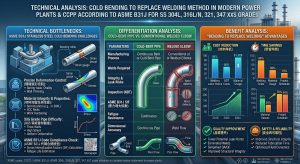
本研究旨在深度剖析在 ASME B31J 規範框架下,針對上述 XXS 特厚壁不銹鋼管線導入「以彎代銲」工法之技術瓶頸。研究範圍涵蓋極端壁厚帶來的幾何形變控制、冷作應變誘發馬氏體相變(SIMT)、成形後熱處理(PBHT)風險,並進一步探討潁璋工程「三合一工法」在實務操作上的突破。最後,提出針對 CCPP 建廠專案的全生命週期資本與營運支出(CAPEX & OPEX)綜合經濟與可靠度效益評估。This study aims to deeply analyze the technical bottlenecks of implementing the “Cold Bending Replacing Welding” method for the aforementioned XXS extra-heavy wall stainless steel pipelines under the ASME B31J framework. The research scope covers geometric deformation control induced by extreme wall thickness, strain-induced martensite transformation (SIMT), and post-forming heat treatment (PBHT) risks. It further explores the practical operational breakthroughs of Ying Zhang Engineering’s “Three-in-One Method.” Finally, it presents a comprehensive economic and reliability benefit assessment of lifecycle CAPEX and OPEX for CCPP construction projects.
二 、ASME B36.19 幾何規範與 XXS 特厚壁管線之物理挑戰 / 2. ASME B36.19 Geometric Specifications and Physical Challenges of XXS Extra-Heavy Wall Pipelines
在探討應力分析與冷作彎管技術之前,必須先確立 XXS 等級不銹鋼管線在 ASME 規範下的確切幾何特徵,因為這直接決定了材料的抗彎截面模數(Section Modulus)以及冷彎所需的塑性變形能量。
Before delving into stress analysis and cold bending techniques, it is essential to establish the exact geometric characteristics of XXS grade stainless steel pipelines under ASME codes, as this directly determines the material’s section modulus and the plastic deformation energy required for cold bending.
2.1 尺寸規範差異與特厚壁界定 / 2.1 Dimensional Code Differences and Definition of Extra-Heavy Walls
管線的外徑(OD)與壁厚(WT)主要由 ASME B36.10M(涵蓋碳鋼及合金鋼)與 ASME B36.19M(專門針對沃斯田鐵系不銹鋼)規範17。雖然兩者在相同公稱管徑(NPS)下具有相同的外徑以確保相容性,但在壁厚編號上存在顯著差異,ASME B36.19M 通常以「S」後綴標示(如 40S, 80S)6。然而,承受極高壓力的 CCPP 管線常需突破 80S 限制而採用 XXS 等級。在此極端情況下,不銹鋼管尺寸需回歸參考 ASME B36.10 或特規標準,其內徑(ID)被極度壓縮。Pipeline outer diameter (OD) and wall thickness (WT) are primarily governed by ASME B36.10M (for carbon and alloy steels) and ASME B36.19M (specifically for austenitic stainless steels)17. Although both share the same OD for the same Nominal Pipe Size (NPS) to ensure compatibility, their wall thickness schedules differ significantly; ASME B36.19M typically uses an “S” suffix (e.g., 40S, 80S)6. However, CCPP pipelines under extreme pressure often exceed the 80S limit, requiring the XXS grade. In such extreme cases, stainless steel pipe dimensions revert to ASME B36.10 or special standards, resulting in a severely compressed inside diameter (ID).
2.2 XXS 尺寸參數與抗彎剛性評估 / 2.2 XXS Dimensional Parameters and Bending Stiffness Evaluation
以發電廠常見口徑為例,XXS 等級厚度極為驚人。對於 NPS 2″ 管線,外徑為 60.3 mm,XXS 壁厚高達 11.07 mm,內徑僅剩 38.16 mm,徑厚比(D/T)降至 5.45 4。極低的 D/T 比意味著管線屬於「厚壁圓筒」,在進行冷作變形時,截面慣性矩龐大,CNC 彎管機需輸出極大彎矩。此外,管壁內外層在彎曲時會產生巨大的應變梯度,為後續冶金與幾何控制帶來極高難度。Taking common power plant pipe sizes as an example, the thickness of the XXS grade is astonishing. For an NPS 2″ pipe, the OD is 60.3 mm, but the XXS wall thickness reaches 11.07 mm, reducing the ID to 38.16 mm and dropping the D/T ratio to 5.45 4. Such a low D/T ratio means the pipe acts as a “thick-walled cylinder.” During cold deformation, the massive moment of inertia requires the CNC bending machine to output an enormous bending moment. Furthermore, a huge strain gradient is generated between the inner and outer wall layers during bending, creating severe difficulties for subsequent metallurgical and geometric control.
| 公稱管徑 (NPS) / Nominal Pipe Size | 外徑 (OD, mm) | XXS 壁厚 (WT, mm) / Wall Thickness | 內徑 (ID, mm) / Inside Diameter | D/T 徑厚比 / Ratio | 理論截面積 (mm2) / Area |
| 1″ | 33.40 | 9.09 | 15.22 | 3.67 | 694.3 |
| 1-1/4″ | 42.16 | 9.70 | 22.76 | 4.35 | 989.1 |
| 2″ | 60.30 | 11.07 | 38.16 | 5.45 | 1712.5 |
| 3″ | 88.90 | 15.24 | 58.42 | 5.83 | 3525.1 |
(表一:典型 ASME XXS 雙倍特厚壁管線幾何參數分析 / Table 1: Geometric Parameter Analysis of Typical ASME XXS Pipelines)
三、ASME B31J 理論框架與管線應力評估模型 / 3. ASME B31J Theoretical Framework and Pipeline Stress Evaluation Model
在克服了厚壁管的物理認知後,我們需從力學分析角度審視其疲勞壽命。管線應力分析高度依賴應力強度因子(SIF, 記為 i),用以量化組件相對於一般直管對銲銲道在承受彎矩時疲勞壽命的縮減程度20。
Having established the physical understanding of thick-walled pipes, we must examine their fatigue life from a mechanical analysis perspective. Pipeline stress analysis heavily relies on the Stress Intensification Factor (SIF, denoted as i), which quantifies the reduction in fatigue life of a component subjected to bending moments relative to a standard straight pipe butt weld20.
3.1 傳統 ASME B31.3 Appendix D 之局限性 / 3.1 Limitations of Traditional ASME B31.3 Appendix D
傳統框架中,彎管的面內(In-plane)與面外(Out-of-plane)SIF 依賴柔性特性參數(h)計算:iin=0.9/h2/3 且iout=0.75/h2/3 14。然而,這套基於薄殼理論的公式忽略了非線性耦合效應,長期預設扭轉 SIF 為 1.0,嚴重低估了三維佈管中的扭轉疲勞應力16。此外,它未精細區分高內壓對特厚壁管線產生的「壓力剛化效應」(Pressure Stiffening Effect)25。In the traditional framework, the in-plane and out-of-plane SIFs for bends rely on the flexibility characteristic parameter (h): iin=0.9/h2/3 and iout=0.75/h2/3 14. However, these formulas, based on thin-shell theory, ignore non-linear coupling effects and have long defaulted the torsional SIF to 1.0, severely underestimating torsional fatigue stress in 3D piping layouts16. Furthermore, they fail to finely distinguish the “pressure stiffening effect” exerted by high internal pressure on extra-heavy wall pipelines25.
3.2 ASME B31J 規範之演進與高精度應力釋放 / 3.2 Evolution of ASME B31J and High-Precision Stress Release
為彌補傳統公式的不足,ASME B31J 導入了基於嚴格實驗測試與高精度有限元素分析(FEA)的數據矩陣13。針對 XXS 厚壁管,由於厚度極大,h 值顯著攀升,B31J 計算證明 5D 冷作彎管的 SIF 大幅降低並強制趨近於下限 1.0,抗疲勞性能幾乎等同於完美直管13。更重要的是,冷作彎管一體成形、零銲縫,直接拔除了傳統 1.5D 彎頭兩端銲道的疲勞裂紋起始點9。其截面橢圓化帶來的柔性係數(k > 1)亦能更精準地釋放熱應力,保護昂貴的旋轉設備管口14。To address the shortcomings of traditional formulas, ASME B31J introduced a data matrix based on rigorous experimental testing and high-precision Finite Element Analysis (FEA)13. For XXS pipes, the extreme thickness causes a significant increase in the h value. B31J calculations prove that the SIF of a 5D cold bend decreases dramatically and is forced toward the lower limit of 1.0, making its fatigue resistance almost identical to a flawless straight pipe13. More importantly, the integrally formed, weld-free cold bend directly eliminates the fatigue crack initiation points inherently present at the butt welds of traditional 1.5D elbows9. The flexibility factor (k > 1) generated by its cross-sectional ovalization also allows for more precise thermal stress release, protecting expensive rotating equipment nozzles14.
四、XXS等級沃斯田鐵不銹鋼之材料特性與冶金變相機制 / 4. Material Characteristics and Metallurgical Phase Transformation Mechanisms of XXS Austenitic Stainless Steels
除了宏觀力學,微觀冶金特性是決定冷彎成功與否的關鍵。CCPP 專案廣泛選用的 304L、316L/N、321 及 347 不銹鋼,在承受 XXS 等級極端冷作應變時,展現出截然不同的冶金反應。
Beyond macroscopic mechanics, micro-metallurgical characteristics are crucial to the success of cold bending. The 304L, 316L/N, 321, and 347 stainless steels widely used in CCPP projects exhibit vastly different metallurgical responses when subjected to extreme cold-working strains at the XXS grade.
4.1 304L 與 316L:加工硬化行為 / 4.1 304L and 316L: Work Hardening Behavior
304L 與 316L 的超低碳(C ≦ 0.03%)設計旨在抑制碳化鉻析出,防止晶間腐蝕2。在冷彎過程中,隨著應變增加,材料內部差排密度激增,發生顯著的加工硬化(Work Hardening)2。對於 XXS 厚度,外側極端拉伸應變使所需冷彎力矩呈指數級上升,若未妥善控制將導致材料脆化。
The ultra-low carbon (C ≦ 0.03%) design of 304L and 316L aims to suppress chromium carbide precipitation and prevent intergranular corrosion2. During cold bending, as strain increases, dislocation density within the material surges, leading to significant work hardening2. For XXS thicknesses, the extreme tensile strain on the outer radius causes the required bending moment to increase exponentially, which can lead to material embrittlement if not properly controlled.
4.2 316LN:形變誘發馬氏體(SIMT)效應 / 4.2 316LN: Strain-Induced Martensite Transformation (SIMT)
316LN 透過添加氮(N)大幅提升降伏強度30。然而,氮降低了材料的「積層錯位能」(SFE),迫使差排進行平面滑移,這在冷彎時極易強力誘發形變誘發馬氏體相變(SIMT)31。在 3D/5D 彎管外弧側高達 10%~15% 的拉伸應變下,大量沃斯田鐵瞬間轉變為高硬度、高脆性的 α’ 馬氏體,急劇降低變形能力並伴隨微裂紋風險33。316LN uses nitrogen (N) addition to greatly enhance yield strength30. However, nitrogen lowers the material’s Stacking Fault Energy (SFE), forcing dislocations into planar slip, which strongly induces Strain-Induced Martensite Transformation (SIMT) during cold bending31. Under the 10%–15% tensile strain on the outer arc of a 3D/5D bend, a large amount of austenite instantly transforms into high-hardness, highly brittle α’ martensite, drastically reducing deformability and introducing micro-cracking risks33.
4.3 321 與 347:再熱裂紋風險 / 4.3 321 and 347: Reheat Cracking Risks
為解決高溫潛變,321 添加鈦(Ti),347 添加鈮(Nb)形成穩定碳化物35。347 鋼的抗潛變極佳,但在經過大半徑冷彎後進行高溫除應力熱處理時,極易在晶界發生再熱裂紋(Reheat Cracking)39。過飽和的鈮與碳發生應變誘導析出,使晶粒內部強度激增,應力鬆弛變形被迫集中於脆弱晶界,引發沿晶微裂紋。To address high-temperature creep, titanium (Ti) is added to 321, and niobium (Nb) to 347, forming stable carbides35. While 347 has excellent creep resistance, it is highly susceptible to reheat cracking at grain boundaries when subjected to high-temperature stress relief after large-radius cold bending39. Strain-induced precipitation of supersaturated niobium and carbon surges intra-granular strength, forcing stress-relaxation deformation to concentrate at fragile grain boundaries, ultimately causing intergranular microcracks.
五、XXS 特厚壁管線「以彎代銲」工法之核心技術瓶頸 / 5. Core Technical Bottlenecks of the “Cold Bending Replacing Welding” Method for XXS Pipelines
基於上述材料冶金特性,我們能明確界定將該工法應用於 XXS 管線時,製造端面臨的三大技術瓶頸。
Based on the metallurgical characteristics described above, we can clearly define the three major technical bottlenecks faced by manufacturers when applying this method to XXS pipelines.
5.1 幾何形變控制 / 5.1 Geometric Deformation Control
冷作彎曲會使外弧側承受極大拉伸應變而產生壁厚減薄;內弧側則易起皺40。5D 彎管的理論表面拉伸應變高達 10%12。同時,ASME B31.3 規定承受內壓彎管的橢圓度不得超過 8%42。在巨大的截面慣性矩下同時控制橢圓度與減薄量,構成了極高的設備剛性與數控技術門檻。Cold bending subjects the outer arc to extreme tensile strain, causing wall thinning, while the inner arc is prone to wrinkling40. The theoretical surface tensile strain for a 5D bend reaches up to 10%12. Meanwhile, ASME B31.3 mandates that the ovality of a bend under internal pressure must not exceed 8%42. Controlling both ovality and thinning under a massive section modulus creates a remarkably high threshold for equipment rigidity and CNC technology.
5.2 固溶退火(PBHT)挑戰 / 5.2 Solution Annealing (PBHT) Challenges
ASME B31.3 規定,當冷作應變超過極限值(通常為 10%~15%)時,強制要求成形後熱處理(PBHT)43。沃斯田鐵不銹鋼必須進行固溶退火:快速加熱至1050°C ∼1100°C,隨後極速冷卻(如水淬)以閃過敏化區1。對 XXS 厚壁管而言,確保內外壁冷卻速率一致極難;而對 347 鋼,升溫若未精確控管,極易觸發再熱裂紋。ASME B31.3 requires mandatory post-forming heat treatment (PBHT) when cold-working strain exceeds specific limits (typically 10%–15%)43. Austenitic stainless steels must undergo solution annealing: rapid heating to the 1050°C ∼1100°C range, followed by extremely rapid cooling (e.g., water quenching) to bypass the sensitization zone1. For XXS pipes, ensuring uniform cooling rates between inner and outer walls is exceedingly difficult; for 347 steel, imprecise heating control can easily trigger reheat cracking.
5.3 殘磁效應與銲接干擾 / 5.3 Residual Magnetism and Welding Interference
冷作誘發的 α’ 馬氏體會使不銹鋼呈現鐵磁性。若彎管帶有高殘餘磁場,現場銲接會產生「磁吹」(Magnetic Arc Blow),導致未熔合或夾渣等致命缺陷7。嚴格的退磁處理成為不可或缺的一環。The cold-work-induced α’ martensite renders the stainless steel ferromagnetic. If the bend retains a high residual magnetic field, field welding will experience “magnetic arc blow,” leading to fatal defects such as lack of fusion or slag inclusion7. Strict demagnetization treatment is thus an indispensable step.
六、冷作彎管與傳統電銲彎頭之流體力學與破壞力學差異化 / 6. Differentiated Analysis of Fluid Dynamics and Fracture Mechanics
一旦克服製造瓶頸,XXS 等級「冷作彎管」在 CCPP 系統中將展現出壓倒性的流體與結構優勢。
Once manufacturing bottlenecks are overcome, XXS grade “cold-bent pipes” exhibit overwhelming fluid and structural advantages in CCPP systems.
6.1 根絕流動加速腐蝕(FAC) / 6.1 Eradication of Flow-Accelerated Corrosion (FAC)
傳統 1.5D 彎頭曲率過小,易發生邊界層分離與二次流,形成劇烈擾動,引發致命的流動加速腐蝕(FAC)8。相反地,5D 大半徑冷作彎管幾何過渡平滑,流線保持層流,大幅降低局部阻力係數 K 與紊流剪切應力,從根源上抑制 FAC 的發生並減輕水錘效應8。The overly small curvature of traditional 1.5D elbows easily causes boundary layer separation and secondary flows, creating severe turbulence that triggers fatal flow-accelerated corrosion (FAC)8. Conversely, the smooth geometric transition of a 5D large-radius cold bend maintains laminar streamlines, significantly reducing the local resistance coefficient K and turbulent shear stress, thereby suppressing FAC at its source and mitigating water hammer effects8.
6.2 疲勞壽命之幾何級數提升 / 6.2 Geometric Progression of Fatigue Life Improvement
傳統彎頭的環向銲道及其 HAZ 具有極大的應力集中效應,是熱機械疲勞與潛變破裂的最薄弱點9。3D/5D 冷彎實現了轉彎高應力區的零銲道化,將接頭移至低應力平直段。根據 ASME B31J 評價,這種佈局重構使管線系統整體的抗疲勞壽命獲得幾何級數提升14。The circumferential welds and their HAZs in traditional elbows possess a massive stress concentration effect, acting as the weakest points for thermomechanical fatigue and creep rupture9. 3D/5D cold bending achieves a weld-free turning zone, shifting joints to low-stress straight sections. According to ASME B31J evaluations, this layout reconfiguration exponentially enhances the overall fatigue life of the piping system14.
七、實務操作突破:潁璋工程「三合一工法」效益 / 7. Practical Breakthroughs: Benefits of Ying Zhang Engineering’s “Three-in-One Method”
為將理論優勢轉化為實務效益並克服厚壁加工極限,業界如潁璋工程(Ying Zhang Engineering)發展出「冷作彎管+感應加熱彎後熱處理(IH-PBHT)+數位化模組管理」的三合一工法7。
To translate theoretical advantages into practical benefits and overcome the machining limits of thick walls, industry leaders like Ying Zhang Engineering have developed the “Three-in-One Method”: CNC Cold Bending + Induction Heating PBHT (IH-PBHT) + Digital Module Management7.
首先,採用高精度多軸 CNC 設備,精準控制 XXS 管的橢圓度與壁厚減薄。其次,導入 IH-PBHT 技術,透過自動化感應線圈實現極高升溫速率的固溶退火,安全跨越再熱裂紋危險區;並配合強制大電流直流退磁,將殘磁中和至 10 Gauss 以內7。最後,透過數位化「管線系統最終報告(PSFR)」,現場可即時掃描核對溫控曲線與硬度映射,確保施工品質。
First, high-precision multi-axis CNC equipment is used to strictly control the ovality and thinning of XXS pipes. Second, IH-PBHT technology is introduced, utilizing automated induction coils to achieve ultra-fast heating for solution annealing, safely bypassing reheat cracking zones; this is paired with forced high-current DC demagnetization to neutralize residual magnetism to under 10 Gauss7. Finally, through the digital “Piping System Final Report (PSFR),” field personnel can instantly scan and verify temperature control curves and hardness mapping, ensuring construction quality.
八、綜合經濟與可靠度效益評估 (CAPEX & OPEX) / 8. Comprehensive Economic and Reliability Benefit Assessment (CAPEX & OPEX)
導入「以彎代銲」技術的經濟效益,在電廠全生命週期中十分可觀。
The economic benefits of implementing the “Cold Bending Replacing Welding” technology are highly substantial over the plant’s entire lifecycle.
8.1 資本支出(CAPEX)下降 / 8.1 CAPEX Reduction
厚壁不銹鋼對銲需耗費頂級銲工大量工時與高價銲材。每取代一個彎頭,實質減少兩道厚壁銲縫,使 100% 射線或超音波非破壞檢測(NDE)數量減少 50% 以上,直接節省外包檢測費用並排除返工延宕風險,總體 CAPEX 呈現淨下降7。Thick-wall stainless steel butt-welding consumes massive amounts of top-tier welder man-hours and expensive consumables. Replacing one elbow practically eliminates two heavy-wall welds, reducing the volume of 100% radiographic or ultrasonic Non-Destructive Examination (NDE) by over 50%. This directly saves outsourced inspection costs and prevents rework delays, resulting in a net decrease in overall CAPEX7.
8.2 營運支出(OPEX)與可靠度提升 / 8.2 OPEX and Reliability Improvement
5D 彎管大幅降低摩擦水頭損失,長期運營下泵浦耗電顯著下降,轉化為淨發電收益11。更重要的是,消除銲縫與抑制 FAC 實現了「免維護」設計,極大降低非計畫性停機(Unplanned Outages)機率,其潛在經濟價值無可估量。The 5D bend drastically reduces friction head loss; over long-term operation, pump power consumption drops significantly, converting into net generation revenue11. More importantly, eliminating welds and suppressing FAC achieves a “maintenance-free” design, drastically lowering the probability of unplanned outages, unlocking an immeasurable potential economic value.
九、結論 / 9. Conclusion
在 ASME B31J 最新規範導引下,將 304L、316L/N、321、347 XXS 特厚壁不銹鋼管線由「傳統電銲彎頭」全面升級為「3D/5D 數控冷作彎管」,不僅在力學與流場上展現絕對優勢,更透過如潁璋工程「三合一工法」等實務管理克服了極限製造技術瓶頸。此工法巨幅削減現場對銲與 NDE 成本,並永久降低能耗與停機風險,已成為新一代高參數 CCPP 建廠工程中,極優化生命週期成本的必然趨勢與最佳實踐。
Guided by the latest ASME B31J code, comprehensively upgrading 304L, 316L/N, 321, 347 XXS extra-heavy wall stainless steel pipelines from “traditional butt-welded elbows” to “3D/5D CNC cold bends” not only demonstrates absolute mechanical and fluid dynamic advantages but also overcomes extreme manufacturing bottlenecks through practical management like Ying Zhang Engineering’s “Three-in-One Method.” This method massively slashes on-site welding and NDE costs while permanently reducing energy consumption and outage risks, making it an inevitable trend and best practice for optimizing lifecycle costs in new-generation high-parameter CCPP construction projects.
參考文獻/References
- Welding Stainless Steel, Aluminum and Copper Alloys, https://www.weldfabworld.com/welding-stainless-steel-aluminum-copper-alloys-metallurgical-considerations/
- 316 vs. 316L vs. 316H Stainless Steel Explained – Seather, https://seathertechnology.com/316-vs-316l-vs-316h-stainless-steel/
- TDS SS G304 | PDF | Construction | Welding – Scribd, https://www.scribd.com/document/1062743703/TDS-SS-G304
- 904l, http://www.904l.co.kr/
- ASTM Carbon Steel Pipe Dimensions | PDF – Scribd, https://fr.scribd.com/document/351878795/ASTM-pipe-schedule-dimensions-pdf
- Mechanical Bulk Items, https://eoi.cairnindia.com/EOIDocLibrary/EOI_Website_Mechanical-Bulk-Items_0.pdf
- 基於ASME B31J 規範之P91/P92 高壓蒸汽管線冷作彎管工法效益評估, https://yz-pipe-bending.com.tw/%E5%9F%BA%E6%96%BC-asme-b31j-%E8%A6%8F%E7%AF%84%E4%B9%8B-p91-p92-%E9%AB%98%E5%A3%93%E8%92%B8%E6%B1%BD%E7%AE%A1%E7%B7%9A%E5%86%B7%E4%BD%9C%E5%BD%8E%E7%AE%A1%E5%B7%A5%E6%B3%95%E6%95%88%E7%9B%8A%E8%A9%95/
- Influence of bend geometry on flow accelerated corrosion under, https://www.researchgate.net/publication/348512984_Influence_of_bend_geometry_on_flow_accelerated_corrosion_under_neutral_pH_conditions
- ASME B31.3 Stress Range Factor: The 2022 Revision and Why It, https://blog.vibrationdata.com/2026/07/18/asme-b31-3-piping-fatigue/
- Effect of cold work hardening on stress corrosion cracking of, https://www.researchgate.net/publication/292184606_Effect_of_cold_work_hardening_on_stress_corrosion_cracking_of_stainless_steels_in_primary_water_of_pressurized_water_reactors
- Pipe Elbows vs Bends: What’s the Technical Difference, https://blog.hb-steel.com/pipe-elbows-vs-bends-what-s-the-technical-difference
- Guide to Pipe and Pipeline Bends: Hot Bends, Cold Bends, Elastic, https://whatispiping.com/pipe-bends/
- ASME B31J (2023) Stress Intensification Factors, https://docs.bentley.com/LiveContent/web/AutoPIPE-v2026/Help/en/Topics/Codes/ASME_B31J_2023_Stress_Intensification_Factors.html
- Stress Intensification & Flexibility Factor Calculator (B31.3 Appendix D), https://pipingtoolset.com/calculators/b313-stress-intensification-factors/
- Introduction to ASME B31J Standard – Northern Crescent Inc., https://www.northerncrescent.ca/blog/introduction-to-asme-b31j-standard/
- Stress Intensity Factor (SIF) For Special Geometries In Piping Stress, https://cadeengineering.com/study-case/stress-intensity-factor-sif-for-special-geometries-in-piping-stress-analyisis/
- ASME B36.10 Pipe Sizes & Schedules – Projectmaterials, https://blog.projectmaterials.com/pipes/pipe-tube-sizes/asme-b36-10-19-pipe-sizes-charts/
- ASME B36.10 vs B36.19: Pipe Schedules – Projectmaterials, https://blog.projectmaterials.com/quick-answers/pipes/asme-b36-10-vs-b36-19/
- Stainless Steel Hollow Bars & Pipes | PDF – Scribd, https://www.scribd.com/document/600112652/EDEN-hollow-bar-size-range
- Importance & Impact of Stress Intensification Factor (SIF) in Piping, https://whatispiping.com/stress-intensification-factor-sif/
- 基於ASME B31J 規範CCPP 廠高壓蒸汽管線P91 2″ XXS 5D 冷作彎, https://yz-pipe-bending.com.tw/%E5%9F%BA%E6%96%BC-asme-b31j-%E8%A6%8F%E7%AF%84ccpp-%E5%BB%A0%E9%AB%98%E5%A3%93%E8%92%B8%E6%B1%BD%E7%AE%A1%E7%B7%9A-p91-2-xxs-5d-%E5%86%B7%E4%BD%9C%E5%BD%8E%E7%AE%A1%E5%B0%8D%E6%AF%94-1-5d-bw/
- Stress Intensification Factors (SIFs) in Pipe Stress Analysis, https://simumech.com/stress-intensification-factors-sifs-in-pipe-stress-analysis/
- Pressure vs Stress in Physics Explained | PDF | Force – Scribd, https://www.scribd.com/document/251209705/Stress-Analysis
- Understanding Stress Intensification Factor | PDF – Scribd, https://www.scribd.com/document/374711033/Sif
- Stress Intensity Factor (SIF), Flexibility Factor: ASME B31.3 vs ASME, https://whatispiping.com/stress-intensity-factor-sif-flexibility-factor-asme-b-31j/
- ASME B31J-2023 Overview: Stress Intensification Factor (SIF) and, https://fengshecad.com/795/
- Understanding B31J SIFs and DNV S-N Curves | PDF – Scribd, https://www.scribd.com/document/804200318/Fatigue-B31-3-DNV-stresses
- How to Read a Material Test Certificate or Mill Test Report, https://www.weldfabworld.com/how-to-read-material-test-certificate/
- Austenitic Stainless Steel | Industrial Pipe Manufacturer & Supplier, https://www.sunnysteel.com/austenitic-stainless-steel.php
- Temperature dependence of true stress-true strain curves of 316LN, https://www.researchgate.net/figure/Temperature-dependence-of-true-stress-true-strain-curves-of-316LN-a-and-M66-b-steels_fig1_226430970
- Abnormal effect of nitrogen on hydrogen gas embrittlement of, https://www.researchgate.net/publication/304455242_Abnormal_effect_of_nitrogen_on_hydrogen_gas_embrittlement_of_austenitic_stainless_steels_at_low_temperatures
- Temperature dependence of strain hardening and plastic instability, https://www.researchgate.net/publication/222417072_Temperature_dependence_of_strain_hardening_and_plastic_instability_behaviors_in_austenitic_stainless_steels
- (PDF) Microstructure Investigations of Phase Transformation in Cold, https://www.researchgate.net/publication/361474771_Microstructure_Investigations_of_Phase_Transformation_in_Cold_Working_AISI_316L_Austenitic_Stainless_Steel
- Enhanced cryogenic tensile properties through cryogenic cyclic, https://www.researchgate.net/publication/363201898_Enhanced_cryogenic_tensile_properties_through_cryogenic_cyclic_plastic_strengthening_in_a_metastable_austenitic_stainless_steel
- Welding of Austenitic Stainless Steel – TWI, https://www.twi-global.com/technical-knowledge/job-knowledge/welding-of-austenitic-stainless-steel-103.aspx
- 316 vs. 321 Stainless Steel: A Comprehensive Guide by Seather, https://seathertechnology.com/316-vs-321-stainless-steel/
- Atlas Steels Technical Handbook of Stainless Steels, https://atlassteels.com.au/wp-content/uploads/2021/08/Atlas-Steels-Technical-Handbook-of-Stainless-Steels-12-08-21.pdf
- 316Ti Stainless Steel | Composition, Performance, Applications, https://casting-china.org/316ti-stainless-steel/
- Effect of Precipitates and Cold Working on the Reheat Cracking of, https://www.researchgate.net/publication/358377283_Effect_of_Precipitates_and_Cold_Working_on_the_Reheat_Cracking_of_STS_347_Austenitic_Stainless_Steel
- Pipe bending technology: 10 Powerful Advances in 2025, https://hinesbending.com/cnc-tube-bending-machines-near-me/pipe-bending-technology/
- Structural behavior of buried pipe bends and their effect on pipeline, https://www.researchgate.net/publication/317177112_Structural_behavior_of_buried_pipe_bends_and_their_effect_on_pipeline_response_in_fault_crossing_areas
- Cold Bending of Pipes: Linde Standard LS 142 | PDF – Scribd, https://www.scribd.com/document/635109586/LS-142-05-T02-3-Cold-Bending-of-Pipes-Manufacture-and-Testing-EN
- SAF2205 UNS S31803 S32205 – Duplex Stainless Steel Pipe, https://www.duplexstainlesssteelpipes.com/product/duplex-2205-stainless-steel-pipe/
- Indian Institute of Metals Series Applied Metallurgy and Corrosion, https://pdfcoffee.com/indian-institute-of-metals-series-applied-metallurgy-and-corrosion-control-a-handbook-for-the-petrochemical-industry-pdf-free.html
- AS 1210-2010: Pressure Vessel Australian Standard – Studylib, https://studylib.net/doc/25884387/as-1210-2010-pressure-vessels
- M630 Material Data Sheets Edition 6 – Scribd, https://www.scribd.com/doc/217376574/M630-Material-Data-Sheets-Edition-6
- Asme B31.3 | PDF | Métaux | Chimie – Scribd, https://fr.scribd.com/document/347756513/ASME-B31-3
- 基於ASME B31.3 規範之高黏度流體輸送管線研究:5D CNC 冷作彎, https://yz-pipe-bending.com.tw/%E5%9F%BA%E6%96%BC-asme-b31-3-%E8%A6%8F%E7%AF%84%E4%B9%8B%E9%AB%98%E9%BB%8F%E5%BA%A6%E6%B5%81%E9%AB%94%E8%BC%B8%E9%80%81%E7%AE%A1%E7%B7%9A%E7%A0%94%E7%A9%B6%EF%BC%9A5d-cnc-%E5%86%B7%E4%BD%9C%E5%BD%8E/
- (PDF) Effect of Annealing Temperature on Mechanical Properties, https://www.researchgate.net/publication/371118179_Effect_of_Annealing_Temperature_on_Mechanical_Properties_and_Work_Hardening_of_Nickel-Saving_Stainless_Steel
- องค์ความรู้ประกอบการสอบเลื่อนระดับเป็นสามัญวิศวกร สาขาวิศวกรรมโยธา, https://www.scribd.com/doc/309658498/%E0%B8%AD%E0%B8%87%E0%B8%84-%E0%B8%84%E0%B8%A7%E0%B8%B2%E0%B8%A1%E0%B8%A3%E0%B8%B9-%E0%B8%9B%E0%B8%A3%E0%B8%B0%E0%B8%81%E0%B8%AD%E0%B8%9A%E0%B8%81%E0%B8%B2%E0%B8%A3%E0%B8%AA%E0%B8%AD%E0%B8%9A%E0%B9%80%E0%B8%A5%E0%B8%B7-%E0%B8%AD%E0%B8%99%E0%B8%A3%E0%B8%B0%E0%B8%94%E0%B8%B1%E0%B8%9A%E0%B9%80%E0%B8%9B-%E0%B8%99%E0%B8%AA%E0%B8%B2%E0%B8%A1%E0%B8%B1%E0%B8%8D%E0%B8%A7%E0%B8%B4%E0%B8%A8%E0%B8%A7%E0%B8%81%E0%B8%A3-%E0%B8%AA%E0%B8%B2%E0%B8%82%E0%B8%B2%E0%B8%A7%E0%B8%B4%E0%B8%A8%E0%B8%A7%E0%B8%81%E0%B8%A3%E0%B8%A3%E0%B8%A1%E0%B9%82%E0%B8%A2%E0%B8%98%E0%B8%B2-pdf
- 顛覆傳統管線工程:針對CCPP建廠業主與EPC統包商去銲接化與模組, https://yz-pipe-bending.com.tw/%E9%A1%9B%E8%A6%86%E5%82%B3%E7%B5%B1%E7%AE%A1%E7%B7%9A%E5%B7%A5%E7%A8%8B%EF%BC%9A%E9%87%9D%E5%B0%8Dccpp%E5%BB%BA%E5%BB%A0%E6%A5%AD%E4%B8%BB%E8%88%87epc%E7%B5%B1%E5%8C%85%E5%95%86%E5%8E%BB%E9%8A%B2/
- 複循環電廠高能管線「彎管工法」整合研究:聲學共振抑制, https://yz-pipe-bending.com.tw/%E8%A4%87%E5%BE%AA%E7%92%B0%E9%9B%BB%E5%BB%A0%E9%AB%98%E8%83%BD%E7%AE%A1%E7%B7%9A%E3%80%8C%E5%BD%8E%E7%AE%A1%E5%B7%A5%E6%B3%95%E3%80%8D%E6%95%B4%E5%90%88%E7%A0%94%E7%A9%B6%EF%BC%9A%E8%81%B2%E5%AD%B8/